
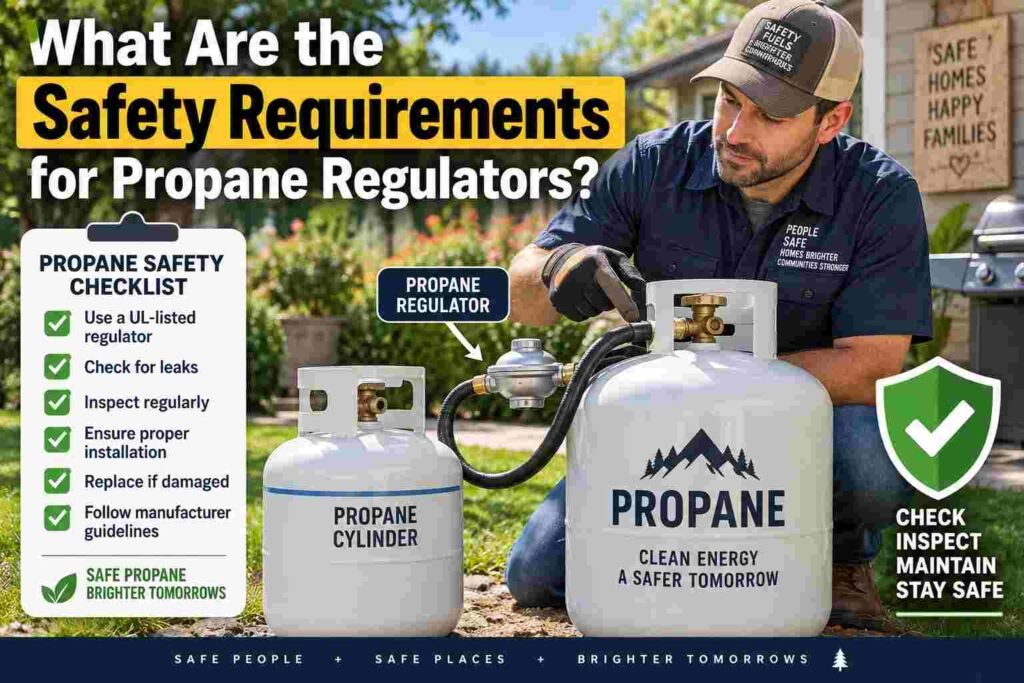
When I talk about propane regulator safety requirements, I am not talking about one single rule. A regulator is part of an entire fuel-gas pressure-control system, so safety depends on the regulator itself, the propane container, piping, appliance load, venting, pressure protection, location, testing, and maintenance.
That is why I do not select or install a propane regulator simply because the threads fit. A regulator that looks physically compatible can still be wrong for the inlet pressure, outlet pressure, BTU load, regulator stage, vent location, or appliance system.
In the United States, propane regulator installations generally have to comply with applicable federal, state, and local requirements, manufacturer instructions, and the relevant fuel-gas standards used in the jurisdiction. Fisher’s current 2026 LP-Gas regulator manual specifically says its regulators must be installed, operated, and maintained according to applicable codes and Fisher instructions, and that trained personnel should install and service the equipment.

Propane Regulator Safety Requirements: Technical Overview
| Safety Requirement | What I Check | Why It Matters |
|---|---|---|
| Correct regulator type | First-stage, second-stage, integral two-stage, 2-PSI, automatic changeover, or high-pressure | Wrong regulator can deliver unsafe pressure |
| Correct inlet-pressure rating | Maximum and minimum inlet pressure | Prevents overpressure and poor regulation |
| Correct outlet pressure | Matches downstream system and appliance requirements | Too much or too little pressure can create unsafe combustion |
| Adequate BTU capacity | Total connected appliance input load | Undersizing causes excessive pressure droop |
| Correct vent position | Vent downward or under approved protection | Prevents water, snow, insects, and debris from affecting operation |
| Overpressure protection | Integral relief or required external protection | Protects downstream piping/appliances if regulator fails |
| Safe relief-discharge location | Clear of openings, ignition sources, and air intakes | Reduces risk of released propane entering a building or igniting |
| Leak and pressure testing | Connections, delivery pressure, lock-up, and system integrity | Confirms safe operation after installation/service |
| Weather and physical protection | Snow, ice, vehicles, water, corrosion, impact | Prevents vent blockage and component damage |
| Qualified installation/service | Trained LP-Gas personnel and applicable local licensing | Propane regulator work involves combustible gas under pressure |
1. The Regulator Must Be the Correct Type for the System
The first safety requirement I check is whether the regulator belongs in that application at all.
A first-stage regulator is not the same as a second-stage regulator. An integral two-stage regulator is not the same as a 2-PSI regulator. A high-pressure industrial regulator is not a substitute for a low-pressure residential regulator.
For example, Fisher’s current R632A integral two-stage regulator reduces propane container pressure to about 11 inches water column. Its R632E, by contrast, is designed to deliver 2 psig into a 2-PSI distribution system. Both are legitimate LP-Gas regulators, but putting the 2-PSI model where an 11-inch-water-column regulator belongs would create a major pressure mismatch.
| Regulator Type | Typical Function | Common Example Pressure |
|---|---|---|
| First-stage | Container pressure to intermediate pressure | Often around 5–10 psig |
| Second-stage | Intermediate pressure to appliance-service pressure | Often around 11 in. w.c. |
| Integral two-stage | Container pressure to final low pressure in one body | Often around 11 in. w.c. |
| 2-PSI service | Higher-pressure building distribution before line regulators | 2 psig |
| High-pressure regulator | Special burners, industrial equipment, first-stage applications | Model-specific PSI range |
If you are unsure which regulator class belongs in your system, see my guide on how to know which propane regulator you need.


2. The Regulator Must Be Properly Sized for the BTU Load
A regulator that is too small may not maintain outlet pressure when several appliances run at once.
I add the input BTU/hr ratings of the appliances that the regulator serves. If a furnace is rated at 100,000 BTU/hr, a water heater at 40,000, a range at 65,000, and a dryer at 22,000, the connected load is 227,000 BTU/hr.
| Appliance | Example Input |
|---|---|
| Furnace | 100,000 BTU/hr |
| Water heater | 40,000 BTU/hr |
| Range/oven | 65,000 BTU/hr |
| Dryer | 22,000 BTU/hr |
| Total | 227,000 BTU/hr |
I then check the regulator’s published performance at the expected inlet and outlet pressure. I do not rely only on the headline BTU rating because regulator capacity changes with inlet pressure and allowable droop.
This becomes especially important when one regulator serves multiple appliances. My article on using one propane regulator for multiple appliances explains that sizing process in more detail.
3. The Regulator Must Be Protected Against Overpressure
Overpressure protection is one of the most important regulator safety requirements.

If a regulator fails open, upstream propane pressure can move downstream toward piping and appliances that were never designed to withstand it. Depending on the regulator and system design, protection may come from an integral relief valve, an internal pressure-limiting feature, a separate pressure-relief valve, a monitor regulator, or another code-approved method.
Fisher’s current R622 second-stage regulator, for example, incorporates a high-performance relief valve and is designed to limit downstream pressure in an overpressure condition. RegO also specifies external pressure-relief protection for certain high-pressure regulator applications.
I never assume that “the regulator itself” automatically provides all of the overpressure protection a system needs. The regulator manual and system design determine what is required.
4. The Regulator Vent Must Stay Open and Unobstructed
The vent is a critical safety feature. The diaphragm needs atmospheric reference pressure in order for the regulator to control gas pressure correctly.


Current RegO safety guidance says regulator vents must remain clear and fully open. Freezing rain, sleet, snow, ice, mud, insects, and debris can block a vent and interfere with pressure control. RegO specifically warns that a blocked vent can result in high-pressure gas reaching appliances.
Fisher’s 2026 R600-series instructions likewise tell customers to keep the vent opening unobstructed and to check it after freezing rain, sleet, or snow.
I never plug a regulator vent, cover it with tape, seal it with insulation, or install a weather cover that prevents the regulator from breathing.
5. Outdoor Regulator Vents Should Face Down or Be Properly Protected
For outdoor service, I want the vent facing vertically downward when the regulator design calls for it, or installed beneath appropriate protection.
RegO’s current guidance says regulators should be installed with the vent facing down or protected from the elements. If a remote vent or discharge tube is used, its outlet should also face down and be screened.
That downward orientation lets condensation drain and makes it harder for rain, snow, insects, and debris to enter the spring case.
I do not rotate a bonnet or modify a vent position unless the manufacturer specifically allows it. RegO warns that field modification of vent positions is not recommended on certain regulator designs.
6. Regulator Relief Discharge Must Have Safe Clearances
The regulator’s relief opening cannot be treated like an ordinary vent that can terminate anywhere.
RegO’s current LP-Gas service guidance shows a typical second-stage regulator installation with the relief discharge at least 5 feet from a source of ignition or mechanical air intake and at least 3 feet from a building opening. The same guidance shows the relief discharge about 12–18 inches above grade, with the note that the height may need to be greater in locations where snow accumulation is deeper.
| RegO/NFPA-Based Installation Example | Minimum Distance Shown | Purpose |
|---|---|---|
| Relief discharge to ignition source | 5 ft | Reduces ignition risk if relief gas is released |
| Relief discharge to mechanical air intake | 5 ft | Helps prevent propane from being drawn into the building |
| Relief discharge to building opening | 3 ft | Helps keep released gas away from windows, doors, and similar openings |
| Second-stage relief discharge above grade | 12–18 in. in RegO example | Helps protect the regulator from water, snow, and debris |
I treat these as important design criteria, but I also check the current regulator instructions and the code adopted in the local jurisdiction. Snow depth, building layout, regulator type, remote venting, and local amendments can change the final requirement.
7. Snow, Ice, Water, and Flooding Must Not Block the Regulator
A regulator that works perfectly in dry weather can become unsafe if winter weather blocks the vent.
RegO warns that freezing rain, sleet, snow, ice, mud, or debris can obstruct a regulator vent and cause improper operation. Fisher’s current LP-Gas instructions similarly tell users to check the vent after snow or freezing weather.
In snowy areas, I make sure a second-stage regulator is high enough to remain above expected accumulation. RegO’s installation tips recommend approximately 12–18 inches above ground and/or above snow accumulation, while noting that some locations may require much more height.
For underground tanks, RegO says the regulator should be installed above the highest probable water level. If the regulator or vent can be submerged, flooded, or repeatedly exposed to standing water, the installation needs to be corrected.
My guide on winterizing a propane regulator covers snow, icing, pigtails, and cold-weather vaporization in more detail.
8. The Regulator Must Be Protected From Physical Damage
I do not place a propane regulator where a vehicle, lawn mower, snowplow, falling ice, roof runoff, livestock, or routine foot traffic can easily strike it.
Fisher recommends locating outdoor regulators away from vehicular traffic and other physical hazards. If the location creates a foreseeable impact risk, the regulator and piping need appropriate protection without blocking ventilation or access.
I also make sure the regulator is supported by the piping arrangement recommended by the manufacturer. A heavy regulator should not hang from a stressed or misaligned fitting in a way that puts bending force on the regulator body.
9. Flow Direction Must Match the Arrow on the Regulator
Many regulators are directional. The inlet and outlet are not interchangeable.
Fisher’s installation guidance says gas flow through the regulator body must follow the direction indicated by the arrow on the body. Installing a directional regulator backward can prevent correct regulation and create an unsafe system.
I do not identify the inlet and outlet by appearance alone. I use the manufacturer markings and model instructions.
10. Piping and Fittings Must Be Clean and Compatible
Debris inside the gas piping can damage a regulator after installation.
Fisher says pipelines should be cleaned before regulator installation and that the regulator should be checked for shipping damage or foreign material. RegO warns that corrosion flakes or other debris can become trapped between the nozzle and seat disc and prevent the regulator from locking up properly.
That can allow pressure to continue rising downstream even after appliance demand stops.
I also avoid excessive pipe compound. RegO warns that too much sealant can move downstream and affect regulator performance.
11. Pigtails Should Be Inspected—and Often Replaced With a New Regulator
The flexible or copper pigtail upstream of the regulator can become a hidden source of trouble.
RegO recommends installing a new pigtail or hogtail when a new regulator is installed. Its serviceman guidance explains that corrosion inside an old copper pigtail can restrict flow or break loose and lodge in the regulator seat.
I inspect pigtails for:
- corrosion;
- kinks and sharp bends;
- cracks or weather damage;
- abrasion;
- loose or damaged fittings;
- internal restriction symptoms;
- incorrect routing that can collect liquid contamination.
A damaged pigtail is not something I straighten and reuse merely because it still passes some gas.
12. A New or Serviced System Must Be Leak-Tested
I consider leak testing a basic propane regulator safety requirement.
RegO says regulator connections should be leak-tested when the regulator is installed. Fisher’s 2026 LP-Gas instructions go further and tell the customer to call for a leak check when the gas supply has been shut off or interrupted for any reason.
That is important because opening the propane valve and seeing an appliance ignite does not prove the piping is leak-free.
A qualified technician uses an approved test method appropriate for the system and applicable code. I do not rely only on smell because odor can be difficult to detect in some conditions and a small leak can still be hazardous.
13. Outlet Pressure Must Be Verified Under Load
The regulator must deliver the correct pressure while appliances are actually using gas.
For many residential low-pressure systems, a common final delivery pressure is about 11 inches water column, or approximately 0.397 psi. That is very different from the roughly 10 psig often used between first- and second-stage regulators.
| Pressure | Approximate Equivalent | Typical Use |
|---|---|---|
| 11 in. w.c. | 0.397 psi / 2.74 kPa | Many low-pressure domestic/RV systems |
| 2 psi | 55.4 in. w.c. | 2-PSI distribution before line regulators |
| 10 psi | 276.8 in. w.c. | Common first-stage outlet example |
RegO’s service procedure recommends checking delivery pressure with approximately half the connected appliance load operating and then checking again with all appliances operating. That helps identify pressure droop, undersized piping, low inlet pressure, and an undersized regulator.
If you want to understand the readings, see how to read a propane regulator gauge.
14. Lock-Up Pressure and Regulator Creep Must Be Checked
A regulator has to close properly when gas demand stops.
RegO’s general service guidance says lock-up pressure should not exceed 130% of the set delivery pressure. For an 11-inch-water-column regulator, that works out to about 14.3 inches water column.
| Set Delivery Pressure | 130% Example |
|---|---|
| 10 in. w.c. | 13.0 in. w.c. |
| 11 in. w.c. | 14.3 in. w.c. |
| 12 in. w.c. | 15.6 in. w.c. |
After flow stops, a small pressure rise can be normal. But if pressure continues creeping upward for several minutes, dirt or damage may be preventing the seat from sealing.
I do not treat regulator creep as an adjustment problem. A regulator that cannot close properly needs professional service or replacement.
See how to know if regulator pressure is too high for more detail.
15. Regulator Adjustment Must Stay Within the Manufacturer’s Range
Some regulators are field-adjustable; others are not intended for routine adjustment.
If a regulator is adjustable, the technician should monitor outlet pressure with the correct instrument and stay within the specified spring range. A regulator should not be turned up to compensate for an undersized pipe, insufficient tank vaporization, or a regulator that is too small for the load.
My article on how to know if a propane regulator needs adjustment explains why pressure should be measured under load before any setting is changed.
16. Cold-Weather First-Stage Settings Can Matter
Very low temperatures reduce propane vapor pressure, which affects the inlet pressure available to the regulator system.
RegO’s installation tips say that where seasonal temperatures reach approximately -20°F or colder, a first-stage regulator should not be set higher than 10 psig. Where temperatures reach approximately -35°F or colder, RegO says the setting should not be higher than 5 psig.
| Seasonal Temperature | RegO First-Stage Guidance |
|---|---|
| About -20°F or colder | Do not set above 10 psig |
| About -35°F or colder | Do not set above 5 psig |
This is a good example of why propane regulator safety depends on location and operating conditions, not just the model number.
17. Regulators Should Be Inspected Regularly
I visually inspect the regulator whenever the propane system is serviced and after severe weather.
I look for:
- blocked, damaged, or missing vent screens;
- heavy corrosion;
- cracks or impact damage;
- snow or ice around the vent;
- water intrusion;
- loose or bent piping;
- damaged pigtails;
- propane odor or unexplained hissing;
- signs that the regulator has been submerged or struck.
RegO says regulators should be regularly inspected when tanks or cylinders are filled. If a vent screen is missing and there is evidence that foreign material has entered around the vent, RegO recommends replacing the regulator.
18. Regulators Have a Service Life
Propane regulators are not necessarily lifetime components.
Service-life recommendations vary by manufacturer and model. Fisher currently lists a 20-year recommended replacement life for several R600-series domestic regulators, including the R622 second-stage family and R632 integral two-stage family.
I do not apply 20 years as a universal rule for every regulator. I check the manufacturer’s guidance for the installed model and consider environmental exposure, corrosion, contamination, service history, and pressure-test results.
If you do not know how old the regulator is, see how long propane regulators last.
19. Regulators Must Be Installed and Serviced by Qualified Personnel
This is one of the most important safety requirements.
Fisher’s 2026 R600-series manual says only personnel trained in the proper procedures, codes, standards, and regulations of the LP-Gas industry should install and service the equipment.
The exact licensing requirement varies by jurisdiction, but the safety principle is consistent: fixed propane regulator work should not be approached as ordinary DIY plumbing.
If you are considering doing the work yourself, read whether you should install a propane regulator yourself or hire a professional.
20. Interrupted Gas Service Requires Special Attention
If the propane supply has been shut off, disconnected, or interrupted, I do not simply turn it back on and assume everything is safe.
Fisher’s current consumer instructions say a qualified gas service person should perform a leak check on the piping system immediately after the gas supply is restored following an interruption.
This is especially important after:
- running completely out of propane;
- regulator replacement;
- piping repair;
- appliance replacement;
- storm or impact damage;
- intentional seasonal shutdown;
- suspected leakage.
What Safety Signs Tell Me to Shut the Propane Off?
I stop using the system and call for service when I notice warning signs that could indicate leakage, overpressure, regulator failure, or unsafe combustion.
| Warning Sign | Possible Concern |
|---|---|
| Propane odor | Leak |
| Continuous hissing | Leak or regulator venting |
| Gas continuously escaping from regulator vent | Internal regulator fault or overpressure condition |
| Oversized or unusually high pilot flames | Possible high pressure |
| Yellow flames or soot | Incomplete combustion or pressure/appliance problem |
| Several appliances lose pressure together | Supply, regulator, piping, or vaporization issue |
| Regulator physically damaged | Leak or loss of pressure control |
Fisher’s current instructions tell customers to close the container shutoff valve if gas is smelled, pilot lights fail to stay on or appear higher than usual, or another abnormal condition occurs, and then call for service.
Frequently Asked Questions
Does a propane regulator have to be vented outside?
Regulator venting requirements depend on the regulator type and installation. Outdoor regulators generally need the vent facing down or otherwise protected. Regulators installed in locations where released gas could enter a building may require approved remote venting. I follow the regulator instructions and applicable code rather than improvising a vent route.
How far should a propane regulator be from a window?
RegO’s second-stage installation guidance shows a minimum of 3 feet from the relief discharge to a building opening. The exact installation must follow the current regulator instructions and locally adopted code because regulator type and building layout can affect the requirement.
How far should a propane regulator be from an ignition source?
RegO’s current guidance shows at least 5 feet from the relief discharge to an ignition source or mechanical air intake for the second-stage installation illustrated in its service material.
How high should a second-stage propane regulator be off the ground?
RegO recommends approximately 12–18 inches above grade and/or above expected snow accumulation. In deep-snow areas, the regulator may need to be much higher.
Can I cover a propane regulator?
You can protect a regulator from weather with an appropriate cover, but the vent and relief path must remain open. I do not wrap a regulator tightly in plastic, foam, fabric, or insulation.
Can a propane regulator be installed backward?
No. Directional regulators must be installed with gas flow following the arrow marked on the body.
Does a new propane regulator need to be leak-tested?
Yes. RegO says regulator connections should be checked for leaks at installation, and the completed system should also be verified for proper pressure and operation.
Does a propane regulator need overpressure protection?
Yes, the downstream system must be protected against excessive pressure. The required method depends on the regulator and application. Some regulators have integral relief or limiting features; others require additional protection.
Can I adjust a regulator to compensate for undersized piping?
No. Turning the pressure up to hide piping pressure loss can create excessive pressure when appliance flow stops. I correct the piping or regulator sizing instead.
How often should I inspect a propane regulator?
I visually inspect it during propane-system service and after severe weather or physical impact. RegO specifically recommends regular inspection when tanks or cylinders are filled. Manufacturer replacement-life guidance should also be followed.
What if the regulator vent screen is missing?
The vent should be protected by the manufacturer-specified screen or vent assembly. RegO says missing screens should be replaced; if foreign material has entered the vent area, regulator replacement may be necessary.
My Propane Regulator Safety Checklist
| Safety Check | What I Want to See |
|---|---|
| Correct regulator type | Matches system stage and pressure |
| BTU capacity | Adequate for connected load at real inlet conditions |
| Flow direction | Matches arrow on regulator body |
| Vent | Clear, screened, facing down/protected as specified |
| Relief clearances | Meets regulator instructions and local code |
| Snow/water protection | Above expected accumulation and flood level |
| Pigtails and piping | No corrosion, kinks, leaks, or excessive stress |
| Overpressure protection | Correct for regulator/system design |
| Leak test | Completed after installation/service/interruption as required |
| Pressure test | Correct flowing pressure, full-load performance, and lock-up |
| Qualified service | Trained propane personnel and required local credentials |
Bottom Line: What Are the Safety Requirements for Propane Regulators?
I think of regulator safety as a complete system, not a single component.
The regulator must be the correct type, pressure class, and BTU capacity. It must be installed in the correct flow direction, protected from excessive inlet or downstream pressure, vented safely, kept above snow and water, and located where relief gas cannot easily enter a building or reach an ignition source.
The piping and pigtails must be clean, undamaged, and properly connected. The completed installation has to be leak-tested and pressure-tested. The regulator must maintain the required pressure under load, lock up safely when gas demand stops, and remain free of pressure creep.
I also keep the vent open and screened, inspect the regulator regularly, follow the manufacturer’s replacement-life recommendations, and use trained propane personnel for fixed-system installation or service.
If I remember only one rule, it is this: a propane regulator that “seems to work” is not necessarily a safe regulator installation. Correct pressure, venting, relief protection, clearances, testing, and system design all have to work together.
Technical Sources
- Fisher – R600 and HSRL Series LP-Gas Regulators Instruction Manual (2026)
- RegO – LP-Gas Regulator Installation and Service Tips
- RegO – Regulator Vent Positions
- RegO – LP-Gas Serviceman’s Manual
- RegO – 2026 LP-Gas Safety Warnings and Catalog
- Fisher – R622/R642/R652 Second-Stage Regulators
- Fisher – R632A Integral Two-Stage Regulator

Mike is an experienced propane technician with over 15 years of professional experience in the field. He has dedicated his career to helping customers with their propane needs, from installation to maintenance and repair. Together with Jeremy, he co-founded this website to provide useful information and guidance to customers seeking reliable propane services.


