
Quick Answer
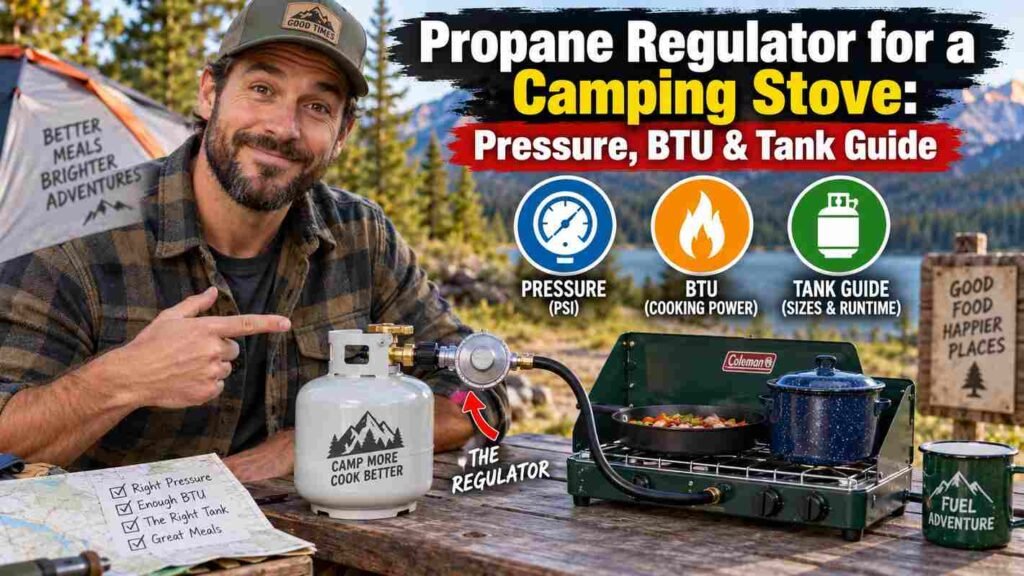
For a propane camping stove, I use the regulator system specified for that exact stove rather than choosing a generic PSI rating. Compact stoves that screw onto a 1-lb cylinder often use a stove-specific regulator built into or attached to the fuel connection. Some larger camp stoves are explicitly high-pressure appliances and require their own matching regulator or manufacturer-approved bulk-tank hose. If I convert a stove from a 1-lb bottle to a 20-lb tank, I use the adapter or hose approved for that stove so I do not accidentally double-regulate the fuel or feed the appliance at the wrong pressure.
Camping stoves can look deceptively similar while using very different propane systems. One stove may screw directly onto a disposable 16.4-oz cylinder through a built-in regulator, while another is a high-pressure two-burner stove that uses a separate regulator and can also connect to a 20-pound cylinder with the correct adapter hose.
That is why I never choose a camping-stove regulator by tank size alone. The important question is how the stove itself was designed to receive propane.


In this guide, I’ll show you how I match the regulator to the stove, how 1-lb and 20-lb setups differ, what BTU rating means, when a low-pressure regulator is appropriate, when a high-pressure regulator is required, and how to avoid common adapter and hose mistakes.
What Type of Propane Regulator Does a Camping Stove Need?
The correct regulator depends on the stove design. I divide propane camping stoves into three broad groups: compact bottle-fed stoves, larger low-pressure camp appliances, and high-pressure camp stoves.
| Camping-Stove Type | Typical Fuel Source | Regulator Approach | What I Do |
|---|---|---|---|
| Compact 1-lb bottle stove | 16.4-oz / 1-lb propane cylinder | Stove-specific regulator or regulated fuel tube | Use the original regulator assembly |
| Tabletop stove adapted to 20-lb tank | 20-lb DOT cylinder | Manufacturer-approved adapter hose | Avoid adding a second regulator unless specified |
| Low-pressure camp appliance | 20-lb cylinder | Fixed low-pressure regulator | Match exact appliance pressure and connection |
| High-pressure camp stove | 1-lb or 20-lb cylinder depending model | High-pressure stove-specific regulator | Use supplied regulator or approved bulk-tank hose |
This is why a universal 0–20 PSI adjustable regulator is not automatically suitable for every camping stove. GasOne currently sells both a 1-PSI low-pressure regulator and 0–20 or 0–30 PSI adjustable high-pressure regulators, but those products are intended for appliances designed to use those pressures. The stove determines which type is correct. citeturn974030search1turn974030search4
If you want a broader explanation of regulator pressure ranges, see how many PSI a propane regulator supplies.


Why Some Camping Stoves Do Not List a Simple PSI Number
Many compact camping stoves are sold as a complete fuel system: stove, regulator/fuel tube, burner orifice, and 1-lb propane cylinder connection. The regulator is part of the appliance design rather than a separate component that you size from a generic pressure chart.
Coleman’s current Triton two-burner propane stove is a good example. It produces 22,000 total BTU/hr and is designed to run from a 16-oz propane cylinder. Coleman also specifies up to about one hour of full-high burn time from one 16-oz cylinder. citeturn446668search0turn446668search3
Instead of trying to replace that setup with a random regulator, I use the regulator or adapter system intended for the stove.
| Example Stove | Published Output | Published Fuel Setup | Regulator Lesson |
|---|---|---|---|
| Coleman Triton 2-Burner | 22,000 BTU/hr total | 16-oz propane cylinder | Use stove-specific fuel/regulator system |
| Coleman Triton+ | 22,000 BTU/hr total | 16-oz propane cylinder | Do not substitute a generic regulator by PSI alone |
| Camp Chef Everest High Pressure | Model-specific high-output burners | 16.4-oz bottle or approved 20-lb hose | Use supplied high-pressure regulator/approved adapter |
| 20-lb tabletop appliance | Model-specific | 20-lb tank through approved conversion hose | Match appliance design, not just tank connector |
Low-Pressure vs. High-Pressure Camping Stoves
This distinction matters more than most people realize.
A low-pressure stove is designed to receive propane after pressure has already been reduced substantially. A high-pressure stove is designed around a higher regulator outlet pressure and a burner orifice sized for that system.

Camp Chef’s current Everest documentation actually labels the product a high-pressure stove. The manual allows either a 16.4-oz disposable cylinder or a refillable tank up to 20 pounds using the company’s specified bulk-tank adapter hose. citeturn446668search40
| Regulator Category | Example Outlet Range | Typical Use | Interchangeable? |
|---|---|---|---|
| Very low / appliance pressure | Around 11 in. WC (~0.4 PSI) | Some grills and low-pressure appliances | No |
| Low pressure | Around 1 PSI on some outdoor appliances | Certain camp/outdoor appliances | No |
| High pressure adjustable | 0–20 PSI | High-output outdoor burners and compatible stoves | No |
| High pressure adjustable | 0–30 PSI | Specialty high-output appliances | No |
I do not replace a high-pressure stove regulator with a low-pressure grill regulator, and I do not put a 20-PSI adjustable regulator on a stove designed around an integrated 1-lb-cylinder regulator.
Can I Use a 20-Lb Propane Tank With a Camping Stove?
Often, yes—but only with the correct hose or adapter for that stove.
Blackstone, for example, currently tells owners that a tabletop unit equipped with a 1-lb regulator connection can be connected to a 20-lb tank using the company’s propane adapter hose. The key is that the adapter is designed around the existing stove regulator architecture rather than replacing it blindly. citeturn974030search0


Camp Chef likewise allows certain Mountain Series high-pressure stoves to use a refillable 20-lb cylinder with the manufacturer-specified HRDSP hose. citeturn446668search39turn446668search40
| Original Stove Fuel | Larger-Tank Conversion | What I Check |
|---|---|---|
| 1-lb bottle screws into stove regulator | 1-lb-to-20-lb adapter hose | Does the adapter feed the existing regulator correctly? |
| Stove uses removable bottle regulator | Manufacturer bulk-tank hose | Is regulator retained or replaced as designed? |
| Stove already uses QCC1 regulator | Direct 20-lb cylinder connection | Use original matched regulator |
| High-pressure camp stove | Approved high-pressure hose/regulator | Do not substitute low-pressure grill parts |
My existing guide on using a regulator on a 1-lb propane tank goes deeper into small-cylinder setups.
What Is Double Regulation, and Why Can It Cause a Weak Flame?
Double regulation happens when propane passes through one regulator and then another when the appliance was designed for only one stage of pressure reduction.
A common example is a tabletop camping stove with its own regulator. If you connect that stove to a 20-lb cylinder through a second low-pressure regulator, the second regulator may reduce the pressure before it ever reaches the stove’s built-in regulator.
The result can be a very small flame, poor burner performance, or an appliance that will not stay lit.
This is why a 1-lb-to-20-lb conversion hose is not always the same thing as a hose-and-regulator assembly. Some conversions need an unregulated high-pressure hose because the stove’s own regulator remains in place. Others require a complete regulator assembly supplied by the manufacturer.
I identify the stove’s original gas path before buying an adapter.
How Much BTU Capacity Does a Camping-Stove Regulator Need?
The regulator and hose must support the full burner input of the stove.
A compact two-burner stove may be around 20,000–30,000 BTU/hr total. Larger outdoor camp stoves can be substantially higher.
| Stove Output | Example Use | Regulator/Flow Requirement |
|---|---|---|
| 10,000 BTU/hr | Small single burner | At least full burner input |
| 20,000–25,000 BTU/hr | Typical compact two-burner stove | Stable flow to both burners |
| 30,000–40,000 BTU/hr | High-output tabletop camp stove | Higher flow through hose and regulator |
| 60,000+ BTU/hr | Large freestanding camp stove | High-capacity stove-specific regulator |
Coleman’s Triton and Triton+ are both currently rated at 22,000 total BTU/hr. citeturn446668search0turn446668search1
If both burners are on high, the regulator has to support the full connected load. My article on what BTU capacity means on a propane regulator explains why flow capacity matters in addition to pressure.
How Long Does a 1-Lb Propane Cylinder Last on a Camping Stove?
Runtime depends on burner output and how hard you run the stove.
A one-pound propane cylinder contains roughly 21,500 BTU of fuel energy. If a stove burns 10,000 BTU/hr, the idealized full-power runtime is a little over two hours. If a two-burner stove uses 20,000–22,000 BTU/hr at full output, idealized runtime is around one hour.
| Total Stove Input | Idealized Full-High Runtime From 1-lb Cylinder | Real-World Note |
|---|---|---|
| 5,000 BTU/hr | About 4.3 hours | Low simmer extends runtime |
| 10,000 BTU/hr | About 2.1 hours | Single-burner cooking |
| 15,000 BTU/hr | About 1.4 hours | Medium/high output |
| 20,000 BTU/hr | About 1.1 hours | Two burners or high-output stove |
| 22,000 BTU/hr | About 1 hour | Matches Coleman’s published Triton estimate |
Coleman currently states that its 22,000-BTU Triton can run for up to about one hour on high from a 16-oz cylinder, which lines up with the simple energy calculation. citeturn446668search0
Real runtime changes with simmering, wind, ambient temperature, cylinder fill, and how much heat you actually demand.
How Long Does a 20-Lb Tank Last on a Camping Stove?
A 20-pound propane cylinder contains roughly 430,000 BTU of fuel energy when full.
| Stove Input | Idealized Full-High Runtime From 20-lb Tank |
|---|---|
| 10,000 BTU/hr | About 43 hours |
| 20,000 BTU/hr | About 21.5 hours |
| 22,000 BTU/hr | About 19.5 hours |
| 30,000 BTU/hr | About 14 hours |
| 60,000 BTU/hr | About 7 hours |
These are planning estimates rather than guarantees. I use them to understand fuel consumption, not to predict the exact minute a cylinder will run empty.
Why a Camping-Stove Flame Gets Weak in Cold Weather
Cold weather can reduce propane vaporization. A small 1-lb cylinder has less surface area and less liquid propane than a 20-lb tank, so it can struggle sooner under high demand.
Blackstone’s current support guidance notes that outside temperature can contribute to regulator freezing or frosting. It also lists leaks and overfilled tanks as possible causes of regulator frost. citeturn974030search3
Coleman user experience also shows that some two-burner systems can lose performance in cold, high-altitude conditions, although actual behavior depends on the stove, fuel source, temperature, and elevation. citeturn446668search1
| Condition | What Can Happen | What I Do |
|---|---|---|
| Cold 1-lb cylinder | Pressure and vaporization fall | Keep spare cylinders and use approved setup |
| Both burners on high | Fuel demand rises sharply | Use adequately sized cylinder/hose |
| High altitude | Combustion and boiling performance change | Follow stove manufacturer guidance |
| Wind | Flame loses heat to surroundings | Use built-in wind guards |
| Frosted regulator | Possible supply or safety issue | Shut down and inspect before reuse |
Why My Camping Stove Has a Tiny Flame After Connecting a 20-Lb Tank
One possible cause is an excess-flow safety device that has restricted gas flow.
Camp Chef’s current stove manual describes a low-flow safety mode that can be triggered by a sudden use of gas. The reset procedure starts by turning off the stove valves and tank valve, checking the fittings and leaks, and then following the manufacturer’s startup sequence. citeturn974030search48
I also check for double regulation, a kinked hose, an incompatible adapter, low tank level, cold weather, and a regulator that does not match the stove.
If your regulator repeatedly stops flowing, see why a propane regulator can work for a few minutes and then stop.
What Hose and Connection Do I Need?
The connection depends on both the cylinder and stove.
A 1-lb disposable propane cylinder normally uses the small threaded camping-cylinder connection. A 20-lb DOT cylinder commonly uses a Type 1/QCC1 valve connection. The hose or adapter has to bridge those systems in the exact way the stove manufacturer intended.
| Connection | Typical Location | What I Check |
|---|---|---|
| 1-lb disposable-cylinder thread | Compact stove fuel inlet/regulator | Hand-tighten as instructed; do not cross-thread |
| Type 1 / QCC1 | 20-lb propane cylinder | Correct regulator or adapter inlet |
| 5/8-18 UNF | Some GasOne hose/regulator outlets | Must match appliance fitting |
| Stove-specific threaded nipple | Camp Chef/Coleman-style regulator assembly | Use approved replacement |
If you are trying to identify a fitting, see how I match regulator inlet and outlet thread sizes.
Can I Use a Generic Adjustable Regulator?
Only if the stove manufacturer permits it and you know the required pressure, connection, and flow capacity.
GasOne sells generic 0–20 PSI and 0–30 PSI high-pressure regulator kits with QCC inlets and 5/8-18 UNF outlets. Those are useful for appliances designed around those specifications, but they are not universal camping-stove replacements. citeturn974030search1turn974030search2
A generic regulator can create three problems: wrong pressure, wrong fitting, and wrong flow behavior. I would rather use the stove maker’s regulator or a clearly specified equivalent than tune a random regulator by trial and error.
Outdoor Use and Camping-Stove Safety
Propane camping stoves are outdoor cooking appliances. I use them outdoors in a well-ventilated area, on a stable surface, away from tents, vehicles, dry vegetation, and combustible walls or overhangs.
I never run a camping stove inside a tent, closed vehicle, or other enclosed sleeping area. Carbon monoxide can accumulate even when the flame looks clean.
Before lighting, I inspect the regulator, cylinder connection, hose, and stove fitting for damage. I leak-test detachable hose/regulator connections using the method in the appliance manual and never use an open flame to find a gas leak.
Camp Chef’s current instructions also emphasize using only the supplied pressure regulator and hose for the appliance and keeping refillable cylinders outdoors in a well-ventilated area when stored. citeturn446668search39
For general propane-regulator precautions, see my propane regulator safety requirements guide.
Frequently Asked Questions
What PSI regulator does a camping stove need?
There is no single camping-stove PSI. Some stoves use an integrated regulator on a 1-lb bottle, some use low pressure, and some are explicitly high-pressure stoves. Use the regulator specified for the exact stove model.
Can I use a 20-lb propane tank with a Coleman camping stove?
Many Coleman-style tabletop stoves can be used with a larger cylinder when the correct manufacturer-approved bulk-tank hose or adapter is available. The adapter must work with the stove’s original regulator design.
Can I connect a 20-lb tank to a 1-lb stove?
Often, yes, with a stove-compatible 1-lb-to-20-lb adapter hose. Do not add a second regulator unless the stove manufacturer calls for one.
Why is my stove flame weak after switching to a big tank?
Common causes include double regulation, a tripped excess-flow device, a restrictive adapter, low tank pressure in cold weather, or an incompatible regulator.
Is a 0–20 PSI regulator good for a camping stove?
Only if the stove is designed for an adjustable high-pressure supply in that range. It is not a universal substitute for a compact bottle-stove regulator.
How long does a 1-lb propane cylinder last?
A 22,000-BTU two-burner stove can use roughly one cylinder per hour at full output, while lower-output or simmering operation lasts longer.
Bottom Line
For a propane camping stove, I match the regulator to the stove design first and the tank size second. Compact 1-lb-cylinder stoves often use a stove-specific regulator, while larger camp stoves may use low-pressure or high-pressure regulators depending on the burner design.
When I switch from a 1-lb bottle to a 20-lb cylinder, I use the manufacturer-approved adapter or hose so the stove receives the same type of fuel supply it was designed for. I avoid double regulation and generic high-pressure regulators unless the appliance specifically calls for them.
Most importantly, I treat the regulator, hose, burner orifice, and cylinder connection as one matched fuel system. If those components are compatible, the stove will be easier to light, easier to control, and far more reliable at camp.

Mike is an experienced propane technician with over 15 years of professional experience in the field. He has dedicated his career to helping customers with their propane needs, from installation to maintenance and repair. Together with Jeremy, he co-founded this website to provide useful information and guidance to customers seeking reliable propane services.


