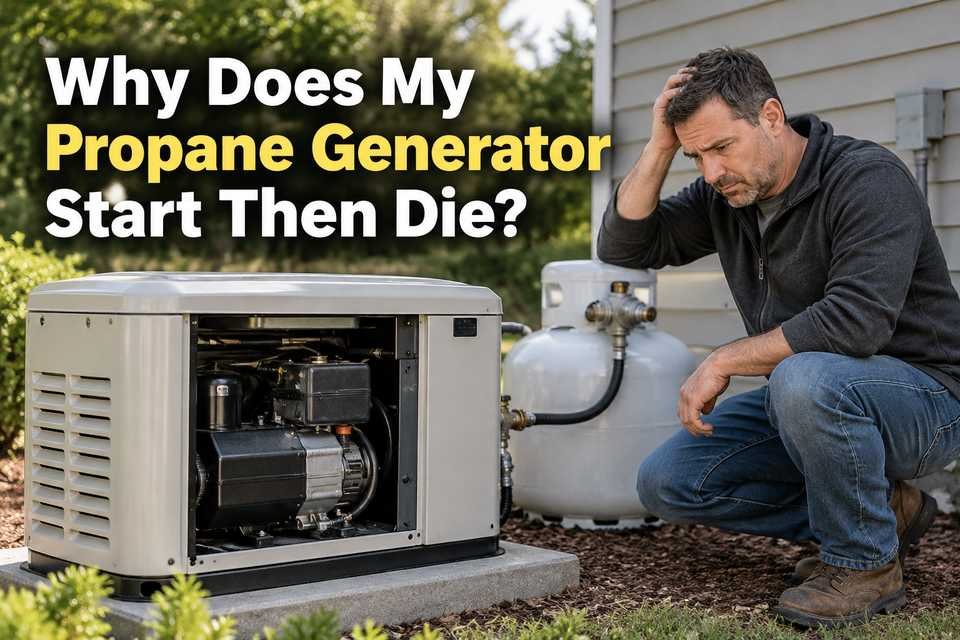
If your propane generator fires up, runs for a few seconds or a minute, and then dies, I would not immediately assume the engine itself is bad. In many cases, the problem is that the generator can get enough propane to start but cannot maintain the fuel flow, oil pressure, cooling, or electrical conditions it needs to keep running.
The exact cause depends on whether you have a portable dual-fuel generator or a permanently installed standby generator. Portable units often add issues such as cylinder valves, hose regulators, low-oil sensors, and CO shutoff systems. Standby units add controller alarms, fuel-pressure requirements, transfer-switch loads, oil-pressure switches, and temperature shutdown protection.
In this guide, I’ll show you how I narrow the problem down safely, what the shutdown timing can tell you, when the propane regulator is likely involved, and when the problem points to the generator itself.


Most Common Reasons a Propane Generator Starts Then Dies
| Possible Cause | Typical Clue | What I Check First |
|---|---|---|
| Insufficient propane flow | Starts, then fades or dies as RPM rises | Tank level, valve, regulator, hose/pipe, dynamic fuel pressure |
| Low oil / low-oil shutdown | Starts, then shuts down with oil alarm or sensor indication | Oil level on level ground, leaks, correct oil grade |
| Overload or output fault | Runs unloaded but dies when transfer switch or loads engage | Remove/reduce load and check controller fault |
| High engine temperature | Runs for a while, then shuts down hot | Cooling air path, debris, oil/coolant as applicable |
| Ignition problem | Rough running, misfire, intermittent shutdown | Spark plug, plug wire, ignition components |
| Fuel solenoid or regulator fault | Fuel cuts off abruptly after start | Controller code, voltage to solenoid, technician pressure test |
| CO safety shutdown on portable unit | CO warning light or abrupt stop in enclosed/poorly ventilated area | Move outdoors to a safe open location and follow manual |
1. The Generator Is Not Getting Enough Propane After It Starts
This is one of the first things I check because it matches the symptom very well. A generator may start on the propane already present in the hose, regulator, mixer, or fuel line, then die once the engine begins demanding a steady flow.
Manufacturer troubleshooting guides routinely list insufficient fuel pressure or low fuel supply as a cause of generators that start and then shut down. Champion, for example, directs technicians to verify fuel pressure with a manometer when a standby generator starts and suddenly stops. Briggs & Stratton also lists incorrect or insufficient fuel pressure among the potential causes of starting and shutdown problems.
The fuel restriction can be anywhere upstream:
- low or empty propane tank;
- tank valve not fully open;
- excess-flow device triggered by opening the valve too quickly;
- undersized propane regulator;
- regulator that is sticking, freezing, contaminated, or failing;
- undersized hose or pipe;
- long pipe run with excessive pressure drop;
- restricted fitting or valve;
- damaged hose;
- weak tank vaporization in cold weather; or
- generator fuel solenoid or demand regulator problem.
If your generator is a portable dual-fuel model, see my guide Propane Regulator for a Portable Dual-Fuel Generator for the differences between portable-generator fuel systems and whole-house regulator systems.


2. Propane Pressure Is Correct at Rest but Drops When the Generator Runs
This is where I separate static pressure from dynamic pressure.
A fuel system can show apparently normal pressure with the generator off and still fail as soon as the engine begins consuming propane. The pressure may collapse because the regulator is too small, the line is too restrictive, or the upstream tank cannot vaporize propane fast enough.
| Pressure Check | What It Tells Me |
|---|---|
| Static pressure | Pressure with little or no propane flowing |
| Dynamic pressure | Pressure while the engine is actually consuming fuel |
| Pressure under electrical load | Whether the system can maintain fuel supply at higher generator demand |
I do not adjust a regulator based on guesswork. Generator fuel pressure should be checked with the correct manometer and compared with the exact generator manufacturer’s specification.
If pressure drops sharply as another appliance or the generator load comes on, my article Why Does Propane Pressure Drop When I Turn On Another Appliance? explains the same system behavior in more detail.
3. The Propane Regulator Is Too Small
A standby generator can be one of the largest propane loads on a property. If the regulator was originally sized only for a furnace, water heater, range, or fireplace, adding a generator can push the system beyond its capacity.

I calculate total connected load by adding the BTU/hr input of every appliance served by the regulator. The generator must be included at its full-load fuel requirement.
For example:
| Connected Appliance | Example Load |
|---|---|
| Standby generator | 270,000 BTU/hr |
| Furnace | 100,000 BTU/hr |
| Water heater | 40,000 BTU/hr |
| Range | 65,000 BTU/hr |
| Total | 475,000 BTU/hr |
If the installed regulator can only deliver 300,000 or 400,000 BTU/hr under the actual pressure conditions, the system may appear fine until the generator starts. Then pressure falls and the generator dies or runs poorly.
For generator-specific sizing, see What Size Propane Regulator Does a Standby Generator Need?.


4. The Tank Cannot Vaporize Propane Fast Enough
Even a correctly sized regulator cannot create propane vapor. The tank has to supply enough vapor to the regulator.
Vaporization capacity falls when outdoor temperature drops and when there is less liquid propane in the tank. That is why a system can work in mild weather but fail during a cold outage when the generator, furnace, and water heater are all running.
I become suspicious of vaporization limits when:
- the problem is worse in cold weather;
- the tank is relatively small;
- the tank is low;
- frost forms unusually on the tank or regulator;
- the generator runs better after sitting; or
- the generator runs alone but dies when other propane appliances operate.
If you are planning generator fuel storage, see What Size Propane Tank Do You Need for a Generator?.
5. Low Oil or a Low-Oil Pressure Shutdown Is Stopping the Engine
Low oil protection is another common reason a generator starts and then shuts itself down.
Champion states that its low-oil sensor can prevent an engine from continuing to run when oil falls below a critical threshold. Briggs & Stratton’s standby troubleshooting guidance also lists low oil pressure as a shutdown cause, and Generac’s current standby support identifies low oil pressure as a controller alarm that can stop operation.
I check oil with the generator on a level surface and follow the exact procedure in the owner’s manual. I also look for leaks and make sure the oil is the correct type and not overfilled.
One important detail: if the oil level is correct but the controller still reports low oil pressure, I do not bypass the protection and keep running the unit. A bad sensor, wiring fault, clogged filter, or real oil-pressure problem needs proper diagnosis.
Example Manufacturer Low-Oil Information
| Manufacturer Example | Published Guidance |
|---|---|
| Champion portable | Low-oil sensor can prevent continued operation when oil is below threshold |
| Briggs & Stratton standby | Low-oil-pressure protection can shut the engine down; applicable service guidance references roughly 7–10 psi switch operation on certain models |
| Generac standby | Low Oil Pressure Code 1300 directs the owner to check oil level and seek service if the alarm persists |
6. The Generator Is Overloaded
If the generator runs normally before the electrical load is applied but shuts down after the transfer switch connects the house, I check load next.
Champion’s standby troubleshooting guide lists generator overload as a possible cause of a unit that starts and suddenly stops. Briggs & Stratton also identifies overcurrent and output-voltage problems among shutdown conditions.
I look at what is coming on at the same time: central air conditioning, electric water heating, well pumps, electric ranges, dryers, large motors, battery chargers, and other high-demand equipment.
A motor can draw several times its normal running current while starting. That means a generator that seems large enough based on steady-state watts can still struggle when multiple motor loads start together.
I do not repeatedly reset an overload without finding the cause. Load management, transfer-switch configuration, or generator sizing may need to be corrected.
7. The Engine Is Overheating
A generator that starts and runs for several minutes before shutting down may be protecting itself from high temperature.
Champion lists high engine temperature as a standby shutdown cause and advises checking intake and exhaust ventilation for blockage. Briggs & Stratton also uses high-temperature protection in standby systems.
I check for:
- leaves, grass, plastic bags, nests, or debris around cooling openings;
- blocked enclosure vents;
- dirty air passages;
- running too close to a wall or obstruction;
- incorrect oil level;
- coolant problems on liquid-cooled units; and
- overloading that forces the engine to work excessively hard.
I always let the engine cool before touching hot components.
8. The Fuel Solenoid, Demand Regulator, or Fuel Valve Is Cutting Off
Standby generators often use electrically controlled fuel valves or solenoids. Portable propane generators may use a demand regulator that only allows gas flow when engine vacuum is present.
If one of these parts sticks, loses power, or fails internally, the engine may receive enough propane to fire but not enough to remain running.
Champion lists a defective fuel solenoid/regulator as a possible no-start or running problem in its standby documentation.
This is where I usually stop DIY troubleshooting. Testing fuel solenoids, regulator pressure, controller outputs, and internal mixer components is better handled with the service manual and proper instruments.
9. The Spark Plug or Ignition System Is Weak
A propane engine still needs a strong spark. A plug can fire during cranking and then misfire as RPM, cylinder pressure, and load increase.
Generac lists damaged or malfunctioning spark plugs among common portable-generator starting problems, while Champion includes faulty spark plugs and loose plug wires in its rough-running troubleshooting guidance.
I inspect the plug and lead according to the maintenance schedule. A fouled, damaged, incorrectly gapped, or worn plug can cause rough running, surging, hard starting, or shutdown.
10. A Portable Generator’s CO Sensor Is Shutting It Down
This mainly applies to portable generators equipped with carbon-monoxide shutoff technology.
Generac’s current portable-generator manual lists CO PROTECT shutdown among the reasons an engine can start and shut off right away. Champion also notes that shutdown can occur because of CO detection.
If a CO warning appears, I treat that as a safety event—not as a nuisance fault to bypass. I move the generator outdoors to an open area far from doors, windows, vents, garages, and occupied spaces, then follow the manufacturer’s instructions.
Never operate a portable generator indoors, in a garage, under an enclosed porch, or near openings where exhaust can enter a building.
What the Shutdown Timing Tells Me
| When It Dies | What I Suspect First |
|---|---|
| Immediately or within a few seconds | Fuel cut-off, low-oil sensor, controller fault, CO shutdown, incorrect fuel setup |
| After 10–30 seconds | Fuel pressure falls under flow, low oil pressure, voltage/output fault |
| Only when electrical load is applied | Overload, fuel-flow limitation, undersized regulator or pipe |
| After several minutes | Overheating, tank vaporization limit, regulator icing, ignition breakdown |
| Only in cold weather | Tank vaporization, regulator freezing, low inlet pressure |
The timing does not prove the cause, but it helps me decide where to start.
My Safe Troubleshooting Order
I use a simple sequence so I do not replace parts randomly:
- Read the controller alarm or fault code before clearing it.
- Check propane supply and tank level.
- Verify the tank valve and any manual shutoff valves are fully open.
- Check engine oil level on level ground.
- Try the generator with unnecessary electrical loads removed.
- Inspect cooling-air openings and exhaust area for blockage.
- Inspect visible hoses, pipes, fittings, and regulator for damage, frost, or obvious leakage.
- If the problem continues, have fuel pressure tested dynamically with a manometer.
I do not loosen propane fittings to “see if gas comes out,” and I do not bypass oil, temperature, CO, or other safety shutdown systems to keep the generator running.
When the Regulator Is Probably the Problem
I put the regulator higher on my suspect list when:
- the generator starts normally but dies as soon as RPM stabilizes;
- it runs better with a full or warmer tank;
- it dies when another propane appliance starts;
- fuel pressure is correct static but low under load;
- the regulator frosts heavily or is visibly damaged;
- the installed regulator’s BTU capacity is below the connected load; or
- the regulator was originally sized before the generator was added.
If you suspect capacity, compare the system against How Do I Calculate Total BTU Load for a Propane Regulator?.
When I Call a Generator or Propane Technician
I call for service when there is a persistent low-oil-pressure alarm with the oil level correct, repeated high-temperature shutdown, fuel-pressure failure, gas odor, suspected regulator malfunction, electrical output fault, repeated overcurrent, or a fault code that returns after basic checks.
Fuel-pressure adjustment and regulator replacement should be done to the generator and regulator manufacturer’s specifications. The technician should verify the pressure while the generator is actually running, not just with the engine off.
Frequently Asked Questions
Why does my propane generator run for 5 seconds and die?
I first suspect fuel flow, low-oil shutdown, an electronic fault, or a safety shutdown. Five seconds is often long enough for the engine to consume the small amount of fuel available during starting, so a restricted regulator or fuel supply can produce exactly this symptom.
Why does my propane generator die when I plug something in?
The electrical load may be too large, or the added engine load may increase propane demand enough to expose an undersized regulator, hose, pipe, or tank vaporization problem.
Can a bad propane regulator make a generator start and stop?
Yes. A sticking, undersized, freezing, contaminated, or incorrectly adjusted regulator can allow enough propane for starting but fail to maintain flow as engine demand rises.
Can low propane cause a generator to shut down?
Yes. A low tank can reduce available vaporization capacity, especially in cold weather. The generator may run until fuel pressure drops below what the fuel system needs.
Why does my generator run on gasoline but die on propane?
That strongly points me toward the propane side of the system: cylinder valve, regulator, hose, fuel solenoid, demand regulator, mixer, or pressure/flow. If it runs normally on gasoline, ignition and basic engine compression are less likely to be the primary cause.
Should I adjust the propane regulator to give the generator more gas?
No. I do not turn the regulator adjustment screw without a manometer and the correct specifications. Too much propane pressure can be just as unsafe and troublesome as too little.
Bottom Line
If my propane generator starts and then dies, I begin with the fuel system because insufficient propane pressure or flow can let the engine start but not keep running. Then I check oil level and shutdown alarms, electrical load, engine temperature, ignition, and fuel-control components.
The most useful clue is often when the generator dies. If it stops only when the load comes on, I look hard at fuel capacity and overload. If it stops after a few seconds with an oil alarm, I investigate oil pressure. If it dies after several minutes, I consider heat, vaporization, or regulator icing.
I do not bypass safety systems or adjust propane pressure by feel. If basic checks do not solve the problem, the next step is a dynamic fuel-pressure test and controller diagnosis by a qualified propane or generator technician.
Technical References

Mike is an experienced propane technician with over 15 years of professional experience in the field. He has dedicated his career to helping customers with their propane needs, from installation to maintenance and repair. Together with Jeremy, he co-founded this website to provide useful information and guidance to customers seeking reliable propane services.