Quick Answer
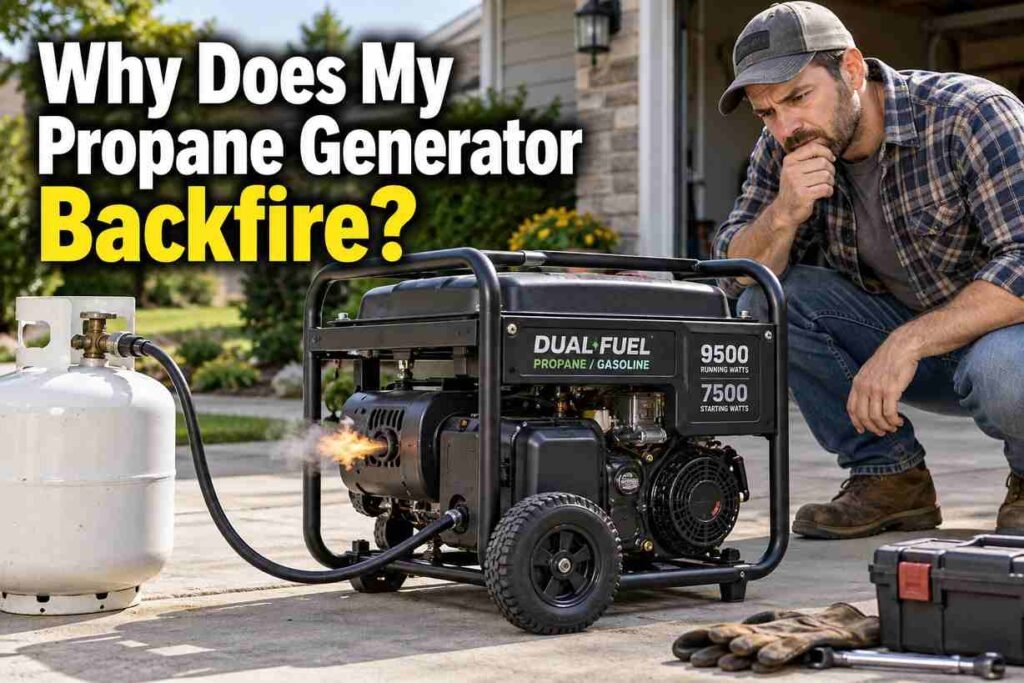
If your propane generator backfires, I usually look for a fuel-mixture or ignition problem first. A lean propane supply, restricted hose or regulator, low fuel pressure, incorrect choke use, weak spark, fouled spark plug, valve-timing or valve-clearance problem, or unburned fuel igniting in the exhaust can all cause popping or banging. The timing of the backfire matters: a pop while starting points me toward starting mixture or ignition; popping under load often points toward lean fuel delivery or misfire; and a bang after shutdown is more likely to be fuel igniting in the hot exhaust.
I also want to separate a true backfire from an afterfire. Technically, a backfire is combustion that travels back through the intake side of the engine. An afterfire is combustion in the exhaust or muffler. Most owners use the word “backfire” for either one, so in this guide I cover both. What matters for troubleshooting is where the sound comes from, when it happens, and what the engine is doing at that moment.
A single soft pop during a rough start is different from repeated sharp explosions while the generator is carrying a load. Repeated backfiring is not something I would ignore. It can be a warning that the air-fuel mixture is wrong, ignition is inconsistent, or combustion is happening at the wrong time.


What a Propane Generator Backfire Usually Tells Me
| When the pop happens | What I suspect first | Other clues to watch |
|---|---|---|
| During starting | Wrong choke/start procedure, lean propane supply, weak spark | Hard starting, several pulls, starts then dies |
| Immediately after starting | Mixture too lean or rich, choke left on too long | Rough idle, black exhaust smell, stumbling |
| Under electrical load | Insufficient propane flow, low pressure, ignition misfire, overload | RPM drop, surging, voltage dip |
| While decelerating | Unburned fuel entering hot exhaust | Popping from muffler as RPM falls |
| At shutdown | Fuel igniting in hot exhaust, stopping procedure | One loud bang after switch-off |
| Repeatedly at all loads | Spark plug, valve, compression, mixer/demand-regulator issue | Rough running even with small load |
That timing gives me a starting point, but I do not replace parts based on the sound alone. I first check the basics: correct fuel selection, propane supply, starting procedure, air filter, spark plug, electrical load, and whether the problem occurs only on propane or on gasoline too.
1. A Lean Propane Mixture Can Make the Engine Pop
A lean mixture means the engine is receiving too much air for the amount of propane reaching the cylinder. Propane generators can become lean when the supply system cannot provide enough vapor volume as engine demand rises. That can happen because the cylinder is too small or nearly empty, the regulator is undersized, the hose is restricted, the tank is cold, or fuel pressure drops under flow.
Lean combustion tends to burn more slowly and less predictably. If combustion is still occurring when the intake or exhaust valve opens, you can hear a pop through the intake or exhaust. A lean engine may also hesitate, surge, lose RPM, or stall when you connect a load.
If your generator also loses power as appliances are added, read my guide on why a propane generator loses power under load. If you have already measured fuel pressure and noticed it falling at startup, see why propane pressure drops when a generator starts.


2. Low Propane Flow Can Cause Backfiring Even When Static Pressure Looks Normal
One mistake I see is assuming that a normal pressure reading with the generator off proves the fuel system is healthy. It does not. With the engine off, very little propane is flowing. The generator may show acceptable static pressure and then experience a large pressure drop as soon as the demand regulator opens and the engine begins consuming fuel.
That is why I care about dynamic pressure—pressure while the engine is cranking, running, and carrying load. A regulator or line can hold pressure at zero flow and still fail when fuel demand rises.
For example, some current Generac LP generator specifications use an inlet pressure around 10–12 inches of water column. That is an example, not a universal setting. I always use the pressure range in the exact generator manual because portable and standby systems can be designed differently.
| Fuel-system condition | What can happen | Possible engine symptom |
|---|---|---|
| Static pressure normal, running pressure drops | Supply cannot maintain flow | Lean pop, stumble, stall |
| Cylinder vaporization too low | Tank cannot produce vapor fast enough | Runs better warm or with fuller/larger cylinder |
| Regulator undersized | Outlet pressure droops as demand increases | Backfire or power loss under load |
| Hose or fitting restricted | Flow bottleneck develops | Starts but runs poorly at higher RPM |
| Valve partly closed | Available fuel volume is limited | Lean running and hesitation |
3. Cold or Frosting Propane Cylinders Can Reduce Fuel Delivery
Propane has to vaporize before most portable generators can use it. Vaporization absorbs heat from the cylinder and surrounding air. Under a heavy fuel draw, the cylinder and regulator can become cold enough for frost to form.
Champion notes in its dual-fuel generator guidance that some frosting during LPG operation can be normal, but unusual cold conditions can reduce the rate at which propane vaporizes enough to restrict flow and hurt generator performance. That is important because a cold cylinder can create a lean condition even when there is still propane left inside.

I never use a torch, open flame, space heater, or other improvised heat source on a propane cylinder. If the generator performs normally with a properly filled cylinder in warmer conditions but backfires as the cylinder frosts heavily, I investigate tank size, fill level, ambient temperature, and vaporization capacity.
4. Incorrect Choke Use Can Create a Bad Starting Mixture
The choke changes how much air reaches the engine during starting. On many dual-fuel generators, the manufacturer specifies a particular choke position for LPG starting, and the procedure may be different from gasoline. Too much choke can create an overly rich mixture, while moving to the run position too early can make starting too lean.
As one manufacturer example, Champion’s current dual-fuel instructions tell owners to start with no electrical loads connected, fully open the LPG cylinder valve, use the specified choke position, and move the choke toward RUN once combustion begins. The exact position and sequence vary by model, so I follow the owner’s manual instead of assuming every propane generator starts the same way.
| Manufacturer example | Figure or setting | Why I mention it |
|---|---|---|
| Champion LPG start procedure | Start with electrical loads disconnected | Reduces starting load while the engine stabilizes |
| Champion cold gasoline example | Below 59°F (15°C) uses a specific full-choke procedure on certain models | Shows that temperature changes starting procedure |
| Champion hot gasoline example | Above 86°F (30°C) uses reduced choke on certain models | Shows why over-choking can foul starting |
| Some Generac LP applications | About 10–12 in. water column inlet pressure | Example only; always use your model specification |
Those figures are manufacturer examples, not settings I would apply across brands. The safe rule is simple: use the exact starting procedure and fuel-pressure specification for your generator model.


5. A Fouled or Weak Spark Plug Can Cause Misfire and Popping
A spark plug can fire well enough for the engine to start and still misfire once cylinder pressure rises. That is why ignition problems sometimes become more obvious under load. A plug that is fouled, worn, cracked, incorrectly gapped, or contaminated can allow unburned propane to pass into the exhaust. If that fuel ignites in the hot muffler, you hear a sharp pop or bang.
Generac’s current portable-generator troubleshooting guidance lists a bad spark plug, disconnected spark-plug wire, excessive rich mixture, dirty air filter, and compression-related problems among causes of engines that start and run rough. I use that as a reminder not to blame the propane regulator for every backfire.
I inspect the spark plug according to the service interval in the manual. I compare its appearance with the manufacturer’s guidance and replace it if it is damaged or overdue. I do not guess at spark-plug gap because the correct value is model-specific.
6. A Dirty Air Filter Can Disturb the Air-Fuel Mixture
The engine needs the correct amount of air as well as fuel. A heavily restricted air filter can create a rich condition. Rich combustion can leave fuel unburned, foul the spark plug, and contribute to popping in the exhaust.
I check the filter for dirt, oil saturation, dust, insects, or rodent debris. I clean or replace it only as the manufacturer specifies. I do not make a habit of running the generator without the filter because dirt entering the engine can cause far more expensive damage.
7. Electrical Overload Can Trigger Rough Running That Sounds Like Backfiring
Sometimes the fuel system is fine and the real problem is that the generator is being asked to produce more power than it can deliver on propane. Many dual-fuel models are rated for fewer watts on LPG than on gasoline. If you size your loads using only the gasoline rating, you may unknowingly overload the generator while using propane.
When the load jumps, the governor opens the throttle and the engine suddenly needs more fuel and torque. If the load exceeds the generator’s capability, RPM can fall sharply. The engine may stumble, surge, or pop. Motor starting loads from air conditioners, refrigerators, pumps, and compressors are especially important because their starting wattage can be much higher than their running wattage.
If the generator repeatedly speeds up and slows down instead of producing isolated pops, see why a propane generator surges or hunts.
8. Valve Clearance or a Sticking Valve Can Cause a True Intake Backfire
A true intake backfire makes me think about valve operation. If an intake valve does not close completely, combustion pressure can travel backward into the intake tract. Incorrect valve clearance, a sticking valve, or loss of compression can all contribute to rough running and popping.
This is not usually my first DIY check because valve inspection and adjustment are model-specific. If the generator backfires through the intake on both gasoline and propane, has become difficult to start, has high operating hours, or shows low compression, I move valve clearance and engine condition higher on the list.
9. Ignition Timing or Flywheel-Key Problems Can Make Combustion Happen at the Wrong Time
Small generator engines typically use fixed ignition timing controlled by the flywheel and ignition system. If timing shifts because of mechanical damage—such as a partially sheared flywheel key after a severe shock—the spark can occur at the wrong point in the cycle. That can produce hard starting, kickback, and backfiring.
This is less common than fuel-flow or spark-plug problems, so I do not start by tearing into the flywheel. I consider timing after simpler checks have been ruled out, especially if the backfire began immediately after a sudden engine stop, impact, or mechanical event.
10. Popping at Shutdown May Be Afterfire, Not a Propane-Supply Failure
If the generator runs normally but gives one loud bang after you shut it off, the problem may be afterfire in the muffler. A hot engine and exhaust can ignite a small amount of unburned fuel after ignition is switched off. The exact shutdown procedure matters.
Champion specifically instructs owners of its dual-fuel models to shut off the propane fuel supply as part of the shutdown sequence. I follow the procedure written for the generator rather than improvising. I also remove large electrical loads before shutdown and allow the engine to stabilize if the manual calls for it.
How I Troubleshoot a Propane Generator That Backfires
- Disconnect electrical loads and reproduce the symptom safely. I want to know whether it backfires with no load or only when appliances are connected.
- Identify when and where the pop occurs. Intake, muffler, startup, load, deceleration, or shutdown are useful clues.
- Check the propane supply. I verify an adequately filled approved cylinder or sufficient bulk-tank supply.
- Inspect the hose, regulator, and valves. I look for kinks, frost, damage, restrictions, or a valve that is not fully open as required.
- Use the correct LPG starting procedure. Choke position and sequence can differ by model.
- Inspect the air filter. A restricted filter can make the mixture too rich.
- Inspect or replace the spark plug if service is due. A weak spark can leave fuel unburned.
- Reduce the electrical load. I compare connected watts with the generator’s propane rating, not just its gasoline rating.
- Compare gasoline and propane operation on a dual-fuel model. If it backfires only on propane, I focus more heavily on the LPG supply and metering system.
- If it backfires on both fuels, I investigate ignition, valves, compression, governor operation, and engine condition.
What If It Backfires Only on Propane but Runs Fine on Gasoline?
That comparison is extremely useful. If the engine runs smoothly on gasoline but pops, surges, or stalls on propane, I first investigate the propane-specific side: cylinder vaporization, regulator, hose, quick-connect, fuel selector, fuel pressure, demand regulator, and mixer.
If the generator will not start on propane at all but runs normally on gasoline, read why a dual-fuel generator won’t start on propane but runs on gasoline. If it starts and then quits, see why a propane generator starts and then dies.
When I Stop Troubleshooting and Call a Technician
I am comfortable doing basic owner-level checks such as reducing load, confirming the correct fuel setting, inspecting the hose, checking the air filter, and servicing the spark plug according to the manual. I stop when the diagnosis requires opening or adjusting the fuel train, measuring or changing regulator pressure, repairing a propane leak, checking valve clearance beyond my experience, or disassembling ignition components.
- You smell propane or suspect a leak.
- The hose, regulator, cylinder valve, or fitting is damaged.
- Backfiring is violent or repeated.
- The generator backfires through the intake on both fuels.
- The engine has compression or valve symptoms.
- Fuel pressure falls outside the generator manufacturer’s specification.
- Electrical wiring, breakers, or receptacles are overheating.
- The generator suddenly began backfiring after a mechanical impact or abrupt stop.
If I smell propane, I shut the generator down when it is safe to do so, eliminate ignition sources, close the fuel supply as appropriate, move people away from the area, and follow the propane supplier’s emergency guidance. I do not keep restarting an engine around a suspected fuel leak.
Frequently Asked Questions
Can low propane pressure cause a generator to backfire?
Yes. Low dynamic pressure can create a lean mixture when the engine demands more fuel. That lean condition can cause hesitation, slow combustion, misfire, and popping. The useful measurement is pressure while fuel is flowing, not only static pressure with the engine off.
Can too much propane cause backfiring?
An overly rich mixture can also cause popping because some fuel may remain unburned and ignite in the exhaust. Rich operation can result from incorrect starting procedure, too much choke on models that use one, air restriction, or a fuel-control fault. I would not adjust a regulator blindly to “give it more fuel.”
Why does my generator backfire when I plug in a large appliance?
A large electrical load makes the engine demand more torque and fuel immediately. If propane flow is marginal, the mixture can go lean at the same moment RPM begins to fall. A motor or compressor can also impose a high starting surge, so I compare both starting watts and running watts with the generator’s LPG rating.
Why does it backfire only when I shut it off?
A shutdown bang is often exhaust afterfire. Unburned fuel can ignite in the hot muffler as the engine stops. I follow the manufacturer’s shutdown sequence, remove loads as directed, and make sure the propane fuel supply is closed according to the manual.
Should I keep running a propane generator that backfires occasionally?
I would not continue normal operation until I understand the cause. A single mild pop during a difficult start may not mean major engine damage, but repeated backfiring can indicate improper fuel mixture, ignition trouble, valve problems, or another condition that should be corrected.
Bottom Line
When my propane generator backfires, I start by identifying when the sound happens and whether it comes from the intake or exhaust. Popping during startup sends me toward choke procedure, fuel delivery, and spark. Popping under load makes me check propane flow, dynamic pressure, regulator capacity, and electrical load. Backfiring on both gasoline and propane pushes ignition, valves, compression, and engine timing higher on my list.
I do not assume the regulator is bad just because the generator pops. Propane backfiring is a symptom, not a diagnosis. By checking the fuel supply, air filter, spark plug, load, and manufacturer’s starting procedure first—and then moving into pressure testing or engine service only when needed—you can narrow the problem without replacing parts at random.

Mike is an experienced propane technician with over 15 years of professional experience in the field. He has dedicated his career to helping customers with their propane needs, from installation to maintenance and repair. Together with Jeremy, he co-founded this website to provide useful information and guidance to customers seeking reliable propane services.