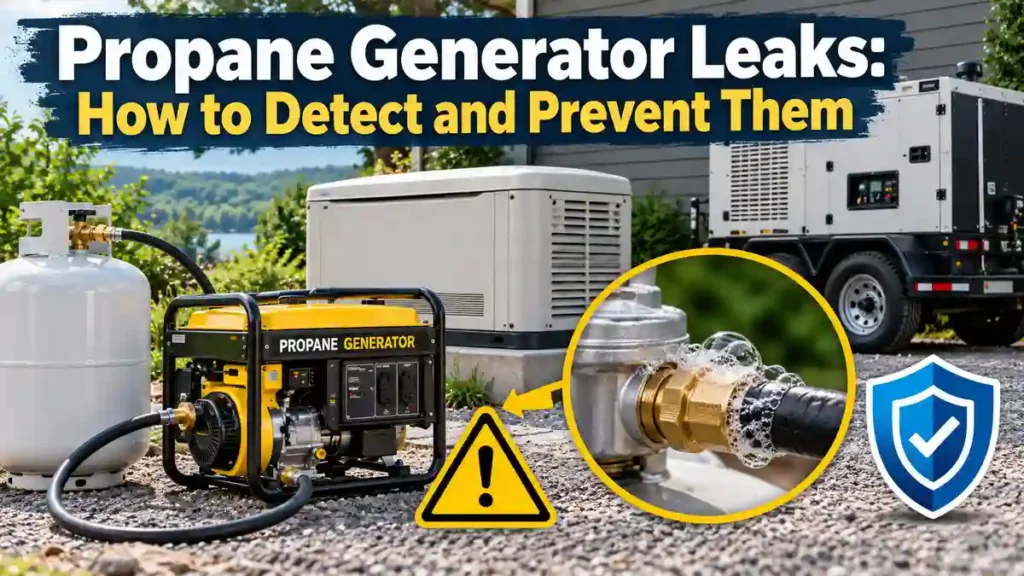
TL;DR — How do I detect and prevent propane generator leaks?
Any suspected active propane leak is an emergency. If you notice a rotten-egg odor, hear a persistent hiss, see a gas-detector alarm, or suspect escaping fuel, leave the area immediately. Do not operate the generator, electrical switches, a phone, or anything that could spark while near the gas. Close the propane supply valve only if you can do so safely without approaching the leak, then call your propane supplier or emergency services from a safe location. Do not restart until a qualified professional has inspected, repaired, and leak-tested the system. Common causes include damaged portable-generator hoses, defective cylinder seals, loose fittings, regulator failures, corroded pipes, physical damage, and incorrect installation. I recommend preventing leaks through approved components, professional pressure and leak testing, routine visual checks, and good records—not DIY gas-line repairs.
Propane generator leaks can turn a useful backup-power system into a serious fire or explosion hazard. A portable dual-fuel generator may use only a short hose between its propane cylinder and engine, while a permanently installed standby generator may rely on a large tank, regulators, buried or aboveground piping, shutoff valves, and a fuel connection inside the enclosure. Both systems can leak, and the warning signs are not always obvious. When preparing to move or put away equipment, I also explain how to transport and store a propane generator safely.


I prefer to separate three questions before I troubleshoot any generator: Is there a possible fuel leak? Is the fuel pressure too low because the system cannot deliver enough vapor? And is the engine or electrical system malfunctioning for an unrelated reason? These problems can look similar from a distance, but they need different responses. A suspected leak always takes priority over diagnosing performance.
In this guide, I’ll show you the signs I take seriously, the technical reasons propane connections fail, how leak detection differs from a pressure problem, what a qualified technician checks, and the habits that help prevent trouble. The emphasis is practical risk reduction, not encouraging you to experiment with a live fuel line.
First: What to Do If You Smell Propane Near a Generator
I would not start the generator to “see whether the smell goes away,” use a match to trace gas, or spray detection fluid when there’s already a suspected active release. The immediate job is to prevent an ignition. If the propane tank or regulator itself is hissing or surrounded by a vapor cloud, I would not approach that tank to close the valve.
One detail deserves emphasis: propane is naturally almost odorless, and commercial fuel normally contains an odorant that many people describe as rotten eggs. However, odor can fade, be masked, or be difficult for some people to detect. The absence of a smell does not prove that a system is leak-free.


Signs of a Propane Generator Leak
| Possible warning sign | What it may mean | Safe response |
|---|---|---|
| Rotten-egg or skunk-like odor | Odorized propane may be escaping | Leave; no switches or ignition sources |
| Persistent hissing at a cylinder, valve, hose, or regulator | Pressurized vapor may be leaking | Keep away and contact the supplier or responders |
| Combustible-gas alarm | A detector has sensed a possible fuel-gas hazard | Treat the alarm seriously and evacuate |
| Visible white vapor cloud at a fitting or cylinder | Rapid release may cool moisture and create visible mist | Do not approach or touch the equipment |
| Unexplained propane consumption | Could be normal load changes, other appliances, meter error, or leakage | Have the system checked; do not rely on tank level alone |
| Cracked hose, damaged fitting, or corrosion | Potential loss of fuel-system containment | Do not operate; arrange qualified inspection |
| Surging, stalling, or poor power | May be fuel starvation, not necessarily a leak | Stop and investigate safely after ruling out a leak |
I don’t use one symptom as proof. For instance, a generator can stall because a cylinder cannot vaporize propane quickly enough in cold weather, or because the regulator is undersized. Neither situation necessarily involves gas escaping into the air. The reverse is also true: a small leak might not noticeably affect performance until the system is tested.
Why Propane Leaks Are Dangerous: The Technical Basics
Propane vapor is denser than air. In calm or poorly ventilated conditions, escaping gas can travel downhill and collect in low spots, drains, pits, or other depressions. That’s why I treat a ground-level release differently from an ordinary outdoor odor drifting past. A generator, battery terminal, relay, hot exhaust, or nearby appliance can become an ignition source.
The fuel becomes flammable within a certain mixture of propane and air. For pure propane, published reference values give a lower flammable limit around 2.1% propane in air and an upper limit around 9.5% by volume. These numbers describe hazard properties, not a target concentration to measure yourself. Never use an uncalibrated consumer device or your nose to decide that a suspected leak is safe.
| Technical property | Typical propane reference | Why it matters |
|---|---|---|
| Relative vapor density | About 1.55 versus air = 1.0 | Propane vapor can settle in low areas |
| Lower flammable limit | About 2.1% in air | A dangerous flammable mixture may form |
| Upper flammable limit | About 9.5% in air | Mixtures within the flammable range can ignite |
| Normal atmospheric boiling point | About −44°F (−42°C) | Liquid propane expands into vapor when released |
| Fuel odor | Odorant generally added | Smell helps but does not guarantee detection |
| Gas supply pressure | Depends on the generator and system design | Cannot be judged from a universal pressure number |
A second danger is often confused with a propane leak: carbon monoxide from the generator’s exhaust. CO is poisonous, odorless, and does not require the propane fuel line to be leaking. A gas-tight generator can still poison people if it runs indoors or too close to openings. I explain safe generator locations in my guide to why you must not run a propane generator indoors.
10 Common Causes of Propane Generator Leaks
1. Worn or Cracked Flexible Propane Hoses
On portable dual-fuel generators, I pay attention to where the factory hose bends around the frame, rests on rough concrete, or gets pulled when the generator moves. Repeated bending, sunlight, abrasion, heat exposure and accidental crushing can damage the outer cover or inner hose. A damaged flexible assembly can lose integrity even if it looks normal from across the yard.

A pressure-rated hose must be suitable for the actual propane application. I wouldn’t substitute a visually similar garden-hose part or extend a fuel hose with miscellaneous connectors. The correct replacement should come from the generator manufacturer or an approved compatible assembly, installed and leak-tested as required.
2. Damaged Cylinder Valve Seals and Connectors
A portable propane cylinder has a valve and a connection system designed to seal properly against an approved hose or regulator. Missing, damaged or incompatible sealing surfaces can allow vapor to escape. Overtightening and cross-threading can make the problem worse.
If I found a questionable cylinder connector, I would stop using that cylinder rather than repeatedly disconnecting and reconnecting it in hopes the seal fixes itself. Cylinder valves, connector compatibility and damaged seals are jobs for an authorized propane supplier or qualified technician.
3. Incorrect Fittings or Improvised Adapters
One recurring risk is a propane connection built from parts that happen to thread together but were never designed to work as a system. Thread shape alone does not prove a fitting is suitable for gas, its pressure rating is adequate, or the mating surfaces provide the intended seal. Some connections seal with approved thread sealant; others seal on a flare or gasket surface and should not be treated the same way.


I would not mix grill regulators, quick-connect fittings and generator fuel hoses just because they appear compatible. If you’re replacing a portable-generator assembly, see my propane regulator guide for portable dual-fuel generators to understand why outlet pressure and manufacturer-approved connections matter.
4. Regulator Diaphragm, Vent, or Body Failure
A propane regulator uses internal components to control downstream pressure as the engine changes fuel demand. The diaphragm, valve seat, vent, seals and housing can be affected by age, damage, contamination or corrosion. A regulator may fail to control pressure properly, or it may develop an external leak.
A regulator vent is part of the device’s pressure-sensing and protective design. I do not assume that gas escaping from a vent is routine or acceptable. Persistent gas odor or release near a vent deserves immediate shutdown, evacuation and qualified assessment. Never plug, tape, or relocate the vent yourself to stop the smell.
5. Loose or Deteriorated Threaded Joints
Permanent standby installations involve pipe unions, nipples, fittings, shutoff valves, sediment traps and other connections. Over time, vibration, poor support, thermal movement or an improperly made connection can expose a sealing defect. A joint may pass a casual visual inspection but fail a proper leak test.
This is why installation and post-service leak testing matter. I want the contractor to check the complete relevant fuel train, not just the connector nearest the generator. Tightening a suspicious fitting while the system is pressurized is not my approach; the professional should first make the system safe and follow the correct repair and retest procedure.
6. Corroded or Physically Damaged Fuel Piping
Standby generator piping may be exposed to rain, soil conditions, landscaping equipment, vehicle traffic or lawn-maintenance tools. Corrosion can damage pipe walls, while impact or strain can compromise a connection. A buried line has different material, corrosion-protection and location requirements from an aboveground connection.
I like seeing a documented pipe route, accessible shutoff points, and proof of required inspections. If the line may have been struck by excavation equipment, I would take it out of service for professional assessment rather than wait to smell gas.
7. Vibration and Poor Pipe Support
An engine creates vibration at startup, while running, and as it shuts down. If rigid pipe is forced to carry that movement without appropriate support or the approved flexible connection, stress can concentrate at fittings. A generator that has shifted on its pad can place additional strain on the fuel connection.
I would ask the installer to examine pipe supports and the manufacturer-specified connection detail. Improvised flexible hoses and excessive loops are not automatically safer. The correct design must meet the generator instructions and local fuel-gas rules.
8. Damaged or Incorrectly Serviced Shutoff Valves
A manual shutoff valve is meant to control gas flow, but its stem packing, body or connections can become a leak point. Damage from weather, impact or improper service can make the problem worse. A valve that’s difficult to operate is not something I would force repeatedly.
I want the generator’s required service shutoff to be accessible and clearly identified before an outage. During an active leak, however, I will not approach the valve if reaching it would put me near the escaping fuel.
9. Fuel-System Work Without a Final Leak Test
This is one of the most preventable problems. Any work that disturbs a regulator, connection, sediment trap, valve or fuel pipe can introduce a new defect. Generac’s maintenance guidance specifically calls for leak testing before initial startup and after fuel-system work, and identifies it as good practice during scheduled service.
I would ask the installer to document what they tested and confirm that the pressure and leak test met the model’s instructions and applicable code. A generator that starts successfully is not evidence that every joint is leak-free.
10. Storm Damage, Flooding, or Animals
Outdoor generators are exposed to the environment. Wind-driven debris can strike hoses and piping, floodwater can damage controls and corrode components, and animals can chew flexible materials or nest around vulnerable areas. After a major storm, I would not put a damaged generator straight back into automatic operation.
The safest path is a professional assessment, especially if the enclosure was flooded, shifted on its base or suffered an impact. A fuel line and the generator’s energized electrical equipment can both be hazardous after severe weather.
Portable vs. Standby Generator Leaks: Where Problems Commonly Start
| Fuel-system component | Portable dual-fuel unit | Permanent propane standby unit |
|---|---|---|
| Fuel source | Replaceable LPG cylinder | Bulk storage tank |
| Typical supply connection | Factory hose/regulator assembly | Code-compliant gas pipe and approved connection |
| Repeated handling | Frequent cylinder connection/disconnection | More limited routine handling |
| Common external risk | Hose abrasion, connector damage, transport | Corrosion, excavation damage, service work, movement |
| Professional checks | Approved hose/cylinder compatibility and safe connections | Supply pressure, piping, regulators, joints and installation integrity |
| My priority | Never run a damaged cylinder or hose | Document full-system commissioning and maintenance |
How Are Propane Generator Leaks Detected?
I divide leak detection into emergency warning signs and planned professional inspections. An odor, active hiss or gas alarm means you shouldn’t continue troubleshooting nearby. You leave and call for help. A routine scheduled inspection happens only after the system is considered safe to service.
Odor and Hissing: Useful Warnings, Not Complete Tests
I treat unusual gas smell or sustained hissing as warning signs but not as reliable methods for certifying a fuel system. Propane odor can fade or be masked by another smell, and some leaks are too small or too far away for an owner to recognize. Silence also doesn’t mean a valve or fitting is tight.
Combustible-Gas Detectors
A propane-rated combustible-gas detector can provide an additional warning layer. If you use a fixed alarm, follow its listed installation instructions, including the correct placement for a heavier-than-air gas. The detector must be suited to propane, maintained, and replaced according to its instructions.
A carbon monoxide alarm is not a propane-leak alarm. CO monitors exhaust-related poisoning risk; a propane detector monitors fuel gas. I recommend both appropriate forms of protection where applicable, but neither makes an unsafe location or damaged installation acceptable.
Approved Non-Corrosive Leak Detection Fluid
During properly controlled maintenance, qualified personnel can apply approved non-corrosive gas-leak detection solution to specified fittings and look for persistent bubbles. The method is useful because escaping vapor causes bubble formation at the defective joint. It is not an instruction to keep a suspected leaking generator operating while you spray fittings.
A manufacturer may allow certain owner maintenance, but because gas-system work is high-risk, I would have a licensed or otherwise qualified technician carry out the test and all repairs. Never use flame as a leak detector; don’t test gas joints in an unsafe atmosphere; and don’t rely on plain soap mixtures that could be corrosive or unsuitable for components.
Professional Pressure and Leak Testing
Technicians may use manometers and other instruments to check supply pressure and system integrity. The exact test procedure and allowable pressure are model- and code-specific. A fuel-pressure check is not the same thing as a leak test: a regulator can show acceptable pressure while a connection leaks, and a leak-free system can still drop pressure under heavy engine demand.
I want both questions answered when symptoms warrant it. The professional should confirm safe containment and the manufacturer’s required supply pressure under the appropriate operating conditions. For fuel-delivery problems, read why propane pressure drops when a generator starts.
Leak, Low Pressure, or Empty Tank? Why I Don’t Confuse Them
| Symptom | Possible explanation | What it proves |
|---|---|---|
| Smell or active hiss | Escaping fuel may be present | Treat as a leak emergency |
| Engine starts then dies | Low vapor flow, low oil, controls, overload, or fuel issue | Not proof of leakage |
| Power falls when appliances turn on | Overload, undersized regulator or pipe, weak vaporization | Not proof of leakage |
| Tank frost during operation | High vaporization demand cools the tank | Not automatically a leak |
| Unexpectedly short runtime | Higher load, partial fill, other connected appliances, or possible loss | Needs investigation; not a leak diagnosis alone |
| Failed professional leak test | Fuel-system containment problem | Requires repair and retest |
My preferred reasoning is simple: is gas escaping, or is the engine not receiving enough fuel? Both might create rough operation, but they are not the same failure. See why a propane generator starts and then dies and why propane generators lose power under load for normal fuel-delivery troubleshooting after the leak hazard has been ruled out.
What Does a Generator’s Required Propane Pressure Tell Me?
For some residential standby models, manufacturer inlet-pressure specifications are expressed in inches of water column (in. WC), a low-pressure gas measurement. The correct range varies by make, model and fuel system. Portable dual-fuel generators may use different regulator arrangements, so I would not impose one universal “11 inches WC” rule on them.
If a specification calls for 11 in. WC, that is approximately 0.40 psi, but the number by itself tells me nothing about whether a fitting leaks. Technicians need the exact permitted inlet-pressure range and fuel-flow demand, not just one pressure number found online.
| Technical measurement | What it describes | What it does not prove |
|---|---|---|
| Static inlet pressure | Pressure with little or no fuel flowing | No leaks anywhere in the line |
| Dynamic inlet pressure | Pressure while the generator consumes fuel | No leak at any fitting |
| Regulator capacity, BTU/hour | Maximum rated fuel-flow capability at specified conditions | That the installed piping is correctly sized |
| Professional leak test | Integrity of the tested section under the procedure used | Perfect electrical performance |
| Tank vaporization capacity | Ability to supply gas at the expected temperature and fill level | That every connection seals |
A system may hold static pressure but struggle when the generator reaches high load because the regulator, hose, piping or tank is undersized. Conversely, a small external leak may exist even when the engine runs smoothly. For proper equipment sizing, see my standby generator propane regulator sizing guide.
My Prevention Checklist: Before Use, After Service, and Seasonally
I don’t believe a safety plan should rely on one annual inspection. The interval for different checks depends on the generator manual, local rules and actual site conditions. I use a layered approach: quick owner observations before operation, scheduled professional testing, and immediate investigation after any event that could damage the fuel system.
| When | What I would check or arrange | Who should handle it |
|---|---|---|
| Before portable generator use | Look for visibly damaged cylinder, approved hose, damaged connector, unusual odor | Owner visually; propane professional if anything is suspect |
| After connecting or changing fuel components | Follow manufacturer-approved safe procedure and required leak checks | Qualified personnel for fuel-system issues |
| After regulator or pipe repair | Full relevant leak test and documented return to service | Qualified propane technician |
| During scheduled standby service | Check fuel system, regulator, enclosure, valves and applicable leak-test requirements | Authorized or qualified service technician |
| After storm, impact or flooding | Inspect for damaged supports, piping, hoses, enclosure and electrical equipment | Qualified service professional |
| Whenever gas odor or alarm occurs | Evacuate, report, do not restart | Emergency response and qualified assessment |
I would record the generator serial number, tank supplier, service company, last leak-test date, and the type of fuel-system work done. That record prevents confusion when someone else is called to service the generator years later.
A Practical Three-Zone Inspection Plan
Here’s an original organizational approach I would use for a property with a permanent propane generator. I divide the installation into three zones, not because any code requires these names, but because it helps prevent gaps between the tank contractor, pipe installer and generator technician.
| Zone | What belongs to it | Why the handoff matters |
|---|---|---|
| Zone 1: Storage and tank outlet | Bulk tank, service valve and initial regulation | The tank supplier may own or service these components |
| Zone 2: Distribution path | Underground/aboveground line, supports and secondary regulation | A different contractor may be responsible for installation or repairs |
| Zone 3: Generator fuel connection | Shutoff, flexible connector, generator inlet and related fittings | Generator installer may handle final connection and commissioning |
The weak spot in a multi-contractor project is often the boundary between responsibilities. If one company says “we tested our pipe” and another says “we tested the generator,” I still want documented confirmation that the complete installed fuel path received the required checks. This is a workflow recommendation, not a claim that I personally inspected a particular installation.
My Leak-Prevention Decision Matrix
I also distinguish an event that demands immediate evacuation from one that calls for scheduled maintenance. It prevents me from treating every performance issue as a gas leak, while still taking even subtle evidence of escaping fuel seriously.
| Observation | My priority | What happens next |
|---|---|---|
| Active odor, hiss, gas alarm, or visible release | Emergency | Leave and contact supplier/emergency services |
| Physically damaged hose, pipe or fitting without apparent release | Stop-use | Keep off and get professional assessment |
| Generator underperforming with no leak signs | Technical diagnosis | Check electrical load and fuel-delivery system safely |
| Routine planned service, no hazard present | Preventive maintenance | Professional check and record leak-test results as required |
Can a Propane Generator Leak While It Is Turned Off?
Yes. A generator being shut down doesn’t guarantee every upstream part is depressurized. Depending on the installation, the cylinder, tank valve, hose, service line or regulator can remain under pressure even when the engine is not running. Some standby systems have automatic controls that may initiate a start, so the manufacturer’s service isolation procedure is particularly important.
I would not assume an idle machine is safe to repair, and I wouldn’t manipulate an automatic standby generator’s electrical controls near a suspected gas release. Qualified personnel must secure the generator and fuel system before servicing.
Can a Leak Make a Propane Generator Use More Fuel?
It can, but fuel consumption alone is a poor leak detector. Your generator may burn more because you are supplying additional air-conditioning, refrigeration or pump loads, because running conditions changed, or because more than one appliance draws from the same tank. An exchange cylinder may also have been filled to less than its nominal weight.
For example, a generator consuming 0.6 gallon/hour for eight hours would burn 4.8 gallons at a constant operating point. A typical full 20-lb cylinder contains about 4.7 gallons. That means the calculated operating plan exceeds one nominal cylinder before I even consider vaporization constraints. I would not mislabel that ordinary fuel demand as a leak.
If consumption is unexpectedly high, I would compare the real run hours, load, refill weight, and other appliances before drawing conclusions, while treating any odor or physical leak warning as urgent regardless of the math. For runtime planning, read how to choose a propane tank size for a generator.
What About Frost on the Regulator or Cylinder?
Frost is another clue that gets misunderstood. Propane vaporization absorbs heat, so cylinders and some regulator components can become cold during high fuel demand. Visible frost may indicate cooling and fuel-flow stress rather than an external leak. But a leak can also create rapid cooling during depressurization.
Because both phenomena can occur, I don’t use frost alone to declare a leak or to prove the system is safe. If there is odor, hissing, a detector alarm or other evidence of escaping gas, leave and report it. If the only problem is a generator that bogs in cold weather after the leak hazard is ruled out, have a technician assess vaporization and pressure under load.
Portable Generator Safety: A Fuel Leak Isn’t the Only Hazard
Even if you’ve confirmed the fuel connections are sound, a portable propane generator must remain outdoors and away from openings. Carbon monoxide comes from combustion, not just leaking fuel, and it can be deadly within minutes. Federal safety guidance calls for portable generators at least 20 feet away from homes and buildings with exhaust directed away from windows, doors and vents, alongside the manufacturer’s instructions.
Never use a generator in a home, garage, basement, shed, carport, or on a porch. Keep working carbon-monoxide alarms in the home. In wet weather, follow approved generator rain-protection and electrical safety guidance rather than enclosing the unit in a homemade box.
Frequently Asked Questions
How can I tell if my propane generator is leaking gas?
A rotten-egg smell, continuous hissing near a fuel connection, combustible-gas alarm or visible gas release can be warning signs. I would treat a suspected active leak as an emergency: leave, avoid sparks and call your propane supplier or emergency services from a safe place.
Can I check a generator propane line with soapy water?
Approved non-corrosive leak detection fluid is used during controlled maintenance, but if you already suspect an active leak, don’t approach the system to perform a test. I prefer a qualified technician to assess the fuel system, use appropriate test methods and repair/retest any defective connection.
Is it normal to smell propane when starting a generator?
I don’t treat a persistent or unexplained propane odor as normal. Stop using the generator and follow the leak emergency procedure. Don’t keep starting it hoping the smell disappears.
Can a propane regulator leak from the vent?
A damaged regulator can allow escaping gas, including through a vent path. Any suspected escaping propane warrants immediate safety action and professional diagnosis. Never block the vent or try to compensate by changing regulator settings.
Does a carbon monoxide alarm detect leaking propane?
No. Carbon monoxide alarms warn about toxic combustion gas, whereas listed LPG combustible-gas detectors are designed to detect propane. They serve different safety functions.
Can a generator run normally with a propane leak?
Possibly. Stable engine operation does not prove that every fitting is gas-tight. That is why installers conduct leak checks after installation and fuel-system service, and why I wouldn’t rely on the sound of an engine as a safety test.
Will closing the propane tank valve stop a leak?
Closing a valve may isolate some supply leaks, but only attempt it if it is immediately safe and you do not need to approach the leak. If the leak is at the tank or valve itself, stay away and leave it to responders. Don’t reopen the system until the leak has been addressed professionally.
How often should a propane standby generator be leak-tested?
Follow the exact manufacturer maintenance schedule and applicable local requirements. I would expect tests after initial installation and fuel-system work, with further checks during scheduled maintenance as specified or recommended. For service intervals, see how often a propane generator needs servicing.
Should I replace a leaking generator?
Not necessarily. A qualified technician may find that a damaged hose, fitting or regulator can be repaired or replaced safely. Major physical damage, obsolete parts or repeated failures change the decision. See five signs a propane generator may need replacement if you’re evaluating repair versus replacement.
My Final Take: Prevention Is a System, Not a Single Leak Test
When I think about propane generator leak prevention, I focus on the complete fuel path: tank, valves, regulators, piping, flexible connections and generator inlet. I want every part to be suitable for the expected pressure and flow, installed correctly, protected from damage, and tested under the right procedure. A safe generator isn’t just an engine that runs; it’s a fuel system that contains propane reliably.
I would prioritize three habits: respond to suspected leaks immediately, have fuel-system work completed and tested by qualified professionals, and keep documentation that makes the next inspection easier. The three-zone checklist and decision matrix above are my practical way of organizing those responsibilities, not a substitute for the manufacturer’s instructions or applicable codes.
If you remember only one thing, make it this: don’t troubleshoot a suspected propane leak by running the generator. Get people to safety first. Once professionals confirm there is no leak, you can investigate starting, pressure, load and maintenance problems without confusing a performance fault with an emergency.
Technical basis: Safety guidance reflects propane industry emergency instructions, manufacturer generator maintenance procedures, U.S. federal propane hazard references, and portable-generator carbon-monoxide safety recommendations. The tables are educational summaries, not pressure-test instructions or permission to work on a live gas system. No outbound links are included.

Mike is an experienced propane technician with over 15 years of professional experience in the field. He has dedicated his career to helping customers with their propane needs, from installation to maintenance and repair. Together with Jeremy, he co-founded this website to provide useful information and guidance to customers seeking reliable propane services.