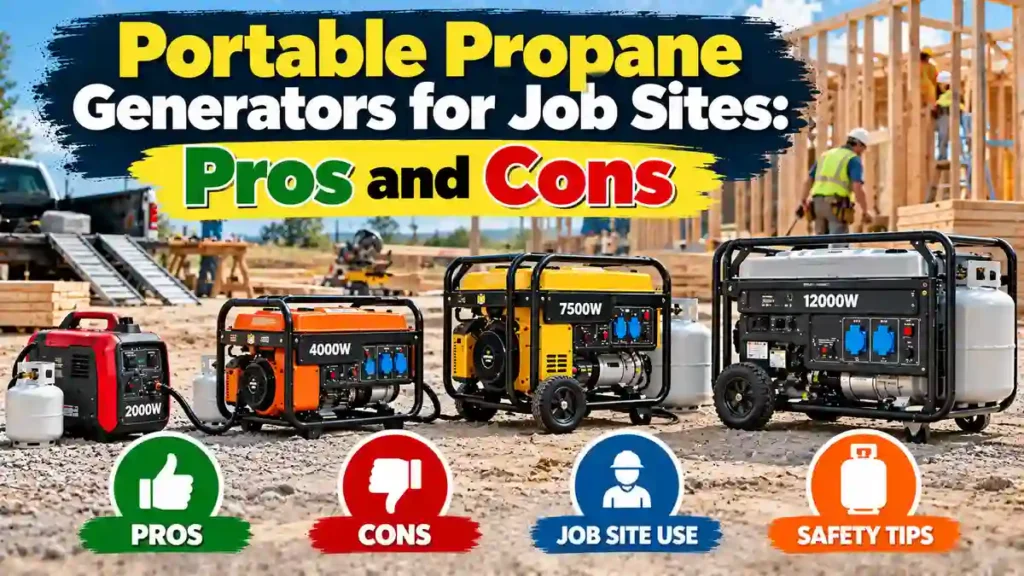
TL;DR — Are portable propane generators good for construction job sites?
Yes—for intermittent tools, temporary lighting, battery charging, residential remodels and contractors who move between locations. Propane stores well and avoids stale-gasoline fuel-system problems. However, many dual-fuel generators provide fewer running watts on LPG, consume a 20-lb cylinder within a few hours under heavy load, and can suffer fuel-vapor supply problems in cold weather. For large compressor starts, welding, continuous high demand or remote sites without refills, a larger gasoline unit, appropriately rated diesel generator or battery system may be better. My preferred general-purpose choice is a dual-fuel machine sized using its propane ratings, not the bigger gasoline number printed on the carton.
When I’m planning temporary electricity for a construction site, I don’t start with the fuel label. I start with the work: what tools must operate simultaneously, which motors have to start, how many hours crews will be working and whether the fuel can actually be delivered. A generator that comfortably powers battery chargers can still trip when a compressor restarts while someone is cutting lumber.


Portable propane generators for job sites can make sense, especially when utility service hasn’t been installed or a contractor needs to move power between projects. But their strengths aren’t the same as their limitations. Here’s the contractor-focused method I’d use to evaluate the equipment, with actual manufacturer ratings where available and clearly labeled hypothetical calculations for the workday.
What Is a Portable Propane Generator for a Job Site?
A propane generator uses an internal-combustion engine fueled by propane vapor to drive an alternator that produces electricity. Most consumer-grade “propane generators” sold for job-site use are actually dual-fuel generators that accept propane or gasoline. A propane-only machine has one approved fuel system, while a dual-fuel unit provides another option when one fuel becomes unavailable.
Conventional portable generators typically run an engine at a governed speed to provide 60-Hz power; inverter generators produce power through electronic conversion and can often reduce engine speed at light load. I favor a quiet inverter when electricians are charging batteries and running smaller devices, but an open-frame conventional unit may give carpenters more running watts for the purchase price.
| Generator concept | What it means for construction |
|---|---|
| Running watts (W) | Power a generator can continuously supply under its rated conditions |
| Starting watts (W) | Short-duration surge capability; not continuous power |
| Kilowatts (kW) | 1,000 watts of power; 7,650 W = 7.65 kW |
| Kilowatt-hours (kWh) | Energy delivered over time; 3 kW for 2 hours = 6 kWh |
| Inverter design | Often better light-load economy and power quality; check exact model |
| Dual-fuel design | Gasoline and LPG modes may have different output and starting ratings |
| 120V vs. 120/240V | Determines compatibility with tools, site distribution and some welders |
For a real-world example, Champion’s 201507 is rated at 8,500 running watts and 10,625 starting watts on gasoline, compared with 7,650 running and 9,565 starting watts on propane. It has GFCI-protected 120V receptacles, a 120/240V locking outlet, and a published propane runtime of up to five hours at half the LPG-rated load on a 20-lb cylinder. That is one manufacturer’s specification—not a universal rating for every model.


9 Advantages of Portable Propane Generators for Construction Sites
1. Cleaner Burning Than Some Liquid-Fuel Alternatives
Propane combustion often produces less soot and certain fuel-related deposits than gasoline or diesel engines. I like that for equipment sitting around a site for occasional work, but I wouldn’t confuse cleaner-burning fuel with zero emissions. A propane generator still produces deadly carbon monoxide and other exhaust pollutants and must operate outdoors.
2. Fuel That Stores Without Gasoline-Like Deterioration
Propane stored in an approved, sound cylinder does not become stale the way gasoline can. For crews that keep an emergency generator in a storage trailer between projects, this removes one familiar fuel-quality problem. The valve, cylinder inspection status and regulator still need attention; stable fuel is not the same as a maintenance-free system.
3. Fewer Problems From Stale Gas in the Carburetor
Operating on LPG avoids introducing aging gasoline into the gasoline carburetor circuit. That can reduce gum and varnish complaints after long inactivity. But I still follow the manual’s oil, air filter, spark plug, battery and exercise schedules. If a dual-fuel unit has gasoline left in its tank or carburetor, its gasoline system still needs proper storage treatment.
4. Convenient Cylinder Exchanges
Swapping a correctly sized cylinder may be simpler than transferring gasoline on a busy site. I wouldn’t promise an exchange is always cheaper or equally filled, though. Exchange cylinders can contain less propane than the nominal 20-lb capacity, and a low fuel level can shorten your planned runtime.
5. Flexibility Across Different Job Locations
A portable unit with wheels can follow a small crew from framing to finishing work without a permanent installation. I check weight, tie-down points, cooling time and cylinder transport rules first. For proper handling and outdoor cylinder storage, see how to transport and store a propane generator safely.

6. Less Risk of Liquid-Fuel Spills During Routine Refueling
An approved propane cylinder and hose avoid pouring liquid gasoline into a generator tank on site. That helps reduce certain spill scenarios. However, propane vapor is flammable and can accumulate in low areas. A damaged fitting or valve creates a different serious hazard, so I don’t label propane “risk-free.”
7. Dual-Fuel Resilience
If a fuel supplier runs out of propane, I like having a manufacturer-approved gasoline mode as a backup. Switching fuels does not cure an electrical or engine fault, and I still need to maintain both systems. But for a contractor working across several areas, flexibility may prevent a missed day of work.
8. Easier Fuel Inventory Counting
Cylinders offer convenient inventory units: full, in use, and ready for refill. I would tag them and record measured deliveries or fill weights rather than rely on the word “full” written on a container. This is especially useful when a project manager must compare fuel consumption across multiple crews.
9. Good Match for Intermittent Temporary Power
A remodeling crew running saws occasionally and charging cordless batteries is different from a concrete-cutting crew working at high power all day. Propane can be attractive for the first scenario because the equipment may spend long periods stored between jobs. For nonstop heavy equipment use, fuel supply logistics may outweigh the convenience.


9 Disadvantages of Portable Propane Generators for Job Sites
1. Lower Rated Watts on LPG for Many Dual-Fuel Engines
On the Champion example above, the LPG continuous rating is 850 W lower than gasoline—about 10% less. I always size a job-site unit from its propane running and starting watts. If you select equipment using gasoline output and then switch to LPG, motor starts can trip overload protection unexpectedly.
2. Short Runtime With Small Cylinders
A nominally full 20-lb cylinder holds about 4.7 U.S. gallons of propane. On the referenced Champion model, the advertised half-load runtime is up to five hours, not an entire eight-hour shift. A spare cylinder or a properly designed larger supply may be necessary, and the workers must have a safe changeover process.
3. Cold-Weather Vaporization Limits
Propane must change from liquid to vapor before reaching many portable generator engines. This process absorbs heat. Low air temperature, a low liquid level and high fuel demand can reduce the cylinder’s vapor-delivery rate even when there is still propane inside. I would not heat a cylinder with a torch or bypass regulators; I would instead have a qualified supplier evaluate the approved fuel setup.
4. Fuel Cost per Electrical kWh Can Be Higher
Propane contains about 91,452 BTU per U.S. gallon; gasoline contains around 120,214 BTU and diesel around 137,381 BTU according to the U.S. Energy Information Administration. Those are fuel heat values, not delivered electricity. The price per gallon, the engine and the load determine dollars per kWh.
5. Compressor and Motor Starting Surges
A compressor motor may require several times its normal running power for a short start. The generator must supply that surge without excessive voltage drop. A 7.65-kW continuous rating doesn’t mean every 240V compressor is compatible; the starting capacity, outlet current, locked-rotor demand and motor controls all matter.
6. Cylinder Transport and Storage Requirements
Propane cylinders need approved storage, upright positioning and protection from damage. They aren’t items I would leave overnight in an enclosed service van. Construction sites are subject to LPG rules in addition to company and local fire requirements; fuel storage can be harder than transporting the generator itself.
7. Refills May Be Inconvenient at Remote Projects
The last cylinder runs out at 3 p.m. on Friday, and the nearest refiller is closed—that can erase any fuel-storage advantage. Before accepting a remote job, I would verify refill delivery or a reserve arrangement. Availability of liquid gallons and availability of adequate vapor flow are two separate constraints.
8. More Connections That Must Be Suitable for the Engine
Portable LPG operation introduces a cylinder valve, hose, approved connector and regulator arrangement. A fitting that appears to fit may have the wrong pressure or sealing design. For any suspected leak, stop, move people away and call a qualified propane professional. My guide to propane generator leak detection and prevention explains the warning signs.
9. Noise, Exhaust and Engine Maintenance Remain
A propane-powered open-frame generator can still be loud, still needs oil changes and still exposes workers to exhaust. I wouldn’t assume propane is automatically quieter. The enclosure, inverter, engine speed and load often matter more. For those comparisons, see my generator noise comparison.
Propane vs. Gasoline vs. Diesel for Construction
I don’t rank fuels by gallons alone. Diesel and gasoline machinery can differ dramatically in engine size and intended duty. The table separates verified fuel-energy content from illustrative equal-output fuel-cost assumptions used later. Real job-site efficiency requires model-specific curves at the same electrical load.
| Factor | Propane (LPG) | Gasoline | Diesel |
|---|---|---|---|
| Fuel energy per gallon | 91,452 BTU | 120,214 BTU | 137,381 BTU |
| Rated output | Often lower on dual-fuel engines | Often higher on same dual-fuel unit | Model-specific; varies widely |
| Motor starts | Check LPG surge rating | Check engine and alternator surge | Check model and motor-start data |
| Example consumption at 3-kW output | 0.75 gal/h* | 0.60 gal/h* | 0.40 gal/h* |
| Example fuel price | $3.00/gal* | $3.50/gal* | $4.20/gal* |
| Example cost per hour | $2.25* | $2.10* | $1.68* |
| Storage/handling | Approved pressurized cylinders | Approved gasoline containers, fuel aging | Liquid diesel storage and fuel-quality management |
| Maintenance | Oil, ignition, fuel hose/regulator | Oil, ignition, gasoline system | Oil, filters, fuel/water management |
| Cold weather | Vaporization can limit flow | Engine starting/fuel conditions matter | Cold-flow and engine starting concerns |
| Portability and use | Portable for intermittent jobs | Portable, widely available | Often heavier; suited to sustained loads |
*Every consumption and price figure in the three right-hand columns is a hypothetical budgeting assumption, not a measured comparison or current fuel price. The different hypothetical engines are not assumed to have the same thermal efficiency. Follow the actual generator’s data sheet.
What Size Propane Generator Do You Need for Construction Work?
I would make a list of every tool that might run at once, then identify motors likely to start while the other loads remain on. This is more useful than purchasing a generator based on “home size” or an arbitrary 5,000-watt rule.
| Job-site equipment | Illustrative running watts | Starting/surge consideration |
|---|---|---|
| Circular saw | 1,200–1,800 W | Motor may demand 2–3× running input briefly |
| Miter saw | 1,200–1,800 W | High momentary motor start |
| Table saw | 1,500–2,500 W | Larger motor; check 120V/240V supply |
| Air compressor | 1,500–2,500 W | May need ~3,000–6,000+ starting watts |
| Corded electric drill | 400–1,000 W | Motor/inrush varies |
| Angle grinder | 750–1,500 W | Starting surge, load-dependent |
| Small concrete mixer | 500–1,800 W | Starting under load raises demand |
| LED work lights | 100–500 W | Usually small continuous load |
| Battery chargers | 100–800 W combined | Check input and power quality |
| Small inverter welder | 1,500–5,000+ W input | Input amps, 120/240V and power factor critical |
These are illustrative ranges for preliminary planning. Tool input nameplates, measured current, motor-starting data and generator/manual compatibility always take priority. A welder rated “160 amps” on the output does not draw 160 amps from its input receptacle: output welding current and input electrical current are different measurements.
Worked Example: A Carpenter and Compressor on One Generator
Suppose the compressor draws 2,000 W running but needs 5,000 W starting; a circular saw draws 1,600 W; site lights consume 300 W; and chargers use 250 W. The simultaneous running total is 4,150 W. But if the compressor restarts while the other equipment stays on, the instantaneous combined demand is approximately 7,150 W.
| Load | Running watts | Conservative start-event watts |
|---|---|---|
| Compressor | 2,000 | 5,000 |
| Circular saw already running | 1,600 | 1,600 |
| Work lights | 300 | 300 |
| Chargers | 250 | 250 |
| Total | 4,150 | 7,150 |
I’d first verify whether the compressor actually starts under that combination, then check generator LPG starting watts, voltage droop, receptacle and breaker ratings. The Champion 201507 example has 7,650 LPG continuous and 9,565 LPG starting watts, but I wouldn’t promise it can start every compressor. One 120V 20A outlet cannot supply all 7,650 W: that receptacle’s own limit is about 2,400 W at 120V before other rules and tool characteristics are considered.
If multiple saws can start together, I would increase capacity or schedule motor starts. A practical site method is to assign a “no overlapping starts” rule for the compressor and large saws when using a smaller generator. That may avoid buying excessive equipment, but it is a work-control method—not permission to exceed ratings.
Propane Generator Runtime: 20-, 30-, 40-, and 100-lb Cylinders
For this planning model I assume a 7.65-kW LPG-rated portable generator. The half-load fuel rate of 0.94 gal/hour is calculated from the Champion 201507’s advertised five-hour runtime on a nominal 4.7-gallon 20-lb cylinder; the 25%, 75% and 100% rates are hypothetical extensions, not manufacturer tests. Actual cylinder fills and weather vary.
| Electrical load | Approx. electrical output | Illustrative LPG use |
|---|---|---|
| 25% | 1.91 kW | 0.55 gal/h |
| 50% | 3.83 kW | 0.94 gal/h |
| 75% | 5.74 kW | 1.23 gal/h |
| 100% | 7.65 kW | 1.52 gal/h |
| Cylinder / nominal fuel | 25% load | 50% load | 75% load | 100% load |
|---|---|---|---|---|
| 20 lb (~4.7 gal) | 8.5 h | 5.0 h | 3.8 h | 3.1 h |
| 30 lb (~7.05 gal) | 12.8 h | 7.5 h | 5.7 h | 4.6 h |
| 40 lb (~9.4 gal) | 17.1 h | 10.0 h | 7.6 h | 6.2 h |
| 100 lb (~23.5 gal) | 42.7 h | 25.0 h | 19.1 h | 15.5 h |
I calculated each cell as nominal gallons ÷ assumed gallons per hour. These are volume-only runtimes to empty; they do not leave a reserve. More importantly, they do not prove a 20-lb cylinder can vaporize 1.52 gal/h on a cold morning. A cylinder can contain enough chemical energy for the runtime on paper yet be unable to supply that rate of vapor. That is why I check tank size, fill level and minimum ambient temperature separately.
I explain cylinder runtime in more detail in how long a 20-lb propane tank will run a generator.
An 8-Hour Job-Site Shift: My Fuel and Electricity Budget
Instead of pretending every job draws full output continuously, I divide a normal shift into load bands. Imagine two hours of light battery charging and lighting at 25%, four hours of moderately busy cutting and compressors at 50%, and two heavier work periods at 75%. This is a hypothetical load schedule; it is not a logged worksite or manufacturer fuel test.
| Shift segment | Time | LPG use | Fuel burned | Electricity produced |
|---|---|---|---|---|
| 25% load | 2 h | 0.55 gal/h | 1.10 gal | 3.83 kWh |
| 50% load | 4 h | 0.94 gal/h | 3.76 gal | 15.30 kWh |
| 75% load | 2 h | 1.23 gal/h | 2.46 gal | 11.48 kWh |
| 8-hour total | 8 h | — | 7.32 gal | 30.60 kWh |
At a hypothetical $3.00 per gallon, that shift costs $21.96 in propane. Five identical days cost $109.80, use 36.6 gallons and produce approximately 153 kWh. Fuel-only electricity cost is $21.96 ÷ 30.6 kWh ≈ $0.72/kWh. A single 20-lb cylinder would not cover the shift, so I’d arrange a safe reserve and refill plan before workers arrive.
Idle fuel consumption, changing tool loads and actual gallons delivered will change the result. The purpose of this model is to show that daily fuel logistics can matter more than a generator’s advertised “maximum hours per tank.”
Cost per kWh: When Does Propane Beat Gasoline or Diesel?
For an equal-output 3-kW electrical task, suppose a generator uses 0.75 gal/h on LPG at $3.00/gal, 0.60 gal/h on gasoline at $3.50/gal, or a different diesel generator uses 0.40 gal/h at $4.20/gal. Those are assumptions for comparison, not published consumption measurements. They illustrate the calculation; a diesel machine may be larger or less efficient at such a light load.
| Illustrative 3-kW example | LPG | Gasoline | Diesel |
|---|---|---|---|
| Fuel use per hour | 0.75 gal | 0.60 gal | 0.40 gal |
| Fuel price per gallon | $3.00 | $3.50 | $4.20 |
| Fuel-only cost/hour | $2.25 | $2.10 | $1.68 |
| Fuel-only cost/8 hours | $18.00 | $16.80 | $13.44 |
| Fuel-only cost/kWh | $0.75 | $0.70 | $0.56 |
A useful break-even rule follows: propane matches gasoline fuel cost per hour when LPG price × LPG gallons/hour = gasoline price × gasoline gallons/hour. With the assumed 3-kW rates, the propane break-even price is $3.50 × 0.60 ÷ 0.75 = $2.80 per gallon. Below that delivered propane price, LPG wins on fuel-only cost in this example; above it, gasoline wins. Actual generator comparisons must use consumption at the same electrical load.
That’s the decision metric I would use for a contractor billing five shifts a week. Other costs—oil, engine service, fuel delivery, cylinder exchange premiums, equipment rental and lost time—can move the true winner. I keep a separate discussion of these issues in my propane-versus-gasoline generator efficiency guide.
Which Construction Tasks Are Best Suited to Propane?
I see propane as a strong candidate for residential remodeling, electrical rough-in, framing with intermittent saw use, equipment battery charging, temporary LED lighting, and small outdoor renovation projects. Those sites often need a portable machine for part of a day rather than a large rental generator running nonstop.
On the other hand, I’d examine diesel equipment or grid service for continuous high-power concrete work, multiple large welders, big compressors, large dewatering pumps or remote jobs with no propane supplier. Battery systems can be attractive for light indoor tasks because they produce no combustion exhaust at the point of use, but their kWh capacity and charging plan must match the actual work.
| Job-site scenario | Power option I would evaluate first | Main reason |
|---|---|---|
| Intermittent saws and cordless-tool charging | Dual-fuel portable propane/gas | Flexible fuel and moderate loads |
| Urban remodel with strict noise and no exhaust-safe space | Battery power or safe existing grid connection | No indoor generator operation |
| Heavy tools all day with on-site diesel supply | Properly sized diesel rental | Duty cycle and fuel logistics |
| Remote cabin construction, LPG deliveries available | LPG portable with planned reserve | Stable stored fuel and predictable refills |
| Remote site without propane supply | Gasoline or diesel depending equipment | Fuel availability matters |
| Indoor welding or cutting | Approved facility power or appropriate battery equipment | Never use combustion generator indoors |
Safety Requirements for Construction Job Sites
Carbon monoxide: A propane generator can kill workers through CO poisoning, even though LPG may burn cleaner than gasoline. Never operate it inside a building under construction, garage, enclosed trailer, tent, crawlspace or partially enclosed work area. The U.S. CPSC recommends outdoor operation at least 20 feet from buildings with exhaust directed away from windows, doors and vents. That is general generator safety guidance; the required arrangement also depends on site conditions and the manufacturer’s instructions.
OSHA electrical protection: Under 29 CFR 1926.404(b)(1), construction employers must provide applicable ground-fault protection—GFCIs or a qualifying assured equipment grounding conductor program under the rule. Requirements for 120V, 15A/20A temporary receptacles are specific, with a narrow generator exception. I would not assume that a receptacle’s presence means the complete site wiring arrangement complies.
Grounding and bonding: OSHA’s portable-generator rules distinguish certain frame-bonded, cord-and-plug-only arrangements from generators connected to building wiring or separately configured distribution. You cannot assume that every unit needs a separate ground rod or that none do. A qualified electrician should evaluate the actual generator, neutral/bond configuration, temporary distribution and transfer equipment.
Propane systems: OSHA 29 CFR 1926.153 covers approved cylinders, regulators, hoses, storage and safeguards for construction work. Storage of LPG containers inside buildings is prohibited by the construction storage provision; operational uses under other subsections have their own limitations, which do not authorize running a portable generator inside. Cylinders must be protected from vehicles, ignition sources and unauthorized handling. Keep appropriate fire extinguishers and follow the site’s fire plan.
Weather and maintenance: Use rated cords, proper strain relief and suitable weather protection without enclosing the engine or blocking cooling airflow. Shut down and cool before servicing or reconnecting fuel. If you smell gas, hear a hiss or detect an LPG alarm, leave the area and have the system professionally checked. No one should troubleshoot a suspected active leak by operating the generator.
Is Dual-Fuel Better Than Propane-Only for Contractors?
For many small crews, I would choose an appropriately sized dual-fuel model rather than a propane-only portable machine. The second fuel gives flexibility when the supply van arrives late or a local refill station closes. But dual-fuel isn’t free resilience: the machine costs money, weighs more than some alternatives and still needs care of the gasoline side even when it usually runs on propane.
I would choose propane-only only when the site is committed to a known LPG supply and the model’s output, operating duty and support network suit the work. Otherwise, switching capability is useful—provided I treat gasoline and LPG ratings as separate electrical specifications.
My Contractor Decision Checklist
- Inventory loads: I note each tool’s nameplate input wattage, amps, voltage and starting needs.
- Model simultaneous work: I include compressor restarts while saws, lights and chargers remain active.
- Choose the fuel rating: I size from propane running and starting watts, not the gasoline carton headline.
- Check site outlets: Receptacle, breaker, neutral/ground, GFCI and distribution compatibility must be correct.
- Model the shift: I budget realistic light-, medium- and high-load hours instead of 100% runtime.
- Calculate cylinder quantity: I include fuel reserve and cold-weather vaporization capacity.
- Verify nearby refills: I establish a supplier or legal delivery route before the crew arrives.
- Plan placement and security: Generator stays outdoors with safe exhaust direction, and cylinders remain protected.
- Budget full cost: Fuel price, maintenance, transport time and likely downtime matter.
- Document maintenance: I follow the model’s service and hose/valve inspection schedule.
Frequently Asked Questions
Are portable propane generators powerful enough for construction?
Yes, for many smaller tools and temporary loads. I compare the LPG running and starting watts against the entire simultaneous tool schedule, not just the biggest individual tool.
Can a propane generator run an air compressor?
Often yes, but motor starting is critical. I need the compressor’s starting demand, voltage, outlet rating and generator surge capacity, along with the other loads running when it restarts.
How long does a 20-lb propane tank last on a job site?
It varies widely. The Champion 201507 advertises up to five hours at half its LPG-rated load on a nominal 20-lb cylinder. Lighter loads can last longer; heavy loads, low fill and vaporization limitations can reduce runtime.
Is propane cheaper to operate than gasoline?
Sometimes. With hypothetical equal-output consumption of 0.75 LPG versus 0.60 gasoline gal/h and gasoline at $3.50/gal, propane must cost below about $2.80/gal to be cheaper on fuel alone.
Can a propane generator run all day?
Potentially, if the specific unit is rated for the duty, properly maintained and supplied with enough propane vapor. I check continuous duty, oil and shutdown requirements, fuel logistics and safe placement.
Are propane generators quieter than gasoline generators?
Not necessarily. Inverter enclosure, engine speed and load usually make a bigger difference than fuel. I compare published dBA measurements at similar loads and distances.
Do LPG generators work below freezing?
They can, but cold weather can limit a cylinder’s vaporization rate. A properly sized approved fuel system, adequate fill and the engine’s temperature ratings are important.
What size generator should a contractor buy?
I calculate simultaneous running loads plus the worst credible motor start, then verify site receptacle limits. Small crews may need a few kilowatts; compressors and saws together may demand a substantially larger LPG-rated generator.
Is dual-fuel worth it for construction?
I think it’s valuable when fuel delivery is uncertain or the generator moves between sites. It isn’t a substitute for proper sizing, maintenance or a reliable workday fuel plan.
Can propane generators be used on commercial construction sites?
Yes, where permitted and operated in compliance with applicable site rules, OSHA requirements and local codes. The job-site plan must address carbon monoxide, fuel storage, electrical protection, grounding/bonding and fire safety.
My Recommendation: Choose the Workload Before the Fuel
My preferred contractor strategy is to classify the job first: intermittent small tools, mixed loads with motor starts, or continuous heavy-duty equipment. Portable propane or dual-fuel power is especially appealing in the first two categories when cylinders are readily available and stored fuel may sit between jobs. For the third, I would seriously price a larger gasoline or diesel solution—or permanent electrical service.
The key takeaway is that an LPG generator can be electrically capable but operationally unsuitable if it runs out of cylinders or cannot vaporize enough propane during a compressor-heavy shift. That’s why I want three calculations on every quote: peak starting watts, 8-hour fuel consumption, and fuel-only cost per useful kWh. Those numbers give you a more defensible buying decision than a generic “propane is better” claim.
Technical and editorial note: Fuel heat values come from U.S. EIA conversion tables; the cited Champion 201507 wattages and half-load runtime are manufacturer-published. Other load, price, fuel-curve and tool figures are explicitly illustrative. OSHA references concern U.S. construction rules. The article is an original editorial synthesis, not a report of firsthand tests. No outbound links are included.

Mike is an experienced propane technician with over 15 years of professional experience in the field. He has dedicated his career to helping customers with their propane needs, from installation to maintenance and repair. Together with Jeremy, he co-founded this website to provide useful information and guidance to customers seeking reliable propane services.