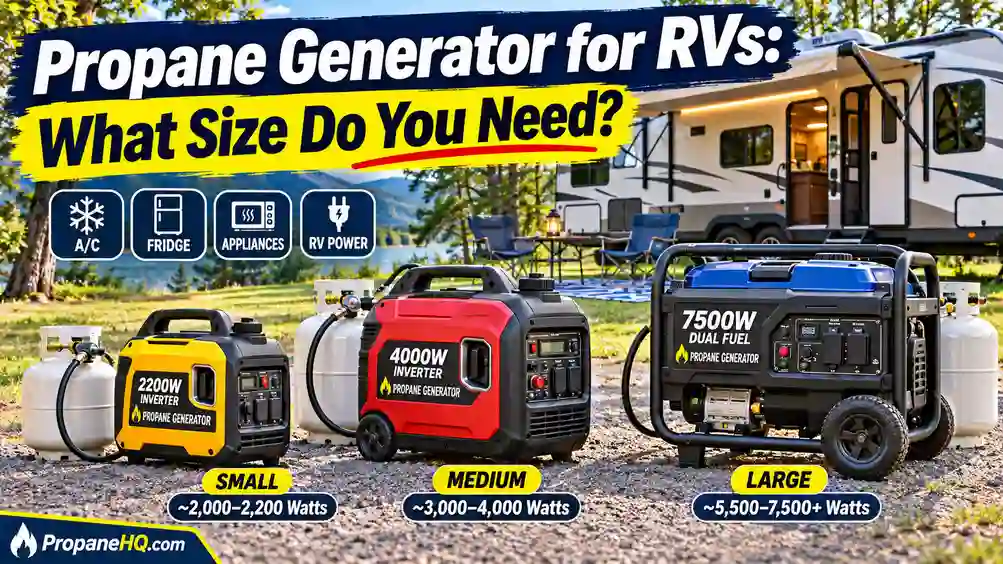
TL;DR — What size propane generator do I need for my RV? For basic lights, electronics, charging, and an efficient refrigerator, a generator providing 2,000–2,500 continuous watts on propane may be enough. For a 30-amp travel trailer with one rooftop air conditioner, I would usually begin shopping around 3,000–4,000 propane running watts, then verify compressor startup. A 50-amp fifth wheel with two air conditioners may need 5,500–8,000 propane running watts to use both, sometimes more for other appliances. Your actual loads, air-conditioner starts, and output connections decide the answer—not the RV’s length or plug alone. Compare continuous propane watts rather than headline peak watts.
| Propane running-watt class | Example RV use | Main limitation |
|---|---|---|
| 2,000 W | LED lights, laptop, TV, modest battery charging | Most standard rooftop A/C starts are difficult |
| 2,500 W | Camper van or lightweight trailer; possibly efficient A/C with verified soft-start compatibility | Little room for microwave plus A/C |
| 3,000 W | Single A/C in a carefully managed small RV | Startup surge and charging loads |
| 3,500 W | Many 30-amp trailers with one A/C and staggered appliances | Heavy simultaneous appliances |
| 4,000 W | Comfortable starting point for a one-A/C 30-amp RV | A 30-amp RV inlet still caps power |
| 5,000 W | Larger trailer, one A/C plus selectively used kitchen loads | Two A/Cs may not start or run together |
| 6,500 W | Some 50-amp fifth wheels with two A/Cs and load management | Two 120V legs and start sequencing |
| 7,500 W | Two-A/C motorhome or fifth wheel with more breathing room | Not full 12,000W 50-amp shore service |
1. How Does a Propane Generator Power an RV?
A propane generator burns liquefied petroleum gas in an engine that drives an alternator. The alternator makes alternating-current electricity for your RV’s 120V circuits, while the RV’s converter or inverter/charger can use that electricity to charge batteries and supply 12V equipment.
I separate portable generators from built-in RV generator sets. A portable unit sits outside at a safe distance and connects through an appropriately rated RV shore-power inlet and cord. A built-in unit is engineered for the RV’s approved generator compartment, exhaust system, transfer switching, fuel plumbing, and controls. A portable unit must never be placed in that compartment unless the entire installation is specifically designed and approved for it.
Inverter generators electronically produce regulated AC output and typically offer lower noise at light loads. Conventional generators can be economical at higher outputs but often run at a relatively fixed engine speed. A dual-fuel generator can operate on gasoline or propane; the propane-only option avoids storing gasoline, while dual fuel adds flexibility. Check how the manufacturer specifies output on each fuel.


Two ratings matter. Running watts are the power the generator can deliver continuously within its stated conditions. Starting watts describe extra, short-lived capability for a compressor or motor. A listing advertising 4,500 starting watts might provide significantly less continuous power on propane. I request both numbers in writing before buying.
I also check voltage. A 30-amp RV normally receives 120V from one hot leg. A 50-amp RV normally receives 120/240V split-phase power, with two 120V legs and a shared neutral. A 120V-only generator may feed a 50-amp RV through an approved, correctly wired adapter, but it cannot supply true 240V loads and its total available amperage remains limited by the generator and connection. Never improvise a 240V connection or backfeed an RV outlet.
2. How Much Electricity Does an RV Actually Need?
| RV type | Typical electrical loads | Illustrative propane generator size | Important considerations |
|---|---|---|---|
| Small camper van | Laptop, LEDs, DC fridge, battery charging | 2,000–2,500 W | No rooftop A/C assumed |
| Pop-up camper | Lights, converter, water pump, occasional small appliance | 2,000–3,000 W | Electric kettle or A/C changes sizing |
| Travel trailer | One rooftop A/C, microwave, converter, refrigerator | 3,000–4,000 W | Often 30-amp service; manage overlap |
| Fifth wheel | One or two A/Cs, residential fridge, charger, kitchen appliances | 4,000–8,000 W | Frequently 50-amp; check each leg |
| Class B motorhome | DC systems, charger, optional compact A/C | 2,500–3,500 W | Battery/inverter configuration matters |
| Class C motorhome | One rooftop A/C, microwave, converter | 3,200–4,000 W | Startup requirements dominate |
| Class A motorhome | Two or three A/Cs, multiple electrical amenities | 5,500–12,500 W | Above 8kW may be needed for three A/Cs |
Here is the distinction I want you to remember: installed load is not simultaneous load. Your trailer might contain 9,000 watts’ worth of appliances, yet you may deliberately run only the A/C, refrigerator and charger together. Sizing for your realistic worst-case overlap can save weight and fuel. My guide to powering multiple appliances explains the same principle in more detail.
3. RV Appliance Wattage Chart: Running vs. Starting Watts
The following numbers are broad illustrative electrical input ranges, not measurements of particular models. Read your own nameplates and manuals before using them in a buying calculation. A rooftop unit marked 15,000 BTU/h describes its cooling capacity, not 15,000 watts of electricity.


| Appliance or system | Illustrative running watts | Potential starting/peak demand | How it operates and what I check |
|---|---|---|---|
| RV absorption refrigerator on propane | ~5–30 W equivalent DC/control load | Usually modest | Controls may run on 12V; verify model |
| RV absorption refrigerator on 120V electric | 200–400 W | Near running | Resistive heating element |
| 12V compressor refrigerator | ~35–100 W DC when active | Brief compressor surge | Indirect AC load if converter supplies it |
| Residential 120V refrigerator | 80–250 W typical compressor operation | 300–900+ W | Compressor and defrost cycles |
| Microwave oven | 1,000–1,700 W input | Model-dependent, often modest extra | Use input, not cooking-output wattage |
| Coffee maker | 700–1,500 W | Near running | High load while heating |
| Electric kettle | 1,000–1,500 W | Near running | Brief but substantial load |
| Television | 40–150 W | Near running | Screen size and technology vary |
| Laptop and charger | 30–150 W | Near running | Adapter’s rating is an upper bound |
| Standalone battery charger | 150–1,500+ W input | Depends on charge stage | Input varies with battery state |
| RV converter / inverter-charger | 200–1,500+ W input | Depends on charging setting | May be an automatic background load |
| LED lighting, group | 20–100 W DC | Minimal | Supplied by battery or converter |
| 13,500-BTU rooftop A/C | 1,200–1,800 W | Roughly 2,500–4,500+ W | Compressor startup can dominate |
| 15,000-BTU rooftop A/C | 1,400–2,000+ W | Roughly 3,000–5,500+ W | Verify startup current or approved soft start |
| Electric space heater | 750–1,500 W | Near running | Sustained resistive load |
| Hair dryer | 1,000–1,875 W | Near running | High setting can crowd out A/C |
| Induction cooktop, one burner | 800–1,800 W | Usually near selected setting | Power can pulse or modulate |
| Electric water-heater element | 1,000–1,500 W | Near running | Switch to propane mode if designed |
| Water pump, 12V DC | 60–150 W DC when active | Brief motor surge | Indirect AC load through converter |
| Electric griddle / toaster | 800–1,500 W | Near running | Heating load may coincide with A/C |
For 12V devices, watts = volts × amps is a useful first approximation. For example, an LED group using 5 amps at 12 volts consumes roughly 60 watts of DC power. If your converter supplies that power, the generator also covers converter losses. If the battery supplies it temporarily, the generator may face that energy demand later when recharging.
4. What Size Propane Generator Do You Need for a 30-Amp RV?
A typical U.S. 30-amp RV shore-power connection is a 120V, 30A service, giving this nominal connection capacity:
120 volts × 30 amps = 3,600 watts.
That does not mean your RV constantly consumes 3,600 watts. It also doesn’t mean a generator advertising 3,600 peak watts can replace full shore power. I usually treat 3,000–4,000 continuous propane watts as the range to examine first when there is one conventional rooftop air conditioner.
Consider a trailer with a 1,500W A/C, a 350W converter/charger and a 150W refrigerator load. The running total is 2,000W. If the A/C requires 3,800W briefly to start while the other loads remain active, the instantaneous demand becomes 3,800 + 350 + 150 = 4,300W. A generator rated 3,500W continuous and 4,500W starting on propane might handle that specific event, subject to the actual surge-duration rating and voltage response.



If you add a 1,300W microwave, steady demand becomes 3,300W, already approaching the RV connection’s maximum. Turning off the A/C compressor or postponing the microwave is often smarter than buying a much larger generator. A 4,000W generator cannot force 4,000W through a 30-amp inlet safely; the inlet and its breaker remain the limit.
5. What Size Generator for a 50-Amp RV?
Most U.S. 50-amp RV services provide two 120V hot legs, each rated for 50 amps, with 240 volts between the legs. Nominal service capacity is:
120V × 50A × 2 legs = 12,000 watts.
That figure is the potential shore connection capacity, not the generator you must buy. Many fifth wheels operate comfortably with fewer watts if you manage the air conditioners and kitchen appliances. For two rooftop A/Cs, I would initially investigate around 5,500–8,000 continuous propane watts, matching the general range used in RV generator guidance. A coach with three air conditioners or substantial electric cooking may justify 10,000–12,500 watts or a manufacturer-specified built-in set.


Leg balance is the trap. Suppose your 6,500W split-phase generator can supply about 3,250W per leg at 120V when balanced. One leg carrying a 1,700W A/C plus a 1,500W heater nearly fills that leg, even though the other leg is lightly loaded. You cannot automatically redirect every unused watt across the panel. Verify each leg’s breakers, your RV’s actual circuit distribution and the generator’s output characteristics.
6. Can a Propane Generator Run an RV Air Conditioner?
Yes—if it supports both the air conditioner’s running draw and its compressor startup event. A single 13,500- or 15,000-BTU rooftop unit might use roughly 1,200–2,000W while operating, yet demand several thousand watts during startup.
For an illustrative 15,000-BTU A/C, suppose running demand is 1,700W, startup demand is 4,000W and other RV loads total 450W. You need at least 2,150W of sustained capacity and enough transient capacity for approximately 4,450W at startup. A so-called 3,000W machine could be suitable with an approved soft starter and careful load management, but I would never assume it will work from the generator’s headline rating alone.
A soft starter reduces compressor inrush but not normal running load. Compatibility varies by A/C and generator. I would verify the soft-start manufacturer’s installation instructions, warranty implications and the measured result rather than promise that any 2,000W generator can run any rooftop A/C.
7. My RV Generator Wattage Calculator: A Five-Step Method
I use one simple worksheet rather than one universal wattage recommendation.
Step 1 — Identify what must work. Separate must-have loads, such as a medical-device power supply or refrigerator, from conveniences such as a hair dryer. For critical medical equipment, follow the device manufacturer’s approved backup-power requirements; don’t rely solely on a recreational generator.
Step 2 — Add realistic simultaneous running watts. Use your appliance nameplates and include converter or charger input. Don’t add an appliance that you have deliberately scheduled to remain off.
Step 3 — Evaluate starting events. For each likely motor start, replace that device’s running watts in the total with its startup watts. Model overlapping starts when automatic controls can make them happen.
Step 4 — Allow operating margin. As a practical planning preference—not an electrical-code rule—I try to keep ordinary planned running load around 70–80% of the generator’s propane continuous rating where feasible. That leaves room for variation, but it is no substitute for checking the transient surge rating.
Step 5 — Verify the entire power path. Compare the propane rating, outlet amperage, 120V/240V configuration, RV plug, cable, breakers and manufacturer compatibility. Reduce expected output for temperature or elevation as directed by the generator maker.
| Sizing worksheet, example | Watts |
|---|---|
| Rooftop A/C running | 1,600 |
| Converter charging | 400 |
| Refrigerator | 180 |
| TV and lights | 120 |
| Simultaneous running total | 2,300 |
| A/C startup replaces its 1,600W running draw with 4,000W | 4,700 transient total |
| Approximate 75%-loading planning target: 2,300 ÷ 0.75 | 3,067 continuous W |
My worksheet points toward at least 3,100 propane running watts with suitable 4,700W transient capability, unless I reduce compressor inrush.
8. Three Realistic Camping Scenarios
Scenario A: Quiet weekend without air conditioning
You’re camping in mild weather with a 12V refrigerator, a few lights, two laptops and occasional battery charging. Imagine 100W of DC refrigeration, 60W of lights, 150W of laptops, and 450W of charging/converter input. Allowing for how DC loads and charging interact, suppose your measured peak AC input totals about 700–900W rather than simply counting the same energy twice.
For this light-duty routine, I would begin with a 2,000W propane inverter generator.
Scenario B: Summer 30-amp travel trailer
You have one 13,500-BTU A/C using 1,450W, a converter using 350W, and other loads totaling 200W. Your running load is 2,000W. Assume A/C starting demand is 3,500W; startup with the background loads reaches 4,050W.
I would compare 3,500–4,000W propane-rated generators and check at least 4,050W of suitable transient capability. If you want the microwave, turn off or pause other loads. If a verified soft starter reduces the actual start event, you may be able to use a smaller machine.
Scenario C: Two-A/C fifth wheel
Two rooftop A/Cs each run at 1,650W, a residential refrigerator draws 180W, charging uses 600W, and lighting/electronics consume 170W. The combined running total is 4,250W. Suppose one compressor requires 4,200W to restart: the total temporarily becomes 4,250 − 1,650 + 4,200 = 6,800W.
For this two-A/C example, I would evaluate 7,500W propane-rated split-phase models and check each electrical leg.
9. Propane Fuel Consumption and Generator Runtime
Generator size doesn’t tell you how long a cylinder lasts. Runtime is determined by the usable propane volume divided by gallons consumed per hour at your actual electrical load. Fuel consumption changes with engine design, load, weather and the manufacturer’s rating conditions.
| Hypothetical propane use | 20-lb cylinder: 4.7 gal | 30-lb cylinder: ~7.1 gal | 40-lb cylinder: ~9.4 gal |
|---|---|---|---|
| 0.35 gal/hour | 13.4 hours | 20.3 hours | 26.9 hours |
| 0.50 gal/hour | 9.4 hours | 14.2 hours | 18.8 hours |
| 0.70 gal/hour | 6.7 hours | 10.1 hours | 13.4 hours |
| 0.90 gal/hour | 5.2 hours | 7.9 hours | 10.4 hours |
I also check the propane supply connection. The RV’s low-pressure quick-connect may not match a portable generator’s required inlet pressure or regulator arrangement. Do not remove or stack regulators to make fittings connect. Follow the generator and RV manufacturer’s instructions or consult a qualified propane technician.
10. Choosing Between a 3,000W, 4,000W and 5,000W RV Generator
A 3,000-watt propane generator appeals to owners who deliberately schedule heavy loads. With an efficient A/C, verified starting compatibility and controlled battery charging, it can be a sensible compromise between portability and comfort. It is less attractive if you expect to use the microwave, A/C and water-heater element simultaneously.
A 4,000-watt propane generator is often my most flexible starting point for a 30-amp travel trailer. It offers more starting margin on suitable models, although the RV’s 30-amp shore connection still limits the maximum power delivered through the inlet. Check the unit’s propane running watts; many products marketed in this class are labeled by gasoline starting output.
A 5,000-watt propane generator becomes appealing for larger single-A/C rigs or substantial charging and kitchen use. I wouldn’t automatically buy it for a small camper: the heavier machine, fuel demand at low load, and campsite noise may outweigh the extra unused capacity. For a 50-amp RV with two A/Cs, 5,000W may still be marginal. For sensitive devices, see inverter propane generator features.
| What matters when buying | What I check before paying |
|---|---|
| Actual propane output | Continuous and starting watts on LPG, separately |
| Electrical configuration | 120V-only or 120/240V split-phase; per-leg capacity |
| RV connection | Matching rated receptacle, cord, inlet and adapter |
| Air-conditioner compatibility | Compressor inrush, soft-start approval, tested performance |
| Noise | Published measurement distance and load condition |
| Fuel setup | Correct cylinder size, vapor flow, hose and regulator |
| Portability | Lift weight, wheels, secure transport and storage |
| Safety | CO shutoff, functioning RV CO alarms, protective breakers |
11. Safety, Connections and Boondocking Reality
A propane generator is still an internal-combustion engine, and its exhaust can contain deadly carbon monoxide. I would never operate a portable generator inside an RV, garage, storage compartment, awning enclosure or partly enclosed space. Place it outdoors at least 20 feet from doors, windows and vents, direct exhaust away, and consider neighboring campsites and wind direction. Keep working CO alarms in the RV; an automatic CO shutoff on the generator is additional protection, not a substitute.
Use manufacturer-approved power cords, weather protection and appropriately rated adapters. Your RV’s electrical management system might reject a generator with a floating neutral or signal a wiring fault. Because bonding depends on how the generator and RV are configured, I would check the instructions and seek an RV-qualified electrician rather than defeat a ground-fault device or install a homemade bonding plug.
I also keep cylinders upright, secured and away from ignition sources during use and transport according to the applicable rules. If you smell gas or suspect a leak, stop operation when safe, leave the area and contact the propane supplier or emergency services. My related generator transport and storage guide covers additional precautions.
12. Common Questions About Propane Generators for RVs
Will a 2,000-watt propane generator run my RV air conditioner?
Possibly, but not reliably for every rooftop unit. Without a suitable soft starter, compressor startup may exceed the generator’s transient capacity. Even when the A/C starts, a 2,000W generator may leave almost no capacity for the converter, microwave or other loads. Verify actual LPG wattage and documented compatibility.
Is a 3,500-watt generator enough for a 30-amp RV?
Often, yes, for one A/C with sensible load management. A 30-amp RV’s nominal shore capacity is 3,600W, but compressor startup can briefly exceed that figure. Check the generator’s propane starting capability and whether the water heater or charger can be managed.
Can I plug a 50-amp RV into a smaller propane generator?
Sometimes, using the correct listed adapter and compatible output. The RV remains limited to the smaller generator’s available power, receptacle and breakers. A 120V-only source does not create a true 240V supply, and some equipment or electrical management systems may be incompatible.
Can I use the RV’s existing propane tank for the generator?
Only if the generator manufacturer approves the fuel supply arrangement and the installed tank, regulator, fittings and piping can safely meet its required pressure and flow. An RV low-pressure propane port is not automatically suitable. Have any needed changes assessed by a qualified technician.
Does a soft starter mean I can buy any small generator?
No. A soft starter can reduce compressor startup stress, but you still need sufficient continuous capacity to run the A/C and background loads. Its effectiveness depends on the exact A/C and generator combination, installation and operating conditions.
What about high-altitude camping?
Engines can lose available power at altitude, and performance may also change in heat or cold. I use the generator manufacturer’s altitude derating guidance instead of assuming sea-level propane ratings will be available in the mountains. An otherwise adequate generator may become marginal at elevation.
Final Recommendation: Size for Your Actual Camping Routine
If you have a modest camper and no A/C, start by checking the 2,000–2,500W propane-running class. If you own a 30-amp trailer with one rooftop A/C, examine 3,000–4,000W, favoring proven motor-start capability and managed loads. For a 50-amp fifth wheel or motorhome with two A/Cs, investigate 5,500–8,000W or more, with the right split-phase connections, leg balance and startup performance.
I would rather see you buy a generator with honest propane continuous-watt specifications, a compatible electrical connection and enough verified compressor-starting capability than a larger machine chosen from a misleading peak-watt headline. Measure your actual loads, decide which appliances you will run together, and buy for that routine. That’s how you get dependable RV power without hauling more generator than you need.

Mike is an experienced propane technician with over 15 years of professional experience in the field. He has dedicated his career to helping customers with their propane needs, from installation to maintenance and repair. Together with Jeremy, he co-founded this website to provide useful information and guidance to customers seeking reliable propane services.