Price and specification review: November 1, 2026. All dollar examples are planning assumptions, not local retail quotes. Model figures below come from the named manufacturers; hypothetical operating scenarios are labeled. I have not personally tested the generators discussed.
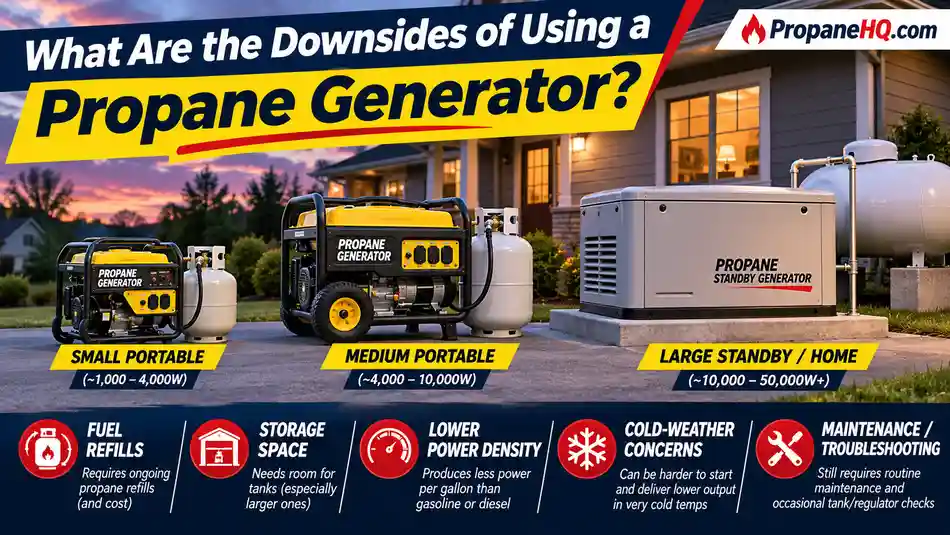
What are the downsides of using a propane generator? The biggest are reduced wattage on many dual-fuel portable models, potentially expensive fuel, finite tank runtime, refill logistics, and a propane supply that may struggle to vaporize enough fuel in freezing weather. Permanent standby systems add significant installation, tank, and service expenses. Propane engines also produce noise, exhaust, and dangerous carbon monoxide; propane is not a maintenance-free or zero-emission fuel.
TL;DR — My buying verdict: For occasional backup, propane can be excellent because properly stored fuel does not deteriorate like stored gasoline. But I would size a dual-fuel unit using its propane running watts, not its gasoline label. I would calculate the gallons needed for the longest likely outage, account for refilling lead times, and ask a technician to check winter vapor capacity for large systems. The most serious portable drawback is managing cylinders and safe outdoor operation; the largest standby drawback is total installed and ongoing fuel cost. These weaknesses are manageable for some owners and decisive for others.
Propane Generator Disadvantages at a Glance
| # | Potential downside | Why it matters most | Practical response |
|---|---|---|---|
| 1 | Lower output on propane | Starting a compressor or pump | Shop by propane continuous/peak watts |
| 2 | Fuel operating cost | Long outages and daily use | Compare local $/kWh and reduce loads |
| 3 | Short cylinder runtime | RVs and small portable units | Plan the required number of cylinders |
| 4 | Emergency resupply | Storm-related delivery disruption | Arrange refills before severe weather |
| 5 | Cold-weather vaporization | High fuel demand on small/cold tanks | Professional winter fuel sizing |
| 6 | Storage footprint | Limited yards and campsites | Check placement and delivery access |
| 7 | High standby setup cost | House-wide backup projects | Compare complete itemized bids |
| 8 | Continuing maintenance | Every engine-driven generator | Follow the model’s service schedule |
| 9 | Noise | Campsites and neighborhoods | Compare measured dBA and load conditions |
| 10 | Carbon monoxide | Any combustion generator | Outdoor-only operation; CO alarms |
| 11 | Large initial tank fill | 250–1,000-gallon storage | Budget initial fuel separately |
| 12 | Fuel-system failure points | Hoses, regulators, piping | Inspections and qualified repairs |
| 13 | Finite long-outage reserve | Multi-day whole-home operation | Calculate a reorder threshold |
| 14 | Combustion emissions | Air-quality and climate goals | Avoid unnecessary generator hours |
| 15 | Wrong fit for some jobs | High-load or daily applications | Evaluate diesel, NG, batteries and hybrids |
Significance is contextual: A 20-pound cylinder is an inconvenience for a weekend camper, but it can become an unacceptable resupply burden for someone depending on refrigeration and a medical device for a week.


The 15 Biggest Downsides of Propane Generators
1. Propane often delivers fewer watts than gasoline
Problem and impact. Many dual-fuel engine-generator sets are rated lower on propane because the engine develops less usable power under the manufacturer’s propane configuration. That matters most for air-conditioner compressors, well pumps and other loads with brief starting surges.
| Manufacturer model | Gasoline running / starting | Propane running / starting | Propane running reduction |
|---|---|---|---|
| Westinghouse WGen3600DFcv | 3,600 / 4,650 W | 3,240 / 4,180 W | 10.0% |
| Champion 201531 inverter | 3,250 / 4,500 W | 2,925 / 4,500 W | 10.0% |
| Westinghouse WGen9500DF | 9,500 / 12,500 W | 8,500 / 11,200 W | 10.5% |
My response: I would add up simultaneous running loads, test realistic motor-starting demand, then compare with the propane specifications and outlet voltage. An advertised 9,500W gasoline rating is not 9,500 propane running watts. Assessment: Important when your electrical load is close to the limit; largely manageable through correct sizing.
2. Propane can become expensive during long operation
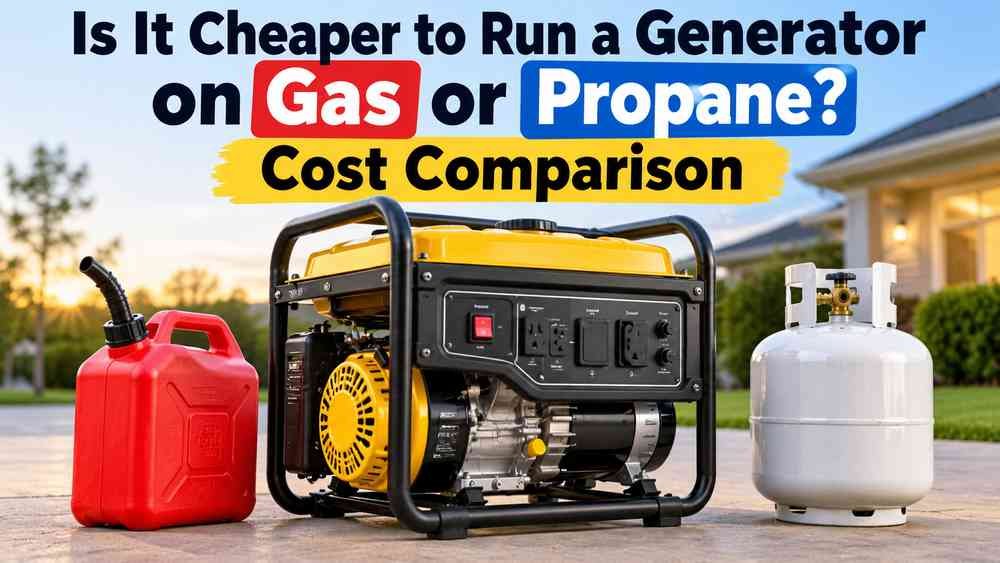
Problem and impact. Fuel cost depends on gallons consumed per hour, delivered propane price, and useful electrical output—not simply generator size. At an illustrative $3.25 per gallon, burning 0.9 gallon per hour costs $2.93 hourly or about $211 for 72 hours. A cheaper local gasoline or diesel supply can change the comparison dramatically.
My response: I would estimate monthly or outage-hour costs using actual model fuel curves and local refill, exchange or bulk delivery prices. Our guide to gasoline-versus-propane generator operating costs explores that tradeoff. Assessment: Minor for a few hours a year, potentially decisive for frequent, long-duration operation.


3. Small cylinders can run out surprisingly fast
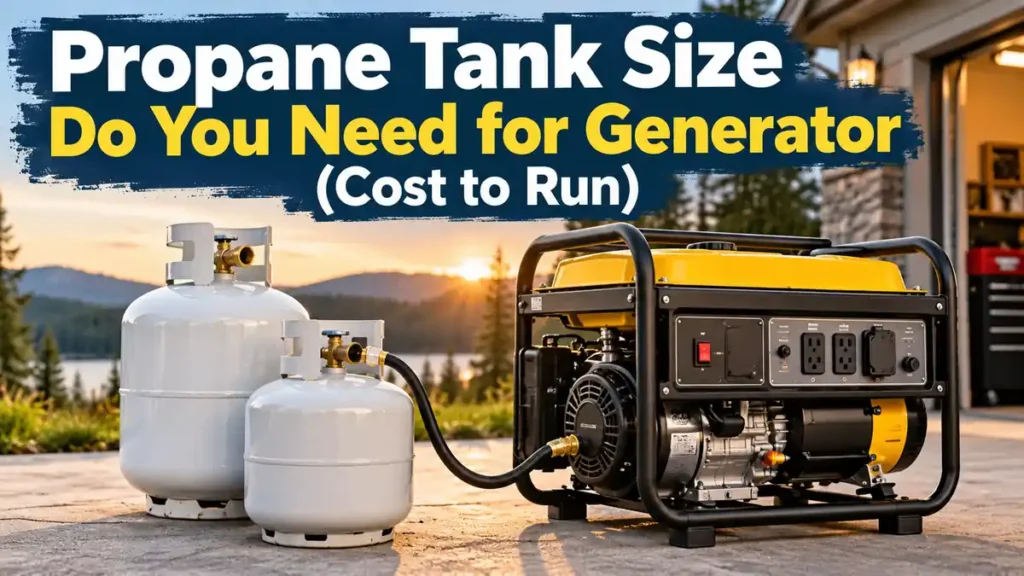
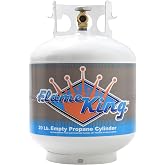
Problem and impact. A properly filled 20-pound cylinder holds roughly 4.7 gallons of propane, not 20 gallons. Cylinder exchanges sometimes deliver fewer pounds than a full refill. Here is pure arithmetic for illustrative fuel rates; real runtime varies by generator and load.
| Cylinder | Approx. full propane | At 0.4 gal/hour | At 0.8 gal/hour |
|---|---|---|---|
| 20 lb | 4.7 gal | 11.8 hours | 5.9 hours |
| 30 lb | 7.1 gal | 17.8 hours | 8.9 hours |
| 40 lb | 9.4 gal | 23.5 hours | 11.8 hours |
| 100 lb | 23.6 gal | 59.0 hours | 29.5 hours |
My response: I would plan a cylinder-swapping and transport strategy before a storm, and verify allowable cylinder connections and fuel demand. Assessment: A major limitation for overnight or multi-day portable use.
4. Propane may be difficult to obtain during emergencies
Problem and impact. A supply chain that works on an ordinary Tuesday may be disrupted by icy roads, flooding, power loss, staff shortages or a storm-related spike in demand. Cylinder exchange cages, refill stations, and home-delivery trucks are different supply channels; none is guaranteed during a disaster.
My response: I would start with a reasonable reserve, ask the supplier about minimum deliveries and emergency service, and schedule refills before warnings become severe. The detailed refill-frequency planning guide shows how I calculate a reorder point. Assessment: High where delivery access is unreliable; manageable with early planning and realistic outage expectations.
5. Cold weather can restrict usable propane vapor
Problem and impact. Propane must vaporize in the cylinder or stationary tank before most household generators can burn it. Very low temperature, declining liquid level and sustained fuel withdrawal can reduce the available vapor rate—even when the gauge says fuel remains. A small cylinder may struggle with a demanding engine that worked normally on a warm day.

My response: I would have a qualified propane professional assess the lowest expected temperature, tank surface area, liquid level, regulator, full-load BTU demand and piping. Never heat cylinders with a flame or modify regulators to force more fuel. Assessment: Potentially critical for winter standby service; less troublesome for low loads in mild climates.
6. Tanks consume space and require careful placement
Problem and impact. Portable cylinders need secure upright positioning and safe transport. Purchased or leased 250-, 500- and 1,000-gallon tanks require suitable siting, clearances, a delivery-truck route and inspection access. Underground tanks look less conspicuous but entail excavation and corrosion protection.
My response: Before ordering equipment, I would walk the site with the propane supplier and electrician. Ask which locations satisfy manufacturer instructions and applicable fire and zoning requirements—not just which location looks best. Assessment: Moderate for properties with room; significant for tight urban lots or difficult access.
7. Whole-house installations can cost much more than the generator
Problem and impact. A permanently installed standby system needs more than a generator enclosure: automatic transfer equipment, electrical wiring, a propane tank or lease, gas piping, suitable regulators, site work, permits and startup testing. Buying a unit advertised for $5,000 does not mean the finished system costs $5,000.


| Illustrative 20kW standby project component | Budget assumption |
|---|---|
| Generator | $5,000 |
| Automatic transfer switch | $900 |
| Purchased 500-gallon above-ground tank | $2,200 |
| Propane piping and regulators | $1,400 |
| Electrical labor | $2,300 |
| Pad, permits and miscellaneous site work | $1,100 |
| First fuel delivery (example) | $1,200 |
| Illustrative total | $14,100 |
My response: I would demand one itemized proposal that explicitly says what is included, to avoid double counting a bundled transfer switch or commissioning charge. See the complete generator-and-propane-tank installation cost guide. Assessment: A major upfront consideration, especially for buried tanks.
8. A propane generator still needs mechanical maintenance
Problem and impact. Cleaner fuel handling does not eliminate oil changes, engine wear, filters, spark plugs, starter batteries, cooling-air checks or exercise runs. A generator that sits for months without service may fail for reasons unrelated to the quality of its propane.
My response: I would record running hours, follow the exact manufacturer’s calendar/hour schedule, check the charging system where fitted and arrange professional inspection of standby systems. Our propane generator maintenance checklist gives the broader schedule. Assessment: Routine and manageable, but a serious reliability risk when neglected.
9. Propane power is not necessarily quiet
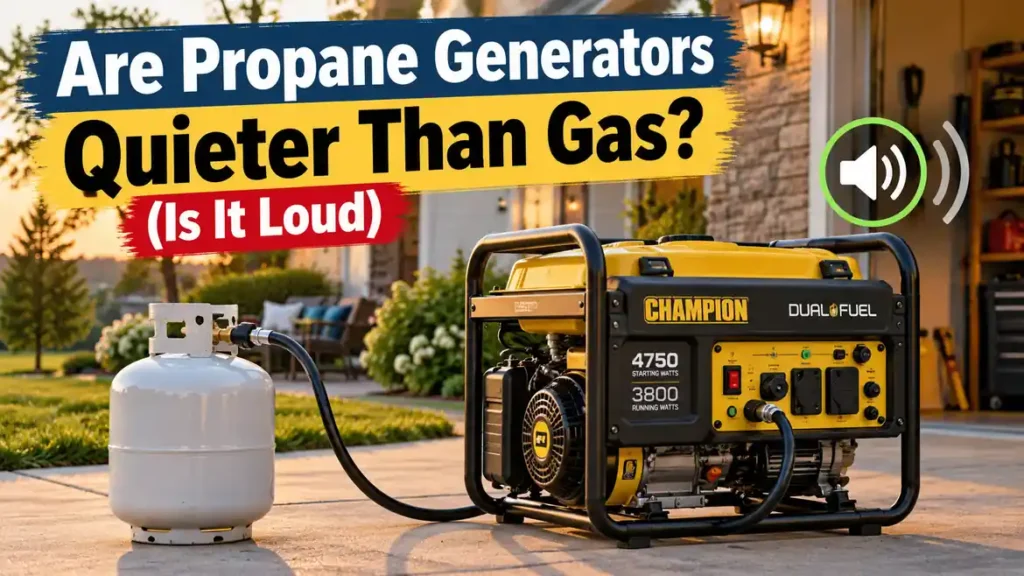
Problem and impact. Noise comes mainly from the engine, exhaust, cooling, enclosure and load—not just the fuel. Manufacturer examples include a Champion 201531 inverter listed at 64 dBA, a Westinghouse WGen3600DFcv at 68 dBA, and a larger WGen9500DF at 74 dBA. Published ratings may use different distances and operating conditions, so they are not a controlled side-by-side test.
My response: I would inspect each model’s measurement method, campground restrictions, and actual sound-reduction design. Compare our guide on whether propane generators are quieter than gasoline generators. Assessment: Minor at an isolated property, potentially a dealbreaker in a crowded campground.
10. Propane generators produce dangerous carbon monoxide
Problem and impact. Propane combustion produces CO in engine exhaust even when the fuel is burning normally. Portable units can be deadly inside a home, garage, basement, shed, tent or partially enclosed porch. CO shutdown equipment is an additional safeguard; it does not make indoor operation safe.
My response: I would operate portable generators outside only, at least 20 feet from buildings, point exhaust away from openings, follow manufacturer clearances, and keep working CO alarms indoors. Never connect through an improvised backfeed cord. Assessment: A non-negotiable life-safety requirement rather than an optional drawback.
11. Filling a large tank can require substantial cash
Problem and impact. Stationary tank sizes describe water capacity; they are normally filled to roughly 80% liquid propane for expansion allowance. If a 500-gallon tank receives 400 gallons at an assumed $3.25 per gallon, the initial fuel alone is $1,300, excluding delivery or rental fees.
| Nominal tank | Approximate 80% fill | Illustrative cost at $2.75/gal | At $3.25/gal | At $4.00/gal |
|---|---|---|---|---|
| 250 gal | 200 gal | $550 | $650 | $800 |
| 500 gal | 400 gal | $1,100 | $1,300 | $1,600 |
| 1,000 gal | 800 gal | $2,200 | $2,600 | $3,200 |
My response: I would separate the tank purchase, initial fill, ongoing deliveries and potential tank lease fees. These are full-fill examples, not typical top-up invoices. Assessment: Important upfront expense, especially at remote rural properties.
12. Extra fuel-system components add failure points
Problem and impact. A propane generator depends on approved hoses, connections, shutoff valves, regulators and—on large installations—correctly sized gas piping. Damage, leaks or inadequate vapor/pressure delivery can cause hard starting, stalling or failure under load. More components mean more compatibility checks.
My response: I would use manufacturer-approved equipment, inspect accessible components visually and stop operation if a leak is suspected. A qualified propane professional should handle tests and repairs; see propane generator leak warning signs. Assessment: Manageable with correct installation, serious if someone improvises fuel connections.
13. Even a big propane tank offers finite outage time
Problem and impact. Generac’s published 20kW Guardian consumption example is about 2.36 gal/hour at half load and 3.74 gal/hour at full load. At 2.36 gal/hour, 24 hours takes 56.6 gallons and 14 days takes about 793 gallons. Actual household load and model change those results.
| Continuous outage | At 2.36 gal/hr (20kW example, half load) | At 3.74 gal/hr (same unit, full load) |
|---|---|---|
| 24 hours | 56.6 gal | 89.8 gal |
| 3 days | 169.9 gal | 269.3 gal |
| 7 days | 396.5 gal | 628.3 gal |
| 14 days | 793.0 gal | 1,256.6 gal |
My response: I would plan deliveries before the gauge gets low. From an 80%-full 500-gallon tank to a 20%-of-capacity reorder point, only 300 gallons are available; that is about 5.3 days at 2.36 gal/hour, excluding other propane appliances. Assessment: Major for prolonged outages.
14. Propane is not a zero-emission energy source
Problem and impact. Propane is a fossil fuel that emits CO₂ and other combustion pollutants. The U.S. EIA lists approximately 12.68 lb CO₂ per gallon of propane, 18.73 lb per gallon of finished motor gasoline, and 22.45 lb per gallon of diesel fuel. A direct gallons-to-gallons comparison is misleading because each fuel contains different energy and generators have different efficiencies.
My response: I would compare emissions per delivered kWh, including the engine’s efficiency and operating load, and reduce unnecessary run time. Batteries have no tailpipe exhaust at the site, although their production and charging still have impacts. Assessment: Important for environmental priorities, not proof that one fuel is always worst.
15. Propane may be the wrong fuel for some operating schedules
Problem and impact. A contractor running high loads every day, a remote site with unreliable propane deliveries, and a household requiring central air conditioning for weeks may have different priorities from someone needing six hours of emergency backup. Tank movement, supplier access, engine duty cycle and operating cost can outweigh propane’s storage-life benefits.
My response: I would compare diesel for certain heavy-duty uses, natural gas where reliable service exists, and battery or solar-plus-storage for quiet low-load periods. No option is universally best. Assessment: Often decisive when equipment operates daily rather than occasionally.
Propane vs. Gasoline and Diesel: Where the Drawbacks Differ
| Buying factor | Propane generator | Gasoline generator | Diesel generator |
|---|---|---|---|
| Fuel storage | Stable in suitable pressure vessel; cylinder logistics | Gasoline ages; safe rotation/storage needed | Diesel also needs proper storage and fuel management |
| Rated portable output | Often lower on dual-fuel propane setting | Often higher on same dual-fuel model | Model dependent; frequent heavy-duty designs |
| Running cost | Depends on local delivered $/gal and consumption | Depends on pump price, load and efficiency | Depends on diesel price and engine efficiency |
| Cold-weather concern | Vaporization/pressure capacity | Starting and fuel-system issues | Cold starts and fuel gelling possible |
| Service | Engine maintenance plus propane system | Engine plus gasoline fuel-system care | Engine, fuel filters and diesel-specific maintenance |
| Noise | Enclosure and engine matter most | Enclosure and engine matter most | Often robust heavy-duty equipment, varies widely |
| Best-fitting use | Prepared emergency backup and fuel storage | Portable occasional power with access to gasoline | Certain prolonged high-load applications |
I would not choose a fuel from a single number. In a side-by-side comparison, use the same electrical load, hours, purchase and maintenance costs, local fuel prices and verified generator efficiency. On reliability, our separate guide asks how dependable propane generators really are; fuel choice is only one part of the answer.
Portable vs. Whole-House Propane Generator Disadvantages
| Portable propane generator | Permanently installed standby propane generator |
|---|---|
| Manual outdoor setup and shutdown | Automatically starts when correctly configured |
| Frequent cylinder swaps on small tanks | Large tank can still need costly deliveries |
| Smaller electrical capacity and outlet limitations | More circuits but high installation cost |
| Must protect against rain without trapping exhaust | Fixed approved outdoor siting and permits |
| Need properly rated cords or transfer equipment | Automatic transfer and professional electrical work |
| Can move between uses but requires safe transport | Not portable; service contracts and site upkeep |
For a ten-year ownership illustration, suppose a standby system costs $15,000 installed, scheduled servicing averages $300 annually, annual exercise fuel costs $50, and annual outages require 48 hours at 2.36 gal/hour with propane at $3.25/gal. That totals $15,000 + $3,000 + $500 + $3,682 = about $22,182 over 10 years before repairs, financing, tank lease fees or fuel-price changes. This is a planning scenario, not a forecast of what any individual home will pay.
Operating Cost: Three Typical Generator Classes
I use $3.25/gallon solely as an illustrative assumption. The first two fuel-use rates are hypothetical; the 20kW rate below is from Generac’s Guardian half-load data. A manufacturer’s nameplate wattage alone cannot determine gallons per hour.
| Generator class | Assumed electrical load | Fuel consumption | Cost/hour | 8 hours | 24 hours | 72 hours |
|---|---|---|---|---|---|---|
| 3,500W portable | 1.5kW | 0.40 gal/hr (illustrative) | $1.30 | $10.40 | $31.20 | $93.60 |
| 7,500W portable | 3.0kW | 0.90 gal/hr (illustrative) | $2.93 | $23.40 | $70.20 | $210.60 |
| 20kW Guardian | 10.0kW (50% load) | 2.36 gal/hr (published model rate) | $7.67 | $61.36 | $184.08 | $552.24 |
Formula: hourly fuel cost = gallons per hour × dollars per gallon. To compare electricity cost, divide hourly fuel cost by actual delivered kW: for the illustration above, $1.30 ÷ 1.5kW = about $0.87/kWh for the small portable example. It is not a utility-grid price and excludes generator purchase and maintenance.
Does Winter Make a Propane Generator Less Reliable?
A generator can stall with propane still in the tank. If the engine’s fuel demand exceeds the available vapor supply, pressure can sag under load. Temperature, tank contents, fuel composition, surface area, regulator and piping all affect the outcome.
| Observable symptom | One possible explanation | Next safe action |
|---|---|---|
| Runs lightly, stalls with large loads | Inadequate fuel flow or electrical overload | Reduce load safely; have fuel and electrical loads assessed |
| Tank frosting and poor operation | High withdrawal causing rapid cooling | Stop and consult supplier about vapor capacity |
| Starts poorly on freezing mornings | Battery, ignition or vapor-pressure problem | Follow manual; request qualified inspection |
| Unusual gas smell | Possible leak | Shut down if safe, leave area and call provider/emergency service |
I would not assume every cold-weather shutdown is caused by propane. Battery condition, oil viscosity, engine service and starting equipment matter too. See our winterization guide for routine preparation.
Which Downsides Are Dealbreakers for You?
| Your situation | Biggest limitation | My practical judgment |
|---|---|---|
| Occasional short outages | Upfront purchase versus infrequent use | Usually manageable with a small, properly rated portable unit |
| Rural home, frequent outages | Delivery access and weeks of fuel | Potentially serious; make a supplier-backed plan |
| Camper or RV owner | Noise, cylinder changes, weight | Manageable if campground rules and loads match |
| Contractor operating daily | Fuel logistics, continuous cost, duty cycle | Compare diesel and other worksite options closely |
| Very cold climate | Vaporization and starting dependability | Professional cold-weather design may be essential |
I would give the most weight to drawbacks that cannot be corrected later without replacing equipment: insufficient propane running watts, lack of suitable outlets, a site with no safe fuel arrangement, or an unrealistic long-outage fuel budget. Minor inconvenience—such as an annual oil change—should not dominate the purchase decision.
How I Would Reduce These Disadvantages
I use a practical twelve-point purchasing and ownership check:
- Size for propane running watts and motor-starting demand, not gasoline ratings.
- Decide which appliances must operate simultaneously.
- Calculate expected gallons for your realistic outage duration.
- Compare local refill, exchange and bulk delivery prices.
- Arrange sufficient reserve fuel before major weather events.
- Have winter vaporization and fuel-line capacity professionally assessed.
- Follow the engine’s calendar- and hour-based maintenance schedule.
- Turn off unnecessary loads to reduce fuel use where possible.
- Compare published noise data at equivalent operating conditions.
- Select a safe outdoor generator site and use approved electrical connections.
- Consider dual-fuel flexibility only if both fuels are accessible.
- Compare 10-year total ownership cost, not the purchase price alone.
An existing suitable tank can improve the economics. A new underground tank, major panel work or long trench can change the project completely. Natural gas service, where available, deserves its own reliability and cost comparison.
When a Propane Generator Is Still Worth Buying
I would still consider propane a strong option for occasional storm backup, recreational vehicles with compatible generator loads, and homes able to store sufficient fuel safely. Propane’s fuel-storage characteristics can eliminate the problem of stale gasoline waiting in an engine tank. A well-designed standby system can also start automatically during an outage, provided its battery, fuel supply and controls are maintained.
A quiet battery backup may be better for essential electronics and short outages; solar-plus-battery can help with longer low-load periods if weather and system size permit. For larger fuel-powered options, compare total cost, noise, duty-cycle rating and fuel logistics—not marketing labels. A written comparison of expected outage hours and total ownership cost makes that decision easier.
Are Propane Generators Less Reliable Than Gasoline or Diesel?
Not by fuel type alone. I would look first at engine design, manufacturer support, battery and starter health, service history, generator loading, fuel condition and the availability of a properly sized supply system. A propane unit with inadequate vapor pressure may stall; a neglected gasoline unit may suffer from deteriorated stored fuel; a diesel unit may experience cold-start or fuel-quality problems. These are different failure modes rather than proof of a universal ranking. For emergency backup, exercise and maintenance records matter more than marketing slogans.
Propane Generators vs. Other Backup Options
| Backup option | Upfront expense | Noise / exhaust at use site | Main operational limitation | Best fit |
|---|---|---|---|---|
| Portable propane | Low to moderate | Combustion noise and exhaust | Cylinders, setup, limited circuits | Occasional essentials and RVs |
| Portable gasoline | Low to moderate | Combustion noise and exhaust | Gasoline storage and refueling | Occasional portable power |
| Diesel generator | Often moderate to high | Combustion noise and exhaust | Fuel upkeep, service and heavy equipment | Selected sustained heavy loads |
| Natural gas standby | High installed | Outdoor combustion noise and exhaust | Dependence on piped gas service | Automatic backup with gas utility |
| Battery backup | Varies widely with capacity | Quiet, no local tailpipe emissions | Limited stored kWh without recharge | Short outages and sensitive loads |
| Solar + battery | High for larger backup systems | Quiet, no local tailpipe emissions | Solar weather and battery capacity | Recharging through extended outages |
The upfront costs above are qualitative classes, not price quotes. I’d also compare lifetime service, installation, usable kilowatt-hours, outage length and the consequences of a prolonged power loss.
Frequently Asked Questions
What is the biggest disadvantage of a propane generator?
For many portable dual-fuel owners, the most immediate downside is lower continuous power output on propane than gasoline. For standby owners, total installed cost and resupply planning can matter more. I would first identify which loads absolutely must keep running, then decide whether enough propane can be stored and delivered for the likely outage duration.
Are propane generators expensive to run?
They can be, particularly at high loads for days. A model consuming 0.9 gal/hour at an illustrative $3.25/gal costs about $2.93/hour before maintenance. Compare that with your local gasoline or diesel price and a specific competing generator’s consumption data; gallon prices alone do not make a fair comparison.
Do propane generators use more fuel than gasoline generators?
They may use a greater number of gallons for similar electrical energy because propane has fewer BTUs per gallon, but actual electrical fuel efficiency varies by engine. Compare gallons per hour at the same kilowatt load or, better, fuel cost per delivered kilowatt-hour. Never assume that two models with similar advertised wattage have identical efficiency.
Why do propane generators produce fewer watts?
In many dual-fuel designs the engine’s usable power differs between the gasoline and vapor-propane setups. The reduction is model specific, not a universal fixed percentage. For example, the Westinghouse WGen9500DF is rated at 9,500 running watts on gasoline and 8,500 on propane. Its propane number is the appropriate rating for propane-mode sizing.
Do propane generators work well in cold weather?
Yes, when the system is designed for the lowest expected temperature, but cold fuel may not vaporize rapidly enough to feed a generator under substantial load. Low tank level makes this worse. A qualified propane supplier should evaluate tank capacity, regulator and piping before winter; do not try to warm tanks with unapproved heaters.
How long does a 20-pound propane tank last on a generator?
At the illustrative rate of 0.4 gal/hour, a properly filled 4.7-gallon cylinder lasts about 11.8 hours. At 0.8 gal/hour it lasts about 5.9 hours. Real results depend on load, engine efficiency, operating conditions and whether the cylinder was filled to its rated weight.
Are propane generators more expensive to maintain?
Not necessarily. Propane avoids some gasoline-staleness issues, but it does not remove oil, spark plug, air-filter, battery or mechanical service. Costs vary with generator design and required service interval. I would compare the actual maintenance schedule and warranty terms of the specific machines rather than making a blanket fuel-based assumption.
Are propane generators quieter than gasoline generators?
Not automatically. Much of a generator’s sound comes from the engine and enclosure; inverter design and operating load can matter more than fuel choice. Published dBA figures should be compared at the same measurement distance and load. If camping noise is a priority, choose equipment designed and rated for lower sound levels.
Can propane generators run continuously for several days?
Some manufacturer-approved generators can, with sufficient propane and required checks, but fuel reserves are finite and service limits still apply. A 20kW standby unit consuming 2.36 gal/hour needs about 170 gallons for three days at that operating rate. Confirm duty-cycle guidance, household load and refill access before relying on extended operation.
Are propane generators reliable during power outages?
They can be reliable when appropriately sized, maintained, tested and supplied with sufficient vapor and electrical starting power. A fuel supply system that is too small can undermine an otherwise sound engine. Reliability depends on installation, operating environment, maintenance and model quality—not just whether it uses propane.
Do propane generators produce carbon monoxide?
Yes. Combustion-engine propane generators release carbon monoxide that can be fatal. Never use a portable generator inside or in a garage, tent, basement or partially enclosed area. Operate it outdoors at least 20 feet from buildings with exhaust directed away from openings and maintain indoor CO alarms. CO shutoff sensors do not make indoor use safe.
Is propane better than gasoline for long-term storage?
Properly stored propane does not go stale the way gasoline can, which is useful for equipment that runs infrequently. However, cylinders, valves and stationary tanks still need safe inspection and storage. The advantage is fuel stability, not a guarantee of engine readiness; you still must maintain and periodically test the generator.
What problems are common with propane generators?
Possible problems include inadequate propane vapor delivery, incompatible or damaged hoses and regulators, hard starting, battery failure, ordinary engine maintenance issues and electrical overloads. The symptoms can look similar, so I would avoid guessing at pressure changes or bypassing safety features. If you smell gas, stop use and arrange professional attention.
What are the disadvantages of a whole-house propane generator?
The main issues are purchase and professional installation cost, bulk fuel storage, delivery scheduling, continuing service, and a finite fuel reserve during long outages. Heating and cooking appliances may share the same tank. I would ask the installer to size fuel piping for full demand and give me a written annual ownership-cost estimate.
Is a propane generator worth buying?
It often is for planned occasional backup when fuel can be stored safely and you do not need every heavy appliance operating simultaneously. It may be less attractive for daily high-load use with expensive deliveries, very cold weather and difficult refilling. I would decide from propane-rated wattage, actual loads, operating hours, local prices and the full installation bill.
Final Verdict: Should You Avoid Propane Generators?
No—not automatically. The downsides of using a propane generator are real, but their significance depends on your workload and fuel arrangement. I would use a smaller portable unit for carefully selected emergency loads or camping when cylinders and noise are manageable. I would consider a properly designed standby system for automatic home backup, with the tank and winter fuel supply sized professionally.
For daily worksite duty, compare heavy-duty diesel alternatives; for quiet short-duration backup, consider batteries; and for long outages, calculate the entire fuel plan before you buy. My final test is simple: Can this specific generator run your loads safely, for the required hours, at a cost and refill schedule you can accept? If yes, propane may still be an excellent choice despite its limitations.

Mike is an experienced propane technician with over 15 years of professional experience in the field. He has dedicated his career to helping customers with their propane needs, from installation to maintenance and repair. Together with Jeremy, he co-founded this website to provide useful information and guidance to customers seeking reliable propane services.