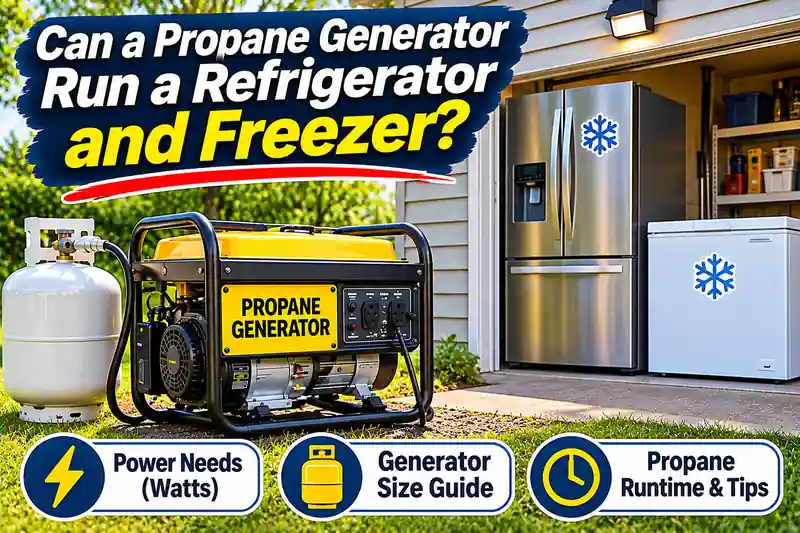
TL;DR: Can a propane generator run a refrigerator and freezer?
Yes. A properly sized propane generator can power a refrigerator and freezer during an outage. The important checks are the appliances’ running consumption, compressor starting surge, the generator’s propane-rated continuous and starting output, and safe electrical connection.
I would not buy a generator based only on the wattage printed on a refrigerator label. I would verify each appliance’s voltage and electrical requirements, account for the possibility that both compressors start close together, and reserve some capacity for other essential loads.
Keep the generator outdoors, away from doors, windows, vents, and other openings. Never operate it in a garage, basement, shed, or enclosed porch. Use approved electrical connections or professionally installed transfer equipment for household circuits.


Why refrigerators and freezers are good candidates for backup power
Keeping food cold is one of the most practical reasons to own a backup generator. A refrigerator protects everyday groceries, while a separate freezer may hold a much larger quantity of meat, prepared meals, and other food that would be costly to replace.
Both appliances cycle on and off. They do not normally draw their maximum electrical power every minute, which means their average energy consumption may be modest. However, their compressors can draw substantially more current during startup.
I would plan for the worst realistic starting combination rather than assume both appliances always operate at their average energy-use rating. The goal is dependable cooling, not simply getting the generator to start once during a quick test.
Running watts versus starting watts
Running watts describe the power an appliance uses after its compressor is operating. Starting watts describe the temporary electrical demand as the compressor starts. The starting demand can be several times the running demand for some conventional compressor motors, although modern inverter-driven models behave differently.


Manufacturers may specify rated current, input power, locked-rotor current, or annual energy consumption. These numbers serve different purposes. Annual kilowatt-hours are useful for estimating energy use, but they do not directly tell you the generator’s required starting capacity.
I would check the appliance manual or nameplate and, where needed, have a qualified technician measure starting demand. Avoid treating a generic online wattage estimate as a precise specification for your model.
Typical refrigerator and freezer power requirements
Actual demand varies widely by appliance age, size, insulation, ambient temperature, compressor technology, and operating condition. The table below offers illustrative planning ranges, not guaranteed ratings.
An efficient modern refrigerator may draw relatively little power while its compressor runs, while an older or larger unit may use more. A freezer can also have a defrost heater or other components that change the load at certain times.
I would use these examples to frame the calculation, then replace them with the specifications for the appliances in your home.

| Appliance | Illustrative running watts | Illustrative starting watts |
|---|---|---|
| Modern refrigerator | 100–250 W | 500–1,200 W |
| Chest freezer | 100–250 W | 500–1,200 W |
| Older or larger refrigerator | 150–400 W | 700–1,800 W |
How to calculate the generator size for both appliances
Start by listing each appliance’s running power. Then identify the larger starting requirement and consider whether the second appliance could also start at the same time. A conservative design should account for plausible overlapping loads rather than assuming perfect sequencing.
For example, suppose your refrigerator uses 180 running watts and needs 900 watts briefly at startup, while your freezer uses 220 running watts and needs 1,100 watts briefly. Their combined running load is 400 watts. If the freezer starts while the refrigerator is already running, the illustrative instantaneous demand is 1,280 watts.
If both compressors start together, the demand could be higher. The appropriate generator rating also depends on how the manufacturer defines its peak output and how long that output is available. I would leave a practical margin for unexpected loads and changing conditions.
Example: refrigerator and freezer wattage calculation
The following worked example shows the difference between continuous load and a motor-starting event. These figures are hypothetical, so I would not use them to purchase a generator without checking the appliance labels.


Notice that the combined running load is much lower than the illustrative overlapping starting demand. This is why the generator’s starting performance matters even for appliances that appear energy-efficient.
| Load event | Example demand | Calculation |
|---|---|---|
| Both running | 400 W | 180 + 220 |
| Refrigerator starts, freezer runs | 1,120 W | 900 + 220 |
| Freezer starts, refrigerator runs | 1,280 W | 1,100 + 180 |
| Both start simultaneously | Up to 2,000 W in this example | 900 + 1,100 |
Is a 2,000-watt propane generator enough?
A 2,000-watt-class generator may run a compatible refrigerator and freezer, but it is not a universal guarantee. First check whether the model’s rating is stated for propane. Some dual-fuel generators produce less power on propane than on gasoline.
Next, confirm the appliances’ compressor starting requirements and the generator’s continuous output. A small inverter generator may handle a pair of efficient appliances well, while a combination of older compressors, defrost loads, and additional equipment could overload it.
I would also consider what else needs power: a modem, lights, a medical device, or a furnace blower. The available capacity shrinks as more appliances are added.
Would a 3,500-watt or 5,000-watt generator be better?
A larger generator can provide more headroom for compressor starting and additional essential circuits. However, bigger is not always better. Larger engines may consume more fuel at light loads, cost more, weigh more, and produce more noise.
I would compare the total expected running load, the worst plausible starting event, the propane-specific ratings, and the generator’s fuel-consumption curve. A correctly sized smaller generator may be more practical for refrigeration-only backup.
If you want to power a well pump, furnace blower, or air conditioner at the same time, those loads can change the calculation dramatically. See can a propane generator power a well pump? for the motor-starting issues associated with private water systems.
Does a dual-fuel generator produce fewer watts on propane?
Many dual-fuel portable generators carry separate gasoline and propane power ratings. Propane output is often lower, although the exact difference depends on the model and engine design.
If a generator advertises 2,200 starting watts on gasoline and 1,980 on propane, I would use the propane number when assessing refrigerator and freezer startup. Those values are illustrative and are not specifications for any particular generator.
I would also look at the continuous rating, since a high starting-watt number alone does not tell you how much power the generator can supply for hours at a time.
Can an inverter propane generator run a refrigerator and freezer?
Yes, if it provides the required voltage, continuous power, and motor-starting capability. Inverter generators can be appealing for refrigeration because many models offer relatively stable electrical output and variable engine speed.
However, the word inverter does not guarantee that a specific model can start both compressors. Check the manufacturer’s actual ratings and test the completed system under safe, realistic conditions.
For a deeper discussion of electronics and output quality, see inverter propane generators for sensitive electronics.
How long will a propane generator run a refrigerator and freezer?
Runtime depends on the generator’s fuel consumption, the amount of usable propane, the other electrical loads, and how many hours you operate the engine. A refrigerator and freezer cycle on and off, but the generator still consumes fuel while its engine is running.
A 20-pound propane cylinder typically holds about 4.7 gallons when properly filled. If a generator averages 0.35 gallon per hour under the relevant load, the theoretical fuel-only runtime is about 13.4 hours. At 0.6 gallon per hour, it is about 7.8 hours.
These are illustrative calculations, not promises. Real runtime can be lower due to operating conditions and fuel-delivery limitations. I would check the generator manufacturer’s fuel-consumption data at the expected load.
Propane tank size and illustrative runtime table
Stored fuel is only part of the planning equation. In cold weather, a small cylinder may be unable to vaporize propane fast enough for a generator at high demand even when liquid propane remains.
I would choose a cylinder or stationary tank using both fuel quantity and the generator’s maximum vapor demand. A properly designed stationary supply may be more practical for prolonged outages than repeatedly changing small cylinders.
For related information, see calculating propane vaporization capacity and automatic propane tank changeover with a generator.
| Average fuel use | 20-lb cylinder (4.7 gal) | Calculation |
|---|---|---|
| 0.35 gal/hr | 13.4 hours | 4.7 ÷ 0.35 |
| 0.45 gal/hr | 10.4 hours | 4.7 ÷ 0.45 |
| 0.60 gal/hr | 7.8 hours | 4.7 ÷ 0.60 |
How much does it cost to keep a refrigerator and freezer running?
The fuel cost is calculated by multiplying gallons used by your local propane price. I would separate fuel cost from the generator’s purchase price, maintenance, and any electrical installation expenses.
For example, at an illustrative propane price of $3.00 per gallon, a generator consuming 0.4 gallon per hour costs about $1.20 in fuel per operating hour. Twelve hours would cost about $14.40, and 24 hours would cost about $28.80.
Your actual cost depends on the price you pay and how efficiently the generator operates at the loads involved. I would use the manufacturer’s fuel-consumption chart rather than assuming a single universal gallons-per-hour figure.
| Container | Approximate usable gallons | Runtime at 0.4 gal/hr |
|---|---|---|
| 20-lb cylinder | 4.7 | 11.8 hours |
| 40-lb cylinder | 9.4 | 23.5 hours |
| 100-lb cylinder | 23.5 | 58.8 hours |
| 250-gallon stationary tank (80% fill) | 200 | 500 hours |
Should you run the generator continuously?
Not necessarily. Some households use a generator intermittently to cool appliances and recharge other equipment, while others run it continuously to serve additional essential loads. The safe and effective schedule depends on appliance temperature, ambient conditions, food safety, and generator instructions.
I would not promise that running a refrigerator for a short fixed interval every few hours will keep food safe. Different refrigerators, freezers, door-opening patterns, and room temperatures produce different results.
Use appliance thermometers and follow established food-safety guidance. A refrigerator should generally be kept at or below 40°F (4°C), and a freezer at 0°F (-18°C) for normal storage. During an outage, the temperatures of the food and appliances matter more than the clock alone.
| Operating period | Fuel at 0.4 gal/hr | Fuel cost at $3/gal |
|---|---|---|
| 8 hours | 3.2 gal | $9.60 |
| 12 hours | 4.8 gal | $14.40 |
| 24 hours | 9.6 gal | $28.80 |
| 48 hours | 19.2 gal | $57.60 |
How long can food stay cold without electricity?
According to common U.S. food-safety guidance, an unopened refrigerator can keep food cold for about four hours. A full freezer may maintain a safe temperature for about 48 hours if the door stays closed, while a half-full freezer may last about 24 hours.
These are approximate outage-planning guidelines, not guarantees. The actual result depends on insulation, ambient temperature, initial food temperature, and how often the doors are opened.
I would keep both doors closed as much as possible and use thermometers. If perishable refrigerated food has been above 40°F for more than two hours, it generally should be discarded. Never rely on smell or taste to judge safety.
| Food storage | Typical temperature target | Outage consideration |
|---|---|---|
| Refrigerator | 40°F / 4°C or colder | About 4 hours unopened without power |
| Freezer | 0°F / −18°C for normal storage | About 48 hours full, 24 hours half-full if unopened |
How to connect both appliances safely
For plug-in appliances, use generator receptacles and extension cords only as allowed by the generator and appliance manufacturers. Cords must be appropriately rated, in good condition, and suitable for the location and expected current.
If you want to power the existing kitchen and freezer circuits through household wiring, have a qualified electrician install an approved transfer switch or other code-compliant transfer arrangement. Never backfeed a dryer outlet or use a double-male cord.
Keep the generator outdoors, away from openings, and follow the manufacturer’s placement instructions. Portable generators produce deadly carbon monoxide even when their exhaust seems to disperse.
Can you use a power strip for a refrigerator and freezer?
I would not assume that a household power strip is suitable for two compressor appliances. Many power strips and surge protectors are not intended for high-inrush motor loads or outdoor generator connections.
Instead, I would follow the generator’s outlet instructions and each appliance manufacturer’s recommendations. If an extension cord is permitted, it should be properly rated for the appliance and length.
Do not daisy-chain extension cords or use damaged plugs and adapters. If the connection requires improvisation, stop and have an electrician design a safer setup.
What if both compressors start at the same time?
Simultaneous compressor starting can create a brief demand well above normal running power. If the generator is marginally sized, voltage may sag, the engine may slow, or an overload device may trip.
Some modern appliances use variable-speed compressors with different startup behavior, but that does not eliminate the need to check compatibility. Defrost heaters and other components may also operate at unexpected times.
I would have enough starting capacity for realistic overlapping loads or use an approved load-management approach. Do not bypass appliance safety controls to prevent simultaneous starts.
Why a refrigerator may not restart immediately after an outage
Some refrigerators have a built-in compressor restart delay. This protects the compressor against restarting immediately while refrigerant pressures are still equalizing.
If the appliance does not restart the moment generator power becomes available, that may be normal. I would consult the appliance manual and observe whether the compressor starts after the expected delay.
Repeated clicking, breaker trips, unusual buzzing, or failure to cool warrants professional attention. Do not repeatedly unplug and replug the appliance in an attempt to force a restart.
Cold weather and propane vaporization
During a winter outage, the propane cylinder can become a limiting factor. Liquid propane needs heat to turn into vapor, and the available vaporization rate generally falls as the temperature drops or the cylinder empties.
If the generator surges or stalls under load in cold weather, insufficient fuel delivery is one possible cause, but it is not the only cause. Electrical overload, regulator mismatch, or engine faults can produce similar symptoms.
I would have a propane professional assess the supply rather than heat the cylinder with a flame, torch, or improvised heater. Read what happens when propane pressure is too high for a generator for more on why regulator compatibility matters.
What to do if the generator overloads
If the generator overload indicator illuminates or a breaker trips, I would shut down or disconnect loads as instructed by the generator manual and identify the cause before restarting.
Check whether the overload occurs when one compressor starts, when both attempt to start, or when an additional appliance switches on. That pattern can help an electrician determine whether the generator is undersized or another problem exists.
Never defeat overload protection or repeatedly reset a breaker without investigating the cause.
A practical refrigeration backup plan
I would start by recording the refrigerator and freezer models, their rated voltage, and the available electrical information. Next I would identify the generator’s propane-specific running and starting ratings and estimate fuel use for the likely outage duration.
I would decide whether I need only refrigeration or additional circuits, such as a well pump, furnace blower, or lights. Then I would have the connection arrangement checked for safety and compatibility.
Finally, I would keep appliance thermometers, a reasonable propane reserve, and a food-safety plan. A generator is useful only if it can run reliably and the food remains at safe temperatures.
| Symptom | Possible cause | Safe response |
|---|---|---|
| Overload when compressor starts | Starting demand too high | Reduce loads; verify sizing |
| Generator surges in cold weather | Fuel vaporization or engine issue | Professional inspection |
| Refrigerator delays restarting | Built-in compressor protection | Follow appliance manual |
| Breaker repeatedly trips | Overload or electrical fault | Stop resetting; diagnose |
Common mistakes to avoid
The first mistake is sizing a generator from average refrigerator energy consumption alone. Annual kilowatt-hours do not tell you the compressor’s starting demand.
The second mistake is using gasoline wattage ratings when you intend to run on propane. The third is assuming that a large propane cylinder fixes an undersized generator. Fuel storage and electrical output are different constraints.
The most dangerous mistake is running a generator indoors or backfeeding home wiring. I would never trade electrical or carbon monoxide safety for convenience.
Frequently asked questions
Can a 1,000-watt propane generator run a refrigerator and freezer? Possibly for some very efficient models, but starting surge may exceed its capability. Verify the actual appliance and generator ratings.
Is a 2,000-watt propane generator enough? Often it may be, but not always. Check both compressor starting requirements and propane-specific output.
Can I run two refrigerators instead? Yes, if their combined running and starting requirements fit the generator.
Does a chest freezer use more power than an upright freezer? Consumption depends on model, size, age, and efficiency; compare the actual energy labels.
Will a refrigerator damage an inverter generator? A compatible refrigerator should not, but excessive starting load can trip protection or cause unstable operation.
Can I plug both appliances into one extension cord? Only if the connection is permitted and appropriately rated; avoid improvised shared connections.
Will the generator consume fuel when compressors are off? Yes, while its engine is running.
Can I use a 20-pound propane cylinder? Sometimes, if approved for the generator and capable of adequate vapor delivery.
How long will frozen food last without power? A full unopened freezer may maintain safe temperatures for roughly 48 hours; check food temperature and safety guidance.
Can I put the generator in an open garage? No. Operate portable generators outdoors away from openings.
Final recommendation
A propane generator can be an effective way to protect a refrigerator and freezer during a power outage. I would choose the generator based on the appliances’ actual voltage, running power, and starting demands, using the generator’s propane-specific ratings.
I would also plan fuel for the duration of the outage, keep thermometers inside both appliances, and use only approved electrical connections. Reliable refrigeration backup is about safe installation and realistic load planning—not simply buying the biggest generator available.

Mike is an experienced propane technician with over 15 years of professional experience in the field. He has dedicated his career to helping customers with their propane needs, from installation to maintenance and repair. Together with Jeremy, he co-founded this website to provide useful information and guidance to customers seeking reliable propane services.