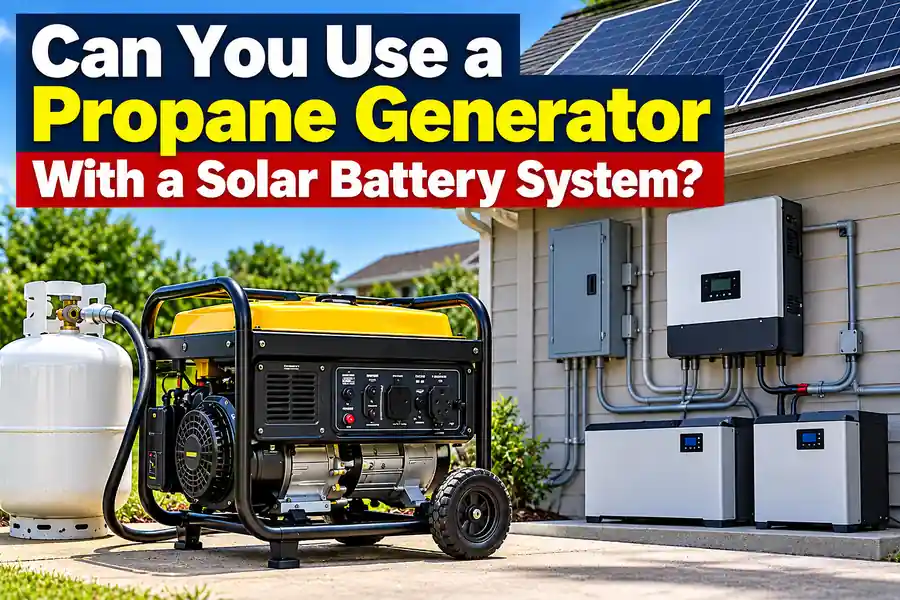
TL;DR: Yes, a propane generator can work with a solar battery system when the inverter, charger, transfer equipment and generator are compatible. A generator may power selected loads and recharge the battery, but never connect it directly to solar panels, battery terminals or a household outlet. Size for running loads, charging demand and motor starting; use a qualified installer for permanent wiring.
I like the idea of using solar energy first, stored battery energy second, and propane as a reliable backup when the weather does not cooperate. But I also know that a hybrid power system only works well when each component is designed to cooperate. Here is how I would plan one for a US home.
How a propane generator and solar battery system work together
A solar battery stores electricity collected from solar panels or supplied by another approved charging source. A propane generator converts fuel into AC electricity. The two can complement one another, but they cannot simply be joined by plugging a generator into a solar panel connector or connecting two AC outputs together. I treat the battery inverter, generator input, transfer equipment, and electrical panel as one engineered system.


During sunny weather, solar panels may supply household loads and recharge the battery. At night, the battery can supply selected circuits. During several cloudy days, the propane generator can support loads and, if the equipment allows, recharge the battery. That is the practical advantage: the generator runs when it is needed rather than continuously.
Whether this arrangement is possible depends on the exact inverter and battery models, firmware, approved wiring diagrams, generator waveform and frequency, and the home’s electrical design. Some systems accept a generator directly; others require a separate transfer switch, dedicated charger, or manufacturer-approved integration kit.
Three common hybrid configurations
| Configuration | How it works | Important limitation |
|---|---|---|
| Generator-capable hybrid inverter | Approved generator AC input powers loads and may charge batteries | Generator compatibility and input settings must be verified |
| Generator plus transfer switch | Switch selects generator or inverter supply for designated circuits | Battery charging may require separate equipment |
| Generator with approved AC battery charger | Generator powers a compatible charger connected to the battery system | Battery chemistry, charge profile and interlocks matter |
My first question is not “How many watts is the generator?” It is “Where does the manufacturer permit generator power to enter this system?” That answer determines the wiring architecture and prevents expensive mistakes.


Some battery products marketed as portable power stations allow AC charging from a generator using the manufacturer’s normal charging cord. That is different from integrating a permanently installed battery inverter with household wiring. Follow the specific product instructions rather than applying portable-power-station advice to a whole-house system.
Can the propane generator charge the solar batteries?
Yes, if the battery system supports an approved generator charging path. The generator usually provides AC electricity, while the battery requires controlled DC charging. An inverter-charger or compatible charger performs the conversion and manages battery voltage, current and charge stages. You should never attach a generator’s AC output directly to battery terminals.
Check the inverter-charger’s allowable AC input voltage, frequency, generator input capacity, maximum charging current and any requirements for neutral-ground bonding. Generator power quality matters too: some inverter-chargers reject unstable voltage or frequency, especially when a conventional generator experiences abrupt load changes.
I recommend starting with a conservative charging limit. A generator must handle the charging demand plus any household loads served simultaneously. Many inverter-chargers offer settings that reduce battery charging when other appliances switch on. These settings are useful, but they are not a substitute for correct sizing and professional commissioning.

How big a propane generator do you need?
Sizing begins with the actual simultaneous loads, not the number of solar panels. Add the running watts of appliances you intend to operate while the generator is on, then add the intended battery charging power and allowance for motor starting. Use manufacturer specifications for actual surge demands.
| Example load | Illustrative running demand |
|---|---|
| Refrigerator | 150 W |
| Freezer | 120 W |
| Lights, router and electronics | 230 W |
| Well pump while running | 900 W |
| Battery charging input | 2,000 W |
| Total simultaneous running load | 3,400 W |
In this illustration, 3,400 watts is the steady-state demand. The pump may require substantially more power at startup. A generator with 3,500 running watts could be inadequate even though its rating exceeds the calculated running total. I would verify the pump’s starting requirement and the generator’s propane-rated continuous and surge outputs before choosing a model.
Manufacturers often advertise a higher gasoline rating than propane rating for dual-fuel generators. Size using the propane rating, at your expected elevation and temperature. Also check whether the generator supplies 120 V only or the 120/240 V split-phase output your inverter and panel require.


Sizing battery charging without overloading the generator
Battery capacity is expressed in kilowatt-hours (kWh), while charger power is expressed in kilowatts (kW). If a battery needs 6 kWh replenished and the charging system delivers 2 kW to the battery, the ideal charging time is three hours. Actual time is longer because conversion losses, charge tapering and simultaneous loads reduce net charging.
| Energy to replenish | Net charge rate | Ideal time |
|---|---|---|
| 3 kWh | 1 kW | 3 hours |
| 6 kWh | 2 kW | 3 hours |
| 10 kWh | 2 kW | 5 hours |
| 12 kWh | 3 kW | 4 hours |
These are arithmetic examples, not promises of charging speed. A battery management system may reduce charging power at high or low temperatures or near full charge. The inverter-charger may also impose lower limits than the battery itself.
I prefer to compare three figures before changing settings: the generator’s continuous propane output, the inverter’s permitted AC input current, and the battery’s allowed charging rate. The lowest applicable limit governs the setup.
How long will the propane generator need to run?
A useful hybrid strategy is to run the generator during periods of higher demand, recharge the battery at the same time, and let the battery handle quiet overnight loads. This can reduce unnecessary generator operating hours, but actual fuel savings depend on the generator’s efficiency curve and the system’s conversion losses.
Consider a battery that needs 8 kWh and a system delivering an average 2 kW net charging power. The ideal recharge duration is four hours. If household loads increase and net charging falls to 1 kW, the time doubles. You can see why an accurate energy budget matters more than a generic “hours per tank” claim.
Generator exercise schedules, battery state-of-charge thresholds, and automatic start features are system-specific. Do not assume every solar inverter can automatically start a portable generator. Automatic starting requires compatible controls and safe transfer arrangements.
Propane fuel consumption and runtime examples
Propane consumption varies with generator model, output and operating conditions. For planning, I use a transparent illustration rather than claiming a universal gallons-per-hour figure.
| Illustrative fuel rate | 4 hours | 8 hours | 24 hours |
|---|---|---|---|
| 0.5 gal/hour | 2 gal | 4 gal | 12 gal |
| 0.8 gal/hour | 3.2 gal | 6.4 gal | 19.2 gal |
| 1.2 gal/hour | 4.8 gal | 9.6 gal | 28.8 gal |
Multiply the generator’s published propane fuel rate at the relevant load by planned operating hours. A nominal 20-pound propane cylinder holds approximately 4.7 gallons when properly filled, but the full amount may not be usable under all conditions. Cold-weather vaporization and cylinder size can limit the rate at which propane reaches the generator.
If you plan to use a larger stationary tank, work with your propane supplier to confirm regulator sizing, pipe capacity and vaporization under the coldest expected conditions. I discuss those limitations in How to Calculate Propane Vaporization Capacity for a Generator and Can a Propane Generator Share a Tank With a Furnace?.
Does the generator power the home or charge the battery first?
That depends on the inverter’s operating mode and configuration. Some inverter-chargers use generator power to serve loads while allocating spare capacity to battery charging. Others operate through a different priority scheme, and some cannot combine generator and battery output at all.
Before commissioning, ask the installer to demonstrate what happens when the generator starts, when the battery is low, when the refrigerator compressor starts, and when the generator stops. These transitions reveal whether the system truly works as intended.
Do not assume a generator will automatically charge the battery just because its plug fits a socket. The permitted connection, input configuration and control logic must all match.
What happens during a grid outage?
In a properly designed backup installation, the battery inverter can supply an approved backup-loads panel when utility power fails. Solar may continue charging if the system supports islanded solar operation. When battery charge becomes low, a compatible generator may provide supplementary power through the approved equipment.
However, not all grid-tied solar systems operate during outages. Many standard grid-tied inverters shut down when the utility grid disappears. Adding a propane generator alone does not necessarily make that solar system usable during a blackout. You may need a battery-capable inverter, transfer equipment and approved controls.
Never backfeed a household outlet with a generator. A licensed electrician must ensure utility isolation and code-compliant transfer arrangements to protect lineworkers and occupants. For more on safe home backup planning, see Can a Propane Generator Run a Refrigerator and Freezer? and Can a Propane Generator Power a Well Pump?.
Common compatibility problems
| Symptom | Possible reason | Safe next step |
|---|---|---|
| Inverter rejects generator input | Voltage or frequency outside accepted range | Check approved specifications with installer |
| Generator trips when charging starts | Charging current plus loads exceed output | Have charging limits and load sequencing reviewed |
| Battery does not charge | Incorrect operating mode or unsupported input path | Consult inverter and battery documentation |
| Power drops during transfer | Transfer design or timing incompatibility | Request professional system testing |
| Generator starts and stalls | Fuel delivery, overload or mechanical issue | Stop use and arrange qualified inspection |
I would not bypass a generator input alarm, modify a neutral-ground connection by guesswork, or defeat a transfer interlock to make an incompatible system appear to work. Those changes can create shock, fire and equipment hazards.
Portable generator versus permanent standby generator
A portable propane generator can be a lower-cost supplemental charging source where the inverter manufacturer allows it. It typically needs manual placement, connection and starting, along with outdoor weather protection that does not obstruct cooling or exhaust. A permanent standby unit is often better suited to frequent or automatic backup operation, but it costs more to install and service.
| Factor | Portable propane generator | Permanent standby propane generator |
|---|---|---|
| Initial equipment cost | Often lower | Often higher |
| Automatic start | Only on compatible models and controls | Common, subject to integration |
| Fuel connection | Approved cylinders or suitable supply | Engineered stationary propane supply |
| Integration complexity | Varies significantly | Requires designed installation |
| Best use | Occasional supplemental backup | Frequent or extended outages |
The right choice depends on how many outages you experience, whether someone is available to operate the equipment, and whether your inverter supports generator-start signals. I would not pay for automatic-start features until the installer confirms end-to-end compatibility.
Solar battery plus propane generator versus generator alone
With a generator-only setup, the engine must run whenever connected loads require generator electricity. With a battery-backed hybrid setup, stored energy can carry small loads while the generator is off. Solar generation may replace some of that stored energy without fuel.
However, hybrid equipment has additional upfront costs, conversion losses, software settings and maintenance considerations. If outages are rare and short, a simple generator installation may be more economical. If you need quiet overnight operation or want to maximize solar use during long outages, a hybrid system can offer meaningful benefits.
I compare costs over several years rather than focusing on the purchase price alone. Include inverter and battery costs, generator maintenance, fuel storage, battery replacement expectations, electrical installation, permits and any service upgrades.
A practical cost comparison
Here is a simple way to estimate fuel cost for generator-assisted battery charging. Suppose the generator consumes 0.8 gallons per hour while the system runs and propane costs $3.00 per gallon. Four hours of operation uses 3.2 gallons and costs $9.60 in fuel. If the battery receives 6 kWh net over that period, the fuel-only charging cost is $1.60 per kWh.
| Input | Illustrative value |
|---|---|
| Generator fuel rate | 0.8 gal/hour |
| Generator run time | 4 hours |
| Propane price | $3.00/gallon |
| Fuel used | 3.2 gallons |
| Fuel expense | $9.60 |
| Net battery energy added | 6 kWh |
| Fuel-only cost per net kWh | $1.60 |
This is only an example. It excludes engine wear, maintenance, equipment purchase, and installation. Actual generator efficiency may differ dramatically. Solar energy collected during daylight can reduce generator charging needs, but it is not accurate to label generator charging “free” simply because the energy ends up in a solar battery.
Safety and installation checklist
| Check | Why it matters |
|---|---|
| Manufacturer-approved generator input | Prevents unsupported electrical connections |
| Correct transfer and utility isolation | Prevents dangerous backfeeding |
| Matching voltage, phase and frequency | Protects inverter and loads |
| Generator output and surge capacity | Prevents overloads |
| Battery charging limits | Protects battery and charger |
| Neutral-ground and grounding design | Supports safe fault protection |
| Approved propane supply and regulator | Provides adequate fuel safely |
| Outdoor generator location | Reduces deadly carbon monoxide exposure |
| Commissioned transfer and outage tests | Confirms real-world operation |
Run engine-driven generators outdoors, far from doors, windows, vents and occupied spaces, following the manufacturer’s specified clearances. Never operate one in a garage, shed or enclosed porch, even with the door open. Install and maintain carbon monoxide alarms inside the home.
Electrical connections and stationary propane piping should be designed and installed by appropriately licensed professionals under local requirements. For related propane safety concerns, see What Happens When Propane Pressure Is Too High for a Generator? and Can You Use an Automatic Propane Tank Changeover With a Generator?.
My recommended planning process
First, list the circuits you actually need during an outage. Second, determine how much energy your battery can deliver and how much usable solar production you can reasonably expect during poor weather. Third, obtain the exact inverter, battery and generator model numbers. Fourth, ask the manufacturer or installer to confirm the approved generator interface in writing.
Next, size generator output for both household loads and battery charging, including starting surges. Confirm propane storage and winter fuel delivery. Finally, have the electrician commission the system under realistic loads, including low-battery operation and a simulated grid outage.
My guiding principle is simple: build the system around the equipment’s documented capabilities rather than assuming any generator and any battery will work together. A smaller, correctly integrated generator can be more useful than a larger machine that the inverter refuses to accept.
Frequently asked questions
Can I connect a propane generator directly to solar panels?
No. Solar panels produce DC electricity and a conventional propane generator produces AC electricity. Use only a manufacturer-approved inverter, charger or transfer arrangement.
Can a propane generator charge a lithium solar battery?
Yes, when a compatible charging system manages the battery according to its specified voltage, current, temperature and battery-management requirements. Never connect the generator directly to the battery terminals.
Will my solar panels work when the power goes out?
Not necessarily. Standard grid-tied solar often shuts down during a utility outage. Backup-capable inverters and approved islanding equipment are needed for continued operation.
Is an inverter generator better for charging solar batteries?
An inverter generator may provide steadier electrical output that some chargers accept more readily, but compatibility depends on the exact generator and charger. Check manufacturer guidance rather than relying on the label alone.
Can a solar battery automatically start a propane generator?
Some systems support automatic generator-start controls with compatible generator models. Others require manual operation or an additional approved controller. Verify both sides of the integration.
Can the battery and generator supply loads at the same time?
Some hybrid inverters support coordinated operation or load assistance; others transfer between sources. Never parallel their outputs unless the equipment is explicitly designed and configured for it.
How much propane will I use to charge a battery?
It depends on generator fuel consumption, battery energy needed, charging efficiency and household loads. Multiply actual gallons per hour by run time, then divide fuel cost by net kWh charged for a useful comparison.
Do I need an electrician?
For a permanently wired home backup system, use a qualified electrician familiar with solar, batteries, generators and transfer equipment. The installer must follow applicable codes and manufacturer instructions.
The bottom line
Yes, you can use a propane generator with a solar battery system—but only through an approved, compatible electrical configuration. The best arrangement lets solar handle daytime energy, batteries handle quiet periods, and the propane generator provide dependable supplemental power when stored energy runs low.
I would prioritize compatibility, safe transfer switching, realistic load calculations and fuel planning before shopping for a larger generator. That approach gives you a backup system that behaves predictably when the grid is down.

Mike is an experienced propane technician with over 15 years of professional experience in the field. He has dedicated his career to helping customers with their propane needs, from installation to maintenance and repair. Together with Jeremy, he co-founded this website to provide useful information and guidance to customers seeking reliable propane services.