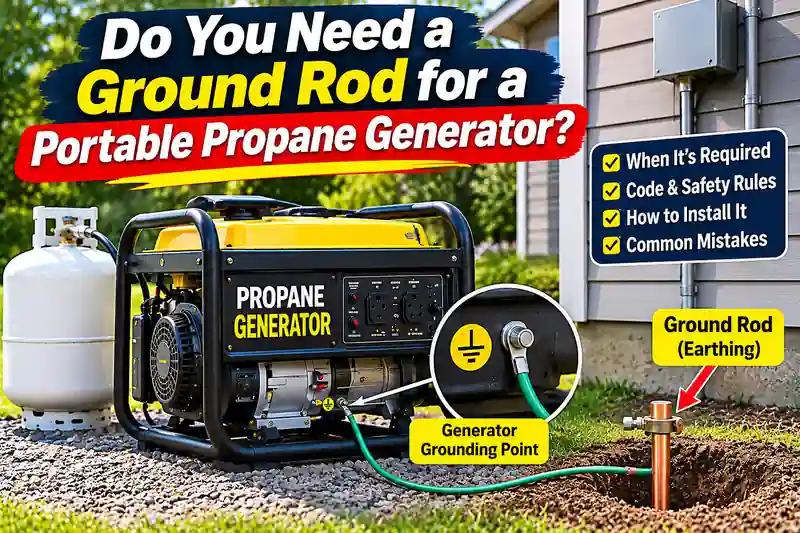
TL;DR: A portable propane generator does not always need a separate ground rod. When it powers cord-connected appliances from its own receptacles and meets applicable bonding conditions, its frame can serve as the grounding electrode. When connected to house wiring, transfer equipment or a solar battery inverter, grounding and bonding depend on the exact system. Never improvise a ground rod or neutral bond; follow the manufacturer and a qualified electrician.
If you have bought a portable propane generator, you may have seen conflicting advice about driving an eight-foot copper rod into the ground. I would not treat that as a universal instruction. Here is how I separate the cases that matter, the electrical terms people often confuse, and the questions I would ask before using a generator for home backup.
The short answer: a ground rod is not always required
I would not automatically drive a ground rod into the soil just because a generator runs on propane. The fuel type does not decide grounding requirements. The important questions are how the generator is connected, whether its neutral is bonded to the frame, what equipment it supplies, and whether it is connected to building wiring through transfer equipment.


When a portable generator supplies appliances only through its own factory-installed receptacles, and the equipment and bonding arrangement meet the applicable requirements, a separate earth electrode is often not necessary. When the generator supplies a building through a transfer switch or another approved connection, the grounding and bonding rules can be different.
A ground rod is not a substitute for an equipment grounding conductor, a correctly configured neutral, or proper overcurrent protection. I consider grounding and bonding part of a complete electrical system rather than a single accessory you can add as a universal fix.
Grounding versus bonding: why the distinction matters
| Term | What it means | Why it matters |
|---|---|---|
| Equipment grounding conductor | Conductive path connecting exposed metal equipment parts to the source’s grounding arrangement | Helps carry fault current so protective devices can operate |
| Bonding | Joining conductive parts to establish electrical continuity | Reduces hazardous voltage differences and creates a fault-current path |
| Neutral-to-frame bond | Connection between grounded circuit conductor and generator frame | Affects whether the generator is treated as a separately derived system |
| Grounding electrode | Rod or other approved electrode connecting an electrical system to earth | Serves purposes such as voltage stabilization and lightning-related grounding; does not replace fault-return conductors |
| GFCI | Device detecting an imbalance between outgoing and returning current | Can reduce shock risk but does not correct improper wiring |
These terms sound similar, but they are not interchangeable. I would be particularly cautious of advice claiming that driving a rod makes an ungrounded or incorrectly bonded generator safe. Earth has too much impedance to be relied on as the normal fault-clearing path.


When you generally do not need a separate ground rod
A common example is a portable propane generator outdoors supplying a refrigerator, work light, or battery charger using cords plugged into the generator’s own receptacles. Under the OSHA portable-generator exemption, the generator frame can serve as the grounding electrode in specified conditions: it supplies only equipment mounted on the generator or connected through generator-mounted receptacles, and the non-current-carrying metal parts and receptacle grounding terminals are bonded to the frame.
That exemption is described in OSHA’s construction electrical rules, and it is not a blanket rule for every home connection. The applicable NEC edition, equipment listing, manufacturer instructions, and local authority having jurisdiction also matter.
Before using a generator this way, I would inspect its instructions and receptacles, use properly rated cords, keep connections dry, and confirm that the connected equipment does not exceed the generator’s propane-rated capacity. I would not improvise a grounding electrode simply because the generator is sitting on rubber tires or plastic feet.

When connecting a generator to a house changes the answer
A generator connected to building wiring is a different situation from a generator powering appliances through its receptacles. A properly installed transfer switch or approved interlock must prevent utility backfeeding. The electrical designer must also establish how the neutral is switched and where the system bonding connection belongs.
If the transfer equipment switches the neutral, the generator may be a separately derived system, subject to the applicable grounding electrode and bonding requirements. If the neutral remains solidly connected to the service neutral, the generator generally is not separately derived, and a neutral-to-frame bond at the generator can create unwanted parallel neutral-current paths.
Do not decide this by looking only at whether the generator has a three-prong outlet. The transfer switch design, generator neutral configuration, grounding conductors and building grounding electrode system must all be evaluated together by a qualified electrician.


Floating-neutral versus bonded-neutral generators
| Generator neutral arrangement | General characteristic | Integration consideration |
|---|---|---|
| Floating neutral | Neutral is not bonded to the generator frame | May be appropriate for some transfer setups with a solidly connected service neutral, subject to equipment instructions |
| Bonded neutral | Neutral is connected to generator frame | Often relevant to separately derived arrangements or standalone equipment; may conflict with some nonswitched-neutral home connections |
| Unknown | Label or documentation is unclear | Do not guess; obtain manufacturer information and professional verification |
I do not recommend removing a factory bond, installing a homemade bonding plug, or modifying generator wiring based on an online diagram. Such changes may defeat GFCI protection, conflict with the product listing, or create shock hazards. The correct solution must match the exact generator and transfer equipment.
What OSHA says about portable generator grounding
OSHA’s construction rule at 29 CFR 1926.404(f)(3)(i) addresses when the frame of a portable generator can serve as the grounding electrode. The conditions include supplying only generator-mounted equipment or cord-and-plug equipment through generator-mounted receptacles and bonding exposed metal parts and receptacle grounding terminals to the frame.
OSHA also has provisions for vehicle-mounted generators. Those are separate from general household installation rules. I would not treat a construction-site exception as permission to connect a generator directly to a residential electrical panel without proper transfer and grounding design.
For workplaces, the employer’s applicable electrical safety requirements, generator manual and site conditions must be followed. A licensed electrical professional should evaluate unfamiliar configurations, particularly where temporary distribution panels or long cord runs are involved.
How the NEC affects a home backup installation
The National Electrical Code covers optional standby systems, grounding and bonding, separately derived systems, and transfer equipment. Relevant subjects include Article 250 for grounding and bonding, Article 445 for generators, and Article 702 for optional standby systems. The exact applicable text depends on the NEC edition adopted locally and any amendments.
For a home backup project, I would ask the installer to document whether the generator is separately derived, whether the neutral is switched, where the system bonding jumper is located, and how the grounding electrode system is connected. Those answers are more useful than a generic instruction to “install an eight-foot rod.”
Where a grounding electrode is required, its type, location, connection method and any supplemental electrode requirements must meet the adopted code. Installing an independent, unbonded rod can create dangerous potential differences rather than improving safety.
Can you just hammer a rod into the ground?
No, not as a general safety fix. A rod driven into soil does not automatically provide a low-impedance fault path back to the generator winding. Protective devices depend on a properly designed circuit, including bonding and equipment grounding conductors where required.
A random ground rod can also be damaged by underground utilities, installed at an improper depth, or connected with unsuitable hardware. If the system requires an electrode, the electrician should choose an approved electrode and connect it in accordance with local code.
I would especially avoid connecting a separate generator rod to an arbitrary metal pipe, fence, or gas line. Gas piping and other metal systems have specific bonding rules and must not be used as improvised grounding electrodes.
Typical portable-generator scenarios
| Use case | Separate ground rod? | What to verify |
|---|---|---|
| Refrigerator plugged into generator receptacle | Often not required under applicable portable-generator conditions | Factory grounding/bonding, cord rating, manual |
| Several appliances on approved extension cords | Often not required if applicable conditions are met | Receptacle grounding, cord condition, load limits |
| Generator feeding home via transfer equipment | Depends on system design and applicable code | Neutral switching, separately derived status, grounding electrode system |
| Generator feeding a temporary distribution system | Depends on configuration and rules | Electrical design, bonding, grounding and GFCI requirements |
| Generator charging a solar battery system | Depends on approved inverter/charger integration | Input bonding and grounding requirements, transfer arrangement |
These are decision aids, not installation instructions. If the generator is connected to premises wiring, I would have the entire system reviewed rather than deciding based on a chart alone.
Does propane change grounding requirements?
No. Propane changes fuel storage, fuel pressure, vaporization, combustion and ventilation considerations, but the electrical grounding decision is based on generator design and connection arrangement. A dual-fuel generator running on gasoline and the same unit running on propane generally have the same electrical grounding architecture.
That said, propane equipment brings additional safety duties. Use the manufacturer-approved regulator and hose, keep cylinders upright where required, and place the generator outdoors away from openings. If you are planning a stationary supply, my articles on propane pressure problems and propane vaporization capacity explain why fuel delivery needs its own careful design.
What about a portable generator with GFCI outlets?
GFCI receptacles are valuable shock-protection devices, but they do not replace correct grounding and bonding. Some generators use GFCI protection that may trip when connected to certain transfer-switch arrangements if neutral paths are configured incorrectly.
If a generator’s GFCI trips when you connect it to a house, I would stop and have the transfer setup inspected. Bypassing or disabling the GFCI is not an acceptable fix. The issue may involve a neutral-to-frame bond, a transfer switch that does not switch neutral, wiring faults, or connected equipment.
Always follow the generator’s instructions for GFCI testing and maintenance. Use weather-resistant equipment and protect cords from physical damage.
Generator grounding and solar battery systems
A propane generator can sometimes supply a solar battery inverter-charger, but the inverter’s generator-input rules may impose specific neutral and bonding requirements. Some inverters have internal transfer relays or bonding relays, while others depend on external switching equipment.
I would never assume a generator that works with a refrigerator can be connected the same way to a permanent battery inverter. Ask the inverter manufacturer and installer for an approved wiring diagram that covers the exact generator model, neutral configuration, transfer behavior and grounding system.
For a deeper look at this arrangement, see Can You Use a Propane Generator With a Solar Battery System?. The key is compatibility and proper utility isolation, not simply adding a ground rod.
Grounding checklist before using your generator
| Question | Safe next step |
|---|---|
| Does the manual describe the neutral as bonded or floating? | Check the exact model documentation |
| Are you powering only cord-connected appliances? | Verify applicable portable-generator conditions and cords |
| Are you connecting to house wiring? | Use an approved transfer system installed by a qualified electrician |
| Does the transfer switch disconnect the neutral? | Have the installer determine separately derived status |
| Are GFCI devices tripping? | Stop and diagnose the underlying electrical issue |
| Is a separate electrode required? | Follow the adopted code and approved installation design |
| Are the frame and outlets damaged? | Do not use until inspected or repaired |
My preferred sequence is simple: read the generator manual, identify the intended use, verify the transfer equipment if applicable, and ask a qualified professional to confirm the grounding and bonding arrangement. I would not start by purchasing a rod.
Five grounding mistakes I would avoid
1. Assuming every generator needs its own rod
Portable-generator rules allow certain cord-connected uses without a separate grounding electrode. Unnecessary modifications can create confusion or new hazards.
2. Treating soil as the fault-current return path
A rod does not replace the equipment grounding and bonding system required to clear faults.
3. Backfeeding through a dryer outlet
This can energize utility lines and expose occupants and workers to lethal shock. Use only approved transfer equipment.
4. Changing neutral bonds without a wiring plan
Bonding must match the system’s transfer design and the generator’s listing. Improvised changes can cause parallel neutral currents or defeat protective devices.
5. Ignoring carbon monoxide because the grounding is correct
Electrical safety is only one part of generator safety. Operate the generator outdoors, far from doors, windows and vents, with indoor CO alarms maintained according to their instructions.
How much does grounding a portable generator cost?
The cost depends on whether you need only a compliant cord-connected setup or a professionally designed home connection. I would avoid quoting a universal ground-rod installation price because labor, soil conditions, inspection, adopted codes, transfer equipment and existing service grounding all vary by location.
For a cord-connected portable generator, the right setup may require no separate electrode at all. For a house connection, the larger expenses are often the transfer equipment, wiring, inlet, permits and electrician labor. A ground rod by itself is rarely the most important budget item.
Before accepting an estimate, ask the contractor to identify the exact grounding and bonding work required and explain how it integrates with your existing grounding electrode system. That helps distinguish code-required work from an unnecessary add-on.
Frequently asked questions
Do I need to ground a propane generator if it is sitting on concrete?
Concrete placement alone does not determine whether a separate grounding electrode is required. The electrical configuration and applicable rules matter.
Can the generator frame serve as ground?
Under specified portable-generator conditions, the frame may serve as the grounding electrode. Confirm the equipment’s bonding and use arrangement against the applicable requirements.
Does a floating-neutral generator need a ground rod?
Not automatically. A floating neutral describes the neutral-to-frame relationship, not a universal electrode requirement. The connection arrangement determines the complete grounding and bonding design.
Can I ground the generator to a water pipe?
Do not improvise a connection to plumbing or other metalwork. Grounding and bonding connections must follow the applicable code and installation design.
Will a ground rod prevent electric shock?
A grounding electrode alone cannot guarantee shock protection. Proper bonding, equipment grounding conductors, protective devices and safe operating practices are essential.
Do I need a ground rod when powering a refrigerator?
Often not when using a generator-mounted receptacle under the applicable portable-generator conditions. Verify the manual, cords and equipment configuration.
What if my transfer switch causes the generator GFCI to trip?
Stop using that configuration and have an electrician check neutral switching, bonding and wiring. Do not bypass the GFCI.
Does a generator connected to solar batteries need a ground rod?
It depends on the inverter-charger and transfer design. Use the manufacturer’s approved wiring scheme and qualified installation.
My bottom line
You do not automatically need a ground rod for a portable propane generator. In many common cord-and-plug applications, the generator frame and factory bonding arrangement meet the applicable portable-generator conditions without a separate earth electrode. Connecting the generator to house wiring, a transfer switch, or a solar battery system changes the analysis.
I would focus on the generator’s neutral configuration, the approved transfer arrangement, equipment grounding conductors and applicable local rules. When in doubt, ask a qualified electrician to assess the complete system rather than installing a rod by guesswork.
For related backup-power planning, you may also find Can a Propane Generator Run a Refrigerator and Freezer? and Can a Propane Generator Power a Well Pump? helpful.

Mike is an experienced propane technician with over 15 years of professional experience in the field. He has dedicated his career to helping customers with their propane needs, from installation to maintenance and repair. Together with Jeremy, he co-founded this website to provide useful information and guidance to customers seeking reliable propane services.