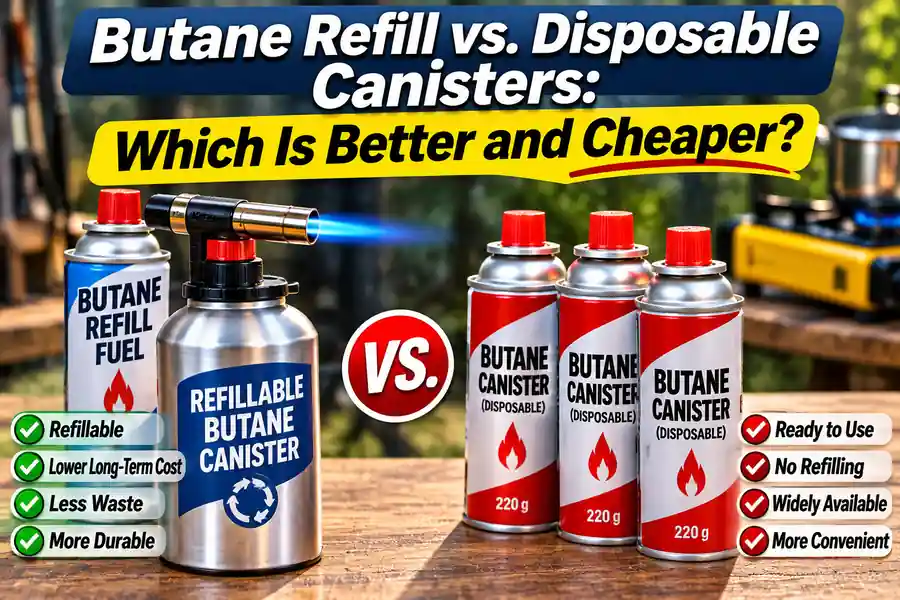
Butane Refill vs. Disposable Canisters: What Is the Difference?
I find that many buying guides confuse three different products: aerosol butane refill cans, single-use stove cartridges, and refillable butane appliances. That confusion can produce bad price comparisons and unsafe decisions. When I use the term ‘butane refill’ in this guide, I mean factory-filled butane sold to refill a compatible, purpose-built lighter, torch or gas soldering iron. I do not mean refilling the metal aerosol can itself.
A disposable butane canister is a factory-filled fuel container that connects to an appliance designed to consume its contents. Common examples include the slim approximately 220 g bayonet-style cassette stove cartridge and various threaded backpacking cartridges containing isobutane or a fuel blend. These cartridges are not designed for household refilling. Some look reusable because their valves open and close, but a self-sealing valve does not make a container refillable.
A small refillable torch, on the other hand, may have its own permanent fuel tank and a filling valve. You buy a suitable refill aerosol and transfer only the amount of gas allowed by the manufacturer’s instructions. Once empty, the refill aerosol itself is still a disposable pressurized container, unless its manufacturer explicitly specifies otherwise.


| Product | What is replenished? | Typical compatible appliance | Can the container itself be refilled? |
|---|---|---|---|
| Butane refill aerosol | A device’s built-in refillable reservoir | Refillable lighters, microtorches, gas soldering irons | No; the supply aerosol is single-use |
| 220 g cassette cartridge | No transfer; the appliance uses the cartridge directly | Approved cassette-style portable stoves | No; replace when empty |
| Threaded stove cartridge, often 110–450 g | No transfer; screw onto an approved stove | Compatible backpacking burners | No, unless specifically designed and marked for refill |
| Refillable butane torch tank | The appliance’s own fuel tank | Manufacturer-approved butane torch | Yes, within the device’s specified procedure |
| Purpose-built refillable fuel cylinder | Cylinder replenished under its specified system | Only matching equipment | Only if specifically certified for refill |
Which Option Is Cheaper? The Answer Depends on Your Appliance
My first rule is to compare like with like. If you own a butane soldering iron, a bottle-style refill is not really competing with a 220 g cassette cartridge: the soldering iron cannot ordinarily accept that stove cartridge. Similarly, a cassette stove normally cannot be fed safely by an aerosol lighter refill. The cheapest purchase that does not fit your tool has no practical value.
The proper comparison starts with four questions: what appliance do you own, what fuel formulation does its manufacturer approve, what container interface does it use, and how much fuel reaches the burner or reservoir? Only then is the price meaningful. A low sticker price can hide wasted gas, incompatible adapters, low-quality valves or inconvenient packaging.
Cost-per-gram formula
For identical compatible fuel products, I divide the actual purchase price by the labeled net fuel mass. Cost per gram = purchase price ÷ net fuel grams. To compare the total cost of a refillable appliance, I also account for fuel lost during transfer and the purchase price of the refillable tool itself.
| Illustrative purchase | Price | Net fuel mass | Price per gram | Price per 100 g |
|---|---|---|---|---|
| Small premium refill aerosol | $6.00 | 60 g | $0.100 | $10.00 |
| Medium refill aerosol | $8.00 | 100 g | $0.080 | $8.00 |
| Large refill aerosol | $12.00 | 200 g | $0.060 | $6.00 |
| Cassette-stove cartridge | $3.50 | 220 g | $0.0159 | $1.59 |
| Threaded backpacking fuel | $7.00 | 110 g | $0.0636 | $6.36 |
| Larger threaded backpacking fuel | $12.00 | 230 g | $0.0522 | $5.22 |
Every price in this table is a hypothetical U.S.-dollar teaching example, not a verified store quotation or a promise about current market prices. I deliberately included several sizes because the same label category can have different costs. A cassette canister may appear much cheaper by mass, but the result does not mean you should use it to fill a torch. Fuel formulation, connector, vapor-delivery design and manufacturer approval must come before price.


My usable-fuel calculation
When a refillable tool is charged from an aerosol, a little butane can be lost through incomplete transfer or a poor-fitting nozzle. I use a ‘usable-fuel’ estimate for budgeting—not as permission to tolerate a leaking valve. If a 100 g can costs $8 and I assume that 90 g reaches the tool across all fills, my estimated useful fuel cost is $8 ÷ 90 g = about 8.9 cents per gram. If the appliance consumes fuel directly from a cassette cartridge, transfer loss may be negligible, although some gas can remain when operation becomes weak.
The ten-percent loss here is an illustrative assumption, not a measured industry average. If gas visibly sprays or you hear sustained hissing, stop immediately and follow the manufacturer’s instructions. A poor seal is a safety problem, not merely a rounding error in a spreadsheet.
| Product and assumed use | Purchased grams | Assumed usable fraction | Usable grams | Illustrative effective cost/g |
|---|---|---|---|---|
| 100 g refill at $8 | 100 g | 90% | 90 g | $0.089 |
| 200 g refill at $12 | 200 g | 95% | 190 g | $0.063 |
| 220 g cassette at $3.50 | 220 g | 98% | 215.6 g | $0.016 |
| 110 g threaded at $7 | 110 g | 97% | 106.7 g | $0.066 |
Types of Butane Containers You Will Find in Stores
1. Small lighter and torch refill cans
These compact aerosols commonly come with a narrow nozzle or a kit of adapters. They are intended to charge a compatible refillable lighter, torch or soldering tool. I would look for a trustworthy brand, clear hazard markings, approved fuel composition and a nozzle that works without forcing the valve. The phrases ‘premium’, ‘five-times refined’ and ‘ultra-pure’ are not substitutes for the device manual.
For occasional lighter use, a modest refill can is usually the sensible purchase. I would not buy a bulk case solely to reduce cost per gram if I had no approved storage area and no realistic way to use it. Saving a few dollars at checkout can create unnecessary storage and disposal obligations.
2. Bayonet-style 220 g cassette stove canisters
These slim cartridges are often sold for portable tabletop stoves. Their neck or locking feature engages a compatible stove’s fuel compartment. The design allows the stove to consume gas directly through its intended connection. It does not make the cartridge a general-purpose reservoir that should be topped up after use.

I would choose these for occasional tabletop cooking only if the exact stove model supports the cartridge type and the environment is approved for using that stove. Use the cartridge orientation shown in the manual. Inserting an incorrect cartridge, warming it artificially or modifying the stove are not money-saving strategies.
3. Threaded isobutane and propane-blend backpacking canisters
Backpacking cartridges frequently contain isobutane blended with propane rather than plain normal butane. Their colder-weather performance can differ from ordinary butane, but so can their pressures and compatibility requirements. For example, commercially available camp-fuel blends include 80% isobutane and 20% propane. You cannot assume that fuel belongs in a cassette stove or refillable lighter.
The threaded connection and compact packaging may be convenient when you carry a matching backpacking stove. The per-gram price may be higher than large cassette cartridges. That premium sometimes buys a particular fuel blend, size, shape and compatibility, rather than a higher heat value that applies to every appliance.
4. Refillable device reservoirs
A refillable gas soldering iron or torch is a long-life appliance with an integrated tank and fill valve. It may operate repeatedly from one approved aerosol refill can. This is where refill purchases can be genuinely convenient, especially when the same device is used frequently. I would inspect the device’s stated operating time, gas-level window, valve condition and manufacturer support before choosing it.


Technical Comparison: Fuel Properties and Container Design
Butane is stored as a liquefied gas under pressure. When an appliance draws vapor, liquid fuel evaporates to replace it, cooling the container and lowering available pressure. Ambient temperature, fuel composition, consumption rate and cylinder orientation all affect performance. This matters far more than whether a package has a red or blue label.
| Technical factor | Ordinary n-butane | Isobutane | Practical buying consequence |
|---|---|---|---|
| Chemical formula | C4H10 | C4H10 | Same formula; different molecular structure |
| Atmospheric boiling point | About 31°F (−0.5°C) | About 11°F (−11.7°C) | Isobutane vaporizes more readily in cold conditions |
| Approximate energy per kg (LHV) | 45–46 MJ | 45–46 MJ | Similar mass-based energy; appliance efficiency matters |
| Cold-weather vapor delivery | Falls sharply near freezing | Often more resilient | Use only a manufacturer-approved fuel |
| Container fit | Varies by product | Varies by product | Connector and appliance approval determine compatibility |
Those are approximate physical-property values for the fuels, not guaranteed operating ranges or a safety certification for any particular package. A cartridge’s labeled net weight is the fuel mass, not the total weight of its steel shell, valve and contents. Never estimate safe filling capacity by assuming two similar-looking cans hold the same mass.
For general household comparisons I use grams because retail packages usually show net fuel weight. If you see a refill aerosol labeled in milliliters instead, do not compare that number directly with grams: liquid density depends on fuel composition and temperature. Read the net mass if supplied, or use reliable manufacturer information before calculating a price-per-gram figure.
Safety: Why Refilling a Disposable Canister Is Not an Acceptable Shortcut
This is the most important distinction in the entire article. Refillable appliances have fill systems intended for approved refilling. Single-use fuel cartridges are manufactured and labeled for one-time use. Their design, inspections and filling controls are not the same. An aftermarket transfer adapter does not transform a disposable canister into a certified refillable vessel.
I would never advocate transferring LPG from a large cylinder into a single-use butane cassette canister, nor topping up a threaded camping cartridge through an improvised connector. Overfilling, valve damage, inappropriate fuel mixtures and uncontrolled leaks can result in fire, rupture or injury. Manufacturer and regulatory warnings against refilling non-refillable gas containers are explicit.
A particularly dangerous confusion is between regular butane and household LPG. Household LPG may contain propane or mixtures with pressure behavior different from the fuel for which a small cartridge was designed. The fact that both burn does not make them interchangeable. If a canister says ‘Do Not Refill’, the safe action is to replace it through the intended supply chain.
| Container or device | Normal refilling status | What I recommend |
|---|---|---|
| Refillable butane lighter | Designed for approved refilling | Use specified fuel and fill procedure |
| Refillable butane microtorch | Designed for approved refilling | Use manufacturer-approved aerosol |
| Refillable butane soldering iron | Designed for approved refilling | Inspect valve and follow tool manual |
| Standard 220 g cassette cartridge | Non-refillable | Replace with new approved cartridge |
| Standard threaded backpacking fuel cartridge | Non-refillable unless clearly marked otherwise | Use until empty; dispose as directed |
| Damaged or corroded pressurized container | Do not refill or use | Keep away from ignition and seek safe disposal guidance |
Which Is Better for Portable Cooking?
For a portable stove built for standard cassette cartridges, I would buy quality factory-filled cartridges and treat them as consumables. I would not purchase lighter refill aerosols to try to fill the cartridges. The stove’s approval markings, fuel orientation and ventilation instructions decide the fuel system. A large 220 g cartridge is often economical per gram, which can make this configuration practical for occasional cooking.
A backpacking stove tells a different story. Its threaded fuel container may use a cold-weather blend and pack neatly with the burner. The best choice is the cartridge format the stove manufacturer specifies, and an amount appropriate to the trip. Packing smaller quantities can reduce carried bulk, but multiple small metal shells can create more packaging waste per unit of fuel.
If you cook for several hours a day, I would compare total appliance ownership costs rather than simply counting canisters. Consider burner output, thermal efficiency, cookware shape, wind shielding allowed by the manufacturer, fuel used per meal and the storage of spare cartridges. I would not run an unapproved portable stove in an enclosed room to save on household gas.
Which Is Better for Lighters, Torches and Soldering Tools?
Here, refilling the specifically designed reservoir makes sense. A good refillable torch or lighter can be charged repeatedly without purchasing a new tool each time. You still discard the empty refill aerosol, but a single supply can may service the smaller device many times. For a soldering iron, fuel quality and fill-valve fit are more important than a few cents saved by shopping for a different cartridge type.
I prefer to assess the lifespan of the complete system: how long the ignition works, whether replacement tips are available, whether its tank maintains a seal and how consistently it holds a flame or heated tip. A durable device with manufacturer-approved refills can be cheaper across years than repeatedly buying complete disposable gas-powered products. However, a poorly made refillable device with a leaking valve can erase that benefit quickly.
The same logic applies to workshop energy decisions. Our guide to portable propane generators for job sites explains another fuel-powered work setting, although generator cylinders and tiny butane tanks follow different equipment rules.
How Long Does a Butane Canister Last?
I estimate runtime by dividing fuel mass by the appliance’s actual consumption in grams per hour. Because burner settings and cooking conditions vary widely, any runtime without a stated consumption assumption is incomplete. A 220 g cartridge might last about 1.8 hours at 120 g/h, or about 3.7 hours at 60 g/h. Neither estimate promises that your particular stove will perform that way.
| Fuel mass | At 40 g/h | At 60 g/h | At 100 g/h | At 120 g/h |
|---|---|---|---|---|
| 60 g | 1.5 h | 1.0 h | 0.6 h | 0.5 h |
| 100 g | 2.5 h | 1.7 h | 1.0 h | 0.8 h |
| 220 g | 5.5 h | 3.7 h | 2.2 h | 1.8 h |
| 230 g | 5.8 h | 3.8 h | 2.3 h | 1.9 h |
| 450 g | 11.3 h | 7.5 h | 4.5 h | 3.8 h |
These are theoretical constant-rate calculations rounded to one decimal place. They ignore usable-fuel losses, changes in vapor pressure, intermittent cooking and any stove cutoff behavior. In real use, energy transferred to a pot also depends on wind, water volume, burner design and cookware. I would measure actual fuel consumption across a few normal cooking sessions if fuel budgeting matters.
A related way to budget fuel is covered in our guide to how often you need to refill a propane generator. The scale is entirely different, but both decisions improve when you know consumption under real loads instead of relying only on rated maximum output.
Monthly Cost Examples for Different Users
I like to convert unit price into a realistic month of use. Someone who needs just 30 g per month for a lighter has a very different purchase pattern from someone who burns 2 kg per month cooking with a tabletop stove. Comparing the two based on the total cost of one package would be misleading.
| Scenario | Fuel needed monthly | Illustrative compatible fuel cost | Estimated monthly fuel spending |
|---|---|---|---|
| Occasional refillable lighter | 30 g | $0.08/g | $2.40 |
| Frequent microtorch or soldering iron | 150 g | $0.08/g | $12.00 |
| Light cassette-stove cooking | 660 g (3 × 220 g) | $3.50 per 220 g | $10.50 |
| Frequent cassette-stove cooking | 1,980 g (9 × 220 g) | $3.50 per 220 g | $31.50 |
| Backpacking fuel use | 460 g (2 × 230 g) | $12 per 230 g | $24.00 |
All example prices and usage levels are illustrative, and they describe different appliances. They are not claims that one fuel delivery format can replace another. Before judging a deal, consider taxes, local hazardous-material shipping surcharges, transport to the store, quantities you must buy, and the probability that the purchase will sit unused.
Don’t confuse cheap fuel with cheap cooking
Fuel cost is only one part of household cooking expense. A more efficient stove may use less gas per meal, and a compatible larger household system might be more economical for everyday cooking. Conversely, a compact cassette stove can make sense for intermittent use or when storage space is limited. I would not promote a portable canister stove as a permanent indoor appliance without checking its actual approval and ventilation requirements.
When Does a Refillable Device Pay for Itself?
A refillable device usually has an upfront cost. For a fair comparison, I use a break-even calculation only when two devices actually perform the same task and both are approved for that use. Suppose a $30 refillable lighter replaces a series of $4 disposable lighters. If refilling costs $0.40 for equivalent use, the savings per avoided disposable lighter are $3.60. The simplified break-even point is $30 ÷ $3.60 = 8.3, or about nine replacement cycles.
This is a hypothetical illustration, not a forecast. Reliability, lost fuel, the lifespan of the igniter and how often you lose a lighter can change the outcome. The calculation would not apply to transferring fuel into a single-use stove cartridge. Those are incompatible cost scenarios.
| Break-even assumption | Amount |
|---|---|
| Refillable lighter purchase | $30.00 |
| Disposable lighter avoided per cycle | $4.00 |
| Fuel cost per refill cycle | $0.40 |
| Savings per replacement cycle | $3.60 |
| Break-even cycles, rounded up | 9 cycles |
If you keep a refillable tool for years, maintenance matters too. A damaged gasket or igniter can be more expensive than the gas itself. I would check serviceability, warranty and replacement components when buying a torch for repeated professional use.
Packaging Waste and Environmental Tradeoffs
There is no magic zero-waste choice here. Butane refill aerosols are themselves disposable pressure containers, even when the device they fill can be reused for years. Disposable stove cartridges generate one empty metal container per purchase. The environmental advantage depends on how much fuel you use, packaging weight, product lifespan, transport and whether your local recycler accepts the spent containers.
I would avoid declaring refill aerosols automatically greener than stove cartridges. They serve different equipment, and emissions from using the gas remain relevant in both cases. Burning butane releases carbon dioxide, and incomplete combustion can produce carbon monoxide. The best environmental buying practice is to avoid unnecessary fuel consumption, choose durable equipment and follow the applicable disposal system.
Some outdoor fuel manufacturers provide specific end-of-life instructions for their cartridges and specialized recycling tools. Those instructions differ by canister type and location. Before you attempt any preparation, consult the original manufacturer and your municipality. Never puncture a container that may still contain fuel, and never assume ordinary curbside metal recycling accepts pressurized cans.
Storage, Transportation and Leakage
Every full or apparently empty pressurized gas can deserves careful handling. I store approved containers upright where their label requires it, in a cool and ventilated location, away from heat and ignition sources. I would not keep bulk spare butane in a hot vehicle, next to a stove burner or in an enclosed cabinet containing electrical equipment that may spark.
Look for damage, severe rust, a bent valve, unexplained gas odor or hissing. If you suspect a leak, stop using the container, keep people away from ignition sources and follow the manufacturer’s safety instructions. A canister with a damaged connection should not be ‘fixed’ by adding adhesive, tape or a makeshift adapter.
These principles resemble larger fuel-system precautions described in our article on how to transport and store a propane generator safely. But do not copy a generator’s distance or installation specifications onto a butane aerosol: different products have different labels and legal requirements.
| Condition | Potential consequence | Practical response |
|---|---|---|
| High heat or direct sunlight | Pressure rise and potential container failure | Move compliant containers to approved cool storage |
| Damaged valve or continuing hiss | Flammable vapor release | Do not ignite; isolate and seek appropriate assistance |
| Rust, crushing or puncture damage | Container integrity compromised | Remove from service and seek disposal guidance |
| Mismatched fuel connection | Leak or appliance malfunction | Use only the specified cartridge or nozzle |
| Poor ventilation during combustion | Carbon monoxide or combustion-product exposure | Use only where the appliance is approved and ventilation is adequate |
How I Would Compare Store Offers
My shopping method has two passes. First, I reject every option that fails device compatibility, labeling or safe storage. Second, I compare the remaining products by unit price and practical usage. For an aerosol refill, I check total net mass, number of compatible nozzles, recognized brand and whether the tool maker recommends that formulation. For a stove cartridge, I check connection type, fuel blend, net weight and actual store availability.
I also check whether retailers are selling the fuel singly or only as a multi-pack. A four-pack may have a better unit price but is not automatically the best purchase when you only need one canister for a weekend. Pressurized fuels are also subject to shipping restrictions, which can make a nearby supplier more practical than a low advertised online price.
In the same spirit, consider the downsides of propane generators when comparing a different fuel-powered appliance. Every fuel system trades cost against operating constraints, maintenance and storage, even when the devices are not directly interchangeable.
Common Buying Mistakes to Avoid
Mistake 1: Buying by the lowest sticker price
A $3.50 cartridge can be more expensive for your actual application than an $8 refill if the first product is incompatible. My decision is based on approved use, not a bare comparison of prices.
Mistake 2: Believing the word ‘refill’ means all cans can be reused
A butane refill aerosol is intended to refill an approved device. It is generally not intended to have its own metal can refilled. I would treat the words ‘non-refillable’ and ‘do not refill’ as a firm stop.
Mistake 3: Ignoring mixed fuels
A threaded canister may contain a propane-isobutane blend. Normal butane, isobutane and propane have different vapor-pressure behavior. I would never replace one with another based on visual similarity alone.
Mistake 4: Counting total can weight as fuel
The shell is not usable gas. For price comparisons, look for the manufacturer’s net fuel content. If the listing omits the net amount, I would ask for the correct label rather than make up a number.
Mistake 5: Treating refilling as a do-it-yourself shortcut
Online videos and adapters do not supersede manufacturer instructions or fuel-container requirements. Saving a few dollars is not worth a leak, overfill or dangerous pressure mismatch.
Mistake 6: Forgetting to plan for disposal
The cost of using cartridges includes finding a legitimate way to discard or recycle them. I would ask the local waste authority before buying large quantities, especially if the area does not accept small fuel containers.
Which Butane Choice Is Right for You?
| Your situation | Best purchasing approach | Why |
|---|---|---|
| Refillable lighter | Compatible butane refill aerosol | Replenishes the lighter’s intended reservoir |
| Butane soldering iron | Approved refined butane aerosol | Precision tool with built-in refillable tank |
| Kitchen culinary torch | Manufacturer-approved refill aerosol | Reusable tool; check valve compatibility |
| Cassette tabletop stove | New factory-filled matching cartridge | Cartridge is used directly and replaced |
| Threaded backpacking stove | Matching factory-filled threaded fuel canister | Approved connector and often specific fuel blend |
| Emergency cooking | Manufacturer-approved stove/cartridge system | Safety, ventilation and storage before price |
| Daily heavy-use cooking | Compare approved household cooking systems | Long-term total energy costs may differ |
There is no single winner for all seven rows. The product that is cheaper per gram is not necessarily the one your appliance can use. The most sensible purchase is the smallest amount of compatible fuel that reliably meets your real workload without creating unsafe storage pressure.
Frequently Asked Questions
Can you refill a disposable 220 g butane canister?
No. Standard single-use cassette canisters are not designed for refilling. Replace them with compatible, factory-filled cartridges. Do not use LPG transfer equipment or aftermarket adapters to work around a non-refillable label.
Are butane refill aerosols reusable?
The aerosol’s purpose is to refill a separate approved device; the pressurized supply can is usually single-use. The refillable component is the lighter, microtorch or soldering iron reservoir, not the supply aerosol itself.
Why is butane sold in both 100 g and 220 g containers?
Different products serve different devices. Small refill cans are commonly meant to transfer gas to a device, while 220 g cassette cartridges are designed to attach directly to portable stoves. Net mass, valve geometry and appliance design differ.
Is isobutane the same as butane?
They have the same molecular formula but different structures and vapor-pressure behavior. Isobutane is commonly used in certain backpacking fuel blends. Use whichever formulation your appliance manufacturer approves.
Is buying butane in bulk always cheaper?
A multi-pack can lower the price per gram, but it also increases the amount of pressurized gas you have to store. A smaller purchase may be better when your usage is low or you lack appropriate storage.
How do I calculate how many canisters I need?
Estimate actual grams burned per hour, multiply by hours of use, then divide by the labeled net grams per compatible cartridge. Round upward and include a sensible margin for uncertainty. Never attempt to make a single-use cartridge last longer by refilling it.
Can I use a butane canister indoors?
Only if the appliance is explicitly approved for that use and all ventilation, clearance and installation requirements are met. Butane combustion can create carbon monoxide, especially when incomplete. Do not assume that a portable camping burner is approved for indoor heating or cooking.
What do I do with an empty butane canister?
Follow the container maker’s guidance and your local waste authority. Some programs require specialized handling of empty gas cartridges; ordinary household recycling may reject them. Never burn a spent cartridge or puncture one that may still contain fuel.
Final Verdict: Better and Cheaper Are Not the Same Question
If I own a refillable lighter, microtorch or cordless soldering iron, I generally choose a reputable approved butane refill aerosol. If I own a cassette stove or a threaded camping stove, I choose the matching factory-filled disposable cartridge. That is not because disposable cartridges are inherently superior but because the appliance was built to use them.
For actual budgeting, I compare the cost per usable gram and then look at the bigger picture: device lifespan, ignition reliability, tool compatibility, transportation, storage and waste. I refuse to treat refilling a single-use canister as a cost-saving option. The savings are uncertain; the potential safety consequences are severe.
My practical buying principle is simple: buy the correct fuel in the correct container, in a quantity you will genuinely use. With that decision made, the price table becomes useful rather than misleading. If you choose a reliable appliance and approved fuel, you usually get better value than you would from chasing the lowest advertised canister price.

Mike is an experienced propane technician with over 15 years of professional experience in the field. He has dedicated his career to helping customers with their propane needs, from installation to maintenance and repair. Together with Jeremy, he co-founded this website to provide useful information and guidance to customers seeking reliable propane services.