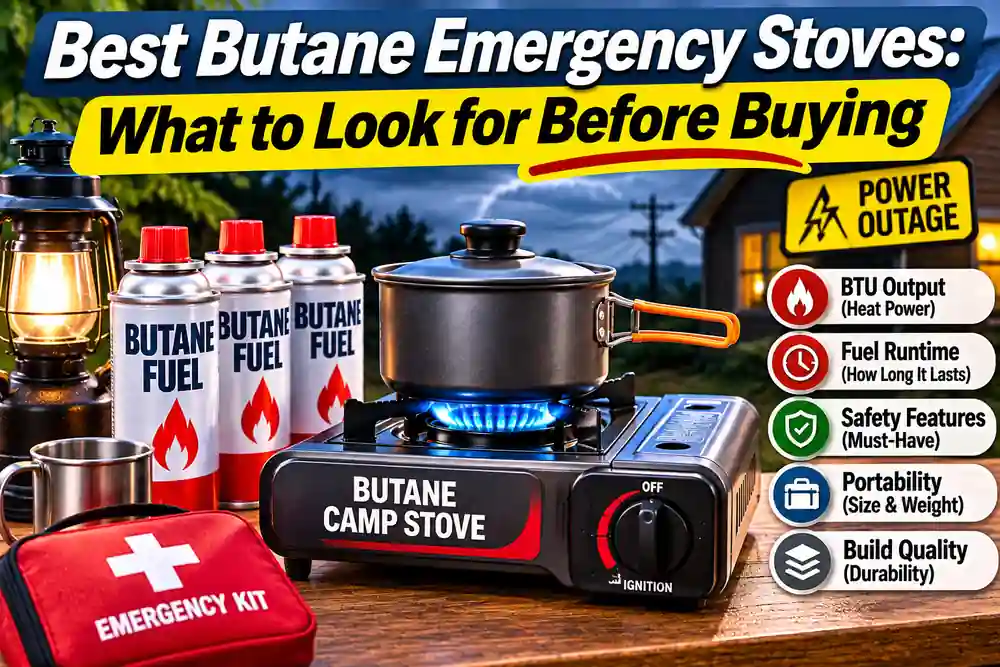
What Makes a Butane Stove Good for Emergencies?
When the electricity goes out, I want a stove that works predictably, not one that simply has the highest number on the box. I look at the task first: will I heat soup, boil water, or prepare several servings for a family? An emergency burner is only one part of a practical plan that also includes drinking water, ready-to-eat food, safe lighting and appropriate shelter.
Butane stoves have an appealing advantage: they can provide cooking heat without a live household electrical circuit. Many compact models use a factory-filled cartridge and a built-in piezoelectric igniter. Yet they also depend on fuel availability, outdoor operating conditions and correct handling of a pressurized canister. A manufacturer-approved portable stove is not a heater, phone charger or indoor kitchen substitute.
My approach is to separate must-have safeguards from conveniences. A pressure safety device matters more than a glossy case. Clear cartridge instructions matter more than a vague claim of ‘universal fuel compatibility.’ A controllable low flame matters when you need to heat a small pot without burning food or wasting precious fuel.


Quick Comparison: Which Type Should You Buy?
| Stove category | Typical fuel connection | Advantages | Main limitation |
|---|---|---|---|
| Cassette-style butane stove | Specified 220–227 g bayonet cartridge | Convenient single burner; commonly available cartridges | Cartridge overheating risks require careful cookware sizing |
| Compact threaded backpacking stove | Approved threaded canister, often isobutane blend | Small and lightweight for outdoor travel | Can be less stable with large pots; more limited pan support |
| Dual-fuel butane/propane stove | Manufacturer-specified cartridge or propane connection | Alternative compatible fuel source when supply changes | Fuel modes and regulators must follow exact manual |
| High-output cassette stove | Specified cassette cartridge | Quicker heating of suitable pots | May use fuel faster at maximum output |
| Electric countertop cooker | Appropriate electrical supply | No combustion at point of use | Requires battery/inverter or utility electricity |
There is no single winner for everyone. For a family preparing simple meals outdoors, I often favor a wide, stable cassette stove with an approved fuel cartridge. A solo hiker may prefer a compact threaded system. A household that wants two approved fuel options may evaluate a dual-fuel model, but I would never improvise a gas adapter to turn a single-fuel stove into a dual-fuel unit.
Eight Features I Would Check Before Buying
1. Verified product certification
The first thing I would inspect is the exact model’s certification mark and applicable standard for its market. Health Canada advises choosing portable butane stoves meeting national safety standards and checking recognized marks such as CSA or Intertek. A brand-name logo is not the same thing as evidence that the particular model was tested. I would also look up any recall notices before relying on an old stove stored in a closet.
2. Cartridge pressure protection and safe installation
Some cassette stoves incorporate pressure-sensing shutoff mechanisms, cartridge-ejection systems and controls that prevent engaging fuel when the knob is not in the off position. These are valuable protections, but they do not make unsafe installation acceptable. I still inspect the valve connection and use the cartridge position marked by the manufacturer. A warped compartment or damaged control is reason to stop using the stove.
3. A wide base and correct cookware support
A pot of hot water can be top-heavy. I prefer a stable base and a sturdy grate with clear maximum cookware dimensions. Oversized pans can reflect heat toward an enclosed cassette cartridge, creating flash-fire danger. I would never place two cassette stoves side by side to support a griddle unless the exact setup is specifically approved by the manufacturer.


4. Good flame control rather than just high BTU
A high maximum rating may boil water quickly in suitable conditions, but I want usable control at lower settings. Emergency cooking often involves warming canned beans or reheating soup, not continuous high-power boiling. A knob that transitions smoothly from medium heat to a stable low flame may conserve more fuel than a stove with only a fierce maximum setting.
5. Ignition that is easy to check
Piezo ignition is convenient because you do not need to hold an external lighter near the burner. But igniters can fail, and some stoves cannot be manually lit safely outside the manufacturer procedure. Before an outage, I test ignition outdoors according to the instructions. I would rather identify a weak ignition system during normal preparation than discover it in the middle of a storm.
6. Fuel cartridges that are available locally
My buying checklist includes the actual cartridge model, not just ‘butane’ printed in a product description. I check local retailers for compatible stock, whether cartridges come singly or in multipacks, and how many I can safely store. A discounted stove that uses hard-to-find proprietary fuel may be an inconvenient emergency choice.
7. Practical weight, storage and cleaning
Emergency gear may need to be carried outdoors or moved during evacuation. I want a unit I can place on a secure surface without complicated assembly and wipe clean after it cools. A carrying case protects controls during storage, but it does not authorize storing a hot stove or loaded cartridge against the manufacturer’s instructions.
8. Clear manufacturer support and instructions
I prefer products with accessible manuals, spare parts guidance and readable warnings. When a listing lacks a model number or gives conflicting fuel specifications, I move on. Being able to confirm the correct pan size, operating environment and troubleshooting steps is more valuable than an extra accessory that I may never use.

How Much Heat Do You Really Need? Understanding BTU Ratings
BTU per hour is a heat-input rate. It tells you approximately how much chemical energy a burner consumes at its rated output, not exactly how much heat reaches your food. A 15,000 BTU/hr burner can consume fuel much faster than an 8,000 BTU/hr burner when both run at their maximum settings. Wind, cookware shape, flame control and other variables determine usable cooking performance.
For a quick illustration, assume normal butane provides about 45.7 MJ/kg of lower heating value, equivalent to approximately 43,300 BTU per kilogram. A 220 g cartridge therefore contains around 9,530 BTU of lower-heating-value energy. Using a different heating-value convention yields a different figure, so don’t compare an LHV calculation with a manufacturer’s HHV-based rating without checking its basis.
| Rated input (illustrative) | Equivalent kW of heat input | Fuel per hour at 43,300 BTU/kg | 220 g theoretical runtime at maximum |
|---|---|---|---|
| 7,000 BTU/hr | 2.05 kW | 162 g/hr | 1.36 hr |
| 8,000 BTU/hr | 2.34 kW | 185 g/hr | 1.19 hr |
| 10,000 BTU/hr | 2.93 kW | 231 g/hr | 0.95 hr |
| 12,000 BTU/hr | 3.52 kW | 277 g/hr | 0.79 hr |
| 15,000 BTU/hr | 4.40 kW | 346 g/hr | 0.64 hr |
Those figures assume the quoted stove output is defined on the same fuel-energy basis as the calculation. Some manufacturers specify output differently, and model-specific runtime specifications should take precedence. The table is an explanatory comparison, not a test of any actual stove. It also does not account for gas that remains in a cooling cartridge or lower flame settings.
Two Real-World Stove Designs Worth Comparing
Compact dual-fuel model: Gas One GS-3400P
As a concrete example rather than a blanket endorsement, the Gas One GS-3400P is advertised with 8,000 BTU/hr output and compatibility with specified 8 oz butane cartridges or 16.4 oz propane cylinders under its approved setup. It also lists piezo ignition, ventilation, a cartridge ejection system and an automatic shutoff mechanism. Those features show what I mean by checking model-level details instead of trusting generic marketplace claims.


If I were considering this model, I would verify the exact fuel connection and supplied components in the current manual, confirm any certification applicable to my location, and consider whether both fuel formats are genuinely available during a regional emergency. A dual-fuel label is not permission to use other cartridges or improvised regulator fittings.
High-output cassette model: Iwatani 35FW
The Iwatani 35FW provides a different example, with manufacturer-listed 15,000 BTU/hr output, magnetic cartridge locking, double wind protection, pressure sensing and a carrying case. Iwatani specifies approximately 55 minutes of burning time at full power under its stated test conditions. That is a good reminder that higher output may trade off against maximum-setting runtime.
I would not declare the 35FW categorically better than an 8,000 BTU/hr unit. It may be useful when quick outdoor heating is the priority, but a lower-output model could suit light cooking or fuel conservation. These examples are technical reference points, not a claim that I have personally tested either unit.
| Published specification | Gas One GS-3400P | Iwatani 35FW |
|---|---|---|
| Advertised heat input | 8,000 BTU/hr | 15,000 BTU/hr |
| Approved fuel system | Specified butane or propane options | Specified butane cassette |
| Ignition | Piezoelectric | Piezoelectric |
| Key safeguards listed | Pressure protection, cartridge ejection, shutoff | Pressure sensing, cartridge-setting safeguard |
| Approx. stove weight | 3.3 lb | 4.2 lb |
| Maximum-setting runtime | Check model/manual | Approximately 55 minutes under cited test conditions |
How Many Canisters Should You Plan for a Blackout?
I start with the menu, then convert planned burner minutes into fuel. If you heat a meal for 20 minutes at an assumed 100 g/hour, the calculated fuel consumption is about 33 g. Two such sessions daily over three days require about 200 g, near the nominal contents of a single 220 g cartridge. Real stove use can differ significantly, so I would not treat that one-cartridge result as a guaranteed supply.
I prefer one meal per day that requires no heat, another that requires only brief reheating, and a contingency option requiring no flame if weather prevents outdoor cooking. Preparing food in advance and keeping shelf-stable ingredients available can reduce both fuel demand and stress. Buying lots of cartridges is not a substitute for safe food storage.
| Daily burner time | Assumed average fuel rate | Three-day fuel demand | 220 g cartridges, theoretical minimum |
|---|---|---|---|
| 20 minutes | 100 g/hour | 100 g | 1 |
| 40 minutes | 100 g/hour | 200 g | 1 |
| 60 minutes | 100 g/hour | 300 g | 2 |
| 90 minutes | 100 g/hour | 450 g | 3 |
| 60 minutes | 150 g/hour | 450 g | 3 |
The minimum is rounded up to whole cartridges and ignores unusable remainder and other losses. Actual consumption depends on appliance, outdoor conditions and burner setting. In my planning, I would measure a normal cooking session beforehand, consult the stove’s manual and keep safe no-cook alternatives rather than relying solely on the arithmetic.
How Much Does a Butane Emergency Stove Cost to Operate?
I compare total emergency-system costs, not the stove’s shelf price alone. The budget includes an approved stove, correctly matched fuel cartridges, suitable cookware and safe storage. Freight, hazardous-material shipping restrictions and local availability can make an apparently cheap online listing less attractive.
The following table uses hypothetical prices to demonstrate how the calculation works; it does not report verified current retailer prices. The actual cost per gram is retail price divided by net grams of fuel. Avoid comparing incompatible fuel systems merely because one has a cheaper sticker price.
| Example item | Illustrative cost | Fuel amount | Cost per 100 g |
|---|---|---|---|
| Single cassette canister | $3.50 | 220 g | $1.59 |
| Four-pack cassette fuel | $12.00 | 880 g | $1.36 |
| Small threaded canister | $7.00 | 110 g | $6.36 |
| Larger threaded canister | $12.00 | 230 g | $5.22 |
If an approved cassette stove consumes 100 g for a weekend, the illustrative $3.50/220 g price corresponds to about $1.59 of fuel. That does not mean an actual household can purchase exactly 100 g at that price, and it excludes the stove. I consider access to safe, compatible replacement cartridges more important than shaving a few cents from a fuel calculation.
The Most Important Safety Warning: Never Use an Outdoor Stove Indoors
Health Canada warns that portable butane stoves should never be used indoors or in confined spaces. The CDC also warns that camp stoves and other fuel-burning devices can generate carbon monoxide that accumulates in homes, basements, garages and campers. Carbon monoxide is colorless and odorless, and poisoning can cause headache, dizziness, nausea, confusion, collapse or death.
If an outdoor-rated stove cannot be operated at a safe outdoor location, I would not operate it at all. An open window, range hood or battery carbon monoxide alarm does not convert an outdoor camping stove into an approved indoor appliance. A garage with the door open and a tent with flaps unzipped are not safe substitutes for proper outdoor operation.
Do not use a butane camping stove for room heating, drying clothes or warming a sleeping space. Keep combustible materials and fuel supplies away from the flame. If someone develops possible carbon monoxide symptoms, stop exposure, move to fresh air and seek emergency care.
My related article on whether a propane generator can run indoors covers similar combustion hazards on a larger scale. The generator’s clearances and installation rules do not replace the stove manufacturer’s instructions.
Preventing Flash Fires and Cartridge Overheating
A critical danger with cassette stoves is reflected heat reaching the fuel compartment. Health Canada advises using the grate right side up, choosing cookware that fits the grate, avoiding multiple stoves placed together, keeping the unit away from other heat sources and allowing sufficient airflow. Failure to follow these rules can overheat the cartridge and cause gas to vent suddenly.
I also avoid aftermarket griddles and oversized fry pans unless the stove manufacturer explicitly approves them. A broad metal plate can cover the cartridge compartment even when the burner itself looks well centered. No promise about pressure safety devices makes that arrangement acceptable.
| Potential mistake | Why it is dangerous | What I would do instead |
|---|---|---|
| Oversized pan covers cartridge | Traps and reflects heat toward pressurized fuel | Use approved cookware dimensions |
| Two cassette stoves under one griddle | Heat can build between fuel compartments | Use one stove as designed; do not improvise |
| Cooking inside garage or tent | Carbon monoxide and fire hazards | Use only a permitted outdoor location |
| Unapproved fuel or adapter | Leak, improper pressure or malfunction | Use specified cartridge and fittings |
| Leaving burner unattended | Boil-over, overheating and fire risks | Supervise the stove continuously |
| Refilling disposable cartridges | Overfill and valve-failure hazard | Replace factory-filled nonrefillable canisters |
If a stove leaks, smells of gas or hisses continuously, I stop operating it and keep ignition sources away. I would not repair a pressurized container with glue, tape or improvised parts. Our propane generator leak prevention guide is a complementary discussion of fuel-safety principles, not a repair procedure for small cartridges.
Cold Weather: Is a Butane Stove Reliable in Winter?
Normal butane boils near 31°F (−0.5°C) at atmospheric pressure, so vapor delivery can be poor near freezing. Isobutane boils around 11°F (−11.7°C), and propane vaporizes at much colder temperatures. However, that does not mean you can substitute fuels in an appliance designed for plain butane. The correct choice is a stove and fuel system approved for the temperature and purpose.
I would never warm a cartridge with a fire, hot water, heater or improvised insulation to force gas delivery. If the temperature is outside the equipment’s operating limits, I plan a no-cook meal or use a separate approved system. Your outage plan needs to work safely when the weather is at its worst, not just during a warm-weather demonstration.
| Outdoor conditions | Practical concern | Buying decision |
|---|---|---|
| Mild weather above 50°F | Normal approved butane systems often work well | Prioritize stability and cooking control |
| Cool weather around 40°F | Cartridge cooling may reduce performance | Review model temperature guidance |
| Near 32°F | Normal-butane vapor pressure can be inadequate | Have an alternative approved fuel system |
| Around 20°F | Many normal-butane systems struggle | Do not rely on butane alone |
| Below 10°F | Cold-weather fuel and equipment design are essential | Use a specifically approved solution |
These are approximate planning bands, not universal safety ratings. Wind, burn rate, fuel blend and the exact stove matter. A related article on winterizing a propane generator explains the same planning mindset for a completely different type of fuel system.
How I Would Test a New Stove Before the Emergency
A new emergency stove should not live unopened in its carton for years. After reading its manual, I would operate it in an approved outdoor location under normal, calm conditions. I would check stable placement, correct cartridge insertion, reliable ignition, controllable flame, secure shutdown and how the cooker fits the pot I intend to use.
I would then measure how much cooking I can accomplish without leaving the burner running unnecessarily. A simple test meal is more informative than a promotional video because it reveals pan stability, actual cooking time and whether the controls are comfortable to operate. I would document which cartridge the appliance accepts and where I can buy replacements.
After the unit is off and cool, I would follow the manual for cartridge removal, cleaning and storage. Before hurricane or storm season, I would recheck for recall notices and visible deterioration. I would never test or operate a stove solely to consume old fuel if the canister is damaged or questionable.
My Emergency Stove Buying Scorecard
I use a weighted scorecard to keep flashy claims from outweighing safety and fit. This is my original editorial framework rather than an industry certification or a claim of laboratory testing. I recommend rejecting any product that fails the essential safety and compatibility checks before adding up scores.
| Buying criterion | Maximum points | How I would assess it |
|---|---|---|
| Verified certification and clear instructions | 25 | Exact model, appropriate jurisdiction and usable manual |
| Cartridge protection and correct loading | 20 | Pressure safeguards and correct connection |
| Safe pot support and stability | 15 | Approved cookware fits without cartridge overlap |
| Local cartridge availability | 15 | Can buy fuel before and after disruptions |
| Flame control and practical runtime | 10 | Reliable simmer and useful cooking duration |
| Service support and spare parts | 10 | Parts, cleaning and warranty information |
| Portability and storage case | 5 | Practical handling and transport |
For example, a product scoring well on portability but lacking a trustworthy manual or certified compatibility would not make my shortlist. My system rewards a stove you can safely use and maintain over one with the most impressive marketing number.
What I Would Buy for Different Households
Apartment household without an approved outdoor cooking area
I would not buy an outdoor butane stove as the main blackout cooking solution. I would buy shelf-stable ready-to-eat foods, stored water, battery lighting and, if appropriate, a battery power station. A small outdoor burner is useless if local rules or building conditions prevent safe operation.
Home with safe outdoor space
I would choose a certified cassette stove with clear manufacturer safety instructions, compatible local cartridges, a sturdy grate and dependable ignition. My menu would emphasize short cooking sessions and include ready-to-eat backup meals. I would keep the stove and fuel in approved storage, not beside a household heater.
Cold-region home
I would not rely on ordinary butane cassettes as the sole cooking plan. I would investigate equipment expressly approved for the expected temperatures and available fuels, with the same outdoor-use precautions. A dual-fuel unit might offer flexibility, but only when every connection and fuel mode is manufacturer-approved.
Family preparing for an extended outage
I would avoid basing the plan on a single burner and a single meal type. I would spread risk across shelf-stable food, clean water, safe fuel storage and a practical cooking routine. If electrical loads are also important, see our article on using a portable propane generator for home power outages. That is a separate purchase decision, not a reason to use a stove indoors.
Mistakes That Make an Emergency Stove a Bad Purchase
The first mistake is choosing output alone. More BTUs can be useful, but a small pot over an overpowered burner can waste fuel and make control harder. The second is ignoring the exact cartridge standard. I have seen buying decisions framed as if all eight-ounce fuel cans were interchangeable, when the real connection and gas mixture must be checked against the manual.
The third mistake is buying purely for an imagined future emergency without testing the system. A basic practice session can reveal missing accessories, unstable cookware or a cartridge type that is difficult to source. The fourth is treating a stove as a whole-house energy solution. It will not run a refrigerator, water pump or medical device.
The fifth mistake is storing more fuel than can be safely accommodated. Follow the container labels, local rules and manufacturer instructions. Do not leave cartridges in hot cars, near ignition sources or in enclosed spaces that could accumulate leaking gas. Our guide to transporting and storing a propane generator safely addresses similar awareness at a different equipment scale.
Frequently Asked Questions
What is the best butane stove for an emergency?
For households with a safe outdoor cooking location, I would prioritize a certified, stable cassette model with pressure safeguards, correct cartridge loading, reliable ignition and widely available approved fuel. There is no single best model across all climates and needs.
Is 8,000 BTU enough for emergency cooking?
An 8,000 BTU/hr stove can be suitable for heating canned foods, small meals and some water-boiling tasks. Cookware and wind matter. A high-output unit can boil faster but often consumes more fuel at its maximum setting.
How long does an 8 oz butane cartridge last?
It varies by fuel mass, heat setting and the stove’s actual consumption. At a hypothetical 100 g/hour, 220 g lasts 2.2 hours. Always defer to the specific manufacturer’s runtime test and operating instructions.
Can I use a butane stove in my kitchen if the power fails?
Not if it is an outdoor-rated portable camping or cassette stove. Public-health warnings expressly prohibit using these devices in enclosed spaces because of carbon monoxide and fire hazards. Use safe no-cook meals when outdoor cooking is not possible.
Are butane or propane emergency stoves better?
That depends on the exact approved stove, local fuel availability, temperature, size and intended cooking task. Propane can vaporize at lower temperatures than normal butane, but compatibility and instructions remain decisive. Never improvise a fuel conversion.
Can I refill a disposable butane stove cartridge?
No. Standard nonrefillable cartridges should be replaced, not topped up. An aftermarket adapter does not turn the cartridge into a certified refillable pressure vessel.
Do I need two burners for a family?
Not necessarily. A one-pot menu and no-cook foods may be easier to manage during an emergency. Do not position separate cassette stoves side by side under a shared griddle or pan unless the manufacturer explicitly permits the setup.
Final Verdict: What I Would Look for Before Buying
I would choose the stove that matches my real emergency cooking plan, approved outdoor space and locally obtainable fuel—not simply the stove with the highest output or lowest online price. The strongest buying features are certified construction, pressure and cartridge safeguards, stable cookware support, reliable controls and clear instructions.
My bottom line is that a butane emergency stove can be a useful tool for outdoor meals, but it cannot make an unsafe cooking location safe. I would keep no-cook foods ready, store fuel responsibly and test the complete stove-and-pot setup before bad weather arrives. A reliable emergency kit should still work when you decide it is safer not to light the stove at all.

Mike is an experienced propane technician with over 15 years of professional experience in the field. He has dedicated his career to helping customers with their propane needs, from installation to maintenance and repair. Together with Jeremy, he co-founded this website to provide useful information and guidance to customers seeking reliable propane services.