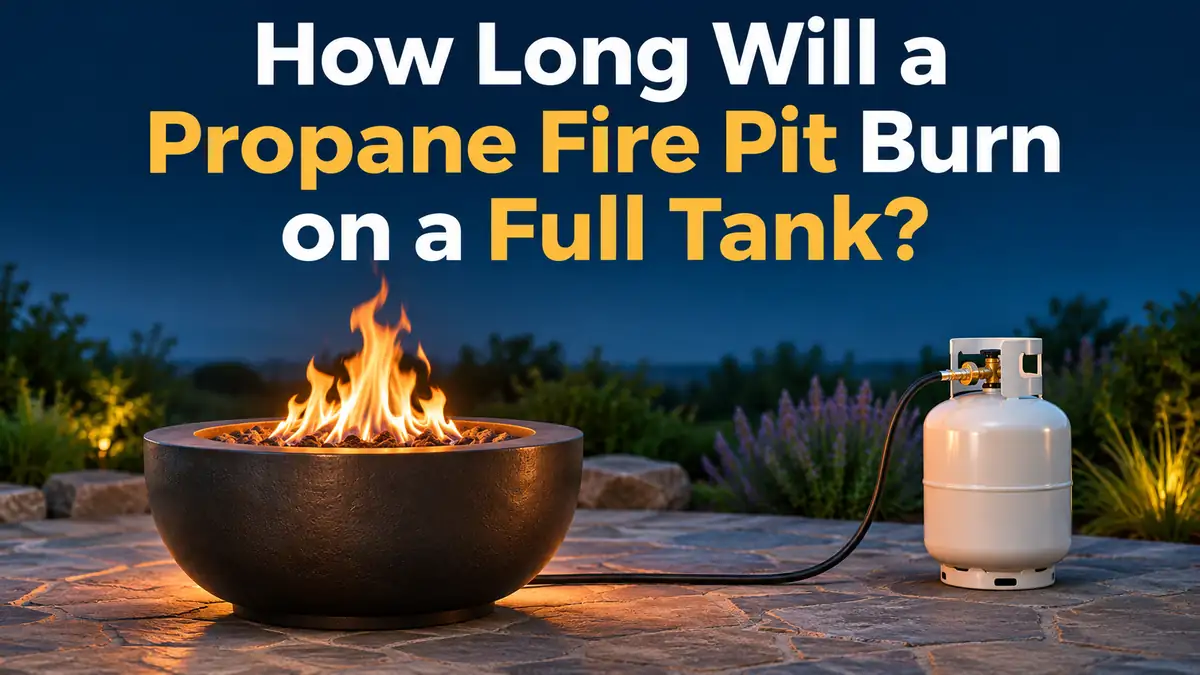
When you ask how long a propane fire pit will burn on a full tank, the word “full” deserves as much attention as the burner rating. A cylinder that looks identical to your last one may contain a different amount of propane. A lower flame setting can also change the result substantially.
My approach is to turn the question into an evening plan: how much fuel do you have, how quickly will you use it, and how much uninterrupted burning time do you need? That gives you a useful decision instead of a broad runtime claim.
The tables below use consistent energy assumptions and original planning examples. These are calculated estimates, not personal field-test results. I also explain how you can measure your own consumption without treating an uncertain gauge reading as an exact fuel inventory.
What Does a “Full Tank” Actually Mean?
Portable cylinders are commonly described by their rated propane capacity. That is different from the combined weight of the metal cylinder and the fuel. The quantity that determines runtime is the propane inside, not the total weight you lift.
Exchange services can supply less than the cylinder’s rated propane capacity. Blue Rhino, for example, lists its exchange product with a net propane quantity of fifteen pounds. Check the label and receipt for your actual purchase instead of assuming every newly exchanged cylinder contains the same amount.
| Term | Meaning | Example |
|---|---|---|
| Rated propane capacity | Designed propane capacity under proper filling requirements | 20-lb cylinder |
| Net propane quantity | Fuel actually supplied | 15 lb or 20 lb in the examples below |
| Tare weight, marked TW | Weight of the empty cylinder assembly | 17.2 lb in a hypothetical weighing example |
| Gross weight | Cylinder plus propane | 37.2 lb if that example cylinder contains 20 lb |
| Available fuel for calculation | Fuel remaining now | Gross weight minus the applicable tare weight |
The expansion space required when filling a cylinder is not an extra deduction you should apply to its properly rated propane mass. Do not take a correctly filled cylinder’s labeled fuel capacity and reduce it again just because you have heard about the fill limit. Let a qualified filler determine the permitted fill.
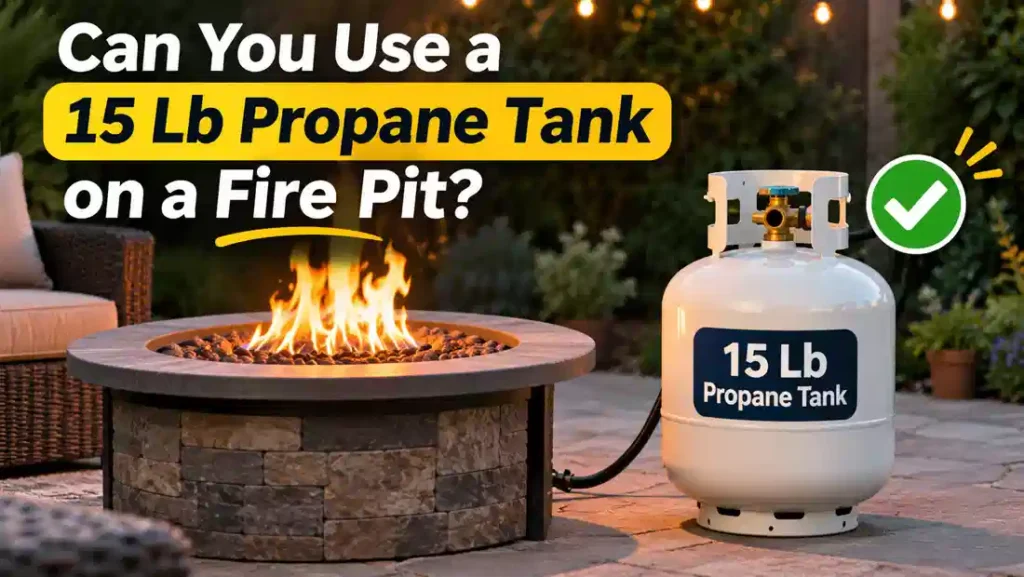
I would start every runtime estimate with the documented or measured net fuel. If your exchange label shows a smaller quantity than the cylinder’s capacity, use the smaller quantity. The comparison of 15-lb propane fills for fire pits explains this common source of confusion.


Technical Details Behind the Runtime Estimates
A propane fire pit’s BTU rating normally describes maximum fuel input per hour. It does not tell you how many people will feel warm, and it does not mean the burner consumes that amount at every permitted setting.
For consistent calculations, I use a rounded energy value by weight. Converting pounds to gallons introduces a temperature-dependent density assumption, so the weight method is especially convenient when the fuel label gives pounds.
| Technical item | Value used | What it means |
|---|---|---|
| Energy per pound of propane | Approximately 21,600 BTU/lb | Rounded planning constant |
| Energy per U.S. gallon | Approximately 91,500 BTU/gallon | Reference for gallon-based estimates |
| Liquid density reference | Approximately 4.24 lb/gallon | Varies with temperature |
| Energy in 20 lb | 432,000 BTU | 20 × 21,600 |
| Energy in 15 lb | 324,000 BTU | 15 × 21,600 |
| Example burner input | 50,000 BTU/hour | Continuous rated-input assumption |
| Runtime unit | Hours | Available fuel energy ÷ hourly input |
These rounded constants are close approximations, so a weight-based calculation and a gallon-based calculation can differ slightly. I would round the final runtime sensibly rather than suggest that a theoretical calculation can predict the exact minute the flame stops.
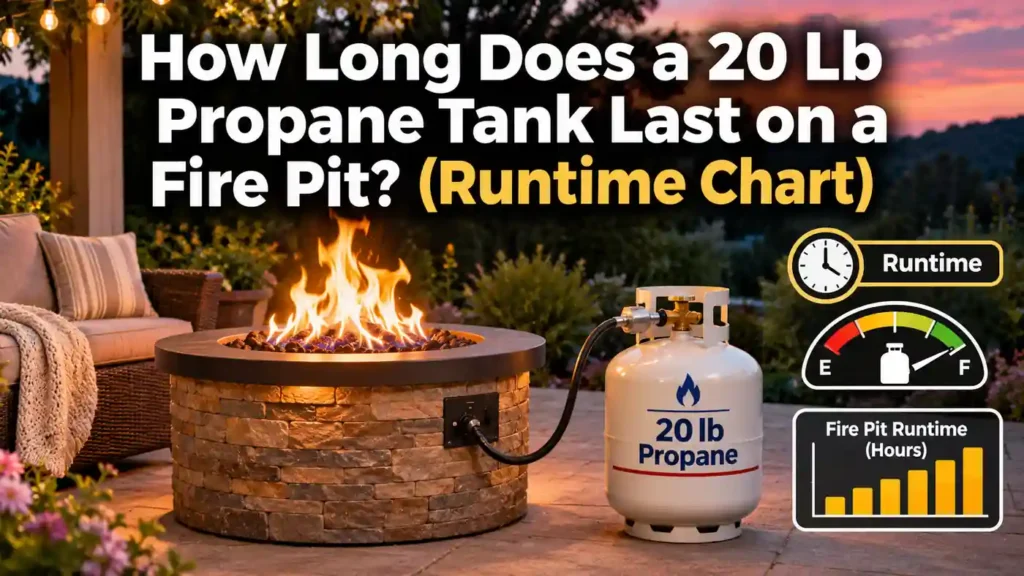
Full-Tank Propane Fire Pit Runtime Chart
This chart compares fuel quantities at several burner inputs. Read each row as continuous operation at the stated input. It is an energy comparison, not permission to connect every listed cylinder size to your fire pit.
| Burner input | 5 lb fuel | 10 lb fuel | 15 lb fuel | 20 lb fuel | 30 lb fuel | 40 lb fuel |
|---|---|---|---|---|---|---|
| 30,000 BTU/hour | 3.6 | 7.2 | 10.8 | 14.4 | 21.6 | 28.8 |
| 40,000 BTU/hour | 2.7 | 5.4 | 8.1 | 10.8 | 16.2 | 21.6 |
| 50,000 BTU/hour | 2.2 | 4.3 | 6.5 | 8.6 | 13.0 | 17.3 |
| 58,000 BTU/hour | 1.9 | 3.7 | 5.6 | 7.4 | 11.2 | 14.9 |
| 60,000 BTU/hour | 1.8 | 3.6 | 5.4 | 7.2 | 10.8 | 14.4 |
| 80,000 BTU/hour | 1.4 | 2.7 | 4.1 | 5.4 | 8.1 | 10.8 |
| 100,000 BTU/hour | 1.1 | 2.2 | 3.2 | 4.3 | 6.5 | 8.6 |
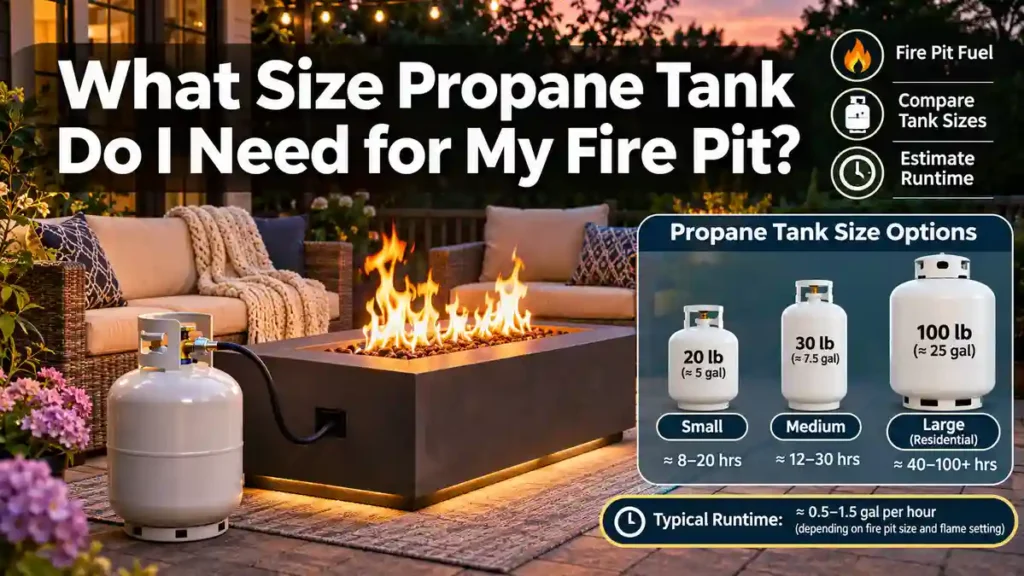
The larger fuel quantities are included to show the relationship between stored energy and runtime. Use only the tank size, connection, regulator, hose, and mounting arrangement approved for the specific appliance. A bigger cylinder is not automatically an acceptable upgrade.

For example, a decorative table may have a compartment built for a particular cylinder. A tank that physically fits is not necessarily approved. Before changing the setup, read what size propane tank your fire pit needs and check the manufacturer’s requirements.
If you specifically use the common barbecue-size cylinder, the dedicated 20-lb fire pit runtime guide provides the narrower comparison. Here, I am focusing on translating your actual fuel supply into a practical plan.
How I Calculate Runtime for Any Known Fuel Amount
Find the rated input on the appliance label or manual. Use that maximum rating for a conservative high-setting estimate when you do not have a reliable measured consumption rate. Do not substitute the rating of a similar-looking model.
| Input or calculation | 20-lb fill | 15-lb fill |
|---|---|---|
| Propane available | 20 lb | 15 lb |
| Burner input | 50,000 BTU/hour | 50,000 BTU/hour |
| Available energy | 432,000 BTU | 324,000 BTU |
| Runtime calculation | 432,000 ÷ 50,000 | 324,000 ÷ 50,000 |
| Calculated runtime | 8.64 hours | 6.48 hours |
| Rounded planning reference | About 8.6 hours | About 6.5 hours |
Under identical operating conditions, the smaller fill lasts three-quarters as long because it contains three-quarters as much fuel. That difference is large enough to affect whether you can complete another evening without refilling.


I would not interpret a shorter runtime after an exchange as evidence of a defective fire pit until I have checked the supplied fuel quantity. Starting with less propane can explain the difference without any equipment fault.
How Many Evenings Can You Get from a Full Tank?
Runtime becomes more useful when you divide it by the length of your typical gathering. I also keep a planning allowance so I am not scheduling an evening around the last theoretical fraction of fuel.
For the following example, I reserve part of the calculated capacity as a budgeting buffer. This is my planning choice, not a manufacturer requirement or a guaranteed usable-fuel threshold. Poor conditions or an equipment problem can still interrupt operation earlier.
| Starting fuel | Theoretical hours | Scheduled hours after allowance | Complete 2-hour evenings | Complete 3-hour evenings |
|---|---|---|---|---|
| 15 lb | 6.48 | 5.18 | 2 | 1 |
| 20 lb | 8.64 | 6.91 | 3 | 2 |
| 30 lb, only if approved | 12.96 | 10.37 | 5 | 3 |
I count complete evenings by rounding down. A remaining fraction may still support a shorter session, but I would check the fuel again before relying on it. That approach helps avoid telling guests the fire will last all night when the numbers only support part of the gathering.
There is a useful distinction here: a refill allowance is not fuel that disappears. It is fuel you choose not to promise in advance. If your measured consumption is consistent, you can refine your plan over time while staying within the appliance instructions.
Will a Lower Flame Make the Tank Last Longer?
Reducing actual burner input reduces fuel consumption and extends theoretical runtime. The difficulty is knowing the true input at a particular knob position. A knob halfway through its travel does not necessarily represent half the rated fuel flow.
| Actual average input | Calculated runtime | Important qualification |
|---|---|---|
| 60,000 BTU/hour | 7.2 hours | Use only if this input is within the appliance rating |
| 50,000 BTU/hour | 8.6 hours | Continuous input assumption |
| 40,000 BTU/hour | 10.8 hours | Requires a known or measured input |
| 30,000 BTU/hour | 14.4 hours | Not a claim about a particular knob position |
| 20,000 BTU/hour | 21.6 hours | Only if the appliance can operate safely at that input |
Outland Living gives an approximate runtime range for its portable fire pits that varies with flame setting. Manufacturer ranges are useful context, but I would use the instructions for your exact model rather than transfer a brand-level estimate to every fire table.
Never turn the flame below the manufacturer’s stable operating range just to chase more hours. If wind repeatedly extinguishes the flame or the burner behaves abnormally, stop using it and follow the troubleshooting guidance. Runtime is secondary to proper combustion and safe operation.
Why Actual Burn Time Can Be Shorter Than the Chart
A runtime chart estimates stored energy divided by consumption. Your appliance also needs adequate gas delivery, correct components, and suitable operating conditions. Having propane left does not guarantee that the system can supply the required flow at that moment.
| Factor | How it affects your estimate | What I would check |
|---|---|---|
| Smaller starting fill | Less stored energy than assumed | Label, receipt, or measured fuel mass |
| Higher actual setting | Greater hourly fuel use | Rated input and actual usage pattern |
| Cold conditions | Can reduce vaporization and gas delivery | Manufacturer guidance and approved cylinder setup |
| Low remaining fuel | Can make vapor-supply limits more noticeable | Fuel quantity and operating conditions |
| Wind | Can affect flame stability and your chosen setting | Whether conditions permit continued operation |
| Equipment fault or leak | May cause abnormal operation or fuel loss | Stop and obtain appropriate inspection |
Propane cools as liquid vaporizes inside the cylinder. A high-demand appliance can draw fuel faster than a cold or nearly empty cylinder can comfortably supply it. This is a delivery limitation, not proof that all the propane has been consumed.
Do not heat a cylinder with a flame, heater, hot water, or another improvised source. Do not move it closer to the fire pit. If cold-weather performance is unsuitable, ask the manufacturer or a qualified propane professional about an approved solution.
Wind also deserves a careful explanation. It does not automatically increase fuel flow through an unchanged burner setting, but it can make you turn the flame up or cause unstable operation. I would avoid assigning a made-up percentage runtime penalty to every breezy evening.
How I Estimate Fuel Remaining Before an Event
For a safely disconnected portable cylinder, weighing can provide a more useful quantity estimate than judging its apparent heaviness. Follow the appliance’s shutdown and disconnection instructions first, and handle the cylinder upright in an appropriate outdoor area. Do not disconnect an operating appliance.
Read the cylinder’s own tare-weight marking. Empty-cylinder weights vary, so copying the tare weight from another tank creates an avoidable error. Account for anything added to the scale that is not included in the cylinder’s tare weight.
| Step | Example value |
|---|---|
| Measured cylinder weight | 28.6 lb |
| Cylinder tare weight | 17.2 lb |
| Estimated propane remaining | 28.6 − 17.2 = 11.4 lb |
| Energy remaining | 11.4 × 21,600 = 246,240 BTU |
| Runtime at 50,000 BTU/hour | 246,240 ÷ 50,000 = 4.92 hours |
| Scheduled time with 20% allowance | 4.92 × 0.80 ≈ 3.94 hours |
In this example, I would be comfortable budgeting a shorter session within the estimated allowance, provided the equipment and conditions are suitable. I would not promise an extended gathering based only on the theoretical maximum.
Pressure alone is not a precise liquid-fuel inventory while liquid propane remains in the cylinder; temperature strongly affects it. A pressure-style gauge can provide clues, but I would not treat a green zone as an exact number of remaining hours.
Build Your Own Measured Runtime Record
Your own consumption history can improve estimates for your usual flame setting. Record starting fuel mass, ending fuel mass, and total burner time across ordinary safe use. Keep the setup and weighing method consistent so the difference reflects fuel consumed.
| Session | Fuel before | Fuel after | Burning time | Calculated use |
|---|---|---|---|---|
| A | 18.0 lb | 14.8 lb | 2.0 hours | 1.60 lb/hour |
| B | 14.8 lb | 10.6 lb | 2.5 hours | 1.68 lb/hour |
| Combined | 7.4 lb consumed | Across both sessions | 4.5 hours | 7.4 ÷ 4.5 ≈ 1.64 lb/hour |
Use total fuel consumed divided by total hours to combine records. Simply averaging session rates can distort the answer when the sessions differ in length. Note the weather and flame setting as well, because a familiar-looking flame is not a calibrated measurement.
With a reliable average, divide the remaining propane mass by that measured hourly rate. Keep an allowance for variation, and do not carry a mild-weather result into a very different operating situation without reassessing it.
My Refill-Trigger Method for Longer Gatherings
Instead of asking whether the cylinder is “nearly empty,” I calculate the fuel needed for the next planned event. That makes the refill decision depend on your schedule, not on a vague impression.
| Planning item | Calculation | Result |
|---|---|---|
| Event duration | Given | 3 hours |
| Required energy | 50,000 × 3 | 150,000 BTU |
| Calculated fuel need | 150,000 ÷ 21,600 | 6.94 lb |
| Fuel target with 20% scheduled-capacity reserve | 6.94 ÷ 0.80 | 8.68 lb |
| Decision | Compare measured fuel with target | Refill or adjust the plan if below target |
Dividing by the usable planning fraction is different from simply adding the same percentage to the fuel requirement. I use the division here so the refill target matches the earlier rule of scheduling only part of the theoretical capacity.
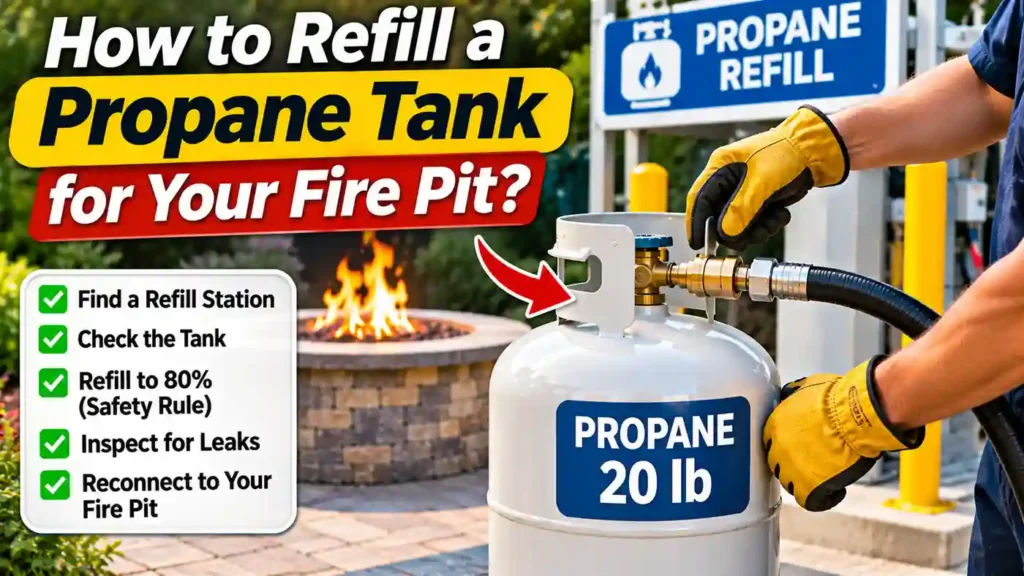
If the remaining quantity falls below your target, arrange a proper refill or an approved replacement cylinder before the event. For the process and practical checks, see how to refill a propane tank for your fire pit.
How Much Does a Full Tank’s Burning Time Cost?
To compare fuel value, divide what you paid for the actual propane quantity by the available burning time. A convenient exchange may cost more per pound than a refill, but local prices and fees determine your result.
| Fuel purchase | Assumed price | Runtime at 50,000 BTU/hour | Calculated cost/hour |
|---|---|---|---|
| 20 lb of propane | $20 | 8.64 hours | $2.31 |
| 20 lb of propane | $25 | 8.64 hours | $2.89 |
| 15 lb of propane | $20 | 6.48 hours | $3.09 |
| 15 lb of propane | $25 | 6.48 hours | $3.86 |
These figures cover fuel only. They exclude the cylinder purchase, delivery, travel, appliance, and maintenance. They also assume the stated fuel quantity is consumed at the rated input. Use the propane fire pit operating-cost guide for broader budgeting.
Safe Ways to Get More Useful Time from Your Fuel
- Use a comfortable approved flame setting: Reduce actual consumption when a lower stable flame meets your needs.
- Run the fire only while you are using it: Avoid burning through fuel before everyone arrives or after the gathering ends.
- Keep the appliance maintained: Follow the manual’s cleaning and inspection schedule instead of ignoring abnormal flame behavior.
- Verify the supplied fuel: Know the difference between cylinder capacity and the net quantity you purchased.
- Plan ahead: Measure remaining fuel before an important event, not after the flame starts weakening.
Do not extend runtime by altering a regulator, bypassing a safety device, adding unauthorized fittings, or connecting multiple cylinders with improvised hardware. Bigger fuel storage requires an approved system, not just a connector that seems to fit.
Keep spare cylinders outdoors in approved storage away from the operating appliance. If you suspect a leak, move everyone away, avoid ignition sources, and call the fire department or propane supplier from a safe location. Review the propane fire pit safety guide before changing your setup.
My Full-Tank Runtime Decision Guide
| Your situation | My decision | Next step |
|---|---|---|
| Known fuel amount and burner rating | Calculate | Use the runtime formula and an allowance |
| Fresh exchange but uncertain fuel quantity | Verify first | Read the net-weight label |
| Partly used cylinder | Measure | Subtract the cylinder’s tare weight from a safe weighing |
| Planning a long gathering | Set a fuel target | Compare remaining pounds with event requirement |
| Flame weakens in cold conditions | Do not assume empty | Stop if abnormal and seek approved guidance |
| Suspected leak or damaged components | Stop use | Leave the area and obtain qualified help |
| Considering a larger cylinder | Check compatibility | Obtain manufacturer approval before any change |
My preference is a modest plan based on known fuel rather than an impressive runtime claim based on assumptions. A small amount of preparation usually gives you a clearer answer than watching a pressure gauge during the party.
Frequently Asked Questions
Will a full tank last all night?
Possibly, but “all night” needs a duration. Compare your planned hours with the actual fuel quantity and burner input, then allow for variation. A fresh exchange alone does not establish the runtime.
Does a larger fire pit always use propane faster?
No. The burner input and operating setting matter more than the outside dimensions. Two differently sized models can have similar ratings, while similarly sized tables can have different fuel demands.
Can I double runtime by turning the knob halfway down?
Not reliably. Doubling theoretical runtime requires halving actual fuel input, and knob travel is not a calibrated flow scale. Use manufacturer data or a measured consumption record.
Does the tank become empty when the flame gets weak?
Not necessarily. Low fuel, cold-weather vaporization limits, regulator issues, or other faults can affect the flame. Follow the manual rather than repeatedly attempting to relight abnormal equipment.
My Final Take on Full-Tank Burn Time
I would start with net fuel weight, use the exact burner rating, and turn the result into complete planned evenings. Then I would check real consumption over time to improve the estimate. That method works better than treating every fresh tank as an identical supply.
A full tank can provide many enjoyable hours, but the useful number is the time you can reasonably plan around. Verify the fill, keep the equipment within its approved configuration, and refill before an important gathering pushes you to the theoretical limit.

Mike is an experienced propane technician with over 15 years of professional experience in the field. He has dedicated his career to helping customers with their propane needs, from installation to maintenance and repair. Together with Jeremy, he co-founded this website to provide useful information and guidance to customers seeking reliable propane services.