

If you’re planning to buy or lease a propane tank in Maryland, I’ll help you compare equipment prices, fuel costs, delivery services, and installation requirements.
Quick Answer: How Much Does a Propane Tank Cost in Maryland?
A new stationary propane tank may cost about $985 for a 120-gallon model, $1,950 for a 250-gallon model, $2,900 for a 500-gallon model, or $4,750 for a 1,000-gallon model before delivery and installation. These are published equipment estimates from Oklahoma-based BLT Tanks, not installed Maryland quotes.
| Nominal tank water capacity | New above-ground equipment reference | Approximate propane at 80% |
|---|---|---|
| 120 gallons | $985 | 96 gal |
| 250 gallons | $1,950 | 200 gal |
| 320 gallons | $2,350 | 256 gal |
| 500 gallons | $2,900 | 400 gal |
| 1,000 gallons | $4,750 | 800 gal |
The U.S. Energy Information Administration reported a Maryland residential propane average of $3.956 per gallon for November 16, 2026, excluding taxes. At that dated reference rate, 400 gallons costs $1,582.40 before any delivery-related charges. Maryland fuel prices vary by account, consumption, location, and supplier; this is not a guaranteed 2027 price.


My recommendation: For primary heating, compare 500- and 1,000-gallon tanks; for cooking and limited water heating, start with 120- and 250-gallon options. Get complete installed quotes, not tank-only prices.
Whether you live near Baltimore, Frederick, Salisbury, or on a rural Eastern Shore property, your best tank size depends on the appliances you use, winter demand, delivery access, and the local permitting authority.
In this guide, I’ll walk you through tank capacities, realistic refill calculations, local suppliers, ownership choices, Maryland’s safety rules, and the questions I’d ask before signing an installation contract.
What Determines the Total Propane Tank Cost in Maryland?
The advertised vessel price is only part of a new propane system. I would divide the budget into tank equipment, transportation, foundation or excavation, regulators and piping, labor, testing, permitting, and the first fill. A level rural property with good truck access may be straightforward, while a narrow suburban lot or a property with a private well or septic system can require additional planning.


Example: Buying and Installing a 500-Gallon Tank
| Project component | Illustrative budget |
|---|---|
| New 500-gallon tank, equipment only | $2,900 |
| Delivery and site preparation, hypothetical | $500 |
| Piping, regulator, installation and testing, hypothetical | $1,050 |
| Initial 400-gallon fill at $3.956 | $1,582.40 |
| Illustrative project total | $6,032.40 |
This is a worked budgeting example, not a Maryland contractor’s quote. The installation allowances are hypothetical. Underground excavation, long trenching, difficult access, and local inspections can change the total significantly.
Questions I’d Ask Before Paying a Deposit
I’d ask who owns the finished tank, whether the quote includes the first fill, which permits the contractor obtains, whether piping reaches all appliances, and what happens if the system fails a final inspection. I would also request the exact tank manufacturer and model.
Where Can You Buy Propane Tanks in Maryland?
Maryland offers a mix of independent propane dealers and regional fuel companies. Some sell tanks outright, some lease, and some offer both. These are useful companies to investigate—not a ranking or confirmation that each will deliver to every address.
Aero Energy — Maryland and the Mid-Atlantic
Aero Energy expressly advertises 120-, 325-, 500-, and 1,000-gallon tanks for sale in Maryland and Pennsylvania, along with leasing. Its website states that Aero Energy must install tanks it sells or leases. This is a practical option to compare if you want an integrated purchase-and-installation quote.
Gerner Energy — Baltimore County and Nearby Communities
Gerner Energy, based in Monkton, advertises propane delivery and tank sales, leasing, and installation. Its tank-ownership information explains how owning the tank may provide more supplier choice. I would check its current delivery boundary for the property.



Sharp Energy — Eastern Shore and Other Maryland Areas
Sharp Energy lists Maryland propane operations, including Easton, Salisbury, and Pocomoke City. Its Salisbury location advertises tank installation, monitoring, and propane delivery, along with cylinder services. I would contact the appropriate office for equipment ownership terms.
Griffith Energy Services — Maryland Delivery Network
Griffith Energy Services advertises residential propane delivery in Maryland and surrounding states, including automatic delivery arrangements. I’d ask whether its local office handles the tank installation or works with a separate contractor.
Mrohs Gas — Lower Eastern Shore
Mrohs Gas advertises residential, agricultural, and commercial propane delivery in Wicomico, Worcester, and Somerset counties and nearby areas. For a property around Salisbury or the lower Eastern Shore, I would request a service-area check.
Dixie Land Energy — Northeastern Maryland
Dixie Land Energy, based in Rising Sun, advertises propane delivery as well as tank purchasing and leasing. I would compare its current tank and fuel contracts if the property is inside its delivery area.


| Company | Area to investigate | Published service |
|---|---|---|
| Aero Energy | Maryland service territories | Tank sales, leases and installation |
| Gerner Energy | Monkton / Baltimore County | Tank sales, leases, installation and delivery |
| Sharp Energy | Eastern Shore and other service areas | Delivery, installation and monitoring |
| Griffith Energy Services | Maryland delivery territories | Residential propane delivery |
| Mrohs Gas | Wicomico, Worcester and Somerset | Residential and agricultural delivery |
| Dixie Land Energy | Rising Sun / northeastern Maryland | Tank purchase, lease and delivery |
Buying vs. Leasing a Propane Tank in Maryland
Buying usually costs more at the beginning, but owning an acceptable tank can make it easier to compare propane suppliers. Leasing may lower the entry cost, although the company commonly retains the right to control who fills its equipment. I wouldn’t assume I could switch companies while keeping a leased tank.
| Comparison | Buy the tank | Lease the tank |
|---|---|---|
| Equipment ownership | Homeowner | Supplier |
| Initial expense | Higher | Often lower |
| Choice of fuel seller | Potentially broader | Often restricted |
| Rental charges | Normally none | May apply |
| Maintenance | Owner/contract dependent | Lease dependent |
| Switching companies | Tank must be accepted by new dealer | May require removal/replacement |
Five-Year Comparison Example
Suppose buying a tank costs $2,900. A hypothetical lease costs $150 annually, or $750 over five years. If leased fuel were additionally priced $0.30 higher per gallon and you used 800 gallons per year, that hypothetical difference would cost another $1,200 over five years. The combined $1,950 lease-related amount is less than the purchase price, but it does not provide ownership. Real quotes may differ, so compare total delivered fuel, service, rental, and removal charges.
What If the Previous Homeowner Leased the Tank?
Before closing on a home, request documentation of tank ownership. Don’t assume a propane vessel belongs to the property owner just because it sits in the yard. Ask the supplier about account transfer, remaining fuel, lease termination, and inspection requirements.
What Propane Tank Sizes Are Used in Maryland?
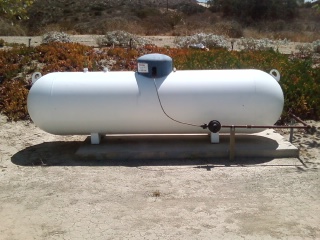
Portable propane cylinders are commonly described by pounds of propane, while stationary ASME tanks are commonly labeled by water-capacity gallons. I always distinguish the two before comparing prices.
| Container | Approximate liquid propane quantity | Typical purpose |
|---|---|---|
| 20-pound cylinder | 4.7 gal | Grill / portable equipment |
| 30-pound cylinder | 7.1 gal | RV appliances |
| 100-pound cylinder | 23.5 gal | Auxiliary appliances |
| 120-gallon stationary tank | 96 gal | Cooking / water heating |
| 250-gallon stationary tank | 200 gal | Moderate household usage |
| 500-gallon stationary tank | 400 gal | Space heating / multiple appliances |
| 1,000-gallon stationary tank | 800 gal | Large homes / long delivery intervals |
These stationary quantities are 80% fill planning estimates, not instructions to override the fill limits applicable to specific equipment. To understand the container differences, see my propane tank versus cylinder guide.
How Much Does a 1,000-Gallon Propane Tank Cost in Maryland?
For households with substantial space-heating demand, large generators, or difficult winter access, I would evaluate a 1,000-gallon tank. BLT Tanks publishes a new above-ground reference of $4,750 and an underground reference of $5,250, excluding Maryland delivery and installation.
| Specification | Approximate value |
|---|---|
| Water capacity | 1,000 gal |
| Liquid propane at 80% | 800 gal |
| Diameter | Around 41 inches |
| Overall length | Approximately 16 feet |
| Manufacturer weight | Confirm exact model |
How Much Would a Full Fill Cost?
At the dated Maryland EIA average, 800 × $3.956 = $3,164.80. If the gauge rises from 30% to 80%, the approximate 500-gallon delivery costs $1,978.00 at that same reference rate. Taxes and possible extra charges aren’t included.
How Long Can It Last?
At eight gallons per day, a full 800 gallons theoretically lasts 100 days. If I plan deliveries at 20%, approximately 600 gallons are available between the 80% and 20% levels, representing 75 days at the same consumption rate.
How Much Does a 500-Gallon Propane Tank Cost in Maryland?
A 500-gallon tank is one of the first sizes I would compare for a year-round home using propane heat, water heating, or a standby generator. New equipment-only references are $2,900 above-ground and $3,325 underground.
| Specification | Approximate value |
|---|---|
| Water capacity | 500 gal |
| Fuel at 80% | 400 gal |
| Overall length | About 9–10 feet |
| Diameter | Approximately 38–41 inches |
Cost to Fill a 500-Gallon Tank
| Price per gallon | Cost for 400 gallons |
|---|---|
| $2.50 | $1,000 |
| $3.00 | $1,200 |
| $3.50 | $1,400 |
| $3.956 (EIA Nov. 16, 2026) | $1,582.40 |
| $4.25 | $1,700 |
| $4.50 | $1,800 |
The alternative price levels are hypothetical. At five gallons per day, 300 gallons between the 80% and 20% levels provide about 60 days before a planned reorder. If your house uses more in the coldest weeks, delivery intervals shorten.
How Much Does a 250-Gallon Propane Tank Cost in Maryland?
A 250-gallon tank may be a good comparison for water heating, cooking, and moderate appliance use. The published new equipment reference is $1,950 above-ground or $2,325 underground, before installation.
| Characteristic | 250-gallon tank | 500-gallon tank |
|---|---|---|
| Propane at 80% | 200 gal | 400 gal |
| Between 80% and 20% | 150 gal | 300 gal |
| Above-ground equipment reference | $1,950 | $2,900 |
| Fill cost at $3.956 | $791.20 | $1,582.40 |
At a hypothetical 50 gallons per month, a 150-gallon operating window would represent roughly three months between planned refills. I would choose based on consumption and delivery cost rather than the smaller sticker price alone.
How Much Do Small Propane Tanks Cost in Maryland?
Portable cylinders and small stationary tanks serve different applications. A 100-pound cylinder typically contains about 23.5 gallons, while a 120-gallon stationary tank contains around 96 gallons at 80% fill. The latter may support fixed household piping if professionally installed.
| Equipment | Propane volume | Example fuel cost at $3.956 |
|---|---|---|
| 20-pound cylinder | 4.7 gal | $18.59* |
| 100-pound cylinder | 23.5 gal | $92.97* |
| 120-gallon stationary | 96 gal | $379.78 |
Portable-cylinder retail refill rates often differ materially from bulk residential delivery prices; these are mathematical comparisons, not Maryland retail-cylinder quotes.
BLT Tanks lists an above-ground 120-gallon vessel at $985 and an underground model at $1,770. Ask whether the Maryland supplier offers that equipment and what the installed price would be.
Are Used Propane Tanks Worth Buying in Maryland?
Refurbished equipment can save money, but I would not buy a vessel without proof of ownership, a readable identification plate, acceptable corrosion condition, and assurance that the intended propane supplier will service it.
An October 2026 BLT Tanks advertisement listed rebuilt 250-gallon vessels around $795–$1,095 and rebuilt 500-gallon vessels around $1,575–$1,895. Those were out-of-state advertisements rather than Maryland inventory.
My Used-Tank Checklist
| Check | Why it matters |
|---|---|
| Legal title | A leased tank may not be the seller’s to sell |
| Vessel nameplate | Required equipment identification |
| Corrosion and coating | Damage may make the vessel unsuitable |
| Valve and regulator condition | May require professional replacement |
| Prior repairs | Must be evaluated for compliance |
| Intended fuel supplier approval | A bargain is useless if nobody will fill it |
| Transport and lifting | Adds cost and safety requirements |
For related considerations, read my guide on when propane tanks should be replaced.
How Does Residential Propane Delivery Work in Maryland?
Maryland suppliers commonly offer automatic delivery or will-call delivery. Automatic delivery uses historical consumption, weather estimates, or remote monitoring. Will-call requires you to monitor the tank and order fuel in advance.
| Delivery option | Main benefit | Main responsibility |
|---|---|---|
| Automatic delivery | Less frequent manual scheduling | Confirm assumptions and monitor unusual use |
| Will-call delivery | More direct control over ordering | Read gauge and allow lead time |
| Prebuy or budget plan | Potential price/payment predictability | Review contract terms |
| Emergency delivery | May help during runout | Availability and fees vary |
I would ask for minimum order size, per-gallon pricing, delivery surcharges, any hazmat fees, and the procedure after a complete runout. A runout may require a qualified technician to restore service and check the system. Don’t bypass a regulator or reconnect equipment yourself.
Where Can You Get Propane Delivery in Maryland?
Delivery territories matter more than office locations. I would compare companies that explicitly serve the address and ask which services they provide for owned versus leased tanks.
| Maryland area | Supplier lead | What to confirm |
|---|---|---|
| Baltimore County / Monkton | Gerner Energy | Purchase, lease, and installation |
| Eastern Shore / Easton | Sharp Energy | Tank installation and delivery |
| Salisbury / Pocomoke City | Sharp Energy, Mrohs Gas | Service territory and refill policy |
| Hagerstown / western Maryland | Griffith Energy Services | Local bulk delivery arrangements |
| Northeastern Maryland / Rising Sun | Dixie Land Energy | Purchase, lease, and fuel terms |
| Other supported Maryland areas | Aero Energy | Tank sale/lease plus installation |
What Does a 20-Pound Cylinder Refill Cost?
For a cylinder accepting approximately 4.7 gallons, refill cost depends on retail pricing:
| Hypothetical retail $/gal | 4.7-gallon refill |
|---|---|
| $3.00 | $14.10 |
| $3.50 | $16.45 |
| $4.00 | $18.80 |
| $4.50 | $21.15 |
| $5.00 | $23.50 |
These are scenarios rather than confirmed station prices. For more on fuel pricing, see my propane refill cost per gallon guide.
What Are Standard Propane Tank Dimensions?
Before buying, I recommend checking both vessel size and the room needed for mandated clearances, access, support, and truck filling. Dimensions vary by manufacturer, so the following are approximate.
| Capacity | Approximate diameter | Approximate length |
|---|---|---|
| 120 gal | 24 in | 5–6 ft |
| 250 gal | 30 in | 7–8 ft |
| 500 gal | 38–41 in | 9–10 ft |
| 1,000 gal | 41 in | About 16 ft |
For townhouses and small lots, the most difficult constraint may not be the tank footprint; it may be code separation from buildings, openings, and boundaries. Get the proposed placement approved before ordering equipment.
Above-Ground vs. Underground Propane Tanks in Maryland
Above-ground tanks are generally simpler to inspect and often less costly to install. Underground tanks may look more attractive, but excavation, coating, cathodic protection, drainage, and servicing affect the budget.
| Tank capacity | New above-ground equipment | New underground equipment |
|---|---|---|
| 120 gallons | $985 | $1,770 |
| 250 gallons | $1,950 | $2,325 |
| 500 gallons | $2,900 | $3,325 |
| 1,000 gallons | $4,750 | $5,250 |
Maryland properties vary from rocky Piedmont lots to coastal soils with groundwater concerns. I would ask the installer about excavation conditions and suitable corrosion protection before selecting a buried tank. Never bury a vessel designed only for above-ground use. The equipment must be listed or otherwise approved for its intended application.
What Are Maryland’s Propane Tank Installation Requirements?
Maryland’s state building-code matrix published in 2026 lists NFPA 58 (2017 edition) under its liquefied-petroleum-gas adoption. The State Fire Prevention Code uses 2024 editions of NFPA 1 and NFPA 101, but those are separate from the statewide LPG edition listing. Maryland’s Board of Plumbing regulations, including COMAR 09.20.01, address applicable code incorporation and modifications. Local jurisdictions can have their own permits, adopted editions, and amendments, so I would verify the rules for the installation address before work begins.
Does a Propane Installer Need Qualifications?
Maryland has a Propane Gas Fitter Certification process and requirements related to the National Propane Gas Association’s Certified Employee Training Program for specified gas distribution and installation work. I would ask who will set the tank, connect the piping, test the system, and sign the relevant permit documentation.
Permitting Varies by County
| Maryland jurisdiction | Published example to check |
|---|---|
| Anne Arundel County | Propane storage tank permit required for installations over 125 gallons |
| Montgomery / Prince George’s | WSSC Water handles permits and inspections for many gas installations |
| Baltimore County | Tank installations on properties using private wells or septic systems have additional site-plan / contractor certification considerations |
| Talbot County | County lists a propane tank permit among its required permits |
| Other counties/cities | Check local permit, zoning, fire, and gasfitting authority |
These examples demonstrate why I would not publish a single universal Maryland permit threshold. A building permit, mechanical or gas permit, fire review, and well/septic assessment may involve different offices.
How Far Must a Tank Be From a House?
The distance depends on water capacity, above-ground versus underground configuration, adjacent hazards, and code exceptions. For preliminary planning, common NFPA 58-based references for certain above-ground individual tanks include the following—not an approval chart.
| Stationary tank size | General planning reference |
|---|---|
| Under 125 gal | Specific smaller-container provisions |
| 125–500 gal | Often 10 ft, subject to code details |
| 501–2,000 gal | Often 25 ft, subject to exceptions |
Do not place the tank solely using this simplified table. Have the local authority and qualified installer verify the exact code and site plan. Wells, septic fields, foundations, openings, ignition sources, and property lines can affect approval.
What Testing Is Required?
Applicable gas codes require proper system installation and appropriate pressure and leak testing. I would make permitting, regulator checks, commissioning, and final inspections explicit items in the contract. DIY work is not a substitute for qualified installation where licensing or permits apply.
How Do Private Wells and Septic Systems Affect Installation?
This is particularly relevant on Maryland rural properties. Baltimore County publishes a contractor certification for propane tanks installed at properties served by private wells and/or septic systems, and requires the contractor to verify that the tank will not adversely affect those systems.
I’d ask the installer to locate the well, septic tank, drain field, underground utilities, and existing piping before selecting a tank location. A tank may satisfy the propane separation requirements but still interfere with a wastewater system or required access for future servicing.
| Site feature | Question I’d ask |
|---|---|
| Private well | Where is the well and what local setbacks apply? |
| Septic tank | Will the tank placement obstruct maintenance? |
| Drain field | Could excavation or truck loads damage it? |
| Utility lines | Have underground services been located? |
| Driveway | Can the delivery truck safely access the fill connection? |
How Do Maryland Winters Affect Propane Tanks?
Maryland winters vary from milder coastal conditions to colder western mountain areas. Low temperature reduces propane vapor pressure and can limit vaporization capacity, especially when the tank is low and several appliances operate together. Propane does not normally freeze in a Maryland winter; its freezing point is far lower than ordinary outdoor temperatures.
Cold-Weather Fuel Reserve Example
| Average daily usage | 7-day supply | 14-day supply |
|---|---|---|
| 3 gal | 21 gal | 42 gal |
| 5 gal | 35 gal | 70 gal |
| 8 gal | 56 gal | 112 gal |
| 12 gal | 84 gal | 168 gal |
I would plan refill timing around the supplier’s actual winter delivery lead times and the home’s highest expected demand. Keep snow and ice from blocking safe access to valves and filling connections, following the supplier’s instructions. Never thaw equipment using open flames.
How Much Propane Does a Maryland Home Use for Heating?
Propane provides roughly 91,500 BTU per liquid gallon. To estimate fuel use at full appliance input, divide the burner’s BTU-per-hour rating by 91,500. This measures energy input, not the heat actually delivered after efficiency losses.
| Appliance input | Approximate propane per operating hour |
|---|---|
| 40,000 BTU/hour | 0.44 gal |
| 60,000 BTU/hour | 0.66 gal |
| 80,000 BTU/hour | 0.87 gal |
| 100,000 BTU/hour | 1.09 gal |
| 120,000 BTU/hour | 1.31 gal |
A 90,000-BTU/hour furnace operating at rated input for eight cumulative hours uses roughly 7.87 gallons, or $31.13 at the dated Maryland reference price. Actual daily consumption depends on cycling, house insulation, weather, and thermostat settings.
What Size Tank Should You Use for a Standby Generator?
The generator’s fuel-consumption chart is the only sensible starting point. For illustration, suppose a generator consumes 3 gallons per hour at a chosen load.
| Continuous runtime | Gallons used |
|---|---|
| 12 hours | 36 gal |
| 24 hours | 72 gal |
| 48 hours | 144 gal |
| 72 hours | 216 gal |
| 120 hours | 360 gal |
| Stationary tank | Fuel between 80% and 20% | Runtime at 3 gal/hour |
|---|---|---|
| 120 gal | 72 gal | 24 hours |
| 250 gal | 150 gal | 50 hours |
| 500 gal | 300 gal | 100 hours |
| 1,000 gal | 600 gal | 200 hours |
This is illustrative. Other appliances may use the same tank, and an undersized vaporization system can cause problems even when plenty of liquid propane remains. For details, see my propane tank size chart for generators.
How Much Does Propane Cost Per Year in Maryland?
The equipment price matters, but regular heating use can make annual fuel purchases the larger long-term expense. Here’s how annual consumption translates into cost at the November 16, 2026 EIA average of $3.956 per gallon.
| Annual propane use | Calculated fuel cost |
|---|---|
| 200 gallons | $791.20 |
| 400 gallons | $1,582.40 |
| 600 gallons | $2,373.60 |
| 800 gallons | $3,164.80 |
| 1,000 gallons | $3,956.00 |
| 1,500 gallons | $5,934.00 |
| 2,000 gallons | $7,912.00 |
These are fixed-rate illustrations, not a prediction of the 2027 annual average. I would obtain a supplier’s actual delivered rate for my expected annual volume.
Five-Year Ownership Example
Suppose the equipment and installation together cost $4,450, and annual household usage is 800 gallons at a hypothetical average of $4.00 per gallon. Five years of fuel would cost $16,000, for an illustrative $20,450 including the initial installation but excluding servicing, taxes, fees, and financing. I would compare this with a lease-plus-fuel quote over the same five years.
Which Propane Tank Brands Can You Consider?
For permanent storage, prioritize the tank model and supplier support over marketing claims. Common manufacturers in the broader U.S. market include Manchester Tank and Quality Steel for stationary vessels; Worthington Enterprises and Flame King are more associated with portable cylinders.
| Manufacturer | Typical equipment type | What I’d check |
|---|---|---|
| Manchester Tank | Cylinders and stationary vessels | Model, approvals, warranty |
| Quality Steel | Stationary tanks | Above-ground versus underground rating |
| Worthington Enterprises | Portable cylinders | Valve and certification compatibility |
| Flame King | Portable specialty cylinders | Approved use |
Your Maryland installer may stock different brands; confirm compatibility with its service and inspection policies.
How Can You Save on Propane in Maryland?
I would compare total delivered cost, not a promotional price without the terms. Ask about order-size pricing, automatic delivery, tank rental, minimum annual purchases, delivery surcharges, monitoring charges, and end-of-contract removal. If you own your tank, determine which local suppliers accept and inspect customer-owned vessels.
Weatherization can reduce annual heating demand. Air sealing, insulation, properly sized equipment, and routine professional maintenance can matter as much as a small per-gallon discount. On rural properties, planning a delivery before winter storms can avoid emergency fees and interrupted heat.
Supplier Quote Comparison Worksheet
| Quote item | Supplier A | Supplier B |
|---|---|---|
| Equipment ownership | Ask | Ask |
| Installed tank price | Ask | Ask |
| Current delivered $/gal | Ask | Ask |
| Minimum delivery | Ask | Ask |
| Annual rental fee | Ask | Ask |
| Maintenance included | Ask | Ask |
| Automatic delivery / monitoring | Ask | Ask |
| Emergency delivery charges | Ask | Ask |
| Permits and inspection included | Ask | Ask |
What Size Propane Tank Is Best for Your Maryland Property?
The right choice depends on usage, space, climate, and how often delivery is practical. I wouldn’t size solely by square footage; a new insulated home can use much less fuel than a poorly insulated older house with similar floor area.
| Situation | Sizes to evaluate |
|---|---|
| Cooking and limited hot water | 120–250 gal |
| Several appliances, modest demand | 250–500 gal |
| Primary propane heating | 500–1,000 gal |
| Long generator runtime | Manufacturer-based calculation |
| Rural home with uncertain winter access | Larger storage if justified |
| Business or agricultural equipment | Professionally designed system |
My Purchase Checklist
- Calculate annual fuel consumption and peak appliance input.
- Decide whether you want to own or lease the tank.
- Obtain written quotes from two or three suppliers serving your address.
- Confirm Maryland and county permits, adopted code editions, and inspection responsibilities.
- Verify property-line, building, well, septic, and ignition-source clearances.
- Check delivery-truck access and winter storm plans.
- Confirm foundation, excavation, corrosion protection, and piping in the quotation.
- Clarify tank maintenance, emergency service, fees, and removal obligations.
- Verify who will own any propane already in the tank on closing day.
- Choose an installer who can document compliant testing and commissioning.
Frequently Asked Questions About Propane Tanks in Maryland
How Much Does a 500-Gallon Propane Tank Cost?
The published equipment reference is $2,900 for a new above-ground tank. Maryland delivery, installation, and the first fill are additional.
How Much Does It Cost to Fill a 500-Gallon Tank?
A 400-gallon fill at the November 16, 2026 Maryland EIA average of $3.956 would be $1,582.40 before taxes or other charges.
Is a 1,000-Gallon Tank Better for Heating?
It stores twice the fuel of a 500-gallon tank at comparable percentage fill, but it also requires more space and capital. I would evaluate annual and peak demand.
Can I Buy a Propane Tank Instead of Leasing?
Yes. Some Maryland dealers, including Aero Energy and Gerner Energy, advertise tank sales. Confirm installation and customer-owned-tank acceptance.
Do I Need a Permit in Maryland?
It depends on the county and installation. Anne Arundel County requires a storage-tank permit for installations over 125 gallons; Montgomery and Prince George’s have WSSC Water gas permitting rules. Check the location-specific authority.
Which NFPA 58 Edition Applies?
Maryland’s 2026 state code matrix lists NFPA 58 (2017) at the state level. Local requirements and amendments may differ, so the installer must verify the edition governing the project.
Can an Underground Tank Be Installed?
Yes, where site conditions and applicable rules allow. Excavation, groundwater, corrosion protection, and servicing access must be assessed.
Can Another Dealer Fill a Leased Tank?
Don’t assume so. Verify legal ownership and authorization before changing suppliers or filling equipment owned by someone else.
Does a 100-Pound Cylinder Hold 100 Gallons?
No. It holds approximately 23.5 gallons of propane. A 100-gallon stationary vessel has much greater liquid capacity.
What If the Tank Runs Out During Winter?
Contact the supplier. Restoring service may require professional leak checking and safety procedures. Avoid improvised connections.
How Long Does a 500-Gallon Tank Last?
At five gallons daily, the 300 gallons between an 80% fill and 20% planned reorder point represent about 60 days.
Do Portable Propane Cylinders Need Recertification?
Certain DOT cylinders require periodic requalification. Stationary ASME tanks follow different inspection and maintenance rules. See my guide to propane tank recertification providers.
Final Thoughts: Choosing a Propane Tank in Maryland
For a home relying on propane heating, I’d begin by comparing 500- and 1,000-gallon tanks. For cooking and modest hot-water use, smaller stationary storage may be enough.
But the equipment price is only one part of your decision. Maryland homeowners should account for fuel costs, contract restrictions, winter deliveries, and county-specific permitting—especially on properties with wells or septic systems.
Before ordering a tank, obtain itemized quotes and have the installation location approved by a qualified professional. The best tank is one that safely meets your demand, fits your property, and comes with a delivery arrangement you can rely on.

Mike is an experienced propane technician with over 15 years of professional experience in the field. He has dedicated his career to helping customers with their propane needs, from installation to maintenance and repair. Together with Jeremy, he co-founded this website to provide useful information and guidance to customers seeking reliable propane services.