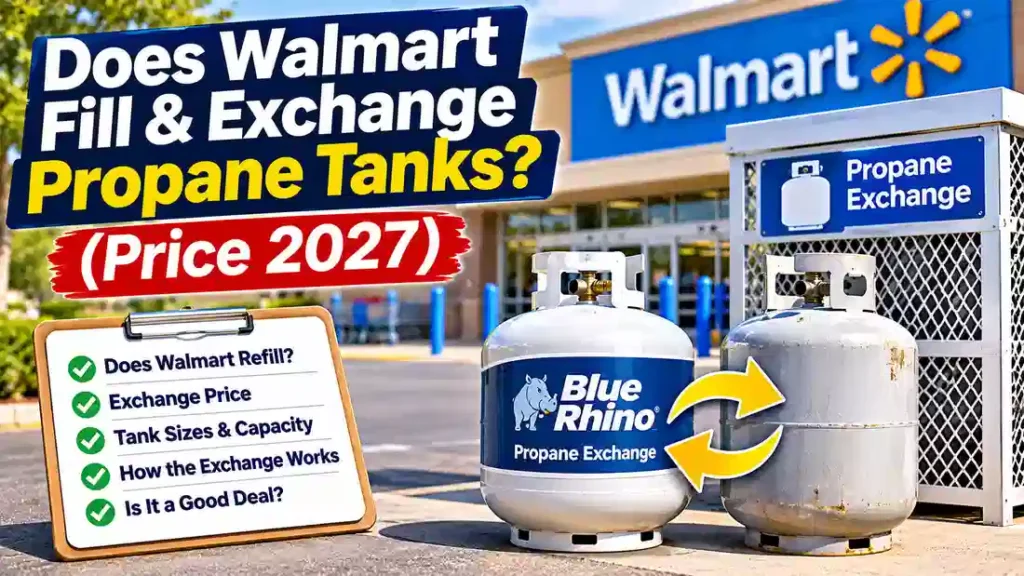
Walmart exchanges propane tanks at participating locations, but normally does not refill your own cylinder on-site. Walmart’s publicly displayed 2027 listings show examples of $19.92 for Blue Rhino exchange and $18.98 for AmeriGas exchange; availability and prices vary by store. A separate Blue Rhino tank purchase with no empty to trade in has been listed around $54. Most standard exchange cylinders contain 15 lb of propane, even though they are often called “20-pound tanks” because the cylinder itself has a nominal 20-lb propane capacity. For 2027, use these as 2026 price benchmarks, not confirmed future prices. I explain how the exchange works, where refilling can save money, and exactly what to check before driving to Walmart.
If you’re preparing a barbecue and find an empty grill cylinder, Walmart may seem like the easiest answer. I can see why: you’re probably already shopping for food or household supplies, and swapping a tank sounds much simpler than locating a dedicated propane dealer. But there are two costs you should separate—the amount you pay at the register and the amount of usable propane you take home.
My goal with this guide is to help you choose intelligently, not just repeat a price. I’ll compare real Walmart product listings available in 2026 with practical 2027 shopping scenarios, explain the 15-lb-versus-20-lb confusion, and show you how to calculate an honest per-gallon cost. The examples and recommendations are my analysis of published information, not a claim that I personally visited a specific Walmart store.


Does Walmart Fill Propane Tanks or Only Exchange Them?
The short answer is that Walmart’s familiar propane service is an exchange. You hand over an eligible empty grill cylinder and receive a prefilled replacement from an outdoor cage or exchange kiosk. Walmart does not generally operate the weigh-and-fill dispensing service you would use at a propane dealer or participating farm store.
This distinction matters because a true refill keeps your original cylinder and adds propane to it, normally with the amount dispensed measured by a qualified attendant. An exchange gives you a different inspected cylinder with a stated net fuel quantity. Some people casually say they “refilled at Walmart” when what they really did was exchange the cylinder.
| Service | Does a typical Walmart offer it? | What you receive |
|---|---|---|
| Exchange a standard grill cylinder | Yes, at participating stores | A replacement cylinder filled by the exchange supplier |
| Refill your existing tank by the gallon | Generally no | Look for a specialized propane refill location |
| Buy a filled cylinder without an empty | Yes, where stocked | A cylinder plus its initial propane |
| Exchange RV-specific 30-lb or 40-lb cylinder | Do not assume availability | Confirm with a specialty supplier |
| Have a large home tank filled | No retail cylinder cage service | Arrange bulk delivery with a propane company |
I would check whether your particular Walmart participates before loading the cylinder into your vehicle. Retail availability, kiosk type, inventory, store hours and acceptable payment methods are not identical everywhere. For other stores in your area, see our propane tank exchange locator guide.
Walmart Propane Exchange Prices: 2026 Benchmarks for 2027
The most important price distinction for this 2027 edition is timing: it is November 2026, so 2027 retail prices cannot yet be confirmed. Below are observed Walmart listings from 2026, which you can use as a starting point when comparing local prices in 2027. Walmart explicitly warns that prices can differ online, in-store and in its app.


| Walmart listing | 2026 listed example | What it means |
|---|---|---|
| Blue Rhino propane tank exchange | $19.92 | Exchange price with acceptable empty cylinder |
| AmeriGas propane tank exchange, 15 lb | $18.98 | Another supplier’s store listing; local availability varies |
| Blue Rhino no-exchange purchase | $54.00 | Buy a supplied cylinder without handing in one |
| Blue Rhino separate exchange-cylinder listing | $17.32 | Another listing, reported out of stock in the viewed context |
| 2027 exchange price | Not yet established | Verify your exact Walmart and supplier before purchase |
I would not promise a single “Walmart propane exchange price” across the country. Even the same supplier can appear at different prices in distinct listings or stores. Taxes, inventory, exchange method and local propane markets can also change the total. Blue Rhino itself advises customers to ask the local retailer for its current price.
When you read an older article advertising an exchange for $14.99, don’t assume that price is still on the cage in 2027. Likewise, a $30–$35 local price does not prove every Walmart increased its price. I prefer to show a verified dated benchmark and then explain how to check the current one.
The Most Important Detail: A 20-Lb Tank Often Contains Only 15 Lb in an Exchange
This is where I think the real value comparison begins. A standard barbecue cylinder is commonly called a “20-pound tank” because it is designed to hold approximately 20 pounds of propane when appropriately filled. But major exchange suppliers commonly provide 15 pounds of net propane in an exchanged cylinder. Blue Rhino and AmeriGas both describe that 15-lb net quantity in their published information.
Propane weighs approximately 4.24 pounds per gallon near typical conditions. This means 15 pounds represents about 3.54 gallons, while 20 pounds is about 4.72 gallons. The difference—roughly 1.18 gallons—is large enough to affect cooking time and the true cost of a purchase.
| Measurement | 15-lb exchange | 20-lb refill to rated capacity |
|---|---|---|
| Propane net weight | 15 lb | 20 lb |
| Approximate liquid propane | 3.54 gal | 4.72 gal |
| Approximate gross energy | 323,000 BTU | 432,000 BTU |
| Fuel compared with a 20-lb fill | 75% | 100% |
| Typical cylinder class | 20-lb DOT barbecue cylinder | 20-lb DOT barbecue cylinder |
I would not call the exchange supplier dishonest merely because the cylinder is named for its capacity, but I do think shoppers should compare net fuel weights clearly. If you’re running a patio heater or grill for a full weekend, the additional 5 pounds in a rated-capacity refill can be noticeable.



How Much Are You Really Paying per Gallon at Walmart?
For a 15-lb exchange containing approximately 3.54 gallons, divide the exchange price by 3.54. At $19.92, your effective price is roughly $5.63 per gallon. At $18.98, it’s about $5.36 per gallon. These calculations give you a fairer comparison with a refill service that advertises a price per gallon.
| Exchange price | Estimated propane received | Effective cost per gallon |
|---|---|---|
| $17.00 | 3.54 gal | $4.80 |
| $18.98 | 3.54 gal | $5.36 |
| $19.92 | 3.54 gal | $5.63 |
| $22.00 | 3.54 gal | $6.21 |
| $25.00 | 3.54 gal | $7.06 |
| $28.00 | 3.54 gal | $7.91 |
Here’s my perspective: the extra amount you pay at Walmart is often a convenience premium. You’re paying for the prefilled exchange system, the cylinder inspection process and an accessible retail location—not simply a bulk commodity price per gallon. That may be worthwhile for a last-minute dinner, but much less appealing if you go through many tanks every year.
Walmart Exchange vs. Refilling at a Propane Dealer: Which Is Cheaper?
A refill location typically charges for measured propane delivered into an eligible cylinder. In many cases you may receive more total propane than an exchange cylinder, provided your tank is empty and can be filled to its authorized capacity. However, not every refill station uses the same fee structure: some charge a flat amount per cylinder, have minimum charges or charge for their refill labor.
| Cost example | Exchange: 15 lb | Refill: 20 lb |
|---|---|---|
| Fuel received | Approx. 3.54 gal | Approx. 4.72 gal |
| Example unit price | $19.92 flat | $3.50/gal |
| Example transaction total | $19.92 | $16.52 |
| Effective per-gallon price | $5.63 | $3.50 |
| You retain your existing cylinder | No | Yes |
| Cylinder must meet refill eligibility | Exchange supplier judges acceptability | Refill operator must accept its condition/date |
Under those assumptions, the refill costs $3.40 less while giving approximately 1.18 gallons more fuel. If you fill your cylinder six times annually, the total difference could become meaningful. But your real benefit depends on travel, local refill rates and whether the tank is completely empty.


I would compare nearby refill locations such as Tractor Supply stores that actually offer dispensing. Our Tractor Supply propane refill pricing guide explains the by-the-gallon approach. You can also review our Costco propane refill guide and our cheapest propane refill comparison; always verify that the particular location still offers the service.
A Simple Calculator for Your Annual Propane Spending
When I want to know whether a refill trip is worth making, I compare how many exchanges I’d buy per year, not only the difference on one transaction. The following table uses $19.92 per 15-lb exchange and $3.50 per gallon for a 20-lb refill. It assumes you use the entire purchased amount of propane before each next transaction.
| Fuel demand | Exchange transactions (rounded up) | Exchange spending | Refills (rounded up) | Refill spending |
|---|---|---|---|---|
| About 14 gal/year | 4 | $79.68 | 3 | $49.56 |
| About 28 gal/year | 8 | $159.36 | 6 | $99.12 |
| About 42 gal/year | 12 | $239.04 | 9 | $148.68 |
| About 56 gal/year | 16 | $318.72 | 12 | $198.24 |
I would also assign a value to the extra drive. A $3 savings may not justify traveling far out of your way. But if the refill station is next to a store you already visit, the better fuel value becomes much more attractive. That is why there is no one winner for every homeowner.
How to Exchange a Propane Tank at Walmart: Step by Step
For a staffed Blue Rhino exchange, the supplier describes a simple process: bring your eligible empty cylinder to the outdoor propane display, complete the purchase inside, then have an employee provide a replacement tank. You should not bring the propane cylinder into Walmart or any other building.
| Step | What I recommend | Common mistake to avoid |
|---|---|---|
| 1. Confirm the location | Check the exact store for exchange availability and price | Assuming every Walmart stocks fuel |
| 2. Transport the cylinder | Keep it upright, valve closed and secured | Leaving it loose in the trunk |
| 3. Go to the outdoor cage | Follow posted instructions | Carrying the tank indoors |
| 4. Pay for exchange | Use the cashier or supported kiosk payment | Assuming all kiosks work the same way |
| 5. Receive replacement | Check visible cylinder condition and labeling | Taking a damaged or suspicious tank |
| 6. Transport it home | Drive directly home and unload promptly | Leaving the cylinder in a hot parked vehicle |
Some stores use self-service vending equipment instead. At those locations, follow the machine instructions for the return compartment, payment and collection. If the kiosk is out of service or displays an unexpected charge, ask the store or the exchange provider for assistance instead of attempting to force open the cage.
Can You Buy a Propane Tank at Walmart Without an Exchange?
Yes. Walmart lists Blue Rhino’s “No Exchange Purchase,” which provides a prefilled cylinder without requiring an empty tank. A listing viewed in 2026 showed $54.00, though it was not available for every fulfillment method or location. Treat it as a reference, not a locked 2027 price.
This option makes sense if you’ve just bought your first gas grill or need an additional approved spare for outdoor use. But you are paying for a cylinder and fuel together, so the price is naturally higher than the exchange-only charge. After purchasing your first cylinder, you can decide whether to use future exchanges or take an eligible cylinder to a refill station.
| Situation | Likely best purchase |
|---|---|
| Brand-new grill, no propane cylinder | No-exchange cylinder purchase or new empty cylinder plus authorized refill |
| Already own an empty, acceptable cylinder | Exchange or refill, depending on cost and urgency |
| Need an extra outdoor backup cylinder | No-exchange purchase or approved separate new cylinder |
| Own a specialized RV cylinder | Dedicated propane supplier rather than assuming Walmart compatibility |
| Need fuel for a home heating tank | Bulk propane-delivery company |
What Brands Does Walmart Exchange?
Walmart listings show Blue Rhino and AmeriGas propane exchange products. The supplier and display you actually encounter depend on your local store. Blue Rhino says it accepts standard grill cylinders from other brands as long as they meet its acceptance requirements; AmeriGas similarly states that it accepts different brands for exchange.
This means an old standard grill cylinder does not have to carry a Blue Rhino logo before you can present it to a Blue Rhino exchange location. However, don’t assume every size, valve style or damaged cylinder qualifies. The exchange provider has the final say on a cylinder’s condition.
For a deeper discussion of exchanging these cylinders, see Blue Rhino propane exchange costs and mistakes to avoid when connecting propane cylinders.
What if My Cylinder Is Expired or Rusty?
One advantage of exchange is the opportunity to turn in a qualifying older cylinder and receive an inspected replacement. But an expired cylinder is not automatically acceptable if it is badly damaged, leaking or otherwise unsafe. Blue Rhino explicitly says the empty tank must be acceptable; the condition of the cylinder matters.
For a DOT cylinder to be filled rather than exchanged, requalification status and condition are especially important. The initial qualification interval and subsequent requalification interval depend on DOT rules and the cylinder’s documentation. I would let a trained propane professional read the collar markings rather than guess based on the tank’s age.
Never attempt to repair a damaged valve, vent fuel deliberately or throw a propane cylinder in household trash. You can also read whether a propane company can refill an expired cylinder for a more specific explanation.
Is Walmart Propane Exchange Available 24 Hours?
A store that operates 24 hours is not automatically a 24-hour propane exchange point. A staffed outdoor cage may require assistance from an associate, and the applicable service hours may be shorter than the store’s opening hours. Some self-service kiosks can operate around the clock, but actual access, payment, local restrictions and inventory still depend on the location.
If you need fuel late at night, I would check the location’s exchange listing and call before leaving home. A ten-minute confirmation is often better than a round trip to a cage that cannot be opened when you arrive.
Walmart vs. Home Depot, Lowe’s, U-Haul and Tractor Supply
I wouldn’t rank these retailers with invented national prices. Some locations focus on exchange, others offer refills, and several may offer both across different branches. The right comparison starts by asking what service is available and how much fuel you actually receive.
| Retailer type | Common propane service | Best reason to check |
|---|---|---|
| Participating Walmart | Pre-filled cylinder exchange | Quick visit during regular shopping |
| Participating Home Depot or Lowe’s | Often exchange through a supplier | Another nearby swap option |
| Participating U-Haul | Many locations offer refill dispensing | May pay for actual gallons dispensed |
| Participating Tractor Supply | Refill at equipped stores | May obtain up to the cylinder’s rated propane fill |
| Dedicated propane dealer | Refill and specialized cylinder services | Tank inspection, bulk fuel and expert support |
The most useful buying question isn’t “Which chain is cheapest?” It is “What is my total price for how many gallons, at a convenient location?” That approach prevents a misleading comparison between a 15-lb exchange and a 20-lb refill.
How Long Will a Walmart Exchange Tank Last?
A 15-lb exchange supplies about 323,000 BTU of gross fuel energy. Your actual runtime depends on your appliance input rating, settings and weather. For illustration, I divide total BTU content by the appliance’s input in BTU per hour; the results are theoretical and assume uninterrupted full-rated consumption.
| Appliance fuel input | Illustrative 15-lb exchange runtime | 20-lb rated refill runtime |
|---|---|---|
| 10,000 BTU/h | 32 hours | 43 hours |
| 20,000 BTU/h | 16 hours | 22 hours |
| 30,000 BTU/h | 11 hours | 14 hours |
| 40,000 BTU/h | 8 hours | 11 hours |
| 50,000 BTU/h | 6.5 hours | 8.6 hours |
If you’re running a grill, the input rating of every burner matters. A four-burner grill at maximum output can consume fuel much faster than one burner on low. A patio heater running continuously may also empty a cylinder sooner than a weekend of intermittent grilling.
I prefer to estimate propane usage using the appliance’s stated BTU/h and my usual number of cooking or heating hours. For backup generators, a single grill cylinder may be inadequate; see how long a 20-lb tank runs a propane generator before assuming your new Walmart tank can cover a power outage.
My Practical Five-Minute Price Check Before Leaving Home
I use a short comparison method when the decision is close. First, I check whether the Walmart exchange is in stock and confirm its posted price. Second, I call a nearby refill location for its per-gallon cost and whether it charges a minimum. Third, I calculate the effective exchange price using 3.54 gallons. Fourth, I decide whether the trip time and fuel savings are worth it.
| Your answer | What it tells you |
|---|---|
| Walmart exchange price = $20.00 | Approximately $5.65 per gallon for 15 lb |
| Local refill price = $3.75/gal | Approximately $17.70 for 4.72 gallons, before fees |
| Difference in volume = 1.18 gal | Refill provides about one-third more fuel than 15-lb exchange |
| Extra refill trip = 35 minutes | Convenience could outweigh the savings |
| You already pass the refill station | Refill may be the better routine purchase |
For my own decision framework, I give convenience a real dollar value rather than treating it as free. If Walmart is already on your route and a propane dealer is 20 miles away, exchanging makes sense even with a higher fuel-unit cost. If a refill dispenser is nearby, I usually favor keeping my usable cylinder and buying measured propane.
How to Transport and Store Your Exchanged Tank Safely
The cylinder should be upright, secured against rolling, and carried in a ventilated vehicle with its valve closed. Drive directly to your destination and remove it promptly. Never store a filled propane cylinder inside your house, basement or enclosed garage, and do not leave it in a hot unattended car.
Before reconnecting the cylinder, follow the appliance’s instructions, inspect the hose and fittings and use an approved leak-detection procedure. Never check for leaks with a match or lighter. If you smell propane, avoid flames and sparks, leave the area and contact appropriate emergency or propane professionals from a safe place.
A critical detail I would not overlook: a “full” exchange tank is not a reason to place spare fuel beneath a grill. Keep backup cylinders outdoors in an appropriate ventilated location away from heat and ignition sources, consistent with the cylinder supplier’s and local rules.
Common Walmart Exchange Mistakes That Cost You Money
1. Assuming a 20-lb exchange delivers 20 lb of propane
Look at the net weight on the supplier label. A standard exchange usually delivers 15 lb, not a rated-capacity 20-lb fill. That is the most important figure for fair price comparison.
2. Exchanging a tank that still has useful fuel
You pay the full exchange charge whether your cylinder is completely empty or still holds fuel. If the cylinder is safe and eligible to refill, topping it up at a metered refill station may reduce waste. Don’t disconnect an appliance in a dangerous way just to measure the remaining gas.
3. Taking a propane cylinder into Walmart
Exchange cylinders belong at the outdoor cage, following the posted instructions. Never carry a tank into the retail building or checkout line.
4. Buying a no-exchange tank when you have an eligible empty
A no-exchange purchase usually includes the price of the cylinder. If you have an acceptable old standard grill tank, check whether the exchange rate offers better value.
5. Confusing a low web price with a guaranteed local price
Availability and pricing can change by store, region and date. Save yourself the trip by checking the exact branch and verifying the exchange provider that operates the cage.
Frequently Asked Questions
Does Walmart refill 20-pound propane tanks?
Walmart’s typical propane offering is exchange rather than filling your existing tank at a dispensing station. For a measured refill, use a qualified refill operator at a participating propane dealer, farm store or service location.
How much is a propane tank exchange at Walmart in 2027?
There is no verified nationwide 2027 Walmart exchange price as of November 2026. Published 2026 Walmart examples include $18.98 and $19.92 on certain listings; your 2027 local price may differ.
How much propane comes in a Walmart exchange tank?
Blue Rhino and AmeriGas standard grill-tank exchanges generally contain 15 lb net propane, or about 3.54 gallons, even though the cylinder class is commonly referred to as 20 lb.
Can I exchange a different brand at Walmart?
If your Walmart’s exchange is operated by Blue Rhino or AmeriGas, their published policies generally accept standard grill tanks from other brands, subject to condition and other acceptance criteria. Always confirm that your actual tank qualifies.
Can I buy a filled tank without bringing an empty?
Yes, participating Walmart locations offer no-exchange filled cylinder purchases where available. They cost more than a normal exchange because you also receive the cylinder.
Is Walmart cheaper than refilling?
Not necessarily. At $19.92 for about 3.54 gallons, Walmart exchange would cost roughly $5.63 per gallon. If a nearby refill supplier charges $3.50 per gallon, refilling an eligible empty 20-lb cylinder would normally provide better fuel value. Include your travel costs and time.
Does Walmart accept an expired propane cylinder?
An older cylinder may qualify for exchange if the exchange provider accepts its condition, but acceptance is not automatic. A refill station follows different inspection and requalification requirements and may reject an out-of-date cylinder.
Are Walmart propane exchange kiosks open all night?
Some self-service kiosks may operate outside staffed retail hours, but you must verify the particular store, payment system and access. Do not infer availability from the Walmart building’s opening hours.
Can Walmart exchange a 30-lb or 40-lb RV propane tank?
You should not assume so. Standard retail exchange cages are designed primarily for 20-lb-class grill cylinders. Contact a propane dealer that handles the larger cylinder type and verify its service requirements.
Final Verdict: When I Would Choose Walmart in 2027
I would choose Walmart when convenience is the priority: you have an acceptable standard grill cylinder, the nearby store has a stocked exchange cage, and you need fuel quickly. I’d choose a metered refill when I want the best price per gallon, the tank is safe and eligible, and a refill station is conveniently located. I would not buy based on an unsupported claim that one chain is always cheaper.
For a 2027 purchase, start with the verified 2026 benchmarks in this guide, then look up your specific store’s current transaction price. Most importantly, compare what you actually receive: around 15 pounds of propane in a standard exchange against up to 20 pounds in a properly filled 20-lb cylinder. That one calculation makes the rest of your decision easier.
Pricing and safety note: This 2027 planning guide was prepared November 4, 2026. Pricing examples come from dated Walmart product listings and supplier information, not from verified 2027 purchases. Official information was checked at Walmart Blue Rhino exchange, Walmart AmeriGas exchange, Walmart no-exchange purchase, Blue Rhino exchange instructions, and AmeriGas cylinder guidance. Local prices, eligibility and equipment rules prevail.

Mike is an experienced propane technician with over 15 years of professional experience in the field. He has dedicated his career to helping customers with their propane needs, from installation to maintenance and repair. Together with Jeremy, he co-founded this website to provide useful information and guidance to customers seeking reliable propane services.