
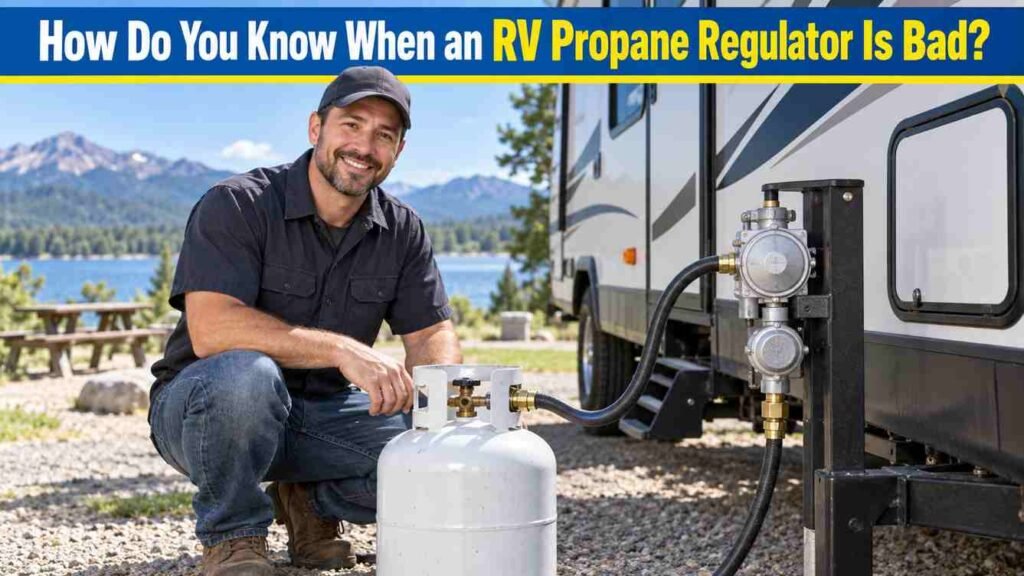
If your RV furnace, water heater, refrigerator, or cooktop is acting strangely, the propane regulator is an obvious suspect because every propane appliance depends on it. But I do not replace a regulator based on one weak burner or one appliance fault. I look for a pattern. A regulator problem usually affects the propane supply to more than one appliance, changes when the total load increases, or produces a clear pressure-control symptom.
In this guide, I’ll show you the signs I use to separate a bad RV propane regulator from common look-alike problems. I’ll also explain what normal RV propane pressure looks like, what high and low pressure symptoms mean, and when I would stop troubleshooting and call a qualified RV or propane technician.
RV Propane Regulator: Normal Technical Values
| Item | Typical Value or Condition | What I Look For |
|---|---|---|
| Regulator type | Two-stage; often automatic changeover on dual-cylinder trailers | Correct type for the RV installation |
| Final outlet pressure | About 11 in. w.c. on many RV systems | Stable pressure at light and loaded conditions |
| 11 in. w.c. in PSI | About 0.397 psi | Shows how low the appliance-side pressure really is |
| 11 in. w.c. in kPa | About 2.74 kPa | Useful for digital manometers and metric specifications |
| Example adjustable range | Some LP-gas regulators are adjustable around 9–13 in. w.c. | Always follow the exact regulator and RV specification |
| Vent condition | Open, screened, dry, unobstructed | No mud, insects, water, ice, corrosion, or damage |
Fisher’s current R632A integral two-stage LP-gas regulator, for example, is designed to reduce tank pressure to 11 inches w.c. and includes pressure taps for checking the system. That does not mean every RV regulator is identical, but it gives you a good picture of the type of pressure control used in many low-pressure propane systems.
If you want more detail on regulator selection, see my guide to what type of propane regulator an RV needs.
What Are the Signs of a Bad RV Propane Regulator?
I group the symptoms into three categories: low-pressure symptoms, high-pressure symptoms, and physical regulator failures. This makes troubleshooting much easier than guessing from one flame.
| Symptom | Possible Regulator Problem | Common Look-Alike |
|---|---|---|
| Weak blue flames on several appliances | Low outlet pressure or excessive droop | Low cylinder level, kinked pigtail, cold weather |
| Furnace quits when water heater starts | Regulator cannot maintain loaded pressure | Undersized hose or restricted pigtail |
| Tall yellow or noisy flames | Outlet pressure may be too high | Dirty burner, wrong air mixture, appliance issue |
| Soot on more than one propane appliance | Possible excessive or unstable pressure | Poor combustion or blocked appliance venting |
| Gas smell or hissing at regulator | Vent leakage, diaphragm/seat failure, fitting leak | Pigtail or cylinder connection leak |
| Pressure keeps rising after appliances shut off | Poor lock-up or seat leakage | Incorrect test setup |
| Changeover does not switch correctly | Automatic-changeover mechanism fault | Closed cylinder valve or bad pigtail |
1. Several RV Propane Appliances Have Weak Flames
One of the strongest clues is that the problem affects multiple appliances. If the cooktop flame is weak, the furnace struggles to stay lit, and the water heater also acts starved for gas, I start looking upstream at the regulator and fuel supply.
A regulator has to maintain usable outlet pressure while gas is flowing. If its spring, diaphragm, seat, or internal mechanism is worn or contaminated, the pressure may look acceptable with almost no load but collapse when several appliances run.


This loaded-pressure drop is closely related to regulator droop. Some droop is normal. Excessive droop is not. If pressure drops so far that appliances cannot operate properly, I would investigate regulator capacity, inlet supply, pigtail restrictions, and regulator condition.
2. The RV Works Until a Second Appliance Turns On
This is a classic load-related symptom. Your stove may look fine by itself. Then the furnace starts and both appliances weaken. Or the water heater fires and the furnace shuts down.
I do not automatically call this a bad regulator because the same symptom can come from a kinked pigtail, restricted hose, low cylinder pressure, or a cylinder that cannot vaporize propane fast enough in cold weather. But if the cylinders are adequately filled, the hoses are good, and inlet supply is normal, a regulator that cannot maintain outlet pressure under load becomes a strong suspect.
| Operating Condition | What May Happen | My Interpretation |
|---|---|---|
| One small burner only | Pressure appears normal | Light-load test alone may miss the problem |
| Furnace starts | Pressure falls noticeably | Check regulator, inlet pressure, hose restriction |
| Multiple appliances on | Flames shrink or appliances shut down | System cannot maintain required flow/pressure |
My related article on propane pressure dropping when another appliance turns on goes deeper into this symptom.
3. Flames Are Too Large, Yellow, or Unstable
A regulator can also fail in the opposite direction. Instead of delivering too little pressure, it may fail to control outlet pressure correctly. That can create oversized flames, unusual burner noise, yellow flames, or soot.
I treat high-pressure symptoms seriously because RV appliances are designed for a specific gas pressure range. The final regulator’s job is to protect those appliance controls from much higher cylinder pressure. If the regulator cannot maintain control, do not try to compensate by changing appliance adjustments.
Yellow flames can also come from dirty burners, blocked air openings, incorrect burner adjustment, or appliance-specific problems. The clue that pushes me back toward the regulator is when several propane appliances show combustion changes at the same time.
4. You Smell Propane or Hear Continuous Hissing at the Regulator
If I smell propane around the regulator, I stop treating the issue as normal performance troubleshooting. PERC advises treating a suspected propane leak as an emergency. Propane odor, hissing gas, detector alarms, and unexplained gas usage can all indicate leakage.
Gas may escape from the regulator itself, but it may also be coming from the pigtail, cylinder connection, inlet fitting, outlet fitting, or hose beside the regulator. That is why location matters.
Continuous gas coming from the regulator vent can indicate internal trouble such as diaphragm damage, seat problems, contamination, or an overpressure condition. I would not plug the vent or attempt to stop it with sealant. The vent is part of the regulator’s safety and pressure-control system.
For a detailed breakdown, see why an RV propane regulator may be leaking.
5. Outlet Pressure Will Not Hold Near the Correct Setting
The best way to judge a regulator is by pressure behavior, not appearance. A regulator can look clean and still have an internal problem.
A qualified technician can check outlet pressure with an appropriate low-pressure manometer. Many RV systems operate around 11 inches w.c., but the exact test procedure and acceptable loaded range depend on the regulator and RV manufacturer.
| Pressure Reading | Approximate Equivalent |
|---|---|
| 9 in. w.c. | 0.325 psi |
| 10 in. w.c. | 0.361 psi |
| 11 in. w.c. | 0.397 psi |
| 12 in. w.c. | 0.434 psi |
| 13 in. w.c. | 0.470 psi |
The important thing is not just the static number. I want to know whether the pressure stays within the manufacturer’s permitted range under a realistic appliance load and whether it settles correctly when the load stops.
If you want the measurement concepts explained in more detail, see how to check propane regulator pressure.
6. The Regulator Has Poor Lock-Up or Pressure Creep
When appliances shut off, a healthy regulator should stop gas flow and let outlet pressure stabilize. The no-flow pressure is called lock-up pressure.
If the pressure continues climbing instead of leveling off, the regulator seat may not be closing correctly. Debris, seat wear, or internal damage can allow gas to creep past the regulating valve. This is not the same as the small normal increase that occurs as a regulator reaches lock-up.
I explain this separately in what lock-up pressure means on a propane regulator.
7. The Regulator Repeatedly Freezes or Ices and Gas Flow Stops
Some exterior frost can occur when propane is flowing heavily because pressure reduction cools the regulator. But if the RV repeatedly loses propane flow as the regulator freezes, I investigate moisture contamination, pigtail restrictions, regulator vent icing, heavy load, and regulator condition.
A regulator that has internal moisture, corrosion, or damage can become increasingly unreliable. However, cold-weather vaporization limits can create the same symptom, especially with small or nearly empty cylinders.
Before replacing the regulator, I separate a true regulator freeze-up from a supply problem. My guide on why an RV propane regulator keeps freezing covers that distinction in detail.
8. The Automatic Changeover No Longer Works Correctly
Many travel trailers and fifth wheels use two removable cylinders connected to an automatic-changeover two-stage regulator. The regulator draws from the selected service cylinder and changes to the reserve cylinder when pressure from the service cylinder drops.
If the indicator behaves incorrectly, the RV loses gas even though the reserve cylinder is full, or gas flow changes depending on which side is selected, I test the entire changeover assembly and both pigtails.
A bad pigtail can imitate a failed changeover. So can a closed cylinder valve or a cylinder connection that has triggered an excess-flow device. I do not condemn the regulator until both supply sides have been checked.
9. The Vent Is Blocked, Corroded, or Damaged
The regulator vent is not decorative. The diaphragm needs the spring case to breathe properly so it can respond to changes in outlet pressure. Water, road debris, mud, insect nests, snow, or ice can interfere with that operation.
Fisher’s R632A uses screened vents and a draining spring-case design, and its first-stage drip-lip vent is oriented downward. That tells you how seriously manufacturers treat drainage and vent protection.
If I see heavy corrosion, water marks, a damaged vent screen, or evidence that the regulator has been submerged, I would have it professionally evaluated and usually replaced rather than assuming it remains reliable.
10. The Regulator Is Old, Corroded, or Physically Damaged
Age alone does not prove a regulator has failed, but age combined with pressure problems is meaningful. Internal diaphragms, seat materials, springs, and seals do not last forever.
Replacement intervals are manufacturer-specific. As one example, Fisher lists a 20-year recommended replacement life for its R632A integral two-stage regulator. That is not a universal RV rule. Your regulator manufacturer or RV manufacturer may specify a different service life, and harsh exposure can justify earlier replacement.
I pay particular attention to impact damage, rust around seams or fittings, missing vent screens, evidence of water entry, and a regulator that has been contaminated or submerged.
Bad Regulator vs. Common RV Propane Problems
Before I replace a regulator, I try to rule out these common causes because they can create nearly identical symptoms.
| Problem | How It Mimics a Bad Regulator | Clue |
|---|---|---|
| Empty or nearly empty cylinder | Low pressure or no gas | Other cylinder works normally |
| Excess-flow device tripped | Very weak gas flow after cylinder change | Often occurs after valve is opened too quickly |
| Kinked or deteriorated pigtail | Pressure falls under load | Problem may follow one cylinder side |
| Blocked regulator vent | Erratic outlet pressure | Visible dirt, ice, insect debris, or damage |
| Cold-weather vaporization limit | Furnace starves for gas | Problem improves as temperature rises or with fuller/larger cylinder capacity |
| One faulty appliance | Pilot or burner problem | Other propane appliances work normally |
How I Narrow Down Whether the Regulator Is Bad
I start with the simplest questions. Do multiple propane appliances have the same problem? Are the cylinders actually supplying gas? Does the problem occur on both cylinder sides? Does it appear only when demand becomes high?
Then I visually inspect the regulator area without dismantling it. I look for cracked hoses, kinked pigtails, loose-looking connections, impact damage, corrosion, a blocked vent, water entry, ice, or evidence of gas leakage.
If the symptoms point toward pressure regulation, the next useful step is a proper pressure test performed with the correct gauge or manometer and according to the regulator and RV manufacturer’s procedure. PERC recommends qualified professionals for propane-system service and repairs, and I agree with that approach because incorrect adjustments can create either fuel starvation or dangerous overpressure.
Can I Adjust a Bad RV Propane Regulator?
I would not use adjustment as a way to compensate for a regulator that is worn, leaking, contaminated, corroded, or unable to hold pressure. Adjustment is for setting a serviceable regulator according to its specification; it is not a cure for internal failure.
If outlet pressure is low because the regulator is undersized, supply pressure is poor, or a pigtail is restricted, turning an adjustment screw does not solve the real cause. If pressure is creeping high because the seat will not close, adjustment is especially inappropriate.
For RV owners, regulator replacement is often more practical than internal repair, but the replacement still needs to match the original system: correct propane service, stage configuration, inlet and outlet connections, pressure setting, BTU capacity, vent orientation, and changeover function if applicable.
When Should I Replace an RV Propane Regulator?
I would strongly consider replacement when a qualified pressure test confirms poor regulation, the regulator leaks through the vent, lock-up is defective, outlet pressure is unstable across normal loads, the regulator has internal or heavy external corrosion, the body is damaged, or the automatic changeover mechanism has failed and the assembly is not serviceable.
| Finding | Typical Action |
|---|---|
| Low loaded pressure caused by kinked hose | Repair supply restriction; regulator may be fine |
| Only one appliance malfunctions | Diagnose appliance before regulator |
| Persistent vent leakage | Shut down system and have regulator serviced/replaced |
| Pressure creeps upward at no flow | Regulator seat/lock-up problem; professional service required |
| Pressure collapses under normal total RV load | Check supply restrictions and regulator capacity/condition |
| Regulator submerged or badly corroded | Replacement is generally the safer approach |
What Happens If I Keep Using a Bad RV Propane Regulator?
A low-pressure regulator problem may leave you with unreliable heat, a water heater that will not stay lit, weak cooktop flames, or a refrigerator that drops out on propane. Those problems are frustrating, but excessive pressure can be more serious.
A regulator that cannot control outlet pressure can affect combustion and appliance safety controls. Gas leakage creates a fire and explosion hazard. For that reason, if I smell propane, hear unexplained hissing, or see evidence of leakage, I stop using the system rather than continuing to test appliances.
PERC advises leaving the area if a propane leak is suspected, avoiding ignition sources, and having the propane system checked by a qualified professional before it is used again.
Frequently Asked Questions
What is the most common sign of a bad RV propane regulator?
The strongest general clue is that several propane appliances show the same pressure-related problem at once. Weak flames, furnace shutdowns, and a water heater that fails under simultaneous demand can point to low loaded pressure. I still rule out cylinders and pigtails before blaming the regulator.
Can a bad RV regulator cause no propane flow?
Yes, but no flow can also result from an empty cylinder, closed valve, tripped excess-flow device, frozen moisture, or blocked pigtail. I would not replace the regulator until those causes are checked.
Can a bad regulator cause yellow flames?
It can if outlet pressure is too high or unstable, but a yellow flame can also come from dirty burners or poor air mixture. Multiple affected appliances make a regulator or system-pressure issue more likely.
Can a bad RV regulator cause the furnace to shut off?
Yes. If the regulator cannot maintain pressure while the furnace is demanding gas, the furnace may fail to ignite properly or may shut down. A restricted pigtail or low cylinder vaporization rate can create the same symptom.
Should an RV propane regulator make noise?
A faint hum or vibration while gas is flowing can occur. Persistent hissing, especially with propane odor, is different and should be treated as a possible leak. See my guide on why an RV propane regulator makes noise.
How much pressure should an RV propane regulator supply?
Many RV systems use about 11 inches of water column at the final low-pressure outlet, which is approximately 0.397 psi or 2.74 kPa. Always use your RV and regulator manufacturer’s specification for the exact system.
How long does an RV propane regulator last?
There is no single life span that applies to every RV regulator. Product design, environment, use, corrosion, contamination, and manufacturer recommendations all matter. Some Fisher LP-gas regulators list a 20-year recommended replacement life, but that should not be treated as a universal RV replacement interval.
Can I test an RV propane regulator myself?
You can visually check obvious items such as cylinder level, hose condition, and whether the vent is blocked, but pressure testing and propane-system service should follow the manufacturer’s procedure and are best handled by a qualified RV or propane technician. Never use a flame to look for leaks.
Bottom Line
When I am trying to decide whether an RV propane regulator is bad, I look for a system-wide pattern rather than one isolated symptom. Multiple weak appliances, pressure that collapses under load, excessive pressure, poor lock-up, persistent vent leakage, repeated changeover failures, or serious corrosion all move the regulator higher on my suspect list.
At the same time, I rule out the simple causes first: empty cylinders, closed valves, tripped excess-flow devices, kinked pigtails, vent blockage, cold-weather vaporization limits, and an appliance-specific fault. A regulator is only one link in the propane system.
If there is propane odor, continuous hissing, visible damage, or evidence the regulator cannot control pressure correctly, I would stop using the propane system and have it checked rather than trying to adjust around the problem.
Technical Sources
For the regulator pressure and product-performance examples in this article, I referenced Emerson Fisher’s R632A integral two-stage regulator information. For propane leak and service safety, I referenced the Propane Education & Research Council safety guide.

Mike is an experienced propane technician with over 15 years of professional experience in the field. He has dedicated his career to helping customers with their propane needs, from installation to maintenance and repair. Together with Jeremy, he co-founded this website to provide useful information and guidance to customers seeking reliable propane services.


