
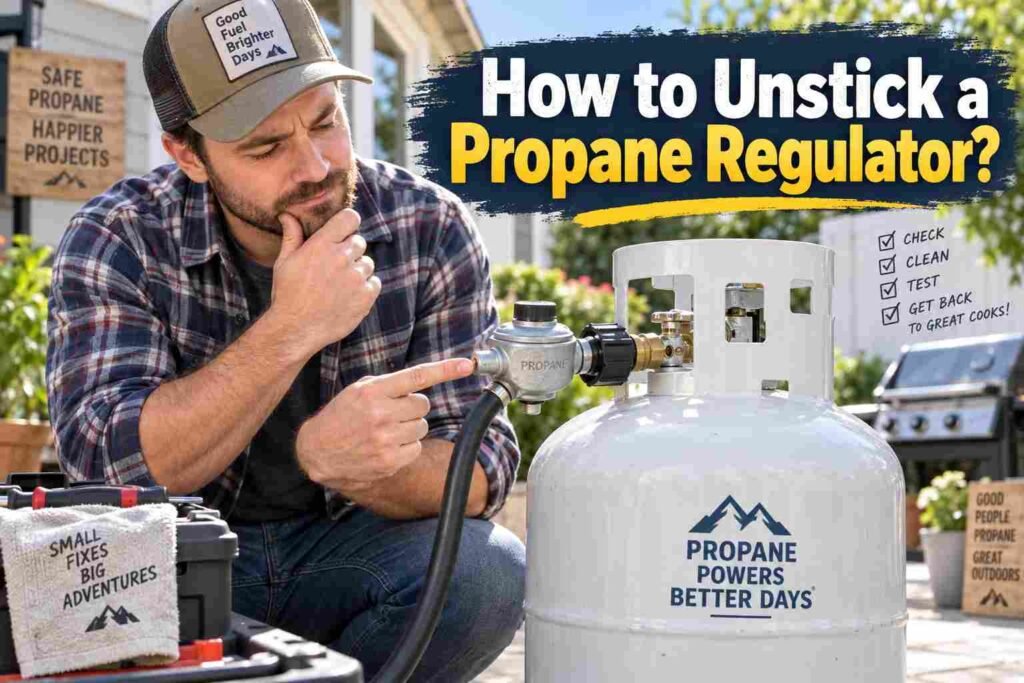
When someone asks me how to unstick a propane regulator, I first clarify what “stuck” means. In many cases, the regulator itself is not mechanically seized. What you are seeing is no gas flow, very weak flames, an appliance that will not light, or a system that worked until the cylinder was changed.
Those symptoms are often caused by a safety device that reacted to a sudden gas surge. Many modern propane cylinder connections include an excess-flow device. If the cylinder valve is opened too quickly, the device can interpret the sudden rush of gas as a broken hose and restrict flow. The result feels exactly like a stuck regulator even though the regulator may be working normally.
That is why I start with the simplest and safest checks before I blame the regulator itself.

Propane Regulator “Stuck” Symptoms: Technical Overview
| Symptom | Likely Cause | What I Do First |
|---|---|---|
| No gas after changing cylinder | Excess-flow device activated | Shut appliances off, close cylinder valve, wait, reopen slowly |
| Very weak flame on all appliances | Restricted excess-flow device, low cylinder pressure, kinked hose, regulator issue | Reset supply and inspect pigtail/connection condition |
| One appliance has low flame | Appliance-specific problem more likely | Check appliance before condemning regulator |
| Gas odor or hissing | Possible leak | Leave area, avoid ignition sources, call propane supplier/emergency services |
| Regulator vent leaking gas | Internal regulator failure or overpressure condition | Shut supply off if safe and have regulator serviced/replaced |
| Regulator freezes and flow stops | Moisture, cold weather, excessive demand, restriction | Do not heat regulator; have system inspected if recurring |
How to Safely Reset a Propane Regulator That Seems Stuck
For a small cylinder, grill, RV, or other system with a Type 1/QCC-style cylinder connection, the following reset procedure is the first thing I try. It is based on manufacturer guidance for excess-flow devices.
1. Turn off all propane appliances
I turn every burner, furnace, water heater, refrigerator, grill valve, and pilot control fully off. The point is to stop downstream gas demand so the pressure on both sides of the excess-flow device can equalize.
If even one appliance valve is still open, the system may continue drawing gas and prevent the safety device from resetting.
2. Close the propane cylinder valve
I close the cylinder valve completely by turning it clockwise. This stops flow from the cylinder.


If I smell propane strongly, hear leaking gas, or suspect the leak is at the cylinder itself, I do not stay near the equipment trying to reset it. Propane leaks can ignite or explode. In that situation, I move away and call the propane supplier, fire department, or emergency services as appropriate.
3. Wait for pressure to equalize
Marshall Excelsior specifies waiting about 60 seconds after shutting appliance valves when a Type 1/QCC excess-flow device has activated. Some systems may need more time, especially if the hose is long.
| Reset Step | Typical Time | Purpose |
|---|---|---|
| All appliances off | Immediate | Stops downstream demand |
| Cylinder valve closed | Immediate | Stops supply flow |
| Equalization wait | About 60 seconds; sometimes longer | Allows excess-flow device to reset |
| Reopen cylinder valve | Slowly over several seconds | Prevents another sudden flow surge |
| Wait before relighting | About 1 minute on some RV guidance | Allows pressure to stabilize |
4. Open the cylinder valve slowly
This is the step that matters most. I do not snap the valve open. I open it slowly so the propane system pressurizes gradually.
Marshall Excelsior warns that opening the cylinder valve too quickly can activate the excess-flow feature. Their guidance is to slowly open the valve after the system has equalized.
5. Wait briefly, then relight appliances one at a time
I give the system a moment to stabilize, then relight appliances according to each appliance manufacturer’s instructions. I do not turn everything on at once.

If normal flow returns, the problem was probably not a physically stuck regulator. It was likely an excess-flow restriction or pressure-equalization issue.
Why Opening the Propane Valve Too Fast Can Make the Regulator Seem Stuck
Many propane cylinder connections are designed to restrict flow if gas suddenly rushes through the fitting. The safety device cannot know whether that surge came from a broken hose or from someone opening the cylinder valve too fast. It simply reacts to the abnormal flow rate.
Once the device activates, only a small amount of propane may pass. You may see tiny burner flames, an RV furnace that will not stay running, or a grill that barely gets warm.
Closing the cylinder valve and appliance valves stops the flow. As pressure equalizes across the device, it can reset. When the cylinder valve is reopened slowly, the system pressurizes without triggering the device again.


This is one reason I always open portable propane cylinder valves slowly after changing tanks.
What If the Reset Does Not Work?
If I repeat the proper reset and flow is still restricted, I stop assuming the problem is simple. Marshall Excelsior specifically warns that if the flow-limiting device fails to reset, a leak may be present in the gas system. Their instructions say to close the LP-gas container valve and have the connections checked.
At that point I look at several possibilities:
- the cylinder valve is not supplying correctly;
- the Type 1/QCC connector is damaged or not fully engaged;
- the pigtail or hose is kinked, internally damaged, or contaminated;
- the excess-flow device itself is faulty;
- the regulator inlet is restricted;
- the regulator is frozen or contaminated;
- the regulator has an internal mechanical failure;
- the system has a gas leak that prevents pressure equalization;
- the cylinder is empty or too cold to supply the required load.
If the issue is on a fixed residential propane system rather than a small portable-cylinder setup, I do not recommend disconnecting piping or experimenting with regulator components. PERC’s current safety guidance says propane system installation, modification, and repair should be handled by a qualified professional.
How Do I Tell Whether the Regulator Is Actually Stuck?
I look for a pattern across the whole propane system. If every propane appliance has low or no flow at the same time, the supply side deserves attention. If only one appliance has a problem, I am more suspicious of that appliance’s valve, orifice, igniter, burner, or local connector than the main regulator.
A regulator that is genuinely failing may show unstable outlet pressure, pressure that will not recover under load, gas venting from the regulator, corrosion, water damage, internal contamination, or repeated freeze-ups. Those problems are different from a one-time excess-flow trip.
| What I Observe | What It Suggests | Next Step |
|---|---|---|
| Problem started immediately after changing cylinder | Excess-flow trip likely | Perform safe reset and reopen valve slowly |
| All appliances weak under load | Supply restriction, undersized regulator, low inlet pressure, cold cylinder | Check supply system professionally if reset fails |
| Regulator leaks from vent | Internal failure/overpressure condition | Stop using system and call qualified technician |
| Pressure cycles or surges | Regulator control problem | Have outlet pressure and lock-up tested |
| Only one burner or appliance affected | Local appliance issue more likely | Troubleshoot appliance branch |
Can I Tap or Hit a Propane Regulator to Unstick It?
I do not recommend it. A propane regulator is a precision pressure-control device containing a diaphragm, spring, valve seat, lever mechanism, vent, and relief features. Hitting the regulator can damage those parts, crack the housing, change calibration, or create a leak.
If a regulator only works after being struck, I treat that as evidence the regulator is not reliable enough to remain in service.
The same rule applies to shaking the regulator, prying on the adjustment mechanism, or forcing the selector on an automatic-changeover regulator.
Can I Spray WD-40 or Lubricant Into a Propane Regulator?
No. I do not spray oil, penetrating fluid, silicone, carburetor cleaner, compressed air, or any other chemical into the regulator inlet or vent.
The regulator’s internal elastomers and sealing surfaces are designed for LP-gas service. Introducing an unapproved chemical can swell seals, contaminate the valve seat, collect dirt, or interfere with pressure control.
If contamination is suspected inside the regulator, the safe solution is inspection and replacement or service according to the regulator manufacturer’s instructions—not spraying chemicals into it.
Can I Heat a Frozen Propane Regulator to Unstick It?
I do not use a torch, heat gun, hair dryer, boiling water, electric heater, or open flame to force a frozen regulator back into operation.
A frozen regulator may be telling me that moisture has entered the system, the vent is iced, the propane load is too high for the conditions, or the regulator is contaminated. Heating the regulator does not correct the underlying cause and can expose propane equipment to unsafe temperatures or ignition sources.
If your regulator repeatedly freezes, see my separate guide on why RV propane regulators keep freezing. I treat repeated freeze-ups as a system problem rather than something to thaw and ignore.
Can a Clogged Vent Make a Propane Regulator Seem Stuck?
Yes. The diaphragm needs the regulator vent to reference atmospheric pressure. If the vent is blocked by mud, insects, snow, ice, paint, or debris, the regulator may not control outlet pressure correctly.
I visually inspect the vent from the outside and make sure it is not obviously covered or obstructed. I do not poke wires, drills, screwdrivers, or compressed air into the regulator vent because that can damage internal components.
If the vent is contaminated internally or the regulator has been submerged, heavily corroded, or physically damaged, I would replace it with the correct approved regulator rather than attempting a field repair.
Can a Kinked Pigtail Cause a “Stuck” Regulator?
Absolutely. A propane pigtail can collapse internally, kink at the fitting, become contaminated with oily residue, or develop a restricted excess-flow device. To the user, the symptom looks like the regulator is not passing gas.
I visually check that flexible hoses are not kinked, crushed, stretched, rubbing on sharp edges, or heat-damaged. If a hose looks questionable, I do not try to straighten a badly damaged hose and put it back into service. I replace it with the correct propane-rated part.
What About an Automatic Changeover Regulator That Will Not Switch?
On an RV or dual-cylinder setup, a regulator may appear stuck when the real issue is the automatic changeover mechanism, one closed cylinder valve, a restricted pigtail, or an empty reserve cylinder.
I confirm both cylinders actually contain propane and that the valves are open as the regulator manufacturer requires. I also check the selector position and indicator. On many automatic-changeover regulators, red means the selected service cylinder has dropped below the changeover threshold and the reserve cylinder has taken over.
If the indicator stays red after a full cylinder is installed and correctly selected, I would not force the selector or open the regulator. I would check the pigtail and cylinder connection and then have the regulator inspected if the problem remains.
For more detail, see how an automatic changeover propane regulator works.
How Pressure Helps Diagnose a Regulator That Seems Stuck
When a technician checks a propane regulator, the key measurement is usually not tank pressure alone. It is whether the regulator maintains the specified outlet pressure at no flow and under load.
For many low-pressure propane systems, the outlet is around 11 inches water column, which is only about 0.397 psi. A first-stage regulator in a conventional two-stage residential system may deliver around 10 psig to a second-stage regulator.
| Pressure Point | Typical Example | Diagnostic Meaning |
|---|---|---|
| Cylinder side | Temperature-dependent; can exceed 100 psig | Shows available inlet pressure, not appliance pressure |
| First-stage outlet | Often around 10 psig | Feeds second-stage regulator |
| Low-pressure final outlet | Around 11 in. w.c. (0.397 psi) | Feeds many domestic/RV appliances |
| Outlet under heavy load | Should remain within manufacturer range | Large drop may indicate restriction, undersizing, or regulator problem |
If outlet pressure is correct with no load but falls dramatically when appliances turn on, the problem may be regulator droop, insufficient inlet pressure, a restricted hose, or an undersized regulator. You can read more in my article on regulator droop in a propane system.
When Should I Stop Trying to Reset the Regulator?
I stop trying the simple reset and call for service when the system shows any sign that goes beyond a one-time excess-flow trip. A propane regulator is a safety component, so repeated malfunction is not something I keep “working around.”
I would stop using the system and have it inspected if:
- the regulator leaks gas from the vent or body;
- you smell propane after the supply is turned on;
- the reset repeatedly fails;
- all appliances continue to have very low flow;
- outlet pressure is unstable or clearly too high;
- the regulator is badly corroded, dented, cracked, or water-damaged;
- the regulator repeatedly freezes and stops flow;
- the system only works after the regulator is tapped, shaken, or moved;
- the regulator is the wrong pressure class or capacity for the installation.
PERC’s current propane safety guidance is direct on this point: propane system repairs, modifications, and service should be handled by a qualified professional. A regulator controls combustible gas under pressure, so an internal problem is not a good candidate for a DIY teardown.
Should I Replace a Propane Regulator Instead of Trying to Unstick It?
Often, yes. If a regulator has an internal mechanical problem, replacement is usually safer and more practical than trying to repair it in the field.
I first confirm that the replacement regulator has the correct inlet pressure rating, outlet pressure, BTU capacity, connection sizes, vent orientation, stage, and intended application. “Looks the same” is not enough.
If you are unsure which replacement is correct, see my guide on how to know which propane regulator you need. I also explain why propane regulators are not universal.
Propane Regulator Reset vs. Replacement
| Condition | Reset May Be Appropriate? | Replacement / Service More Appropriate? |
|---|---|---|
| Problem started after opening cylinder valve quickly | Yes | If reset fails repeatedly |
| No visible damage, no gas odor | Yes, simple supply reset may be reasonable | If pressure remains abnormal |
| Gas leaking from vent/body | No | Yes—stop use and call qualified professional |
| Regulator only works after tapping or shaking | No | Yes |
| Severe corrosion or physical damage | No | Yes |
| Repeated freezing or moisture problems | Temporary reset may restore flow | Underlying cause needs service |
Common Mistakes That Make a Propane Regulator Seem Stuck
Opening the cylinder valve too quickly
This is one of the most common causes I see on portable propane systems. The excess-flow device sees a rapid surge and restricts gas flow. The fix is not to keep opening and closing the valve faster; it is to shut everything down, allow equalization, and reopen slowly.
Trying to reset the system while an appliance valve is still open
If gas demand remains downstream, the excess-flow device may not equalize and reset properly. I make sure every propane appliance control is off first.
Assuming low flow means the regulator is bad
A low cylinder, cold weather, a damaged hose, a restricted connector, or a closed reserve-cylinder valve can all create the same symptom.
Using the wrong regulator
A regulator may appear to “stick” when it is simply undersized or designed for a different pressure range. A grill regulator, first-stage regulator, second-stage regulator, integral two-stage regulator, and high-pressure adjustable regulator are not interchangeable.
Trying to fix a leak by tightening everything harder
Overtightening fittings can damage threads, flare seats, gaskets, and regulator bodies. If a connection leaks, I use the correct fitting procedure and replace damaged components rather than forcing them tighter.
Frequently Asked Questions
How do I reset a propane regulator after changing the tank?
I turn all propane appliances off, close the cylinder valve, wait about 60 seconds for pressure to equalize, then slowly reopen the cylinder valve. On some RV systems, manufacturer guidance recommends waiting another minute before relighting appliances. If normal flow does not return, I stop and check for a leak, damaged connector, pigtail problem, or regulator fault.
Why does my propane regulator have no flow?
Possible causes include a tripped excess-flow device, empty cylinder, closed valve, frozen regulator, kinked hose, blocked pigtail, internal regulator failure, or leak that prevents pressure equalization. If you have pressure but no usable flow, see my guide on why a propane regulator can have pressure but no flow.
Can I remove the regulator and clean it?
I do not recommend opening or cleaning the internal mechanism of a propane regulator unless the manufacturer specifically provides a service procedure and the work is performed by a qualified person. PERC advises against untrained repair or modification of propane system components.
Can I blow compressed air through a propane regulator?
No. Compressed air can damage the diaphragm, move contamination deeper into the regulator, upset calibration, or introduce moisture. I replace or professionally service a contaminated regulator rather than blowing air through it.
Can I use a hammer to free a propane regulator?
No. If a regulator needs impact to function, I consider it unreliable. Striking a regulator can damage the housing or internal control parts and create a leak.
Why does the regulator work after I disconnect and reconnect the tank?
Disconnecting and reconnecting can stop flow long enough for an excess-flow device to reset. The real cause may have been opening the cylinder too quickly, not a stuck regulator.
How long should I wait for an excess-flow device to reset?
Marshall Excelsior specifies about 60 seconds for its Type 1/QCC connector guidance, with additional time sometimes needed depending on hose length. Its RV Stay-Longer instructions use a roughly one-minute wait before relighting, and suggest trying a two-minute waiting period if needed. I follow the instructions for the actual connector or regulator installed on the system.
What if the regulator keeps locking up?
Repeated lockout is not normal. I check for leaks, hose restrictions, regulator sizing, cold-weather supply limits, and the condition of the cylinder connection. If it keeps happening, I have the system professionally tested rather than repeatedly resetting it.
How I Troubleshoot a “Stuck” Propane Regulator
My approach is simple: I separate a resettable supply restriction from an actual regulator failure.
| Step | What I Check | What It Tells Me |
|---|---|---|
| 1 | Any propane odor, hissing, visible damage? | If yes, stop and treat as leak/safety issue |
| 2 | Did problem begin after tank change or fast valve opening? | Points toward excess-flow activation |
| 3 | All appliance controls fully off? | Required for proper equalization/reset |
| 4 | Hose/pigtail damaged or kinked? | Can imitate regulator restriction |
| 5 | Does a slow reopening restore flow? | If yes, likely excess-flow reset |
| 6 | Does low flow return repeatedly? | System needs deeper inspection |
Bottom Line: How Do You Unstick a Propane Regulator?
In most cases, I do not try to physically “unstick” the regulator. I first reset the propane supply because a tripped excess-flow device is a common cause of no-flow or low-flow symptoms.
For a portable-cylinder or RV Type 1/QCC system, I turn all propane appliances off, close the cylinder valve, wait for pressure to equalize, then reopen the cylinder valve slowly. If normal flow returns, the regulator probably was not mechanically stuck.
If the reset does not work, or if the regulator leaks, vents gas, freezes repeatedly, has visible damage, produces unstable pressure, or only works when tapped or shaken, I stop using it and have the system inspected. I do not open the regulator, spray lubricant into it, hit it, heat it, or force the internal mechanism.
Technical Sources

Mike is an experienced propane technician with over 15 years of professional experience in the field. He has dedicated his career to helping customers with their propane needs, from installation to maintenance and repair. Together with Jeremy, he co-founded this website to provide useful information and guidance to customers seeking reliable propane services.


