
Quick Answer
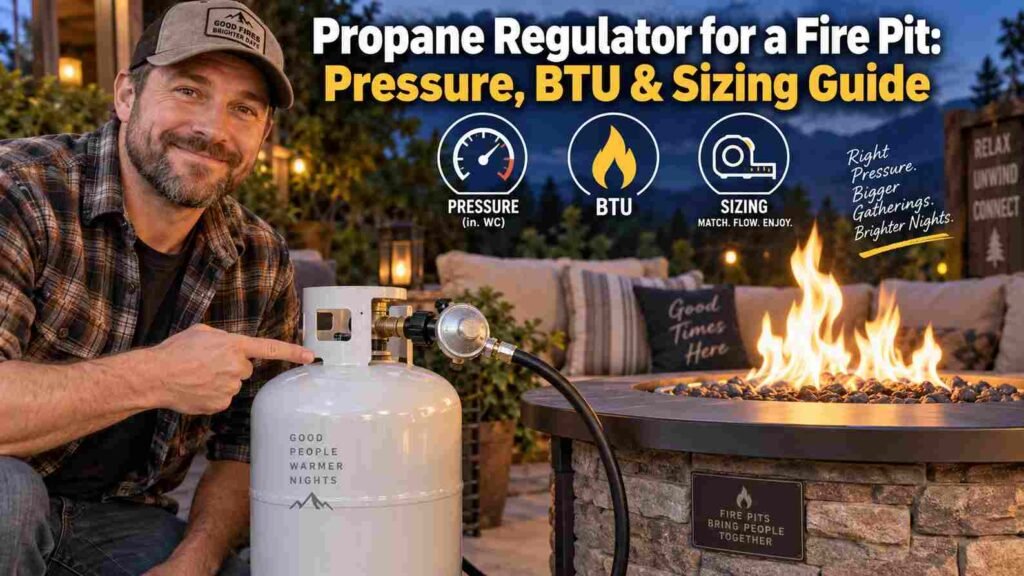
For most propane fire pits, I use a regulator that delivers the exact low pressure specified by the fire-pit manufacturer—commonly around 11 inches of water column for portable cylinder-fed models. Built-in LP fire-pit inserts often use low-pressure supply as well, with some current systems specifying roughly 8–11 inches WC at the appliance. The regulator must also be large enough for the fire pit’s BTU rating, which can range from about 40,000 BTU/hr to well over 200,000 BTU/hr. I never replace a fire-pit regulator with a higher-PSI model just to get a taller flame; pressure, BTU capacity, burner orifice, gas line size, and ignition system all have to match.
A propane fire pit looks simple from the outside: tank, regulator, hose, valve, burner, and flame. But the regulator is doing more than just reducing tank pressure. It has to deliver the correct pressure while flowing enough propane for the burner at full fire.
That is why I do not choose a fire-pit regulator by connection size or maximum PSI alone. A regulator can fit the tank and still be wrong because it supplies too much pressure, too little flow, or the wrong outlet range for the ignition system.


In this guide, I’ll show you how I match regulator pressure, BTU capacity, tank type, gas line size, fittings, portable vs. built-in fire-pit design, and safety requirements.
What Pressure Regulator Does a Propane Fire Pit Need?
For many portable propane fire pits, the target pressure is about 11 inches of water column, which is roughly 0.4 PSI. That is a standard low-pressure LP-gas range.
HPC Fire’s small-tank fire-pit kit, for example, uses a QCC1 cylinder connection and a regulator that supplies 11″ WC to the appliance. Built-in HPC fire-pit systems can have different requirements; current electronic systems commonly specify about 8–11″ WC supply pressure for LP gas, with the appliance regulating internally as designed.
| Fire-Pit Type | Example LP Pressure | Approx. PSI | Typical Regulator Approach |
|---|---|---|---|
| Portable cylinder-fed fire pit | 11″ WC | 0.40 PSI | Factory low-pressure QCC1 regulator |
| Built-in certified fire-pit insert | 8–11″ WC supply on some systems | 0.29–0.40 PSI | Fixed low-pressure supply sized to manufacturer specs |
| Some LP fire-feature systems | 11–14″ WC on certain product families | 0.40–0.51 PSI | Manufacturer-specific low-pressure regulation |
| 2-PSI distribution system | 2 PSI upstream | 2.0 PSI | Requires downstream regulation before low-pressure fire pit |
The exact manual always wins. I do not assume that every propane fire pit wants exactly 11″ WC just because many portable units do.


If pressure terminology is confusing, see my guide on propane regulator inlet pressure versus outlet pressure.
Why I Do Not Use a High-Pressure Regulator on a Standard Fire Pit
A 10-, 20-, or 30-PSI regulator is normally the wrong choice for a fire pit designed around low-pressure LP gas.
Ten PSI is roughly 25 times higher than 11″ WC. Feeding a low-pressure valve, pilot system, or electronic gas control with that kind of pressure can create unsafe flame height, noise, valve damage, unstable operation, or failure of the ignition system.
| Pressure | Approx. Inches WC | Typical Application |
|---|---|---|
| 11″ WC | 11″ WC | Portable LP fire pit / low-pressure appliance |
| 14″ WC | 14″ WC | Upper range on some LP fire-feature systems |
| 2 PSI | About 55″ WC | Intermediate distribution pressure |
| 10 PSI | About 277″ WC | High-pressure outdoor burner applications |
| 20 PSI | About 554″ WC | Forge / boiler / specialty burner systems |
HPC specifically notes that excessive pressure can cause very tall flames, valve noise, humming or chatter, and component damage. If a fire pit is designed for low-pressure operation, I keep it low-pressure.
For a broader comparison of propane pressure ranges, see how many PSI a propane regulator supplies.

How Many BTUs Does a Propane Fire Pit Use?
Fire-pit output varies dramatically. Small portable units may be around 40,000–60,000 BTU/hr. Larger built-in burners can be 100,000, 150,000, 200,000 BTU/hr or more. HPC notes fire-feature ratings ranging from roughly 40,000 to 400,000 BTU/hr across its product line.
| Fire-Pit Output | Typical Use | Regulator Capacity I Consider |
|---|---|---|
| 40,000–60,000 BTU/hr | Small portable fire pit | At least full burner input at required pressure |
| 75,000–100,000 BTU/hr | Medium portable or built-in unit | Regulator rated comfortably above burner load |
| 100,000–150,000 BTU/hr | Large residential fire pit | Commercial-capacity low-pressure regulator |
| 150,000–300,000 BTU/hr | Large built-in fire feature | High-flow low-pressure regulator and correctly sized piping |
| 300,000–400,000 BTU/hr | Very large custom fire feature | Engineered gas supply and regulator system |
Pressure and capacity are separate specifications. A regulator can deliver 11″ WC and still be too small if its maximum flow is only 60,000 BTU/hr and the burner requires 150,000 BTU/hr.
HPC’s current regulator catalog illustrates this clearly: it lists low-pressure regulators around 100,000, 150,000, and 300,000 BTU/hr capacity, all intended to regulate within a low-pressure range rather than deliver high PSI.
My article on what BTU capacity means on a propane regulator explains why this matters.


How I Size a Fire-Pit Regulator
I start with the fire pit’s nameplate or installation manual. I want four numbers: fuel type, required inlet pressure, maximum input BTU/hr, and connection size.
If the fire pit is rated 100,000 BTU/hr and needs 11″ WC, the regulator has to provide at least 100,000 BTU/hr while holding the required outlet pressure under load.
For a 200,000-BTU built-in fire feature, I need a regulator, flex connector, shutoff valve, and gas line all capable of carrying that flow. Installing a 300,000-BTU regulator does not help if the flex line is only rated for 100,000 BTU/hr.
| What I Verify | Example | Why It Matters |
|---|---|---|
| Fuel type | LP / propane | Natural-gas and propane components differ |
| Required inlet pressure | 8–11″ WC | Protects valves and controls |
| Burner input | 150,000 BTU/hr | Sets minimum regulator and piping flow capacity |
| Connection size | 3/8, 1/2, 3/4 in. depending on system | Must match approved gas train |
| Ignition type | Match-lit, flame-sense, electronic | Some controls are more pressure-sensitive |
If you need help working through the flow calculation, see how I calculate propane regulator BTU capacity.
Portable Fire Pit vs. Built-In Fire Pit Regulator
I treat portable and built-in fire pits differently because the gas supply architecture is different.
| Feature | Portable Fire Pit | Built-In Fire Pit |
|---|---|---|
| Propane source | Usually 20-lb cylinder | Often larger cylinder bank or ASME tank |
| Regulator | Usually factory hose/regulator assembly | Separate regulator system sized to fire feature |
| Typical pressure | Often 11″ WC | Manufacturer-specific low-pressure supply |
| Connection | Usually QCC1 / Type 1 | POL, NPT, flare, fixed piping depending on design |
| Gas line length | Short hose | Can be long underground or fixed run |
| Sizing concern | Factory matched components | Pressure drop and BTU capacity over full run |
For a portable unit, I prefer the original regulator and hose assembly or an exact manufacturer-specified replacement. For a built-in fire pit, I size the regulator as part of the complete LP system.
Some certified built-in electronic fire pits are not approved for small portable LP cylinders at all. Their manuals call for permanent fixed piping. That is another reason I never assume a portable fire-pit regulator can be substituted on a built-in system.
Can I Use a 20-Lb Propane Tank With a Fire Pit?
Yes, if the fire pit is specifically designed and listed for a portable cylinder.
A 20-pound cylinder is common for portable fire pits in the 40,000–60,000 BTU/hr range. The fire pit’s supplied regulator often uses a Type 1/QCC1 connector with an excess-flow device.
Large built-in fire features may demand more vapor than a 20-pound cylinder can reliably provide, especially in cold weather or at low tank levels. HPC specifically advises considering larger tanks such as 100-pound cylinders or permanent larger tanks for high-BTU fire features.
I do not connect a built-in 150,000- or 200,000-BTU fire feature to a small cylinder unless the manufacturer explicitly approves that setup.
Why My Fire Pit Flame Gets Smaller After a Few Minutes
If the fire pit starts strong and then the flame shrinks, I look at both the regulator and the propane supply.
| Symptom | Possible Cause | What I Check |
|---|---|---|
| Strong flame, then weak flame | Cylinder vaporization limit | Tank size, temperature, fill level |
| Weak flame only on HIGH | Regulator or gas line undersized | BTU capacity and line sizing |
| Very low flame after tank change | Excess-flow device triggered | Shut down and reopen cylinder valve slowly |
| Flame changes with other appliances | Shared regulator undersized | Combined BTU load |
| Problem worse in cold weather | Tank vapor pressure/vaporization reduced | Larger approved propane supply |
| Flame weak from first ignition | Wrong pressure regulator | Required inlet pressure |
HPC’s troubleshooting guidance specifically notes that low flame on high can be caused by improper gas pressure, low tank level, a pinched hose, or an undersized gas supply line.
If you have a regulator that seems to work briefly and then stops flowing, see why a propane regulator can work for a few minutes and then stop.
Why I Open the Propane Tank Valve Slowly
Portable cylinder connectors often include an excess-flow safety device. If gas starts moving too quickly when the cylinder valve is opened, that device can restrict flow.
The result can look like a bad regulator: the fire pit lights, but the flame remains tiny even when the control is turned to high.
I make sure the fire-pit control valve is off before opening the cylinder. Then I open the cylinder valve slowly so the pressure can equalize before lighting, following the appliance manufacturer’s instructions.
This is also why I do not immediately replace the regulator when a portable fire pit suddenly develops a weak flame after a tank change.
Can I Use a 2-PSI Propane System for a Fire Pit?
Yes, but only as an upstream distribution system with proper downstream regulation where the fire pit requires low pressure.
A 2-PSI line is useful for moving a lot of gas over a longer distance through smaller piping. But a fire pit designed for 10 or 11″ WC cannot be connected directly to 2 PSI.
I install or specify a listed line-pressure regulator at the appropriate point to reduce the 2-PSI distribution pressure to the pressure required by the fire feature.
This is a professional gas-system design issue. I verify regulator venting, capacity, lock-up pressure, line sizing, and local code requirements rather than treating a 2-PSI regulator as a plug-and-play accessory.
What Size Gas Line Does a Fire Pit Need?
There is no single pipe size for every fire pit. I size the gas line from four things: BTU demand, pipe length, available pressure, and piping material.
A 50,000-BTU portable fire pit may use a short 3/8-inch hose supplied by the manufacturer. A 200,000-BTU built-in fire feature at the end of a long run may need much larger piping.
HPC’s own gas-line guidance emphasizes gas type, operating pressure, maximum appliance BTU, line length, and piping material as the key sizing inputs.
I do not reduce a large fire-pit supply line just because a smaller fitting will screw into the regulator. A restriction upstream of the burner can cause severe pressure drop under load.
Regulator and Hose Connections
Portable fire pits commonly use QCC1/Type 1 cylinder connections. Built-in systems may use NPT, flare, or manufacturer-specific flex connections.
Current HPC low-pressure fire-pit regulator options include 3/8-inch, 1/2-inch, and 1-inch connection sizes depending on capacity. Their flex-line ratings also vary with diameter and length.
I match the connection type and flow rating instead of building a long stack of adapters.
If you are trying to identify a regulator port, see my guide to matching regulator inlet and outlet thread sizes.
Can I Adjust the Regulator to Make the Flame Taller?
Only if the regulator is designed to be adjusted and the final pressure remains within the fire-pit manufacturer’s approved range.
I do not turn up a regulator beyond specification to get a more dramatic flame. Higher pressure can alter the fuel-air ratio, create soot, produce excessive flame height, overheat controls, or damage the gas valve.
For many fire pits, flame height is adjusted with the appliance control valve while the supply regulator holds a stable inlet pressure.
If a fire pit has weak flame at the correct pressure, I check gas-line sizing, regulator capacity, cylinder vaporization, burner cleanliness, flex-line restrictions, and installation of the fire media before changing pressure.
Ventilation Around a Propane Fire-Pit Enclosure
Built-in propane fire pits need enclosure ventilation because propane is heavier than air. If a leak occurs, gas can collect in the lower part of an unventilated enclosure.
HPC installation drawings, for example, call for opposing ventilation openings and increase the required vent area for higher-BTU fire-pit inserts. The exact vent area depends on the product and enclosure design.
I follow the specific fire-pit installation manual rather than copying vent dimensions from another brand or burner.
The regulator vent also has to remain clear and installed in the orientation specified by its manufacturer.
Propane Fire-Pit Regulator Safety
I treat a built-in fire pit as a permanent gas appliance. The installation needs an accessible shutoff, approved regulator and connectors, correctly sized piping, enclosure ventilation, and the clearances specified by the fire-pit manufacturer.
I leak-test all gas connections after installation or service using an approved leak-detection solution or the procedure specified by the manufacturer. I never look for a leak with an open flame.
I also keep fire media out of burner ports and away from components where the manufacturer prohibits coverage. Improper media placement can affect combustion and flame behavior.
For permanent fire-pit gas systems, I recommend a qualified LP-gas installer because the regulator, piping, shutoff, venting, and burner all interact. Local fuel-gas and fire codes can also affect installation.
For broader guidance, see my propane regulator safety requirements article.
Frequently Asked Questions
What PSI regulator does a propane fire pit need?
Most propane fire pits are low-pressure appliances. Many portable models use about 11″ WC, which is approximately 0.4 PSI. Built-in systems may specify another low-pressure range, so I follow the manual.
Can I use a grill regulator on a fire pit?
Only if the fire-pit manufacturer specifies the same pressure, capacity, connection, and regulator type. A similar 11″ WC rating does not automatically make two regulator assemblies interchangeable.
Can I use a 20-PSI regulator on a fire pit?
Not on a standard low-pressure fire pit. Twenty PSI is far above the inlet pressure of most fire-pit valves and ignition systems.
How big should the regulator be for a 150,000-BTU fire pit?
It needs to supply at least the full 150,000 BTU/hr at the fire pit’s required outlet pressure and expected inlet conditions. I normally choose a regulator with comfortable capacity margin and verify the manufacturer’s capacity chart.
Why is my fire pit flame so low?
Common causes include incorrect pressure, an undersized regulator, small propane tank, low tank level, cold weather, a pinched hose, tripped excess-flow device, undersized piping, or blocked burner components.
Does a built-in fire pit need a separate regulator?
Often, yes, depending on the upstream propane system and the fire-pit design. If the supply is higher than the appliance’s permitted inlet pressure, an appropriately sized downstream regulator is required.
Bottom Line
For most propane fire pits, I choose a low-pressure regulator that matches the manufacturer’s required inlet pressure and has enough capacity for the full burner BTU rating. Portable units commonly use about 11″ WC, while built-in systems may specify roughly 8–11″ WC or another manufacturer-defined low-pressure range.
I also verify tank size, vaporization capacity, gas-line length and diameter, hose and flex-line BTU rating, ignition-system limits, enclosure ventilation, and the exact inlet/outlet fittings.
Most importantly, I do not treat higher pressure as an upgrade. The right fire-pit regulator is the one that holds the specified pressure while delivering enough gas for the burner safely and consistently.

Mike is an experienced propane technician with over 15 years of professional experience in the field. He has dedicated his career to helping customers with their propane needs, from installation to maintenance and repair. Together with Jeremy, he co-founded this website to provide useful information and guidance to customers seeking reliable propane services.


