
Quick Answer
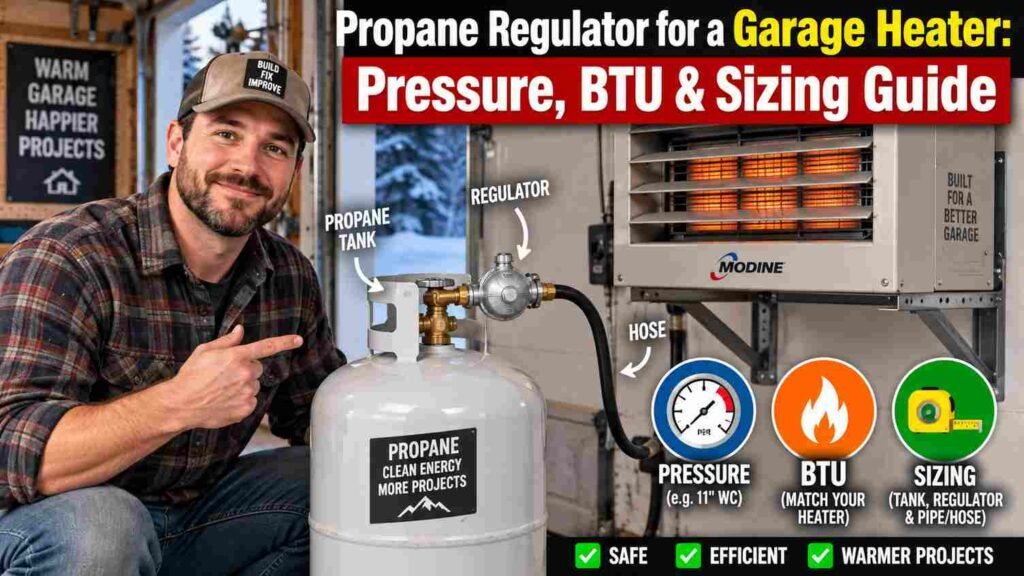
For most permanently installed propane garage heaters, I use a regulator system that delivers about 11–14 inches of water column to the heater, with the appliance gas valve typically regulating propane to about 10 inches WC at the manifold. The regulator must also be large enough for the heater’s full BTU input. A 45,000-BTU unit and a 125,000-BTU shop heater can use similar inlet pressure but require very different regulator flow capacity. For a fixed garage heater, I prefer a properly sized two-stage propane system or another manufacturer-approved arrangement rather than a generic adjustable high-pressure regulator.
A propane garage heater is a good example of why pressure and capacity are two different regulator specifications. A 100,000-BTU heater may still need only about 11–14 inches of water column at the appliance inlet, but the regulator has to flow enough propane to feed that heater continuously on the coldest days.
That is why I do not choose a garage-heater regulator by looking only at PSI. I check the heater nameplate, required inlet pressure, manifold pressure, BTU input, propane tank size, pipe length, and whether the heater is a permanently vented unit heater or a portable construction heater.


In this guide, I’ll show you how I match the regulator to the heater, when I use two-stage regulation, how I size for BTU load, and what I check when the heater loses pressure or heat.
What Pressure Does a Propane Garage Heater Need?
For many vented propane unit heaters, the incoming gas pressure at the appliance is typically in the 11–14 inches WC range.
Modine’s current Hot Dawg installation information specifies 11–14″ WC inlet pressure for propane models and about 10″ WC manifold pressure. Reznor likewise specifies a minimum propane supply pressure of 11″ WC and a maximum of 14″ WC on current unit-heater documentation.
| Pressure Point | Typical Propane Value | Approx. PSI | What It Means |
|---|---|---|---|
| Heater inlet minimum | About 11″ WC | 0.40 PSI | Minimum supply pressure under load |
| Heater inlet maximum | About 14″ WC | 0.51 PSI | Do not exceed unless heater manual says otherwise |
| Manifold pressure | About 10″ WC | 0.36 PSI | Pressure delivered through appliance gas valve to burners |
| 2-PSI distribution line | 2 PSI | 2.0 PSI | Requires downstream regulation before a low-pressure heater |
I use the exact heater manual as the final authority. Some models can differ, especially if they use a different gas valve, conversion kit, or high-altitude configuration.


If you want a deeper explanation of these numbers, see what inlet pressure versus outlet pressure means on a propane regulator.
Why 11 Inches WC Is Not the Same as 11 PSI
This is one of the most important points I explain to homeowners. Eleven inches of water column is only about 0.4 PSI. Eleven PSI is roughly 27 times higher.
| Pressure | Approx. PSI | Typical Use |
|---|---|---|
| 10″ WC | 0.36 PSI | Propane heater manifold pressure |
| 11″ WC | 0.40 PSI | Common propane appliance inlet pressure |
| 14″ WC | 0.51 PSI | Common maximum appliance inlet pressure |
| 2 PSI | 2 PSI | Intermediate propane distribution system |
| 10 PSI | 10 PSI | High-pressure outdoor burner systems |
A garage unit heater designed for 11–14″ WC should never be connected directly to a 10-PSI regulator.
If the building uses a 2-PSI propane distribution system, I install the required downstream line regulator so the heater receives the lower pressure it was designed for.
My article on how many PSI a propane regulator supplies explains the different regulator categories in more detail.

How Many BTUs Does a Propane Garage Heater Use?
Garage unit heaters are sold across a wide BTU range because heating load changes with garage size, insulation, ceiling height, outdoor temperature, air leakage, and how warm you want the space.
Current Modine Hot Dawg models range from about 30,000 BTU/hr for smaller garages to 125,000 BTU/hr for large garages and outbuildings.
| Heater Input | Typical Application Example | Regulator Flow Requirement |
|---|---|---|
| 30,000 BTU/hr | 1 to 1.5-car garage | At least full 30,000-BTU input |
| 45,000 BTU/hr | 2 to 2.5-car garage | At least 45,000 BTU/hr |
| 60,000 BTU/hr | 3 to 3.5-car garage | At least 60,000 BTU/hr |
| 75,000 BTU/hr | Large garage / shop | At least 75,000 BTU/hr |
| 100,000 BTU/hr | Large garage or outbuilding | At least 100,000 BTU/hr |
| 125,000 BTU/hr | Large shop / cold climate | At least 125,000 BTU/hr |
These application examples are only starting points. I size the heater itself using a proper heat-loss calculation whenever possible.
Once I know the heater input, I make sure the regulator can deliver that amount of propane while maintaining the required outlet pressure.


How Much Regulator Capacity Should I Allow?
I do not like sizing a regulator exactly at the heater’s nameplate rating if the regulator manufacturer offers a comfortable size step above it.
For example, Mr. Heater currently lists a low-pressure regulator rated for appliances up to 115,000 BTU/hr with an outlet range of 11–14″ WC. It also sells two-stage regulators rated at about 160,000 and 200,000 BTU/hr with 11″ WC output.
| Example Regulator Capacity | Suitable Heater Load Example | My Comment |
|---|---|---|
| 115,000 BTU/hr | Up to roughly 100,000 BTU/hr heater | Useful if only one heater is served and all other specs match |
| 160,000 BTU/hr | 125,000 BTU/hr heater | Provides useful flow margin |
| 200,000 BTU/hr | 125,000-BTU heater plus another small load | Must still verify total connected load and regulator chart |
I also remember that published regulator capacity depends on inlet pressure, outlet pressure, and allowable droop. I use the regulator manufacturer’s capacity chart when sizing a permanent system.
For a detailed explanation, see what BTU capacity means on a propane regulator.
Does a Garage Heater Need a Two-Stage Propane Regulator?
For a permanently installed garage or shop heater supplied from a propane tank, a two-stage system is often the most stable approach.
The first stage reduces the highly variable tank pressure to an intermediate pressure. The second stage reduces it again to the low pressure the appliance needs, commonly around 11″ WC.
An integral two-stage regulator can perform both steps in one body, while other systems use separate first-stage and second-stage regulators.
Mr. Heater describes its current two-stage propane regulator as providing a more stable propane flow, with an 11″ WC setting and up to 160,000 BTU/hr capacity.
I do not automatically use the same regulator on every garage heater. Tank location, piping distance, total connected load, regulator venting, and local installation requirements all matter.
What If My House Already Has a Propane System?
If the garage heater is being added to an existing whole-house propane system, I first check whether the current regulators and piping have enough spare capacity.
For example, a house may already have a furnace, water heater, range, dryer, fireplace, and generator. Adding a 75,000-BTU garage heater can push the total connected load beyond what the regulator or underground piping was originally sized to handle.
| Existing Appliance | Illustrative Input |
|---|---|
| House furnace | 80,000 BTU/hr |
| Water heater | 40,000 BTU/hr |
| Range | 60,000 BTU/hr |
| Fireplace | 30,000 BTU/hr |
| Garage heater | 75,000 BTU/hr |
| Example total | 285,000 BTU/hr |
I size the upstream regulator for the simultaneous connected load, not just the garage heater.
My guide on how to calculate the BTU capacity needed for a propane regulator shows how I total appliance loads.
Can I Use a 2-PSI Line for a Garage Heater?
Yes, a 2-PSI distribution system can be useful when the propane tank is far from the garage or when a building has several large appliances.
At 2 PSI, more BTUs can be moved through a smaller pipe than at 11″ WC. But the heater itself usually cannot accept 2 PSI directly.
I install a properly sized line-pressure regulator near the appliance or appliance branch so the final pressure is reduced to the heater’s required inlet pressure.
The line regulator must be rated for propane, installed with the correct vent orientation, and sized for the heater’s BTU load. The outlet pressure then needs to be verified under full-fire operation.
What Size Propane Tank Does a Garage Heater Need?
The tank has to do more than hold enough gallons. It must also vaporize propane fast enough on cold days.
A 30,000-BTU heater is easy on a propane supply compared with a 125,000-BTU heater running continuously during freezing weather. As outdoor temperature drops and tank level falls, vaporization capacity decreases.
| Heater Load | Tank Consideration | What I Watch |
|---|---|---|
| 30,000–45,000 BTU/hr | Moderate demand | Smaller systems may work depending on climate and runtime |
| 60,000–75,000 BTU/hr | Higher winter demand | Tank surface area and fill level matter |
| 100,000–125,000 BTU/hr | High continuous demand | Larger stationary tank often provides more reliable vaporization |
| Multiple house appliances + garage heater | Very high total demand | Size tank for combined peak load |
I do not rely on a small portable cylinder for a permanently installed garage unit heater unless the heater manufacturer specifically approves that arrangement.
If the propane tank frosts heavily or the heater loses pressure during long runs, inadequate vaporization may be the real problem rather than the regulator.
Why My Garage Heater Pressure Drops When It Fires
If the pressure looks normal with the heater off but drops below 11″ WC when the burners light, I look for a supply problem.
| Possible Cause | What Happens | What I Check |
|---|---|---|
| Undersized regulator | Pressure falls at full fire | Regulator BTU capacity |
| Undersized gas line | Large pressure drop under load | Pipe diameter, length, fittings |
| Small or cold propane tank | Tank cannot vaporize enough gas | Tank size, temperature, liquid level |
| Too many appliances firing | System load exceeds capacity | Combined BTU demand |
| Restricted valve or fitting | Local pressure loss | Shutoff valve, sediment trap, connector |
| Regulator icing or contamination | Intermittent low pressure | Regulator condition and moisture |
This is why I always evaluate pressure while the heater is operating, not just with everything shut off.
If you want more detail on load-related pressure drop, see what regulator droop means in a propane system.
Vented Garage Heater vs. Portable Construction Heater
I make a strong distinction between a permanently installed, vented garage heater and a portable forced-air construction heater.
A vented unit heater such as a Modine Hot Dawg is designed to exhaust combustion products outside the garage. Modine specifically notes that harmful combustion products, including carbon monoxide, are vented outdoors.
Portable propane construction heaters can use different regulator arrangements and are not automatically suitable for a residential garage. Some current forced-air heater manufacturers specifically warn against using construction-style heaters in residential garages, especially where other ignition sources are present.
| Heater Type | Typical Use | Regulator Approach | Garage Suitability |
|---|---|---|---|
| Vented unit heater | Permanent garage/shop heat | Fixed LP system, 11–14″ WC inlet | Designed for indoor installed use when properly vented |
| Separated-combustion unit heater | Garage/shop with controlled combustion air | Fixed LP system | Excellent for many garage applications |
| Portable forced-air construction heater | Jobsite / construction heat | Included hose and regulator | Use only where manufacturer permits |
| Portable radiant heater | Temporary spot heat | Model-specific regulator | Follow exact indoor-use listing and clearance rules |
I never assume that because a propane heater includes a regulator, it is automatically safe for an enclosed garage.
What Size Gas Pipe Does a Garage Heater Need?
Gas pipe size depends on heater BTU input, run length, gas pressure, pipe material, and how many other appliances share the line.
A 125,000-BTU heater at the end of a long low-pressure run may need a substantially larger pipe than a 30,000-BTU heater located a few feet from the second-stage regulator.
Modine installation guidance specifically warns that the piping must be sized so adequate inlet pressure remains after pressure loss through the supply line.
I use the applicable propane pipe-sizing tables and include equivalent length for fittings. I do not simply match the pipe size to the heater’s threaded inlet.
What Fittings and Shutoff Components Do I Need?
A permanent garage heater normally requires an accessible manual shutoff valve and proper service connection arrangement. Many installation manuals also call for a sediment trap and a pressure test port.
I use fittings rated for propane service and make sure any flexible connector is sized for the heater’s BTU demand.
If I am unsure about the regulator or heater connection, I verify whether it is NPT, flare, POL, or another connection before assembling the system.
My guide on matching regulator inlet and outlet thread sizes explains the common connection types.
Can I Turn Up the Regulator to Get More Heat?
No. I do not raise the inlet pressure above the heater manufacturer’s maximum to get more heat.
A propane unit heater is designed around a specific burner orifice and manifold pressure. For many models, the gas valve regulates manifold pressure to about 10″ WC.
If the heater cannot warm the garage at the correct pressure, I look at heater sizing, insulation, airflow, thermostat location, burner condition, venting, and actual heat loss instead of increasing gas pressure.
Overpressure can damage the combination gas valve and create unsafe combustion.
Garage Heater Regulator Safety
A permanently installed propane garage heater should be treated like a furnace. I follow the heater manufacturer’s installation instructions, local fuel-gas requirements, and regulator manufacturer’s venting and orientation requirements.
I leak-test the complete gas system after installation or service using an approved leak-detection solution or code-compliant pressure test. I never use an open flame to locate a leak.
The regulator vent has to remain unobstructed and protected from water, insects, ice, and debris. If a regulator is installed outdoors, I orient and protect it according to the manufacturer’s instructions.
I also verify heater clearances from vehicles, storage shelves, gasoline containers, paint, solvents, and other combustibles. Garages can contain many ignition and vapor hazards that ordinary living spaces do not.
For general regulator requirements, see my propane regulator safety requirements guide. For permanent regulator work, also see whether propane regulator installation should be handled by a professional.
Frequently Asked Questions
What PSI regulator does a propane garage heater need?
Most vented propane unit heaters use less than 1 PSI at the appliance. A common inlet range is 11–14″ WC, or about 0.40–0.51 PSI.
What is the manifold pressure on a propane garage heater?
Many unit heaters use about 10″ WC manifold pressure on propane, but I always verify the exact heater manual and nameplate.
Can I use an 11-inch WC regulator?
Yes, if the heater is designed for that pressure and the regulator has enough BTU capacity. Many low-pressure propane heater systems use approximately 11″ WC.
Is a 10-PSI regulator too high for a garage heater?
Yes, for a standard unit heater designed for 11–14″ WC inlet pressure. Ten PSI is far above normal appliance pressure.
Does a 125,000-BTU heater need a bigger regulator than a 45,000-BTU heater?
Usually, yes. They may use similar outlet pressure, but the 125,000-BTU heater requires much more propane flow.
Why does my propane garage heater shut off on very cold days?
Possible causes include insufficient tank vaporization, low inlet pressure, regulator icing, an undersized regulator or gas line, blocked venting, or an appliance fault. I verify the gas supply under full load before blaming the heater.
Bottom Line
For most permanently installed propane garage heaters, I want roughly 11–14 inches WC at the heater inlet and enough regulator capacity to supply the heater’s full BTU input. A 30,000-BTU unit and a 125,000-BTU unit may use similar pressure, but they do not need the same flow capacity.
For a fixed tank-fed system, a properly sized two-stage regulator setup is often a strong choice because it provides stable low-pressure propane to the appliance. If the building uses 2-PSI distribution, I add the required downstream regulator before the heater.
Most importantly, I treat a garage unit heater as a permanent gas appliance. I size the regulator, tank, piping, shutoff, venting, and heater together rather than trying to solve a heat problem by turning up propane pressure.

Mike is an experienced propane technician with over 15 years of professional experience in the field. He has dedicated his career to helping customers with their propane needs, from installation to maintenance and repair. Together with Jeremy, he co-founded this website to provide useful information and guidance to customers seeking reliable propane services.


