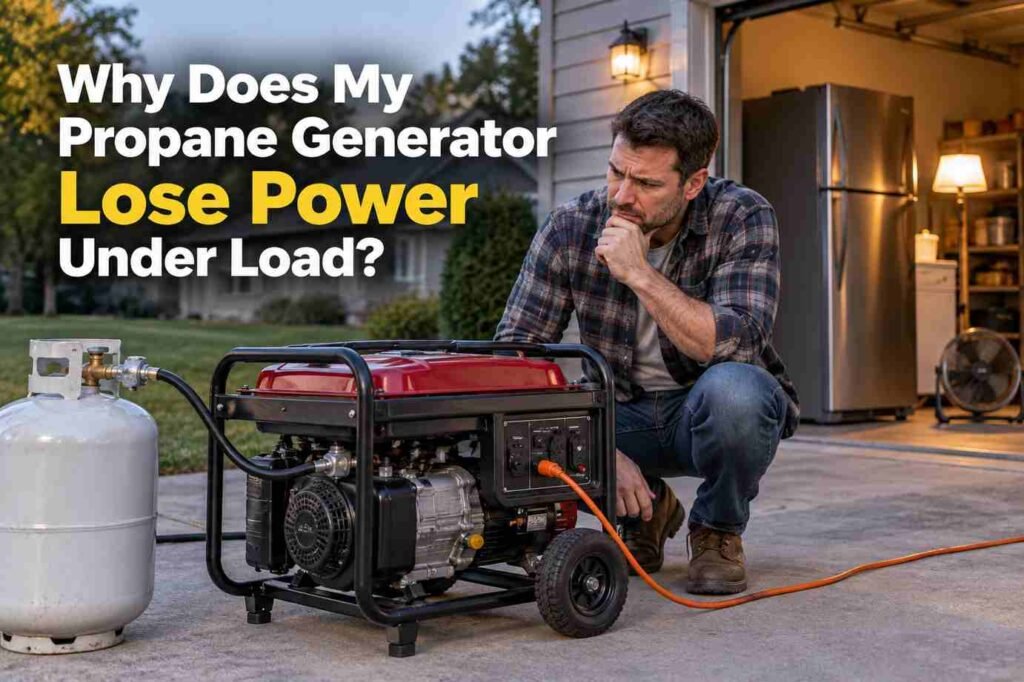
Quick Answer
If your propane generator runs normally with little or no electrical load but bogs down, loses RPM, surges, or stalls when you add appliances, the first thing I suspect is that the engine is not getting enough usable fuel under demand. The cause can be a nearly empty or undersized propane cylinder, cold-weather vaporization limits, a restricted hose or regulator, incorrect fuel pressure, an overloaded generator, a dirty air filter, an ignition problem, or an engine that needs maintenance. I would start by reducing the electrical load, checking the generator’s propane rating, confirming the tank and regulator are correctly sized, and watching what happens when the load is added gradually.
A propane generator needs much more fuel at full load than it does while idling or powering a few lights. That is why a generator can start perfectly, sound smooth with no load, and then suddenly struggle when a refrigerator compressor, well pump, air conditioner, heater, or other motor starts. The fault often appears only when fuel demand and electrical demand rise at the same time.
What “Losing Power Under Load” Usually Looks Like
When I say a propane generator is losing power under load, I am not talking about a unit that will not start at all. I mean the engine starts and runs, but its performance falls apart as you connect more electrical load. You may hear the engine slow down, the exhaust note change, the frequency drop, or the governor open the throttle without the engine recovering.


- The engine runs smoothly with no load but bogs when appliances are connected.
- Voltage drops when a large appliance starts.
- The generator surges or hunts as the governor tries to maintain engine speed.
- The overload light comes on, or a breaker trips.
- The engine stalls when a motor, pump, compressor, or air conditioner starts.
- The same generator performs better on gasoline than it does on propane.
- Power gets worse in cold weather or as a small propane cylinder becomes empty.
Those clues matter because they help separate a generator-side electrical overload from a fuel-supply problem. If you also notice repeated RPM changes, read my guide on why a propane generator surges or hunts. If the generator will not run on propane at all but runs on gasoline, see why a dual-fuel generator runs on gasoline but not propane.
The Most Common Causes at a Glance
| Possible cause | What happens under load | What I would check first |
|---|---|---|
| Electrical overload | Engine slows, breaker trips, overload light may appear | Add up running watts and starting watts |
| Propane flow is too low | Runs unloaded, bogs as throttle opens | Tank valve, hose, regulator, fittings, fuel supply |
| Small or cold propane cylinder | Works at light load, weakens at high demand | Cylinder size, fill level, frost, ambient temperature |
| Incorrect regulator or pressure | Lean running, hunting, hesitation, shutdown | Use the exact regulator/fuel-pressure specification in the manual |
| Restricted hose or fitting | Fuel demand exceeds what can pass through | Kinks, damaged hose, quick-connect restrictions |
| Dirty air filter | Rich or weak combustion under load | Inspect and service air filter |
| Spark plug/ignition issue | Misfire becomes obvious as load rises | Plug condition, gap, ignition service interval |
| Carburetor/mixer or demand regulator issue | Poor propane metering at higher airflow | Inspection/service by a qualified technician |
| Valve clearance or engine condition | Low torque, hard starting, weak high-load performance | Maintenance history and manufacturer procedure |
| Altitude/temperature derating | Available power is lower than nameplate expectation | Altitude, ambient heat, manufacturer derating guidance |
1. The Generator May Simply Be Overloaded
I always check the electrical load before I start blaming the propane system. A generator has a maximum running-watt rating and usually a higher short-duration starting-watt rating. Motors and compressors can demand much more power for a few seconds when they start than they use after they are running. A refrigerator that seems small on paper can create a sharp starting surge, and a well pump or air conditioner can be even more demanding.
Propane can make this more noticeable because many dual-fuel generators are rated for fewer watts on LPG than on gasoline. For example, one Champion 3,500-running-watt dual-fuel model is rated at 3,500 running watts on gasoline but 3,150 running watts on LPG. The exact difference depends on the model, so I always use the propane rating on the data plate or manual rather than assuming the gasoline number applies.
| Example load | Typical running demand | Possible starting demand | Why it matters |
|---|---|---|---|
| LED lights | 10–100 W | Little or none | Usually easy for a generator |
| Refrigerator | 100–800 W | Can be several times running watts | Compressor startup can cause a brief dip |
| Sump/well pump | 500–2,000+ W | Often much higher than running watts | High inrush can bog a marginal system |
| Window/portable A/C | 500–1,500+ W | High compressor starting surge | May expose both overload and fuel-flow problems |
| Electric space heater | 1,500 W | About the same as running | Large continuous load |
| Microwave | 900–1,500+ W input | Usually modest starting surge | Can consume a large share of small-generator capacity |
These are only broad examples. I use the actual appliance nameplate whenever possible. If your generator loses power the instant one large motor starts but handles several smaller loads with the same total running watts, starting surge is a strong suspect.


2. The Propane Tank May Not Be Vaporizing Fuel Fast Enough
This is one of the most overlooked propane-specific causes. A generator normally uses propane vapor, not liquid propane. The liquid inside the cylinder must absorb heat and boil into vapor fast enough to supply the engine. As the generator load increases, the engine needs more BTUs per hour, so the required vaporization rate rises.
A small cylinder can contain enough total propane to run the generator for hours and still be unable to vaporize fuel fast enough at high load. This is especially likely in cold weather, with a partly empty cylinder, or when the cylinder begins frosting heavily. The result feels exactly like fuel starvation: the engine runs at light load, then loses power as soon as demand rises.
If I see frost forming on the cylinder or regulator while the generator is struggling, I treat that as an important clue. Frost does not automatically mean the regulator is defective, but it can show that the propane system is experiencing a large pressure and temperature drop. A larger approved cylinder or properly designed bulk-tank supply can provide more vaporization capacity. Never heat a propane cylinder with a flame, torch, heater, or other improvised heat source.
3. A Restricted Propane Hose, Quick Connect, or Fitting Can Starve the Engine
A hose can look perfectly fine from the outside and still restrict flow. I check for sharp bends, kinks, crushed sections, contamination, damaged quick-connect fittings, partially seated connectors, and fittings that are simply too restrictive for the generator’s BTU demand. On portable units, I also make sure I am using the hose and regulator intended for that specific generator.
This matters because propane-system components are rated by flow, pressure, and application. A regulator or quick connector that works for a grill may not be appropriate for a generator that needs a much higher sustained fuel rate. If you are selecting equipment for a portable unit, see my propane regulator guide for portable dual-fuel generators.

4. The Regulator May Be Undersized, Incorrect, or Failing Under Flow
The regulator has to do more than show the right pressure while the engine is idling. It must maintain the required outlet pressure while the generator is consuming fuel at high load. A system can look fine during a static pressure check and still suffer excessive pressure drop when flow increases.
For permanently installed generators, the fuel line, first-stage/second-stage regulation, and final inlet pressure have to match the manufacturer’s specification. As one example, Generac lists 10–12 inches of water column for LP gas at the generator inlet on several air-cooled models and specifically states that fuel pressure must remain within specification at all load ranges. That is an example, not a universal setting. Your generator manual is the authority for your model.
If you are sizing a standby-generator regulator, see what size propane regulator a standby generator needs. For the fuel-demand side of the calculation, my guide on calculating total BTU load for a propane regulator explains why regulator capacity must be based on the actual connected load, not just pipe size.
Static pressure versus pressure under load
This distinction is important. Static pressure is measured when little or no fuel is flowing. Dynamic pressure is what the generator actually sees while fuel is moving. A regulator, pipe, hose, or tank can pass a static test and still fail dynamically. If the generator only bogs at 50%, 75%, or 100% electrical load, I want to know what the fuel pressure is doing at that moment.


| Observation | What it may suggest | Next step |
|---|---|---|
| Pressure normal unloaded, falls sharply under load | Supply restriction, undersized regulator/line, tank vaporization limit | Check system sizing and dynamic pressure |
| Pressure too low at all times | Wrong regulator setting/type, supply problem | Compare with manufacturer specification |
| Pressure too high | Incorrect regulation or adjustment | Stop and have the system corrected |
| Pressure stable but engine still bogs | Look beyond supply pressure | Check load, air, ignition, mixer/demand regulator, engine condition |
Testing gas pressure on a permanent propane system should be done with the correct manometer and procedure. If you are not trained to work on fuel-gas systems, this is where I would bring in a qualified propane technician or generator service technician rather than adjusting a regulator by trial and error.
8. A Dirty Air Filter Can Make the Engine Weak Under Load
Not every load problem is caused by propane. The engine needs the correct air-fuel mixture. A heavily restricted air filter changes airflow and can make combustion unstable or overly rich. The engine may sound acceptable with no load but fail to develop full torque as the governor opens the throttle.
I inspect the air filter for dirt, oil saturation, rodent debris, and physical damage. I clean or replace it only according to the generator manufacturer’s instructions. Running without the filter is not a good diagnostic habit because it can allow dirt into the engine.
9. The Spark Plug or Ignition System May Be Breaking Down
Ignition problems often become more obvious under load because cylinder pressure rises and the spark has a harder job to do. A worn, fouled, incorrectly gapped, or damaged spark plug can cause misfire, hesitation, and weak power. If the generator has many operating hours, I compare the plug condition and service interval with the owner’s manual.
I also pay attention to whether the engine runs rough on both gasoline and propane. If it loses power on both fuels at similar loads, that pushes me toward ignition, air, valve clearance, compression, governor, or electrical-load issues rather than a propane-only supply problem.
A Step-by-Step Troubleshooting Sequence I Would Use
- Disconnect large loads. Let the generator stabilize with little or no load.
- Confirm the correct propane fuel setting. On multi-fuel generators, make sure the selector and any required controls are in the LPG position.
- Check the propane supply. Use a known-good, sufficiently full cylinder or verify the bulk tank has adequate fuel.
- Open the cylinder valve correctly. Follow the manual and avoid snapping it open rapidly.
- Inspect the hose and regulator. Look for kinks, damage, frost, loose fittings, or the wrong components.
- Inspect the air filter and spark plug. Service them if due.
- Add electrical loads gradually. Note exactly which load causes the RPM or voltage to fall.
- Compare the load with the propane watt rating. Use LPG running and starting watts, not gasoline figures.
- If the problem occurs only on propane, investigate fuel flow and regulation.
- If the problem occurs on both fuels, investigate the generator, ignition, governor, engine, and connected load.
How I Tell Fuel Starvation From Electrical Overload
| Symptom | Fuel starvation more likely | Electrical overload more likely |
|---|---|---|
| Engine gradually sags as load rises | Yes | Possible |
| Engine improves with fuller/larger propane supply | Strong clue | No |
| Problem worse in cold weather | Strong clue | Usually no |
| Breaker trips immediately | Less likely | Strong clue |
| Overload indicator activates | Possible secondary effect | Strong clue |
| Runs better on gasoline at same load | Strong propane-side clue | Could also reflect lower LPG watt rating |
| Runs poorly on both fuels | Less likely propane-specific | Check load or engine/generator condition |
Should I Adjust the Propane Regulator to Get More Power?
No, I would not turn regulator adjustments blindly to chase more generator power. Too little pressure can starve the engine, but too much pressure can also create unsafe and unstable operation. The correct pressure range comes from the generator and fuel-system design. A qualified technician should verify inlet pressure with the generator running under load before deciding an adjustment is needed.
If you want a deeper explanation of pressure terminology, see inlet pressure vs. outlet pressure on a propane regulator. That distinction becomes important when diagnosing where a pressure drop is occurring.
When I Would Stop Troubleshooting and Call a Professional
I am comfortable with basic owner-level checks such as load reduction, checking the correct fuel setting, inspecting a hose, replacing a serviceable air filter, or trying a known-full approved cylinder. I would stop and call a qualified technician when the diagnosis requires opening the fuel train, changing regulator settings, pressure testing a permanent propane installation, repairing a leaking fitting, or working inside the generator’s electrical system.
- You smell propane or suspect a leak.
- The regulator, hose, fitting, or fuel valve is damaged.
- Fuel pressure is outside the manufacturer’s specification.
- The generator repeatedly backfires, stalls, or runs dangerously rough.
- A breaker or wiring connection overheats.
- The generator has correct fuel supply but still cannot carry a normal load.
- You need regulator, pipe, or tank sizing for a permanent standby installation.
If you smell gas, shut the generator down if it is safe to do so, keep flames and sparks away, close the fuel supply when appropriate, move people away from the area, and follow your propane supplier’s emergency guidance. Do not keep restarting the generator to see if the smell goes away.
Frequently Asked Questions
Why does my generator run fine until I plug something in?
The moment you plug in a load, the alternator demands more torque from the engine. If the load is too large, or the propane system cannot deliver enough fuel to make that extra torque, engine speed drops. That is why a generator can seem perfect with nothing connected and weak the instant a substantial appliance starts.
Can a bad propane regulator make a generator bog down?
Yes. A regulator that cannot maintain the required pressure and flow can allow the engine to idle but starve it under load. The same symptom can also come from an undersized regulator, an undersized tank, a restrictive line, or another fuel-system component, so I would verify the entire supply rather than replacing the regulator automatically.
Bottom Line
When a propane generator loses power under load, I start with two questions: Am I asking for more electrical power than the generator can provide on propane, or is the engine unable to get enough fuel to make its rated power? Those two paths explain a large share of real-world problems.
I check the propane-specific running-watt rating, starting surge of the connected appliances, cylinder size and fill level, cold-weather vaporization, hose and regulator capacity, and fuel pressure under load. Then I move to the air filter, spark plug, valve clearance, governor, and general engine condition. If it starts and runs but only fails when demand rises, the load itself is giving you a useful diagnostic clue.
For a related symptom where the engine starts normally but quits after a short time, see why a propane generator starts then dies.

Mike is an experienced propane technician with over 15 years of professional experience in the field. He has dedicated his career to helping customers with their propane needs, from installation to maintenance and repair. Together with Jeremy, he co-founded this website to provide useful information and guidance to customers seeking reliable propane services.