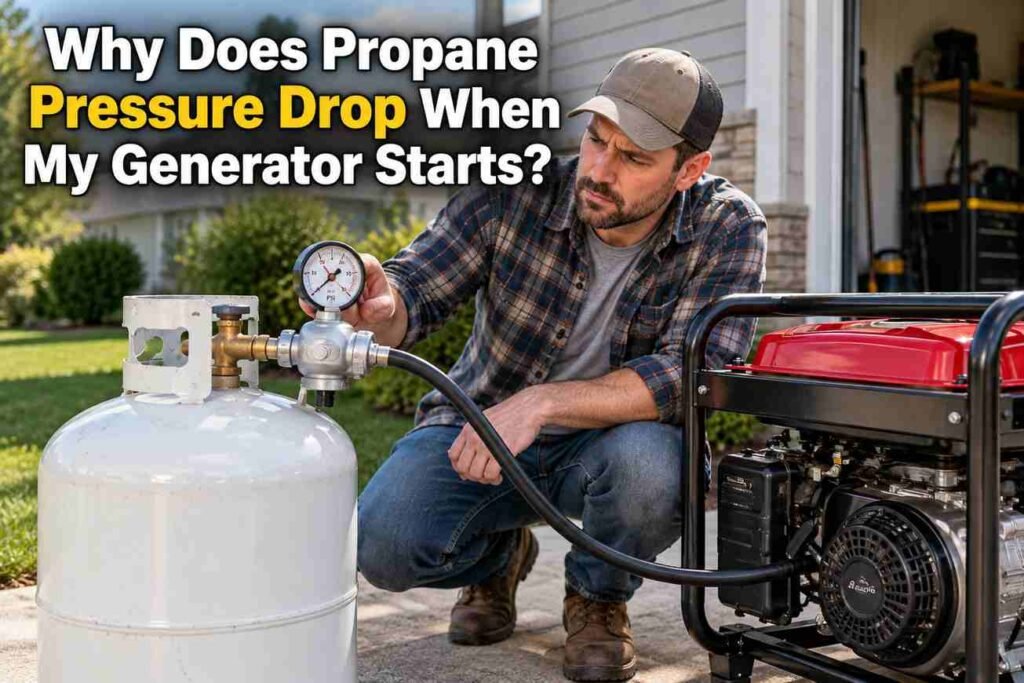
Quick Answer
Propane pressure drops when your generator starts because the engine suddenly demands a much larger volume of fuel. A small pressure dip can be normal, but a large or sustained drop usually means the propane system cannot deliver enough vapor at the required pressure. I would look first at tank size and fill level, regulator capacity, hose or pipe size, line length, cold-weather vaporization, partially closed valves, restrictive fittings, and whether the system was sized for the generator’s full-load BTU demand. The key test is fuel pressure while the generator is cranking and carrying load—not just static pressure with the engine off.
This problem can be confusing because the propane pressure may look perfect before you start the generator. You can connect a manometer, see a normal static reading, and assume the fuel system is fine. Then the starter turns, the engine fires, the demand regulator opens, and the pressure suddenly falls. If the pressure falls below the generator manufacturer’s operating range, the engine may crank without starting, start and stall, surge, backfire, or lose power as electrical load is added.
I treat that pressure drop as a flow problem until proven otherwise. The generator is not simply asking for “pressure.” It is asking for enough propane vapor volume at the correct pressure. A system can have good pressure with no flow and still fail the moment the engine begins consuming fuel.


Why Propane Pressure Changes the Moment a Generator Starts
With the generator off, very little or no propane is moving through the line. That is why the pressure you measure is called static pressure. When the engine starts, propane begins flowing through the tank valve, regulator, hose or piping, fittings, shutoff valves, and the generator’s own fuel-control components. Every one of those components creates some resistance to flow.
As fuel flow increases, pressure loss across the system increases. The regulator must respond by opening farther, the tank must vaporize propane fast enough, and the piping must carry the required volume without excessive friction loss. If any part of that chain is undersized or restricted, pressure at the generator inlet drops.
Static Pressure vs. Cranking Pressure vs. Running Pressure
| Pressure condition | What is happening | What the reading tells me |
|---|---|---|
| Static pressure | Generator off; little or no fuel flow | Shows regulator outlet pressure at near-zero flow |
| Cranking pressure | Starter turning; engine beginning to draw fuel | Shows whether the system responds to sudden demand |
| No-load running pressure | Engine running with little electrical load | Shows supply under moderate fuel flow |
| Full-load running pressure | Generator carrying a heavy electrical load | Shows whether tank, regulator, and piping can sustain maximum demand |
This is why I do not diagnose a generator fuel problem using static pressure alone. A regulator can hold the correct static outlet pressure yet allow the pressure to collapse when flow increases. Likewise, an undersized pipe can show perfect pressure with the generator off because no meaningful volume is moving through it.
How Much Pressure Drop Is Too Much?
The correct answer depends on the generator model. I always use the manufacturer’s specified inlet-pressure range and check it under the operating conditions the manual requires. As one current example, Generac lists 10–12 inches of water column for LP at the inlet on its GP-series multi-fuel portable generator manual and states that pressure must not fall below the required specification once the generator is operating. Generac also publishes gaseous-fuel guidance noting that pressure should be checked during static, cranking, no-load, and full-load conditions.


That does not mean every propane generator should be adjusted to 10–12 inches water column. Some portable units use a manufacturer-supplied regulator assembly, while standby systems may use separate first-stage and second-stage regulation. I always follow the exact manual for the generator and fuel setup.
| Example manufacturer data | LP value | Why it matters |
|---|---|---|
| Generac GP-series multi-fuel manual | 10–12 in. water column at generator inlet | Example of a specified operating inlet-pressure range |
| Generac 10 kW standby model | 10–12 in. water column LP requirement | Shows a current standby model with a similar inlet range |
| Generac 10 kW LP consumption at 50% load | 35 ft³/hr | Fuel flow rises substantially even at partial load |
| Generac 10 kW LP consumption at 100% load | 58 ft³/hr | Full load requires much more sustained vapor flow |
Those numbers show why the pressure can be stable at idle yet fall as demand rises. The regulator and piping must deliver both the specified pressure and the required volume. If you are unfamiliar with the difference between these measurements, my guide to propane regulator inlet pressure vs. outlet pressure explains how the two sides of the regulator relate.
1. The Propane Tank May Be Too Small for the Generator
One of the first things I check is the propane supply itself. A propane generator normally consumes vapor. That vapor is created when liquid propane inside the tank absorbs heat and boils. The tank therefore has a maximum practical vaporization rate that depends on its size, liquid level, outdoor temperature, and how quickly fuel is being withdrawn.
A small cylinder can contain plenty of total fuel and still be unable to vaporize propane quickly enough for a large generator. When the generator starts, the sudden vapor demand cools the tank. If vapor production cannot keep up, tank pressure falls and the downstream regulator has less inlet pressure available.
This is especially common with small portable cylinders in cold weather. A generator that starts easily on a warm afternoon may struggle early in the morning when the cylinder is cold. A partly empty cylinder can also have less wetted surface area available to absorb heat, which can reduce vaporization capacity.

2. The Regulator May Be Undersized for the Generator’s BTU Demand
A regulator is not selected only by outlet pressure. It also has a flow or BTU capacity. If the generator demands more propane than the regulator can pass while holding its set pressure, the outlet pressure can droop when the generator starts.
I compare the generator’s maximum fuel consumption with the regulator’s rated capacity, then allow for the rest of the propane loads connected to the same system. If the regulator also supplies a furnace, water heater, range, dryer, or other appliances, the combined demand may be much higher than the generator demand alone.
For permanent systems, see my guide on what size propane regulator a standby generator needs. If you are working from appliance ratings, my article on calculating total BTU load for a propane regulator shows how I add the connected demand before choosing capacity.
3. Long or Undersized Propane Piping Can Cause Pressure Loss
Pipe size matters because propane vapor loses pressure as it moves through pipe. The pressure loss increases with flow rate, pipe length, fittings, and restrictions. A pipe that is adequate for a furnace may be too small once a generator is added at the far end of the system.


This is one reason generator installation manuals usually require the fuel line to be sized for full-load consumption. I do not size a generator line based on the no-load fuel rate or on what “looks big enough.” I use the manufacturer’s full-load fuel-consumption value, the developed pipe length, the regulator system pressure, and the applicable gas-sizing table.
| Piping factor | Effect on available pressure | What I check |
|---|---|---|
| Pipe too small | Higher friction loss as flow increases | Required diameter for full-load BTU demand |
| Long line | More cumulative pressure loss | Total developed length, not straight-line distance |
| Many elbows/fittings | Adds equivalent resistance | Fitting count and sizing method |
| Flexible connector too small | Can become a bottleneck | Connector rating and manufacturer requirements |
| Shared line with other appliances | Total flow rises when loads operate together | Combined connected BTU demand |
4. A Hose, Quick Connect, Valve, or Fitting May Be Restricting Flow
On portable generators, the restriction may be much simpler than a piping calculation. I inspect the propane hose for kinks, crushing, internal damage, and excessive length. I also make sure the quick-connect fitting is fully seated and that the cylinder valve is open according to the generator manufacturer’s instructions.
A partially closed shutoff valve or a restrictive aftermarket fitting can pass enough propane for idle yet create a large pressure drop when the engine starts. If the generator uses a manufacturer-supplied regulator and hose assembly, I do not replace it with a generic grill regulator unless the manufacturer specifically allows that substitution.
If you are setting up a portable dual-fuel machine, see my propane regulator guide for portable dual-fuel generators.
5. The First-Stage or Second-Stage Regulator May Be Drooping
In many permanent propane systems, tank pressure is reduced in stages. The first-stage regulator reduces high tank pressure to an intermediate pressure, and the second-stage regulator reduces that pressure again to the low pressure required by the appliances. If either regulator is undersized, damaged, contaminated, icing, or operating outside its design range, the downstream pressure can sag when the generator begins drawing fuel.
Regulator droop is the normal tendency for outlet pressure to decrease somewhat as flow increases. A properly selected regulator keeps that change within an acceptable range. Excessive droop is a problem because the generator may receive adequate pressure while idle but inadequate pressure during cranking or load.
I explain this in more detail in what regulator droop means in a propane system.
6. Cold Weather Can Make the Pressure Drop Worse
Cold weather affects the propane tank before the gas even reaches the regulator. Propane must absorb heat from the surrounding environment to vaporize. When the temperature falls and the generator suddenly demands a high flow rate, the tank can cool rapidly. Frost may form at the liquid level or around components as moisture freezes on the cold surface.
Generac’s gaseous-fuel guidance specifically notes that LP vaporization rate depends on liquid level, ambient temperature, and humidity, and that low temperature combined with high fuel consumption can reduce vaporization. That is why tank sizing has to consider the coldest expected operating conditions—not just average weather.
7. A Nearly Empty Tank Can Create a Larger Pressure Drop
A low tank is not only a runtime issue. As the liquid level drops, the tank may have less effective surface area for heat transfer. Under heavy withdrawal, that can make vaporization more difficult, particularly in cold weather. If a generator begins showing low-pressure symptoms as a cylinder gets low, I test it with a properly filled approved cylinder before assuming the generator itself is defective.
8. Other Appliances May Be Stealing Available Capacity
On a shared propane system, the generator may not be the only load that matters. A furnace, water heater, range, clothes dryer, pool heater, fireplace, or tankless water heater may start at the same time. The combined fuel flow can exceed what the regulator or piping was designed to supply.
This is why I size the propane system for the connected load and consider which appliances can operate simultaneously. If the generator pressure is fine until the furnace or water heater fires, that is a strong clue that the problem is system capacity rather than the generator’s internal fuel controls.
What the Pressure Drop Can Make the Generator Do
| What you see | Possible relationship to low propane pressure |
|---|---|
| Long cranking before start | Fuel mixture may be too lean during cranking |
| Starts, then dies | Pressure recovers statically but collapses once fuel flow increases |
| Surging or hunting | Governor and fuel system may chase an unstable lean condition |
| Backfiring or popping | Lean combustion or ignition issues may be involved |
| Loses power under load | Fuel flow may be insufficient as demand rises |
| Runs better on gasoline | Points toward the propane supply side on a dual-fuel generator |
If your main symptom is loss of engine power after appliances are connected, read why a propane generator loses power under load. If the RPM repeatedly rises and falls, see why a propane generator surges or hunts.
How I Diagnose a Propane Pressure Drop at Generator Startup
- Verify the generator’s required LP inlet-pressure range. I use the exact model manual or specification sheet.
- Check static pressure. This confirms what the regulator is delivering before the generator draws fuel.
- Watch pressure during cranking. A sharp collapse here points toward inadequate supply, vaporization, regulation, or a restriction.
- Watch pressure after the engine starts. I check no-load running pressure and then observe what happens as electrical load is added.
- Check tank size, fill level, and outdoor temperature. These determine how much vapor the supply can produce.
- Verify regulator capacity. The regulator must support the generator plus any other simultaneous propane loads.
- Verify pipe or hose sizing. I pay attention to line length, fittings, flexible connectors, and shared branches.
- Inspect valves and fittings. I look for partially closed valves, kinks, damaged hoses, or restrictive quick connects.
- If pressure remains correct but the generator still runs poorly, I move the diagnosis inside the generator. At that point I consider the demand regulator, mixer, ignition, air supply, governor, and engine condition.
Can I Fix Low Propane Pressure by Adjusting the Regulator?
I would not adjust a propane regulator blindly. If the real problem is an undersized tank, restricted line, wrong regulator capacity, or cold-weather vaporization limit, turning an adjustment screw may not fix the underlying issue. It can also create excessive outlet pressure.
The correct approach is to compare measured dynamic pressure with the manufacturer’s required range, identify where the pressure loss is occurring, and correct the sizing or restriction problem. On a permanent propane installation, I would have a qualified propane or generator technician perform pressure and flow checks with the correct manometer and procedures.
When the Pressure Drop Is Probably Not the Main Problem
If the propane pressure stays within the required range during cranking and full load but the generator still will not start or carry load, I look elsewhere. The problem may be inside the generator’s fuel-control system, or it may be unrelated to propane altogether.
- Dirty or restricted air filter
- Worn or fouled spark plug
- Incorrect fuel-selector position
- Demand-regulator or mixer problem
- Governor problem
- Low compression or valve-clearance issue
- Electrical overload
- Starting surge from a large motor or compressor
Frequently Asked Questions
Is some propane pressure drop normal when a generator starts?
Yes. When fuel begins flowing, some pressure loss through the regulator and piping is normal. What matters is whether the pressure remains inside the generator manufacturer’s specified operating range. A brief small change is very different from a collapse that causes hard starting, stalling, or lean operation.
Why is propane pressure normal when the generator is off but low when it runs?
Because static pressure is measured with almost no flow. Once the generator runs, the tank, regulator, piping, hose, fittings, and valves must deliver real fuel volume. An undersized or restricted system often looks normal statically and fails dynamically.
Can an undersized propane tank cause pressure drop?
Yes. If the tank cannot vaporize propane fast enough for the generator’s demand, tank pressure and downstream available flow can fall. The risk increases with small tanks, low liquid level, cold weather, and high generator load.
Can a bad regulator cause pressure to drop only when the generator starts?
Yes, but I do not assume the regulator is bad immediately. An undersized regulator, inadequate inlet pressure, restricted piping, cold tank, or excessive connected load can create the same symptom. Dynamic pressure testing helps separate these causes.
Should I measure propane pressure while the generator is under load?
Yes, if the manufacturer’s service procedure calls for it and the test is performed safely. Full-load pressure is often more useful than static pressure because it shows whether the system can maintain the required pressure while delivering maximum fuel volume.
Bottom Line
When propane pressure drops as your generator starts, the generator is exposing a weakness that may be invisible with the engine off. The sudden fuel demand creates flow through the tank, regulator, piping, valves, and hose. If any part of that system cannot supply enough vapor volume, the pressure at the generator inlet falls.
I start by checking the generator’s required inlet pressure, then compare static, cranking, no-load, and loaded readings. From there, I look at tank vaporization capacity, regulator BTU capacity, pipe and hose sizing, line length, fittings, outdoor temperature, and other connected appliances. Once the propane supply can maintain the manufacturer’s required pressure under full demand, the generator has a much better chance of starting cleanly and carrying its rated load.

Mike is an experienced propane technician with over 15 years of professional experience in the field. He has dedicated his career to helping customers with their propane needs, from installation to maintenance and repair. Together with Jeremy, he co-founded this website to provide useful information and guidance to customers seeking reliable propane services.