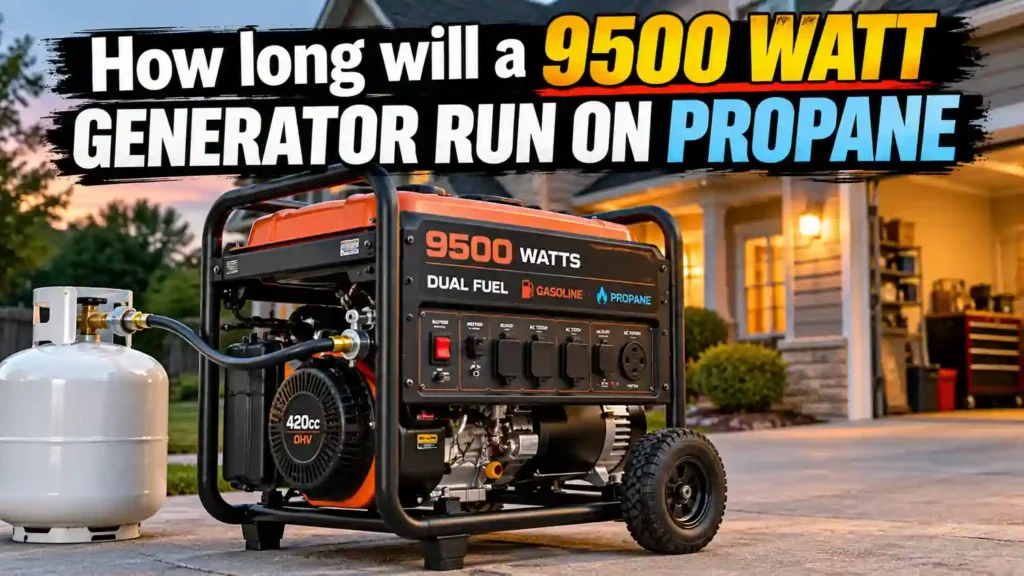
TL;DR — How long will a 9500 watt generator run on propane?
A 9,500-watt-class portable generator can run approximately 4.5–7 hours at half load on a full 20-lb propane cylinder in two published manufacturer examples, but runtime varies substantially with the exact model and load. The Westinghouse WGen9500DF lists about 7 hours at 50% propane load; the Generac GP9500E TF lists 4.5 hours at 50% load on a 20-lb tank. A lighter load may run longer. A full 100-lb cylinder could theoretically provide around 35 hours at the Westinghouse example’s observed specification-based fuel rate, provided the correct fuel supply can vaporize enough propane. Crucially, “9,500 watts” may refer to gasoline running watts or starting watts, not continuous output on propane.
Updated October 28, 2026. All manufacturer figures reflect the specific models and test loads identified below. Calculated figures are illustrative, not independently tested runtime guarantees.


If you’re trying to calculate how long a 9500 watt generator runs on propane, I want you to check three things before buying another cylinder: the generator’s actual propane wattage rating, the amount of propane you can use, and the appliances connected to the machine. I also want you to understand why a generator can stop before the tank looks completely empty.
A 9,500-watt label is especially confusing. Sometimes it means 9,500 starting watts. Other times, it means 9,500 continuous gasoline watts, while the generator delivers less power on liquid propane. These differences change your load percentage, fuel use, and the runtime you should expect.
In this guide I will compare real manufacturer specifications, estimate run times for common propane cylinders, and walk through home-backup examples. I’ll also share my three-limiter runtime check—a practical way I organize fuel quantity, winter vaporization, and continuous engine service so you don’t mistake a calculated number for guaranteed hours of power.
Quick Answer: 9500 Watt Generator Propane Runtime by Tank Size
For the estimates in the next table, I start from a Westinghouse WGen9500DF manufacturer example of about 7 hours on a 20-lb cylinder at 50% propane-rated load. Assuming roughly 4.7 gallons of propane in that cylinder, the implied burn rate is 4.7 ÷ 7 = 0.67 gallons per hour. I extend that one rate across tank sizes only to explain fuel budgeting. Real output and burn rate change with load, model and operating conditions, and cold-weather vapor delivery can become the limiting factor.


| Propane supply | Approx. full propane amount | Theoretical hours at 0.67 gal/h | What I would tell you |
|---|---|---|---|
| 20-lb cylinder | 4.7 gal | 7 hours | Matches the illustrative Westinghouse 50%-load benchmark |
| 30-lb cylinder | 7.1 gal | 10.6 hours | Useful only if connection and vapor supply are approved |
| 40-lb cylinder | 9.4 gal | 14 hours | More volume, but still temperature dependent |
| 100-lb cylinder | 23.6 gal | 35 hours | Arithmetic estimate, not proof of sufficient vaporization |
| 250-gal stationary tank at 80% fill | About 200 gal | About 298 hours | Theoretical total fuel, excluding reserves and other appliances |
| 500-gal stationary tank at 80% fill | About 400 gal | About 597 hours | Requires suitable installation and fuel delivery design |
Important: These larger-tank durations are not manufacturer-certified operating times, and a standard portable regulator/hose cannot automatically be connected to a large stationary propane system. A qualified propane professional must size approved connections, capacity and pressures. For long outages I would also keep a reserve rather than plan to run the tank empty.
If you’re deciding between portable cylinders, my separate guides explain how long a 20-lb propane cylinder lasts and generator runtime on a 100-lb cylinder. This article focuses specifically on the 9,500-watt generator class.
Does “9500 Watts” Mean Running Watts or Starting Watts?
This is the first question I would ask if you told me the model number. Starting watts describe brief extra output for motor starting, not power the generator can deliver continuously for hours. Running watts specify sustained output under the manufacturer’s rating conditions.
Propane-rated output may be lower than the gasoline rating. The Westinghouse WGen9500DF, for example, lists 9,500 running watts on gasoline but 8,500 running watts on propane. The Cummins Onan P9500DF EFI has a different naming convention: its 9,500 gasoline watts are the peak rating, while propane output is 6,750 running watts and 8,550 peak watts.
| Actual model | Gasoline running / peak | Propane running / peak | Published propane runtime test |
|---|---|---|---|
| Westinghouse WGen9500DF | 9,500 / 12,500 W | 8,500 / 11,200 W | 7 hours at 50% propane load |
| Generac GP9500E TF | 9,500 / 12,500 W | 8,550 / 11,250 W | 4.5 hours on 20 lb at 50% load |
| Cummins Onan P9500DF EFI | 7,500 / 9,500 W | 6,750 / 8,550 W | 10.8 hours on 20 lb at 25% load |
Manufacturer specification comparison checked October 28, 2026. The load percentages differ, and these are different engines, so the listed runtimes are not a head-to-head efficiency ranking.

On the Westinghouse, 50% propane load is approximately 4,250 W. On the Onan EFI, the published 25% propane test works out to about 1,688 W. Those are very different amounts of electricity. I’d never say the Onan is automatically more economical just because its quoted hours are higher.
To check your own generator, I find the product model and revision number, read the manual’s propane running watts, then locate the propane runtime test condition. If it only states gasoline runtime, I don’t pretend it automatically applies to propane. My propane versus gasoline efficiency comparison explains why fuel-specific ratings matter.
How Load Percentage Changes Your Propane Runtime
Load percentage is the power being used divided by the generator’s rated continuous output on propane. Suppose you have an 8,500-running-watt propane model. A combined load of 2,125 watts is 25%; 4,250 watts is 50%; and 6,375 watts is 75%. These percentages help match your use to a manufacturer fuel chart.
| Electrical load | Share of an 8,500-W LP rating | Typical situation |
|---|---|---|
| 1,700 W | 20% | Refrigerator, electronics, a few lights |
| 2,125 W | 25% | Essentials with limited additional appliances |
| 4,250 W | 50% | Multiple household circuits or selected tools |
| 6,375 W | 75% | Heavy simultaneous equipment use |
| 8,500 W | 100% | Full continuous propane-rated capacity; verify thermal and outlet limits |
I would not assume a 25% load doubles runtime compared with 50%. Engines still consume fuel at idle, and changes are not linear. The correct way to estimate another load percentage is to obtain that model’s actual fuel consumption table or carefully measure fuel usage under safe, representative operating conditions. If you don’t have such data, a range with stated assumptions is more credible than a precise number.


How Many Hours Will a 20-lb Propane Tank Last?
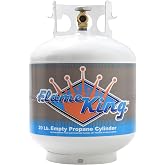
A standard 20-lb propane cylinder contains approximately 4.7 gallons when properly filled to its rated propane capacity. A tank obtained through exchange may contain less, depending on the supplier’s labeled net fill weight. That immediately changes the number of hours you can plan for.
For the Westinghouse WGen9500DF example at 50% load, approximately 7 hours on a full 20-lb cylinder is a reasonable manufacturer-based reference. For the Generac GP9500E TF at 50% load, its published figure is 4.5 hours. I would not combine the two into a guarantee that every 9,500-watt generator lasts six hours.
Another problem is the meaning of “full tank.” When I know the actual pounds of propane dispensed, I can estimate gallons using approximately 4.24 lb per gallon. If the cylinder holds only 15 pounds of propane, that is roughly 3.5 gallons, not 4.7. On the same 0.67-gallon-per-hour example rate, that works out to only about 5.3 hours.
| Actual propane in cylinder | Approx. gallons | Illustrative runtime at 0.67 gal/h |
|---|---|---|
| 15 lb | 3.54 gal | 5.3 h |
| 17 lb | 4.01 gal | 6.0 h |
| 20 lb | 4.72 gal | 7.0 h |
These are calculations, not evidence that your cylinder was filled to any of these amounts. A properly serviced cylinder should be filled by weight and never overfilled. I also wouldn’t use a propane tank gauge’s percentage display as a precise fuel-volume meter unless the gauge and tank were designed to provide that reading.
How Long Will a 9500 Watt Generator Run on a 100-lb Propane Tank?
At the Westinghouse example’s implied 0.67 gallons per hour, a full 100-lb cylinder containing roughly 23.6 gallons of propane has enough volume for about 35 hours at the same assumed load. The arithmetic is straightforward: 23.6 ÷ 0.67 ≈ 35.2. But I would not guarantee you can sustain the generator’s 50% output for all those hours from a single cylinder.
The reason is propane vaporization. Propane engines typically withdraw vapor through a suitable regulator. Vaporization depends on ambient temperature, cylinder geometry, liquid level, heat transfer, and demand. Even with usable fuel remaining, the cylinder can fail to vaporize fast enough. A large 9,500-watt-class generator may demand more gas than a cold, nearly empty 100-lb cylinder can comfortably supply.
Before using any cylinder beyond the manufacturer’s approved standard arrangement, I ask a qualified propane professional to verify the total BTU-per-hour demand, temperature, regulator and hose capacity, and applicable installation rules. I never connect multiple cylinders with a homemade manifold or bypass the factory regulator.
How Much Propane Does a 9500 Watt Generator Use Per Hour?
For the published 20-lb-cylinder examples, I can reverse the runtime calculation to estimate implied fuel consumption at the stated test point. The Westinghouse’s 7-hour figure is approximately 0.67 gal/h; the Generac’s 4.5-hour figure implies approximately 1.04 gal/h if the cylinder contains 4.7 gallons. These are derived values, not independently measured fuel-flow specifications.
| Example model | 20-lb test duration | Implied LP gallons/hour | Implied LP pounds/hour | Load condition |
|---|---|---|---|---|
| Westinghouse WGen9500DF | 7 h | About 0.67 | About 2.85 lb | 50% propane-rated load |
| Generac GP9500E TF | 4.5 h | About 1.04 | About 4.44 lb | 50% reported load |
| Cummins Onan P9500DF EFI | 10.8 h | About 0.44 | About 1.85 lb | 25% propane-rated load |
I would not rank those generators by this table, because the tests were at different generator loads and under separate manufacturer test conditions. If I am comparing actual cost, I put both engines at similar delivered electrical watts and measure their real fuel use. That’s how I avoid misleading comparisons.
How Much Propane Do I Need for 24, 48, or 72 Hours?
During a prolonged blackout, I do not think only in “hours per cylinder.” I also think in how many filled cylinders, how frequently I must change them, and whether I can obtain refills safely. Using the 7-hour Westinghouse benchmark as a planning example, here is the theoretical fuel quantity for continuous operation.
| Continuous operation | Propane at 0.67 gal/h | Approx. 20-lb cylinder equivalents | Approx. 100-lb cylinder equivalents |
|---|---|---|---|
| 12 hours | 8.0 gal | 1.7 | 0.34 |
| 24 hours | 16.1 gal | 3.4 | 0.68 |
| 48 hours | 32.2 gal | 6.9 | 1.36 |
| 72 hours | 48.2 gal | 10.3 | 2.04 |
For practical planning I would round cylinder requirements up, not down, and maintain a contingency reserve. A partial cylinder, cold weather, higher appliance demand, or the need to stop for maintenance can all change the result. Don’t interpret the 100-lb column as approval to connect such a cylinder to the generator; it is only equivalent fuel volume.
Worked Example: Using a 9500 Watt Generator During a Power Outage
Let’s imagine I want to keep the refrigerator, freezer, some lights, internet equipment and the furnace blower operating. I build a simple appliance list from example wattages. My goal is to estimate the normal continuous demand, not promise that every motor will start simultaneously.
| Home backup load | Illustrative running watts | Additional startup issue |
|---|---|---|
| Refrigerator | 450 W | Compressor surge |
| Freezer | 300 W | Compressor surge |
| Furnace blower | 650 W | Motor startup |
| LED lighting | 200 W | Usually small |
| Router, TV and chargers | 250 W | Usually small |
| Total while running | 1,850 W | Verify largest simultaneous motor surge |
At 1,850 W, this house uses about 22% of an 8,500-W propane running rating. That sounds relatively light. But I would not simply scale the generator’s 50%-load, 7-hour result into 14 hours. The engine burns fuel even while producing little electricity, and fuel consumption is not directly proportional to load.
For a better estimate, I would find the manufacturer’s runtime at 25% load for the exact model, or do a controlled consumption measurement with accurately known propane quantity and a properly connected fuel system. I would also consider whether the furnace blower and refrigerator compressor can start together. If the generator runs the loads but stumbles during startup, that is a sizing and transient-response problem, not necessarily a short runtime problem.
For a larger central-AC or well-pump house, my propane generator size guide for U.S. houses helps separate continuous watts from startup demand. It’s a different question from how many gallons you need to last three days.
My Three-Limiter Runtime Check: Fuel, Vapor, and Service
Here is the original planning framework I use to avoid overpromising runtime. I call it the three-limiter check. The first limit is how much fuel is physically in the tank. The second is whether the tank and regulator can supply enough vapor at the worst likely temperature. The third is how long the generator can operate before a required service or safe interruption. The usable operating plan is constrained by the first limit you hit.
| Runtime limiter | Question I ask | Example action |
|---|---|---|
| 1 — Fuel volume | Will the remaining gallons cover my planned hours at the expected load? | Calculate gallons/hour × run hours; include reserve |
| 2 — Vapor supply | Will the tank and regulator deliver adequate vapor while cold and partially depleted? | Ask a propane professional to check worst-case demand and temperature |
| 3 — Engine/service schedule | Does the oil check, maintenance interval or fault response require a safe shutdown first? | Review the manual’s continuous-operation instructions and hour meter |
For example, suppose my total stored fuel suggests 35 theoretical hours, but the cold-weather vaporization capacity becomes insufficient below a certain liquid level. Then the practical run might end earlier. Likewise, an extended outage may require a scheduled shutdown to check engine oil even when plenty of propane remains. I document these limits rather than giving readers one deceptively precise hour count.
Does Cold Weather Shorten Propane Generator Runtime?
Cold weather can reduce the ability of propane to vaporize fast enough, particularly in a small cylinder at high engine demand. The propane itself does not “expire” in the tank. Instead, the available vapor flow may drop as ambient temperature falls and the liquid level declines.
I watch for hard starts, low power under load, unusual regulator icing and repeated shutdowns. I never try to thaw a tank with a flame, wrap it with an unapproved heater, modify pressure settings, or tamper with the regulator to push more fuel through. If I see these symptoms, I stop and arrange a professional check. I’ve explained related symptoms in why propane pressure drops when the generator starts and why a propane generator starts then dies.
How Much Does It Cost to Run a 9500 Watt Generator on Propane?
To estimate fuel cost, I multiply my actual delivered price per gallon by the generator’s gallons-per-hour rate. I do not confuse nominal cylinder size with the actual amount of propane purchased. For this illustration I use the Westinghouse’s implied 0.67 gal/h fuel rate and hypothetical U.S. prices, not verified live retail quotes.
| Illustrative propane cost | Fuel cost per hour at 0.67 gal/h | Fuel cost for 24 hours | Fuel cost for 72 hours |
|---|---|---|---|
| $2.50 per gal | $1.68 | $40.20 | $120.60 |
| $3.00 per gal | $2.01 | $48.24 | $144.72 |
| $4.00 per gal | $2.68 | $64.32 | $192.96 |
The costs are for one fixed illustrative load, with no taxes, cylinder exchange premium, delivery charge, rental, or generator maintenance included. A heavier load could raise consumption, so I wouldn’t use this one chart as an all-purpose monthly electricity budget. For broader fuel comparisons, read my gasoline-versus-propane generator operating-cost guide.
Can I Make a 9500 Watt Propane Generator Run Longer?
Yes, primarily by reducing how much electricity I ask it to generate and by choosing an appropriate fuel supply. I turn off equipment that can wait, avoid simultaneous high-draw appliances, and use efficient lights and electronics. I also plan for the refrigerator and freezer to cycle normally; I do not open the doors unnecessarily during the outage.
I check whether the generator has an approved fuel-saving mode and what restrictions apply. Many larger conventional generators do not slow down the engine in the same way that inverter models can, so I don’t promise a dramatic efficiency improvement from simply switching a control. If the goal is continuous multi-day operation, I ask a licensed propane supplier whether a properly designed stationary tank offers better refill logistics than repeated cylinder changes.
I also make sure the engine is maintained. Dirty air filters, neglected oil service and unresolved faults can turn a fuel-planning problem into a breakdown. My propane generator maintenance schedule covers what I check before and after an extended outage.
Portable Generator Safety During Extended Runtime
I never operate a portable generator in a house, garage, carport, shed, basement, tent, or another enclosed or partially enclosed area. Exhaust contains deadly carbon monoxide even when the engine runs on propane. I run the generator outdoors at least 20 feet from the home, with the exhaust directed away from doors, windows and vents, and keep working carbon monoxide alarms indoors. I follow the manufacturer’s guidance for rain and snow protection rather than moving the generator inside.
When supplying household circuits, I use a qualified electrician’s approved transfer switch or listed interlock arrangement. I never backfeed a wall receptacle or improvise power connections. Cylinders stay upright and appropriately secured, away from heat and sources of ignition. I turn off equipment and follow the manufacturer’s fuel-change procedure before disconnecting a cylinder. If I smell gas, I move away and contact the supplier or emergency services from a safe location.
Frequently Asked Questions
How long will a 9500 watt generator run on a 20-lb propane tank?
For specific published examples, the Westinghouse WGen9500DF lists around 7 hours at 50% propane load and the Generac GP9500E TF lists about 4.5 hours at 50% load. Your actual runtime depends on load, model, fill quantity, weather, and condition.
How long will a 9500 watt generator run on a 100-lb propane tank?
At the illustrative 0.67 gal/h consumption rate, about 35 hours of fuel volume would be available from a completely filled 100-lb cylinder. I would not use that as a guaranteed operating time or connect a cylinder without checking approved fuel supply and vaporization capacity.
Can a 9500 watt generator run overnight?
It can, depending on the load, cylinder volume and the generator’s safe operating instructions. But I would never place it near bedrooms or inside a garage for convenience. A 20-lb cylinder may not cover a full night’s continuous use at heavier load. I plan fuel reserves and required engine service in advance.
Will a 9500 watt generator run a whole house?
It may power selected household circuits, but I wouldn’t expect it to run every major electrical appliance simultaneously. I verify its actual propane running watts, motor starting needs and the connection limits. My whole-house generator sizing guide explains how I select loads for a U.S. home.
Is a 9500 watt generator the same as a 9500 running watt generator?
No. A 9,500-watt label may describe starting power, gasoline-rated running power, or another configuration. I always identify whether the number is a peak or continuous specification and what the generator delivers on propane.
Does propane last longer than gasoline in a dual-fuel generator?
Not necessarily. Fuel consumption, usable tank quantity, and engine design all matter. A gasoline tank and a propane cylinder do not hold the same energy simply because both are called full. I compare manufacturer runtime specifications at equivalent electrical outputs before deciding.
My Final Answer
For a 9,500-watt-class propane generator, I would use roughly 4.5–7 hours on a full 20-lb cylinder at half load as a model-specific starting reference, not a universal rule. For a 100-lb cylinder, the same example fuel-rate calculation gives around 35 hours of fuel volume, but vapor supply, weather and safe service requirements can reduce practical operating time.
My advice is to find your exact model, identify its propane running rating, list the appliances you will use together, and calculate fuel from its published runtime or actual measured consumption. Then check whether the tank and regulator can supply that load, including in cold weather. That approach gives you a far more useful backup-power plan than a wattage label alone.

Mike is an experienced propane technician with over 15 years of professional experience in the field. He has dedicated his career to helping customers with their propane needs, from installation to maintenance and repair. Together with Jeremy, he co-founded this website to provide useful information and guidance to customers seeking reliable propane services.