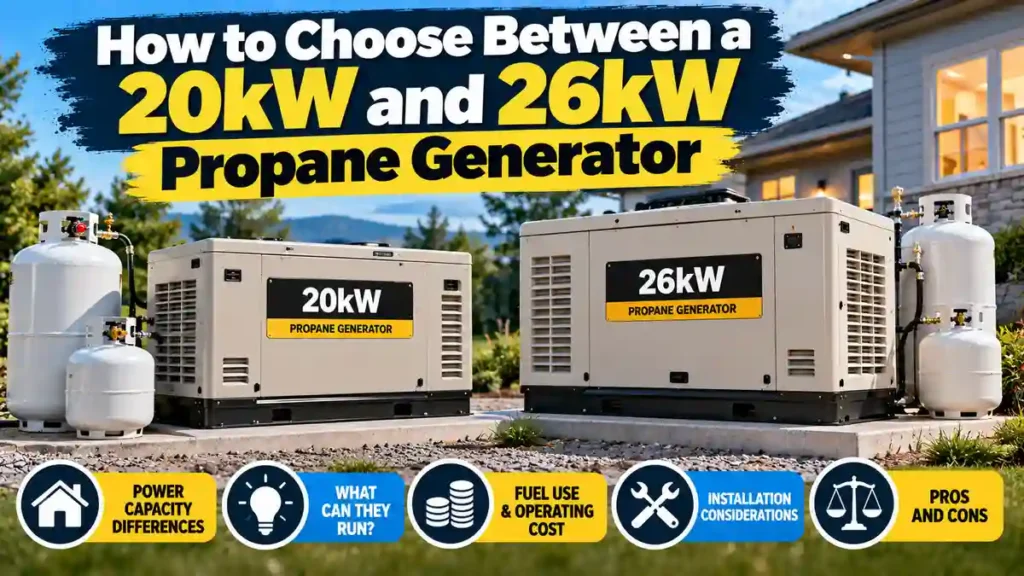
TL;DR — Should I choose a 20kW or 26kW propane generator?
Choose 20kW when a documented home-load calculation shows essential and reasonably simultaneous loads will fit, including motor starts and planned load shedding. Consider 26kW when you need more room for two HVAC systems, electric water heating, cooking, pumps or future electrical upgrades. A 26kW model offers 6,000 W (30%) more nominal continuous power, but it isn’t necessarily 30% more expensive to run or capable of starting every motor. Don’t size from house square footage alone. Verify actual LP ratings, transfer-switch strategy, installation bids, and cold-weather propane vapor-delivery capacity.
| At a glance | 20kW standby LP generator | 26kW standby LP generator |
|---|---|---|
| Nominal LP running output | 20,000 watts | 26,000 watts |
| Theoretical 240V current, single phase | 83.3 amps | 108.3 amps |
| Relative capacity | Baseline | 30% higher |
| Common strategy | Essential loads plus intelligent shedding | More simultaneous home loads |
| Half of LP-rated power | 10kW | 13kW |
| Fuel use | Specific model and actual load determine it | Not automatically 30% greater |
| Overall purchase | Usually lower-cost starting point | Added output may affect tank and piping |
I would never choose a whole-home propane generator from wattage alone. The question in a 20kW vs 26kW propane generator comparison is whether your home’s likely loads, air-conditioner starting currents and fuel supply actually justify the extra 6,000 watts. Your neighbor’s 2,500-square-foot home could need much less power than your smaller all-electric house.


The approach below starts with electrical demand, then examines propane consumption, fuel tank planning, initial costs and ownership. I use manufacturer-published consumption figures where possible and label the rest as hypothetical calculations. That makes this a decision guide rather than an unsupported claim that one generator is always superior.
1. Understanding the Difference Between 20kW and 26kW
kW is power; kWh is energy. Twenty kilowatts means the generator can supply up to 20,000 rated running watts under specified conditions. A household drawing 10kW for three hours uses 30kWh of electricity. A 26kW unit does not force a refrigerator to consume more energy; the home’s demand determines the load.
At a theoretical 240V, 20,000 ÷ 240 is 83.3 amps, while 26,000 ÷ 240 is 108.3 amps. Those numbers do not override individual 120V branch breakers, leg balancing or the generator output breaker. The automatic transfer switch may be rated 200A because it carries your utility service, but it doesn’t create 200A of generator output.
A motor’s starting demand can be substantially above its running watts. A 20kW unit that carries 17kW steadily might still struggle with a large compressor start. The engine, alternator, starting-kVA capability and voltage dip all matter.


For manufacturer-specific detail, Generac’s newer 26kW model 7327 is rated 26kW on propane and 24kW on natural gas. Some older 20kW Generac models have different natural-gas ratings or even 3-phase configurations. I compare exact model numbers and the LP specification rather than treating every 20kW listing as equivalent.
2. What Can a 20kW Propane Generator Power?
I consider 20kW a serious residential backup size. In a home with modest electric heating and managed loads, it can run refrigeration, lighting, communications, a well pump, ordinary kitchen appliances and potentially more than one cooling system. But electric resistance heating, vehicle charging, dryers and several compressor starts may require a plan.
| Home appliance | Illustrative running watts | What I double-check |
|---|---|---|
| Refrigerator | 150–500 W | Motor-start surge |
| Freezer | 100–400 W | Motor-start surge |
| Central A/C (each) | 2,500–6,000+ W | Locked-rotor current / soft-start compatibility |
| Electric water heater | 3,500–5,500 W | May be shed temporarily |
| Well pump | 700–2,000+ W | High startup current |
| Electric range / oven | 2,000–8,000+ W | Multiple elements may overlap |
| Microwave | 1,000–1,800 W | Input rather than cooking output |
| Washing machine | 300–1,000 W | Motor start |
| Electric dryer | 4,000–6,000 W | Resistance heating |
| Lighting, TV, router, home office | 300–1,300 W together | Several circuits |
| Level-2 EV charger | 3,800–11,500+ W | Often disabled in an outage |
The numbers above are general planning ranges, not the ratings on your equipment. I check the actual appliance nameplate, connected wiring and likely coincidence of loads. For a more general sizing walkthrough, see how I calculate home power requirements for a propane generator.
3. What Does the Extra 6kW Buy on a 26kW Generator?
Six kilowatts is enough to cover an additional 4.5kW electric water heater and some lighting, or reduce the number of times the controls have to shed loads. I see the biggest benefit in houses with two large cooling zones, electric water heating and active kitchen loads.
| Example simultaneous demand | Required running power | 20kW? | 26kW? |
|---|---|---|---|
| Essentials and one A/C | 9kW | Within rating | Within rating |
| Two A/C systems plus cooking | 16kW | Within rating, check motor starts | Within rating, check motor starts |
| Above plus 4.5kW water heater | 20.5kW | Exceeds running rating | Within running rating |
| Above plus 7.2kW EV charging | 27.7kW | No; shed loads | No; shed loads |
| 17kW running plus major compressor inrush | 17kW + transient | Check starting kVA | Check starting kVA |
That table demonstrates why more power does not guarantee unlimited simultaneous use. A 26kW generator has more running capacity, but I still want a credible worst-case start analysis. If the home only draws 10–12kW during outages, I may value an appropriately sized tank or professional maintenance more than the larger generator.

4. 20kW vs 26kW Propane Generator Fuel Consumption
Manufacturer fuel curves matter more than a simple “30% bigger means 30% more fuel” rule. Generac’s published reference data for the older Guardian-series 20kW class gives approximately 2.36 gallons/hour at 50% load and 3.74 gal/hour at full load. Newer 26kW Generac 7327 data gives 2.05 gal/hour at half load and 3.95 gal/hour at full load. These are different model generations and different electrical loads, not a same-output efficiency test.
| Percent of each unit’s LP rating | Legacy 20kW Guardian | Next Gen 26kW 7327 | Data status |
|---|---|---|---|
| 25% | ~1.65 gal/h | ~1.60 gal/h | Hypothetical light-load estimates |
| 50% | 2.36 gal/h at 10kW | 2.05 gal/h at 13kW | Manufacturer-published |
| 75% | ~3.05 gal/h | ~3.00 gal/h | Interpolated estimates |
| 100% | 3.74 gal/h at 20kW | 3.95 gal/h at 26kW | Manufacturer-published |
I calculated the 75% points halfway between the published 50% and 100% values. The 25% values are separate assumptions, not tested figures. Real low-load consumption can deviate substantially from a straight line, and some older generators differ by model revision. Use the fuel-data decal for the equipment you’re actually buying.
| Constant run duration | 20kW unit at its 50% load (10kW) | 26kW unit at its 50% load (13kW) |
|---|---|---|
| 8 hours | 18.9 gallons | 16.4 gallons |
| 24 hours | 56.6 gallons | 49.2 gallons |
| 72 hours | 169.9 gallons | 147.6 gallons |
These are not equal-load comparisons. A house actually drawing 10kW needs model-specific consumption for 10kW on both machines. At their respective full rated outputs, the 72-hour fuel demands become approximately 269.3 gallons and 284.4 gallons. In all cases I check the manufacturer’s full-load BTU/hour requirement to size the gas supply.
5. Tank Sizes and Winter Fuel Planning
Tank capacity is not the same as usable propane for a multi-day blackout. Most stationary tanks are filled to around 80% of water capacity. I also reserve a margin for scheduling the next delivery; for illustration I plan from 80% down to 20% of nameplate capacity. That makes the budgeted quantity 60% of the tank size.


| Tank size | At 80% fill | Budgeted fuel (80% to 20%) | 20kW at 2.36 gal/h | 26kW at 2.05 gal/h |
|---|---|---|---|---|
| 120 gal | 96 gal | 72 gal | 30.5 h | 35.1 h |
| 250 gal | 200 gal | 150 gal | 63.6 h | 73.2 h |
| 500 gal | 400 gal | 300 gal | 127.1 h | 146.3 h |
| 1,000 gal | 800 gal | 600 gal | 254.2 h | 292.7 h |
Again these two columns use different electrical outputs (10kW and 13kW); don’t conclude that the 26kW model must run longer for an identical house load. Other propane appliances may consume part of the fuel, and you might want a larger reserve than 20%.
The more difficult problem in freezing weather is vapor delivery. A propane tank can contain plenty of liquid but be unable to vaporize enough gas as temperatures drop or the liquid level falls. The regulator, piping length, tank surface area and other appliances all affect the system. Have a qualified propane supplier size the complete supply at the generator’s full-load fuel demand, including winter conditions.
| Condition | Risk | What I request |
|---|---|---|
| Cold weather and low fill | Lower vaporization capacity | Tank sizing at minimum expected temperature |
| Long line to generator | Pressure drop | Pipe and regulator sizing worksheet |
| Propane furnace and generator together | Combined peak BTU/hour demand | Whole-property demand calculation |
| Extended outage | Running out before delivery | Refill reserve and delivery plan |
For detailed storage calculations, see my propane generator tank sizing guide.
6. Purchase, Installation and Maintenance Costs
I compare the complete installed system, including the transfer switch, wiring, propane piping, pad, permits and initial testing. Public 2026 U.S. market estimates often put ordinary air-cooled home standby projects near $10,000–$18,000 installed, but complicated propane retrofits can cost materially more. These are preliminary planning figures rather than current bids for a particular ZIP code.
| Cost component | Illustrative U.S. budget | What changes it |
|---|---|---|
| Generator equipment, roughly 20–26kW | $4,500–$8,500+ | Model generation, brand, package |
| Automatic transfer switch / switching work | $1,200–$3,500 | Bundled or separate; panel compatibility |
| Electrical installation | $1,500–$4,500+ | Distance, trenching, panel needs |
| Propane piping and regulators | $800–$3,500+ | BTU demand, layout and existing tank |
| Pad and site preparation | $300–$1,500+ | Factory base vs. foundation and grading |
| Tank installation or upgrade | $1,000–$5,000+ | Size, lease or purchase, delivery |
| Permits and inspection | $200–$1,000+ | Local requirements |
| Routine service | $250–$600+ per year | Travel, parts, maintenance plan |
Some quotes bundle these line items, so I would never add the highest values and call that a typical price. A 26kW Generac model has been listed with manufacturer starting pricing around $6,989 for generator equipment before installation, but that is not a commitment from your installer.
A smaller 20kW generator with automatic load shedding can be cheaper than a 26kW project that triggers gas-line or tank upgrades. On the other hand, when the entire fuel and electrical infrastructure is already suitable, the extra capacity may cost less than expected. I ask for two comparable quotes based on the same scope.
7. What Size Generator for a 1,500- to 4,000-Square-Foot House?
House size is a poor substitute for real electrical measurements. A smaller all-electric home may draw more power than a larger property heated with propane. I use these hypothetical homes only to frame the discussion, not to recommend equipment based solely on floor area.
| Home size | Example loads | How I would evaluate |
|---|---|---|
| 1,500 sq ft | One A/C, propane water heat, basic circuits | 20kW might already be generous |
| 2,000 sq ft | One A/C, electric kitchen, well pump | 20kW plus shedding vs 26kW |
| 2,500 sq ft | Two HVAC zones, electric water heater | Compare surge and coincident demand |
| 3,000 sq ft | Multiple A/C, workshop, electric cooking | 26kW may provide valuable headroom |
| 4,000+ sq ft | Several HVAC systems and large electric loads | 26kW may still be too small |
8. My Worked Home-Load Calculation
Imagine two central A/C systems, refrigeration, a pump, electric cooking and an electric water heater. The following is a hypothetical simultaneous-running scenario, not a real home measurement.
| Load | Illustrative running kW |
|---|---|
| Main A/C | 3.5 |
| Second A/C | 3.0 |
| Refrigerator and freezer | 0.5 |
| Well pump | 1.2 |
| Lights and network | 0.6 |
| Electric range | 4.0 |
| Electric water heater | 4.5 |
| Microwave | 1.4 |
| Combined running load | 18.7 |
A nominal 20kW machine can cover 18.7kW running on paper but leaves little margin. Assume the well pump’s short starting requirement is 6kW instead of its 1.2kW running load. Then the brief combined demand is 18.7 − 1.2 + 6.0 = 23.5kW. Only a model-specific motor-starting assessment can establish whether the generator can handle this transient; its running kW alone isn’t enough.
Now let a load-management module delay the 4.5kW water heater while the pump starts. Running demand drops to 14.2kW, and the hypothetical start event drops to 19.0kW. That might make a professionally matched 20kW design workable. A 26kW system has more running headroom but still needs verification of starting capability and voltage drop.
9. Air Conditioning, Soft Starts and Load Management
Locked-rotor amperage (LRA) is the high current associated with a stopped or starting motor, not its normal operating draw. Large compressors and well pumps can have substantial inrush. Inverter-driven HVAC and approved soft starters may reduce starting stress, but compatibility is equipment-specific.
| Strategy | Potential benefit | Limit |
|---|---|---|
| Delay electric water heating | Removes ~4.5kW in our example | Hot water temporarily postponed |
| Disable EV charging on outage | Removes 3.8–11.5kW or more | Vehicle charging unavailable |
| Stagger air-conditioner starts | Avoids simultaneous compressor inrush | Requires compatible controls |
| Approved compressor soft start | May reduce start current | Not compatible with every compressor |
| Choose 26kW instead | Adds nominal 6kW running headroom | Does not eliminate fuel or motor-start checks |
A 200A transfer switch does not mean a 20kW generator can power a 48kW electrical load. And I would never backfeed home wiring through a wall outlet. A qualified electrician must design and install an approved transfer mechanism.
10. The 10-Year Cost of Ownership
Here is my original hypothetical ownership model. Assume an existing propane tank and compliant gas piping, with installed costs of $13,500 for 20kW and $16,500 for 26kW, plus routine service at $350 and $425 per year. At the same assumed household electrical demand, I model 2.3 and 2.5 gallons/hour, respectively, at a hypothetical constant $3/gallon. These are not measured same-load fuel figures or future price predictions.
| Ten-year cost component | 20kW model | 26kW model |
|---|---|---|
| Installed system | $13,500 | $16,500 |
| Routine maintenance (10 years) | $3,500 | $4,250 |
| Fuel: 30 outage hours/year | $2,070 | $2,250 |
| Total: occasional outages | $19,070 | $23,000 |
| Fuel: 150 outage hours/year | $10,350 | $11,250 |
| Total: frequent outages | $27,350 | $32,000 |
| Optional separate larger-fuel-system upgrade | Not assumed | + $1,500 if needed |
At $4/gallon instead of $3, the modeled ten-year fuel expense for frequent outages becomes $13,800 for the 20kW and $15,000 for the 26kW. The model excludes inflation, financing, unscheduled repairs and resale value. I would replace every assumption with itemized local bids and realistic outage history before relying on it.
11. Eight Costly Sizing Mistakes
Buying by square footage: I inventory the real appliances and HVAC configuration instead.
Ignoring compressor starting amps: Motor surge and voltage dip can dominate the decision.
Assuming everything may run together: I specify which heavy appliances can be shed.
Confusing transfer-switch amperage with generator watts: The generator output breaker remains a limit.
Budgeting the entire tank’s gallons: I plan a refill reserve and other propane consumption.
Ignoring winter vaporization: Adequate liquid fuel does not guarantee enough gas flow.
Comparing NG and LPG or mismatched model generations: I verify the exact 20kW and 26kW data sheets.
Forgetting upgrades: Heat pumps, electric cooking and EVs may materially change future electrical demand.
12. My Recommendation Matrix
| Choose a 20kW generator when… | Consider a 26kW generator when… |
|---|---|
| Loads and motor starts fit with comfortable margin | Documented concurrent loads need the extra 6kW |
| Shedding nonessential electric heating is acceptable | Multiple HVAC or major electric appliances overlap |
| Lower purchase and installation cost matters | Avoiding frequent load shedding has real value |
| The existing propane supply is suitable | Tank and pipe are verified for larger full-load draw |
| Electrical growth is modest or controlled | Additional electric appliances are planned |
For my own buying process, I would request a professional load schedule, the generator’s LP nameplate and motor-starting performance, a transfer-switch plan, a cold-weather full-load propane design, and two installed quotes. I would also check local service availability; see my 2026 whole-home propane generator comparison for that separate issue.
13. Frequently Asked Questions
Is 20kW enough for a whole house?
Often, especially with manageable electrical heating and appropriate load shedding. A whole-house transfer switch does not mean every connected appliance can operate simultaneously.
Is 26kW too big for a 2,000-square-foot house?
Not automatically. If the house has large electric heating, cooling and charging loads, 26kW may be justified. I would use a load worksheet, not floor area.
How much propane does a 20kW generator burn per hour?
The older Generac Guardian 20kW class is published around 2.36 gal/hour at its half-rated LP load and 3.74 at full load. Other models may differ.
How much propane does a 26kW generator use per day?
Generac 7327 is listed at 2.05 gal/hour at 50% and 3.95 at full LP load. That’s roughly 49.2 to 94.8 gallons in 24 hours at those two constant test points, not a typical-home prediction.
How long will a 500-gallon tank last with 26kW?
If I budget 300 gallons from 80% down to 20% fill, it would last about 146 hours at the 7327’s published half-load rate or about 76 hours at its full-load rate. Temperature and other propane appliances can change the result.
Is a 26kW generator worth extra money?
I think so only when it solves a real simultaneous-load or starting-power requirement, reduces disruptive shedding, or supports documented expansion.
Can a 20kW generator run two air conditioners?
Sometimes. Their running watts, inrush current, startup sequencing and other loads decide. I would not promise it without checking compressor and generator specifications.
Which tank size is needed for 26kW?
There is no universal answer. Your propane supplier must check both outage storage capacity and the tank’s full-load vaporization ability at the coldest relevant temperature.
Does the larger generator always burn more fuel at the same load?
No. Different engine and alternator designs can have different efficiency. Published half-load ratings also represent different output levels, so I compare gallons/hour only at equal actual kW when possible.
What is the difference between a Generac 20kW and 26kW?
The nominal LP running-capacity gap is 6kW. Fuel consumption, NG output, electronics, warranty and electrical phase vary with the exact model and year; Generac’s newer 7327 isn’t the same generation as older 20kW Guardian units.
Can 26kW run continuously?
It can operate within its rated output subject to the manufacturer’s runtime, oil-service and maintenance instructions, suitable propane delivery and correct outdoor installation. It isn’t unlimited power for every appliance.
Will 26kW need a bigger gas line?
Possibly. Full-load fuel demand, pipe distance, operating pressure, number of regulators and other appliances determine the pipe design—not kW alone.
14. Final Verdict
I would choose 20kW when proper starting calculations, credible load management and the propane supply support the essential appliances with a reasonable margin. I’d pay for 26kW when the load study identifies repeated 20–26kW simultaneous demand or substantial motor-starting requirements that make the smaller system impractical.
My final decision would rest on four documented facts: actual household loads, largest expected motor start, winter propane supply capacity and the complete installed bid. Those matter more than choosing the larger number because it looks safer.
Data note: The published LP consumption points are for identified older Guardian 20kW and newer Generac 7327 26kW references and are not equal-generation or equal-output efficiency tests. The 25%/75% consumption estimates, home loads, fuel-budget scenarios, cost ranges and 10-year ownership example are illustrative, not field tests or guarantees. No outbound links are included.

Mike is an experienced propane technician with over 15 years of professional experience in the field. He has dedicated his career to helping customers with their propane needs, from installation to maintenance and repair. Together with Jeremy, he co-founded this website to provide useful information and guidance to customers seeking reliable propane services.