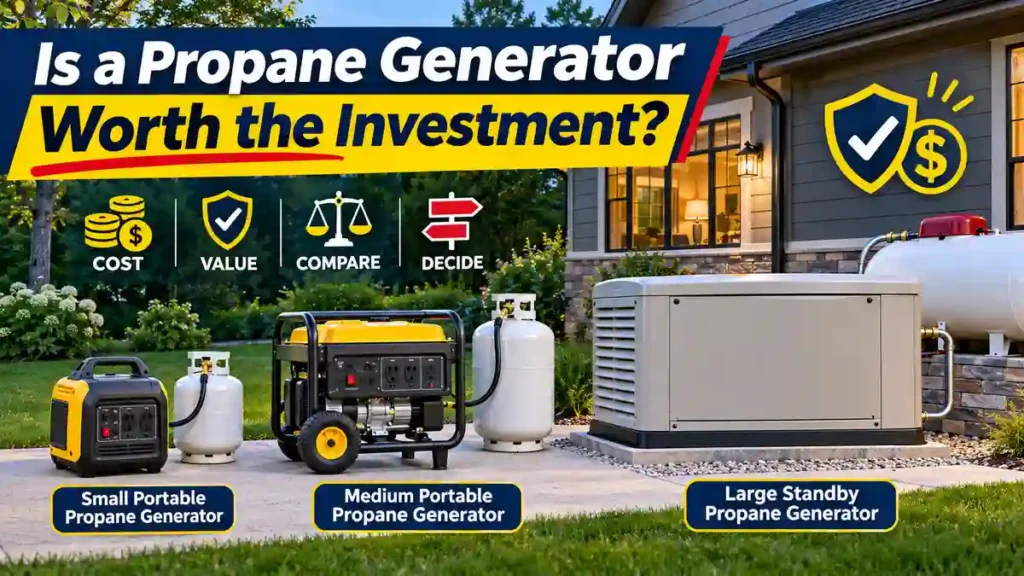
TL;DR — Is a propane generator worth it? Yes, if your outages are long or frequent, your home depends on electrically powered essentials, or you value having fuel stored on-site. A portable propane or dual-fuel unit often offers the strongest financial value for occasional emergencies. A permanently installed standby generator costs much more, but automatic operation can justify the premium for some households. Neither choice is guaranteed to pay for itself. I would compare total ownership cost with realistic avoided outage losses, then treat convenience and peace of mind as separate benefits.
| Backup choice | Illustrative initial investment | Operating and upkeep | Best fit |
|---|---|---|---|
| Portable propane generator | $700–$2,000 before optional home connection | Fuel plus periodic engine service; manual setup | Essential circuits, short outages |
| Dual-fuel portable generator | $800–$2,500 before optional home connection | Flexible fuel choice; similar engine upkeep | Households wanting gasoline/propane flexibility |
| Whole-house propane standby | Roughly $10,000–$25,000 installed; complex projects higher | More propane, scheduled service, inspections | Automatic, higher-capacity backup |
| Home battery backup | Highly variable; $7,000 used in the model below | Limited stored energy; possible replacement expense | Quiet, short-duration essential loads |
| No dedicated backup | $0 | Potential outage losses and inconvenience | Reliable grid, low-consequence outages |
Dollar amounts are U.S. planning figures, not retailer quotes. The battery figure is a modeled example, not a national price estimate. Prices and calculations are current as of November 2026 unless otherwise noted.
1. What makes a propane generator worth the investment?
I separate the question into financial value and backup-power value. Financially, a generator is worthwhile if its avoided expenses exceed its purchase, installation, fuel, maintenance and eventual replacement costs. Practically, it may still be worth owning if it keeps a well pump operating, protects a basement from flooding or lets your household remain at home during a multiday outage.


Your needed electrical load matters more than your home’s square footage. A refrigerator, lights and router may require a small system; central air conditioning, electric cooking and multiple motor loads can require much more. I start by listing running watts, starting surges and the appliances that truly must work. I then weigh outage frequency, expected outage duration and whether someone can start a portable generator safely.
The most common mistake is comparing generator sticker prices rather than the total cost of ownership.
2. How much does a propane generator cost to buy?
A portable generator usually needs less initial spending than a stationary standby unit, but the rated wattage alone does not reveal its value. In particular, some dual-fuel models produce less rated power on propane than gasoline. For example, a Champion unit sold as a 7,500-watt gasoline generator is rated at 6,750 running watts on propane.
| Generator class | Typical output | Equipment-only budget or published example | Primary use / extra consideration |
|---|---|---|---|
| Small portable | About 3–5 kW | $700–$1,200 planning allowance | Refrigeration, lights, electronics; outdoor setup |
| Medium portable | About 6–8 kW | $900–$1,800; Westinghouse 7,500W dual-fuel listed at $1,149 | More essentials; possibly 240V loads |
| Large dual-fuel portable | About 9–12 kW | $1,200–$2,500 planning allowance | More circuits; larger fuel demands |
| 14 kW standby | 14 kW | Generac listing starts at $4,889 | Home backup; transfer and installation extra |
| 20 kW standby | Around 20 kW | Budget roughly $5,500–$8,000; model availability differs | Check residential voltage/phase before buying |
| 22 kW standby | 22 kW | Generac listing starts at $6,309 | Larger home load; transfer switch may be separate |
| 24 kW standby | 24 kW | Generac listing starts at $6,729 | Higher load or managed appliance starting |
| 26 kW standby | 26 kW | Generac listing starts at $6,989 | Higher peak capacity, not automatically higher fuel cost |
The listed Generac prices are manufacturer starting prices, not installed project totals. The unbranded price bands are illustrative shopping budgets, not verified market averages. A current 20 kW listing may be a three-phase product, so I would not substitute it for a standard single-phase residential model without checking specifications.


3. How much does installation cost?
A portable generator can power suitable appliances with manufacturer-approved cords, but connecting one to household wiring requires a properly installed transfer switch or approved interlock arrangement and inlet. Never backfeed through a receptacle. A standby unit typically requires an electrical contractor, a fuel professional and inspection.
For requirements beyond the equipment price, read my propane generator installation guide.
Here is my hypothetical 20 kW propane standby project. I use rounded allowances to demonstrate how quickly the extras accumulate—not to represent contractor bids.
| Installation component | Hypothetical allowance |
|---|---|
| Generator unit | $6,500 |
| Automatic transfer switch and equipment | $1,200 |
| Electrical installation and wiring | $2,800 |
| Gas piping, regulator work and pressure testing | $1,600 |
| Pad and site preparation | $800 |
| Permits, inspection and commissioning | $700 |
| Propane tank installation or upgrade | $2,400 |
| Illustrative installed total | $16,000 |
If you already have a suitable bulk propane tank, the project could avoid some tank expense. But its usable fuel volume, winter vaporization rate, regulator arrangement and line capacity must support the generator plus other connected appliances. An underground tank usually adds excavation, corrosion protection and site-work costs. I would request itemized written proposals rather than assume any national average applies to my property.
4. What is the total cost of ownership?
A purchase price is only the beginning. I include propane, periodic oil and filters, a starting battery, repairs, inspections and a reserve for surprises. Generator replacement is another possible cost, but I do not assume a universal replacement date.

Consider the $16,000 installation above, operated 30 hours annually at the 20 kW manufacturer’s published half-load propane rate of 2.36 gallons per hour. At a modeled propane price of $3 per gallon, annual outage fuel costs $212.40. Add an illustrative $300 yearly service budget and $150 yearly repair/battery reserve, for $662.40 in annual ownership expenses after installation.
| Time owned | Initial cost | Accumulated running/service/reserve | Modeled cumulative cost |
|---|---|---|---|
| 1 year | $16,000 | $662 | $16,662 |
| 5 years | $16,000 | $3,312 | $19,312 |
| 10 years | $16,000 | $6,624 | $22,624 |
| 15 years | $16,000 | $9,936 | $25,936 |
These are undiscounted, constant-price scenarios. They omit financing, taxes, insurance changes, emergency refills and major failures. The 15-year line does not promise a 15-year lifespan or exclude an eventual full replacement.
5. How much does a propane generator cost to run?
The working formula is hourly fuel cost = propane gallons per hour × delivered price per gallon. Electricity cost per kilowatt-hour is that hourly cost divided by the actual electrical output, not the generator’s advertising wattage.
For fuel storage planning, compare your projected burn rate with my propane tank size chart for generators.


For illustration I use $3.00 per gallon, somewhat above the U.S. Energy Information Administration’s $2.730 per-gallon residential propane average on October 26, 2026, which excluded taxes. Delivered tank-filling prices, cylinder exchanges and minimum-delivery fees can differ substantially.
| Generator example at about 50% rated load | Propane use, gal/hour | 1 hour | 8 hours | 24 hours | 72 hours |
|---|---|---|---|---|---|
| 5 kW portable — modeled | 0.45 | $1.35 | $10.80 | $32.40 | $97.20 |
| 7.5 kW-class dual-fuel — Champion example | 0.85 | $2.55 | $20.40 | $61.20 | $183.60 |
| 10 kW portable — modeled | 1.10 | $3.30 | $26.40 | $79.20 | $237.60 |
| 14 kW Generac next-generation standby | 1.76 | $5.28 | $42.24 | $126.72 | $380.16 |
| 20 kW Generac Guardian standby | 2.36 | $7.08 | $56.64 | $169.92 | $509.76 |
| 26 kW Generac next-generation standby | 2.05 | $6.15 | $49.20 | $147.60 | $442.80 |
Methodology: Generac publishes the standby figures above. The Champion 7,500-watt gasoline/6,750-watt propane-rated model advertises 5.5 hours at half propane load on a nominal 20-pound cylinder; roughly 4.7 usable gallons divided by 5.5 hours is approximately 0.85 gal/hour. The 5 and 10 kW entries are deliberately labeled model assumptions, not verified specifications. All rows assume uninterrupted operation at the stated load and a constant fuel price.
At 20 kW rated output and 10 kW actual output, the 20 kW example produces electricity for about $0.71/kWh in fuel alone. The 26 kW example at 13 kW output works out to about $0.47/kWh. Those are different delivered loads and product generations, so they are not a head-to-head efficiency test. A 26 kW generator does not necessarily burn 30% more fuel than a 20 kW unit: efficiency and loading matter. Always use the specific model’s fuel curve.
A 500-gallon bulk tank normally holds about 400 gallons when filled to 80%. At 2.36 gallons/hour, that is roughly 169 hours mathematically, before reserving fuel for other appliances or accounting for real-world delivery and vaporization constraints. Tank size alone does not guarantee sufficient winter gas flow.
6. Propane vs. gasoline, diesel and natural gas: which is cheaper?
I compare the cost per usable kWh, not just the cost per gallon. Diesel’s energy content and generator efficiency differ from gasoline; natural gas is billed in therms or cubic feet, not liquid gallons. Fuel flexibility and storage requirements also change the economics.
If gasoline is your main alternative, see my gas versus propane generator cost comparison.
| Factor | Propane | Gasoline | Diesel | Natural gas |
|---|---|---|---|---|
| Storage | Stable sealed bulk or cylinders; tank infrastructure | Stale-fuel management; refueling containers | Stored tank fuel; quality management | Utility supply; no household tank normally |
| Outage availability | On-site supply until depleted; delivery may be delayed | Station access may be disrupted | Deliveries and storage capacity matter | Depends on utility system staying available |
| Engine/fuel upkeep | Oil and ignition service still needed | More fuel-system attention after storage | Diesel-specific maintenance | Engine service; fewer stored-fuel concerns |
| Primary strength | Long-term on-site fuel | Widely available portable equipment | Strong option for heavy, long-duration duty | Convenient where supply is dependable |
| Main limitation | Cost of tanks and fuel use | Short-term storage difficulties | Equipment and emissions/maintenance complexity | Not available at every property |
For a hypothetical 72-hour outage at a steady 5 kW electrical load, imagine four different, suitably capable generators. My assumptions—not measured specifications—are propane 1.20 gal/hour at $3.00, gasoline 0.65 gal/hour at $4.27, diesel 0.45 gal/hour at $6.35, and natural gas 0.70 therm/hour at $2.00/therm.
| Fuel | Modeled cost/hour | 72-hour fuel bill | Fuel cost/kWh at 5 kW |
|---|---|---|---|
| Propane | $3.60 | $259.20 | $0.72 |
| Gasoline | $2.78 | $199.84 | $0.56 |
| Diesel | $2.86 | $205.74 | $0.57 |
| Natural gas | $1.40 | $100.80 | $0.28 |
The gasoline and diesel prices are rounded from October 26, 2026 EIA U.S. averages; the natural-gas tariff is assumed, not a verified average. This is a mathematical comparison, not an apples-to-apples test of real generators. Fuel rates, taxes, gas tariffs and efficiency can reverse the order. Do not use it to select a fuel without model-specific consumption data.
7. Seven advantages that can make propane worth paying for
First, propane stored in a sound, approved system does not degrade like gasoline, so you need not continuously rotate a reserve simply because it has been sitting. Second, propane operation avoids some stale-gasoline carburetor issues, although an engine still needs maintenance. Third, a large tank gives you fuel on-site when gas stations cannot pump.
Fourth, backup refrigeration can prevent food loss. Fifth, a powered sump pump or well pump may avoid far bigger losses or disruption. Sixth, a standby unit can start and transfer automatically, which matters when nobody is available to operate a portable set. Seventh, prearranged bulk delivery may be easier than repeatedly acquiring small fuel containers during a regional emergency.
Of those seven benefits, only actual costs you otherwise would have incurred count as financial savings. The rest are resilience or convenience. I would never add a made-up dollar figure for “peace of mind” to force a positive ROI.
8. Seven disadvantages and hidden costs
A propane standby unit involves (1) a high purchase price, (2) site and electrical work, (3) volatile propane prices, (4) substantial consumption over multiday outages, (5) tank purchase or rental terms, (6) continuing maintenance and (7) the risk of spending thousands on equipment that rarely runs.
Before budgeting for long outages, review how to arrange propane delivery for a home generator.
There are additional constraints. Storms can interrupt propane delivery. A partly filled tank in very cold weather may not vaporize propane rapidly enough for a large generator without appropriate system design. A regulator, transfer switch, controller or engine can fail unexpectedly. If your home only needs to power a router and refrigerator for two hours, a large standby system may be economically disproportionate.
This is why I inspect the propane system and prioritize essential loads before recommending bigger equipment.
9. How long does a propane generator last?
I would not promise that “propane generators last 20 years” or that propane engines always outlive gasoline engines. Portable and stationary designs have different duty cycles, cooling systems, engine construction and service needs. The operating-hour record, maintenance log and actual condition are more useful than one universal age estimate.
A unit that runs briefly a few times yearly may suffer battery neglect, moisture intrusion or fuel-system deterioration. One that operates for hundreds of hours during storms can accumulate wear rapidly. Oil changes, air filtration, proper loading, weather protection and professionally sized fuel supply influence the outcome.
Check warranty terms for years, operating-hour limits, exclusions, labor coverage and transferability. I model replacement as a risk, rather than asserting a date that the manufacturer has not guaranteed.
10. How much maintenance should I budget?
Propane does not eliminate combustion-engine maintenance. A standby generator still needs inspection, oil and oil-filter service, air filtration, spark-plug attention where applicable, battery checks and periodic fuel-system inspection. Generator-specific schedules control.
For a service checklist, see what maintenance a propane generator requires.
| Task | Portable propane/dual-fuel | Propane standby |
|---|---|---|
| Oil and filter | According to manual and hours; some units have no replaceable oil filter | Scheduled by hours and calendar; model-dependent |
| Air filter / spark plugs | Inspect and replace as specified | Inspect/service at specified intervals |
| Starting battery | If fitted; charge and test | Essential for automatic starting; periodic testing |
| Fuel connections | Check hose, seals and approved regulator | Professional inspection and leak checks |
| Exercising/testing | Run only as instructed in safe outdoor location | Follow controller and manufacturer exercise schedule |
| Illustrative annual service allowance | $120 in my long-term model | $300, plus $150 repair/battery reserve in my model |
The allowances above are budget assumptions, not published nationwide service averages. Generac identifies routine annual checks, intervals such as 200 hours/two years for some service packages, and daily checks when operating continuously; other models vary. Long outages can bring service due sooner than the calendar suggests. Never work on hot, energized or pressurized equipment without appropriate training.
11. Does a standby generator increase home value?
A permanently installed standby system can appeal to buyers who remember local blackouts or want automatic backup. That may improve marketability, especially in outage-prone areas. But an attractive feature is not the same as a verified increase in appraised value.
I would not assume a 100% cost recovery, a particular percentage of resale appreciation, or an insurance discount without local documentation. The age, permits, transferable warranty, maintenance record and remaining service life can all affect buyer perceptions. If resale value is part of your justification, ask a local real-estate professional for comparable sales rather than rely on a general promotional claim.
12. Is it worth it if you lose power only once a year?
Suppose you have one eight-hour outage annually, and estimate $150 of losses per year if you do nothing. For a portable propane generator, use $1,900 upfront including an approved home connection, $120 annual maintenance and $20.40 annual fuel (8 hours × 0.85 gal/hour × $3).
Over 10 years, ownership costs $3,304. Even if it prevents 70% of the $1,500 potential outage losses—$1,050—the net financial benefit is negative $2,254. A $16,000 standby system with $450 annual maintenance/reserve and $56.64 annual outage fuel would cost about $21,066 over the same period before potential replacement. Preventing 95% of $1,500 would still leave a very large financial deficit.
For this household I would compare a smaller battery, a refrigerator-focused backup, or no purchase at all. Comfort can still justify a generator, but the financial case is weak.
13. What if you experience frequent, lengthy outages?
Now consider a rural home losing power 120 hours annually. It relies on a well pump and has heating or cooling needs that make a 20 kW standby system reasonable after proper load calculations. Using 2.36 gal/hour and $3 propane, annual fuel costs $849.60, or about 283 gallons. Add $450 in annual service/repair allowance.
To avoid buying more capacity than your home needs, start with my home generator power-needs calculation guide.
On the $16,000 example installation, 10-year total ownership cost is $28,996. To break even purely on dollars, the household would need nearly $2,900 in verifiable avoided losses per year, ignoring discounting and unusual failures. If genuinely preventable losses were $4,000 per year and the system prevented 95%, the modeled 10-year net benefit would be $38,000 − $28,996 = $9,004.
That positive case is possible but not typical or guaranteed. You must substantiate losses rather than multiply outage hours by an arbitrary dollar rate. Automatic backup may still be valuable for safety, pumps and continuity even when payback is unlikely.
14. Is whole-house propane backup worth the extra money?
I would choose whole-house standby power if the home has significant simultaneous loads, outages occur while the occupants are away, or manual refueling and startup are impractical. It can operate an automatic transfer switch and, if designed properly, protect a wider range of appliances.
For a closer look at equipment sizing, read my 20 kW versus 26 kW propane generator comparison.
But “whole-house” does not automatically mean every device simultaneously. Load-management controls may prioritize heating, water pumps and refrigeration over air conditioning or other big appliances. A small portable unit with approved transfer equipment may cover essentials for a fraction of the upfront price. Batteries can be a better fit for silence and rapid switchover, but duration is limited by usable stored energy and recharge options.
My recommendation: size for what must stay on, then price the extra comfort loads separately.
15. Portable propane vs. standby: which is the better investment?
| Feature | Portable propane or dual-fuel | Propane standby |
|---|---|---|
| Purchase price | Lower | Higher |
| Installation | May avoid fixed work if powering individual devices; home connection costs extra | Electrical, fuel, siting and permits normally required |
| Starting and transfer | Usually manual | Typically automatic |
| Capacity | Often essentials to several circuits | Can serve many circuits with proper design |
| Portability | Yes, but bulky larger models | Fixed |
| Fuel | Exchange cylinders or approved larger supply | Typically bulk propane |
| Maintenance | Owner-managed according to manual | Scheduled professional service often advisable |
| Noise | Model- and load-dependent; can be loud | Model- and load-dependent, often enclosed |
| Best value | Occasional, manageable outages | Higher-consequence outages and automatic coverage |
Remember that portable propane units must run outdoors, more than 20 feet from windows, doors and vents, consistent with CDC guidance, and never in a garage or enclosed space. Install working carbon-monoxide detectors. Standby generators also require manufacturer-specified outdoor clearances and code-compliant exhaust placement; portable rules are not a substitute for standby installation instructions.
16. Can a propane generator pay for itself?
The simple calculation is net financial benefit = avoided outage losses − total ownership costs. Return on investment (ROI) can then be expressed as net financial benefit ÷ total ownership cost × 100. A positive net figure is not the same as cash income.
For example, suppose a portable setup costs $3,500 over 10 years, including purchase, safe connection, fuel and maintenance. It prevents $800 in spoilage, $1,000 in hotel stays and $900 in documented remote-business interruptions—$2,700 total, with no overlapping claims. Net benefit is negative $800, and financial ROI is about −23%.
A payback period exists only when recurring net savings can realistically recover the initial outlay. For most homeowners, keeping the lights on is closer to insurance-like resilience than an income-generating investment. I would never count theoretical property value, comfort and business savings twice.
17. The 10-year comparison: five backup choices
Here is my original apples-to-apples economic framework for a home experiencing 30 hours of outages per year and an estimated $600/year in losses without backup. Every option is assessed against the same $6,000 potential 10-year losses. Protected-loss percentages reflect hypothetical coverage differences; they are not performance guarantees.
| Choice | Initial investment | 10-year upkeep + energy + reserve | Ownership cost | Avoided losses | Residual losses | Ownership + residual losses |
|---|---|---|---|---|---|---|
| No generator | $0 | $0 | $0 | $0 | $6,000 | $6,000 |
| Portable propane | $1,900 | $1,965 | $3,865 | $4,200 (70%) | $1,800 | $5,665 |
| Dual-fuel portable | $2,400 | $2,300 | $4,700 | $4,500 (75%) | $1,500 | $6,200 |
| 20 kW propane standby | $16,000 | $6,624 | $22,624 | $5,700 (95%) | $300 | $22,924 |
| Battery backup | $7,000 | $2,750 | $9,750 | $3,600 (60%) | $2,400 | $12,150 |
Assumptions: The portable propane case uses $120/year maintenance plus 30 × 0.85 × $3 = $76.50/year fuel, rounded to $1,965 over 10 years. Dual-fuel uses $130/year maintenance and an assumed $100/year fuel. Standby uses the 30-hour model from Section 4. Battery includes $50/year upkeep, $25/year charging and a hypothetical $2,000 battery/replacement allowance within 10 years, totaling $2,750. No inflation, financing, tax effects, major generator replacement or interest/discount rate is applied.
This example narrowly favors the portable propane option on total economic cost, not because it delivers more comfort. If outage losses are far lower, buying nothing becomes cheaper. If outages happen unattended or affect high-value systems, automatic standby becomes more compelling. A battery’s performance depends especially on usable kWh and how long outages last.
18. Five situations where propane backup is worth considering
Frequent extended outages: Every additional outage creates more opportunity to prevent loss and inconvenience. Rural properties: Repairs and fuel access can be slower, making stored fuel helpful. Electric well pumps: Losing pumping capacity can make a home unlivable even when most appliances are off. Sump pumps and essential controls: Avoiding one flood or freeze event can justify substantial preparedness spending, although it must not be counted as a certain annual saving. Existing bulk propane storage: If the tank and regulator system are already adequate, the installation hurdle may be smaller.
I would also consider automatic backup for households where safe manual generator operation is unlikely during bad weather. That is a practical requirement, not just a luxury.
19. Five situations where propane backup may not be worth it
Very reliable electricity: A costly engine that never runs may deliver little financial return. Tiny backup loads: A compact battery or smaller inverter generator may suffice. Expensive installation: Long gas-pipe runs, challenging excavation or panel upgrades can distort the economics. Short, predictable outages: A properly sized battery might cover them quietly and without on-site combustion. Difficult propane delivery or storage: Regional supply, access and local siting requirements can undermine the appeal of propane.
I would not discourage emergency power altogether. I would first choose the smallest safe system that meets your outage-duration and load requirements, then decide whether additional convenience deserves the premium.
20. Ten mistakes to avoid before buying
- Comparing equipment prices but ignoring professional installation.
- Treating a generator’s maximum rated kW as its normal electrical demand.
- Assuming propane always costs less than gasoline, diesel or natural gas.
- Oversizing the generator rather than prioritizing essential loads.
- Forgetting tank purchase, leasing, refill and delivery terms.
- Excluding oil changes, filters, battery service and repairs.
- Assuming every engine has the same service life or warranty.
- Treating a potential resale benefit as guaranteed property appreciation.
- Counting hypothetical food, hotel and business losses as certain—and sometimes counting them twice.
- Ignoring winter fuel vaporization, starting surges, electrical transfer safety and carbon-monoxide hazards.
My bottom line: If you only need occasional emergency electricity, I would compare a correctly sized portable propane/dual-fuel generator and an essentials-only battery before paying for whole-house standby. If outages are frequent, lengthy or risky—and automatic operation matters—I would price a properly designed standby propane system. The best investment is the smallest reliable backup that protects what matters, at a cost you can sustain.
Frequently asked questions
Is propane cheaper than gasoline for running a generator? Not necessarily. Propane’s per-gallon price, each engine’s consumption and the electrical load determine cost per kWh. Price both fuels locally and use manufacturer fuel tables.
Does a propane generator use fuel when it is not powering appliances? A running engine consumes fuel even at light load. An automatic standby unit also runs periodic exercise cycles, which use some fuel; an engine that is fully off does not burn propane.
Is a 20 kW or 26 kW propane generator a better value? Neither rating wins automatically. Compare realistic household running/starting loads, transfer equipment, fuel-consumption curves, fuel-supply sizing and installed quotes.
Can I use an existing propane tank? Potentially, if a qualified professional verifies its usable capacity, piping, regulators and vapor-delivery rate under the coldest expected conditions.
Will a propane generator raise my electric bill? Not while running independently of the utility grid; it consumes purchased propane instead. Some standby accessories and battery chargers use a small amount of grid electricity between outages.
Editorial note: Price and consumption comparisons reflect data checked November 1, 2026. Manufacturer examples are illustrative; specifications can vary by generation and model. All hypothetical financial models should be recalculated for local taxes, delivered fuel prices, contractor bids, actual electrical loads and outage history before making a purchase.

Mike is an experienced propane technician with over 15 years of professional experience in the field. He has dedicated his career to helping customers with their propane needs, from installation to maintenance and repair. Together with Jeremy, he co-founded this website to provide useful information and guidance to customers seeking reliable propane services.