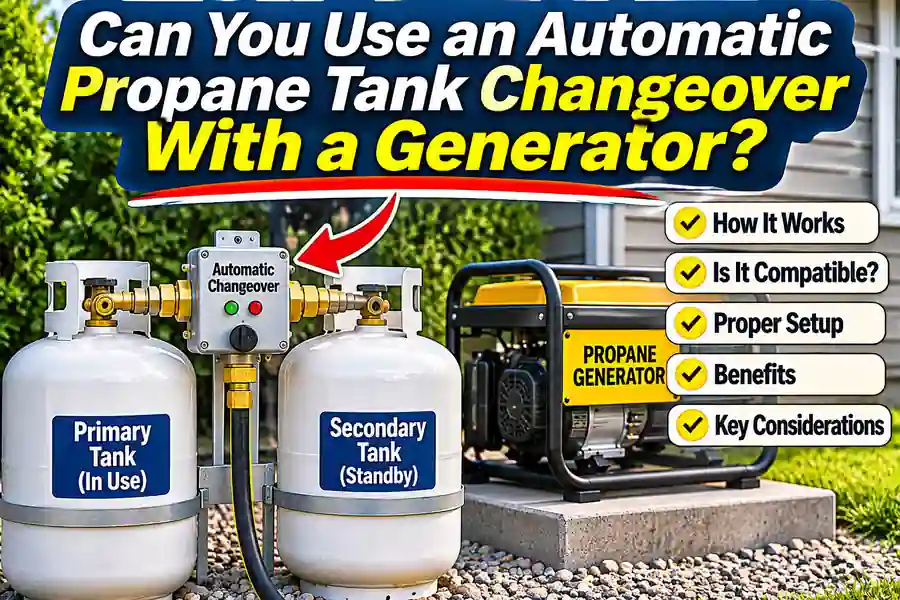
Yes, some propane generator installations can use an automatic changeover arrangement, but only when the changeover equipment is approved for the application and can supply the generator’s required gas pressure and maximum flow. A typical automatic changeover regulator sold for two RV cylinders is not automatically suitable for a large home standby generator.
I would first determine whether you are connecting two portable cylinders to a compatible portable generator or designing a stationary backup-power system. Those are different jobs. For either setup, the manufacturer’s instructions and a qualified propane professional should determine the regulator and piping design.
Automatic changeover does not create more fuel, increase vaporization capacity, or eliminate the need to refill cylinders. It only changes which supply is feeding the system when the equipment operates as designed.


What is an automatic propane tank changeover?
An automatic propane changeover device is intended to switch the supply from one propane container to another when the selected primary container can no longer maintain the required supply conditions. Many familiar systems use two cylinders, a changeover regulator, and an indicator showing which cylinder is supplying gas.
In a common two-cylinder arrangement, the owner selects a service cylinder and keeps the second cylinder available as a reserve. When the first supply is depleted sufficiently, the assembly changes over to the reserve, helping maintain fuel delivery without an immediate manual cylinder swap.
The exact switching behavior depends on the product. I would not assume that every device switches at the same pressure, maintains the same outlet pressure, or provides the same maximum BTU/hr capacity. The device must be matched to the intended appliances.
Why generator owners consider automatic changeover
The appeal is straightforward: during a power outage, nobody wants to go outside in the rain or cold to disconnect a depleted cylinder. A compatible automatic system may keep a small generator running long enough for the owner to notice that one cylinder is empty and arrange a refill.


I also see value in reducing the number of manual cylinder changes during extended operation. But I would distinguish convenience from guaranteed continuity. A depleted reserve, a frozen-up cylinder, a regulator with insufficient capacity, or a malfunctioning valve can still interrupt the fuel supply.
For whole-home standby power, I generally prefer evaluating whether a properly sized stationary tank provides a simpler, more robust fuel supply than a complicated small-cylinder arrangement.
How the changeover process works
In a typical two-cylinder system, both cylinder valves are opened as specified by the equipment instructions, and a selector identifies the primary source. The regulator draws from that source while the reserve remains available. When the primary supply falls below the device’s switching threshold, the system changes to the reserve.
Many products provide a mechanical indicator to show that a changeover has occurred. The owner can then arrange to replace or refill the depleted cylinder following the manufacturer’s instructions. An indicator is not a substitute for periodically checking the reserve.
I would read the actual regulator manual before buying. Some assemblies are designed specifically for RV service, some for other propane applications, and others may have different flow or pressure configurations. The word “automatic” does not establish generator compatibility.



The biggest issue: regulator capacity
The changeover assembly must pass enough propane vapor for the generator at its maximum expected fuel demand. Manufacturers commonly rate gas regulators in BTU per hour, pounds per hour, or another flow measure at specified inlet and outlet conditions.
A generator can have a much greater fuel requirement than an RV refrigerator, water heater, or cooktop. If a regulator cannot supply enough fuel, the engine may start and run at light load but surge, lose power, or shut down when a large electrical load is applied.
I would locate the generator’s maximum propane input rating and compare it with the regulator’s documented capacity under the intended conditions. I would also account for any other appliances served by the same regulator. Never assume a regulator is suitable simply because its fittings connect.
Example: comparing generator demand with a regulator rating
Suppose a generator’s manufacturer specifies a maximum propane fuel input of 180,000 BTU/hr. A changeover regulator with a published capacity of only 120,000 BTU/hr would not meet that demand. Even a regulator with a nominal rating above 180,000 BTU/hr still needs to be checked for the actual pressure conditions and installation requirements.


If the generator shares the system with a 35,000 BTU/hr appliance that may run simultaneously, the illustrative combined demand becomes 215,000 BTU/hr. This is a simple load-addition example, not a complete regulator selection calculation.
I would ask the installer to verify the manufacturer’s rating conditions, allowable inlet-pressure range, outlet pressure, piping losses, and the ability of the cylinders to vaporize propane in the cold.
| Example component | Illustrative input | Decision |
|---|---|---|
| Generator maximum | 180,000 BTU/hr | Use manufacturer rating |
| Changeover regulator | 120,000 BTU/hr | Insufficient for this example |
| Other appliance | 35,000 BTU/hr | Include if simultaneous |
| Combined demand | 215,000 BTU/hr | Evaluate entire system |
Cylinder vaporization may be the limiting factor
Even a correctly sized regulator cannot deliver more vapor than the connected cylinders can sustainably produce. Liquid propane must absorb heat to vaporize. As temperature drops, the available vaporization rate generally declines, especially when a cylinder is nearly empty.
A small cylinder feeding a generator at high load can struggle in cold weather. An automatic changeover device does not make the reserve cylinder warmer or increase the physical vaporization rate of either container. In some configurations, the reserve may become active sooner than expected because the primary cannot maintain adequate vapor pressure.
For a more detailed explanation, see how to calculate propane vaporization capacity for a generator and why a propane tank freezes during generator operation.
Can you use automatic changeover with 20-pound cylinders?
It depends on the generator’s fuel demand, the changeover equipment, the approved hose and regulator configuration, and the ambient conditions. A 20-pound cylinder holds roughly 4.7 gallons of usable propane when properly filled, but that stored quantity does not establish whether it can vaporize fuel fast enough for your generator.
Two 20-pound cylinders do not automatically behave like one large stationary tank. With many automatic changeover systems, the cylinders are used sequentially rather than both supplying the full load together. That can leave the active cylinder as the bottleneck.
I would be especially cautious about running a large portable generator at high load from a single 20-pound cylinder during freezing weather. Check the generator manufacturer’s cylinder guidance and consult a qualified propane supplier.
What about 40-pound and 100-pound cylinders?
Larger cylinders provide more stored fuel and can offer greater vaporization capability than smaller cylinders under comparable conditions. A nominal 40-pound cylinder holds about 9.4 gallons, while a 100-pound cylinder holds roughly 23.5 gallons. These are approximate liquid volumes, not guaranteed operating runtimes.
However, the physical size of the cylinder does not guarantee that a particular changeover regulator, hose, or connection assembly is approved for it. Larger containers may require different connection hardware and installation provisions.
I would compare the generator’s demand with documented vaporization performance at the expected winter temperature and lowest planned fill level, rather than choosing a cylinder based only on gallons.
| Cylinder size | Approximate usable propane | Important limitation |
|---|---|---|
| 20 lb | 4.7 gal | High load and cold can limit vaporization |
| 40 lb | 9.4 gal | Check regulator and cylinder compatibility |
| 100 lb | 23.5 gal | Check mounting, fittings and vaporization |
Will the generator stop when the regulator switches tanks?
A properly matched automatic changeover system is intended to maintain supply through the changeover event. But I would not promise that every generator will run without interruption. The result depends on the changeover design, regulator capacity, remaining vapor pressure, the generator’s sensitivity to pressure changes, and installation quality.
Some generators may be particularly sensitive to brief fuel-pressure dips during a heavy electrical load. A system that appears to work during a short no-load test may behave differently after several hours of fuel withdrawal in cold weather.
I would have the installer verify operation according to the regulator and generator manufacturers’ procedures. Do not intentionally run a generator until it stalls repeatedly as a substitute for proper commissioning.
Can a whole-house standby generator use automatic changeover?
A whole-house standby generator often has a substantially greater fuel demand than a small portable unit. Its manufacturer may specify a particular inlet-pressure range, pipe size, regulator configuration, and minimum supply capacity. A small RV-style automatic changeover regulator is generally not an appropriate default choice.
For a standby system, I would usually start by asking whether a single appropriately sized stationary propane tank offers the needed runtime and winter vaporization capacity. If multiple stationary tanks or an engineered switching system are proposed, that design belongs with the propane supplier and generator installer.
You can read more about stationary fuel storage in can a propane generator share a tank with a furnace? and shared-tank fuel-system planning.
Automatic changeover versus connecting tanks together
Automatic changeover and manifolded simultaneous withdrawal are not the same. A changeover system typically selects one supply at a time and moves to another when needed. A properly designed manifold may draw from more than one container, potentially changing available vaporization performance.
I would not assume that two cylinders connected through a changeover regulator can supply the combined vaporization capacity of both cylinders at once. The device’s internal flow path determines what happens.
For a related discussion, see can you connect two propane tanks to one generator?. The correct approach depends on the generator, container type, pressure regulation and approved components.
Pressure compatibility is non-negotiable
A propane generator may use a manufacturer-supplied regulator, a demand regulator, or a specified stationary gas inlet. Adding another regulator or changeover assembly can change the pressure available to the generator. Too little pressure can cause fuel starvation; too much can damage components or create unsafe operation.
I would ask three questions before approving any connection: What pressure does the changeover assembly deliver? What pressure does the generator require at the designated inlet? And what pressure and flow are available while the generator is running under load?
Do not remove a factory regulator, bypass a safety device, or adjust a regulator to make an incompatible system work. For more detail, see what happens when propane pressure is too high for a generator.
Hoses, fittings, and check valves
Propane connections must use approved components rated for the fuel, pressure, temperature and intended service. A fitting that physically matches is not evidence that the assembly is compatible with the generator. Hose length and diameter also affect pressure drop.
Depending on the system, the approved assembly may include check valves, pigtails, shutoffs, relief provisions or excess-flow protection. These parts have specific purposes and should not be omitted or substituted casually.
I would buy only equipment documented for the intended application and have the propane professional confirm the final arrangement. Homemade manifolds, improvised tees and adapters of uncertain rating are not a safe shortcut.
What happens when both tanks are empty?
An automatic changeover regulator cannot supply fuel from an empty reserve. If both containers are depleted, the generator will eventually stop or shut down according to its controls. In an outage, that may leave essential circuits without power.
The practical solution is fuel monitoring and a refill plan. I would check the changeover indicator and cylinder levels routinely rather than waiting for the generator to quit. The appropriate inspection frequency depends on expected fuel use and outage duration.
For an estimate of refill needs, see how often you need to refill a propane generator. Always confirm current consumption using your generator’s specifications and actual load.
How long could two cylinders last?
Runtime depends on how much propane is stored and the generator’s average fuel consumption. A rough planning estimate divides usable gallons by average gallons per hour, but that calculation does not verify vaporization capacity or regulator suitability.
For example, two properly filled 20-pound cylinders together hold about 9.4 gallons. At an illustrative average use of 0.6 gallon per hour, that represents about 15.7 hours of theoretical fuel supply. At 1.2 gallons per hour, it is only about 7.8 hours. Real performance can differ with temperature, generator load and unusable remaining fuel.
I would leave a reserve margin rather than plan to consume every gallon. A changeover system provides convenience, not unlimited runtime.
| Illustrative scenario | Calculation | Estimated runtime |
|---|---|---|
| Two 20-lb cylinders | 9.4 gal ÷ 0.6 gal/hr | 15.7 hours |
| Two 20-lb cylinders | 9.4 gal ÷ 1.2 gal/hr | 7.8 hours |
| Two 40-lb cylinders | 18.8 gal ÷ 0.6 gal/hr | 31.3 hours |
Automatic changeover versus manual switching
Manual cylinder switching may be simpler and less expensive, but it requires someone to be present and able to shut down or change the fuel supply safely according to the equipment instructions. Automatic changeover can reduce interruptions when one cylinder is depleted, provided the equipment is approved and properly sized.
Automatic systems also introduce additional components that must be inspected and maintained. A stuck indicator, damaged pigtail, regulator failure or empty reserve can defeat the convenience benefit.
I would choose based on actual generator demand, manufacturer compatibility, outage length, cold-weather conditions and the owner’s ability to monitor the system—not just on whether a product description says “automatic.”
| Factor | Automatic changeover | Manual switching |
|---|---|---|
| Changeover when primary empties | Automatic if functioning | Owner must intervene |
| Reserve monitoring | Still required | Still required |
| Hardware complexity | More components | Often fewer components |
| Fuel capacity | Depends on cylinders | Depends on cylinders |
| Suitability for high load | Must be verified | Must be verified |
Installation and location considerations
Propane cylinders and regulators must be located and secured according to the applicable codes and manufacturer instructions. Generator exhaust clearance is a separate issue. Portable generators must operate outdoors, away from openings where carbon monoxide could enter buildings.
I would avoid placing cylinders where generator exhaust, excessive heat, impact or falling debris could affect them. Cylinders should be kept upright where required by their design and properly restrained. Regulators must be oriented and protected as instructed by their manufacturer.
Do not operate a portable generator in a garage, basement, shed, enclosed porch or other enclosed or partly enclosed space. A changeover regulator does nothing to reduce carbon monoxide risk.
Cold-weather performance and tank frosting
Cold weather is one of the toughest conditions for a cylinder-fed generator. The generator may be needed continuously while the cylinders cool during vapor withdrawal. A frost line can be normal, but reduced fuel pressure and unstable engine operation deserve professional attention.
A changeover system may switch away from a cold primary cylinder even when liquid propane remains if that cylinder cannot maintain the required supply conditions. That can make fuel monitoring confusing and reduce the expected practical runtime.
Never apply a torch, flame, heat gun or improvised heater to a cylinder or regulator. If winter demand exceeds the cylinder’s capabilities, the safe response is a properly engineered fuel-supply solution.
Troubleshooting an automatic changeover system
If a generator stalls or surges after a changeover, possible causes include an empty reserve, insufficient cylinder vaporization, a regulator with inadequate flow capacity, a pressure mismatch, or a generator fault unrelated to the propane supply.
I would record whether the issue happens at startup, under high electrical load, during cold weather, or when the indicator changes. That information helps a qualified technician investigate without guessing.
Do not loosen a pressurized fitting to check whether gas is flowing, defeat a regulator or bypass protective devices. If you smell propane or hear a hiss, leave the area and contact the supplier or emergency services from a safe location.
A buying checklist for changeover equipment
Before buying, I would verify that the generator manufacturer permits the proposed connection. Then I would obtain the changeover assembly’s documented outlet pressure, flow capacity, inlet range, compatible cylinder types, approved connectors and installation requirements.
I would also ask whether the regulator can support the generator’s maximum fuel demand under the actual conditions, including low ambient temperature and reduced cylinder fill. The answer may require a propane supplier’s assessment.
Finally, I would check the replacement-parts and inspection requirements. A slightly cheaper regulator is not a bargain if its capacity or intended use does not match the generator.
| Issue | Possible cause | Safe response |
|---|---|---|
| Switch occurs early | Cold or low primary vapor supply | Have supplier assess vaporization |
| Generator stalls at changeover | Pressure/flow interruption | Professional inspection |
| Reserve is empty | No fuel available | Refill safely per instructions |
| Surging under load | Insufficient flow or unrelated fault | Check with qualified technician |
Cost: is automatic changeover worth it?
The cost is more than the price of a regulator. A complete installation may require compatible pigtails, fittings, mounting, protective arrangements, labor and commissioning. If the existing generator connection is incompatible, modifications may add cost or make the idea impractical.
For an occasional small portable generator, a properly approved automatic arrangement may be worthwhile for convenience. For high-demand backup power, investing in adequate stationary storage and a professionally designed fuel supply may be more effective.
I would compare the total cost, actual fuel capacity, expected refill frequency and reliability during a long outage. Automatic switching is useful only if the underlying supply is adequate.
| Requirement | What to verify |
|---|---|
| Generator approval | Manufacturer-permitted connection |
| Outlet pressure | Within specified generator inlet range |
| Regulator capacity | At least required demand at rated conditions |
| Cylinder compatibility | Approved type, size, fittings |
| Winter vaporization | Adequate at expected temperature and fill |
| Safety and commissioning | Qualified installation and testing |
Frequently asked questions
Can I use an RV automatic changeover regulator with my generator? Only if the regulator and complete connection are approved for the generator and meet its pressure and flow requirements. Do not assume compatibility.
Will the generator keep running when the tank switches? A compatible system is intended to maintain supply, but interruption-free operation depends on the design and operating conditions.
Can I connect two 20-pound tanks? Some approved systems support two cylinders, but vaporization and flow capacity may be inadequate for larger generators.
Do both tanks supply propane at the same time? Not necessarily. Many automatic changeover devices use one selected supply and then switch to the reserve.
Does automatic changeover increase runtime? It can make more stored fuel available without manual switching, but it does not reduce the generator’s fuel consumption.
Can it prevent freezing? No. Cold-weather vaporization limits still apply.
Can a 100-pound cylinder be used? Only with equipment and installation provisions approved for that cylinder and application.
Will it work on a whole-house generator? Possibly with a specifically engineered system; small RV changeover products should not be assumed suitable.
Can I install one myself? Have a qualified propane professional confirm and install the fuel system according to local requirements.
What if I smell propane? Leave the area, avoid ignition sources and contact the supplier or emergency services from a safe location.
Final recommendation
I see automatic propane changeover as a convenience feature, not a substitute for fuel-system engineering. It can make sense for a compatible portable generator with approved cylinders and regulator hardware. But the generator’s maximum fuel demand, required inlet pressure and cold-weather vaporization needs must come first.
For a large standby generator, I would usually ask the propane supplier to evaluate a properly sized stationary tank before choosing a multi-cylinder changeover system. Whatever arrangement you select, have it verified and commissioned by qualified professionals so your backup power remains dependable when you need it most.

Mike is an experienced propane technician with over 15 years of professional experience in the field. He has dedicated his career to helping customers with their propane needs, from installation to maintenance and repair. Together with Jeremy, he co-founded this website to provide useful information and guidance to customers seeking reliable propane services.