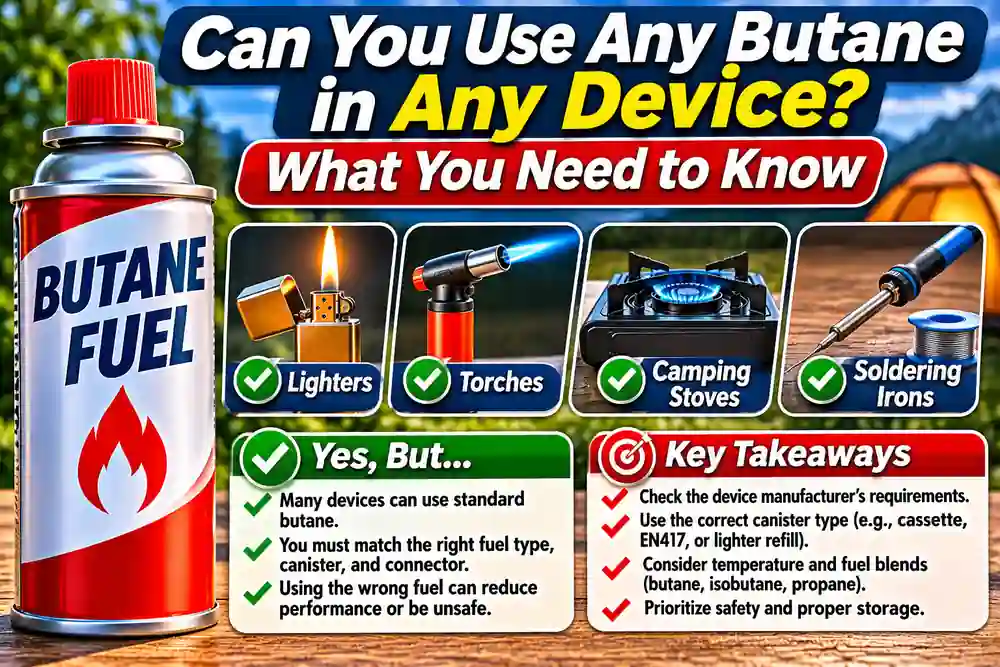
Can You Use Any Butane in Any Device? The Short Answer
When I see the word ‘butane’ on two different fuel cans, I do not assume they can power the same appliance. The label identifies a fuel family, not a universal connector standard. A can intended for refilling a lighter is not automatically suitable for a cooking stove, and a camping gas cartridge is not an ordinary refill can just because both contain C4 hydrocarbons.
I would always identify the device first. Does it have a small refill valve, a bayonet-style cartridge compartment, a threaded fuel inlet or a proprietary cartridge holder? What precise gas composition does the manual permit? Does the equipment need vapor withdrawal in a specified orientation? These questions prevent the most common—and potentially most dangerous—compatibility mistakes.
This guide focuses on consumer devices: lighters, culinary torches, soldering irons, cassette and backpacking stoves, heaters and specialized appliances. I also explain why generator or household LPG fittings are not a shortcut for a smaller butane tool. Compatibility means the entire fuel-delivery system is approved, not merely that the fuel will ignite.


Why Butane Compatibility Matters
Butane is highly flammable and commonly stored as a liquefied gas in pressurized containers. During operation, a suitable appliance withdraws gas or liquid according to its design. Fuel composition and temperature affect pressure; valve geometry controls how fuel enters; and calibrated burners regulate the amount mixed with air. Changing any of those conditions can cause weak combustion, leakage, overheating or unexpected flame behavior.
A tight-looking physical connection can still be unsafe. Some adapters can join incompatible containers, but that does not prove the receiving appliance was tested for the mixture or pressure. I treat manufacturer instructions as the deciding authority. If the instructions do not approve a particular setup, I would not improvise it.
| Compatibility factor | What to verify | Risk when mismatched |
|---|---|---|
| Gas composition | n-Butane, isobutane or explicitly approved blend | Unexpected pressure or burner performance |
| Valve or connector | Correct nozzle, bayonet, thread or proprietary fitting | Leakage or damaged seals |
| Cartridge design | Approved disposable cartridge or refillable reservoir | Overfill, rupture or incorrect withdrawal |
| Operating orientation | How the manufacturer says to position it | Liquid entering a vapor-only system |
| Appliance temperature rating | Specified ambient and cartridge conditions | Loss of pressure or unsafe heating |
| Regulator and jet | Designed for the specified fuel supply | Excess fuel flow or poor combustion |
Different Types of Butane: Are They Interchangeable?
Normal butane (n-butane)
Normal butane has the chemical formula C4H10 and an atmospheric boiling point near 31°F (−0.5°C). It is used in many consumer fuel products. That boiling point matters because a cartridge supplying vapor can lose pressure as the temperature approaches freezing. Normal butane may perform well in approved warm-weather equipment but is not a reliable universal cold-weather fuel.
Isobutane
Isobutane has the same molecular formula but a different molecular structure. Its atmospheric boiling point is near 11°F (−11.7°C), allowing better vaporization under some cooler conditions. Backpacking fuels frequently feature isobutane, sometimes blended with propane. That cold-weather advantage does not mean you should inject isobutane fuel into a lighter, torch or stove that specifically requires another formulation.


Propane-butane or propane-isobutane mixtures
Certain camping cartridges intentionally blend fuels to improve performance. Propane has a much lower atmospheric boiling point, about −44°F (−42°C), and different vapor-pressure characteristics. The correct blend is established by the manufacturer, and products must be designed for the pressures involved. I never recommend adding propane to an ordinary butane refill container or using household LPG in a butane-only appliance.
Refined, premium and multi-filtered butane
Premium butane sold for lighters and precision tools often emphasizes low nonvolatile residue or multiple stages of refining. This can matter for small valves and burner jets, but ‘5X’ and ’11X’ are not universal compatibility grades. A very clean fuel is still wrong if its packaging, composition or nozzle cannot be used as specified by your appliance.
| Fuel | Chemical identity | Approximate boiling point at 1 atm | Compatibility implication |
|---|---|---|---|
| Normal butane | C4H10, n-butane | 31°F / −0.5°C | Use only in approved fuel system |
| Isobutane | C4H10, branched isomer | 11°F / −11.7°C | Not a universal substitute |
| Propane | C3H8 | −44°F / −42°C | Higher-pressure system requirements can differ |
| Camping fuel blend | Defined mixture; varies by brand | Depends on composition | Use only as the stove maker permits |
| Premium refined lighter fuel | Commercial product, composition varies | Depends on constituents | Purity alone does not establish fit |
The numbers above are approximate reference temperatures, not appliance operating limits. Real performance also depends on fuel withdrawal rate, altitude, container cooling, regulators and burner design. A fuel can may list a mixture rather than a single pure chemical; read the actual safety and product labeling.
Can You Use Any Butane in a Refillable Lighter?
No. Many refillable butane lighters are designed for refined lighter-grade butane, but the correct nozzle and fill procedure still matter. A butane aerosol with an unsuitable nozzle may spray or fail to seal against the refill valve. A camping cassette cartridge with an entirely different connector should not be forced or adapted to refill a lighter.
I check whether the lighter manufacturer specifies refined butane and whether it recommends a particular nozzle. I inspect the refill valve for damage and use the manual’s filling instructions. I would not deliberately vent gas indoors or keep pressing a leaking aerosol against the valve. A continuing hiss or unusual odor is a sign to stop rather than retry.



For inexpensive disposable lighters, a visible valve-like part is not proof that the product was designed to be refilled. If the lighter is marked nonrefillable, I do not try to convert it. The safer long-term choice is a purpose-built refillable lighter, with fuel selected according to its instructions.
What Kind of Butane Can You Use in a Torch?
Small culinary and jewelry microtorches often accept approved lighter-grade butane from a compatible refill aerosol. Other torches use specific replaceable fuel cartridges, and some heavy-duty torch systems are intended for propane or MAP-Pro-type fuel rather than butane. I identify the exact model before buying gas.
Even among refillable butane torches, differences in valve design and approved formulation can matter. A torch may burn on the wrong gas in a superficial demonstration but still have unsuitable pressure control, flame stability or sealing. That is why I do not rely on internet videos showing that an adapter appears to work.
Culinary torches
For a kitchen torch used to brown food, I look for food-use approval of the appliance, manufacturer-specified fuel and a consistent flame. Refined butane may be appropriate when named in the manual. Keep fuel containers away from food preparation flames, do not refill while hot and always work in the permitted ventilation conditions.


Jewelry and hobby torches
A jewelry microtorch must deliver suitable heat for the particular metal and solder. The fuel is only one component. I would choose the correct approved refill, verify a stable stand and consider whether the flame has enough heat capacity for the work. If not, buy a more appropriate rated torch instead of substituting an unapproved fuel.
Can You Use Any Butane in a Soldering Iron?
Many cordless soldering irons are designed for refined butane, particularly models with an integrated refillable tank. For those tools, the correct fuel is the grade and formulation permitted by the manufacturer’s instructions. Some units convert combustion heat into a soldering-tip temperature without directing a visible flame at the joint.
I would prioritize low-residue fuel, a fitting nozzle, controllable heat and replacement tips. High purity does not automatically increase the flame temperature or fix a poorly maintained iron. If the tool struggles to heat a large solder joint, consider the tip size, gas setting and thermal mass before assuming the answer is a different fuel blend.
For electronics work, I generally favor a temperature-controlled electric iron where electricity is available. If field repairs require portable electricity, our guide to inverter propane generators for sensitive electronics discusses one separate way of supplying power. It does not mean a generator’s fuel can be used in a butane iron.
Which Butane Canisters Fit Portable Camping Stoves?
There are several distinct camping fuel systems. The common cassette-style stove has a specific cartridge design, often labeled around 220 g or 227 g of gas. Many backpacking burners use threaded fuel canisters, often sold in 110 g, 230 g or 450 g sizes. Other systems use proprietary fittings. The same weight does not mean the same valve.
I would read the stove’s manual for the fuel container name, approved manufacturer models where specified, gas type and orientation. A cartridge that looks similar may be a different standard. If a seller lists the product as ‘fits all camp stoves’ without providing actual compatibility details, I would avoid the claim.
| Device type | Common fuel package | Can it accept lighter refill aerosol? | Buying decision |
|---|---|---|---|
| Cassette stove | Specified bayonet cartridge, often ~220 g | No, unless manufacturer expressly provides a designed system | Buy matching factory-filled cartridge |
| Threaded backpacking stove | Approved threaded camping cartridge | No | Match thread, fuel blend and stove manual |
| Integrated refillable lighter | Approved lighter-grade aerosol | Often yes, if nozzle and fuel match | Follow lighter instructions |
| Refillable culinary torch | Approved butane aerosol | Often yes, model-dependent | Check fill valve and formulation |
| Refillable gas soldering iron | Manufacturer-approved refined fuel | Often yes, model-dependent | Use specified fuel and refill method |
| Proprietary cartridge appliance | Specific manufacturer cartridge | Usually no | Use the named approved cartridge |
Why you should not refill disposable stove cartridges
A canister having a self-sealing valve does not make it refillable. Standard disposable cartridges are designed for factory filling and single-use consumption, not repeated home refilling. An adapter that mechanically transfers gas does not validate cylinder strength, valve life, fill mass or the correct mixture. Overfilling or incorrect gas can create serious pressure and fire hazards.
I treat a ‘Do Not Refill’ label as conclusive. If a cartridge is empty, replace it with a compatible factory-filled product and dispose of the original through the appropriate local system. Do not puncture or burn a used cartridge, or try to drain residual fuel by intentionally venting it.
Is It Safe to Use an Adapter to Connect Different Canisters?
Only when the complete connection or accessory is expressly approved for the specific appliance and fuel arrangement. The mere presence of a metal adapter for sale does not create manufacturer approval. I distinguish an authorized component supplied for a certified dual-fuel stove from an improvised conversion part sold without testing information.
Adapters introduce additional joints that can leak, and some allow an appliance to encounter a fuel or pressure range it was never designed to regulate. I would avoid modifying burner orifices, drilling valves, disabling shutoffs or using a larger cylinder to feed a small butane appliance unless a properly rated and approved system is explicitly supplied by the manufacturer.
How Does Fuel Pressure Affect Device Compatibility?
Liquefied gas fuels have temperature-dependent vapor pressures. A container holding mostly n-butane does not behave identically to one with a substantial propane fraction. The pressure difference can change ignition, fuel flow and the operation of safety devices. Exact vapor pressures vary with composition and temperature, so I would not rely on a single ‘butane pressure’ number for every can.
A device’s gas-control design needs to match its fuel supply. This is especially important when choosing an imported stove or a torch advertised for several gases. Marketing descriptions sometimes list multiple fuels without explaining whether different regulators or connectors are required. I would verify the manual and certification rather than assume compatibility from a product title.
| Condition | What happens physically | Implication |
|---|---|---|
| Higher ambient temperature | Liquefied-gas vapor pressure generally rises | Keep within label temperature limits |
| Lower ambient temperature | Vapor pressure drops, especially for n-butane | Weak or failed stove performance |
| Higher propane fraction in blend | May increase vapor pressure compared with n-butane | Use only approved mixture and system |
| High fuel withdrawal rate | Evaporation cools container | Flame output may decline |
| Improvised connection | Seals or regulators may be incorrect | Leak, poor combustion or dangerous flow |
Butane Compatibility in Cold Weather and at Altitude
Normal butane’s boiling point around 31°F explains why vapor-delivery systems may struggle in near-freezing conditions. Isobutane or approved blends can improve performance in certain stoves, but that does not allow you to exchange fuel formulations freely. I select a burner and cartridge combination explicitly rated for the conditions I expect.
At higher altitude, atmospheric pressure is lower and cooking takes place under different environmental conditions. Water also boils at a lower temperature, affecting food preparation. The correct equipment remains the manufacturer’s approved stove and fuel system; I would not compensate for altitude by installing an unapproved canister or modifying the jet.
For a separate discussion of cold-weather fuel planning in larger equipment, see how to winterize a propane generator. The article covers a different system but illustrates why fuel supply and expected minimum temperature must be considered together.
How to Read a Butane Canister Label
The label is my starting point, but I also confirm the appliance manual. I look for the named fuel or mixture, net fuel quantity, prescribed use, flammability warnings, handling directions, disposal information and any model or valve-standard reference. A label that simply states ‘premium gas’ without identifying its intended use would not be enough for my buying decision.
| Label information | What it tells you | Question I ask |
|---|---|---|
| Butane or fuel blend name | General fuel composition | Is this exactly what the appliance permits? |
| Net weight (g or oz) | Quantity of fuel, not container weight | How much usable fuel am I buying? |
| Cartridge or valve description | Physical connection design | Does it match the approved fitting? |
| Temperature and storage warning | Conditions affecting container safety | Can I store and transport it correctly? |
| Refillable/nonrefillable designation | Whether the container is intended for refilling | Am I following its specified use? |
| Manufacturer and safety information | Traceability and hazard directions | Can I verify the product’s authenticity? |
I also distinguish a manufacturer’s claims about purity from official certification or compatibility statements. ’11X refined’ may be a selling point for a lighter refill, but it does not tell me whether a camping stove can accept the packaging. The correct fuel without the correct container is still the wrong purchase.
Can You Mix Different Butane Brands?
Brand changes are not automatically dangerous or automatically safe. If two reputable fuel products meet precisely the same specification explicitly approved by the appliance, a different brand may be acceptable. But I would never mix fuels intentionally inside a cartridge or transfer between different pressurized containers to create a blend.
When a refillable device has residual fuel from an approved product, check the manufacturer’s refill directions before using another brand. If a tool requires a proprietary cartridge or states a specific fuel limitation, respect it. A manufacturer’s product warranty and support may also depend on following specified fuel guidance.
Can You Use Butane Indoors?
Device compatibility and location safety are separate tests. Even an entirely correct fuel and cartridge combination can be dangerous in the wrong location. Outdoor-rated camping stoves must never be operated inside a home, tent, garage, camper or other enclosed area. Combustion can produce carbon monoxide, which is colorless and odorless, and can lead to poisoning or death.
A manufacturer-approved indoor appliance may have a different certification and installation requirement, but I would never interpret an open window or exhaust fan as permission to use an outdoor-rated burner inside. Follow the specific appliance’s instructions and applicable local rules. For related exhaust risks, our propane generator indoor-use safety guide covers larger combustion equipment.
A Practical Compatibility Checklist Before You Buy
I use a six-question test for every unfamiliar fuel container. It is an editorial buying framework, not a replacement for a certification mark. A single failed critical compatibility requirement means I would not use the product, regardless of how many other details appear satisfactory.
| Question | Pass condition | If not |
|---|---|---|
| Exact appliance model known? | Manual and model identification available | Do not guess fuel requirement |
| Correct fuel composition? | Named gas or blend explicitly approved | Select correct formulation |
| Correct cartridge or valve? | Manufacturer-approved connection | Do not use improvised adapter |
| Correct container use? | Refillable device or certified cartridge as specified | Never refill disposable can |
| Safe operating environment? | Location and temperature meet instructions | Choose alternative method |
| Sound container and seals? | No damage, rust, odor or leakage | Stop and seek qualified guidance |
I like this method because it prevents a false sense of confidence from a single label claim. For example, a fuel might pass the composition check while failing the cartridge check; a stove might pass the connection test but fail the outdoor location requirement. Compatibility must be complete, not approximate.
How Much Does the Wrong Butane Cost You?
A cheap butane can is not a bargain if it cannot be used correctly. I compare net fuel cost only among products the appliance permits. Consider a hypothetical 60 g refill priced at $6 and a 220 g cassette cartridge priced at $3.50. The cassette cartridge costs far less per gram, but that does not make it suitable for a refillable soldering iron.
| Illustrative product | Example price | Net fuel mass | Price per 100 g |
|---|---|---|---|
| Refined lighter refill aerosol | $6.00 | 60 g | $10.00 |
| Medium refill aerosol | $8.00 | 100 g | $8.00 |
| Standard cassette cartridge | $3.50 | 220 g | $1.59 |
| Threaded camping cartridge | $12.00 | 230 g | $5.22 |
All prices in the table are hypothetical examples for teaching arithmetic, not verified current retail prices. This table should never be used to justify transferring fuel between incompatible containers. I would rather spend a few dollars more on a safe, approved supply than save money on fuel that requires a risky modification.
Common Mistakes That Cause Butane Compatibility Problems
Buying based only on the word ‘butane’
The fuel name is not a connector standard or a complete chemical specification. I check the manual, valve type and permitted blend rather than assuming an aerosol refill, cassette cartridge and threaded canister are interchangeable.
Using a so-called universal adapter
An adapter may make two parts join, but it cannot prove safe pressure regulation, withdrawal orientation or burner calibration. Unless the appliance maker approves the complete configuration, I would not use it.
Refilling a nonrefillable cartridge
Single-use containers have fill specifications and safety controls that are not reproduced by a home transfer setup. An aftermarket filling device does not make the cartridge certified for repeated filling.
Assuming premium butane solves every performance issue
Poor ignition may involve a clogged jet, low fuel level, cold temperature, damaged igniter or valve issue. A purity label cannot compensate for worn equipment, and I would not modify a burner to force a bigger flame.
Ignoring outdoor-use rules
A perfectly matching canister does not make an outdoor stove safe inside a tent or kitchen. I plan an approved outdoor cooking area and a no-cook alternative for emergencies.
How to Store Butane Products When You Own Several Devices
If you own a lighter, camping stove and torch, I would keep their approved fuels clearly identified so nobody accidentally grabs the wrong canister. Store them according to manufacturer labels and local fire rules, away from heat, sparks, children and direct sunlight. Keep damaged or leaking containers out of service.
I use a small written inventory naming each appliance model and its approved fuel. This is especially helpful for households with many similar-looking cans. Do not peel off original hazard labels or permanently decant fuel into unmarked containers. Pressurized products need their original identification and safety instructions.
For broader fuel-equipment handling principles, see our article on how to transport and store a propane generator safely. It concerns propane generator systems, so the storage instructions for individual butane containers must still come from their own labels.
What About Butane and Propane Generators?
Ordinary propane generators use a different, purpose-built fuel supply system. They do not accept a small butane aerosol merely because both gases belong to the LPG family. A generator’s fuel demand, regulators, withdrawal type and installation requirements must match the manufacturer’s specifications. Never improvise a small-container hookup to power a generator.
For readers selecting household electrical backup, Can a Portable Propane Generator Power Your Home During an Outage? addresses a different purchase. A camping stove produces cooking heat; a generator produces electricity. Their equipment ratings and connection rules are not interchangeable.
Frequently Asked Questions
Can I use lighter butane in a camping stove?
Not unless the stove manufacturer expressly approves that fuel and delivery system. Most cassette stoves accept a particular factory-filled cartridge, not a lighter refill aerosol. Do not improvise a transfer.
Is 11X refined butane safe in every lighter?
No. A purity claim is not a universal compatibility assurance. The lighter must be designed for the specific fuel formulation and its refill valve must match the nozzle.
Can isobutane replace normal butane?
Only when the appliance manufacturer explicitly permits the substitution or approved blend. Their boiling points and vapor-pressure characteristics differ, and the device may have specific design limits.
Can you use butane in a propane torch?
Only if the torch manufacturer provides an approved butane configuration. Do not assume a propane-only burner will regulate or ignite properly on a different gas.
Are all 220 g butane cartridges identical?
No. Nominal fuel mass alone does not establish valve geometry, formulation or compatibility. Match the specific cartridge standard and appliance instructions.
Can you refill a disposable camping canister?
No. Do not refill any cartridge marked nonrefillable. Replace it with an approved factory-filled product and follow local disposal guidance.
Can a butane stove use a propane cylinder?
Only if it is specifically designed and approved for propane use with the correct supplied equipment. A dual-fuel designation requires following the exact manual, not inventing a conversion.
What should I do if I smell butane?
Stop using the device, avoid sparks and flame, move people away and follow the manufacturer’s leak emergency instructions. Seek emergency assistance if a significant release or unsafe condition exists. Do not keep testing ignition.
Final Verdict: Match the Device, Not Just the Fuel Name
My answer to ‘Can you use any butane in any device?’ is a clear no. Fuel formulation, cartridge design, valves, pressure behavior, withdrawal method and manufacturer approvals all matter. A product might be chemically similar to the right gas but packaged or regulated in a way that makes it unsuitable for your equipment.
The most useful buying habit I can recommend is to keep the exact model number and approved fuel description on your shopping list. I would choose a reputable source, inspect the container, follow the specified connection procedure and refuse the temptation to make an incompatible cartridge fit. With pressurized flammable gas, a correct match is more valuable than a cheap workaround.

Mike is an experienced propane technician with over 15 years of professional experience in the field. He has dedicated his career to helping customers with their propane needs, from installation to maintenance and repair. Together with Jeremy, he co-founded this website to provide useful information and guidance to customers seeking reliable propane services.