Last reviewed: November 5, 2026. My calculations use an illustrative propane energy content of 91,500 BTU per gallon and a nominal 4.7 gallons in a properly filled standard 20-pound cylinder. Exact energy content and fills vary. Tables, prices and runtimes below are planning examples, not claims that every product performs identically.
When I compare propane fire pit tables vs bowls, I do not begin with the shape alone. I begin with the evening I want to create. Will people sit around a sofa and set down mugs? Will I pack the unit in a vehicle? Is there room for an external upright cylinder? Would a tall table interrupt the view across the seating area? Those practical questions decide the format more reliably than a polished product photo.
In this guide, I will show you what is physically different, compare technical specifications, calculate fuel consumption and running expenses, work through two buying scenarios, and give you a calculator you can adjust. I’ll also explain where marketing descriptions can mislead you so you can compare products on equal terms.
Propane fire pit tables vs bowls: side-by-side comparison
| Feature | Propane fire pit table | Propane fire pit bowl |
|---|---|---|
| Main purpose | A burner integrated into a table-like structure | An open fire feature centered on a bowl/basin |
| Usable surface | Usually provides a rim or tabletop; some have removable lids for use only when cool | Usually limited rim space; not a practical table |
| Typical physical profile | Low coffee-table, dining-height or tall bar-height designs | Low basin, raised pedestal or portable bowl |
| Cylinder location | Some conceal an approved cylinder; others require external cylinder | Frequently external with hose; some decorative bases differ |
| Portability | Often bulky; weight and size vary substantially | Portable models can be easier to carry; heavy decorative bowls exist |
| Seating arrangement | Pairs naturally with patio couches or chairs | Facilitates circle-style gathering |
| Fuel efficiency | Determined by rated BTU/hr and actual valve setting | Same principle: BTU/hr and actual setting |
| Wind sensitivity | Both exposed to outdoor air; glass wind guards only if approved | Both exposed; do not improvise shields |
| Assembly | May require legs, panels, doors, lid and burner media | Portable bowls may need little assembly |
| Typical purchasing priority | Furniture finish, dimensions, material, warranty | Fire view, transport, burner output, hose layout |
This is a comparison of common formats, not a rigid rule. I have seen fire tables with external tanks and round decorative bowls that are too heavy to move casually. A product marketed as a “fire bowl table” may combine both designs. Read the exact listing and appliance manual rather than assuming the name tells you how it works.
1. What exactly is a propane fire pit table?
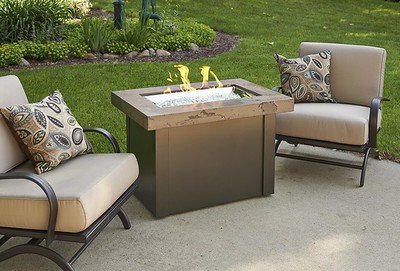
A fire pit table is outdoor furniture with a gas combustion area. The tabletop may be square, rectangular or round, with a burner and approved decorative medium—often lava rock or fire glass—at the center. Many models provide a removable lid so that, after the unit is completely cool and the manufacturer permits it, the top can function as an ordinary table. I like this dual purpose because patio space is expensive even when the fire feature itself is not.
What I would inspect first is the actual surface left around the burner. A 42-inch-long table with a 34-inch opening does not leave 42 inches of usable cup space. I would also check the lid’s storage arrangements, the weight, the door or panel for the cylinder, and whether the control knob is accessible without reaching across the flame.
A square 28-inch table may fit a compact seating area, while a 48-inch rectangular table works differently with an outdoor sofa. Some models hide a standard upright 20-pound cylinder in the base. Others, including certain long rectangular models, keep the cylinder outside and connect by an approved hose. That difference can affect trip hazards, appearance and the floor area you need.


Fire table design variations
| Design | Illustrative dimensions | Usual advantage | Limitation to check |
|---|---|---|---|
| Small square table | 28–32 in. wide; ~22–25 in. tall | Integrated look in small patios | Limited edge area and tight cylinder door |
| Rectangular coffee table | 40–55 in. long; ~15–25 in. tall | Works beside lounge seating | Bulky, often more assembly |
| Tall dining-style fire table | ~36–48 in. wide/long; ~28–38 in. tall | Social dining or high-chair layout | Hot-center surface cannot be treated as ordinary dining space |
| Round table with center fire | ~30–45 in. diameter | All-around seating | Check cylinder fit and heavy composite body |
Dimensions are illustrative design bands, not mandatory industry specifications. For any configuration, the manual’s spacing and fire-zone instructions take priority over generic furniture advice.
2. What is a propane fire pit bowl?
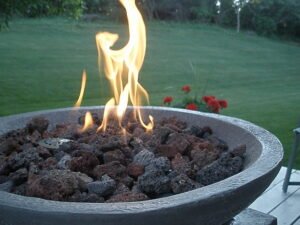
A propane fire pit bowl concentrates the design on the flame. Many look like large metal basins holding rocks around a burner; some have short legs, while others sit on a substantial pedestal. Portable models frequently have an external propane cylinder connected through an approved regulator and hose. Decorative bowls can be quite heavy, so “bowl” does not necessarily mean “portable.”
What I appreciate about a bowl is its simplicity. It is often easier to place seats in a circle without a wide tabletop intervening. For an approved campground or open backyard setup, that atmosphere may matter more than having somewhere to rest a drink. However, I would never assume a portable bowl is allowed beneath an awning, inside a screen room or on a combustible deck. Those are installation questions governed by the exact appliance and local rules.
The open design can make the flame more visible, but visibility is not a reliable measure of useful warmth. Burner shape, output, wind, ambient temperature and where people sit determine how comfortable the fire feels. A bowl with a 58,000-BTU/hr rating may consume more fuel at maximum than a table rated 40,000 BTU/hr—but only because of the different firing rates, not because one is a bowl.
3. Which has more heat: a fire pit table or bowl?
I compare BTU per hour, not product height or flame photograph. BTU/hr describes the fuel-energy input rating in product specifications. Higher ratings generally permit higher gas consumption and potentially greater heat release, but they do not guarantee a proportional increase in the heat you feel on a windy patio. Burner design and surroundings matter.



| Example configuration | Illustrative input rating | Gallons/hour at maximum | What it tells me |
|---|---|---|---|
| Compact table | 30,000 BTU/hr | 0.33 | Potentially lower fuel use than a high-output bowl |
| Mid-output bowl | 40,000 BTU/hr | 0.44 | Could match a similar-rated table |
| Standard fire table | 50,000 BTU/hr | 0.55 | Common comparison reference |
| High-output portable bowl | 58,000 BTU/hr | 0.63 | Consumes more at full output than 50k model |
| Larger rated table | 60,000 BTU/hr | 0.66 | Can exceed the bowl’s full-input consumption |
Here is an important distinction: a 58,000-BTU/hr bowl and a 50,000-BTU/hr table differ by 16% in nominal maximum input. That does not mean the bowl delivers 16% more comfortable warmth to the people seated around it. It means the stated input rate is 16% higher; actual heat transfer and exposure depend on the design.
4. Propane usage and runtime comparison: 20-pound cylinder
A standard 20-pound propane cylinder has a nominal propane capacity of roughly 4.7 gallons when filled appropriately. To calculate full-input consumption, I divide the burner rating by 91,500 BTU/gallon. Then I divide available gallons by consumption per hour. This produces a transparent starting point for planning, not a guaranteed shutoff time.
| Burner input | Gal/hr | 20-lb cylinder (4.7 gal) | Cost/hr at $3/gal | Cost/hr at $4/gal | Cost/hr at $5/gal |
|---|---|---|---|---|---|
| 20,000 BTU/hr | 0.219 | 21.5 hr | $0.66 | $0.87 | $1.09 |
| 30,000 BTU/hr | 0.328 | 14.3 hr | $0.98 | $1.31 | $1.64 |
| 40,000 BTU/hr | 0.437 | 10.8 hr | $1.31 | $1.75 | $2.19 |
| 45,000 BTU/hr | 0.492 | 9.6 hr | $1.48 | $1.97 | $2.46 |
| 50,000 BTU/hr | 0.546 | 8.6 hr | $1.64 | $2.19 | $2.73 |
| 58,000 BTU/hr | 0.634 | 7.4 hr | $1.90 | $2.54 | $3.17 |
| 60,000 BTU/hr | 0.656 | 7.2 hr | $1.97 | $2.62 | $3.28 |
| 65,000 BTU/hr | 0.710 | 6.6 hr | $2.13 | $2.84 | $3.55 |
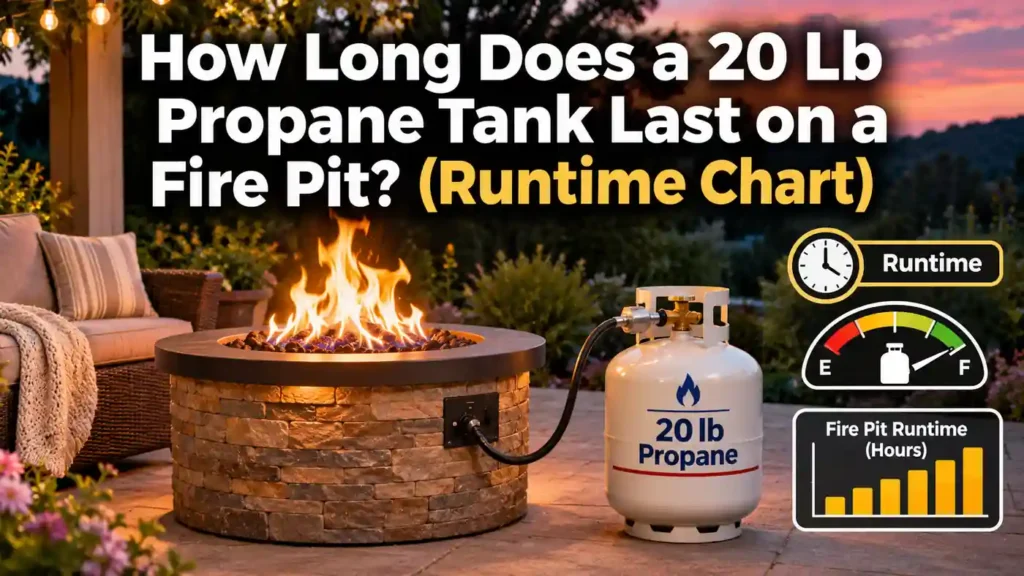
The table shows why I would not promise “10 hours per tank” without seeing the burner setting. A 30,000-BTU/hr model is estimated at roughly 14.3 hours of full-rated operation, while a 60,000-BTU/hr model is closer to 7.2 hours from the same assumed fuel quantity. Real-world operation can end earlier because of cylinder conditions, appliance demand or other factors. For more background, read my 20-pound propane tank runtime chart.
5. An interactive fire table vs bowl runtime calculator
Instead of guessing which design lasts longer, enter each appliance’s maximum BTU rating and your expected average firing percentage. I use a linear approximation for part-load fuel use because real burner controls are product-specific. In other words, 60% on this calculator means an assumed 60% of the maximum input rate—not that a knob positioned at 60% necessarily burns exactly that amount.


Table vs bowl: estimate fuel cost and runtime
Edit the figures to compare two real models. Both estimates use the same propane price and available fuel.
Bowl: ~9.9 hours, $1.90/hour
Planning estimate only. Follow the specific appliance manual for cylinder size, placement, supply and safe operation.
Some WordPress installations optimize or strip inline scripts. The calculator is embedded in this article, but its interactive behavior should be checked on the live page. If it does not run, the static formulas and tables above still provide the same core information.
6. Worked example: a 50,000-BTU table versus a 58,000-BTU bowl
Imagine that I can buy a rectangular fire table for $250 or a portable bowl for $145. Both use approved standard propane cylinder setups, and I plan to operate them for two hours every Saturday over 26 weeks. I will compare them fairly by holding the propane price at $4/gallon and using maximum rated input throughout. These are invented buying scenarios for teaching the calculation, not exact retailer quotations.
| Metric | 50,000-BTU table | 58,000-BTU bowl |
|---|---|---|
| Example purchase price | $250 | $145 |
| Full-input propane per hour | 0.546 gal | 0.634 gal |
| Fuel over 52 operating hours | 28.42 gal | 32.96 gal |
| 52-hour fuel cost at $4/gal | $113.66 | $131.85 |
| Equipment + fuel (excludes taxes, cylinder, accessories) | $363.66 | $276.85 |
| Nominal full-input hours from 4.7 gal | 8.6 hr | 7.4 hr |
The table consumes approximately $18.19 less in propane over the 52 hours, but it costs $105 more to purchase in the example. Consequently, the bowl remains about $86.81 cheaper over that first season before accessories. I would not call the bowl universally the “best value” though. If I use the fire table as patio furniture when cool, its surface could replace another purchase. That nonfuel benefit is what the bare runtime comparison misses.
This calculation also shows a subtle shopping lesson: choosing a fire table does not by itself save fuel. Choosing a lower-rated burner and operating it at a suitable, approved lower setting can. Check my fire pit hourly and monthly fuel expense guide for other usage patterns.
If you are deciding between a table and a bowl but also want to evaluate materials, features and total ownership cost, my Propane Fire Pit Buying Guide brings those purchase decisions together in one place.
7. Does a propane fire pit table cost more than a bowl?
Typically, furniture-style tables add materials and assembly, so comparable entry-level tables may cost more than simple portable bowls. But the market overlaps: a premium composite bowl may exceed the price of a basic steel table. I would not judge affordability from the label alone. The useful question is what comes with the model—lid, burner media, storage, protective cover, hose and approved regulator.
| Category | Illustrative shopping budget | Potential extra expenses | My buying priority |
|---|---|---|---|
| Basic portable bowl | $90–$200 | Cylinder, fuel, carrying cover, approved accessories | Completeness and transport practicality |
| Midrange portable or decorative bowl | $200–$500 | Cylinder cover, delivery, protective cover | Finish and stability |
| Basic steel fire table | $160–$350 | Cylinder and fuel; sometimes protective cover | Burner, lid, corrosion protection |
| Large steel or aluminum fire table | $350–$800 | Freight, assembly, optional accessories | Fit, quality and warranty |
| Premium composite/stone-look fire feature | $700–$2,000+ | Freight, professional placement or services if required | Weight, support and finish longevity |
These are rough purchase-planning bands in U.S. dollars, not current verified prices. For examples by shopping channel, see my guide to the best places to buy propane fire pits, and for a broader equipment-cost breakdown see how much a propane fire pit costs.
8. The cost-per-evening method I use
I prefer an original comparison metric I call the cost per useful evening. The idea is simple: instead of asking which product has the lower sticker price, I spread the purchase price across how often I genuinely expect to use the item. Then I add fuel for that evening. It is a budgeting method, not a measured durability claim.
Say I use either option for 40 evenings over two years, at 90 minutes each evening and 70% of nominal input. Assume the table costs $260 and the bowl $150. The equipment portion is $6.50 per outing for the table and $3.75 for the bowl. The fuel expense per outing is about $2.30 for the 50,000-BTU table and $2.66 for the 58,000-BTU bowl at $4 per gallon.
| Cost per evening across 40 evenings | Table: $260, 50k BTU | Bowl: $150, 58k BTU |
|---|---|---|
| Equipment cost per evening | $6.50 | $3.75 |
| Fuel cost (1.5 hr × 70% × $4/gal) | $2.30 | $2.66 |
| Combined estimated cost per evening | $8.80 | $6.41 |
| Practical question | Will I actually use the tabletop? | Will I miss a stable surface? |
This framework helps me avoid two common mistakes. First, I do not pay extra for a built-in table if I already have suitable patio furniture. Second, I do not choose the lowest-priced bowl if I will end up buying extra furniture or accessories to make the space comfortable. Those additions belong in the comparison.
9. How much space do they actually take up?
The metal dimensions are only part of the footprint. I also need to account for seating, permitted overhead and side clearances, entryways and the cylinder position. Some table designs include a hidden tank, but others need the same external upright cylinder arrangement as a portable bowl. An exposed hose is not automatically unsafe when used as directed, yet it can affect traffic patterns around the seats.
Here is a planning exercise: a 48-by-24-inch rectangular table occupies 8 square feet of tabletop footprint, while a circular 19-inch bowl occupies approximately 2 square feet in plan view (π × 9.5² ÷ 144 ≈ 1.97). That is a fourfold difference in object footprint. It does not mean the bowl only needs one-quarter as much safely usable patio area, because manufacturer-mandated distances and cylinder space still apply.
| Object | Plan-view dimensions | Approximate object footprint | Important caveat |
|---|---|---|---|
| Rectangular fire table | 48 × 24 in. | 8.00 sq ft | Not the required safety clearance |
| Compact square table | 28 × 28 in. | 5.44 sq ft | Does not include chairs or walking area |
| Portable round bowl | 19 in. diameter | 1.97 sq ft | Cylinder and hose may sit outside |
| Large round decorative bowl | 38 in. diameter | 7.88 sq ft | Could outweigh the table |
I would mark those rough shapes with tape outdoors before buying. Then I would open the actual product manual and add its required clearances; I never substitute a generic diagram for the manufacturer’s safety guidance.
10. What about cylinder storage, hoses and gas connections?
This detail is one of the most consequential differences in day-to-day ownership. A table with manufacturer-approved built-in cylinder storage can look tidy and reduce loose hose runs. Yet some narrow or long tables still use a cylinder outside the body. Likewise, portable bowls commonly use a separate upright cylinder, but decorative pedestals differ. I do not assume a tank can sit beneath the bowl simply because the space looks available.
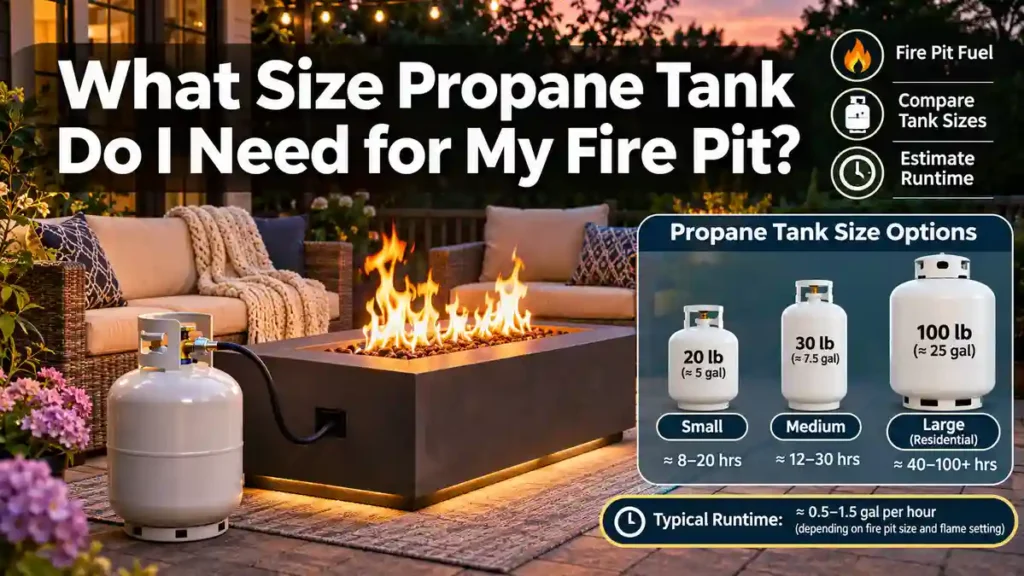
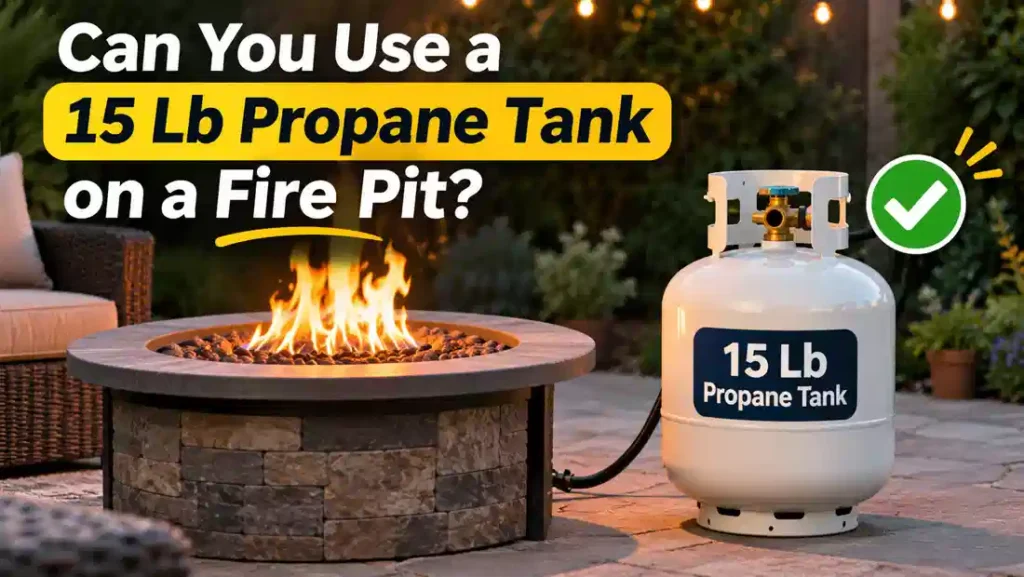
I follow the exact listed cylinder size and location. An approved regulator and hose must match the appliance. Never remove or replace a regulator with an improvised fitting, modify hose routing through hot surfaces, or connect to a house line without a product-approved arrangement and qualified work where required. If you are unsure which cylinder size is supported, consult my propane tank sizing guide and 15-pound versus 20-pound cylinder discussion.
11. Which one is easier to maintain?
A portable bowl can have fewer body panels and no table door, which may simplify wiping down the shell and inspecting visible areas. A table can add lids, hinged components and furniture finishes that need care. However, both use a fuel system, ignition parts, combustion components and approved decorative media. Neither becomes maintenance-free because it uses propane rather than wood.
- Before use: inspect accessible approved hose and fittings for visible damage, verify the manufacturer-prescribed setup, and keep the combustion area clear.
- During use: keep combustible materials, children and pets at the distances required by the product instructions; do not leave the flame unattended.
- After use: turn off the controls and cylinder according to the manual, allow complete cooling and cover only when permitted.
- Seasonally: clean using the manufacturer’s method, check for rust or surface damage and replace damaged parts with approved replacements.
- For storage: follow outdoor cylinder-storage rules, protective-cover instructions and the appliance’s winter guidance.
I would pay attention to the location of ignition controls. If a control or battery compartment is sheltered within the table, it may be less exposed to rain; that does not guarantee protection from corrosion. I evaluate the manual, component quality and warranty instead of generalizing by shape.
12. Which is safer: propane fire pit table or bowl?
I would not label either format inherently safer. Every propane fire feature presents flame, hot surfaces, gas-handling and carbon monoxide risks. Both must be used outdoors in a location the manufacturer approves, with required clearances and without improvised parts. A table’s broad surface can invite people to set objects near the flame, while a low bowl may put a hot rim closer to pets or children. These are different behavioral risks rather than evidence that one design is automatically safer.
The safe choice is the model whose installation requirements you can actually meet. Never use either inside a home, garage, tent or other enclosed area. Do not treat a roofed patio as acceptable without following explicit manufacturer guidance and applicable codes. I also would not roast food over a unit unless its manufacturer approves that use. My detailed propane fire pit safety guide covers placement and checks, and my renters’ fire pit guide explains why permission and property rules come before shopping.
13. My decision guide: choose a table or a bowl
| If your priority is… | My starting choice | Why | Check before paying |
|---|---|---|---|
| A coordinated sofa seating area | Fire table | Provides furniture-like visual structure | Actual usable tabletop and required clearance |
| Camping or approved travel | Purpose-built portable bowl | Often easier to transport | Carrying weight, approved site use and cylinder setup |
| Concealing the cylinder | Specific table with approved integrated storage | Cleaner visual appearance | Manufacturer actually allows interior storage |
| A prominent open flame view | Bowl | Often emphasizes the fire rather than tabletop | BTU rating and burner shape |
| Lowest upfront purchase | Basic bowl or entry-level table | Prices overlap | Total delivered, equipped price |
| Longest runtime | Lower-BTU model at suitable setting | Fuel use follows actual input | Approved cylinder supply and real low-setting performance |
| Small outdoor space | Measure both first | Object size is not safety footprint | Manual clearances and local rules |
| A decorative permanent feature | Premium table or heavy composite bowl | Finish dominates choice | Weight, freight, warranty, long-term service |
When two products look almost identical in photos, I make a four-column note: exact model number, actual burner rating, ready-to-use price and approved cylinder arrangement. That small comparison typically reveals the meaningful differences faster than browsing more lifestyle photographs.
14. Five buying mistakes that matter more than shape
- Comparing only maximum flame photos. Exposure and fuel rate are not visible in promotional photography. I compare BTU/hr and actual dimensions.
- Assuming every table hides the tank. Some tables require an external cylinder, just like a bowl. Read the description and manual.
- Confusing a fire-table lid with an always-safe dining surface. Use any cover or lid only as the manufacturer permits and never while hot.
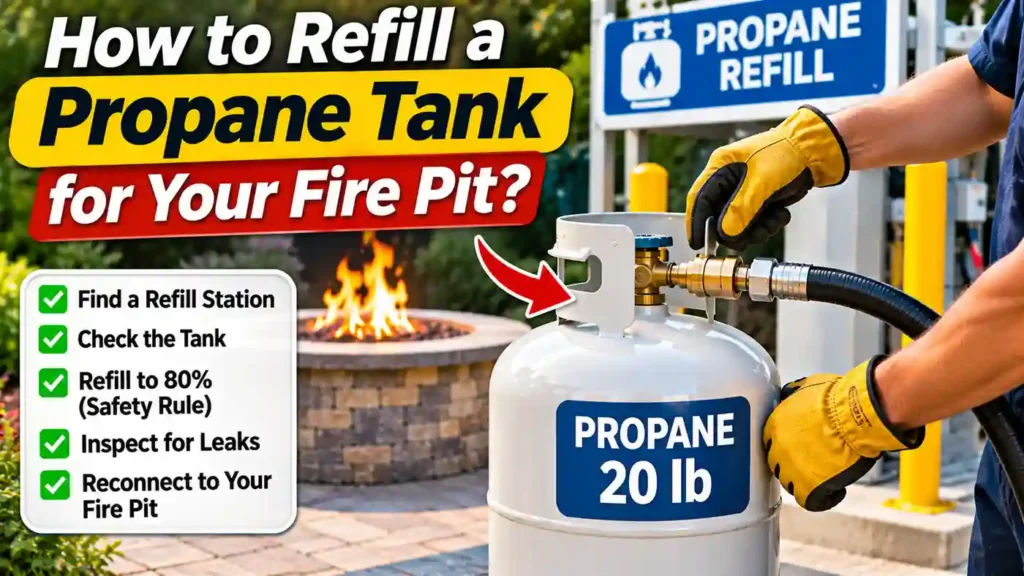
- Forgetting cylinder purchase and refills. A separately purchased cylinder plus fuel can materially change a low advertised price. See how to refill your fire pit propane tank.
- Buying before measuring clearances. A perfectly sized photo can still represent a product that does not fit a real patio safely.
15. Fuel-cost scenarios for different habits
I budget from expected burner-hours, not just tank count. In this table I use a 50,000-BTU/hr table and a 58,000-BTU/hr bowl, each assumed to average 70% of its rated input. For example, two hours a week for four weeks equals eight operating hours in a planning month. This is an average-input estimate; the actual valve position will not necessarily scale fuel use linearly.
| Usage pattern | Table gallons | Table cost at $4/gal | Bowl gallons | Bowl cost at $4/gal |
|---|---|---|---|---|
| Light: 2 hours/month | 0.77 | $3.06 | 0.89 | $3.55 |
| Weekly: 8 hours/month | 3.06 | $12.24 | 3.55 | $14.20 |
| Social: 16 hours/month | 6.12 | $24.48 | 7.10 | $28.40 |
| Frequent: 30 hours/month | 11.48 | $45.90 | 13.31 | $53.25 |
Notice that the monthly spending gap is modest at low use but becomes more meaningful over time. It is also possible for a 60,000-BTU table to cost more to run than a 40,000-BTU bowl. That is why I keep product format and fuel rate as separate decisions. Your propane price, frequency and real burner setting matter more than marketing categories.
16. Frequently asked questions
Are propane fire pit tables hotter than fire bowls?
Not automatically. I compare the stated BTU/hr ratings and flame characteristics. A table and bowl with equal rated input have approximately equal full-rate propane consumption, although the heat you feel may differ because of burner geometry and surrounding conditions.
Does a propane fire pit table use less propane than a bowl?
Only if its actual burner input is lower. A 30,000-BTU/hr table uses around 0.328 gallon an hour at full input, while a 58,000-BTU/hr bowl uses around 0.634 gallon. But reverse their ratings and the fuel comparison reverses too.
Can I put a propane fire pit bowl on top of an ordinary table?
I would not do this unless the specific product is expressly listed and instructed for that tabletop installation, including appropriate surface protection and clearance. A freestanding bowl is not automatically a tabletop appliance.
Can a propane fire pit table be used as a regular table?
Some are designed for that purpose with a removable lid, but only under the conditions stated in the manual—typically after full cooling, with the burner off. I would never cover a live flame or assume the area near a lit burner is safe for objects, food or drinks.
How long does a propane fire pit bowl last on a 20-pound tank?
For an assumed 4.7 gallons and a 58,000-BTU/hr full-input bowl, my calculation is roughly 7.4 hours. A lower setting can extend runtime, but actual operation depends on equipment, temperature, fill and the real input rate.
Which is better for a small patio?
The better fit is whichever manufacturer-approved unit can satisfy all placement and ventilation rules. A compact bowl has a smaller physical footprint, but its separate propane tank and hose may require more usable space than expected. A small table can sometimes organize the space better, despite being larger.
Are gas fire bowls easier to move?
Portable metal bowls often are. Heavy decorative bowls may weigh more than basic steel tables. I compare assembled weight, safe handling instructions and whether the cylinder can be disconnected and transported according to applicable rules.
Do propane fire pits create smoke?
Properly operating propane combustion generally avoids the wood smoke and ash associated with burning logs, but it produces combustion gases, including carbon monoxide under certain conditions. Outdoor-only use and proper ventilation remain essential.
My final verdict
If I wanted a fire feature next to my patio seating where the unit could also function as furniture when completely cool, I would start with a propane fire pit table. If I wanted a camp-style gathering around a visible flame, with easy transport as a major priority, I would start with a purpose-built portable propane fire bowl. Those are different uses—not different levels of quality.
Then I would make the actual choice with five numbers: purchase price, burner BTU/hr, cylinder fuel capacity, estimated hours of use and total outdoor footprint. The charts and interactive calculator on this page show how the numbers fit together. Before buying, visit my retailer comparison, tank-sizing guide, 20-pound runtime chart and fire pit safety checklist. That sequence leads from choosing a design to choosing a safe, suitable product.

Mike is an experienced propane technician with over 15 years of professional experience in the field. He has dedicated his career to helping customers with their propane needs, from installation to maintenance and repair. Together with Jeremy, he co-founded this website to provide useful information and guidance to customers seeking reliable propane services.