Updated November 9, 2026 · U.S. propane shopping guide · 2027 pricing subject to change
Lowe’s sells propane tanks for grills and offers Blue Rhino propane tank exchanges at participating stores. Its standard Blue Rhino exchange is a 20 lb-capacity cylinder containing 15 lb of propane—not a complete 20 lb fill. You can also buy a prefilled cylinder without handing in an empty one. If you want to refill your own cylinder to its rated capacity, you will generally need a propane refill station outside Lowe’s.
2027 price note: This guide was prepared in November 2026. Lowe’s displays many propane prices only after you select a store. The cost ranges below are illustrative shopping budgets—not verified nationwide 2027 shelf prices.


When I shop for a propane tank for a grill, I look at more than the price on the cage outside the store. I want to know how much propane I am actually buying, whether the tank itself is included, how many cookouts it should support, and what my next refill or exchange will cost. Those details can change the better deal.
Lowe’s sells grills and supplies alongside exchange cylinders. But an exchange, a new empty tank, and a measured refill are different transactions. I’ll compare their costs, fuel quantities and likely grilling times.
Lowe’s Propane Tank Prices: What Should You Budget?
For 2027 planning, I would treat any price without a selected store and confirmed date as an estimate. Lowe’s asks shoppers to choose a store for pricing and availability, so there is no verified nationwide price I can quote.
Here is the budget worksheet I would use before checking my local store. These ranges are illustrative U.S. shopping scenarios, not a representation of current Lowe’s prices.


| What you buy | Illustrative budget | What you receive | What to verify |
|---|---|---|---|
| Blue Rhino exchange | $20–$30 | An exchange cylinder containing 15 lb of propane | Store-specific exchange price and stock |
| Blue Rhino initial purchase, no empty tank | $55–$80 | An exchange-program cylinder with 15 lb of propane | Price for “no exchange” rather than “exchange” |
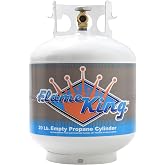
| New empty 20 lb steel cylinder | $45–$85 | An unfilled 20 lb-capacity cylinder | Brand, OPD valve, preparation, shipping |
| New empty 20 lb cylinder with gauge | $60–$105 | Unfilled cylinder with a gauge | Whether the gauge is included and usable |
| Measured fill of an empty 20 lb cylinder elsewhere | $14–$24 | Approximately 4.7 gal at $3–$5 per gallon | Local refill price, fees and actual gallons |
Exchange is typically cheaper upfront when you surrender an eligible cylinder. A no-exchange purchase includes the tank, while an empty tank needs fuel before use.
Compare your first-day total as well as the cost of future refills; a $25 exchange and $60 empty tank are not equivalent purchases.
How much does it cost to exchange a propane tank at Lowe’s?
My practical expectation for a standard exchange is a rough $20–$30 shopping budget, but the actual charge must be checked at your participating Lowe’s. Blue Rhino’s exchange pages at Lowe’s show “Get Pricing & Availability” instead of a reliable national dollar figure. Taxes and promotions may also vary.
If your tank is missing or you have never owned one, ask for the initial purchase/no-exchange price. Paying an exchange price normally requires surrendering an acceptable standard grill cylinder. Keep those two price categories separate when comparing offers.
What Sizes of Propane Tanks Does Lowe’s Sell for Grills?
The most common choice for a full-size backyard gas grill is a standard upright 20 lb-capacity propane cylinder. Lowe’s also lists other sizes and products from brands such as Flame King, Worthington and Bernzomatic, although local stock varies. Not every size shown online is designed for the same grill, valve, regulator or storage compartment.

| Nominal capacity | Approx. propane gallons | Idealized fuel energy | My typical use case |
|---|---|---|---|
| 1 lb | 0.24 gal | 21,600 BTU | Compact portable appliances with matching connection |
| 5 lb | 1.18 gal | 108,000 BTU | Small compatible portable grills |
| 10 lb | 2.36 gal | 216,000 BTU | Compact outdoor cooking when space is limited |
| 20 lb | 4.72 gal | 432,000 BTU | Standard freestanding gas grills |
| 30 lb | 7.08 gal | 648,000 BTU | Compatible RV or extended-use setups |
| 40 lb | 9.43 gal | 863,000 BTU | Longer-duration use where size is permitted |
Capacity estimates use about 4.24 lb of propane per gallon and 91,500 BTU per gallon. Nominal sizes describe propane weight when properly filled; do not subtract another 20% from these fuel amounts.
I choose a cylinder by grill-manufacturer requirements first. A 30 lb cylinder may not fit the compartment or approved mounting system for a 20 lb tank.
Does a 20 lb propane tank always have 20 lb of gas?
No. “20 lb” is the cylinder’s nominal propane capacity. A Blue Rhino exchange sold through Lowe’s is labeled 15 lb of propane. The bottle may be the familiar 20 lb size, but the fuel delivered is about three-quarters of its rated 20 lb load. This is the single detail I would want every grill owner to notice before comparing prices.
Should you buy a 30 lb tank for a grill?
Only if your grill and its mounting system are designed or explicitly approved for that size. Bigger tanks provide more fuel, not a different burner output. If you are curious about prices and safe size selection, I cover a larger-cylinder example in How Much Does a 30 lb Propane Tank Cost?.


Lowe’s Propane Exchange vs. Refill: What Is the Difference?
A propane exchange means turning in your eligible empty cylinder and receiving a different prefilled cylinder. A refill means a qualified operator adds propane to your existing cylinder, using an approved method and filling limit. Lowe’s advertises exchange service; it does not generally offer a nationwide pay-by-the-gallon refill service at its store propane cages.
| Feature | Lowe’s Blue Rhino exchange | Measured refill at another supplier |
|---|---|---|
| What happens | Trade eligible cylinder for another | Keep your own cylinder |
| Standard fuel received | 15 lb, about 3.54 gallons | Up to 20 lb, about 4.72 gallons when empty |
| Payment basis | Flat exchange charge | Often gallons added; sometimes flat fee |
| Convenience | Fast at participating retail stores | Depends on operator and service hours |
| Tank condition | Provider supplies inspected exchange cylinder | Your cylinder must pass inspection and date requirements |
| Remaining propane | Any usable fuel in surrendered tank is forfeited | You normally keep what remains and pay for the addition |
| Best reason to choose | Convenient swap; no filling appointment | More fuel per visit and often lower fuel cost |
The exchange cylinder has about 25% less propane than a full 20 lb cylinder. Viewed the other way, a properly filled 20 lb cylinder offers 33.3% more propane than a 15 lb exchange, at the same grill consumption rate.
An exchange can make sense when you need fuel quickly. I just compare the actual fuel quantity with the trip and convenience.
My Cost Comparison: Exchange vs. Refill per Gallon
Let me work through an example that avoids a common pricing trap. Suppose a store charges $25 to exchange a tank containing 15 lb, while a nearby refill provider charges $4.00 per gallon. The exchange includes approximately 3.54 gallons. At $25, you are paying about $7.07 per gallon of propane delivered.
The other supplier would charge approximately $18.88 to deliver 4.72 gallons into your empty 20 lb tank at $4 per gallon. This assumes the refiller charges by the gallon and adds no flat service fee.
| Scenario | Fuel supplied | Total fuel cost | Effective price per gallon |
|---|---|---|---|
| $20 exchange | 3.54 gal | $20.00 | $5.65 |
| $25 exchange | 3.54 gal | $25.00 | $7.07 |
| $30 exchange | 3.54 gal | $30.00 | $8.47 |
| Refill at $3/gal | 4.72 gal | $14.16 | $3.00 |
| Refill at $4/gal | 4.72 gal | $18.88 | $4.00 |
| Refill at $5/gal | 4.72 gal | $23.60 | $5.00 |
These are illustrative calculations, not quoted Lowe’s rates. The key is that a lower cash register total does not necessarily mean a lower price for each gallon of propane. If you refill halfway through a cylinder’s fuel supply, you also avoid surrendering propane that has already been paid for.
The break-even question I would ask
At $4 per gallon, an exchange containing 3.54 gallons has about $14.16 of fuel at the refill-station rate. If the exchange costs $25, the remaining $10.84 represents a premium for convenience, handling, cylinder inspection, logistics and retail service. I call this my convenience premium calculation—not a breakdown of Blue Rhino’s actual costs or profit.
If that convenience saves a 45-minute round trip, you may happily pay it. If you refill several tanks every month, the extra cost can add up. This approach helps you make a decision based on your own circumstances rather than treating either option as universally best.
For the weight conversion behind these examples, see my guide to how much one gallon of propane weighs.
How to Exchange a Propane Tank at Lowe’s
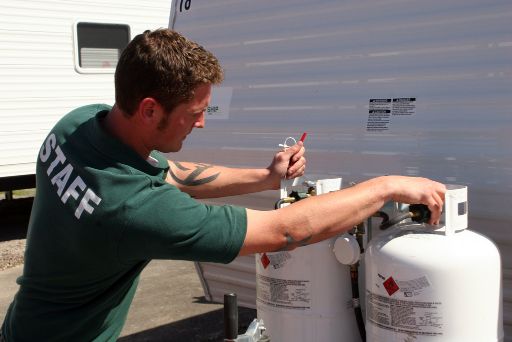
At a participating Lowe’s with a staffed exchange display, the process is straightforward. The exact store procedure may vary, so follow local signs and the attendant’s directions.
- Bring an eligible standard grill cylinder. Close the valve and secure the cylinder upright in your vehicle. If it is leaking or severely damaged, do not transport it to a store; contact the propane provider for instructions.
- Locate the outdoor Blue Rhino cage. Keep your cylinder outside the building. Never carry a propane tank through the indoor aisles or into the checkout line.
- Ask for an exchange at the register. Confirm the store’s exchange price and whether it has filled replacement cylinders available.
- Follow the associate’s instructions. An authorized employee opens the cage and provides the replacement cylinder. Do not try to open the cage yourself.
- Check the replacement before leaving. Look for the label, valve condition, protective collar, obvious damage and the stated net fuel weight.
- Secure the new cylinder upright. Take it home without unnecessary stops, keep it out of a hot parked vehicle, and connect it using the grill’s instructions.
Blue Rhino’s exchange policy generally accepts other brands of standard 20 lb grill cylinders in good condition; the tank does not have to say Blue Rhino. Whether a questionable, out-of-date or damaged cylinder is accepted is a matter for the provider, and a suspected leak should be handled as a safety issue rather than a routine exchange.
Can You Buy a Propane Tank at Lowe’s Without an Empty One?
Yes. Lowe’s lists Blue Rhino initial-purchase or no-exchange options at participating locations. You pay more because you are receiving a cylinder as well as the included propane, without providing an old cylinder to offset the transaction. The current store-specific price should be checked before you go.
That can be useful when you buy your first gas grill. You can take home a ready-to-connect, prefilled standard cylinder without hunting down a separate filling station. On the other hand, buying a new empty cylinder and having it filled elsewhere may give you more propane on day one. The right choice depends on the full first-purchase math, not just convenience.
Before checkout, I ask: Is it filled? How many pounds are inside? Does this price require an empty exchange?
Technical Details of Lowe’s Standard Grill Propane Tanks
The following comparison covers standard U.S. upright steel grill cylinders. Measurements and tare weights vary among models; always use the markings and instructions for the specific tank in front of you.
| Specification | Standard 20 lb cylinder | Typical Blue Rhino exchange |
|---|---|---|
| Nominal cylinder capacity | 20 lb | 20 lb class cylinder |
| Propane supplied | Up to 20 lb when properly filled | 15 lb, labeled net fuel weight |
| Liquid fuel volume | Approx. 4.72 gal | Approx. 3.54 gal |
| Fuel energy | Approx. 432,000 BTU | Approx. 324,000 BTU |
| Valve on typical modern grill cylinder | OPD with Type 1/QCC1 | OPD with Type 1/QCC1 |
| Approximate dimensions | Around 18 in tall × 12–13 in wide | Similar, varies by exchange model |
| Expected operating orientation | Upright | Upright |
| Grill compatibility | Depends on grill and retention system | Standard compatible 20 lb-capacity grill connections |
The OPD is an overfilling prevention device, not a reason to skip proper handling or an authorized fill procedure. A Type 1/QCC1 connection is common on modern gas grills, but I still recommend checking your grill manual before selecting a tank or an adapter.
A small 1 lb-bottle grill is not automatically compatible with 20 lb cylinders. Use only approved connections and fuel arrangements.
How Long Will a Lowe’s Propane Tank Last on a Grill?
Runtime depends on how fast your burners consume propane. A grill rated at 40,000 BTU per hour does not burn that amount every minute unless all relevant burners run continuously at their rated setting. Outdoor temperature, wind, lid position, food load and your use of high versus medium heat all affect real usage.
For a simple full-output estimate, I divide the available fuel energy by grill input in BTU per hour. These are idealized calculations, not guaranteed cooking times.
| Grill input rating | 15 lb exchange (approx.) | Full 20 lb refill (approx.) |
|---|---|---|
| 20,000 BTU/h | 16.2 hours | 21.6 hours |
| 30,000 BTU/h | 10.8 hours | 14.4 hours |
| 40,000 BTU/h | 8.1 hours | 10.8 hours |
| 50,000 BTU/h | 6.5 hours | 8.6 hours |
| 60,000 BTU/h | 5.4 hours | 7.2 hours |
Worked example: If I use a 40,000 BTU/h grill at its full rated burner input for two hours per cookout, one 15 lb exchange gives roughly four two-hour sessions in theory. A fully refilled 20 lb tank gives about five such sessions, with a little fuel remaining. In practice, the grill may cycle between high and lower heat, so actual cookouts per tank can be greater.
This is why I would not promise that every exchange lasts a certain number of weekends. Instead, estimate your average burner setting and hours per cookout, and keep a spare cylinder if running out midway through dinner would be disruptive.
The Real Cost per Cookout: My Practical Calculator
I like to translate a propane price into what I actually care about: an evening with the grill. Consider a hypothetical 40,000 BTU/h grill used for 90 minutes at an average of 60% of its maximum burner input. That is 36,000 BTU of propane fuel input for the cookout.
Using about 91,500 BTU per gallon, the cookout consumes approximately 0.393 gallons, or 1.67 lb. At a refill price of $4 per gallon, the fuel costs about $1.57. At an illustrative $25 exchange with an effective price of $7.07 per gallon, the same fuel quantity has a cost of about $2.78.
| My example: one cookout | Measured refill at $4/gal | $25 exchange containing 15 lb |
|---|---|---|
| Estimated fuel used | 0.393 gal | 0.393 gal |
| Effective fuel price | $4.00/gal | $7.07/gal |
| Approximate fuel cost | $1.57 | $2.78 |
| Difference per cookout | — | About $1.21 more |
This scenario is my own calculation for comparing purchase options; it is not a field test or a prediction of your actual bill. If you grill eight times in a month under these same assumptions, the modeled fuel difference is about $9.68. You can replace the price and hours with your actual figures to estimate your own costs.
My Decision Guide: Which Lowe’s Propane Option Should You Choose?
I make the decision in this order: first verify safety and fit, then check whether I already have an acceptable cylinder, and only then compare the true price of the fuel. Here is the guide I would use for a typical U.S. grill owner.
| Your situation | My pick | Why |
|---|---|---|
| New grill, no cylinder | Initial-purchase Blue Rhino or new empty 20 lb cylinder plus refill | Both can get you started; compare first-day total |
| Empty standard 20 lb cylinder, refill station closed | Lowe’s exchange | Convenient ready-to-grill supply |
| Frequent grilling and accessible refill station | Measured refill | Often more gallons for the money |
| Partially full cylinder | Keep using it or top it up at a qualified refiller | Avoid forfeiting remaining fuel in an exchange |
| Need a spare for guests or parties | Additional approved 20 lb cylinder | Easier changeover and less risk of running out |
| RV compartment fits only a specific size | Follow RV manufacturer’s specified cylinder | Physical fit and approved mounting are essential |
| Rusty, damaged, leaking or questionable cylinder | Contact propane professional | Do not treat normal exchange as a repair or leak disposal service |
One way I make this decision more personal is to count trips, not just dollars. If you have to drive far to a filling station, a nearby Lowe’s exchange may be worth the fuel premium. If a refill supplier is directly on your commute, measured refills become especially appealing. There is no universal winning option because the convenience cost differs for each household.
Propane Tank Storage, Transport and Grill Safety
Buying the right tank means little if it is stored or connected incorrectly. I keep three principles in mind: use an approved cylinder, keep it upright and secure, and follow the appliance manufacturer’s instructions. A propane cylinder does not belong in an enclosed living area, a basement, or an indoor garage for routine storage.
Keep cylinders outdoors in a ventilated, stable location, away from heat and sources of ignition. Never store an attached or spare propane cylinder under conditions prohibited by the grill manufacturer. Close the valve whenever the grill is not in use. Do not put a cylinder into a confined grill compartment unless the grill was built for that exact arrangement.
Before lighting, inspect accessible hoses and connections, and perform the leak-check method specified in the appliance instructions. Never test for leaks using a flame. If you smell propane, hear hissing, or suspect a leak, do not operate electrical switches or ignite anything; move away and contact the propane supplier or emergency responders from a safe place. You can also read Do Propane Fumes Rise or Fall? for an explanation of how escaping propane behaves.
A propane cylinder that is too old, corroded, badly dented, or otherwise unserviceable must be assessed by a qualified professional. Requalification rules depend on its DOT specification and examination method; do not treat a painted exterior or an exchange cage as a substitute for proper inspection.
Frequently Asked Questions About Lowe’s Propane Tanks
Does Lowe’s refill propane tanks?
Lowe’s advertises Blue Rhino cylinder exchange at participating stores rather than a general pay-by-the-gallon refill service. If you want to keep your own cylinder and add fuel, find an authorized propane refill provider and confirm the size it accepts.
Does Lowe’s exchange any brand of propane tank?
Blue Rhino generally accepts standard 20 lb grill cylinders of other brands when they meet the provider’s acceptance requirements. Do not assume severely damaged, leaking or unusual cylinders will be accepted. Contact the provider for guidance on unsafe equipment.
Can you buy a Lowe’s propane tank without trading one in?
Yes, Lowe’s lists Blue Rhino initial-purchase/no-exchange options. The no-exchange price is different from the price paid when you return an acceptable empty cylinder.
How much propane comes in a Lowe’s Blue Rhino exchange?
The standard Blue Rhino exchange is labeled with 15 lb of propane—about 3.54 U.S. gallons. That is different from the 20 lb nominal fuel capacity of a common grill cylinder.
How much does a full 20 lb propane tank hold?
A properly filled 20 lb-capacity propane cylinder contains approximately 4.72 U.S. gallons of liquid propane, based on about 4.24 lb per gallon. An authorized filler follows the cylinder’s markings and approved procedure.
Will a 15 lb exchange last as long as a 20 lb refill?
No. At an identical burner consumption rate, a full 20 lb cylinder provides about one-third more operating time than a 15 lb exchange. Both actual runtime and usable vapor output depend on the appliance and conditions.
My Final Recommendation: Buy the Fuel You Need, Not Just the Tank You Recognize
For most people with a standard backyard grill, a 20 lb-capacity cylinder is the familiar starting point. Lowe’s makes it convenient to exchange an eligible cylinder for a ready-to-use Blue Rhino tank, and it also lists initial-purchase options for people who have no empty tank. But the 15 lb propane fill is essential when you compare costs.
If I already had a serviceable cylinder and a convenient refill station, I would normally price a measured refill first. If convenience mattered more than the cost per gallon or I needed fuel immediately, I would consider the Lowe’s exchange. For a brand-new grill, I would compare a prefilled first-purchase tank against a new empty cylinder plus its first authorized fill.
Check Lowe’s local exchange and no-exchange prices and compare them with a nearby refill station’s gallon price. Then read Is Propane Cheaper If You Own the Tank?, What Time of Year Is Propane the Cheapest?, and Is Propane Gas Economical? for the bigger cost picture.

Mike is an experienced propane technician with over 15 years of professional experience in the field. He has dedicated his career to helping customers with their propane needs, from installation to maintenance and repair. Together with Jeremy, he co-founded this website to provide useful information and guidance to customers seeking reliable propane services.