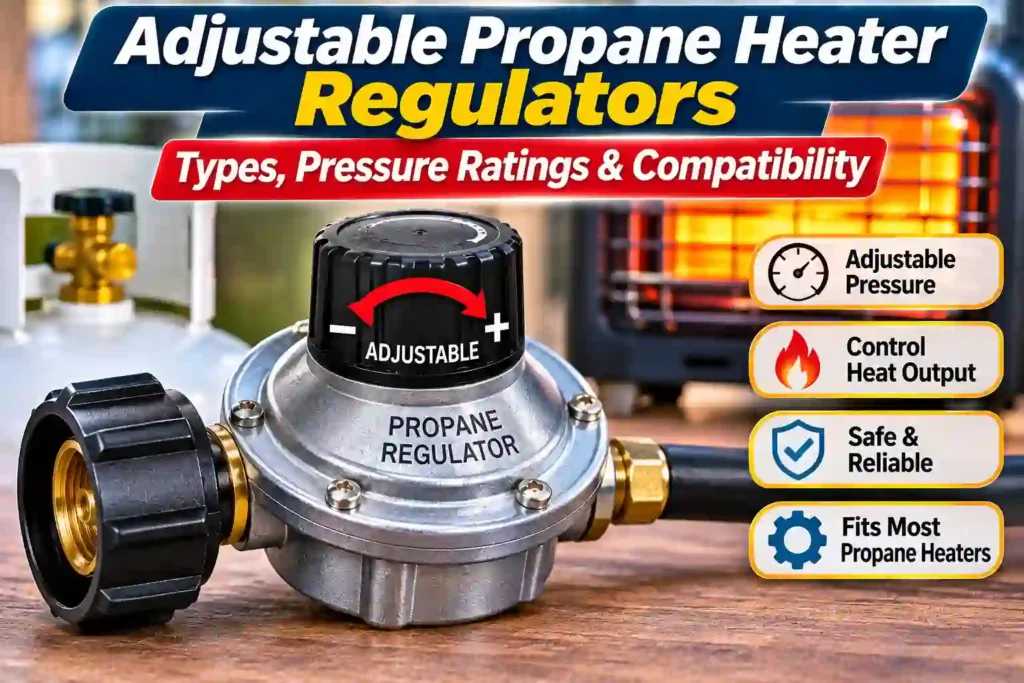


Choosing between an adjustable and fixed propane heater regulator can be confusing, especially if you are unfamiliar with gas pressure requirements and propane heating equipment.
Both regulator types perform the same basic function: reducing incoming propane pressure to a controlled level that the heater can use. However, they differ in how their outlet pressure is established, their intended applications, and the level of control they provide.
An adjustable regulator allows its outlet pressure to be changed within a specified range, while a fixed regulator provides a predetermined outlet pressure established by the manufacturer.


Although an adjustable regulator may appear more versatile, it is not necessarily the better choice for every propane heater. In fact, using an adjustable regulator on an appliance designed for a fixed-pressure supply could create serious safety problems.
Whether you own a patio heater, portable radiant heater, garage heater, wall heater, or forced-air construction heater, choosing the correct regulator is essential for reliable performance.
In this guide, I’ll compare adjustable and fixed propane heater regulators, explain their advantages and disadvantages, discuss their applications, and help you determine which type is appropriate for your heating equipment.
Quick Answer
A fixed propane regulator is generally the better choice for conventional residential, portable, and patio heaters designed to operate at a predetermined gas pressure.


Adjustable regulators are appropriate for specialized heating equipment that specifically requires or permits variable supply pressure.
| Feature | Fixed Regulator | Adjustable Regulator |
|---|---|---|
| Outlet pressure | Predetermined | Adjustable within a specified range |
| Ease of use | Generally easier | Requires greater technical knowledge |
| Pressure adjustment | Not intended for user adjustment | Design-dependent |
| Residential wall heaters | Generally preferred | Only where specifically approved |
| Patio heaters | Generally preferred | Usually unnecessary |
| Construction heaters | Model-dependent | Suitable for certain models |
| Risk of incorrect adjustment | Lower | Higher |
| Installation | Application-specific | May require professional setup |
| Versatility | Limited to its specifications | Greater within its approved application |
My recommendation is to use a fixed-pressure regulator whenever your propane heater is designed for one.
Choose an adjustable regulator only when the heater manufacturer’s specifications expressly permit or require it.
Never increase propane pressure beyond the manufacturer’s specified limits to obtain additional heat.
What Is a Fixed Propane Heater Regulator?
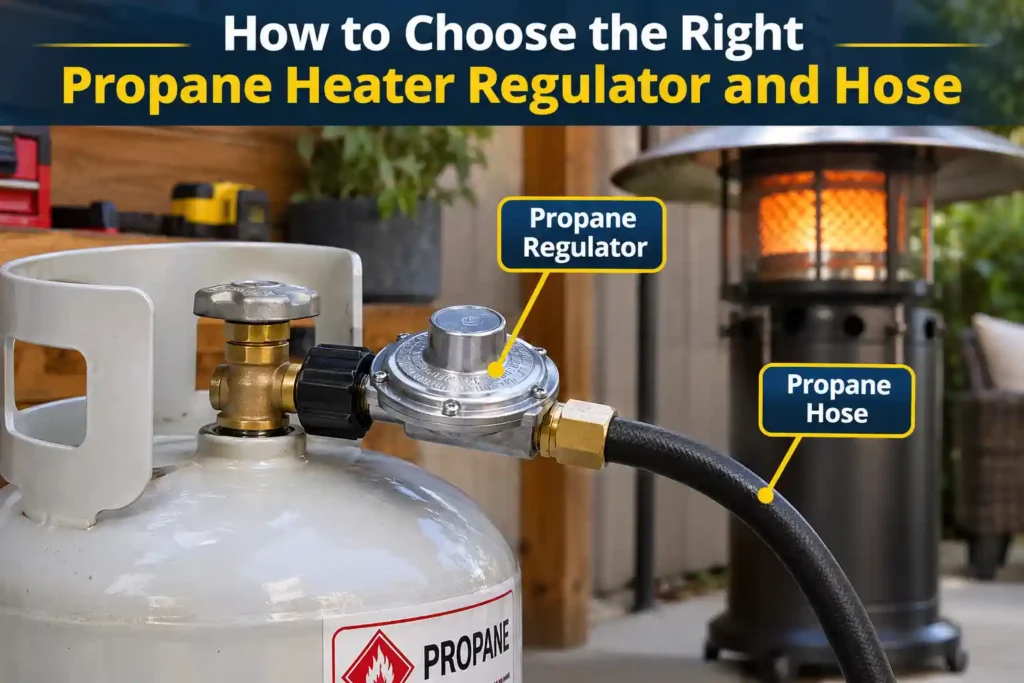
A fixed propane regulator is a pressure-control device designed to deliver propane at a predetermined outlet pressure. The manufacturer establishes its pressure setting according to the regulator’s intended application.



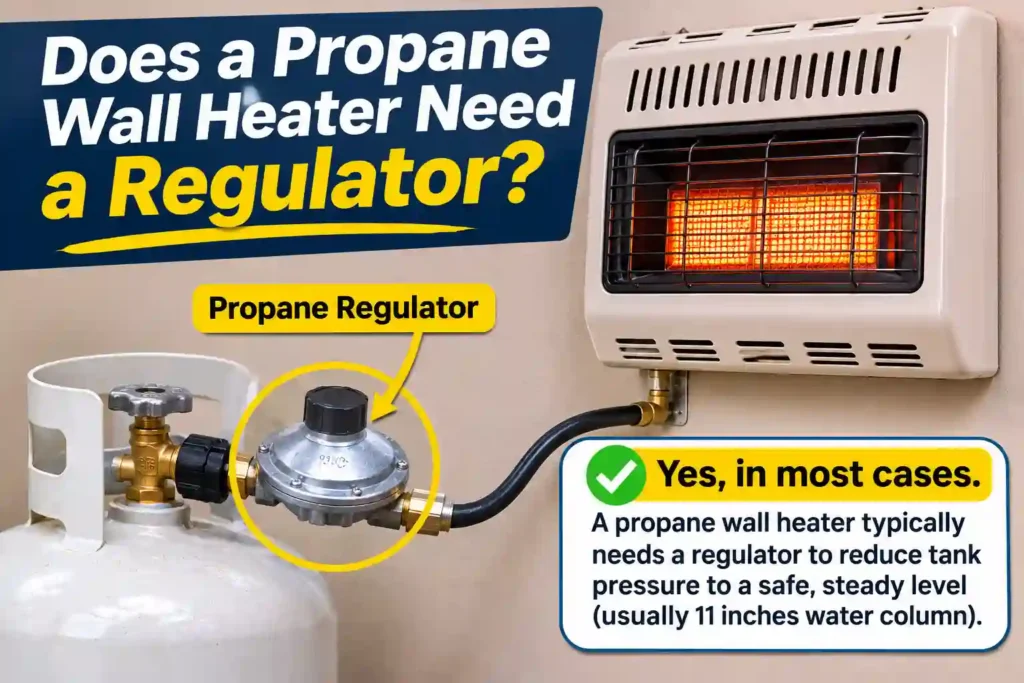
For example, many conventional low-pressure patio heater regulators are designed to deliver approximately 11 inches of water column.
The user does not need to manually increase or decrease the regulator pressure during normal heater operation.
Instead, the heater’s control knob, thermostat, or gas-control valve determines its heat output.
Advantages of Fixed Propane Regulators
- Easier to operate.
- Reduced risk of accidental pressure adjustment.
- Consistent gas delivery within designed operating conditions.
- Suitable for many conventional heating appliances.
- Generally straightforward replacement when using approved assemblies.
- Less opportunity for unauthorized pressure modification.
- Widely available for common propane applications.
Disadvantages of Fixed Propane Regulators
- Limited to their designed outlet pressure.
- Cannot accommodate applications requiring variable supply pressure.
- Different pressure requirements may require different regulators.
- Incorrectly sized models can restrict fuel delivery.
- Not suitable for every specialized heating application.
For ordinary homeowners using propane heaters, the simplicity of a fixed regulator is often its greatest advantage.


What Is an Adjustable Propane Heater Regulator?
An adjustable propane regulator allows its outlet pressure to be established within a specified operating range.
Depending on its construction, the regulator may feature an accessible adjustment knob or a protected adjustment mechanism intended for qualified technicians.
Adjustable regulators are available for both low-pressure and high-pressure applications.
However, adjustable does not automatically mean high-pressure. Likewise, fixed does not necessarily mean low-pressure.
Some industrial regulators offer adjustable intermediate-pressure settings, while certain fixed first-stage regulators deliver approximately 10 PSI for downstream regulation.
Advantages of Adjustable Propane Regulators
- Greater flexibility within approved operating conditions.
- Suitable for specialized heating equipment.
- Allows precise professional pressure setting.
- Can accommodate different approved pressure requirements.
- Useful in certain commercial and industrial applications.
- Available in various pressure and capacity ranges.
Disadvantages of Adjustable Propane Regulators
- Greater risk of incorrect pressure settings.
- May require specialized pressure-testing equipment.
- Often requires more technical knowledge.
- Can be incompatible with conventional household heaters.
- Unauthorized adjustments may cause unsafe combustion.
- May introduce unnecessary complexity.
An adjustable regulator is not a universal solution for propane heater performance problems.
How Adjustable and Fixed Propane Regulators Work
Both regulator types commonly use a diaphragm, spring, valve mechanism, and pressure-sensing arrangement to control gas delivery.
As propane demand changes, the regulator responds by controlling the amount of gas passing through its internal valve.
Fixed Regulator
The regulator maintains its designed outlet pressure automatically without requiring routine user adjustment.
Adjustable Regulator
The regulator maintains its selected pressure setting within its designed operating conditions.
These diagrams illustrate general pressure-regulation concepts. They are not disassembly, installation, or pressure-adjustment instructions.
The primary difference is how the regulator’s target outlet pressure is established.
| Internal Characteristic | Fixed Regulator | Adjustable Regulator |
|---|---|---|
| Pressure-setting mechanism | Preset | Adjustable |
| Diaphragm | Commonly present | Commonly present |
| Internal valve | Controls gas flow | Controls gas flow |
| Spring setting | Predetermined | Variable within designed limits |
| Response to changing demand | Automatic | Automatic |
| User adjustment | Generally not permitted | Only when specifically authorized |
Both types automatically respond to normal changes in gas demand. A fixed regulator does not simply deliver an uncontrolled, constant amount of propane.
Low-Pressure vs. High-Pressure Propane Regulators
When comparing adjustable and fixed regulators, it is important to understand pressure classifications.
Many conventional propane heaters require low-pressure gas, while certain construction and industrial heaters operate at higher pressures.
Propane Regulator Pressure Comparison Chart
| Pressure Rating | Equivalent PSI | Equivalent Inches WC |
|---|---|---|
| 10 inches WC | 0.361 | 10 |
| 11 inches WC | 0.397 | 11 |
| 14 inches WC | 0.506 | 14 |
| 1 PSI | 1.000 | 27.7 |
| 2 PSI | 2.000 | 55.4 |
| 5 PSI | 5.000 | 138.4 |
| 10 PSI | 10.000 | 276.8 |
| 20 PSI | 20.000 | 553.6 |
| 30 PSI | 30.000 | 830.4 |
These figures represent approximate pressure conversions rather than recommended appliance operating pressures.
How Much Higher Is High-Pressure Propane?
Pressure comparison relative to an 11-inch WC propane supply.
11 Inches WC — 1.0 Times
1 PSI — 2.5 Times
5 PSI — 12.6 Times
10 PSI — 25.2 Times
20 PSI — 50.4 Times
A 20 PSI supply is approximately 50 times the pressure of an 11-inch WC supply.
Installing a regulator with excessive outlet pressure can damage the heater’s gas-control components and cause unsafe combustion.
Never assume that turning down an adjustable high-pressure regulator makes it suitable for a conventional low-pressure heater.
For additional information, read my guide on inlet pressure vs. outlet pressure on a propane regulator.
Which Regulator Is Better for Different Types of Propane Heaters?
The best regulator depends on the heater’s intended application rather than the number of available adjustment settings.
| Heater Type | Typical BTU Input | Preferred Regulator Configuration |
|---|---|---|
| Portable camping heater | 4,000–9,000 | Manufacturer-specific integrated or fixed regulator. |
| Portable radiant heater | 9,000–18,000 | Approved model-specific configuration. |
| Tabletop patio heater | 10,000–15,000 | Fixed regulator, where specified. |
| Residential wall heater | 10,000–30,000 | Professionally regulated low-pressure supply. |
| Freestanding patio heater | 30,000–50,000 | Fixed regulator and hose assembly, where specified. |
| Garage heater | 30,000–125,000 | Model-specific regulated supply. |
| Forced-air construction heater | 35,000–200,000+ | Fixed or adjustable, depending on design. |
| Tank-top heater | 10,000–45,000 | Manufacturer-approved regulator. |
| Commercial heater | 100,000–300,000+ | Professionally selected regulator. |
The BTU ranges are illustrative and should not be used as universal equipment specifications.
Manufacturer Pressure Requirement Examples
Manufacturer documentation demonstrates why heater output alone cannot determine the correct regulator.
| Equipment Example | Example Specified Pressure |
|---|---|
| Certain Mr. Heater residential wall heaters | 11–14 inches WC incoming supply |
| Mr. Heater MH40PH patio heater | 11 inches WC regulator pressure |
| Certain Mr. Heater forced-air construction heaters | 10 PSI regulator outlet |
| Other construction heater models | 20 PSI regulator outlet on certain models |
These requirements are specific to particular heater models. Always consult the current manufacturer’s documentation for your exact equipment.
Even among heaters manufactured by the same company, pressure requirements can differ substantially.
Adjustable vs. Fixed Regulators: Which Is Safer?
A fixed regulator is generally less susceptible to accidental pressure adjustment because its operating pressure is predetermined.
However, neither regulator type is inherently safe for every application. Safety depends on correct selection, installation, operating conditions, and maintenance.
| Safety Consideration | Fixed Regulator | Adjustable Regulator |
|---|---|---|
| Accidental pressure adjustment | Lower risk | Higher risk |
| Incorrect regulator selection | Possible | Possible |
| Excessive outlet pressure | Possible if incompatible or defective | Possible if incorrectly adjusted or defective |
| Technical knowledge required | Generally lower | Generally higher |
| Professional pressure verification | Application-dependent | Particularly important |
| Suitability for inexperienced users | Generally better when approved | Limited to authorized applications |
| Unauthorized modification risk | Lower | Higher |
For conventional propane heaters, I would choose the manufacturer-approved fixed regulator rather than introducing an unnecessary pressure adjustment mechanism.
An adjustable regulator can be equally appropriate when it is specifically designed for the application and correctly configured.
Does an Adjustable Regulator Make a Propane Heater Hotter?
An adjustable regulator does not automatically make a propane heater more powerful.
Every propane heater has a maximum rated fuel input. Its burner, gas valve, combustion chamber, heat exchanger, and safety components are designed to operate within particular limits.
Increasing supply pressure beyond these limits may cause overfiring instead of delivering safe, usable additional heat.
| Operating Condition | Possible Result |
|---|---|
| Correct gas pressure | Normal heating performance. |
| Insufficient gas pressure | Weak flames and reduced heat. |
| Excessive gas pressure | Overfiring and overheating. |
| Unstable gas pressure | Inconsistent burner operation. |
| Incorrect fuel-air mixture | Improper combustion. |
| Excessive fuel input | Increased equipment damage and fire risk. |
If your heater is not producing sufficient heat, the underlying problem may involve inadequate propane supply, restricted gas flow, burner contamination, or regulator failure.
Installing an adjustable regulator and increasing pressure is not an appropriate troubleshooting method.
Which Regulator Is More Fuel-Efficient?
Neither an adjustable nor fixed regulator automatically provides better fuel efficiency.
The heater’s BTU input, operating time, thermostat setting, combustion efficiency, and heating conditions primarily determine propane consumption and useful heating performance.
When both regulators maintain the same correct operating pressure, the same heater should have comparable fuel consumption under equivalent conditions.
Propane Heater Fuel Consumption Comparison
| Heater Input | Propane Consumption per Hour | Fuel Cost at $3.50/Gallon |
|---|---|---|
| 9,000 BTU/hr | 0.098 gal | $0.34 |
| 18,000 BTU/hr | 0.197 gal | $0.69 |
| 30,000 BTU/hr | 0.328 gal | $1.15 |
| 40,000 BTU/hr | 0.437 gal | $1.53 |
| 48,000 BTU/hr | 0.525 gal | $1.84 |
| 60,000 BTU/hr | 0.656 gal | $2.30 |
| 80,000 BTU/hr | 0.874 gal | $3.06 |
| 100,000 BTU/hr | 1.093 gal | $3.83 |
| 150,000 BTU/hr | 1.639 gal | $5.74 |
| 200,000 BTU/hr | 2.186 gal | $7.65 |
These calculations use approximately 91,500 BTU per gallon of propane and a hypothetical fuel price of $3.50 per gallon. Actual consumption depends on operating conditions.
An adjustable regulator should not be considered a fuel-saving device. Use the heater’s approved temperature or heat-output controls to manage fuel consumption.
Worked Example: Fixed vs. Adjustable Regulator for a 48,000 BTU Patio Heater
Suppose you own a 48,000 BTU propane patio heater.
The manufacturer specifies an 11-inch WC fixed regulator and an approved hose assembly.
You are considering two hypothetical replacement products.
| Specification | Regulator A | Regulator B |
|---|---|---|
| Regulator type | Fixed | Adjustable |
| Outlet pressure | 11 inches WC | 0–20 PSI advertised range |
| Advertised BTU capacity | 75,000 BTU/hr | 150,000 BTU/hr |
| Hypothetical price | $25 | $40 |
| Manufacturer approval | Confirmed for example heater | Not confirmed |
| Suitability | Appropriate if all specifications match | Do not substitute |
Although Regulator B has a higher advertised BTU capacity and greater pressure flexibility, Regulator A is the appropriate choice for this hypothetical heater.
The additional capacity and adjustability provide no necessary benefit.
Fuel Consumption Calculation
Gallons per Hour = Heater BTU Input ÷ 91,500
48,000 ÷ 91,500 = 0.525 gallons per hour
Maximum Fuel Input
48,000
BTU/hr
Specified Example Pressure
11 WC
Approximately 0.4 PSI
Hourly Consumption
0.525
Gallons per hour
Theoretical 20 lb Tank Runtime
9.0 hrs
Hourly Fuel Cost
$1.84
At $3.50 per gallon
Four-Hour Operating Cost
$7.34
Assumes maximum rated fuel input, approximately 4.7 gallons of available propane, adequate vaporization, and propane priced at $3.50 per gallon.
The heater’s specifications determine the appropriate regulator, regardless of whether another product appears more powerful.
Propane Heater Fuel Consumption Calculator
Use this calculator to estimate operating costs and fuel consumption based on your heater’s rated input.
Propane Heater Operating Cost Calculator
Hourly Consumption
0.525
Gallons per hour
Theoretical Tank Runtime
9.0 hrs
Hourly Operating Cost
$1.84
Daily Operating Cost
$7.34
Daily Propane Consumption
2.10
Gallons per day
30-Day Fuel Cost
$220.33
Estimates assume maximum rated input during burner operation and adequate fuel delivery. Thermostat cycling may reduce actual consumption. This calculator does not establish regulator or propane cylinder compatibility.
Is an Adjustable Regulator Better for High-BTU Propane Heaters?
Not necessarily. A regulator’s BTU capacity and pressure adjustability are separate characteristics.
A fixed regulator can have a substantially higher fuel delivery capacity than an adjustable regulator.
For example, a fixed regulator with an operating capacity of 200,000 BTU per hour may supply more fuel than an adjustable regulator with an operating capacity of 100,000 BTU per hour.
The correct regulator must meet the heater’s maximum input requirements while maintaining appropriate pressure.
| Heater Input | Minimum Fuel Delivery Demand |
|---|---|
| 30,000 BTU/hr | 30,000 BTU/hr |
| 60,000 BTU/hr | 60,000 BTU/hr |
| 100,000 BTU/hr | 100,000 BTU/hr |
| 150,000 BTU/hr | 150,000 BTU/hr |
| 200,000 BTU/hr | 200,000 BTU/hr |
Actual regulator capacity must be verified under expected operating conditions.
I recommend reading my guide on what BTU capacity means on a propane regulator before purchasing a high-capacity regulator.
Which Regulator Performs Better in Cold Weather?
Both fixed and adjustable regulators can operate reliably in cold weather when correctly selected for the application.
However, outdoor temperature affects propane cylinder pressure and vaporization capacity.
When a heater consumes propane faster than the cylinder can vaporize it, the fuel supply may become insufficient.
This can cause weak flames, reduced heat output, pressure fluctuations, or unexpected shutdowns.
Increasing the regulator’s pressure setting cannot create additional propane vaporization capacity.
Cold-weather performance depends on several factors, including:
- Propane cylinder size.
- Remaining liquid propane level.
- Ambient outdoor temperature.
- Heater fuel demand.
- Regulator design and operating temperature range.
- Gas piping and hose capacity.
- Simultaneous demand from other appliances.
If your equipment frequently develops excessive frost or ice, read my guide on why propane regulators keep freezing up.
Can You Replace a Fixed Regulator With an Adjustable Regulator?
Only when the heater manufacturer specifically approves that replacement configuration.
Replacing a fixed regulator with an adjustable regulator introduces the possibility of incorrect pressure settings, particularly when the adjustable range significantly exceeds the heater’s permitted inlet pressure.
Before any approved substitution, the following specifications must be verified.
| Compatibility Requirement | Importance |
|---|---|
| Required outlet pressure | Prevents incorrect supply pressure. |
| Inlet pressure rating | Ensures compatibility with incoming propane. |
| BTU capacity | Provides adequate fuel delivery. |
| Minimum controllable flow | Supports stable operation at low demand. |
| Hose working pressure | Ensures hose suitability. |
| Inlet and outlet fittings | Maintains approved connections. |
| Safety certification | Helps establish suitability for intended applications. |
| Manufacturer approval | Establishes appliance compatibility. |
For permanently installed equipment, professional pressure verification and leak testing are particularly important.
If your propane heater originally came with a fixed regulator, replacing it with the same manufacturer-approved regulator assembly is generally the most straightforward option.
There is little reason to introduce an adjustable regulator unless the heater’s design specifically requires or permits one.
How Much Do Adjustable and Fixed Propane Regulators Cost?
Adjustable regulators may cost more because of their additional pressure-setting features. However, price also depends on flow capacity, manufacturer, construction, and intended application.
| Regulator or Service Type | Estimated Cost |
|---|---|
| Basic fixed low-pressure regulator | $12–$35 |
| Fixed patio heater regulator and hose | $15–$60 |
| Adjustable high-pressure regulator | $20–$65 |
| Adjustable regulator and hose assembly | $25–$80 |
| Integral two-stage regulator | $40–$120 |
| Commercial adjustable regulator | $75–$250 |
| Professional replacement with labor | $100–$350 |
Adjustable and Fixed Regulator Price Comparison
Basic Fixed Regulator: $12–$35
Fixed Patio Heater Assembly: $15–$60
Adjustable High-Pressure Regulator: $20–$65
Adjustable Regulator and Hose: $25–$80
Integral Two-Stage Regulator: $40–$120
Commercial Adjustable Regulator: $75–$250
Professional Replacement: $100–$350
Bars represent the upper end of each estimated price range.
These are illustrative US budgeting estimates rather than verified current retail quotations. Actual prices depend on the seller, equipment model, location, and installation requirements.
An adjustable regulator is not necessarily worth the additional expense if your heater requires a fixed-pressure supply.
For more detailed pricing information, read my guide on the cost of replacing a propane regulator.
Adjustable vs. Fixed Regulators: Which Lasts Longer?
There is no universal rule establishing that one regulator type lasts longer than the other.
Regulator longevity depends on manufacturing quality, diaphragm materials, internal components, environmental exposure, frequency of use, and maintenance.
| Durability Factor | Fixed Regulator | Adjustable Regulator |
|---|---|---|
| Moisture resistance | Model-dependent | Model-dependent |
| Internal component wear | Possible | Possible |
| Adjustment mechanism wear | Generally not applicable | Possible |
| Corrosion resistance | Construction-dependent | Construction-dependent |
| Service life | Manufacturer-specific | Manufacturer-specific |
| Maintenance requirements | Application-dependent | Application-dependent |
Protect your regulator from physical damage and inappropriate weather exposure. Follow the manufacturer’s inspection and replacement recommendations.
Keep regulator vents unobstructed and avoid unauthorized modifications to the regulator housing or internal components.
You can learn more in my guide on how long propane regulators last.
Which Regulator Should You Choose? Decision Guide
If you are unsure whether to purchase an adjustable or fixed regulator, use the following decision guide.
Step 1: Identify Your Heater Model
Locate the manufacturer’s identification label and record the exact heater model, fuel type, and maximum BTU input.
Step 2: Check the Required Gas Pressure
Consult the manufacturer’s manual to determine the required inlet pressure range and approved regulator configuration.
Step 3: Determine Whether a Fixed Regulator Is Specified
If the manufacturer specifies a fixed-pressure regulator, purchase the approved fixed regulator and hose assembly.
Step 4: Check Whether an Adjustable Regulator Is Approved
If the heater requires an adjustable regulator, confirm the specified pressure range, actual BTU capacity, connection compatibility, and professional setup requirements.
Step 5: Resolve Any Uncertainty Before Purchasing
If you cannot confirm whether an adjustable regulator is suitable, consult the heater manufacturer or a qualified propane technician.
| Your Situation | Recommended Choice |
|---|---|
| Manufacturer specifies a fixed regulator | Approved fixed regulator. |
| Manufacturer requires adjustable pressure | Approved adjustable regulator. |
| Existing heater has an integrated regulator | Follow the approved fuel supply configuration. |
| Conventional residential wall heater | Professionally designed regulated supply. |
| Heater produces insufficient heat | Diagnose the actual problem before replacing the regulator. |
| Regulator specifications are unknown | Contact the manufacturer or qualified technician. |
For ordinary residential and patio heating applications, an approved fixed regulator will often be the simplest choice.
For specialized equipment, the manufacturer may specify an adjustable regulator or a professionally configured pressure-control system.
Common Mistakes When Choosing Between Adjustable and Fixed Regulators
| Common Mistake | Possible Consequence |
|---|---|
| Assuming adjustable regulators are always better | Unnecessary complexity. |
| Confusing PSI and inches WC | Dangerous overpressure. |
| Choosing according to physical size | Incompatible operating specifications. |
| Ignoring BTU capacity | Restricted fuel delivery. |
| Increasing pressure to improve heat | Unsafe combustion. |
| Using unapproved hose assemblies | Potential propane leakage. |
| Ignoring tank vaporization capacity | Poor cold-weather performance. |
| Adjusting a factory-set regulator | Incorrect operating pressure. |
| Assuming all high-pressure regulators are adjustable | Incorrect product selection. |
| Purchasing solely based on price | Compatibility and reliability problems. |
A regulator that looks more sophisticated is not necessarily more suitable for your heater.
I recommend prioritizing verified equipment compatibility rather than purchasing a regulator based on its advertised adjustment range or physical appearance.
Propane Heater Regulator Buying Checklist
Use this checklist before purchasing either regulator type.
Regulator Selection Checklist
0 of 11 specifications checked
Completing this checklist does not replace manufacturer approval or professional safety testing.
Safety Precautions When Using Adjustable Propane Regulators
Important Propane Regulator Safety Precautions
- Never exceed the heater manufacturer’s pressure specifications.
- Never modify regulator springs or internal components.
- Do not bypass a required regulator or safety device.
- Use only approved hoses, fittings, and regulator assemblies.
- Never use an open flame to check for gas leakage.
- Never operate outdoor-only propane heaters indoors.
- Use appropriate carbon monoxide alarms.
- Keep propane hoses away from hot surfaces and sharp edges.
- Follow the heater’s ventilation and clearance requirements.
- Leave professional pressure adjustments to qualified technicians.
If you suspect a propane leak: Leave the affected area immediately, avoid electrical switches and other ignition sources, and contact your propane supplier or emergency services from a safe location.
Do not attempt to repair an active gas leak or resume operation until the equipment has been declared safe.
If a carbon monoxide alarm sounds: Move everyone to fresh air immediately and contact emergency services.
For further guidance, read my article on whether you can install a propane regulator yourself or need a professional.
Frequently Asked Questions
Are Adjustable Propane Regulators Better Than Fixed Regulators?
Not necessarily. Adjustable regulators offer greater pressure-setting flexibility, while fixed regulators generally provide simpler operation.
The better choice depends on the heater manufacturer’s requirements and the intended operating conditions.
Can I Use an Adjustable Regulator on a Patio Heater?
Only if the patio heater manufacturer explicitly approves that regulator.
Many conventional patio heaters are designed for fixed low-pressure regulator assemblies, so replacing them with adjustable high-pressure regulators is generally inappropriate.
Can I Use a Fixed Regulator on a Construction Heater?
Yes, if the fixed regulator meets the construction heater’s specified pressure, capacity, connection, and safety requirements.
Not every construction heater requires an adjustable regulator.
Does an Adjustable Regulator Use More Propane?
Not inherently. At the same correct operating pressure and heater input, fuel consumption should be comparable.
Excessive pressure may increase fuel delivery unsafely.
Are All Adjustable Propane Regulators High-Pressure?
No. Adjustable regulators are available for various pressure ranges, including certain low-pressure applications.
Pressure classification and adjustability are separate regulator characteristics.
Are All Fixed Propane Regulators Low-Pressure?
No. Fixed regulators are also available for intermediate-pressure and high-pressure applications.
For example, certain fixed first-stage propane regulators deliver approximately 10 PSI for downstream pressure reduction in appropriately designed systems.
Can an Adjustable Regulator Fix a Weak Heater Flame?
Not necessarily. Weak flames may result from insufficient fuel supply, restricted hoses, burner contamination, inadequate vaporization, or regulator failure.
The cause should be properly diagnosed. See my guide on why a propane regulator may have low pressure.
Can I Increase Regulator Pressure to Get More Heat?
No. Increasing pressure beyond the heater’s approved operating specifications can result in unsafe combustion, overheating, and equipment damage.
Use the appliance’s approved heat-output controls instead.
Do Adjustable Regulators Require a Pressure Gauge?
Some applications require appropriate pressure-measuring instruments for commissioning and verification.
A built-in gauge is not a substitute for professional testing when required.
Which Regulator Is Better for Beginners?
A manufacturer-approved fixed regulator is generally easier for beginners because it eliminates unnecessary user pressure adjustments.
However, the manufacturer’s equipment specifications should always determine which regulator is appropriate.
My Final Thoughts
When comparing adjustable and fixed propane heater regulators, the best choice ultimately depends on the equipment’s design and intended operating pressure.
Fixed regulators offer simplicity, reduced risk of accidental adjustment, and reliable performance for many conventional heating applications.
Adjustable regulators provide additional flexibility for specialized heating equipment that specifically requires variable or professionally configured supply pressure.
For homeowners using conventional patio heaters, portable heaters, and residential heating appliances, I recommend following the manufacturer’s original regulator specifications rather than purchasing an adjustable regulator simply because it offers more features.
The most important considerations remain correct outlet pressure, sufficient BTU capacity, compatible connections, and manufacturer approval.
A properly selected regulator helps maintain reliable heating performance without introducing unnecessary safety risks.

Mike is an experienced propane technician with over 15 years of professional experience in the field. He has dedicated his career to helping customers with their propane needs, from installation to maintenance and repair. Together with Jeremy, he co-founded this website to provide useful information and guidance to customers seeking reliable propane services.