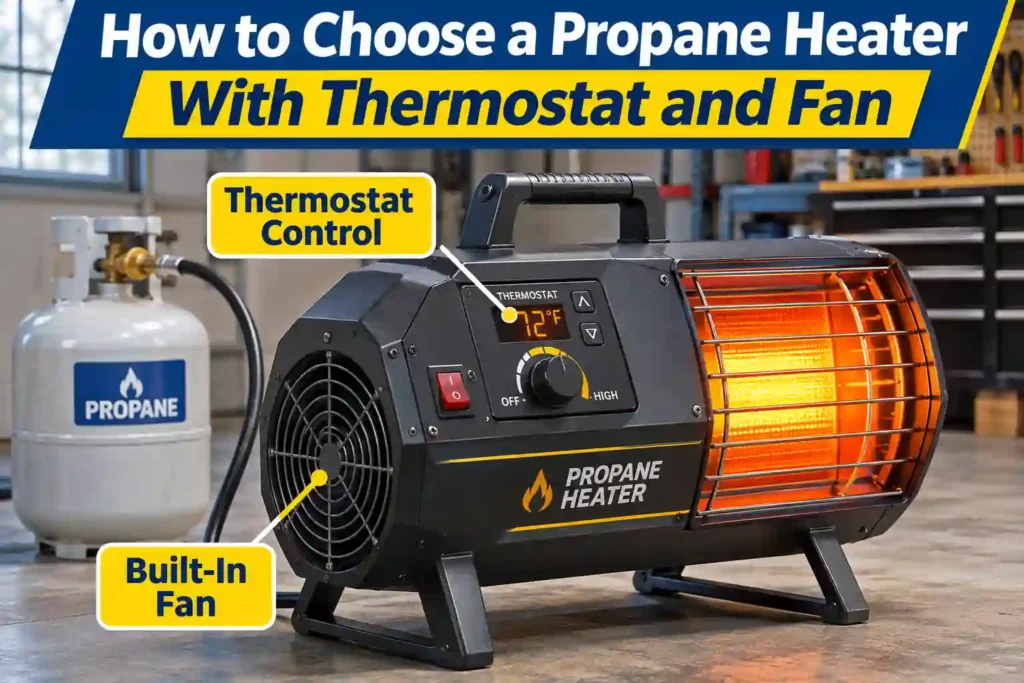


A propane heater with a thermostat and fan can provide a more comfortable and consistent heating experience than a basic manually controlled propane heater.
The thermostat helps regulate room temperature, while the fan circulates warm air throughout the space. Together, these features can reduce uneven heating, improve comfort, and help manage propane consumption.
However, not all propane heaters equipped with thermostats and fans are designed for the same applications. Some are suitable for residential living spaces, while others are intended exclusively for garages, workshops, construction sites, or outdoor environments.


Choosing the wrong heater could result in insufficient heating, excessive fuel consumption, unnecessary electricity expenses, or unsafe indoor operating conditions.
When shopping for a propane heater, I recommend considering more than its maximum BTU rating. You should also evaluate thermostat accuracy, fan performance, ventilation requirements, electrical power consumption, propane supply compatibility, and safety features.
In this guide, I’ll explain how to choose a propane heater with a thermostat and fan that meets your heating requirements, budget, and intended application.
Quick Answer
The best propane heater with a thermostat and fan is one that provides sufficient heating capacity for your space, maintains your desired temperature, distributes warm air effectively, and is specifically approved for your intended installation.


| Feature | What to Look For |
|---|---|
| Heating capacity | Appropriate BTU rating for your space. |
| Thermostat | Automatic temperature control. |
| Fan | Integrated blower or approved optional blower. |
| Fuel type | Propane-compatible equipment. |
| Electrical requirements | Compatible voltage and power source. |
| Ventilation | Suitable for the intended indoor or outdoor location. |
| Regulator | Manufacturer-specified pressure and capacity. |
| Safety features | Flame-failure protection and other applicable safeguards. |
| Noise level | Suitable for the intended environment. |
| Maintenance | Accessible service and replacement parts. |
| Certification | Appropriate safety listing for the intended application. |
For residential heating, I would prioritize a properly sized direct-vent propane heater with thermostatic control and an approved blower.
For garages and workshops, a vented propane unit heater may be a better option. Forced-air construction heaters are useful for approved work environments but should not be treated as substitutes for residential heating equipment.
What Is a Propane Heater With a Thermostat and Fan?
A propane heater with a thermostat and fan combines three important heating functions: heat generation, temperature regulation, and air circulation.
Unlike a basic radiant propane heater, which primarily warms nearby objects and people, a fan-assisted convection heater can distribute heated air across a larger area.
| Component | Function | Benefit |
|---|---|---|
| Propane burner | Generates heat. | Provides the main heating source. |
| Thermostat | Monitors temperature. | Helps maintain comfortable conditions. |
| Blower fan | Circulates heated air. | Improves heat distribution. |
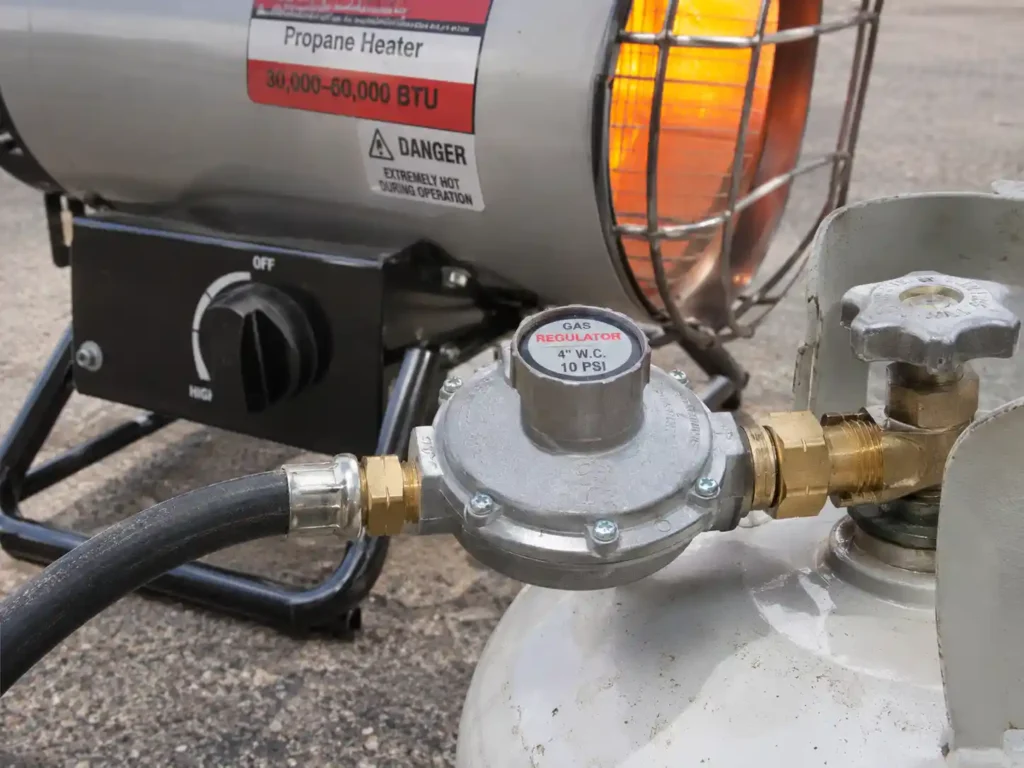
| Gas regulator | Controls incoming propane pressure. | Maintains appropriate fuel delivery. |
| Gas-control valve | Controls burner operation. | Supports temperature regulation. |
| Heat exchanger, where equipped | Transfers combustion heat. | Separates combustion gases from circulated room air. |
| Safety sensors | Monitor abnormal conditions. | Help prevent unsafe operation. |
The thermostat and fan perform different functions. A thermostat controls when heat is required, while the fan helps distribute the available heat.



How Does a Thermostat-Controlled Propane Heater Work?
A thermostatically controlled propane heater responds to changes in the surrounding temperature.
When the temperature falls below the selected setting, the thermostat signals the heater to produce heat. Depending on the model, the burner may cycle on and off or automatically vary its heating output.
Thermostatic Heating Cycle
Temperature falls below the selected setting.
The burner produces heat.
Room temperature gradually increases.
Burner reduces output or shuts off.
The cycle repeats when additional heating is needed. Fan startup, shutdown, and burner modulation vary by model.
Some propane heaters use mechanical thermostats that do not require household electricity. Others use digital thermostats, electronic ignition, and electrically powered controls.


A thermostat can help prevent unnecessary continuous burner operation, but actual propane savings depend on the building’s heat loss and your temperature settings.
What Does the Fan Do on a Propane Heater?
The fan moves air across heated surfaces or through the heater’s designed airflow path, helping distribute heat throughout the surrounding space.
Without a blower, warm air naturally rises and cooler air settles closer to the floor. This can create uneven temperatures, particularly in rooms with high ceilings.
A fan-assisted heater can improve air circulation and reduce localized hot and cold areas.
Without a Fan
Warmer Ceiling Area
↑ ↑ ↑
Natural Heat Movement
Cooler Floor Area
- Relies on natural convection.
- May produce uneven temperatures.
- No circulation fan electricity expense.
- Generally quieter operation.
With a Fan
Warm Air Circulation
↗ → ↘
Fan-Assisted Airflow
Improved Heat Distribution
- Moves heated air throughout the space.
- Can reduce localized cold areas.
- Usually requires electricity.
- Produces some operating noise.
These diagrams illustrate general heating concepts. Actual heat distribution depends on room layout, heater placement, and blower capacity.
A blower does not increase the heater’s maximum rated propane input. Its primary benefit is improving the distribution of heat that the burner already produces.
1. Choose the Right Type of Propane Heater
Before comparing thermostats and fans, determine which heating appliance is appropriate for your intended location.
Direct-Vent Propane Heater
Uses an approved venting system to obtain outdoor combustion air and discharge combustion gases outside.
A direct-vent heater is a strong option for permanent residential heating, particularly when equipped with electronic thermostatic controls and an integrated blower.
Vent-Free Blue-Flame Heater
Heats surrounding air and may include thermostatic control and an optional blower.
Indoor use is subject to manufacturer requirements, room-size limitations, ventilation requirements, and local restrictions.
Infrared Propane Heater
Primarily provides radiant warmth to nearby surfaces and people. Certain models include thermostatic controls and optional fans.
Vented Propane Garage Heater
Commonly includes an integrated fan, heat exchanger, and external thermostat connection.
Suitable for approved garage or workshop installations when professionally sized and installed.
Forced-Air Propane Construction Heater
Provides rapid, high-output heating for approved work environments.
Direct-fired construction heaters are not substitutes for residential indoor heaters.
Propane Heater Type Comparison
| Heater Type | Typical BTU Input | Thermostat | Fan |
|---|---|---|---|
| Direct-vent wall heater | 8,000–40,000 | Common | Model-dependent |
| Vent-free blue-flame heater | 10,000–30,000 | Common | Integrated or optional |
| Infrared wall heater | 10,000–30,000 | Available | Model-dependent |
| Portable radiant heater | 4,000–18,000 | Model-dependent | Selected models |
| Garage unit heater | 30,000–125,000 | Common | Integrated |
| Forced-air construction heater | 35,000–200,000+ | Selected models | Integrated |
| Patio heater | 10,000–50,000 | Less common | Generally unavailable |
These ranges are illustrative. Actual equipment specifications vary by manufacturer and model.
For regular heating inside an occupied home, I prefer properly vented equipment because combustion products are discharged outdoors.
2. Determine How Many BTUs You Need
BTU stands for British Thermal Unit. Propane heater input ratings indicate the amount of fuel energy the appliance consumes per hour.
Selecting an appropriately sized heater is important because undersized equipment may operate continuously without achieving the desired temperature. Oversized equipment may cycle frequently and create uncomfortable temperature fluctuations.
The required heating capacity depends on several factors:
- Total floor area.
- Ceiling height.
- Wall and ceiling insulation.
- Outdoor temperature.
- Air leakage.
- Number and quality of windows.
- Desired indoor temperature.
- Heater efficiency.
Preliminary Propane Heater Sizing Chart
The following table uses an illustrative heating requirement of 30–50 BTU/hr per square foot of floor area for preliminary budgeting.
| Floor Area | Estimated Useful Heating Requirement |
|---|---|
| 100 sq. ft. | 3,000–5,000 BTU/hr |
| 200 sq. ft. | 6,000–10,000 BTU/hr |
| 300 sq. ft. | 9,000–15,000 BTU/hr |
| 400 sq. ft. | 12,000–20,000 BTU/hr |
| 500 sq. ft. | 15,000–25,000 BTU/hr |
| 750 sq. ft. | 22,500–37,500 BTU/hr |
| 1,000 sq. ft. | 30,000–50,000 BTU/hr |
| 1,500 sq. ft. | 45,000–75,000 BTU/hr |
| 2,000 sq. ft. | 60,000–100,000 BTU/hr |
This is a rough screening method, not a professional heat-loss calculation. Actual requirements can fall outside these ranges, particularly in very cold climates or poorly insulated buildings.
Propane Heater BTU Sizing Calculator
Estimate Your Heating Requirements
Estimated Useful Heat Required
20,000
BTU/hr output
Estimated Fuel Input Required
25,000
BTU/hr input
For preliminary estimates only. This calculator does not determine installation suitability, combustion-air requirements, or safe heater sizing. Obtain a professional heat-loss assessment for permanent installations.
I recommend comparing both BTU input and useful heat output when evaluating heaters with different efficiency ratings.
3. Choose the Right Thermostat
Not every propane heater thermostat provides the same level of temperature control.
Mechanical vs. Digital Thermostats
| Feature | Mechanical Thermostat | Digital Thermostat |
|---|---|---|
| Temperature adjustment | Rotary dial | Digital buttons or display |
| Temperature display | Often unavailable | Usually available |
| Electricity requirement | Model-dependent | Usually required |
| Programming | Generally unavailable | Available on selected models |
| Temperature precision | Model-dependent | Often more precise |
| Ease of operation | Simple | More configurable |
| Power outage performance | May continue operating | Depends on power source |
| Purchase cost | Generally lower | Generally higher |
Mechanical thermostats are practical for users who prefer straightforward temperature adjustment.
Digital thermostats are useful when you want a numerical temperature display, programmable schedules, or more precise control.
Some heaters also support compatible external wall-mounted thermostats. This can be beneficial in large rooms where the temperature immediately surrounding the heater differs from the temperature elsewhere.
Always verify that the thermostat controls the burner rather than merely switching the fan on and off.
4. Evaluate the Fan and Blower Performance
A propane heater’s fan is particularly important when heating a large room, garage, or workshop.
Although manufacturers often emphasize BTU ratings, the blower’s airflow capacity also affects heating comfort.
Airflow is commonly measured in cubic feet per minute (CFM).
What Does CFM Mean on a Propane Heater?
CFM describes the volume of air moved by the fan in one minute.
A higher CFM rating generally indicates greater airflow, although actual performance depends on the heater’s construction, airflow restrictions, and fan design.
| Illustrative Fan Airflow | General Application |
|---|---|
| 50–100 CFM | Small supplemental heating applications. |
| 100–200 CFM | Small rooms and localized air circulation. |
| 200–400 CFM | Medium-sized spaces. |
| 400–600 CFM | Larger rooms and workshops. |
| 600–1,000 CFM | Selected garage and unit heaters. |
| 1,000+ CFM | Larger commercial heating applications. |
These airflow ranges provide general context rather than equipment sizing recommendations.
Fan Speed Settings
Some propane heaters feature a single-speed blower, while others offer multiple fan speeds or automatic operation.
| Fan Setting | Function |
|---|---|
| OFF | Disables an optional circulation blower. |
| ON or Manual | Operates the blower continuously while enabled. |
| AUTO | Operates according to temperature or heating demand. |
| LOW | Provides reduced airflow. |
| HIGH | Provides increased airflow. |
| Variable speed | Automatically adjusts airflow on compatible models. |
Certain Mr. Heater vent-free heater models feature manual, automatic, and off blower settings.
For residential applications, I prefer an automatic blower because it can operate in coordination with heating demand.
Never disable a fan that is required for safe combustion, heat exchanger cooling, or normal heater operation.
An optional circulation blower is different from a fan that is essential to the heater’s combustion or safety system.
5. Choose Between an Integrated Fan and an Optional Blower
When shopping for a propane heater online, carefully read the product description.
Some heaters are advertised as blower-compatible, but the actual blower may be sold separately.
| Feature | Integrated Fan | Optional Blower |
|---|---|---|
| Included with heater | Yes | Not necessarily |
| Additional purchase | Usually unnecessary | Often required |
| Installation | Factory-installed | May require assembly |
| Replacement | Model-specific | Model-specific |
| Heating operation without fan | Depends on heater design | Often possible if approved |
| Initial purchase cost | Generally higher | Lower before adding accessory |
| Convenience | Ready for approved operation | Requires compatibility verification |
An optional blower can be useful if you want a heater that provides natural convection during a power outage and assisted air circulation when electricity is available.
However, this capability must be confirmed in the manufacturer’s documentation.
If purchasing a separate blower kit, verify its part number, mounting configuration, voltage, electrical connection, and heater compatibility.
6. Consider Electricity Requirements
Although propane provides the main heating energy, many fan-assisted heaters require electricity.
This is particularly important if you are purchasing a propane heater for emergency heating, an off-grid cabin, or an area experiencing frequent power outages.
| Component | Electricity Required? |
|---|---|
| Mechanical gas-control valve | Not necessarily. |
| Mechanical thermostat | Not necessarily. |
| Standing pilot | Usually no household electricity. |
| Piezo igniter | No household electricity. |
| Battery-powered igniter | Battery required. |
| Electronic thermostat | Depends on design. |
| Optional circulation blower | Usually yes. |
| Forced-air construction heater fan | Usually yes. |
| Vented garage unit heater | Generally yes. |
| Electronic direct-vent wall furnace | Generally yes. |
Many conventional vent-free wall heaters can operate without household electricity if their blower is optional and their gas controls are designed for independent operation.
In contrast, many electronically controlled direct-vent heaters and garage unit heaters require electricity for normal operation.
Do not assume a propane heater will continue working during an electrical outage simply because it burns propane.
How Much Electricity Does a Propane Heater Fan Consume?
A blower’s electrical consumption depends on the motor design, airflow capacity, and operating time.
The following table illustrates electricity expenses at an assumed rate of $0.16 per kWh and eight hours of daily fan operation.
| Fan Power | Daily Consumption | Monthly Electricity Cost |
|---|---|---|
| 25 watts | 0.20 kWh | $0.96 |
| 50 watts | 0.40 kWh | $1.92 |
| 75 watts | 0.60 kWh | $2.88 |
| 100 watts | 0.80 kWh | $3.84 |
| 150 watts | 1.20 kWh | $5.76 |
| 200 watts | 1.60 kWh | $7.68 |
| 300 watts | 2.40 kWh | $11.52 |
| 500 watts | 4.00 kWh | $19.20 |
These are illustrative 30-day electricity expenses, excluding propane consumption and other electrical components.
Monthly Cost = Watts ÷ 1,000 × Daily Hours × 30 × Electricity Rate
For a 75-watt blower running eight hours per day:
75 ÷ 1,000 × 8 × 30 × $0.16
$2.88 per Month
For many smaller residential heaters, the fan’s electricity expense may be relatively modest compared with the cost of propane.
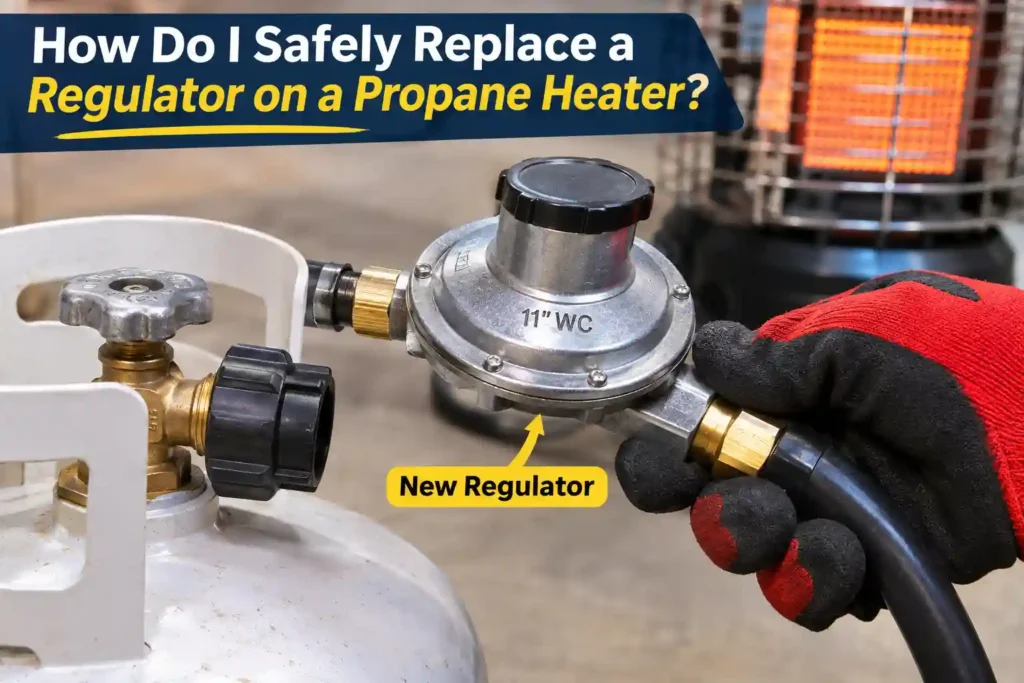
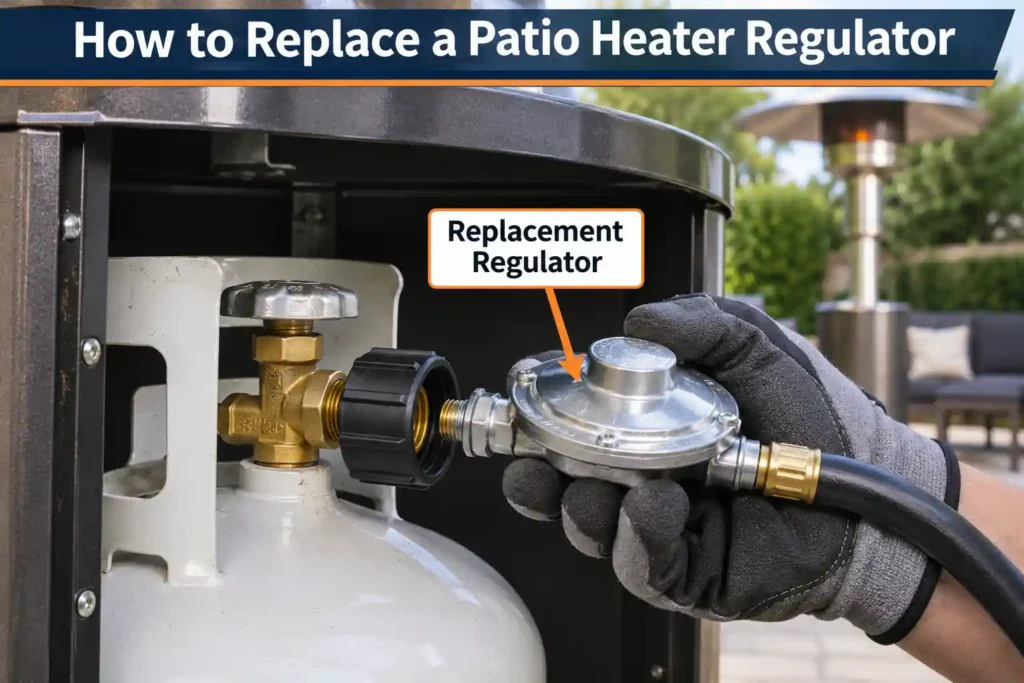
7. Check the Propane Heater’s Regulator Requirements
The regulator is responsible for supplying propane at the pressure required by the heating appliance.
Many conventional residential propane heaters require low-pressure gas supplied at approximately 11 inches of water column, equivalent to approximately 0.4 PSI.
However, construction heaters and specialized equipment may require different pressures.
| Heater Input Rating | Minimum Fuel Delivery Demand |
|---|---|
| 10,000 BTU/hr | 10,000 BTU/hr |
| 18,000 BTU/hr | 18,000 BTU/hr |
| 20,000 BTU/hr | 20,000 BTU/hr |
| 30,000 BTU/hr | 30,000 BTU/hr |
| 40,000 BTU/hr | 40,000 BTU/hr |
| 50,000 BTU/hr | 50,000 BTU/hr |
| 80,000 BTU/hr | 80,000 BTU/hr |
| 100,000 BTU/hr | 100,000 BTU/hr |
The regulator must accommodate the heater’s maximum rated fuel input under actual operating conditions.
The thermostat and fan do not eliminate the need for proper propane pressure regulation.
For additional information, read my guide on what BTU capacity means on a propane regulator.
You should also understand the difference between inlet pressure and outlet pressure on a propane regulator before purchasing replacement equipment.
8. Determine the Appropriate Propane Tank Size
A propane heater with a thermostat may cycle on and off throughout the day. Consequently, actual fuel consumption depends on how long the burner operates rather than simply how long the heater remains switched on.
Larger heaters generally require greater fuel availability and adequate cylinder vaporization capacity.
Propane Heater Runtime Comparison
| Heater Input | 20 lb Propane | 40 lb Propane | 100 lb Propane |
|---|---|---|---|
| 10,000 BTU/hr | 43.0 hrs | 86.0 hrs | 215.0 hrs |
| 18,000 BTU/hr | 23.9 hrs | 47.8 hrs | 119.5 hrs |
| 20,000 BTU/hr | 21.5 hrs | 43.0 hrs | 107.5 hrs |
| 30,000 BTU/hr | 14.3 hrs | 28.7 hrs | 71.7 hrs |
| 40,000 BTU/hr | 10.8 hrs | 21.5 hrs | 53.8 hrs |
| 50,000 BTU/hr | 8.6 hrs | 17.2 hrs | 43.0 hrs |
| 80,000 BTU/hr | 5.4 hrs | 10.8 hrs | 26.9 hrs |
| 100,000 BTU/hr | 4.3 hrs | 8.6 hrs | 21.5 hrs |
Theoretical maximum-input burner runtime assuming approximately 91,500 BTU per gallon and sufficient propane vaporization.
These calculations do not establish cylinder compatibility. High-output heaters may require considerably larger fuel supplies, especially during cold weather.
If the propane cylinder cannot vaporize fuel quickly enough, the heater may experience reduced output even when sufficient liquid propane remains.
9. Compare Propane Heater Safety Features
Safety should be one of your highest priorities when purchasing heating equipment.
A thermostat and fan provide convenience, but neither replaces essential combustion and gas-control safeguards.
| Safety Feature | Purpose |
|---|---|
| Flame-failure protection | Interrupts fuel delivery if the flame is lost. |
| Oxygen depletion sensor | Responds to oxygen depletion on compatible heaters. |
| Overheat protection | Shuts down equipment under certain overheating conditions. |
| Tip-over switch | Interrupts operation if compatible portable equipment overturns. |
| Airflow proving switch | Verifies required airflow on certain heaters. |
| High-temperature limit switch | Helps prevent excessive equipment temperatures. |
| Vent safety system | Monitors specified venting conditions. |
| Safety certification | Establishes testing against applicable product requirements. |
An oxygen depletion sensor is not a carbon monoxide alarm. These devices serve different purposes.
Use only heating appliances designed for the intended indoor environment, maintain required ventilation, and arrange professional installation and servicing where required.
10. Consider Fan Noise and Heating Comfort
Fan noise can be particularly important when purchasing a propane heater for a living room, office, cabin, or other quiet environment.
Some forced-air construction heaters generate substantial noise because they use high-velocity fans.
Residential wall heaters generally prioritize quieter operation, although actual noise levels vary.
| Illustrative Sound Level | General Perception |
|---|---|
| 30 dB | Quiet room. |
| 40 dB | Quiet indoor environment. |
| 50 dB | Moderate background noise. |
| 60 dB | Normal conversation. |
| 70 dB | Relatively noticeable equipment noise. |
| 80 dB | Loud equipment operation. |
These are general sound-level references rather than measured propane heater noise ratings.
When comparing products, look for published sound ratings, variable-speed blower controls, vibration-resistant motor mounts, and automatic fan settings.
A quieter heater may be worth the additional investment if you intend to use it regularly in an occupied living area.
Propane Heater Brands and Models With Thermostats and Fans
The following manufacturers and product lines are useful starting points when researching propane heaters.
Rinnai EX38DTP
A direct-vent propane wall furnace with electronic thermostatic control and forced-convection heating.
Worth considering for professionally installed residential zone heating where controlled indoor temperatures and warm-air circulation are important.
Mr. Heater 30,000 BTU Blue Flame
Selected models provide thermostat-controlled heating and electric blower capability.
Confirm whether the blower is included and whether vent-free equipment is permitted at your location.
Heatstar Vent-Free Propane Heaters
Selected 20,000–30,000 BTU models are available with thermostatic controls and blower systems.
Check the exact model’s fuel type, installation requirements, and accessory compatibility before purchasing.
Mr. Heater Big Maxx
A fan-assisted unit heater product line for garages and workshops with compatible thermostat controls.
Verify propane configuration, venting requirements, and professional fuel conversion requirements where applicable.
Mr. Heater MH170FAVT
A thermostatically controlled forced-air propane construction heater intended for approved work environments, not ordinary residential living spaces.
Its high-output design makes it relevant to certain construction and industrial heating applications.
Propane Heater Brand and Model Comparison
| Brand or Model | Heater Type | Application to Research |
|---|---|---|
| Rinnai EX38DTP | Direct-vent wall furnace | Residential zone heating |
| Mr. Heater 30,000 BTU Blue Flame | Vent-free convection heater | Approved supplemental heating |
| Heatstar vent-free models | Wall-mounted propane heater | Approved indoor locations |
| Mr. Heater Big Maxx | Vented unit heater | Garages and workshops |
| Mr. Heater MH170FAVT | Forced-air construction heater | Approved construction environments |
These are equipment examples rather than a universal ranking. Always confirm the exact model’s specifications, fuel type, blower inclusion, and installation requirements.
How Much Does a Propane Heater With Thermostat and Fan Cost?
Prices depend on heating capacity, ventilation design, thermostat features, manufacturer, and installation complexity.
| Heater or Accessory Type | Estimated Purchase Price |
|---|---|
| Portable thermostatic heater | $80–$200 |
| Optional blower fan kit | $40–$120 |
| Vent-free blue-flame wall heater | $150–$350 |
| Infrared wall heater with thermostat | $150–$400 |
| Forced-air construction heater | $150–$500 |
| Vented garage unit heater | $450–$1,200 |
| Direct-vent propane wall furnace | $700–$2,500 |
Propane Heater Purchase Cost Comparison
Portable Thermostatic Heater: $80–$200
Optional Blower Kit: $40–$120
Blue-Flame Wall Heater: $150–$350
Infrared Wall Heater: $150–$400
Construction Heater: $150–$500
Vented Garage Heater: $450–$1,200
Direct-Vent Wall Furnace: $700–$2,500
Bars represent the upper end of each estimated equipment price range.
These are illustrative US equipment budgets rather than verified current retail prices. Installation, shipping, and taxes are excluded.
Permanent installations may also involve gas piping, regulators, venting components, electrical connections, mounting hardware, and professional labor.
For related expenses, read my guide on the cost of replacing a propane regulator.
Worked Example: Operating a 30,000 BTU Propane Heater With Thermostat and Fan
Suppose you purchase a 30,000 BTU propane heater equipped with a 75-watt blower.
You operate the heater for eight hours per day, and the thermostat allows the burner to operate for approximately 50% of that period.
Assume the blower also operates for four hours per day.
Example Operating Conditions
| Specification | Example Value |
|---|---|
| Heater maximum fuel input | 30,000 BTU/hr |
| Daily heating period | 8 hours |
| Assumed burner duty cycle | 50% |
| Actual daily burner runtime | 4 hours |
| Propane price | $3.50/gallon |
| Blower power | 75 watts |
| Electricity price | $0.16/kWh |
Propane Consumption Calculation
Gallons per Hour = BTU Input ÷ 91,500
30,000 ÷ 91,500 = 0.328 gallons per hour
Daily propane consumption:
0.328 × 4 hours = approximately 1.31 gallons
Daily Propane Consumption
1.31 gal
Daily Propane Cost
$4.59
Monthly Propane Cost
$137.70
Monthly Blower Electricity
$1.44
Combined Estimated Monthly Operating Cost
$139.14
Propane: approximately 99% of monthly operating expenses.
Blower electricity: approximately 1% of monthly operating expenses.
Illustrative 30-day calculation. Actual thermostat cycling, fan operation, and heating expenses vary. Totals are calculated using unrounded fuel consumption.
This example demonstrates why insulation, thermostat settings, and burner runtime are particularly important when managing heating expenses.
Propane Heater With Thermostat and Fan Operating Cost Calculator
Use this calculator to estimate the combined propane and electricity cost of operating your heater.
Propane and Electricity Cost Estimator
Daily Propane Consumption
1.31 gal
Daily Burner Runtime
4.0 hrs
Monthly Propane Expense
$137.70
Monthly Fan Electricity
$1.44
Monthly Electricity Consumption
9.00 kWh
Combined Daily Cost
$4.64
Estimated Total Monthly Operating Cost
$139.14
Assumes full rated fuel input whenever the burner operates and a 30-day month. Excludes pilot consumption, other electrical components, and installation expenses. Burner duty cycle is an estimate, not a guaranteed thermostat performance rating.
Does a Thermostat Really Save Propane?
A thermostat can reduce unnecessary fuel consumption by limiting burner operation when additional heating is not required.
However, the actual savings depend on the temperature setting, outdoor conditions, insulation, heater sizing, and how a manually controlled heater would otherwise be operated.
Monthly Fuel Cost at Different Burner Duty Cycles
Based on a 30,000 BTU heater, eight-hour daily heating period, and propane priced at $3.50 per gallon.
25% Burner Duty Cycle: $68.85
40% Burner Duty Cycle: $110.16
50% Burner Duty Cycle: $137.70
75% Burner Duty Cycle: $206.56
100% Burner Duty Cycle: $275.41
These are modeled fuel costs, not guaranteed thermostat savings. Duty cycle represents the percentage of the heating period during which the burner operates at maximum rated input.
A fan may improve comfort by distributing warm air more effectively, potentially allowing you to maintain a lower thermostat setting.
Nevertheless, a blower alone does not guarantee reduced propane consumption.
Which Propane Heater Should You Choose for Your Application?
| Intended Application | Heater Type to Consider |
|---|---|
| Living room | Direct-vent thermostatic wall heater with blower. |
| Small cabin | Approved direct-vent heater with suitable power requirements. |
| Basement | Professionally installed vented heating equipment. |
| Garage | Vented propane unit heater with thermostat. |
| Workshop | Appropriately sized fan-assisted vented heater. |
| Barn | Equipment specifically approved for agricultural conditions. |
| Construction site | Approved forced-air construction heater. |
| Off-grid property | Approved mechanically controlled heater with optional blower. |
| Outdoor patio | Outdoor-rated radiant propane heater. |
| Emergency heating | Indoor-approved heater with verified outage capability. |
Always verify the appliance’s intended location and applicable installation requirements.
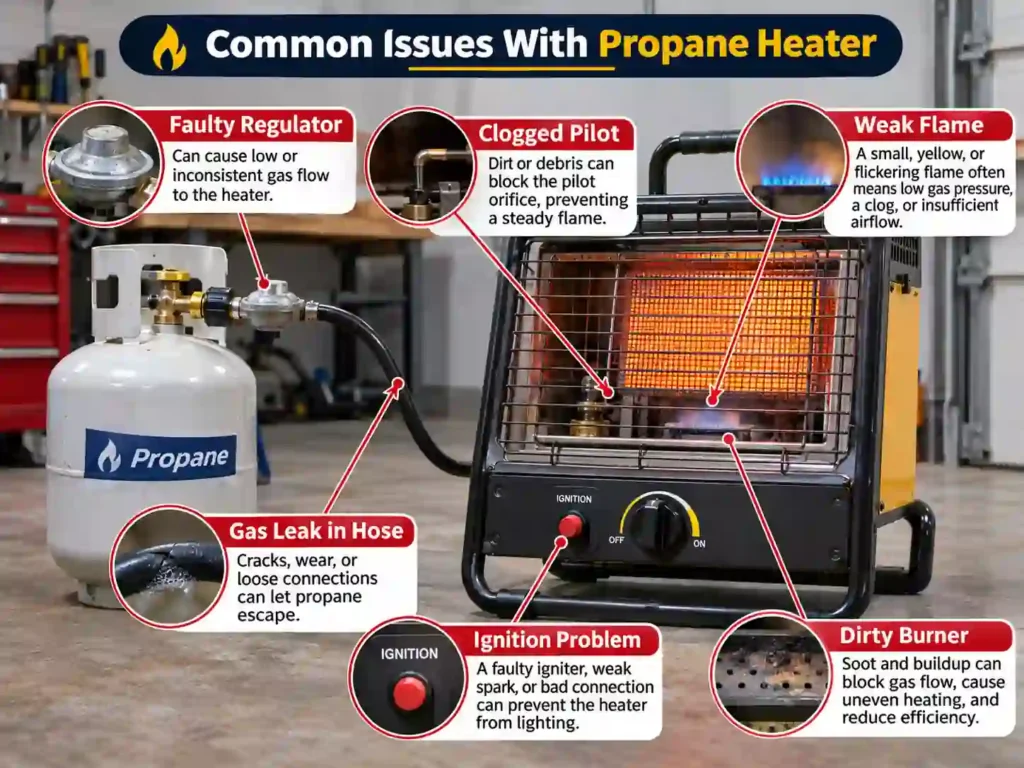
Common Problems With Propane Heaters With Thermostats and Fans
| Problem | Possible Cause |
|---|---|
| Fan does not turn on | Power supply, fan switch, or blower motor. |
| Fan runs continuously | Manual setting or control problem. |
| Heater shuts off too soon | Thermostat location, safety system, or fuel supply. |
| Heater does not reach desired temperature | Insufficient capacity or excessive building heat loss. |
| Weak burner flame | Gas supply or regulator issue. |
| Uneven room temperature | Poor air circulation. |
| Thermostat does not respond | Thermostat or control-system malfunction. |
| Excessive fan noise | Motor wear, vibration, or damaged blower. |
| Heater loses output during winter | Inadequate propane vaporization. |
| Heater repeatedly shuts down | Fuel delivery, overheating, or safety-control issue. |
These symptoms may have several possible causes. Professional diagnosis is recommended before replacing internal gas-control or safety components.
For fuel supply problems, read my guide on how to know if a propane heater regulator is failing.
Other related issues include low propane regulator pressure and propane regulator freezing.
Which Propane Heater With Thermostat and Fan Should You Buy? Decision Guide
Step 1: Identify the Heating Location
Determine whether you need a heater for a residential living space, garage, workshop, cabin, or approved construction environment.
The intended location determines which heater designs are appropriate.
Step 2: Estimate Your Heating Requirements
Consider floor area, ceiling height, insulation, outdoor temperatures, and building heat loss.
Arrange a professional heat-loss assessment for permanent heating installations.
Step 3: Choose Your Thermostat and Blower Configuration
Decide whether a mechanical thermostat, digital temperature control, integrated fan, or approved optional blower best suits your needs.
Step 4: Consider Power Outages
If you need emergency heating, verify whether the heater can operate safely without household electricity.
Do not assume the burner will continue operating when its required fan or electrical controls lose power.
Step 5: Compare Total Ownership Costs
Include the heater purchase price, professional installation, propane consumption, electricity expenses, and future maintenance requirements.
Step 6: Confirm Installation Compatibility
Verify propane supply capacity, regulator pressure, electrical requirements, ventilation, required clearances, and manufacturer approval before purchasing.
Propane Heater With Thermostat and Fan Buying Checklist
Before placing your order, verify the following equipment requirements.
Propane Heater Purchasing Checklist
0 of 15 requirements checked
Completing this checklist does not replace professional equipment sizing or installation approval.
Safety Tips When Operating a Propane Heater
Important Propane Heating Safety Precautions
- Never operate outdoor-only propane heaters indoors.
- Install appropriate carbon monoxide alarms.
- Maintain manufacturer-required clearances and ventilation.
- Never obstruct air intakes, blower outlets, or exhaust vents.
- Never bypass thermostats or safety switches.
- Do not increase regulator pressure to obtain additional heat.
- Keep combustible materials away from the heater.
- Never operate damaged equipment.
- Follow manufacturer instructions regarding unattended operation.
- Keep outdoor propane supply cylinders in approved locations.
- Arrange professional installation and maintenance where required.
If you smell propane: Leave the affected area immediately, avoid operating electrical switches or creating sparks, and contact your propane supplier or emergency services from a safe location.
Do not return to the affected area or resume heater operation until it has been declared safe.
If a carbon monoxide alarm sounds: Move everyone to fresh air immediately and contact emergency services.
For additional guidance, see my article on whether you can install a propane regulator yourself or need a professional.
Frequently Asked Questions
Are Propane Heaters With Thermostats Better?
They are generally more convenient for maintaining consistent temperatures. A thermostat can also reduce unnecessary heating when the desired temperature has been reached.
Is a Propane Heater With a Fan More Efficient?
A fan can improve heat distribution, but it does not automatically increase combustion efficiency or reduce fuel consumption.
Actual energy savings depend on the heating environment, thermostat settings, and operating conditions.
Do Propane Heaters With Fans Require Electricity?
Most electrically powered blowers require electricity. Some heaters can operate without their optional blower, while others require electricity for safe operation.
Can I Use a Propane Heater With a Thermostat in My Garage?
Yes, provided it is specifically approved for the garage environment and installed according to applicable safety requirements.
A vented propane unit heater is often worth considering for permanent garage heating.
Is a 30,000 BTU Propane Heater Enough for 1,000 Square Feet?
Possibly, depending on insulation, climate, ceiling height, air leakage, and useful heat output.
Floor area alone cannot determine the correct heating capacity.
Can I Add a Fan to My Existing Propane Heater?
Only if the manufacturer offers or approves a compatible blower kit. Do not modify the heater’s airflow system using an unapproved fan.
Can I Add an External Thermostat to a Propane Heater?
Certain heaters support external thermostats, while others do not. Check the manufacturer’s approved thermostat type and electrical requirements.
Can a Propane Heater With a Fan Work During a Power Outage?
Some models with mechanical gas controls and optional blowers can operate without electricity.
Other heaters require electrical power for ignition, combustion airflow, and safety functions. Always verify the exact model’s capabilities.
Should I Buy a Vented or Vent-Free Propane Heater?
For regular residential heating, I prefer properly installed vented equipment because combustion products are discharged outdoors.
Vent-free heaters have additional indoor air-quality considerations and may be subject to local restrictions.
Can I Leave a Thermostatically Controlled Propane Heater Running Overnight?
Do not assume a thermostat makes overnight or unattended operation safe.
Only operate equipment in a manner expressly permitted by its manufacturer and applicable installation requirements.
My Final Thoughts
Choosing the right propane heater with a thermostat and fan requires careful consideration of heating capacity, temperature controls, airflow performance, fuel supply, electrical requirements, and installation safety.
For residential living spaces, I recommend considering a properly sized direct-vent propane heater with automatic thermostatic control and an approved blower.
For garages and workshops, a professionally installed vented propane unit heater may provide better air circulation and heating coverage.
If emergency heating is your priority, determine whether the heater can safely operate without household electricity before purchasing it.
Most importantly, do not select a heater simply because it has the highest BTU rating or the lowest purchase price.
A properly sized propane heater with suitable safety features, reliable temperature controls, and effective air circulation can provide comfortable heating while helping you manage long-term operating expenses.

Mike is an experienced propane technician with over 15 years of professional experience in the field. He has dedicated his career to helping customers with their propane needs, from installation to maintenance and repair. Together with Jeremy, he co-founded this website to provide useful information and guidance to customers seeking reliable propane services.