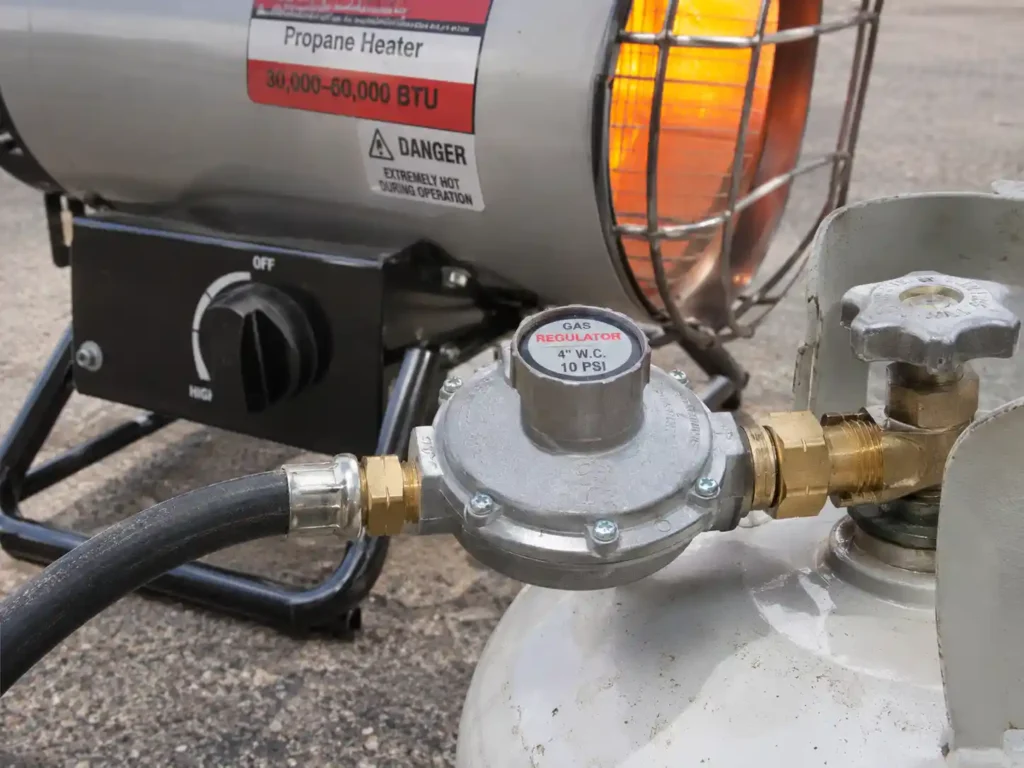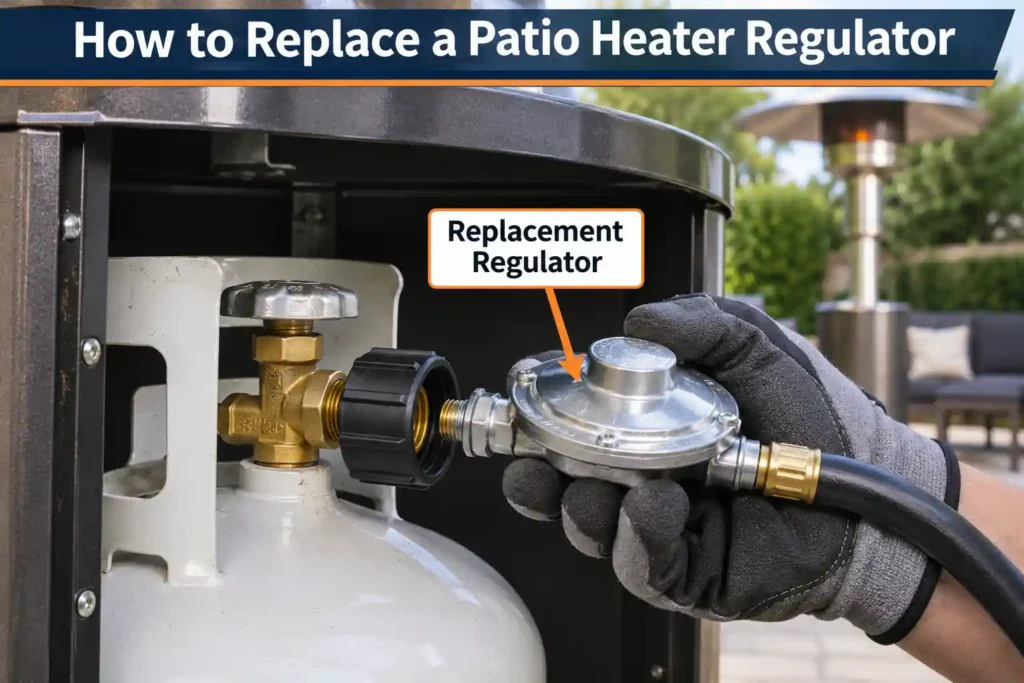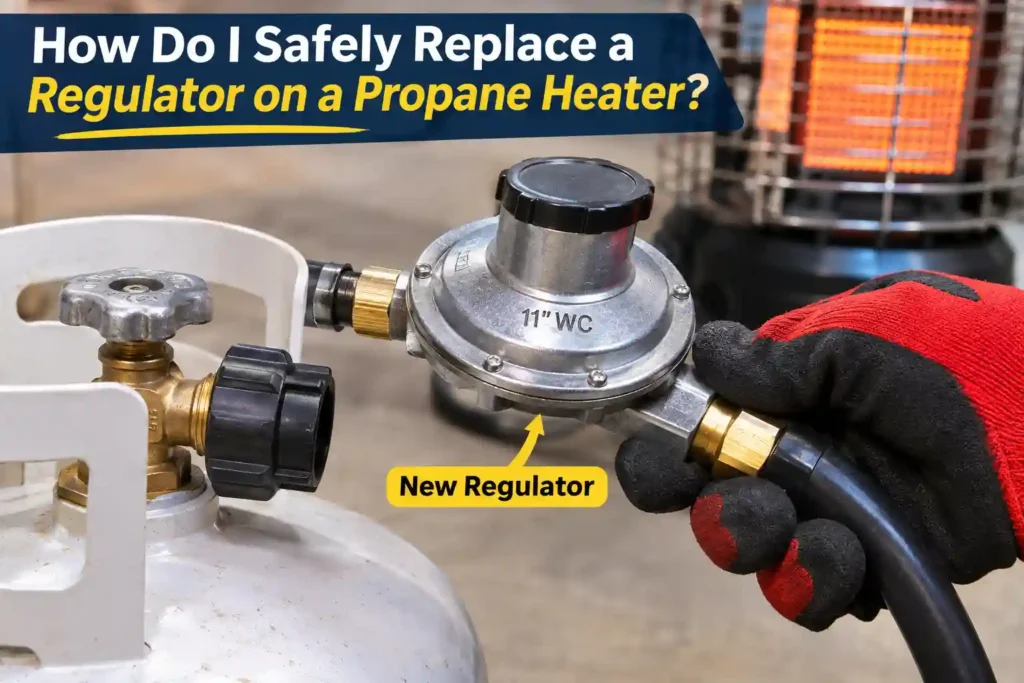


Replacing a regulator on a propane heater may seem like a straightforward maintenance task, but it involves working with a highly flammable fuel and a critical pressure-control device.
The regulator ensures that propane reaches your heater at the correct pressure. Installing an incompatible regulator, damaging a connection, or failing to check for leaks can result in poor heating performance, equipment damage, fire, or dangerous carbon monoxide production.
Whether you own a portable propane heater, garage heater, patio heater, or residential heating system, understanding the replacement process can help you make informed decisions and avoid expensive mistakes.


In this guide, I’ll explain how to prepare for regulator replacement, choose the correct replacement part, understand the installation process, and determine when you need professional assistance.
Quick Answer
To safely replace a regulator on a propane heater:
- Identify the heater’s exact make and model.
- Check whether the manufacturer permits owner replacement.
- Obtain a manufacturer-approved regulator with the correct pressure, BTU capacity, and connections.
- Shut down the heater and isolate the propane supply according to the operating manual.
- Have the defective regulator removed and the approved replacement installed according to manufacturer instructions.
- Ensure that all affected connections are properly leak-tested.
- Verify that the heater operates at its specified gas pressure.
- Arrange professional inspection if you notice abnormal flames, unusual noises, or inconsistent heat.
Never modify a propane regulator, bypass its safety features, or use an open flame to check for gas leaks.
Fixed residential heating systems and internally mounted regulators should be serviced by a qualified gas technician.


When Should You Replace a Propane Heater Regulator?
Before purchasing a replacement, it is important to determine whether your existing regulator is actually defective.
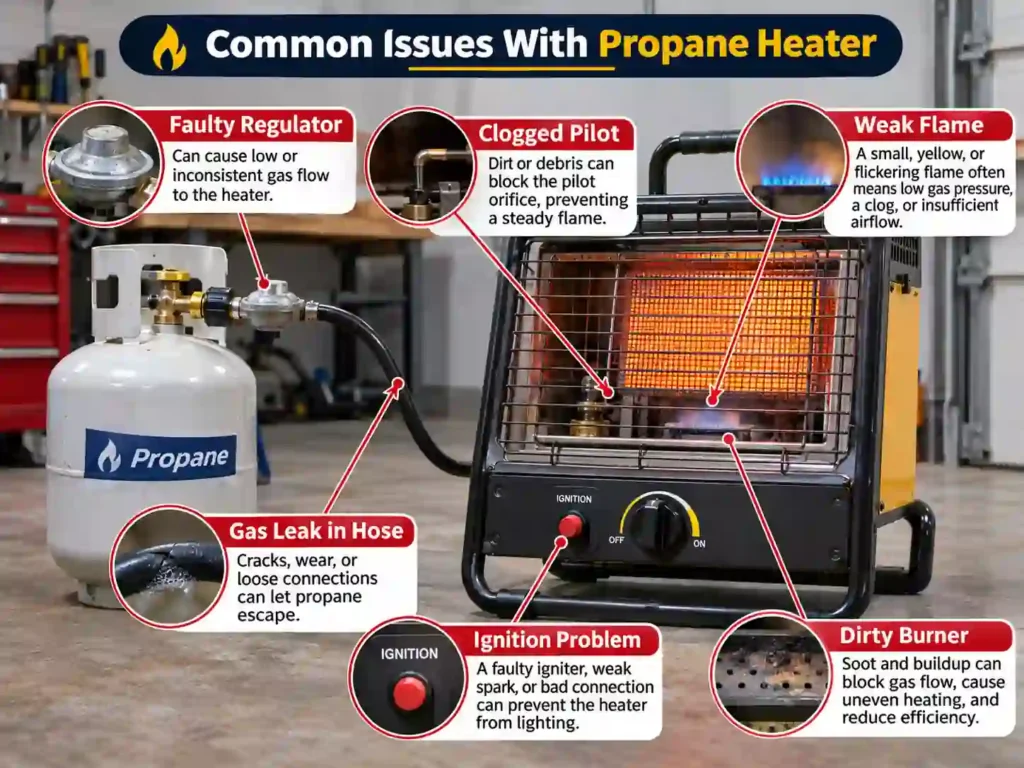
Propane regulators can develop problems due to aging, contamination, corrosion, moisture exposure, and internal mechanical wear. However, similar symptoms may originate from other parts of the heating system.
| Warning Sign | Possible Regulator Problem | Recommended Action |
|---|---|---|
| Weak burner flames | Insufficient outlet pressure | Professional diagnosis |
| Excessively large flames | Overpressure | Stop using the heater |
| Frequent shutdowns | Unstable fuel delivery | Inspect the fuel system |
| Cracked regulator housing | Physical damage | Arrange replacement |
| Persistent gas odor | Possible gas leakage | Evacuate and seek assistance |
| Excessive icing | Moisture or fuel supply problems | Investigate the cause |
| Persistent whistling | Flow restriction or vibration | Arrange inspection |
| Yellow flames with soot | Improper combustion | Stop using the heater |
| Severe corrosion | Environmental deterioration | Professional evaluation |
| Exceeded recommended service life | Aging internal components | Schedule replacement |
I recommend reading my guide on how to know if a propane heater regulator is failing before deciding whether replacement is necessary.
If professional testing confirms that the regulator cannot maintain the correct operating pressure, replacing it is generally preferable to attempting an internal repair.
Can You Replace a Propane Heater Regulator Yourself?
Whether you can replace a regulator yourself depends on the heater design, manufacturer instructions, installation type, and applicable local requirements.



Some portable propane heaters feature detachable regulator and hose assemblies that are intended to be connected or replaced by the owner. Other heaters have integrated regulators that require specialized tools, pressure testing, and professional servicing.
Propane system installation, modification, and servicing should be carried out by qualified professionals whenever required by the equipment manufacturer or applicable safety regulations.
| Type of Propane Heater | Regulator Configuration | Recommended Replacement Method |
|---|---|---|
| Portable camping heater | Integrated or detachable | Manufacturer-approved servicing |
| Outdoor patio heater | External hose and regulator assembly | Owner replacement if expressly permitted |
| Propane garage heater | External or integrated regulator | Qualified technician recommended |
| Torpedo construction heater | Specialized regulator assembly | Manufacturer-approved servicing |
| Residential wall heater | Integrated or external regulator | Qualified technician |
| Propane furnace | Fixed gas supply system | Qualified technician |
| Commercial space heater | Specialized pressure-control system | Qualified technician |
| Tank-top propane heater | Model-specific regulator | Follow manufacturer instructions |
My recommendation is to avoid treating all propane heaters the same way. A regulator replacement procedure suitable for an outdoor patio heater may be completely inappropriate for a residential wall heater.
For more information, read my guide on whether you can install a propane regulator yourself or need a professional.


Tools and Materials Needed for Regulator Replacement
The necessary tools depend on the heater’s regulator design and connection type.
Before beginning any manufacturer-authorized replacement, gather the appropriate equipment.
| Tool or Material | Purpose |
|---|---|
| Manufacturer-approved regulator | Replaces the defective pressure-control device. |
| Approved replacement gas hose | Replaces damaged or deteriorated hoses when required. |
| Heater owner’s manual | Provides model-specific installation instructions. |
| Appropriate wrench | Used only where specified by the manufacturer. |
| Approved leak-detection solution | Helps identify leaking gas connections. |
| Protective gloves | Protect hands from sharp surfaces. |
| Safety glasses | Provide basic eye protection. |
| Replacement seals or gaskets | Used where specified by the manufacturer. |
| Manometer | Used by qualified technicians to measure gas pressure. |
| Approved gas thread sealant | Used only on compatible connections where required. |
You may not need all these materials for every heater.
Some replacement regulators come as complete hose assemblies with factory-installed fittings. These assemblies can reduce the need to disturb individual gas connections.
Do not purchase adapters, sealants, or additional fittings unless they are approved for your particular installation.
How to Choose the Correct Replacement Regulator
Choosing the correct replacement is arguably the most important part of the entire process.
A regulator that physically connects to your propane heater is not necessarily compatible with it.
1. Identify Your Heater’s Model Number
Locate the manufacturer’s identification label on your heater.
This label typically provides the model number, serial number, fuel type, maximum BTU input, and operating pressure requirements.
Use this information to locate the original manufacturer’s replacement parts list.
If the label is damaged or unreadable, contact the manufacturer before purchasing a regulator.
2. Check the Required Outlet Pressure
Different propane heaters operate at different gas pressures.
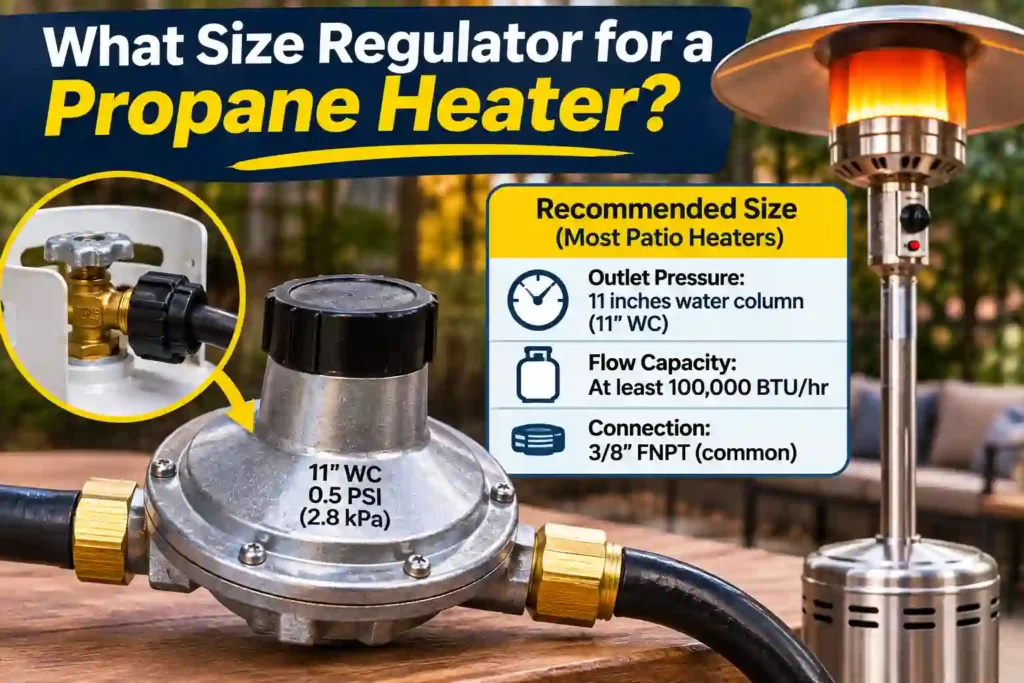
Many conventional low-pressure heating appliances use approximately 11 inches of water column. Certain industrial and construction heaters operate at much higher pressures.
| Pressure Rating | Approximate Equivalent |
|---|---|
| 10 inches WC | 0.36 PSI |
| 11 inches WC | 0.40 PSI |
| 14 inches WC | 0.51 PSI |
| 1 PSI | 27.7 inches WC |
| 5 PSI | 138.4 inches WC |
| 10 PSI | 276.8 inches WC |
| 20 PSI | 553.6 inches WC |
These values are pressure conversions, not universal regulator recommendations.
Installing a regulator with excessive outlet pressure may cause dangerous overfiring. A regulator with insufficient pressure may prevent the heater from operating correctly.
3. Check the Regulator’s BTU Capacity
Your replacement regulator must have sufficient capacity to supply the heater’s maximum fuel demand while maintaining the required outlet pressure.
For example, a regulator intended for a small camping appliance may not provide enough propane for a large garage heater.
| Heater Input Rating | Approximate Propane Consumption |
|---|---|
| 9,000 BTU/hr | 0.098 gallons/hr |
| 18,000 BTU/hr | 0.197 gallons/hr |
| 30,000 BTU/hr | 0.328 gallons/hr |
| 40,000 BTU/hr | 0.437 gallons/hr |
| 60,000 BTU/hr | 0.656 gallons/hr |
| 80,000 BTU/hr | 0.874 gallons/hr |
| 100,000 BTU/hr | 1.093 gallons/hr |
| 150,000 BTU/hr | 1.639 gallons/hr |
These theoretical consumption figures are based on approximately 91,500 BTU per gallon of propane.
I recommend reading my explanation of what BTU capacity means on a propane regulator before selecting a replacement.
4. Verify Inlet and Outlet Connections
Propane regulators are available with several types of connections, including threaded, flare, cylinder-valve, and proprietary manufacturer fittings.
These connections use different sealing methods and are not automatically interchangeable.
Using an incorrect fitting may damage threads or create a connection that appears secure but leaks under pressure.
For further information, see my guide on matching regulator inlet and outlet thread sizes.
5. Choose an Approved Replacement Assembly
Whenever possible, purchase the original equipment manufacturer’s recommended replacement regulator or hose assembly.
Check that the replacement is designed for propane vapor service, approved for the heater’s application, and suitable for its operating environment.
Avoid choosing replacement regulators based solely on price, appearance, or online descriptions claiming universal compatibility.
Step-by-Step Guide to Safely Replacing a Propane Heater Regulator
The following steps explain the general replacement process. They do not replace the installation instructions for your specific heater.
Only perform an owner replacement when the manufacturer expressly permits it and applicable safety requirements allow it. Internal regulators, fixed gas piping, and pressure adjustments require qualified professional servicing.
Turn Off the Propane Heater
Before any replacement work begins, the heater must be completely shut down.
Allow the equipment to cool naturally before handling the regulator or nearby components.
Working around a hot burner, heating element, or ignition system creates unnecessary risks.
If you smell propane before beginning, do not proceed with the replacement. Leave the affected area and contact the appropriate emergency or propane service personnel.
Isolate the Propane Supply
The propane supply must be isolated using the manufacturer’s approved shutdown procedure.
Closing a cylinder valve does not necessarily mean that every part of the fuel system is immediately free of pressure.
Residual propane may remain inside hoses and other components.
Do not loosen gas fittings to release trapped pressure or deliberately vent propane into an enclosed area.
A qualified technician should handle depressurization whenever it is required.
Prepare a Safe Working Area
For portable equipment that permits owner replacement, follow the manufacturer’s requirements concerning location and ventilation.
Keep the work area away from flames, smoking materials, electrical ignition sources, and combustible materials.
Outdoor patio heaters should remain outdoors during servicing and testing unless the manufacturer specifies an appropriate alternative.
Never carry out gas connection work in a confined space where escaped propane could accumulate.
Propane vapor is heavier than air and may collect near floor level, drains, and low-lying areas.
Inspect the Existing Regulator Assembly
Before removal, examine the accessible regulator housing and gas hose.
Look for visible signs of damage, including:
- Cracked or corroded regulator housing.
- Bent or damaged fittings.
- Deteriorated gas hoses.
- Damaged threads.
- Missing or damaged seals.
- Evidence of moisture intrusion.
- Obstructed regulator vents.
- Signs of previous unauthorized modifications.
If you discover extensive damage, the regulator may not be the only component requiring replacement.
A damaged hose or connection can continue causing problems even after a new regulator is installed.
Remove the Old Regulator Using the Approved Procedure
The removal method varies considerably among heater designs.
Some portable heaters use a detachable hose and regulator assembly, while others require access to internal gas-control components.
Follow the exact removal procedure provided by the manufacturer.
Do not force connections that resist removal. Different fittings may use different thread directions, sealing surfaces, and installation requirements.
If removing the regulator requires dismantling the heater’s gas valve, burner assembly, or fixed gas piping, arrange professional servicing instead.
Compare the Old and New Regulators
Before installing the replacement, verify that its specifications match the heater’s requirements.
Replacement Regulator Compatibility Checklist
Completing this checklist does not independently confirm that the installation is safe.
If any specification differs from the original manufacturer’s requirements, do not install the replacement until compatibility has been confirmed.
Install the Manufacturer-Approved Replacement
The replacement regulator must be installed according to the heater manufacturer’s specific instructions.
Correct installation involves more than connecting two fittings together.
The regulator must be positioned appropriately, the hose must follow an approved route, and all connections must use their intended sealing methods.
Incorrect mounting may expose the regulator vent to water or debris.
An improperly routed hose may contact hot surfaces, become pinched, or create a tripping hazard.
Never modify the regulator to make it fit an incompatible heater.
Some patio heater manufacturers explicitly require the original approved type of regulator and hose assembly.
Check All Affected Connections for Gas Leaks
Leak testing is an essential part of regulator replacement.
For manufacturer-authorized portable heater installations, the owner’s manual may provide an approved bubble-solution leak-check procedure.
An approved leak-detection solution can reveal escaping gas through the formation of growing bubbles at a connection.
However, a bubble check is not a substitute for comprehensive professional leak and pressure testing where required.
| Leak-Check Observation | Meaning or Action |
|---|---|
| Growing bubbles | Possible gas leakage; do not operate. |
| Persistent propane odor | Treat as a suspected gas leak. |
| Continuous hissing | Possible escaping propane. |
| No visible bubbles | No leak detected at the checked location; not proof of overall safety. |
| Abnormal pressure reading | Further professional investigation required. |
Never use matches, lighters, candles, or other flames to check for propane leakage.
If a leak is suspected, leave the affected area and seek assistance rather than repeatedly attempting to repair or test the connection.
Verify the Regulator’s Operating Pressure
A newly installed regulator does not automatically guarantee correct fuel delivery.
For systems requiring professional commissioning, a technician should verify that the regulator maintains the heater’s specified operating pressure.
This may involve checking incoming gas pressure, regulated outlet pressure, performance under fuel demand, and pressure behavior when the burner shuts down.
| Professional Test | Purpose |
|---|---|
| Inlet pressure test | Confirms adequate incoming gas pressure. |
| Outlet pressure test | Verifies correct regulated pressure. |
| Flow pressure test | Evaluates pressure under operating demand. |
| Lock-up pressure test | Checks pressure control when demand stops. |
| System leak test | Identifies potential gas leakage. |
| Combustion assessment | Evaluates burner operation. |
Do not attempt to correct abnormal pressure readings by adjusting the regulator’s internal spring.
For additional information, read my guide on how to check propane regulator pressure.
Return the Heater to Service
Once the replacement has been correctly installed and the required safety checks have been completed, the heater can be returned to service according to the manufacturer’s startup procedure.
Normal operation should be consistent with the manufacturer’s descriptions of flame appearance, heat output, ignition, and operating sounds.
Stop using the heater if you notice abnormal combustion, overheating, repeated shutdowns, persistent gas odors, or other unusual behavior.
Common Mistakes When Replacing a Propane Heater Regulator
Incorrect regulator replacement can create problems that are more serious than the original equipment failure.
| Common Mistake | Potential Consequence | Prevention |
|---|---|---|
| Buying an incompatible regulator | Incorrect gas pressure | Verify manufacturer specifications |
| Selecting insufficient BTU capacity | Poor heat output | Match maximum fuel demand |
| Using excessive outlet pressure | Overfiring and overheating | Use approved pressure rating |
| Applying sealant to unsuitable fittings | Leakage or connection damage | Follow fitting instructions |
| Overtightening connections | Damaged threads or seals | Follow manufacturer requirements |
| Reusing damaged hoses | Gas leakage | Replace defective components |
| Blocking regulator vents | Pressure-control problems | Maintain approved vent orientation |
| Skipping leak testing | Undetected gas leakage | Complete required safety checks |
| Installing unapproved adapters | Connection incompatibility | Use approved components |
| Adjusting factory pressure settings | Unsafe combustion | Leave adjustments to professionals |
One mistake I particularly recommend avoiding is purchasing a regulator simply because it resembles the original.
Two regulators can have nearly identical external appearances while providing significantly different outlet pressures.
Worked Example: Choosing a Regulator for a 40,000 BTU Heater
Suppose you own a propane patio heater rated at 40,000 BTU per hour.
Using the approximate energy content of propane, you can calculate its theoretical maximum fuel consumption.
Gallons per Hour = BTU Input ÷ 91,500
40,000 ÷ 91,500 = 0.437 gallons per hour
Heater Input Rating
40,000
BTU per hour
Fuel Consumption
0.437
Gallons per hour
Estimated Runtime
10.8 hrs
With 20 lb of propane
Hourly Fuel Cost
$1.53
At $3.50 per gallon
Illustrative estimates at maximum rated input, assuming 4.7 gallons of available propane and adequate vaporization capacity.
The replacement regulator must be capable of supplying the required fuel demand while maintaining the specified outlet pressure.
However, the BTU rating alone is not enough to establish compatibility.
You must also consider inlet pressure, outlet pressure, connections, regulator design, and manufacturer approval.
Propane Heater Fuel Consumption and Runtime Chart
The following chart illustrates the theoretical fuel consumption of different propane heater sizes.
| Heater Input | Gallons per Hour | Estimated Runtime With 20 lb | Hourly Cost at $3.50/Gallon |
|---|---|---|---|
| 9,000 BTU | 0.098 | 47.8 hours | $0.34 |
| 18,000 BTU | 0.197 | 23.9 hours | $0.69 |
| 20,000 BTU | 0.219 | 21.5 hours | $0.77 |
| 30,000 BTU | 0.328 | 14.3 hours | $1.15 |
| 40,000 BTU | 0.437 | 10.8 hours | $1.53 |
| 60,000 BTU | 0.656 | 7.2 hours | $2.30 |
| 80,000 BTU | 0.874 | 5.4 hours | $3.06 |
| 100,000 BTU | 1.093 | 4.3 hours | $3.83 |
| 150,000 BTU | 1.639 | 2.9 hours | $5.74 |
| 200,000 BTU | 2.186 | 2.2 hours | $7.65 |
These calculations estimate fuel consumption only. The propane price is hypothetical. The table does not establish regulator or propane cylinder compatibility. High-output heaters may require substantially larger propane tanks to maintain adequate vaporization.
How Much Does It Cost to Replace a Propane Heater Regulator?
The replacement cost depends on the regulator design, heater model, labor requirements, and availability of manufacturer-approved components.
| Regulator or Service Type | Estimated Cost |
|---|---|
| Basic low-pressure regulator | $15–$35 |
| Patio heater regulator assembly | $20–$60 |
| Portable heater regulator and hose | $25–$75 |
| High-pressure heater regulator | $30–$100 |
| Two-stage regulator | $40–$120 |
| Professional diagnostic service | $75–$200 |
| Professional replacement including labor | $100–$350 |
These are illustrative US budgeting estimates rather than verified current retail quotes. Actual expenses depend on local labor rates, equipment specifications, and additional repairs.
A portable patio heater with a detachable regulator assembly may be relatively inexpensive to service.
Replacing an integrated regulator on a residential or commercial heating appliance may require additional labor, specialized testing, and replacement components.
For a more detailed cost breakdown, see my guide on the cost of replacing a propane regulator.
What If the Heater Still Does Not Work After Regulator Replacement?
Replacing the regulator may not solve the problem if another component is responsible.
| Problem After Replacement | Possible Cause |
|---|---|
| Heater will not ignite | Ignition system or pilot assembly problem. |
| Weak flames | Insufficient fuel supply or restricted hose. |
| Heater repeatedly shuts off | Thermocouple or safety sensor problem. |
| Regulator freezes | Moisture or insufficient tank vaporization. |
| Excessively large flames | Incorrect regulator pressure. |
| Gas odor | Leaking connection or damaged component. |
| Persistent whistling | Flow restriction or component vibration. |
| Low heating output | Incorrect regulator capacity or burner problem. |
| Yellow flames and soot | Abnormal combustion. |
If the new regulator does not restore normal performance, discontinue operation and arrange further professional diagnosis.
Do not assume that installing a second replacement regulator will resolve the issue.
What to Do If You Suspect a Gas Leak
- Leave the affected area immediately.
- Do not attempt to ignite the heater.
- Do not operate electrical switches or equipment that could generate sparks.
- Keep away from smoking materials and open flames.
- Contact your propane supplier or emergency services from a safe location.
- Do not return until the area has been declared safe.
- Do not resume operation until the equipment has been professionally evaluated.
Safety Checklist After Replacing a Propane Heater Regulator
Before returning your heater to regular operation, make sure all applicable manufacturer requirements and professional safety checks have been completed.
Post-Replacement Inspection Checklist
This checklist is an educational reference, not a professional safety certification.
When Should You Hire a Professional?
I recommend hiring a qualified propane technician whenever the replacement involves internal gas-control components, fixed piping, pressure adjustments, or specialized testing.
Professional assistance is particularly important when you encounter persistent gas leakage, abnormal pressure readings, damaged fittings, severe corrosion, or uncertainty about replacement compatibility.
| Situation | Recommended Decision |
|---|---|
| Manufacturer-approved detachable regulator assembly | Owner replacement only if expressly permitted. |
| Integrated heater regulator | Hire a qualified technician. |
| Fixed residential gas piping | Hire a qualified technician. |
| Unknown regulator specifications | Contact the manufacturer or technician. |
| Suspected active propane leak | Evacuate and contact emergency assistance. |
| Pressure adjustment required | Hire a qualified technician. |
| Heater continues malfunctioning after replacement | Arrange professional diagnosis. |
The additional cost of professional servicing is generally small compared with the potential consequences of an incorrectly installed gas regulator.
How to Extend the Life of Your New Regulator
After installing an approved replacement regulator, proper maintenance can help prevent premature deterioration.
Protect the regulator from unnecessary moisture exposure, avoid damaging the housing, and keep the hose away from hot surfaces.
Follow the manufacturer’s approved storage and operating instructions.
- Protect the regulator from unnecessary weather exposure.
- Inspect accessible hoses for cracks and deterioration.
- Keep the regulator vent free from external obstructions.
- Avoid dropping or striking the regulator housing.
- Use only manufacturer-approved propane connections.
- Follow the heater’s operating pressure requirements.
- Arrange professional inspections when operating problems occur.
- Record the regulator’s installation date.
- Follow manufacturer-recommended replacement intervals.
Never paint over, plug, or obstruct the regulator vent. Inspect accessible components periodically and follow the recommended replacement interval.
You can learn more about service life in my guide on how long propane regulators last.
Frequently Asked Questions
Can I Replace a Propane Heater Regulator Without Replacing the Hose?
It depends on the heater design. Some manufacturers provide separate replacement regulators, while others require replacement of the complete regulator and hose assembly.
Can I Use a Grill Regulator on a Propane Heater?
Only if the heater manufacturer approves that particular regulator and all pressure, capacity, connection, and safety requirements are satisfied.
Do I Need Teflon Tape When Replacing a Regulator?
Not necessarily. Different fittings use different sealing methods. Some threaded connections require an approved gas-rated sealant, while flare fittings and other connections may not. Follow the manufacturer’s instructions.
How Long Does It Take to Replace a Propane Heater Regulator?
A straightforward detachable regulator replacement may require relatively little time. More complicated installations can take longer because of equipment access, leak testing, pressure verification, and professional commissioning.
Can I Install a Higher-Pressure Regulator to Get More Heat?
No. Increasing the gas pressure above the heater’s specified requirements can result in unsafe combustion, overheating, and equipment damage.
Why Is My New Propane Regulator Making Noise?
Possible causes include diaphragm vibration, restricted fuel flow, incorrect pressure, or installation problems. Persistent hissing should be treated as a potential gas leak.
Should I Replace a Regulator That Has Been Submerged in Water?
Do not return flooded propane equipment to service without professional evaluation. Water and contaminants may compromise internal components.
Can I Repair the Old Regulator Instead of Buying a New One?
Many consumer propane heater regulators are sealed assemblies intended for replacement rather than internal repair. Only qualified professionals should service repairable regulator designs according to manufacturer requirements.
My Final Thoughts
Replacing a propane heater regulator safely requires careful attention to equipment compatibility, pressure requirements, gas connections, and post-installation testing.
The most important decision is selecting a manufacturer-approved regulator that satisfies your heater’s exact specifications.
Although some portable heaters permit owner replacement of detachable regulator assemblies, fixed residential and commercial heating systems generally require qualified professional servicing.
My recommendation is to never compromise safety to save money on replacement parts or labor.
A correctly selected and installed regulator helps your heater operate reliably while reducing the risk of gas leakage, improper combustion, and equipment damage.

Mike is an experienced propane technician with over 15 years of professional experience in the field. He has dedicated his career to helping customers with their propane needs, from installation to maintenance and repair. Together with Jeremy, he co-founded this website to provide useful information and guidance to customers seeking reliable propane services.