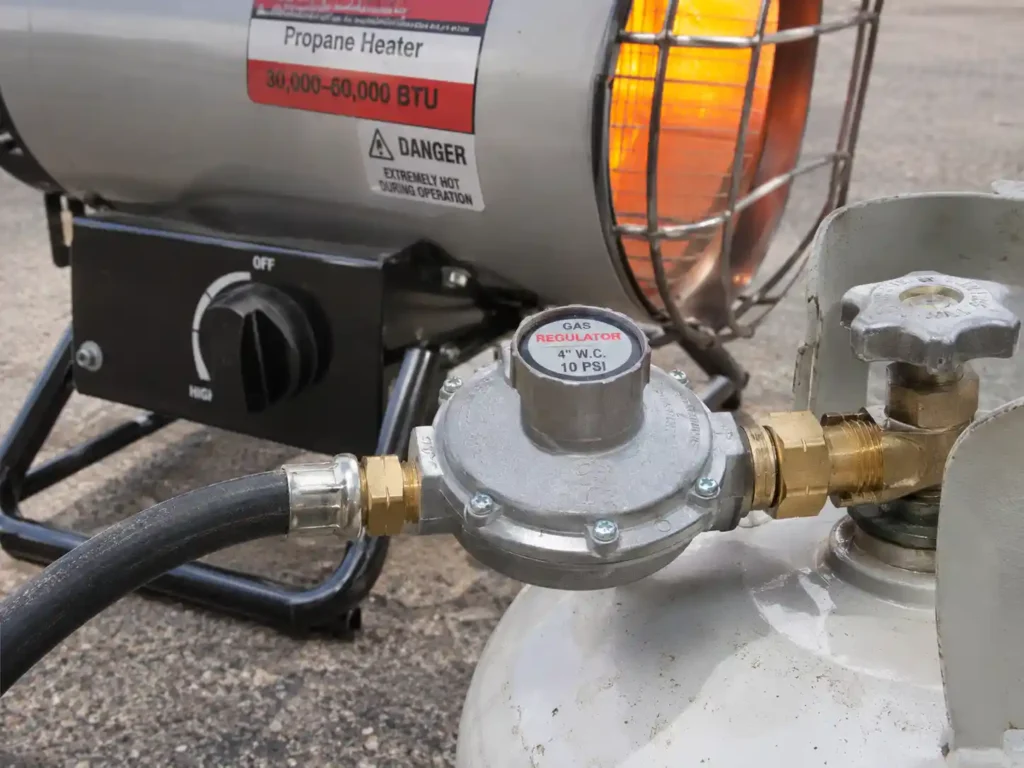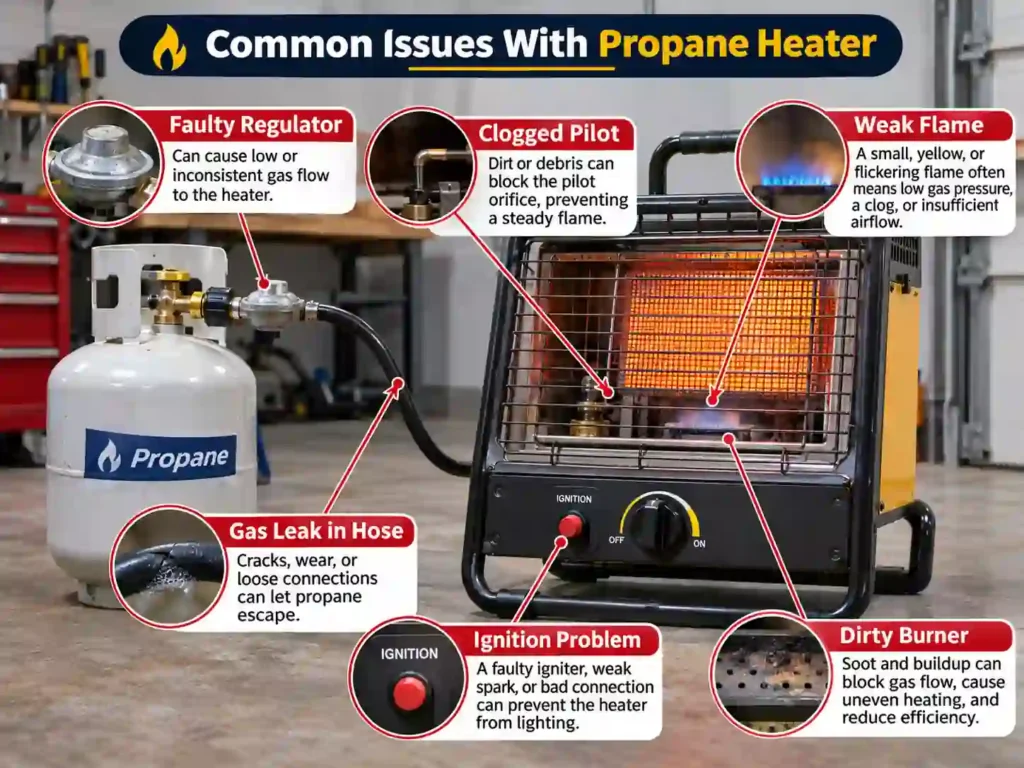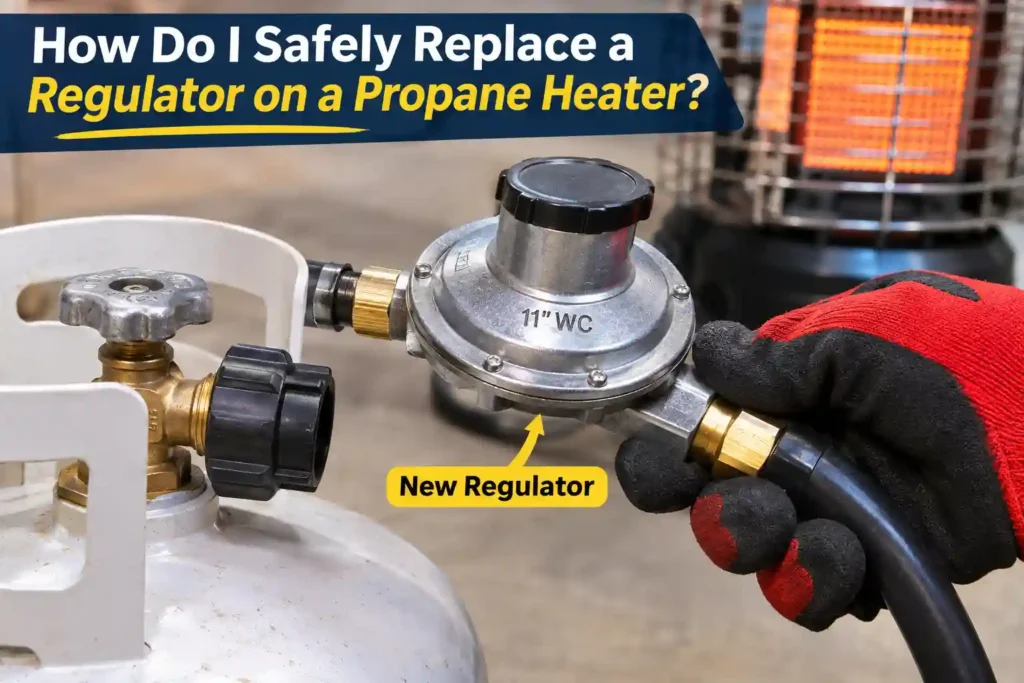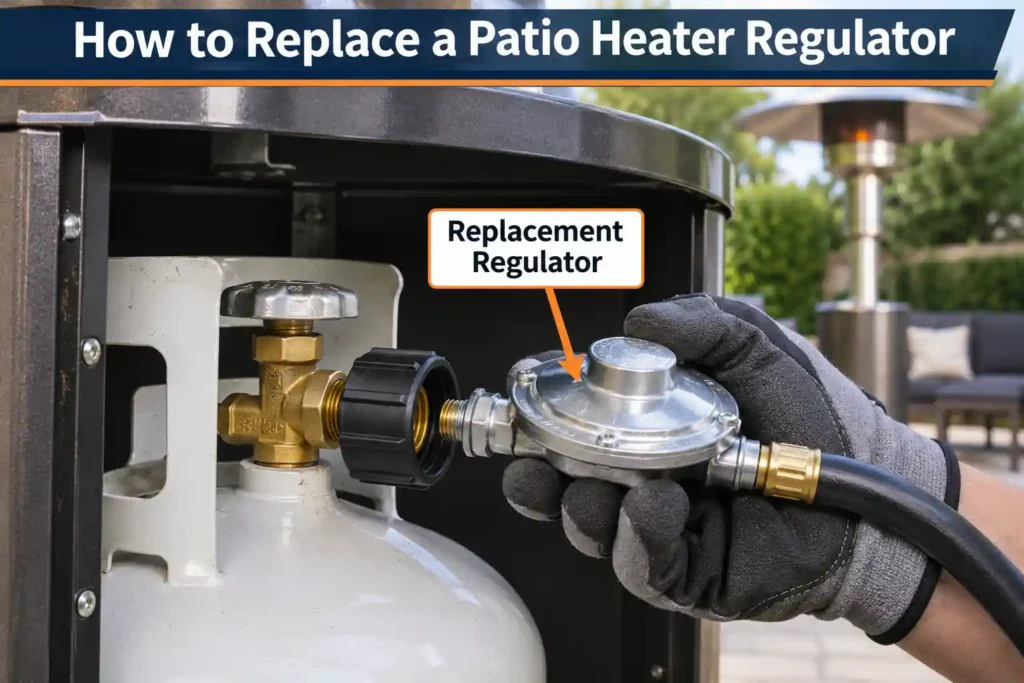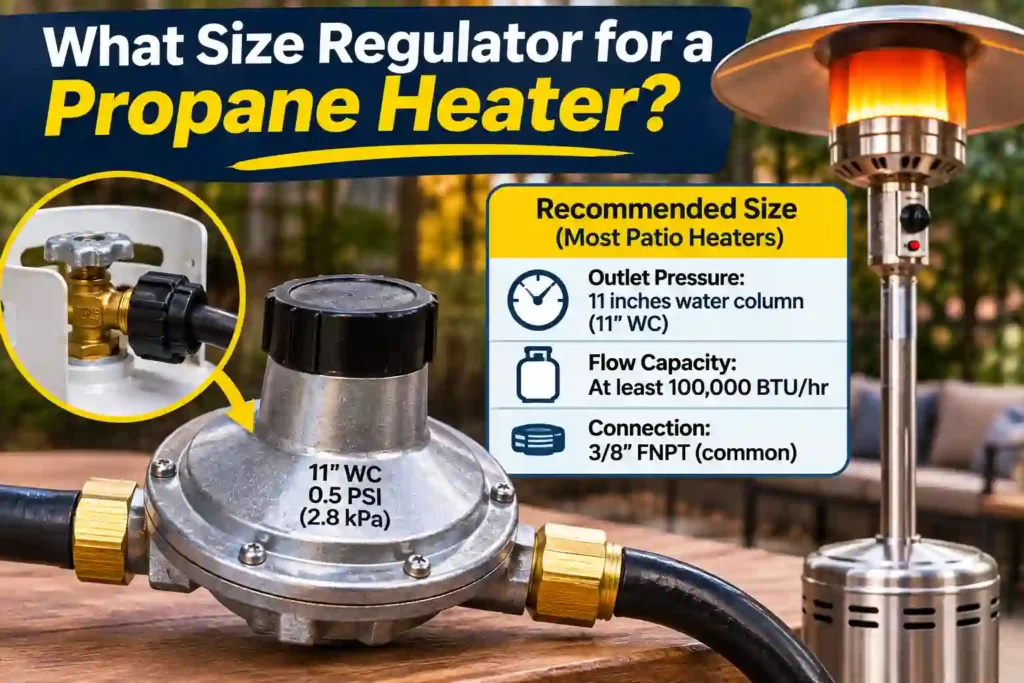


Choosing the right regulator size for a propane heater is essential for maintaining consistent heat output, reliable fuel delivery, and safe operation.
A regulator that is too small may restrict propane flow, causing weak flames, insufficient heating, and unexpected shutdowns. On the other hand, a regulator with an incorrect outlet pressure may supply more propane than the heater is designed to handle.
Whether you have a 9,000 BTU portable heater, a 30,000 BTU wall heater, a 48,000 BTU patio heater, or a 100,000 BTU garage heater, selecting the correct regulator requires understanding several technical specifications.


I do not recommend choosing a propane regulator based solely on the size of your propane tank. The heater’s maximum BTU input, required operating pressure, connection type, and installation configuration are much more important.
In this guide, I’ll explain how to determine the correct regulator size, calculate fuel requirements, compare regulator types, and avoid common sizing mistakes.
Quick Answer
The correct regulator size for a propane heater depends on the heater’s maximum BTU input and required gas pressure.
Many conventional low-pressure propane heaters require a supply pressure of approximately 11 inches of water column (0.4 PSI). However, construction heaters and certain high-output portable heaters may require higher pressures or specialized regulator assemblies.


| Heater Input Rating | Minimum Required Fuel Delivery Capacity |
|---|---|
| 9,000 BTU/hr | 9,000 BTU/hr |
| 18,000 BTU/hr | 18,000 BTU/hr |
| 30,000 BTU/hr | 30,000 BTU/hr |
| 48,000 BTU/hr | 48,000 BTU/hr |
| 60,000 BTU/hr | 60,000 BTU/hr |
| 100,000 BTU/hr | 100,000 BTU/hr |
| 150,000 BTU/hr | 150,000 BTU/hr |
| 200,000 BTU/hr | 200,000 BTU/hr |
The regulator must deliver at least the heater’s maximum rated fuel demand under the expected inlet pressure and operating conditions.
BTU capacity alone does not establish compatibility. Always use a regulator approved for your heater’s specific pressure, connections, fuel type, and installation requirements.
Some portable heaters already have an integrated regulator and do not require an additional external regulator.
What Does Regulator Size Mean?
When people ask what size propane regulator they need, they are often referring to the physical dimensions of the regulator or the size of its connections.
However, propane regulator sizing involves several different specifications.



| Specification | What It Means |
|---|---|
| BTU capacity | Maximum fuel delivery capacity under specified conditions. |
| Inlet pressure | Gas pressure entering the regulator. |
| Outlet pressure | Regulated pressure supplied to the appliance. |
| Inlet connection | Connection between the regulator and fuel supply. |
| Outlet connection | Connection between the regulator and heater or piping. |
| Regulator stage | Method used to reduce propane pressure. |
| Operating temperature | Environmental conditions the regulator can accommodate. |
| Fuel compatibility | Whether the regulator is designed for propane vapor service. |
All these specifications must be considered together.
For example, a regulator rated for 100,000 BTU per hour may have sufficient flow capacity for a 30,000 BTU heater. However, if its outlet pressure is incompatible with the heater, it is not a suitable replacement.
I explain the importance of fuel delivery capacity in greater detail in my guide on what BTU capacity means on a propane regulator.
What PSI Regulator Do You Need for a Propane Heater?
Propane heaters are manufactured with different operating pressure requirements.


Many residential propane heaters use low-pressure gas supplied at approximately 11 inches of water column. Certain construction and industrial heaters use higher-pressure regulator assemblies.
Propane Regulator Pressure Conversion Chart
| Inches of Water Column | Equivalent PSI | Equivalent mbar |
|---|---|---|
| 10 WC | 0.361 PSI | 24.91 |
| 11 WC | 0.397 PSI | 27.40 |
| 12 WC | 0.433 PSI | 29.89 |
| 14 WC | 0.506 PSI | 34.87 |
| 27.7 WC | 1 PSI | 68.95 |
| 55.4 WC | 2 PSI | 137.90 |
| 138.4 WC | 5 PSI | 344.74 |
| 276.8 WC | 10 PSI | 689.48 |
| 553.6 WC | 20 PSI | 1,378.95 |
These are approximate pressure conversions, not recommendations for specific heating appliances.
For conventional low-pressure propane heaters, the difference between 11 inches of water column and 11 PSI is particularly important.
A pressure of 11 PSI is approximately 27.7 times greater than 11 inches of water column.
Confusing these measurements could result in dangerous overpressure, equipment damage, and unsafe combustion.
For additional information, read my guide on what 11 inches of water column means for propane.
Recommended Regulator Types for Different Propane Heaters
Different heating applications require different regulator configurations.
The following table provides general guidance to help you identify which type of regulator to investigate.
| Propane Heater Type | Typical BTU Range | Regulator Configuration |
|---|---|---|
| Small portable heater | 4,000–9,000 | Integrated or model-specific. |
| Portable radiant heater | 9,000–18,000 | Integrated or approved external assembly. |
| Tabletop patio heater | 10,000–15,000 | Model-specific regulator. |
| Wall-mounted heater | 10,000–30,000 | Low-pressure supply regulator. |
| Freestanding patio heater | 30,000–50,000 | Approved low-pressure hose assembly. |
| Garage heater | 30,000–125,000 | Model-specific regulated supply. |
| Forced-air construction heater | 35,000–200,000+ | Dedicated regulator assembly. |
| Tank-top heater | 10,000–45,000 | Manufacturer-specific regulator. |
| Residential propane furnace | 40,000–150,000+ | Professionally designed regulated supply. |
| Commercial space heater | 100,000–300,000+ | Professionally sized gas system. |
These BTU ranges are illustrative. Always confirm actual equipment specifications.
Why Heater Type Matters More Than BTU Rating Alone
Consider these illustrative examples of how operating pressure requirements can differ between heaters with similar BTU ratings.
| Heater Example | BTU Rating | Example Pressure Requirement |
|---|---|---|
| Low-pressure garage heater | 30,000 BTU/hr | 11–14 inches WC incoming pressure |
| High-pressure forced-air construction heater | 35,000 BTU/hr | 10 PSI on certain models |
| Conventional low-pressure patio heater | 40,000 BTU/hr | 11 inches WC on certain models |
Although these heaters have relatively similar BTU ratings, their pressure requirements are not identical.
This demonstrates why you should never select a regulator using the heater’s BTU rating alone. Confirm the pressure requirement in the manual for your exact heater model.
How to Calculate the Regulator Size Needed for a Propane Heater
The regulator’s fuel delivery capacity must satisfy the heater’s maximum rated fuel input.
Propane contains approximately 91,500 BTU of energy per US gallon.
You can use this figure to estimate how much propane your heater requires.
Gallons per Hour = Heater BTU Input ÷ 91,500
For a 30,000 BTU propane heater:
30,000 ÷ 91,500 = 0.328 gallons per hour
Estimated Hourly Propane Requirement
0.328 Gallons
Based on continuous operation at maximum rated fuel input.
This means the heater theoretically requires approximately 0.328 gallons of propane per hour at maximum rated input.
Propane Heater BTU and Fuel Consumption Chart
| Heater Input | Gallons per Hour | Approximate Pounds per Hour | Estimated 20 lb Runtime |
|---|---|---|---|
| 9,000 BTU | 0.098 | 0.42 lb | 47.8 hours |
| 15,000 BTU | 0.164 | 0.70 lb | 28.7 hours |
| 18,000 BTU | 0.197 | 0.84 lb | 23.9 hours |
| 20,000 BTU | 0.219 | 0.93 lb | 21.5 hours |
| 30,000 BTU | 0.328 | 1.40 lb | 14.3 hours |
| 40,000 BTU | 0.437 | 1.86 lb | 10.8 hours |
| 48,000 BTU | 0.525 | 2.23 lb | 9.0 hours |
| 60,000 BTU | 0.656 | 2.79 lb | 7.2 hours |
| 80,000 BTU | 0.874 | 3.72 lb | 5.4 hours |
| 100,000 BTU | 1.093 | 4.65 lb | 4.3 hours |
| 125,000 BTU | 1.366 | 5.81 lb | 3.4 hours |
| 150,000 BTU | 1.639 | 6.98 lb | 2.9 hours |
| 200,000 BTU | 2.186 | 9.30 lb | 2.2 hours |
Theoretical estimates assume continuous maximum rated fuel input and approximately 4.7 gallons of available propane. Larger heaters may require substantially larger cylinders to provide adequate vaporization. These runtime figures do not establish cylinder compatibility.
Propane Heater Regulator Capacity Calculator
Use this calculator to estimate your heater’s fuel demand and compare it against a regulator’s advertised BTU capacity.
Propane Heater BTU Calculator
Minimum Fuel Demand
30,000
BTU/hr
Hourly Consumption
0.328
Gallons/hr
Estimated Runtime
14.3 hrs
Hourly Fuel Cost
$1.15
Regulator Capacity Comparison
Heater Demand: 30,000 BTU/hr
Advertised Regulator Capacity: 60,000 BTU/hr
Actual regulator performance and equipment compatibility still require verification.
This calculator does not establish safe regulator sizing, operating pressure, cylinder compatibility, or installation approval. Always follow manufacturer specifications.
Actual regulator capacity depends on inlet pressure, delivery pressure, temperature, and system demand. Therefore, advertised maximum capacity should not be treated as a guaranteed capacity under all operating conditions.
What Size Regulator for a 30,000 BTU Propane Heater?
A 30,000 BTU propane heater requires a regulator capable of delivering at least 30,000 BTU per hour under the applicable operating conditions.
For many conventional residential wall heaters, the required incoming gas pressure is approximately 11 inches of water column, although the permitted pressure range varies by model.
| Specification | Sizing Consideration |
|---|---|
| Heater input | 30,000 BTU/hr |
| Minimum fuel demand | 30,000 BTU/hr |
| Hourly propane consumption | 0.328 gallons |
| Common supply pressure | Approximately 11 inches WC, depending on model |
| Regulator type | Manufacturer-approved low-pressure supply regulator |
| Connection size | Check heater specifications |
A compatible regulator advertised at 60,000 or 75,000 BTU per hour may have sufficient capacity, provided it meets all other equipment requirements and delivers the required pressure under load.
What Size Regulator for a 60,000 BTU Propane Heater?
A 60,000 BTU propane heater theoretically consumes approximately 0.656 gallons of propane per hour.
However, heaters within this BTU range can have substantially different pressure requirements.
A residential heating appliance may require a low-pressure supply regulator, while a forced-air construction heater may require a specialized higher-pressure assembly.
Maximum Fuel Demand
60,000
BTU/hr
Hourly Consumption
0.656
Gallons/hr
The regulator must maintain the manufacturer’s specified pressure under the actual operating conditions.
The regulator must deliver at least 60,000 BTU per hour at the heater’s specified operating pressure and expected inlet conditions.
Do not substitute a conventional grill regulator without confirming the heater manufacturer’s approval.
What Size Regulator for a 100,000 BTU Propane Heater?
A 100,000 BTU propane heater requires a fuel delivery system capable of supplying approximately 1.093 gallons of propane per hour at maximum rated input.
The regulator must have sufficient flow capacity while maintaining the required outlet pressure.
At this heating capacity, other fuel delivery components become particularly important.
- Propane cylinder vaporization capacity.
- Gas hose dimensions.
- Gas piping length.
- Ambient temperature.
- Remaining propane level.
- Simultaneous demand from other appliances.
- Manufacturer-specified inlet pressure.
Even a properly sized regulator cannot compensate for a propane tank that cannot vaporize fuel quickly enough.
For garage heating installations, see my detailed guide on choosing a propane regulator for a garage heater.
Single-Stage vs. Two-Stage Regulators for Propane Heaters
Propane regulators are available in several configurations.
The appropriate design depends on the heater and fuel supply system.
Single-Stage Regulator
Regulator
A single-stage regulator reduces incoming propane pressure to its intended delivery pressure in one stage.
Approved single-stage assemblies are commonly found on certain portable propane appliances and outdoor heating equipment.
Two-Stage Regulator
Regulator
Regulator
A two-stage system reduces propane pressure through two successive stages, helping provide stable delivery pressure across changing supply conditions.
These systems are commonly used in fixed residential and commercial propane installations.
| Feature | Single-Stage Regulator | Two-Stage Regulator |
|---|---|---|
| Pressure reduction | One stage | Two stages |
| Pressure stability | Design-dependent | Generally improved |
| Common application | Certain portable appliances | Residential gas systems |
| Installation complexity | Generally lower | Generally higher |
| Typical cost | Lower | Higher |
| Heater compatibility | Model-specific | System-specific |
The diagrams illustrate pressure-regulation concepts only. They are not installation plans and do not show all required gas-control or safety components.
The correct design must comply with appliance requirements and applicable installation rules.
How to Size a Regulator for Multiple Propane Heaters
If several heaters share one propane supply, the regulator must accommodate the combined demand of the equipment it serves.
Suppose your property has the following propane appliances.
| Appliance | Maximum BTU Input |
|---|---|
| Garage heater | 60,000 BTU/hr |
| Wall heater | 30,000 BTU/hr |
| Patio heater | 48,000 BTU/hr |
| Combined Fuel Demand | 138,000 BTU/hr |
The combined theoretical propane consumption is:
138,000 ÷ 91,500 = 1.508 gal/hr
Combined Maximum Fuel Demand
138,000 BTU/hr
Garage Heater: 60,000 BTU/hr (43.5%)
Wall Heater: 30,000 BTU/hr (21.7%)
Patio Heater: 48,000 BTU/hr (34.8%)
Illustrative simultaneous maximum fuel demand. A qualified technician must design the actual pressure regulation, piping, and appliance connections.
In this example, a regulator with an actual operating capacity of 100,000 BTU per hour would be insufficient for simultaneous maximum demand.
For a more detailed explanation, see my guide on how to calculate total BTU load for a propane regulator.
Does Propane Tank Size Affect Regulator Sizing?
Although the heater determines the required gas demand, tank size affects the ability of the fuel supply to meet that demand.
Propane must vaporize before it can supply a conventional vapor-fed heater.
When a heater consumes propane faster than the cylinder can vaporize it, fuel delivery may decrease.
| Propane Cylinder Size | Approximate Propane Volume | Total Stored Fuel Energy |
|---|---|---|
| 5 lb | 1.18 gallons | 108,000 BTU |
| 10 lb | 2.35 gallons | 215,025 BTU |
| 20 lb | 4.70 gallons | 430,050 BTU |
| 30 lb | 7.05 gallons | 645,075 BTU |
| 40 lb | 9.40 gallons | 860,100 BTU |
| 100 lb | 23.50 gallons | 2,150,250 BTU |
Stored energy is different from maximum hourly vaporization capacity.
A small cylinder may contain enough propane to operate a heater for several hours theoretically but still be unable to deliver enough vapor during cold weather or high fuel demand.
Vaporization capacity depends on factors including:
- Cylinder dimensions.
- Remaining liquid propane level.
- Ambient temperature.
- Fuel withdrawal rate.
- Operating duration.
This is why replacing a regulator with a larger model does not necessarily solve cold-weather fuel supply problems.
What Happens If Your Propane Regulator Is Too Small?
An undersized regulator may struggle to maintain the required pressure when your heater operates at maximum output.
Possible symptoms include:
- Weak or unstable burner flames.
- Reduced heating performance.
- Difficulty starting the heater.
- Frequent or unexpected shutdowns.
- Excessive pressure droop.
- Poor performance when multiple appliances operate simultaneously.
- Inadequate fuel delivery during colder weather.
For example, a heater rated at 80,000 BTU per hour cannot reliably achieve its maximum input if the regulator can deliver only 50,000 BTU per hour under actual operating conditions.
Example of an Undersized Regulator
Required Heater Input: 80,000 BTU/hr
Available Regulator Capacity: 50,000 BTU/hr
Capacity Shortfall
37.5%
Unmet Fuel Demand
30,000
BTU/hr
This is a numerical capacity comparison, not a prediction of actual heater performance.
A qualified technician can determine whether the regulator, piping, or propane supply is responsible.
For more information, read my guide on why a propane regulator may have low pressure.
What Happens If Your Propane Regulator Is Too Big?
A regulator with a higher BTU capacity does not automatically deliver too much propane.
The heater’s gas-control system determines fuel consumption, provided the supply pressure is correctly maintained.
However, excessive regulator sizing can sometimes create control problems when the system operates at very low demand, depending on the regulator design.
The greater concern is selecting a regulator with excessively high outlet pressure.
| Regulator Selection | Potential Result |
|---|---|
| Correct capacity and pressure | Appropriate fuel delivery |
| Insufficient capacity | Restricted fuel supply |
| Excessive outlet pressure | Overfiring and unsafe combustion |
| Insufficient outlet pressure | Weak flames and poor performance |
| Excessive capacity for application | Possible low-flow control instability |
| Incorrect fuel connection | Potential leakage or incompatibility |
I recommend reading my guide on what happens if you oversize an LPG regulator before choosing an unnecessarily large regulator.
How to Choose the Correct Regulator: Buying Checklist
Before purchasing a propane heater regulator, verify the following specifications.
Propane Heater Regulator Buying Checklist
Completing this checklist does not independently establish equipment compatibility or installation safety.
If you cannot confirm an essential specification, contact the heater manufacturer or a qualified propane technician before buying the replacement.
How Much Does a Propane Heater Regulator Cost?
The price of a propane heater regulator depends on its design, capacity, pressure range, and intended application.
| Regulator Type | Estimated Cost |
|---|---|
| Basic low-pressure regulator | $15–$35 |
| Patio heater regulator and hose | $20–$60 |
| Portable heater regulator assembly | $25–$75 |
| High-pressure construction heater regulator | $30–$100 |
| Integral two-stage regulator | $40–$120 |
| Commercial propane regulator | $75–$250 |
| Professional replacement with labor | $100–$350 |
Regulator Cost Comparison
Basic Low-Pressure Regulator: $15–$35
Patio Heater Regulator: $20–$60
Portable Heater Assembly: $25–$75
High-Pressure Regulator: $30–$100
Two-Stage Regulator: $40–$120
Commercial Regulator: $75–$250
Professional Replacement: $100–$350
The bars represent the upper end of each estimated price range.
These are illustrative US budgeting estimates, not verified current retail prices or installation quotations.
Although inexpensive replacement regulators are widely available, I recommend prioritizing compatibility, manufacturer approval, and appropriate safety certification over purchase price.
Common Mistakes When Sizing a Propane Heater Regulator
| Sizing Mistake | Possible Consequence |
|---|---|
| Selecting according to tank size alone | Incorrect regulator selection |
| Confusing PSI with inches WC | Dangerous overpressure |
| Ignoring heater BTU input | Insufficient fuel delivery |
| Using a grill regulator without approval | Pressure or capacity incompatibility |
| Ignoring cold-weather vaporization | Poor winter heating performance |
| Selecting by fitting size alone | Incorrect gas pressure |
| Adding an unnecessary external regulator | Restricted fuel delivery |
| Using natural gas equipment for propane | Unsafe or unreliable operation |
| Ignoring multiple appliance loads | Insufficient system capacity |
| Adjusting regulator pressure without testing | Unsafe combustion |
One of the biggest mistakes is assuming that a larger regulator will automatically improve heater performance.
If the actual problem involves insufficient tank vaporization, a clogged burner, damaged hose, or faulty gas valve, installing a larger regulator may not help.
Never increase regulator pressure beyond the heater manufacturer’s specifications to obtain more heat.
If your heater produces abnormally large flames, excessive soot, or signs of overheating, discontinue operation and arrange professional inspection.
If you suspect a propane leak, leave the affected area immediately, avoid ignition sources, and contact your propane supplier or emergency services from a safe location.
Frequently Asked Questions
Is an 11-Inch Water Column Regulator Suitable for a Propane Heater?
Yes, for heaters specifically designed to receive propane at that pressure. However, certain construction heaters and other specialized appliances require different pressures.
Can I Use a 100,000 BTU Regulator on a 30,000 BTU Heater?
Potentially, provided its actual performance range, outlet pressure, connections, and manufacturer approval are suitable. Higher BTU capacity alone does not establish compatibility.
Can I Use a Grill Regulator for a Propane Heater?
Only if the heater manufacturer approves that particular regulator. Similar connection sizes and operating pressures do not guarantee compatibility.
Does a 20 lb Propane Tank Need a Specific Regulator Size?
The regulator is selected primarily according to the appliance’s requirements rather than the cylinder’s weight capacity. However, the cylinder must also supply adequate propane vapor.
Do All Propane Heaters Need an External Regulator?
No. Some portable propane heaters incorporate an integrated regulator and require a specific cylinder connection or approved hose configuration.
Adding another regulator may interfere with fuel delivery.
Can a Larger Regulator Make My Heater Hotter?
Not under normal, correctly regulated operating conditions. The heater is designed to operate at a specified maximum fuel input. Increasing gas pressure to obtain more heat can be dangerous.
Do I Need a Two-Stage Regulator for a Garage Heater?
It depends on the heater specifications and overall propane supply system. Fixed residential propane installations commonly use two-stage regulation, while portable garage or construction heaters may require dedicated regulator assemblies.
How Do I Know If My Regulator Is Undersized?
Weak flames, low heat output, and pressure reductions under increased demand are possible indicators. Professional pressure testing is needed to confirm the underlying cause.
Can I Adjust My Existing Regulator Instead of Buying a Larger One?
Pressure adjustment does not increase the regulator’s designed maximum flow capacity. Unauthorized adjustment can also create unsafe combustion conditions. Have a qualified technician assess the system.
Does a Propane Regulator Affect Fuel Consumption?
A correctly operating regulator helps maintain the heater’s specified gas supply pressure. Actual fuel consumption is primarily determined by heater input rating, operating settings, and runtime.
My Final Thoughts
Choosing the right regulator size for a propane heater requires more than matching the regulator to the propane tank or selecting a product with an impressive BTU rating.
The three most important considerations are the heater’s maximum fuel demand, its required operating pressure, and the regulator’s actual capacity under expected operating conditions.
For many conventional low-pressure propane heaters, a regulated supply of approximately 11 inches of water column is appropriate. However, certain high-output construction and industrial heaters have substantially different pressure requirements.
I always recommend checking the manufacturer’s specifications before purchasing a replacement.
A properly sized and approved regulator helps maintain reliable heating performance, consistent fuel delivery, and safe appliance operation.
If you are uncertain about pressure requirements, regulator capacity, or installation compatibility, consult a qualified propane technician rather than experimenting with different regulators.

Mike is an experienced propane technician with over 15 years of professional experience in the field. He has dedicated his career to helping customers with their propane needs, from installation to maintenance and repair. Together with Jeremy, he co-founded this website to provide useful information and guidance to customers seeking reliable propane services.