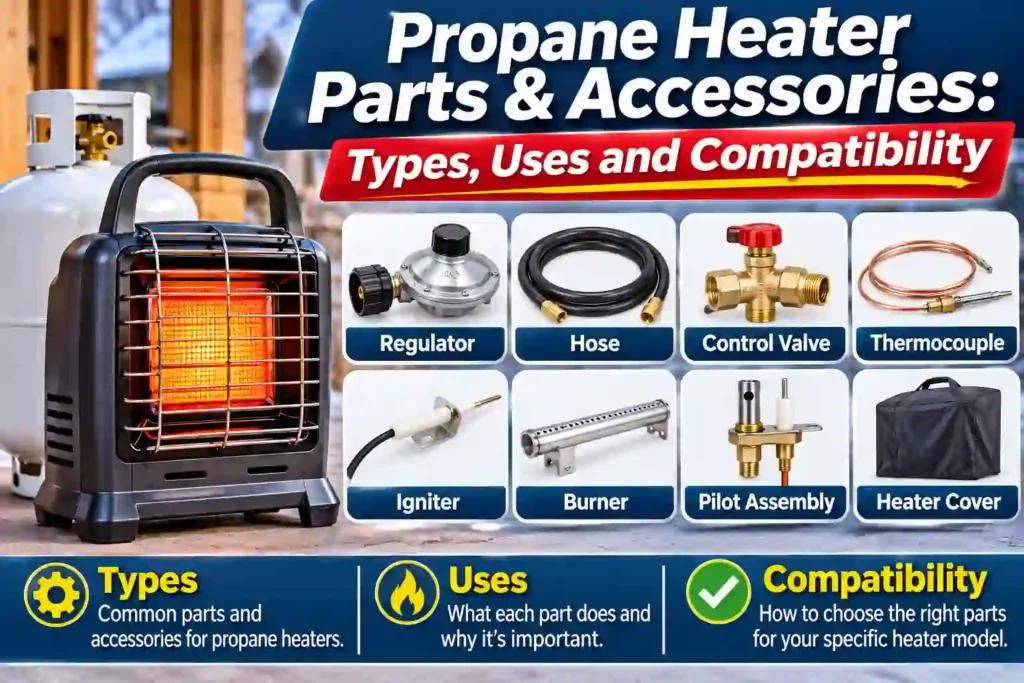


Propane heaters are popular for providing supplemental heat in homes, garages, workshops, construction sites, patios, and camping areas. Although these heaters come in different designs and sizes, they rely on several essential components to deliver propane, ignite the burner, regulate heat, and maintain safe operation.
Over time, some of these components may become worn, damaged, or less reliable. You may also want to purchase accessories that improve convenience, protect your equipment, or allow the heater to operate with a manufacturer-approved fuel supply configuration.
However, not all propane heater parts and accessories are interchangeable. A hose designed for a portable camping heater may be unsuitable for a patio heater, while a regulator intended for a construction heater may deliver excessive pressure to a residential wall heater.


Understanding the purpose of each component can help you purchase the correct replacement and avoid unnecessary expenses.
In this guide, I’ll explain the different types of propane heater parts and accessories, their functions, compatibility requirements, estimated prices, and important considerations before buying replacement equipment.
Quick Answer
The most common propane heater parts and accessories include regulators, gas hoses, thermocouples, pilot assemblies, burners, ignition systems, fuel filters, gas-control valves, replacement fittings, protective covers, and propane tank accessories.
| Part or Accessory | Primary Function | Replacement Priority |
|---|---|---|
| Propane regulator | Controls gas pressure. | High |
| Propane hose | Transfers fuel to the heater. | High |
| Thermocouple | Detects pilot flame presence. | High |
| Pilot assembly | Provides ignition flame. | High |
| Burner assembly | Produces heat through combustion. | High |
| Igniter | Starts the ignition process. | Medium |
| Gas-control valve | Controls propane delivery. | High |
| Fuel filter | Helps prevent fuel-system contamination. | Model-dependent |
| Tip-over switch | Shuts down compatible heaters if overturned. | High |
| Oxygen depletion sensor | Responds to reduced oxygen levels. | High |
| Protective cover | Protects equipment during storage. | Optional |
| Propane tank gauge | Helps estimate remaining fuel. | Optional |
Always select parts according to the heater’s exact manufacturer, model number, operating pressure, BTU rating, and installation requirements.


Safety-related components should never be bypassed, modified, or replaced with unapproved alternatives.
Understanding the Different Categories of Propane Heater Parts
Propane heater components can generally be divided into six categories according to their purpose.
| Category | Examples |
|---|---|
| Fuel delivery | Regulators, hoses, fittings, and filters. |
| Ignition | Piezo igniters, electrodes, and pilot assemblies. |
| Heating | Burners, reflectors, and ceramic heating elements. |
| Safety | Thermocouples, tip-over switches, and oxygen depletion sensors. |
| Temperature control | Thermostats, control knobs, and gas valves. |
| Protective accessories | Covers, carrying bags, guards, and replacement hardware. |
Understanding these categories makes it easier to identify the replacement parts you need instead of purchasing unnecessary components.
1. Propane Heater Regulators
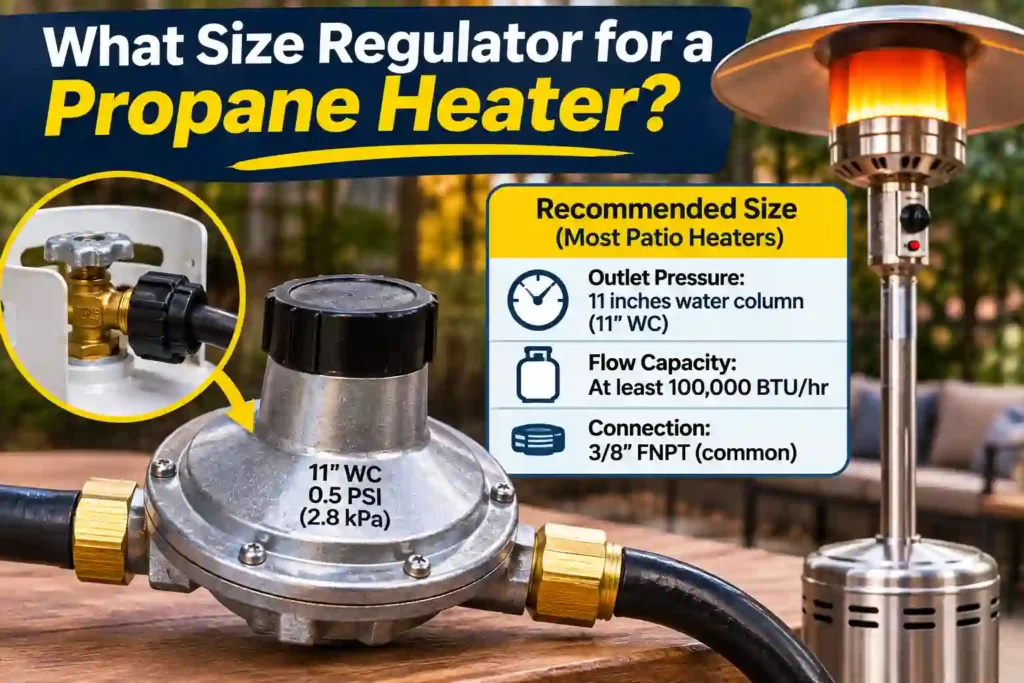
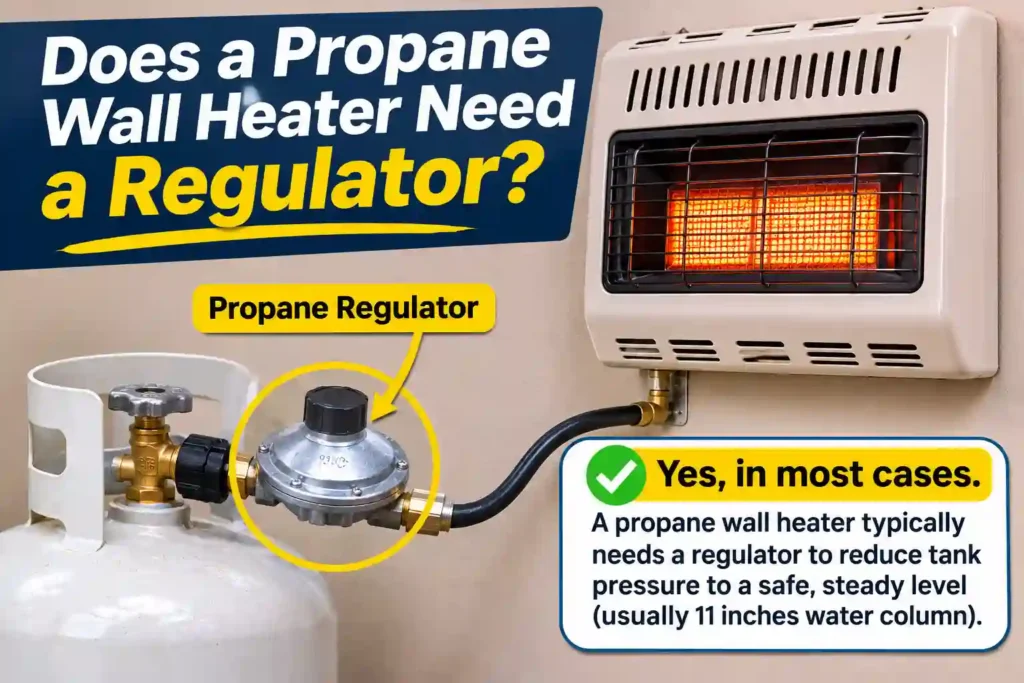
A propane regulator reduces incoming gas pressure to the level required by the heater. It also helps maintain consistent fuel delivery as propane demand changes.
Many conventional residential and patio heaters operate with a regulated supply of approximately 11 inches of water column, equivalent to 0.4 PSI. However, certain construction heaters require considerably higher pressures.



Types of Propane Heater Regulators
| Regulator Type | Common Application |
|---|---|
| Low-pressure regulator | Conventional patio and residential heaters. |
| High-pressure regulator | Certain construction and industrial heaters. |
| Single-stage regulator | Selected portable heating appliances. |
| Two-stage regulator | Fixed residential propane systems. |
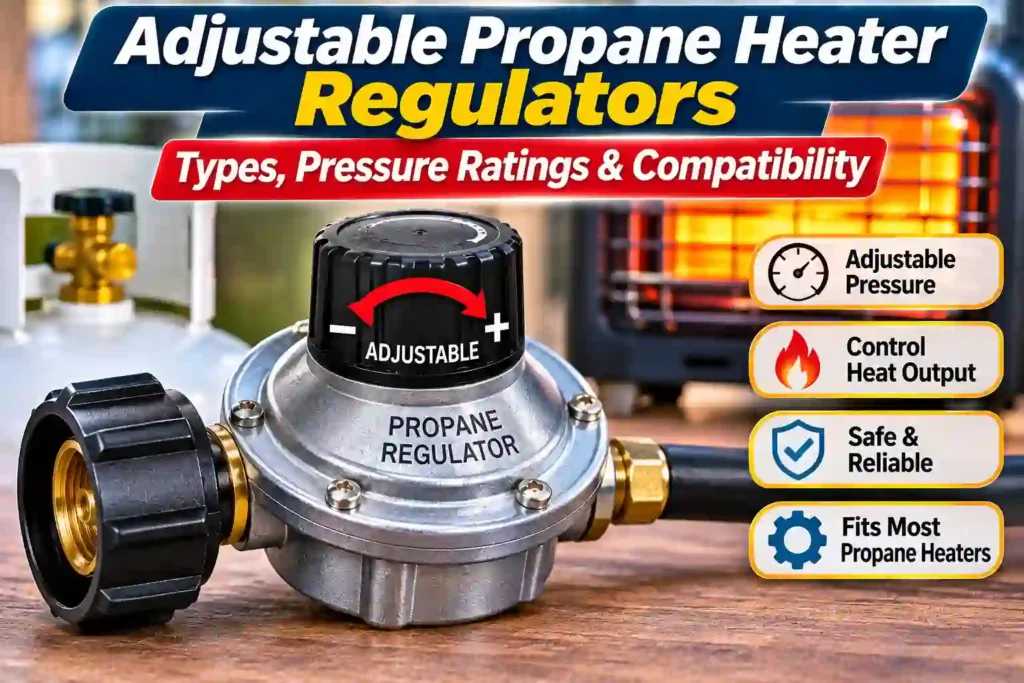
| Adjustable regulator | Specialized manufacturer-approved applications. |
| Integrated regulator | Certain portable radiant heaters. |
| Regulator and hose assembly | Outdoor patio heaters. |
When purchasing a replacement regulator, verify the inlet pressure, outlet pressure, BTU capacity, connection type, and manufacturer approval.
I recommend reading my guide on what BTU capacity means on a propane regulator before purchasing one.
2. Propane Heater Hoses
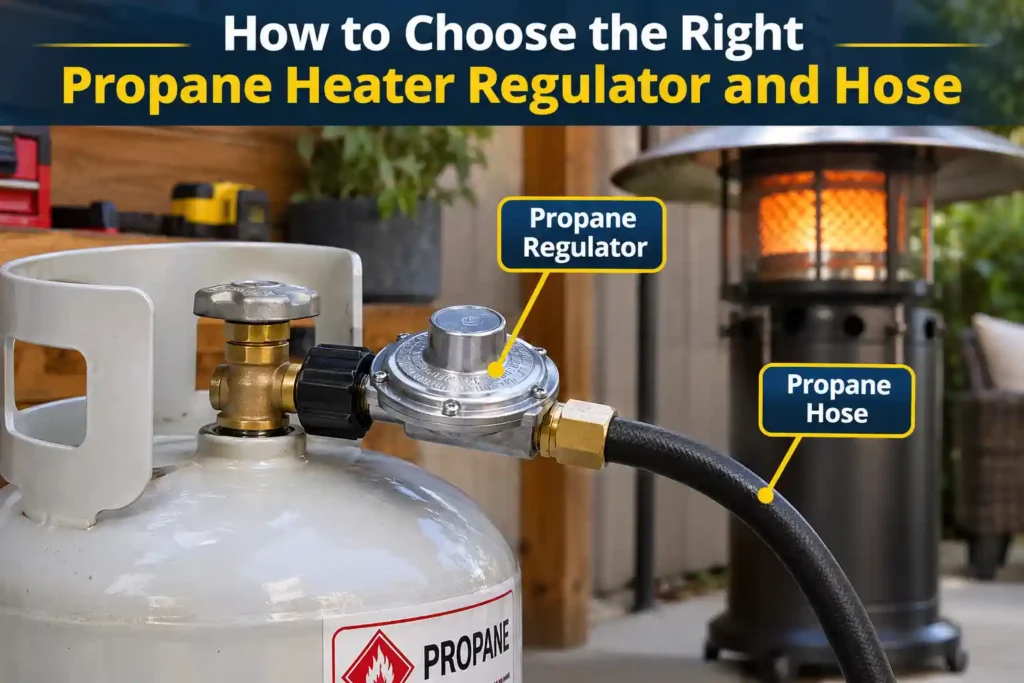
A propane hose transfers fuel between the cylinder, regulator, and heating appliance. Depending on its location, it may carry regulated gas pressure or full cylinder pressure.
Propane heater hoses are available in several configurations.


| Hose Type | Primary Use |
|---|---|
| Low-pressure propane hose | Approved downstream regulator connections. |
| High-pressure propane hose | Approved cylinder-pressure connections. |
| Stainless steel braided hose | Applications requiring additional abrasion protection. |
| Regulator and hose combination | Patio heaters and selected outdoor appliances. |
| Quick-connect hose | Compatible portable heating equipment. |
| Remote-cylinder hose | Approved connection to an external propane cylinder. |
| Pigtail hose | Specific cylinder-to-regulator connections. |
Hoses may be available in lengths ranging from approximately 1 foot to 20 feet or more. However, the appropriate length depends on the heater manufacturer’s requirements.
Do not use unapproved hose extensions, damaged hoses, or incompatible adapters.
3. Propane Heater Thermocouples
A thermocouple is a flame-sensing safety component commonly found in propane heaters equipped with standing pilot lights.
When heated by the pilot flame, the thermocouple produces a small electrical voltage that helps maintain the gas safety valve in its operating position.
If the pilot flame goes out, the thermocouple cools, allowing the safety system to interrupt gas delivery.
Possible signs of a thermocouple-related problem include:
- Pilot light that repeatedly goes out.
- Heater that shuts down shortly after ignition.
- Pilot flame that will not remain lit.
- Intermittent heating operation.
These symptoms may also be caused by incorrect gas pressure, a dirty pilot assembly, or defective gas-control components.
Thermocouples differ in length, connector design, mounting configuration, and operating characteristics. A universal replacement should not be assumed compatible.
Never bypass a thermocouple to keep a propane heater operating. This component helps prevent unburned propane from continuing to flow when the pilot flame is extinguished.
4. Pilot Light Assemblies
The pilot assembly produces a small flame that helps ignite the main burner in heaters using a pilot-based ignition system.
A complete pilot assembly may include a pilot burner, gas tube, ignition electrode, thermocouple, and mounting bracket.
Some designs also incorporate an oxygen depletion sensing system.
| Pilot Assembly Component | Function |
|---|---|
| Pilot burner | Produces the pilot flame. |
| Pilot orifice | Controls pilot gas flow. |
| Electrode | Provides ignition spark. |
| Thermocouple | Detects pilot flame presence. |
| Pilot tube | Delivers propane to the pilot. |
| Mounting bracket | Maintains correct component positioning. |
Pilot assemblies are particularly sensitive to compatibility because their flame characteristics and component positions affect heater safety.
Always use the manufacturer-approved replacement.
5. Piezo Igniters and Electronic Ignition Systems
An igniter produces the spark needed to start combustion. Depending on the heater design, ignition may be mechanical, battery-powered, or electronically controlled.
Common Types of Propane Heater Igniters
| Ignition Type | Power Source | Common Application |
|---|---|---|
| Piezo push-button igniter | Mechanical action | Portable and patio heaters |
| Battery-powered igniter | Battery | Selected patio and wall heaters |
| Electronic spark ignition | Electrical supply | Residential and commercial heaters |
| Hot surface ignition | Electrical supply | Certain furnaces and unit heaters |
| Automatic ignition module | Electrical supply | Thermostatically controlled equipment |
Hot surface ignition systems use a heated element rather than a conventional spark to ignite the gas.
If the igniter stops working, the problem may involve the ignition button, battery, electrode, wiring, or control module.
Do not repeatedly attempt ignition when gas may be accumulating around the burner.
6. Propane Heater Burner Assemblies
The burner is the component where propane mixes with combustion air and burns to generate heat.
Different heater designs use different burner configurations.
| Burner Type | Typical Application |
|---|---|
| Blue-flame burner | Convection wall heaters. |
| Ceramic radiant burner | Infrared portable heaters. |
| Stainless steel burner | Certain patio heaters. |
| Forced-air burner | Construction and industrial heaters. |
| Tubular burner | Selected garage and commercial heaters. |
A deteriorated burner may cause uneven heating, abnormal flames, ignition difficulties, or soot accumulation.
The burner’s dimensions, gas orifice, mounting design, and fuel input rating must match the original equipment.
Never enlarge a burner orifice to increase heater output.
7. Propane Heater Gas-Control Valves
A gas-control valve manages propane delivery to the pilot and main burner. Some valves incorporate safety shutoff mechanisms, thermostatic controls, and internal pressure regulation.
A defective gas-control valve can cause unreliable ignition, inconsistent heat output, or failure to control fuel delivery.
Gas-control valves are not ordinary interchangeable plumbing fittings. Their internal operating characteristics are specific to the appliance.
I recommend professional diagnosis and replacement whenever a gas-control valve is suspected of malfunctioning.
8. Propane Fuel Filters
A propane fuel filter helps prevent certain contaminants from entering sensitive heater components.
Fuel filters are especially relevant to some portable radiant heaters connected to external propane cylinders through flexible hoses.
Certain hose materials may release oily substances into the fuel stream. These contaminants can accumulate inside the heater and interfere with gas flow.
For example, Mr. Heater identifies the F273699 fuel filter for applicable Buddy heater configurations. Its F273704, F271802, and F271803 hoses are among the models identified as not requiring a separate filter.
Always confirm current compatibility and fuel filter requirements for the exact heater and hose configuration using the manufacturer’s documentation.
| Hose Configuration | Fuel Filter Requirement |
|---|---|
| Manufacturer-approved filter-free hose | Generally not required. |
| Hose specifically requiring a filter | Required. |
| Approved regulated hose | Follow model-specific instructions. |
| Unknown or generic hose | Do not assume compatibility. |
| Original replacement assembly | Follow manufacturer requirements. |
A fuel filter should not be added or omitted contrary to the manufacturer’s instructions.
9. Oxygen Depletion Sensors
An oxygen depletion sensor, commonly called an ODS, is a safety system found on certain propane heaters.
It is designed to interrupt heater operation when oxygen depletion affects the specially designed pilot system.
These sensors are commonly associated with certain vent-free wall heaters and portable indoor-rated propane heaters.
An ODS is not a carbon monoxide detector. It does not eliminate the need for appropriate ventilation, correct installation, and carbon monoxide alarms.
Never bypass, modify, or remove an oxygen depletion sensing system.
10. Tip-Over Safety Switches
A tip-over switch helps interrupt heater operation when compatible equipment is tilted beyond its intended operating position.
These safety switches are commonly found on portable radiant heaters, freestanding patio heaters, and selected construction heaters.
If the switch becomes defective, the heater may fail to ignite or shut down unexpectedly.
However, repeated shutdowns do not necessarily mean that the switch is faulty. An unstable surface, damaged wiring, or other safety-related issues may be responsible.
Replacement switches must have the correct operating characteristics and mounting orientation.
Never disable a tip-over switch to prevent a heater from shutting down.
11. Propane Heater Reflectors and Heat Shields
Reflectors and heat shields help direct radiant heat and protect surrounding heater components from excessive temperatures.
These parts are particularly common on outdoor patio heaters.
Replacement reflector panels are available in different diameters and shapes, but the original mounting configuration and heat-clearance requirements must be maintained.
A larger reflector is not automatically an improvement. Unapproved reflector extensions may interfere with heat distribution or required clearances.
12. Ceramic Heating Elements and Radiant Panels
Ceramic radiant panels are used in certain propane heaters to convert combustion heat into infrared radiation.
These panels become hot during operation and transfer radiant energy toward nearby surfaces.
Cracked or deteriorated ceramic panels may affect combustion and heat distribution.
Because these components form part of the burner system, use only approved replacement parts and arrange professional servicing where required.
13. Propane Heater Thermostats and Control Knobs
Thermostats and control knobs allow users to adjust heating output or maintain a desired temperature.
| Control Type | Function |
|---|---|
| Manual control knob | Adjusts available heating settings. |
| Mechanical thermostat | Responds to temperature changes. |
| Electronic thermostat | Provides automated temperature control. |
| Remote thermostat | Controls compatible heating equipment remotely. |
| Temperature sensor | Provides temperature information to the control system. |
Not every propane heater supports an external thermostat. Some models are designed exclusively for manual operation.
Do not modify a manually controlled heater to accept an aftermarket thermostat unless the manufacturer expressly permits it.
14. Propane Heater Blower Fans
Blower fans help circulate heated air around a room or work area. Certain propane wall heaters offer optional blower kits.
An approved blower may improve warm-air distribution, but it does not increase the heater’s maximum propane input rating.
When purchasing a blower, check the mounting arrangement, electrical voltage, power requirements, and model compatibility.
Essential Propane Heater Accessories
In addition to replacement parts, several optional accessories can improve equipment protection, portability, and fuel management.
Patio Heater Covers
Patio heater covers protect cool, non-operating heaters from rain, dust, and unnecessary weather exposure.
Choose a cover that fits the heater’s dimensions and follow manufacturer storage instructions. Never cover a heater while it is operating or still hot.
Heater Carrying Bags
Carrying bags provide convenient storage and transportation for compatible portable heaters.
Select a bag designed for your heater’s dimensions and ensure the equipment has cooled completely before storage.
Propane Tank Gauges
Propane tank gauges help estimate fuel availability.
However, pressure-based gauges cannot reliably measure the precise amount of liquid propane remaining because cylinder pressure is strongly influenced by temperature.
Electronic Propane Level Monitors
Compatible ultrasonic sensors can provide more useful fuel-level estimates than ordinary pressure gauges.
Some electronic monitors transmit fuel-level information to a smartphone, making it easier to plan propane refills.
Propane Cylinder Stabilizers
Propane cylinder stabilizers help maintain cylinder stability in suitable approved applications.
Check compatibility with the cylinder’s diameter, weight, and intended operating location.
Carbon Monoxide Alarms
Carbon monoxide alarms provide an important additional safety measure in buildings containing fuel-burning appliances.
Choose appropriately certified alarms and install them according to the manufacturer’s placement and maintenance instructions.
Approved Gas Leak-Detection Solution
Approved gas leak-detection solution is used for manufacturer-authorized gas connection checks.
It does not replace required professional system testing. Never use an open flame to check propane connections for leakage.
Propane Heater Parts Compatibility Chart
Not every replacement part is applicable to every heater design. The following chart provides a general overview of the components commonly associated with different propane heating appliances.
Varies = Model-dependent
No = Generally not applicable
| Component | Portable Heater | Patio Heater | Wall Heater | Garage Heater |
|---|---|---|---|---|
| Regulator | Yes | Yes | Yes | Yes |
| Gas hose | Yes | Yes | Varies | Varies |
| Thermocouple | Yes | Yes | Yes | Varies |
| Pilot assembly | Yes | Yes | Yes | Varies |
| Piezo igniter | Yes | Yes | Varies | Varies |
| Fuel filter | Varies | Varies | Varies | Varies |
| Tip-over switch | Yes | Yes | Varies | Varies |
| Oxygen depletion sensor | Varies | Varies | Varies | Varies |
| Reflector | Varies | Yes | No | Varies |
| Thermostat | Varies | Varies | Yes | Yes |
| Blower fan | Varies | No | Varies | Yes |
| Protective cover | Varies | Yes | No | Varies |
This chart indicates general component applicability, not confirmed compatibility with individual heater models. Never use this chart as an installation specification.
Which Brands Manufacture Propane Heater Parts and Accessories?
Several established brands produce heating equipment, replacement components, and propane accessories.
| Brand | Main Product Categories |
|---|---|
| Mr. Heater | Hoses, filters, and heater replacement parts. |
| Dyna-Glo | Wall heater and construction heater parts. |
| Hampton Bay | Patio heater replacement accessories. |
| Heatstar | Construction and commercial heater components. |
| RegO | Regulators and propane valves. |
| Marshall Excelsior | Regulators, fittings, and connectors. |
| Camco | Propane hoses and recreational accessories. |
| Flame King | Regulators, cylinders, and propane accessories. |
I recommend starting with the heater’s original equipment manufacturer when shopping for replacement parts.
A well-known accessory brand does not guarantee compatibility with your particular appliance.
How Much Do Propane Heater Parts and Accessories Cost?
The cost depends on the manufacturer, component design, equipment model, and replacement requirements.
| Replacement Part or Accessory | Estimated Price |
|---|---|
| Igniter button | $5–$20 |
| Thermocouple | $8–$30 |
| Fuel filter | $10–$25 |
| Tip-over switch | $8–$25 |
| Propane hose | $15–$50 |
| Propane regulator | $15–$60 |
| Pilot assembly | $20–$65 |
| ODS pilot assembly | $25–$80 |
| Regulator and hose assembly | $20–$80 |
| Protective heater cover | $15–$60 |
| Patio heater reflector | $25–$80 |
| Thermostat | $25–$100 |
| Blower fan kit | $40–$120 |
| Gas-control valve | $40–$150 |
| Burner assembly | $40–$180 |
| Professional servicing | $75–$250+ |
These are illustrative US budgeting estimates rather than verified current retail quotations. Parts prices exclude labor, shipping, and applicable taxes.
Replacement Parts Price Comparison
Igniter Button: $5–$20
Thermocouple: $8–$30
Propane Hose: $15–$50
Propane Regulator: $15–$60
Regulator and Hose Assembly: $20–$80
Thermostat: $25–$100
Blower Fan Kit: $40–$120
Gas-Control Valve: $40–$150
Burner Assembly: $40–$180
Bars represent the upper end of selected estimated parts price ranges.
Professional servicing may add approximately $75–$250 or more, depending on the equipment and complexity of the repair.
For additional information about pressure-control components, read my guide on the cost of replacing a propane regulator.
How to Identify the Correct Replacement Part
Before purchasing replacement components, follow these five steps.
Step 1: Locate the Model Number
Find the heater’s identification label, which may be located near the base, rear housing, control panel, or propane cylinder compartment.
Step 2: Check the Manufacturer’s Parts Diagram
Many manufacturers provide exploded parts diagrams showing individual components and their corresponding part numbers.
Step 3: Record the Original Part Number
Whenever possible, identify the exact replacement part number rather than relying on visual similarities.
Step 4: Verify Technical Specifications
Depending on the component, these may include gas pressure, BTU capacity, voltage, connection dimensions, mounting configuration, and operating temperature.
Step 5: Confirm Compatibility Before Ordering
Contact the manufacturer or authorized parts supplier if there is any uncertainty.
Avoid modifying replacement components to make them fit.
Worked Example: Choosing Parts for a 48,000 BTU Patio Heater
Suppose you own a 48,000 BTU patio heater that produces insufficient heat and frequently shuts down.
You suspect that the regulator and hose assembly may require replacement.
Using approximately 91,500 BTU per US gallon of propane, you can estimate the theoretical fuel demand.
Gallons per Hour = Heater BTU Input ÷ 91,500
48,000 ÷ 91,500 = 0.525 gallons per hour
Maximum Fuel Demand
48,000
BTU/hr
Hourly Consumption
0.525
Gallons per hour
Theoretical 20 lb Tank Runtime
9.0 hrs
Hourly Operating Cost
$1.84
At $3.50 per gallon
Assumes continuous maximum rated fuel input, approximately 4.7 gallons of available propane, adequate vaporization, and a hypothetical propane price.
The replacement assembly must accommodate this fuel demand at the manufacturer’s specified pressure.
However, the original symptoms could also indicate inadequate cylinder vaporization, a damaged thermocouple, a restricted burner, or a faulty gas-control valve.
Professional diagnosis can help prevent unnecessary parts replacement.
Propane Heater Parts Replacement Cost Calculator
Use this calculator to estimate a repair budget based on the components you may need to replace.
Propane Heater Repair Budget Estimator
Select the replacement parts you want to include in your estimated repair budget.
Replacement Parts Subtotal
$40.00
Professional Labor
$100.00
Estimated Total Repair Cost
$140.00
Comparable New Heater
$250.00
Repair vs. Replacement Cost
Repair Cost as a Percentage of a New Heater:
56.0%
The estimated repair cost is $110.00 below the replacement heater price.
This calculator uses hypothetical parts prices. It estimates costs only and does not diagnose equipment problems, recommend specific repairs, or determine whether equipment is safe to repair.
Common Propane Heater Problems and Related Replacement Parts
Understanding which components may be associated with common operating problems can help you communicate more effectively with a qualified heater technician.
| Heater Problem | Components That May Require Inspection |
|---|---|
| Heater will not ignite | Igniter, pilot assembly, gas-control valve. |
| Pilot light will not stay lit | Thermocouple, pilot assembly, regulator. |
| Weak flame | Regulator, hose, fuel supply. |
| Heater repeatedly shuts off | Safety switches, thermocouple, regulator. |
| Insufficient heat | Burner, regulator, thermostat. |
| Uneven heat distribution | Radiant panels, burner, reflector. |
| Fan does not operate | Blower motor, wiring, electrical controls. |
| Temperature cannot be adjusted | Thermostat, control valve. |
| Gas odor | Possible gas leak. Evacuate and seek assistance. |
| Persistent regulator freezing | Regulator and propane supply system. |
These symptoms are possible indications rather than definitive diagnoses.
You can learn more about the warning signs of a failing propane heater regulator and why propane regulators develop low pressure.
OEM vs. Aftermarket Propane Heater Parts
OEM stands for Original Equipment Manufacturer. OEM parts are produced or specified for the original equipment.
Aftermarket components are supplied by other manufacturers.
| Feature | OEM Parts | Aftermarket Parts |
|---|---|---|
| Model compatibility | Usually clearly documented | Must be independently confirmed |
| Purchase price | Often higher | Often lower |
| Availability | Model-dependent | May offer more options |
| Warranty considerations | Generally more straightforward | Depends on warranty terms |
| Safety specifications | Original equipment requirements | Must be verified |
| Installation requirements | Manufacturer documentation | Varies |
For critical gas-control and safety components, I recommend using original manufacturer-approved replacement parts whenever possible.
Aftermarket protective covers and carrying bags may be easier to evaluate than aftermarket regulators, burners, or gas valves.
I would prioritize original manufacturer-approved parts for regulators, burners, thermocouples, pilot assemblies, oxygen depletion sensors, and gas-control valves.
For non-critical accessories such as storage bags and protective covers, aftermarket options may be suitable when their dimensions and intended use match the equipment.
Where Can You Buy Propane Heater Parts and Accessories?
Replacement components are available through several retailers and equipment suppliers.
| Retailer or Supplier | Parts to Research |
|---|---|
| Amazon | Hoses, regulators, covers, filters, and accessories. |
| Home Depot | Heater accessories and selected replacement parts. |
| Lowe’s | Residential and outdoor heater accessories. |
| Tractor Supply | Propane heating accessories and hoses. |
| Walmart | Selected portable and patio heater accessories. |
| Northern Tool | Construction heater components. |
| Manufacturer websites | Original replacement components. |
| Authorized propane dealers | Regulators and professional gas-system components. |
Product availability varies by retailer, location, and heater model.
For safety-related components, I would prioritize authorized suppliers that can confirm compatibility with the original equipment.
Propane Heater Parts and Accessories Buying Checklist
Before purchasing replacement parts, use the following checklist to help identify appropriate equipment.
Replacement Parts Purchasing Checklist
Completing this checklist does not independently establish installation safety.
Should You Repair or Replace Your Propane Heater?
Replacing individual components can be more economical than purchasing a new heater. However, this depends on the condition of the equipment, availability of approved parts, and total repair expenses.
If the heater has a suspected propane leak, dangerous combustion, or significant physical damage, discontinue use and seek qualified assistance.
Have the actual cause of the malfunction identified before ordering replacement parts. Multiple components can produce similar operating symptoms.
Determine whether the manufacturer still supplies approved replacement components for your heater model.
Include replacement parts, labor, diagnostic fees, and any additional testing required after installation.
If the heater is otherwise in good condition and can be repaired safely, replacing defective components may be economical. Extensive corrosion, unavailable parts, or multiple component failures may make replacement more practical.
| Heater Condition | Suggested Decision |
|---|---|
| Single defective component | Consider approved replacement. |
| Damaged external hose | Discontinue use and arrange approved replacement. |
| Minor cosmetic deterioration | Inspect and maintain according to manufacturer instructions. |
| Severe burner corrosion | Professional evaluation or heater replacement. |
| Multiple failed gas-control components | Compare professional repair and replacement costs. |
| Approved replacement parts unavailable | Consider replacing the entire heater. |
| Suspected active propane leak | Evacuate and seek emergency assistance. |
Safety Precautions When Replacing Propane Heater Parts
Proper appliance operation, maintenance, gas leak awareness, and carbon monoxide safety are essential whenever propane heating equipment is used.
Important Propane Heater Safety Precautions
- Never bypass safety switches or flame-sensing devices.
- Never modify burner orifices or regulator pressure settings.
- Use only manufacturer-approved gas-control components.
- Replace damaged propane hoses before further use.
- Never check for gas leaks with an open flame.
- Never operate outdoor-only heaters indoors.
- Use appropriate carbon monoxide alarms.
- Follow manufacturer ventilation and clearance requirements.
- Do not attempt to repair an active propane leak.
- Hire qualified technicians for internal gas-system repairs.
If you smell propane: Leave the affected area immediately, avoid operating electrical switches or creating sparks, and contact your propane supplier or emergency services from a safe location. Do not return until the area has been declared safe.
If a carbon monoxide alarm sounds: Move everyone to fresh air immediately and contact emergency services.
For more information, read my guide on whether you can install a propane regulator yourself or need a professional.
Frequently Asked Questions
Are Propane Heater Parts Universal?
No. Components differ in pressure requirements, dimensions, connections, electrical characteristics, and safety specifications.
Always verify the heater manufacturer’s approved replacement part number before purchasing a component.
What Parts Commonly Fail on Propane Heaters?
Thermocouples, igniters, pilot assemblies, hoses, and regulators are among the components that may require replacement during a heater’s service life.
However, professional diagnosis is often necessary because different equipment problems can produce similar symptoms.
Can I Use a Universal Thermocouple?
Only if the heater manufacturer confirms compatibility. Similar appearance and length do not guarantee correct operation.
Do All Propane Heaters Need a Fuel Filter?
No. Fuel filter requirements depend on the heater design and approved hose configuration.
Some portable heaters require a separate fuel filter when used with particular hoses, while other approved hose assemblies do not.
Can I Replace a Propane Heater Regulator Myself?
Only when the manufacturer explicitly permits owner replacement.
Fixed gas systems and integrated gas-control components require qualified professional servicing.
How Often Should Propane Heater Hoses Be Replaced?
Follow the manufacturer’s recommended service life and inspection requirements.
Replace cracked, deteriorated, or otherwise damaged hoses before further operation.
Can I Upgrade My Propane Heater to Produce More Heat?
Do not modify the regulator, burner, or gas-control valve to increase heat beyond the appliance’s rated capacity.
Increasing gas pressure or modifying burner components may cause dangerous overheating and improper combustion.
Is It Worth Repairing an Old Propane Heater?
Repair may be worthwhile when the heater remains structurally sound and approved replacement components are available.
Extensive corrosion or multiple component failures may make replacement more economical.
Can a Bad Regulator Damage Other Heater Parts?
Yes. Incorrect gas pressure may damage gas-control components and interfere with safe combustion.
Read my guide on inlet pressure vs. outlet pressure to understand this relationship.
How Long Do Propane Heater Regulators Last?
Service life varies according to manufacturer recommendations, operating conditions, and environmental exposure.
See my guide on how long propane regulators last for additional information.
My Final Thoughts
Understanding propane heater parts and accessories can help you identify equipment problems, purchase suitable replacement components, and avoid unnecessary repair expenses.
Regulators, hoses, thermocouples, pilot assemblies, gas-control valves, and burners are essential operating components. Protective covers, carrying bags, and fuel-level monitors provide additional convenience.
My recommendation is to prioritize manufacturer approval and equipment compatibility rather than choosing replacement parts solely on price.
Always identify your heater’s exact model number before purchasing replacement components, and leave critical gas-control and safety-system repairs to qualified professionals.
Properly selected parts and accessories can help extend the useful life of your propane heater while maintaining reliable heating performance and safe operation.

Mike is an experienced propane technician with over 15 years of professional experience in the field. He has dedicated his career to helping customers with their propane needs, from installation to maintenance and repair. Together with Jeremy, he co-founded this website to provide useful information and guidance to customers seeking reliable propane services.