
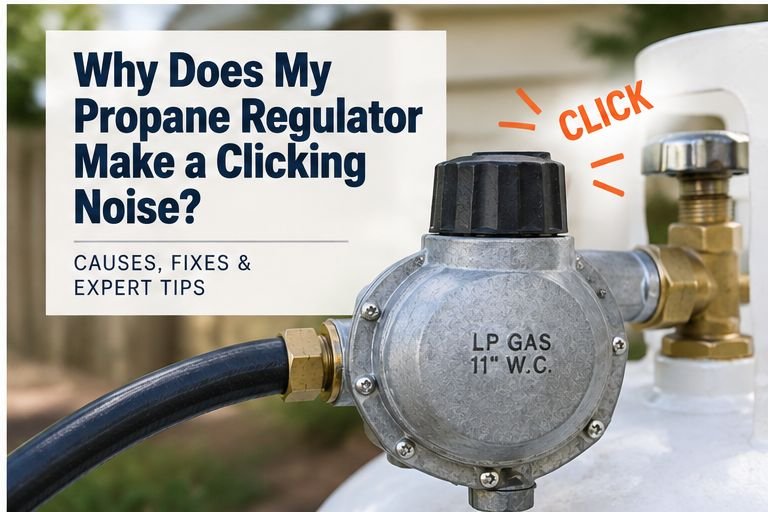
A clicking noise near a propane regulator can be caused by internal valve movement, an excess-flow device reacting to a surge, pressure changes as appliances cycle, movement in nearby piping, or a control inside the appliance rather than the regulator itself. One isolated click during startup is different from rapid, repeated clicking accompanied by weak flames, loss of gas, propane odor, or appliance shutdown. If you smell propane or suspect leakage, stop troubleshooting and follow your propane supplier’s emergency procedure from a safe location.
Does a Propane Regulator Normally Click?
If the sound is more of a steady vibration, compare it with propane regulator humming. A sharper high-pitched tone may fit propane regulator whistling instead.
A propane regulator can produce or transmit occasional mechanical sounds, but repeated clicking is not something you should diagnose by sound alone. A regulator contains a diaphragm, spring, valve, seat, and related components that move as downstream demand changes. Other safety valves and appliance controls can also create clicks that travel through metal piping.


RegO’s excess-flow guidance specifically notes that closure of an excess-flow valve during a controlled professional test may produce an audible click along with a stoppage of flow. That does not mean every click at a home regulator is an excess-flow valve. It simply shows why identifying the actual component is important.
| Clicking Pattern | Possible Source | Important Clue |
|---|---|---|
| Single click when gas is opened | Valve/safety-device movement | Does normal flow continue? |
| Click then very weak flame | Possible excess-flow restriction | Often follows sudden startup |
| Repeated clicks as appliance starts | Appliance ignition/control | Sound may not be regulator |
| Clicks when furnace cycles | Gas valve, regulator response, piping | Correlates with appliance demand |
| Clicking plus propane odor | Potential unsafe condition | Stop use and follow emergency guidance |
1. An Excess-Flow Device May Be Reacting to a Gas Surge
A sudden increase in propane flow can cause an excess-flow valve to close or restrict flow, and its movement may be audible. Excess-flow valves are designed to react when flow exceeds a predetermined closing rate under certain conditions. RegO describes them as surge-sensitive.
This can be relevant on portable-cylinder equipment when the cylinder valve is opened rapidly. A user may hear a click and then find that the grill, heater, or burner has only a tiny flame. Do not bypass the safety feature. Shut the equipment down and follow the manufacturer’s approved reset procedure.
RegO also cautions that testing excess-flow valves can involve hazardous gas discharge and should be performed by trained personnel. Homeowners should not intentionally create a high-flow condition to see whether a valve clicks.


2. The Regulator Valve Is Responding to Changing Demand
If clicking is followed by a loss of gas, compare the symptoms with a regulator that keeps shutting off. If the click happens as soon as the cylinder valve opens, see why a regulator trips when the tank valve opens.
The regulator’s internal valve moves as appliance demand changes, so mechanical movement can sometimes create a faint sound. When a furnace starts, for example, downstream pressure falls slightly and the regulator responds by admitting more gas. When the furnace stops, demand falls and the regulator closes toward its lock-up condition.
Most of this movement is not loud enough to notice. If a regulator suddenly becomes noisy after years of quiet service, or clicking is accompanied by pressure problems, inspection is sensible.
3. The Clicking May Actually Come From the Appliance Gas Valve
Many propane appliances contain electrically operated gas valves and ignition controls that click during normal startup and shutdown. Furnaces, water heaters, fireplaces, boilers, generators, and other equipment can have relays, solenoids, igniters, and valves.
Sound can travel along a gas pipe and make the regulator appear to be the source. If the clicking happens only when one appliance tries to ignite, stand at a safe distance and determine whether the sound is louder near the appliance or supply regulator. Do not remove appliance panels unless the manufacturer’s user instructions allow it.

4. Repeated Ignition Attempts Can Sound Like a Regulator Problem
If the appliance has trouble staying on after a cylinder change, compare it with an appliance that will not stay lit after changing tanks.
Rapid clicking may be an electronic igniter repeatedly trying to light a burner. If ignition fails, the appliance may retry several times before locking out. The underlying cause can include an appliance problem, insufficient gas pressure, air in a line after service, or another condition.
If other propane appliances operate normally, that points more strongly toward the individual appliance. If every appliance is experiencing low gas flow, the common propane supply should be investigated.
5. Piping Can Expand, Contract, or Shift Slightly
Temperature and pressure changes can make metal piping or mounting components move enough to produce a click or tick. The sound may be transmitted to the regulator body. This is similar to the ticking sometimes heard from heating ducts or plumbing as temperatures change.


Gas piping still needs proper support and clearance. Do not wedge materials around piping or bend tubing to stop the sound. A technician can determine whether support, contact with the structure, or mechanical stress is contributing.
6. The Regulator Could Be Experiencing Unstable Pressure
Repeated regulator movement can occur when downstream demand or pressure is unstable. The cause might involve regulator sizing, a restricted line, changing appliance load, tank vaporization, or a regulator fault.
Pressure cannot be accurately judged by flame appearance or clicking alone. A qualified technician can measure delivery pressure under load and observe whether it remains stable as appliances cycle.
7. Dirt or Debris May Affect the Regulator Seat
Foreign material inside a regulator can interfere with the seat and normal pressure control. RegO’s service guidance identifies dirt from upstream piping as a cause of lock-up and pressure creep. If a seat cannot close smoothly, regulator behavior can become abnormal.
Do not open the regulator to clean it. Internal service requires appropriate procedures and may not be permitted for every model. Replacement is often the correct approach for sealed or non-serviceable regulators.
8. Cold Weather Can Change Regulator and Tank Behavior
Cold weather can reduce propane vaporization and can contribute to regulator icing, changing how the system behaves. A small cylinder that easily supports an appliance in summer may struggle with the same BTU demand in severe cold, especially at a low liquid level.
If clicking is accompanied by weakening flames or shutdown after several minutes, note the outdoor temperature, tank level, and appliance load. These details can help distinguish a regulator issue from insufficient vaporization.
9. The Regulator May Be Worn or Damaged
New clicking from an old, corroded, impact-damaged, or weathered regulator deserves professional inspection. A regulator is exposed to changing pressure and may also be exposed to outdoor weather. Diaphragms, seats, springs, seals, and vent components do not last forever.
Do not select a replacement solely by thread size. Regulators differ by stage, inlet pressure, outlet pressure, capacity, connection, venting arrangement, and intended application.
How to Tell Whether the Click Is From the Regulator or Appliance
The safest way to narrow down the source is to observe when the sound occurs rather than dismantling anything. Write down which appliance starts immediately before the click and whether gas flow changes afterward.
- If clicking occurs only when the furnace starts, the furnace controls may be involved.
- If clicking occurs immediately when a portable cylinder is opened and flow becomes tiny, an excess-flow condition may be involved.
- If every appliance loses gas after the click, focus on the common supply system.
- If only one appliance is affected, focus on that appliance and branch.
- If clicking occurs with no apparent gas demand, arrange an inspection rather than assuming it is normal.
What Does a Propane Excess-Flow Valve Do?
An excess-flow valve is designed to reduce or stop flow when the flow rate through it exceeds its predetermined closing value under the conditions for which it was selected. It is not a universal leak detector and cannot protect against every type of line damage.
RegO explains that a partial split or restricted break may release less gas than the amount required to close an excess-flow valve. Long or restrictive piping can also prevent enough flow from developing to trigger closure. This is why excess-flow protection must not be treated as a substitute for proper piping, leak prevention, and emergency procedures.
Why Opening the Propane Valve Slowly Can Matter
On equipment whose manufacturer instructs slow valve opening, doing so reduces the sudden surge that can activate certain excess-flow arrangements. The appliance controls should generally be off before the supply is opened, and the user should follow the exact startup procedure in the equipment manual.
Do not partially open a service valve as a way to control appliance pressure. RegO warns that throttling certain tank outlet valves can restrict flow and interfere with excess-flow valve performance. Pressure control is the regulator’s job.
Clicking and Low Flame
A click followed by a very low flame can point toward restricted propane flow rather than a burner that simply needs more pressure. Potential causes include excess-flow restriction, a nearly empty cylinder, a frozen or damaged regulator, restricted piping, incorrect connection, or insufficient vaporization.
Increasing regulator pressure without diagnosis can create a dangerous overpressure condition. Verify the cause instead.
Clicking and No Gas Flow
If clicking is followed by no gas at multiple appliances, shut the appliances off and follow the manufacturer or supplier restart instructions. If flow does not return, arrange service. Do not repeatedly cycle valves in an attempt to force gas through.
Clicking and Propane Smell
Clicking combined with propane odor should be treated as a potential leak or abnormal gas condition. Do not attempt to locate a leak with a flame. Avoid smoking, flames, engines, switches, and other ignition sources. Leave the area and contact the propane supplier or emergency services from a safe place in accordance with local emergency guidance.
What a Technician Can Test
A technician can determine whether the regulator is actually clicking and whether its pressure performance is correct. Depending on the system, the inspection may include regulator model and capacity, inlet pressure, delivery pressure, lock-up pressure, piping size, tank supply, vent condition, appliance demand, and safety devices.
RegO’s service manual describes checking delivery pressure with roughly half the appliance load and then with all appliances operating to verify pressure remains adequate. It also describes monitoring lock-up pressure after appliances shut off. These measurements can reveal problems that are impossible to identify by sound alone.
Quick Diagnostic Table
| Symptom | Possible Area | Recommended Response |
|---|---|---|
| One click, normal operation | Normal valve/control movement possible | Monitor |
| Click + tiny flame after tank opening | Excess-flow/startup issue possible | Follow manufacturer reset instructions |
| Rapid clicks at one appliance | Ignition/control issue | Check appliance manual / service |
| Clicks + all appliances lose pressure | Common supply system | Propane technician |
| Clicking + gas odor | Potential leak | Leave area and call from safe location |
Frequently Asked Questions
Can an excess-flow valve make a clicking sound?
Yes, movement of an excess-flow valve can be audible. RegO specifically notes an audible click during certain professional test conditions when the valve closes. Do not intentionally create a gas surge to test it yourself.
Why does my grill regulator click and then have a low flame?
A safety-flow restriction triggered during startup is one possible cause. Turn the equipment off and use the grill manufacturer’s reset procedure. Persistent low flow needs inspection.
Can I tap the regulator to stop clicking?
No. Do not strike, tap, shake, drill, or modify a propane regulator. Physical damage can make a gas-control problem worse.
Should I replace the regulator if it clicks?
Not based on sound alone. Identify whether the click comes from the regulator, an excess-flow valve, piping, or appliance control and verify pressure performance before choosing replacement equipment.
Bottom Line
A clicking sound near a propane regulator is a clue, not a diagnosis. It can come from normal valve movement, an excess-flow device reacting to a surge, an appliance ignition or gas valve, piping movement, unstable pressure, contamination, or regulator wear. The most useful information is what happens immediately before and after the click. If flow remains normal and the sound is occasional, monitor it. If clicking comes with low gas flow, repeated shutdowns, propane odor, or visible damage, have the system professionally inspected.
Technical references include RegO’s LP-Gas Serviceman’s Manual and RegO excess-flow valve guidance. Follow the manufacturer instructions for your specific equipment and all applicable codes.

Mike is an experienced propane technician with over 15 years of professional experience in the field. He has dedicated his career to helping customers with their propane needs, from installation to maintenance and repair. Together with Jeremy, he co-founded this website to provide useful information and guidance to customers seeking reliable propane services.


