
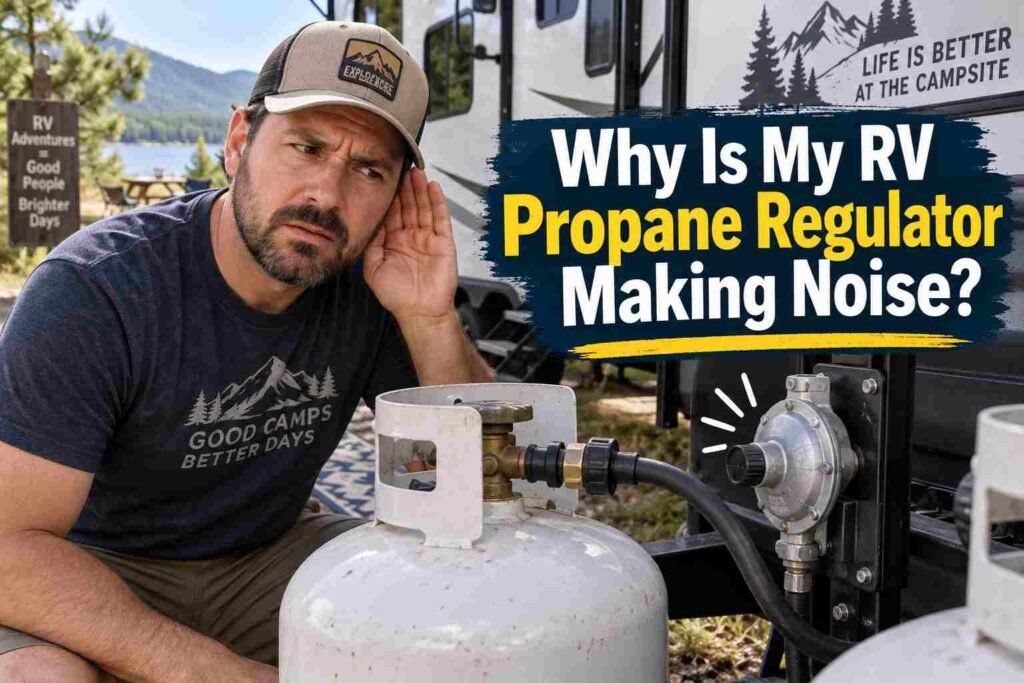
When you hear a new sound near the propane cylinders, it is easy to assume the regulator is failing. I do not make that assumption from noise alone. In an RV, the regulator sits in a system that includes cylinder valves, pigtail hoses, an automatic changeover mechanism on many trailers, fittings, distribution piping, and several appliances. Sound can travel through all of them.
The useful question is not simply, “Why is my RV propane regulator making noise?” I want to know what kind of noise you hear, when it happens, whether propane is flowing, whether you smell gas, and whether appliance performance changes at the same time.
What Different RV Propane Regulator Noises Usually Mean
| Noise | Common explanation | When it often occurs | How I treat it |
|---|---|---|---|
| Soft humming | Diaphragm, spring, valve, or gas-flow vibration | Furnace, water heater, or multiple appliances running | Often normal if pressure and appliance operation are stable |
| Whistling | High-velocity flow, restriction, hose resonance, or regulator vibration | Higher propane demand | Inspect if new, loud, persistent, or paired with poor appliance performance |
| Buzzing or chattering | Unstable valve movement, inadequate inlet pressure, excessive demand, debris, or vibration | Load changes or several appliances starting | Needs attention if repeated or strong |
| Clicking | Changeover mechanism, nearby valve, hose movement, or another component | Cylinder changeover or appliance cycling | Locate the actual source before blaming the regulator |
| Brief rush of gas | System pressurizing after cylinder valve is opened | Immediately after opening the cylinder | May be normal if momentary and there is no gas odor |
| Continuous hissing | Possible leak, venting, damaged hose/fitting, or regulator fault | With or without appliance demand | Shut off propane and have the system checked |
How an RV Propane Regulator Works
Most RVs use a two-stage propane regulator. The regulator is mechanical. It does not need an electric motor to control pressure. Instead, springs, diaphragms, seats, and valves respond continuously to changes in gas demand.
That matters because moving mechanical parts can make sound. When your furnace starts, propane flow increases. The regulator opens farther to supply that demand. When the furnace shuts off, flow falls and the regulator closes back down. A subtle hum or vibration during those changes does not automatically mean something is broken.
Typical RV Propane Pressure Numbers
| Point in RV propane system | Typical pressure | Purpose |
|---|---|---|
| Propane cylinder | Varies greatly with temperature | Stores propane under vapor pressure |
| After first regulator stage | About 10–13 psi in common RV designs | Intermediate pressure |
| After second regulator stage | About 11 in. w.c. | Low-pressure supply to RV appliances |
| 11 in. w.c. converted to psi | About 0.397 psi | Shows how low appliance pressure actually is |
| 11 in. w.c. converted to kPa | About 2.74 kPa | Metric equivalent |
Grand Design describes its RV two-stage system as reducing cylinder pressure to roughly 10–13 psi in the first stage, then to 11 inches of water column in the second stage. If you want a deeper explanation of that final pressure, see my guide to what 11 inches water column means for propane.
Why Is My RV Propane Regulator Humming?
A mild hum is one of the noises I worry about least when it happens only while propane is flowing. Regulators have a flexible diaphragm that responds to downstream pressure. Gas rushing through the regulator, spring movement, and vibration transmitted into the mounting bracket can produce a low hum.
The sound may become more noticeable when your furnace runs because a furnace is often one of the larger propane loads in an RV. If the water heater and furnace are operating at the same time, the regulator is supplying more gas and the vibration can become easier to hear.


I become more concerned when the hum is accompanied by symptoms such as weak flames, appliances shutting down, pressure that falls sharply under load, or a regulator that was previously quiet and suddenly became loud. Those clues tell me the sound may be a symptom of a flow or pressure problem rather than normal mechanical resonance.
Why Is My RV Propane Regulator Whistling?
A whistle is usually associated with gas moving through a restriction or with a component resonating at a certain flow rate. The sound can come from the regulator, but it can also come from a pigtail hose, fitting, valve, or nearby piping.
If the whistling appears only at high demand, I would check whether the regulator and pigtails are correctly sized for the RV load. A system can look fine with one burner operating but struggle when the furnace, water heater, refrigerator, and cooktop demand propane together.
I also inspect the regulator vent area visually. Fisher and RegO both stress that regulator vents must remain unobstructed. Mud, insects, ice, snow, paint, or other debris can interfere with regulator operation. On an RV, the vent should be oriented as the RV/regulator manufacturer specifies—commonly downward and protected from weather.
For a broader look at the same sound, I cover it separately in Propane Regulator Whistling: High-Pitched Noise Explained.
Why Is My RV Propane Regulator Hissing?
This is the noise I take most seriously. Some momentary sound can occur as a propane system pressurizes, but a continuing hiss is not something I dismiss as normal regulator noise.
Grand Design instructs RV owners to listen for hissing and states that a hissing sound lasting longer than about one second may indicate a propane leak. If you suspect a leak, the manufacturer directs you to close the shutoff valve and contact a dealer or qualified propane technician.
A regulator vent is also a safety opening. If propane is actually discharging from the regulator vent, Fisher instructs users to shut down and obtain service. Do not plug, tape, cap, or otherwise block the vent to stop a sound.
Why Does My Automatic Changeover Regulator Make Noise?
Travel trailers and fifth wheels commonly use two cylinders connected to an automatic changeover regulator. This regulator draws from the selected service cylinder and can switch to the reserve cylinder when the first one is depleted.
Because the assembly contains moving mechanisms and two pigtail connections, there are more places where vibration or a brief mechanical sound can originate. If you hear clicking or a short change in sound when one bottle empties, I first verify the changeover indicator and cylinder status rather than assuming immediate regulator failure.
Repeated clicking, loud chatter, hissing, or poor appliance operation deserves inspection. The changeover mechanism should not be treated as an excuse for any unusual noise.
Can Opening the Propane Cylinder Too Fast Cause Noise?
It can contribute to strange behavior. RV cylinder pigtails commonly incorporate excess-flow protection. If a cylinder valve is opened abruptly, the sudden rush can cause excess-flow protection to restrict gas flow. You may then see weak appliance flames or appliances that will not stay lit.
Grand Design tells owners to open cylinder valves slowly when placing the system in service. I follow the RV and regulator manufacturer’s procedure instead of snapping the valve open quickly.
If your regulator seems to have good static pressure but poor flow, see my guide on why a propane regulator can show pressure but no flow.
Common Causes of RV Propane Regulator Noise
| Cause | Likely sound | Other clues |
|---|---|---|
| Normal diaphragm/valve movement | Faint hum or vibration | Only while appliances are drawing gas |
| High propane demand | Hum, whistle, vibration | Sound increases as more appliances run |
| Pigtail or hose resonance | Whistle or buzz | Sound seems strongest at hose or fitting |
| Blocked/contaminated vent | Unstable or unusual operation | Visible dirt, insects, ice, or debris |
| Undersized regulator or excessive load | Chatter, whistle, hum | Pressure drops when several appliances run |
| Debris at regulator seat/nozzle | Erratic noise | Lock-up, creep, or pressure instability |
| Loose mounting bracket or line contact | Buzz/rattle | Noise transmitted into RV structure |
| Leak or regulator venting | Continuous hiss | Propane odor, abnormal flames, or sound with no normal demand |
How I Narrow Down the Noise Without Disassembling the Gas System
I keep owner-level checks simple because a propane regulator is safety equipment. I do not recommend opening the regulator body, changing spring settings, plugging vents, or taking fittings apart as a casual DIY diagnostic.
1. Identify exactly when the noise occurs
I note whether it starts when the furnace ignites, when the water heater runs, when two or three appliances operate together, or immediately after opening a cylinder. This tells me whether the sound tracks gas demand.
2. Turn appliances off one at a time
If the system is otherwise safe and there is no gas odor, reducing demand can reveal whether the noise is load-related. A hum that disappears as appliances shut down is very different from a hiss that continues with every appliance off.
3. Confirm which cylinder is in service
On an automatic changeover system, I check the regulator indicator and cylinder levels. An empty or nearly empty supply cylinder can change how the system behaves.
4. Look at the regulator vent
I visually check that the vent is not blocked by insect nests, road debris, ice, paint, or a misplaced cover. I do not poke tools into the regulator or alter the vent.
5. Inspect pigtails and mounting
I look for obvious kinks, age cracking, rubbing, loose mounting, or a hose touching a metal panel that could amplify vibration. RegO recommends installing new pigtails when a new regulator is installed and ensuring the regulator is properly selected for the system load.
6. Have pressure tested under load
If noise is persistent, the useful test is not just static pressure. A qualified technician can connect a calibrated manometer and observe pressure while appliances operate. That helps reveal excessive regulator droop, inadequate capacity, inlet pressure problems, or unstable regulation.
When Is RV Propane Regulator Noise Normal?
I consider a noise more likely to be normal when it is faint, happens only while propane is flowing, has been present without getting worse, and appliance operation remains normal. A soft hum from a working regulator can simply be the sound of the diaphragm and valve responding to flow.
I consider it more suspicious when it is new, loud, rapidly changing, present with all appliances off, paired with gas odor, accompanied by poor flames, or associated with regulator icing, abnormal pressure, or appliance shutdowns.
| Condition | Lower concern | Higher concern |
|---|---|---|
| Sound level | Faint hum | Loud hiss, chatter, or whistle |
| When it occurs | Only under normal gas flow | Continues with appliances off |
| Gas odor | None | Any suspected propane odor |
| Appliance flames | Stable and normal | Weak, lifting, yellow, or unusually high |
| Trend | Unchanged over time | Sudden new noise or getting louder |
Can an Incorrect Regulator Size Make an RV Noisy?
Yes, regulator sizing matters. The regulator has to supply the combined BTU demand of the RV’s propane appliances at the correct outlet pressure. If the regulator or another part of the supply path is undersized, outlet pressure can fall as load increases.
This is why I do not choose an RV regulator based only on the fact that the fittings physically match. I check regulator type, outlet pressure, inlet rating, BTU capacity, cylinder arrangement, mounting, and manufacturer approval. My guide on calculating propane regulator BTU capacity explains the load calculation in detail.
Can a Bad RV Propane Regulator Cause Appliance Problems?
Yes. A failing or incorrectly adjusted regulator can cause pressure that is too low, too high, unstable, or slow to recover. Depending on the failure, you may see burners that will not stay lit, a furnace that cycles off, weak stove flames, soot, yellow flames, or unusually high flames.
Grand Design’s regulator guidance notes that pressure that is too high affects safety and system performance, while pressure that is too low prevents LP appliances from operating correctly. If you have pressure symptoms along with noise, I treat the combination as more significant than noise by itself.
Related guides on PropaneHQ include why a propane regulator has low pressure and whether a bad regulator can cause a yellow flame.
What About RV Regulator Recalls?
Regulator history is worth checking if your RV has a model known to be involved in a recall. For example, Grand Design published information for NHTSA Recall 21V-393 involving certain Winntec LP regulators on affected travel trailers. The recall warned that regulator failure could allow unregulated high-pressure LP gas to reach an appliance and advised owners to shut off LP if they smelled gas, saw larger-than-normal flame height, or heard loud hissing from an appliance.
I do not assume your regulator is recalled simply because it is noisy. I identify the regulator make/model and check your RV manufacturer and NHTSA recall information by VIN when applicable.
Should I Adjust an RV Propane Regulator to Stop the Noise?
No—not as a noise fix. Changing outlet pressure without measuring it with the proper instrument can create unsafe appliance pressure. Grand Design states that second-stage pressure adjustment should be performed by a dealer or qualified propane service technician using a properly calibrated manometer.
If a regulator is correctly sized and installed but is abnormally noisy, the solution may be replacement, a pigtail correction, removal of a system restriction, or another repair. Turning an adjustment screw until the noise stops is not a diagnosis.
When Should I Replace an RV Propane Regulator?
I consider replacement when a qualified inspection finds the regulator cannot maintain correct pressure, has internal contamination or corrosion, vents gas, has excessive lock-up or creep that cannot be corrected through approved service, or is part of a recall requiring replacement. Physical damage, water intrusion, and age also matter.
RegO says regulators that have been submerged should be replaced, and Fisher advises replacing regulators with internal corrosion or water intrusion. If you are evaluating an older unit, see my article on how long propane regulators last.
Frequently Asked Questions
Is it normal for an RV propane regulator to hum?
A faint hum while propane is flowing can be normal. The regulator diaphragm and valve are constantly responding to demand. I investigate if the hum becomes loud, is new, or comes with pressure or appliance problems.
Is a hissing propane regulator normal?
I do not consider sustained hissing something to ignore. A very brief sound during initial pressurization can occur, but continuous hissing may indicate escaping gas or a regulator problem. Shut off the propane supply if you suspect a leak and obtain qualified service.
Why does the regulator get louder when my furnace starts?
The furnace increases propane demand, so more gas flows through the regulator. That can make normal flow and diaphragm vibration more noticeable. If pressure drops or the furnace fails at the same time, the system should be checked for capacity, restriction, or pressure issues.
Can an empty propane cylinder make the regulator noisy?
Low cylinder supply can change system behavior, especially in cold weather or under high demand. On a dual-cylinder automatic changeover system, confirm which cylinder is selected and whether the indicator shows that the service cylinder is empty.
Can a propane pigtail cause whistling?
Yes. A pigtail can transmit or generate vibration as gas flows through it. Restrictions, excess-flow devices, hose geometry, and fittings can all influence noise. A technician can isolate whether the sound is actually from the regulator or the pigtail.
What pressure should an RV propane regulator supply?
A conventional RV two-stage regulator commonly supplies about 11 inches of water column downstream. That is approximately 0.397 psi or 2.74 kPa. Always follow the RV and appliance manufacturer specifications for your specific system.
Can I block the regulator vent if it whistles?
No. The vent must remain open and unobstructed. Blocking it can prevent the regulator from operating safely and can create a dangerous overpressure condition.
Should I replace a noisy regulator immediately?
Not every hum requires replacement. I base the decision on the type of sound, leak checks, pressure under load, vent condition, regulator condition, age, recall status, and appliance performance.
Bottom Line
If your RV propane regulator is making noise, start by identifying the sound. A faint hum or vibration under load can be normal. Whistling or buzzing can point to flow, restriction, hose resonance, or regulator instability. Sustained hissing deserves immediate attention because it can indicate a propane leak or regulator fault.
I also pay attention to what the RV is doing at the same time. If the noise is paired with weak flames, appliances shutting down, gas odor, unusually high flames, or pressure changes, I stop treating it as a harmless sound and have the LP system checked.
For most owners, the safest line is simple: you can observe when the noise occurs, check cylinder status, visually inspect the vent and pigtails, and note appliance behavior. Pressure adjustment, regulator disassembly, and gas-system repair belong with a qualified RV or LP-gas technician.
Technical Sources
I used current manufacturer and RV-service guidance for the technical values and safety recommendations in this article, including Grand Design RV owner documentation, Fisher/Emerson LP-gas regulator manuals and the LP-10 Serviceman’s Handbook, RegO regulator service guidance, and Grand Design/NHTSA recall information concerning affected Winntec regulators.

Mike is an experienced propane technician with over 15 years of professional experience in the field. He has dedicated his career to helping customers with their propane needs, from installation to maintenance and repair. Together with Jeremy, he co-founded this website to provide useful information and guidance to customers seeking reliable propane services.


