
Quick Answer
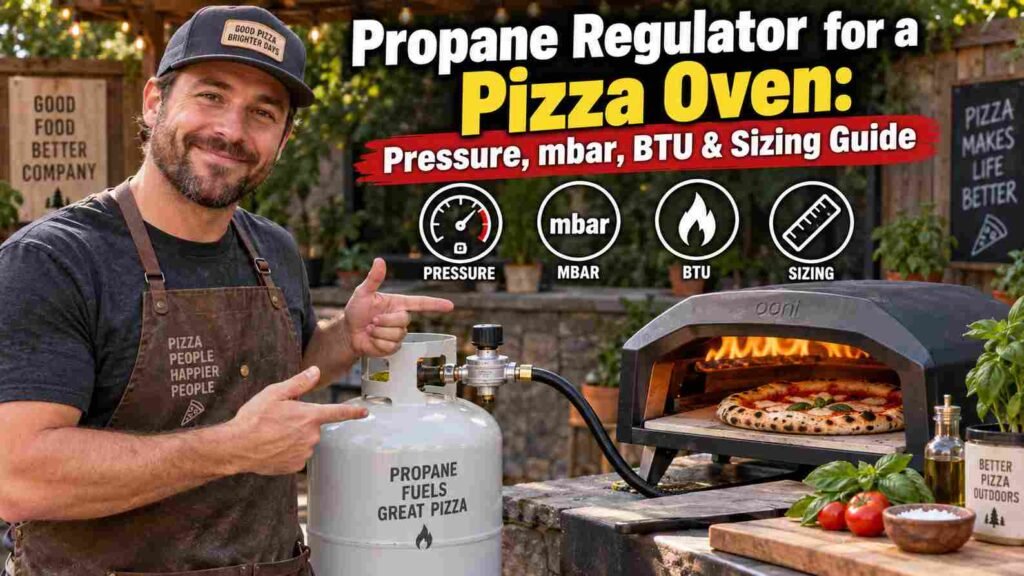
For a propane pizza oven, I use the exact regulator pressure specified for the oven model and market—not a generic regulator chosen by appearance. Many portable pizza ovens use low-pressure propane regulators in the 28–37 mbar range, while some regional models use 50 mbar. In U.S. terms, 28 mbar is about 11.2 inches of water column or 0.41 PSI. The regulator also needs the correct tank connection, hose fitting, and enough flow capacity for the oven’s burner. If the original manufacturer supplies or specifies a hose-and-regulator assembly, I use that as my first choice.
A propane pizza oven is a high-temperature appliance, but that does not mean it needs a high-pressure regulator. In fact, many popular pizza ovens use relatively low propane pressure while still producing enough heat to reach 900–950°F.
That is why I do not choose a regulator by asking, “How many PSI can it make?” I start with the oven’s required pressure, then check the regulator’s connection, hose, flow capacity, and regional specification.


This matters because pizza ovens sold in different countries can use different regulator pressures even when the oven looks almost identical. A regulator that is correct for a U.S. oven may be wrong for a 37 mbar or 50 mbar European model.
In this guide, I’ll show you how I match the regulator to the oven, compare 28, 30, 37, and 50 mbar systems, size for burner demand, and avoid the most common regulator mistakes.
What Pressure Regulator Does a Propane Pizza Oven Need?
The correct pressure is the number printed in the oven manual, data plate, or manufacturer’s regulator specification.
Ooni explicitly tells owners to match the regulator pressure to the oven pressure. Its current U.S. regulator guidance says U.S. pizza ovens use about 28 mbar. Gozney’s current U.S. Roccbox and Dome Gen 2 regulator assemblies use about 30 mbar. Ooni’s European Koda 16 models are also sold in 37 mbar and 50 mbar propane versions.


| Regulator Pressure | Approx. Inches WC | Approx. PSI | Where I May See It |
|---|---|---|---|
| 28 mbar | 11.2 in. WC | 0.41 PSI | U.S./Canada Ooni-type low-pressure systems |
| 30 mbar | 12.0 in. WC | 0.44 PSI | Some Gozney and European-market systems |
| 37 mbar | 14.9 in. WC | 0.54 PSI | UK/EU propane pizza-oven versions |
| 50 mbar | 20.1 in. WC | 0.73 PSI | Certain European propane models |
Those pressures are all low compared with the 10–30 PSI regulators used on crawfish boilers, turkey fryers, and blacksmith forges. I never put a 10-PSI regulator on a pizza oven designed for 28 or 30 mbar.
If you want a refresher on pressure terminology, see my guide to regulator inlet pressure versus outlet pressure.
28 mbar vs. 30 mbar vs. 37 mbar vs. 50 mbar
These numbers are close enough that it is tempting to treat them as interchangeable. I do not.
The burner jet, venturi, control valve, flame-safety device, and air-fuel calibration are designed around a particular inlet pressure. A small pressure mismatch can change flame shape, heat output, combustion quality, and ignition behavior.
| Pressure | Relative to 28 mbar | What I Do |
|---|---|---|
| 28 mbar | Baseline | Use only on oven specified for 28 mbar |
| 30 mbar | About 7% higher | Use only where manufacturer specifies 30 mbar |
| 37 mbar | About 32% higher | Not a substitute for 28/30 mbar unless approved |
| 50 mbar | About 79% higher | Use only on oven designed for 50 mbar |
Ooni’s European Koda 16 documentation makes this distinction very clear: 37 mbar and 50 mbar versions are optimized for propane, while another 30 mbar variant is optimized for butane. The regulator pressure is part of the appliance configuration, not an optional tuning setting.

That is why I match the regulator to the exact oven model, fuel, and country version.
Can I Use a Standard BBQ Regulator on a Pizza Oven?
Sometimes the pressure is similar, but I still do not assume compatibility.
A common U.S. BBQ regulator supplies about 11 inches of water column, which is close to 28 mbar. That sounds promising, but pressure is only one requirement.
I also need the correct cylinder connector, hose length, hose-end fitting, excess-flow characteristics, regulator flow capacity, and any manufacturer-specific quick connector.


Ooni tells owners to check three things when replacing a gas regulator: regulator pressure must match the oven, the tank-to-regulator connection must match, and the hose connection to the oven must match.
So even if a grill regulator produces about the right pressure, I do not use it unless the oven manufacturer approves that type of replacement.
Why a High-Pressure Regulator Is the Wrong Choice
Pizza ovens get extremely hot because the burner design concentrates heat inside an insulated oven—not because the propane regulator supplies high PSI.
A 10-PSI regulator produces roughly 277 inches of water column. A 28 mbar pizza-oven regulator supplies only about 11.2 inches WC. That is a huge difference.
| Regulator Setting | Approx. PSI | Typical Application |
|---|---|---|
| 28 mbar | 0.41 PSI | Low-pressure pizza oven |
| 30 mbar | 0.44 PSI | Low-pressure pizza oven |
| 37 mbar | 0.54 PSI | Regional propane pizza oven |
| 50 mbar | 0.73 PSI | Higher low-pressure regional model |
| 10 PSI | 10 PSI | Seafood boiler / high-pressure outdoor burner |
| 20 PSI | 20 PSI | Forge / high-output specialty burner |
Feeding a low-pressure pizza oven from a high-pressure regulator can over-fire the burner, damage controls, create unstable flames, and defeat the intended safety system.
If an oven is not getting hot enough, I troubleshoot the burner, gas supply, tank, regulator, and oven condition rather than increasing pressure beyond specification.
How Much BTU Capacity Should the Regulator Have?
Pressure is only one side of regulator selection. The regulator also needs enough flow capacity for the oven’s burner.
Portable pizza ovens are usually much lower in total BTU input than large crawfish boilers or commercial fire features, but they still need stable gas flow at full flame.
As one current reference point, Ooni’s Koda 16 natural-gas conversion specification lists about 27,300 BTU/hr for the oven. Propane models and other brands vary, so I always use the actual nameplate or manual for sizing.
| Illustrative Pizza-Oven Load | Regulator Capacity I Want | Why |
|---|---|---|
| 15,000 BTU/hr | At least 15,000 BTU/hr at required pressure | Small compact burner |
| 25,000 BTU/hr | At least 25,000 BTU/hr | Typical portable-oven scale |
| 30,000 BTU/hr | At least 30,000 BTU/hr | Larger high-heat portable oven |
| 40,000 BTU/hr | At least 40,000 BTU/hr | Large or multi-burner oven |
I do not size a real regulator from these illustrative values. I use the oven’s rated input and verify that the regulator can deliver at least that flow at the required outlet pressure.
If you want more detail on regulator capacity, read what BTU capacity means on a propane regulator.
Why the Original Hose-and-Regulator Assembly Is Usually Best
For a portable pizza oven, my first choice is the manufacturer’s original regulator and hose or an exact approved replacement.
That approach solves several compatibility problems at once: pressure, hose rating, fitting size, connector type, and regulator capacity are already matched to the burner.
Ooni sells a dedicated hose and regulator and instructs buyers to match it to the oven pressure and local cylinder connection. Gozney likewise sells region-specific regulator-and-hose assemblies; its U.S. Roccbox burner includes a 30 mbar screw-fit regulator for standard U.S. propane tanks.
This is safer and simpler than assembling a regulator, adapter, hose, and connector from unrelated parts.
What Tank Connection Does a Pizza Oven Use?
The tank connection depends on the market.
In the U.S., portable propane appliances commonly connect to a standard DOT cylinder using a Type 1/QCC1 fitting. Other countries use different screw-on, clip-on, or POL-style cylinder connections.
| Connection Type | Where I May See It | What I Check |
|---|---|---|
| Type 1 / QCC1 | U.S. portable propane cylinders | Regulator inlet and excess-flow device |
| POL / CGA 510 | Some heavy-duty or regional LP systems | Correct internal cylinder connection |
| Clip-on regulator | Certain European cylinders | Valve diameter and regulator pressure |
| Screw-on regional fitting | Country-specific LPG bottles | Thread and seal compatibility |
I do not choose a regulator only because it fits the tank. The outlet pressure still has to match the oven.
If you are unsure what fitting is on your regulator, see how I match regulator inlet and outlet thread sizes.
Can I Use a 20-Lb Propane Tank With a Pizza Oven?
Yes. Many U.S. propane pizza ovens are designed to connect to a standard 20-pound cylinder.
A pizza oven generally uses less propane per hour than a large outdoor boiler, so a 20-pound cylinder can provide many cooking sessions depending on the burner rating and how long you run the oven at high flame.
I still keep the cylinder upright, outdoors, and positioned according to the oven manufacturer’s clearance instructions. I do not place the tank inside an enclosed oven stand unless that enclosure is specifically designed and approved for LPG cylinder storage.
If you own an Ooni and want more tank-specific information, see what kind of propane tank to use for Ooni.
How Long Will a Propane Tank Run a Pizza Oven?
Runtime depends on the oven’s BTU input and how much time the burner spends at full flame.
One gallon of propane contains roughly 91,500 BTU. A full 20-pound cylinder holds about 4.6 gallons of propane, or roughly 420,000 BTU of gross energy.
| Example Burner Input | Idealized Full-Fire Runtime From 20-lb Cylinder | Real-World Note |
|---|---|---|
| 15,000 BTU/hr | About 28 hours | Actual use varies with flame setting and conditions |
| 20,000 BTU/hr | About 21 hours | Preheat and cooking cycle matter |
| 25,000 BTU/hr | About 17 hours | Cold weather can affect vaporization |
| 30,000 BTU/hr | About 14 hours | Useful planning estimate only |
| 40,000 BTU/hr | About 10.5 hours | Higher-output oven |
Those figures are simple energy estimates. Real runtime can differ because the cylinder is not always filled to exactly the same level, the burner cycles or is adjusted, ambient temperature changes vaporization, and some fuel remains when pressure becomes too low for normal operation.
Why My Pizza Oven Flame Gets Weak
If the oven used to heat normally and suddenly has a small flame, I do not immediately assume the regulator is defective.
| Symptom | Possible Cause | What I Check |
|---|---|---|
| Weak flame after tank change | Excess-flow device activated | Reset system and reopen tank slowly per manual |
| Flame weak at all settings | Wrong regulator pressure | Check model and mbar rating |
| Flame starts strong then drops | Tank vaporization or regulator issue | Tank level, temperature, regulator flow |
| Burner goes out in wind | Flame safety / wind exposure | Oven position and manufacturer guidance |
| Yellow or irregular flame | Burner contamination or wrong gas setup | Burner ports, air intake, regulator/fuel type |
| Oven cannot reach normal temperature | Supply or burner restriction | Regulator, hose, orifice, tank and burner |
Many portable propane connectors include an excess-flow safety device. Opening the cylinder valve too quickly can trigger restricted flow. Following the manufacturer’s reset and valve-opening procedure often fixes a suddenly weak flame.
If your regulator repeatedly stops flowing after a few minutes, see why a propane regulator can work briefly and then stop.
Can I Replace a 28 mbar Regulator With a 30 mbar Regulator?
I do not make that substitution unless the oven manufacturer explicitly approves it.
The difference is small numerically—about 2 mbar—but appliance approvals and burner calibration are based on a specified test pressure. In some markets, ovens are intentionally configured around 28 mbar; in others, 30 mbar is standard.
If the original regulator is lost or damaged, I order the correct replacement using the oven model, serial information, region, and fuel type rather than choosing the nearest pressure I can find.
Can I Replace a 37 mbar Regulator With a 50 mbar One?
No, not unless the oven is specifically convertible and the manufacturer supplies the required conversion components and instructions.
Fifty mbar is about 35% higher than 37 mbar. The burner orifice and control system may be different between versions.
Ooni sells Koda 16 variants specifically configured for 37 mbar and 50 mbar propane service. I treat those as different gas configurations rather than interchangeable regulator options.
Can I Connect a Pizza Oven to a Large Home Propane Tank?
Possibly, but I do not connect a portable oven directly to a residential propane system without confirming pressure and approved connection methods.
A house propane system may deliver approximately 11″ WC at the appliance side, 2 PSI in an elevated-pressure distribution system, or another pressure depending on how the property is configured.
If the pizza oven needs 28 mbar, 30 mbar, 37 mbar, or 50 mbar, I need to know whether the existing supply can provide that exact pressure and whether the oven is approved for a fixed gas connection.
This is where a qualified gas professional is useful. The line regulator, shutoff, quick disconnect, hose, and oven connection all need to be rated and installed correctly.
Regulator Hose and Connection Safety
I inspect the pizza-oven hose before each use. I look for cracks, abrasion, melted areas, cuts, animal damage, or loose fittings.
The hose stays away from the hot oven body, hot stone area, burner exhaust, sharp edges, and walking paths. I never extend the hose using unapproved couplings just to move the cylinder farther away.
I leak-check gas connections after installing or replacing the regulator using the method specified in the oven manual. I never use a flame to search for a leak.
If I smell propane, I close the cylinder valve if it is safe to do so, extinguish ignition sources, and do not use the oven until the leak is corrected.
For broader regulator guidance, see my propane regulator safety requirements article.
Outdoor Use Matters
Gas pizza ovens such as the Ooni Koda and Gozney Arc families are outdoor appliances. Their manufacturers specifically state that these ovens are not intended for indoor use.
I use the oven in a well-ventilated outdoor area with the clearances specified in the manual. I do not operate it inside a garage, enclosed porch, tent, shed, or other area where combustion gases can accumulate.
The fact that the regulator is low-pressure does not make the appliance safe indoors. Carbon monoxide and fire hazards come from combustion and heat, not just from gas pressure.
Frequently Asked Questions
What PSI regulator does a propane pizza oven need?
Many pizza ovens use less than 1 PSI. For example, 28 mbar is about 0.41 PSI, 30 mbar is about 0.44 PSI, 37 mbar is about 0.54 PSI, and 50 mbar is about 0.73 PSI. Use the exact regulator pressure specified for your oven.
What regulator does an Ooni pizza oven need?
It depends on the model and market. Ooni’s current U.S. regulator guidance references 28 mbar, while European propane variants may use 37 or 50 mbar. Match the regulator to the exact oven version.
What regulator does a Gozney pizza oven use?
It depends on the model and region. Gozney’s current U.S. Roccbox and Dome Gen 2 replacement assemblies use about 30 mbar. Always check the manual for your exact oven.
Can I use a 10-PSI regulator on a pizza oven?
Not on a pizza oven designed for 28–50 mbar low-pressure service. Ten PSI is far higher than those appliance pressures.
Why does my pizza oven have a low flame?
Common causes include a tripped excess-flow device, wrong regulator pressure, low propane level, cold cylinder, restricted hose, dirty burner, or incorrect regional regulator.
Can I use a different brand regulator?
Only if it matches the required pressure, gas type, capacity, inlet connection, hose connection, and manufacturer requirements. I prefer an original or explicitly approved replacement.
Bottom Line
For a propane pizza oven, I match the regulator to the exact pressure specified for the oven model and region. Common propane pizza-oven pressures include 28, 30, 37, and 50 mbar, all of which are under 1 PSI.
I also verify regulator flow capacity, cylinder connection, hose-end fitting, fuel type, and any manufacturer-specific quick connector. For portable ovens, the original hose-and-regulator assembly is usually the safest and simplest replacement choice.
Most importantly, I never treat a higher-pressure regulator as an upgrade. Pizza ovens reach extreme cooking temperatures through burner and oven design—not by feeding the burner more pressure than it was engineered to handle.

Mike is an experienced propane technician with over 15 years of professional experience in the field. He has dedicated his career to helping customers with their propane needs, from installation to maintenance and repair. Together with Jeremy, he co-founded this website to provide useful information and guidance to customers seeking reliable propane services.


