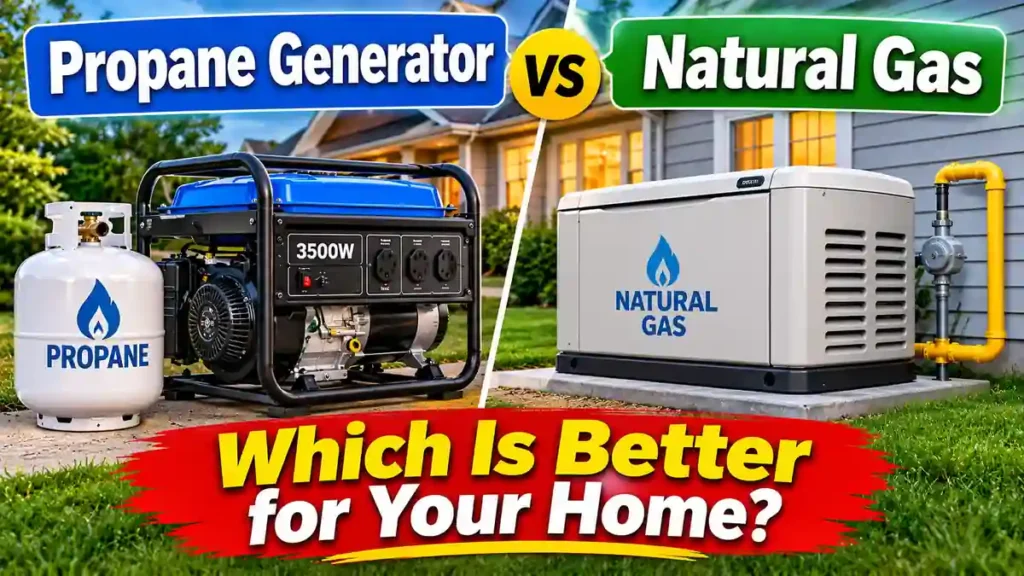
When I compare a propane generator vs. natural gas generator, I don’t start by arguing over which flame is hotter or which fuel sounds cheaper on a utility advertisement. I start with your actual house: Is natural gas available at the property? What happens when the power is out for three days? How much fuel does the generator need at the loads you plan to use? Those questions can change the best choice completely.
Many permanent home standby generators can be configured for either liquid propane vapor (LP) or natural gas (NG). That makes this more of a fuel-system decision than a battle between two unrelated engines. But they do not always make the same electrical power on both fuels, and the piping, pressure requirements and installation costs can differ. I’ll explain the real trade-offs using published model figures, sample cost calculations and an outage-readiness method I would use for my own planning.
Propane generator vs. natural gas: quick comparison chart
| Decision factor | Propane (LP) | Natural gas (NG) |
|---|---|---|
| Fuel location | Liquid stored in an approved outdoor tank on your property | Gas supplied through a utility pipeline and meter |
| Available without utility gas main? | Yes, with an approved tank and supplier | Usually no; utility distribution service needed |
| Supply duration | Finite: depends on stored gallons and burn rate | Potentially continuous while utility service and pressure remain normal |
| Refueling | Bulk-truck refill or approved cylinder change | No on-site refill; billed by utility |
| Typical variable operating cost | Sensitive to delivered price per gallon | Often lower where residential gas tariffs are favorable, not guaranteed |
| Generator electrical rating | Can be slightly higher on a dual-configured unit | May be lower; check model’s NG continuous kW |
| Cold-weather limitation | Tank vaporization and regulator sizing matter | Meter capacity and adequate inlet pressure matter |
| Primary outage vulnerability | Tank depleted, road delivery delay or low vaporization | Utility gas interruption or inadequate pipeline pressure |
| Installation | Tank site, regulator and LP piping plus electrical transfer | Gas meter/piping work plus electrical transfer |
| Best fit | Rural and off-grid homes, or homeowners who value stored fuel | Homes with dependable utility gas and sufficient service |
My first decision rule is simple: do not compare price until you’ve confirmed both fuels are actually available. If your street has no natural gas service, its lower hypothetical hourly cost means nothing. Conversely, if your gas meter already has enough unused capacity, buying and maintaining a large propane tank may add expense without giving you a meaningful benefit for your typical outages.


Are propane and natural gas generators the same machine?
Often, yes. A listed home standby unit may support both LP vapor and NG when configured according to the manufacturer’s instructions. A current 22-kW-class Generac unit is one example: its published specifications list 22 kW maximum continuous power on propane and 21 kW on natural gas. Other models and generations have different ratings, so I would never apply that one-kilowatt difference to every generator.
That does not mean you can freely alternate the fuel line during a storm. Converting a fixed standby system can involve approved settings, fuel-system parts, different delivery pressure, line-size verification, purging and leak testing. Generac specifically cautions against frequently changing its home standby systems back and forth between NG and LP. I would choose the primary fuel during design and arrange any authorized conversion through qualified professionals.
Portable tri-fuel generators are another category and may have a manufacturer-approved selector for gasoline, propane or natural gas. That’s not the same as a fixed automatic standby system. If you’re comparing portable products, my tri-fuel generator compatibility guide explains the distinctions. In this article, I’m primarily comparing propane and natural gas for residential backup power.
How much power do propane and natural gas generators produce?
I always look at continuous watts for the selected fuel before sizing appliances. A unit’s propane rating may not equal its natural gas rating. On the 22-kW Generac example, the LP-to-NG change from 22 to 21 kW is roughly a 4.5% reduction. Older 22-kW-class models have been rated differently, including substantially larger NG derating. There is no trustworthy universal percentage.


| Specification | Propane (LP) | Natural gas (NG) |
|---|---|---|
| Maximum continuous electrical rating | 22 kW | 21 kW |
| Rated voltage | 120/240 V single-phase | 120/240 V single-phase |
| Approx. consumption at 50% rated load | 2.45 US gal/hour | 221 cubic feet/hour |
| Approx. consumption at full rated load | 3.71 US gal/hour | 311 cubic feet/hour |
| Fuel delivery | Approved LP vapor regulator/tank system | Approved natural gas meter/pipe supply |
| Fuel requirement | Model-specified LP inlet pressure | Model-specified NG inlet pressure |
These are one model family’s published figures, not guarantees for your unit. The half-load tests represent half of each fuel’s own rated output, which may be slightly different electrical wattage, so they aren’t a perfect equal-kilowatt laboratory comparison. They are still useful for first-pass budgeting. I would ask the installer for the exact model, fuel-specific data sheet and maximum BTU/hour requirement before finalizing either gas line.
For your house, generator capacity should reflect running loads and motor starting surges, not only square footage. If a well pump or air conditioner draws a large startup current, sizing to LP watts and then operating on NG may leave you short. My guide to calculating your home’s generator power needs walks through a proper load inventory.
Which is cheaper to run: propane or natural gas?
Natural gas is often cheaper to operate when available through an existing residential utility, but the correct answer depends on local rates, delivered propane price, generator design and load. The biggest mistake I see in simple online comparisons is putting dollars per propane gallon next to dollars per natural gas therm without converting them to the same fuel-input and electrical-output basis.
The U.S. Energy Information Administration uses approximately 91,452 BTU per gallon of propane and around 1,036 BTU per cubic foot of natural gas as sample energy factors. One therm is 100,000 BTU. Natural gas’s actual heating value varies with supply, so your utility’s billing conversion is the better number for an exact comparison.
| Measurement | Propane | Natural gas |
|---|---|---|
| Typical retail billing unit | US liquid gallon | Therm, Ccf or utility-specific unit |
| Sample energy per physical unit | ~91,452 BTU/gal | ~1,036 BTU/cubic ft |
| Approximate therm equivalent | 0.9145 therm per gallon | 1 therm = 100,000 BTU |
| How to compare bills | Fuel gallons used × delivered $/gal | Actual therms consumed × $/therm |
| What the math does not include | Tank charges, delivery and taxes | Fixed utility charges, installation and taxes |
Worked fuel-cost example: the same generator on LP or NG
Let’s use the 22-kW manufacturer example at the published half-load points. For illustration only, I will assume $3.00 per gallon of propane and $1.50 per therm of natural gas. These are not October 2026 market price quotes. You should replace both with your own delivered price and gas bill, including the correct utility heating-value factor.



On propane, 2.45 gallons/hour × $3.00 = $7.35 per hour. On natural gas, 221 cubic feet/hour × 1,036 BTU/cubic foot ÷ 100,000 gives approximately 2.29 therms/hour. At $1.50 per therm, that is $3.43 per hour. In this illustrative scenario, NG saves about $3.92 for each generator operating hour at those two half-load test points.
| Comparison | Propane | Natural gas |
|---|---|---|
| Published consumption, half-load point | 2.45 gal/hour | 221 ft³/hour (about 2.29 therm/hour) |
| Assumed retail energy price | $3.00 per gal | $1.50 per therm |
| Estimated running cost | $7.35/hour | $3.43/hour |
| 24 hours of operation | $176.40 | About $82.42 |
| 72 hours of operation | $529.20 | About $247.27 |
| Costs excluded | Tank rental/delivery/fees | Fixed utility charges/fees |
My preference is to separate variable fuel cost from fixed ownership cost. A homeowner who already pays for natural gas service might find NG economical. Someone who would need to bring a new gas main to the home should not ignore the connection expense. A homeowner using propane for a furnace may already have a large tank and a supplier relationship, changing the propane calculation considerably.
One more nuance: you can’t infer electrical efficiency directly from the BTU content of a gallon or cubic foot. The engine’s efficiency and electrical load determine kilowatt-hours produced. I’d compare the fuel-specific rated output and consumption at as close to the same actual electrical load as the data allow. I would not use a simplified propane-versus-gasoline chart for this decision; my separate propane vs gasoline generator efficiency article is about a different fuel comparison.
Runtime: how long can a propane generator run vs. natural gas?
Natural gas offers a compelling advantage: a properly connected standby generator does not depend on an on-property fuel tank. If the utility keeps the gas flowing at the required pressure, the generator can keep operating subject to its service and maintenance limits. But I would never promise “unlimited runtime” without that qualification. Pipeline service can be interrupted or deliberately shut off during emergencies.


Propane puts the fuel reserve under your control, but it is finite. A 500-gallon stationary tank normally holds about 400 gallons at approximately 80% liquid fill. If I choose to preserve a 20% gauge reserve, I would budget just 300 gallons between those levels—not 500. At the example generator’s 2.45 gal/hour half-load rate, that is about 122 hours until the 20% reserve, before counting other propane appliances.
| Nominal tank capacity | Gallons from 80% to 20% | At 2.45 gal/hr | At 3.71 gal/hr |
|---|---|---|---|
| 250 gal | 150 gal | ~61 hours / 2.6 days | ~40 hours / 1.7 days |
| 500 gal | 300 gal | ~122 hours / 5.1 days | ~81 hours / 3.4 days |
| 1,000 gal | 600 gal | ~245 hours / 10.2 days | ~162 hours / 6.7 days |
Those are arithmetic examples, not tank-size approvals. Cold-weather propane vaporization, full-load BTU requirements, tank placement, and gas-piping capacity can require a larger or different system. If the furnace, water heater and generator share the tank, their direct propane demand uses the same reserve. I would have the supplier size the system for simultaneous maximum gas input, not for the typical electrical load alone.
For a broader set of cylinder and bulk storage calculations, see my propane tank size and generator runtime chart. If you’d rather learn how to arrange a refill before a storm, my home generator propane delivery guide compares automatic, will-call and monitored delivery plans.
Reliability during hurricanes, ice storms, earthquakes and long outages
This is where I believe the decision becomes more interesting than price. Natural gas avoids refilling a tank, but its reliability depends on a remote network of infrastructure and utility response. Propane avoids a pipeline connection, yet it depends on the gallons you have and, eventually, road access for delivery. Each fuel has a different failure path.
| Scenario | Propane concern | Natural gas concern |
|---|---|---|
| Multi-day power outage | Finite stored gallons; plan refills or conserve loads | Service may continue if pipeline and pressure remain normal |
| Ice storm and blocked roads | Truck may not reach an almost empty tank | Often avoids delivery need, but service can still fail |
| Earthquake or gas-main damage | On-site tank may remain available if intact and inspected | Gas shutoff, damaged mains or pressure interruption possible |
| Extreme cold | Tank vaporization and regulator performance can limit flow | Available gas volume and inlet pressure must meet demand |
| Remote rural property | Supplier distance and refill lead time | Natural gas main may not exist |
| Unexpected extended outage | Refill planning and maintenance matter | Gas utility contingency plan matters |
I would not assume that natural gas distribution fails whenever the electrical grid fails. In many ordinary blackouts, gas service can remain available. Nor would I assume stored propane is immune to emergencies: an empty tank, damaged regulator, flooding or difficult access can make a perfectly good generator useless. In either case, having enough fuel delivered at the correct pressure is what matters at engine start and full load.
My original two-failure-path test for choosing generator fuel
Instead of asking which fuel is “more reliable” in the abstract, I would run a two-failure-path test for the exact home. I would imagine the next 72-hour outage happening in two ways: Roads blocked, gas lines working; then gas service interrupted, roads open. I’d identify which backup system still has usable fuel in each scenario. This is a planning method I developed for comparing dependencies, not an official technical rating or a claim about a particular utility’s outage history.
For a house with dependable NG, the first scenario favors natural gas because nobody needs to deliver fuel. In the second scenario, an on-site propane tank may be useful—but only if the generator is correctly configured for propane, the tank has enough usable fuel, and the property has no fuel-system damage. I would not tell a homeowner to convert an installed NG generator during an emergency; many systems are not designed for casual fuel switching.
The test helps me distinguish fuel autonomy from fuel continuity. Propane gives you visible, countable autonomy measured in gallons and hours. NG gives you potentially excellent continuity through a utility system, but less direct control over the source. The best fit depends on which failure would cause the greater problem at your address and whether you have a legitimate alternative backup plan.
Installation costs: tank and propane line vs. natural gas meter
I would ask installers for two complete installed quotes whenever both fuels are available. A propane project may include purchasing or leasing an ASME tank, concrete pad or underground tank work, delivery clearance, regulators, trenching, approved piping and first fill. A natural gas project may require a larger meter, upgraded utility service, a permitted line from the meter, pressure verification and utility coordination. Both need appropriate electrical transfer equipment and a code-compliant generator location.
The less obvious cost is the one that appears after the generator arrives. A small existing gas pipe may supply a furnace but not support that furnace and a high-output standby generator simultaneously. The LP tank you already own may hold enough gallons on paper but be unable to vaporize the required fuel at low temperatures. I would request a design showing gas demand in BTU/hour, sizing, and verified inlet pressure at maximum load before approving the quote.
| Expense or requirement | Propane system | Natural gas system |
|---|---|---|
| Fuel source | Approved tank, cylinder arrangement or existing LP supply | Utility service and gas meter |
| Gas line | Approved pipe, regulator and sizing for LP input | Approved pipe, meter capacity and sizing for NG input |
| Site work | Tank setbacks, access, anchoring and possible excavation | Meter/service changes, trenching if needed |
| Electrical | Transfer switch, circuit work and inspections | Transfer switch, circuit work and inspections |
| Ongoing service | Fuel deliveries and possible tank lease | Utility charges and gas service maintenance |
| Professional testing | Fuel pressure, leak checks and generator commissioning | Fuel pressure, leak checks and generator commissioning |
Codes and contractor-licensing laws depend on the location. I would hire appropriately qualified electrical and fuel-gas professionals for a permanent generator and confirm required permits before work begins. My 50-state guide to professional generator installation covers that part of the process without confusing general federal guidance with local rules.
Maintenance, noise, emissions and fuel storage
If the exact same standby model supports LP and NG, routine engine maintenance can be broadly similar: oil and filter service, battery inspection, exercise cycles, air-filter checks and professional periodic testing. I would not choose natural gas simply because someone claimed it is “maintenance-free.” An NG-fueled engine still has an engine, alternator, controls and fuel-delivery components that need inspection.
Noise depends heavily on the generator’s enclosure, engine speed, load, distance and installation—not only the fuel. Emissions also require nuance. Both propane and natural gas are fossil fuels that produce carbon dioxide and potentially carbon monoxide and other combustion pollutants. Methane leakage from natural gas infrastructure and upstream propane production both matter to environmental comparisons. I would avoid claiming either fuel is universally “zero-emission” or perfectly clean.
For stored propane, I would also inspect the condition of the tank and verify supply arrangements before winter. For natural gas, I would ask the utility whether the service can carry the generator and all other gas appliances simultaneously. No matter which one I choose, I would follow a regular propane generator maintenance schedule adapted to the precise equipment and fuel configuration.
Which fuel is better for your particular home?
My recommendation changes with the property, not just the equipment brochure. I would rather see you own a right-sized, correctly installed system you can actually fuel than a huge generator whose most important feature fails on outage day.
| Your situation | My starting choice | Why |
|---|---|---|
| House already has suitably sized, dependable natural gas service | Natural gas | No tank refills and often favorable variable operating costs |
| Rural house without NG pipeline | Propane | On-site storage and supplier delivery are practical |
| Remote home with winter access delays | Propane with generous reserve, professionally sized | Fuel autonomy, but plan for blocked deliveries and vaporization |
| Earthquake-prone area with concerns about NG service | Evaluate propane resilience | Pipeline interruptions can occur; tank siting safety also matters |
| Home has existing properly sized LP tank and supplier | Compare propane first | Avoid assuming NG conversion is cheap |
| New house with both gas services available | Get complete bids for both | Installed costs, power rating and actual bills decide |
| Only a portable generator needed | Compare approved dual/tri-fuel models | Fuel choices and output ratings differ from standby systems |
To confirm the electrical size before deciding on gas, my propane generator size-for-house guide explains how to match common household loads. And for an ownership-based view of outage performance, read whether propane generators are reliable in practice.
What happens if natural gas service stops or propane runs out?
If NG pressure falls below the generator’s required inlet range, the engine can struggle or shut down; a properly designed system should not be forced to operate outside its specifications. If propane is depleted or cannot vaporize fast enough, the engine can show similar symptoms. The standby controller may report a failed start or shutdown. Neither fuel system should be bypassed, modified or switched over through an improvised connection.
For propane runouts, I explain the safe recovery and service considerations in what happens if a propane generator runs out of fuel. For an NG utility interruption, I would contact the gas provider and authorized generator service company. A conversion between fuels may require a licensed gas contractor, new fittings, piping and controller setup—not a homeowner emergency workaround.
Safety: neither propane nor natural gas makes a generator safe indoors
Both fuels power combustion engines capable of producing deadly carbon monoxide. A portable LP or NG generator must be operated outside and well away from doors, windows and vents; public-health guidance generally uses at least 20 feet for portable units. A permanently installed standby unit has its own manufacturer-approved outdoor siting and clearances. The tank or utility gas source being outside does not make an indoor engine safe.
I would install working battery-backed CO alarms indoors, keep vents and openings clear of generator exhaust, and never connect a generator to home wiring using improvised cords. A qualified electrician should provide an approved transfer arrangement. If you smell gas, avoid sparks and flames, get everyone away and contact the supplier or emergency responders from a safe location. For more details see why propane generators cannot be used indoors.
Frequently asked questions
Is propane better than natural gas for a standby generator?
Propane is better when you need fuel stored on-site or have no NG utility access. Natural gas is often the more convenient, economical choice for an existing adequately sized gas service. I would decide based on outages, prices, equipment ratings, fuel delivery and installation rather than declare one winner for every house.
Which fuel makes a standby generator more powerful?
Some dual-configured standby generators deliver more continuous electrical power on propane. For example, a current Generac 22-kW model lists 22 kW LP and 21 kW NG. The difference varies by model, so check the exact fuel-specific specifications before calculating your home load.
Can a natural gas generator be switched to propane?
Some models are field-configurable for either fuel, but that doesn’t make changeover an everyday switch. Fuel pressure, piping, permitted installation and controller settings may differ. I would only arrange an approved conversion through the manufacturer and qualified professionals, with appropriate safety testing.
Will natural gas keep running during a blackout?
It may. A grid outage does not automatically shut down a gas utility, and NG service often continues during ordinary outages. However, pipeline damage, pressure problems or emergency utility shutoffs can interrupt it. I would verify local conditions and maintain a contingency plan rather than guarantee endless fuel.
How long can a 500-gallon propane tank run a home generator?
At the example 2.45 gal/hour half-load consumption, a nominal 500-gallon tank filled to 80% contains about 400 gallons, yielding roughly 163 theoretical running hours. If I preserve a 20% gauge reserve, the planned usable band is about 300 gallons, or 122 hours. Real load, other appliances and winter vaporization change the result.
Is natural gas always cheaper than propane?
No. Prices vary by region, tariff, tank delivery costs and generator efficiency. Natural gas may have a lower variable fuel cost on an existing residential account, but a new utility connection or meter upgrade can change total ownership cost. I would compare complete installed quotes and local unit prices over realistic expected outage hours.
Can I use propane and natural gas together for extra reliability?
Not unless your equipment and fuel system are explicitly engineered and approved for that arrangement. A listed generator may support either fuel after proper configuration, but that does not mean simultaneous mixing or improvised automatic switching is safe. I would use separate, compliant backup arrangements rather than homemade dual-source piping.
My final recommendation
If I already had stable, adequately sized natural gas service, I would usually compare NG first because I value not having to schedule fuel deliveries during an outage. But if I were outside the gas network—or particularly concerned about utility service interruption—I would lean toward a properly sized propane installation with enough storage to carry the outage I actually expect. An on-site tank is valuable because it is physically present, not because it magically guarantees unlimited power.
Before choosing, I would calculate the home load, request the generator’s LP and NG electrical and gas-consumption specifications, obtain two detailed installed quotes if both options exist, and stress-test how each fuel might fail. That sequence is more useful to me than saying one fuel is always cheaper, cleaner or more reliable. The winner is the fuel that can safely deliver the required energy at your address when you need it most.

Mike is an experienced propane technician with over 15 years of professional experience in the field. He has dedicated his career to helping customers with their propane needs, from installation to maintenance and repair. Together with Jeremy, he co-founded this website to provide useful information and guidance to customers seeking reliable propane services.