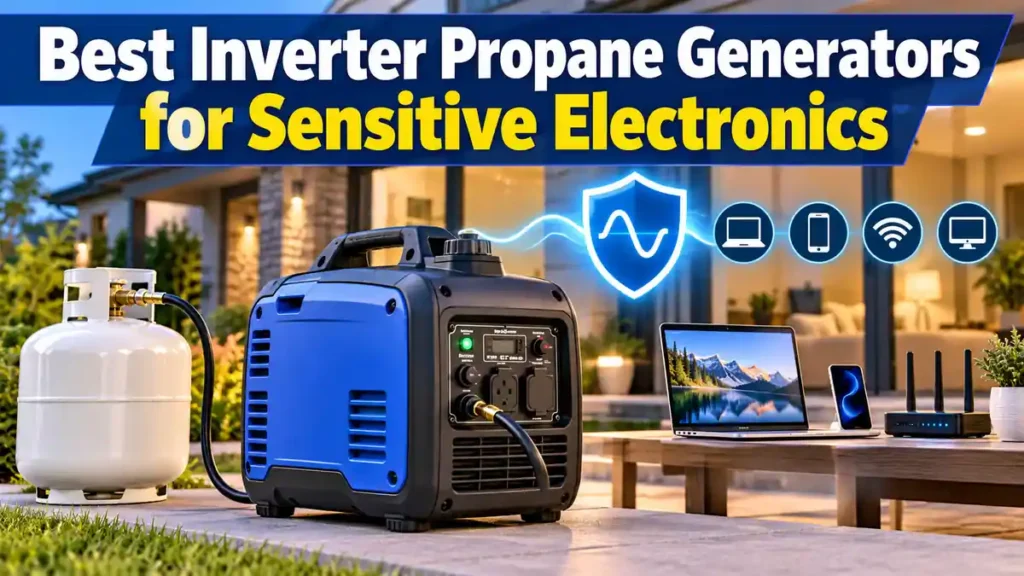
When you’re shopping for the best inverter propane generators for sensitive electronics, I wouldn’t start with the biggest wattage sticker. A 9,500-watt machine might be unnecessary for a laptop, router and monitor, while a tiny inverter might be inadequate if you also need a refrigerator or sump pump. I want the unit to produce stable power and carry the real load with room for a motor to start.
I selected the models in this guide using published manufacturer specifications, not personal laboratory tests. My picks are an editorial comparison of clean-power claims, propane-specific output, practical outlets, portability and the type of household equipment you want to protect. I also include a simple decision framework that I would use before buying, along with example watt calculations so you can determine whether you need a compact inverter or a much larger backup setup.
Best propane inverter generators for sensitive electronics: comparison chart
| Model | LP running watts | Documented power quality | Best use |
|---|---|---|---|
| Champion 201183, 2500W class | 1,665 W | Less than 3% THD | Laptops, router, TV and light-duty electronics |
| Champion 201531, 4500W class | 2,925 W | Less than 3% THD | Lightweight home-office essentials |
| Champion 201319, 4500W class | 3,150 W | Less than 3% THD | Electronics and selected small appliances |
| Westinghouse iGen4500DF | 3,330 W | Less than 3% THD | Convenient remote-start backup |
| DuroMax XP9500iH | 7,200 W | Less than 3% THD | More circuits; 120/240V capability |
I deliberately list propane running watts, not the gasoline starting watts that often appear in the product title. For example, a Champion model marketed as a 4,500-watt inverter may supply only 2,925 continuous watts on LP. You need to base your circuit and appliance plan on the lower applicable rating. If you are unsure what your house actually draws, start with how to calculate home power needs for a propane generator.


I also avoid treating these choices as a claim that one brand is objectively more reliable than another. Current inventory, exact production revision, warranty service in your area and price may change the final ranking. What I can verify is the electrical rating and features published for the specific models listed here.
1. Champion 201183 — my compact pick for laptops, routers and TVs
The Champion 201183 is attractive when your main job is keeping an office connection, communications equipment and a few small devices running. Champion specifies 1,665 propane running watts and 2,500 starting watts on LP, with less than 3% THD. It is a 120-volt-only portable inverter with a 20-amp household duplex receptacle and a 12V accessory outlet. Champion lists a weight of about 39 pounds, making it much easier to move into an approved outdoor location than a 200-pound unit.
Champion advertises up to 34 hours on a 20-lb propane cylinder at 25% load. I would not use that runtime as a promise when operating close to the full 1,665-watt LP rating. The closer I get to the generator’s rated output, the faster it can consume fuel. I consider the 201183 a strong fit for an electronics-first backup plan, not a substitute for a 240-volt whole-home system.
My caution: running a refrigerator or other motor alongside computers can create a starting surge. If essential electronics and a compressor must share the inverter, I would measure the starting load and make sure the generator has sufficient margin. For detailed portable runtime math, see how long a 20-lb propane tank can power a generator.


2. Champion 201531 — my lightweight midrange choice
Champion’s 201531 pairs a 2,925-watt LP running rating with a claimed less-than-3% THD output. It is an enclosed dual-fuel inverter with a household 120V duplex receptacle and a 120V TT-30R RV-style outlet. The manufacturer lists a weight under 55 pounds and a noise figure of 64 dBA measured at 23 feet. I like this capacity range when you want to power work equipment with room for a few ordinary home essentials.
Champion lists propane runtime up to 25 hours from a 20-lb tank at 25% load. That is an example test point, not a runtime guarantee under continuous high use. The model is also parallel ready with a separately sold compatible kit. I would only combine units using the manufacturer’s approved parallel equipment and would never attempt to join AC outlets with homemade cords.
My practical trade-off is that it may be easier to carry than heavier electric-start options, but it does not magically produce 240V electricity. Before buying it for a home panel or larger equipment, I would confirm that your loads can be supported through its available 120V outlets and properly approved connection method.
3. Champion 201319 — best for a slightly larger electronics-and-appliance load
The Champion 201319 raises the LP continuous rating to 3,150 watts and provides 4,500 starting watts on propane under the manufacturer’s specifications. It is an enclosed inverter with less than 3% THD, electric starting, a 120V household duplex outlet and a TT-30R outlet. Champion lists 61 dBA at 23 feet, though real noise depends on distance and operating load.
The advertised LP runtime is up to 21 hours on a 20-lb cylinder at 25% load. What makes it compelling for me is the combination of clean inverter power and slightly more sustained wattage than smaller machines. I can imagine using it for a router, workstations, lights and a refrigerator, provided the load inventory and startup demands fit the LP rating.

I would not choose this model solely because the starting-watt number matches gasoline mode. Starting watts are temporary capability, not the continuous power I can spend on appliances all day. If a well pump or HVAC compressor is among your planned loads, I would check the start characteristics first and consider a larger or different generator.
4. Westinghouse iGen4500DF — best for remote-start convenience
Westinghouse publishes 3,330 LP running watts and 4,050 LP peak watts for the iGen4500DF. The company describes its inverter output as less than 3% THD and specifically markets it for sensitive electronics such as laptops, tablets and televisions. It also includes an LED information display, wheels, telescoping handle and wireless remote starting, which can be useful when convenience matters.
The Westinghouse iGen4500DF is heavier—about 105 pounds according to its product listing—so I would treat the wheels as a major practical feature rather than assume this is a carry-in-one-hand model. Westinghouse also quotes noise as low as 52 dBA under specified conditions, but I would not compare that directly against another brand’s 23-foot reading without checking the measurement setup.
My preference for this model is based on the combination of LP running wattage, convenience features and a documented THD claim. I would verify whether the exact unit offered is the DF, DFc or another revision, because suffixes can correspond to changes in features or compliance. Compare the actual label and manual before deciding.


5. DuroMax XP9500iH — best larger inverter option for home backup
The DuroMax XP9500iH is in a different weight and capacity class. Manufacturer specifications show 7,200 propane running watts, 9,025 LP peak watts, less than 3% THD and 120/240V output. It has a 120/240V locking outlet and other high-capacity connections, which makes it more appropriate to evaluate for a planned backup-circuit installation than the compact 120V-only models.
There are trade-offs. DuroMax lists the unit at roughly 216 pounds dry and recommends at least a 40-lb propane supply for the model. The manufacturer’s published propane example is about 19 hours at 25% load on a 40-lb tank, and much less at a heavier load. That is why I wouldn’t assume a 20-lb grill cylinder is an appropriate fuel solution simply because I can find one nearby.
For a home with computers and appliances on multiple circuits, this is the one I would have an electrician assess first. The generator’s 120/240V capability does not authorize a direct backfeed connection to a house panel. Any transfer switch or interlock must be appropriate for the electrical system and installed as required by local code; see my professional propane generator installation guide.
The technical specifications I check before protecting a computer
My buying checklist starts with total harmonic distortion (THD). THD expresses how much a voltage waveform departs from an ideal sine wave due to harmonic components. Less than 3% is a commonly marketed inverter-generator specification, and these manufacturers publish that claim for the models above. But low THD by itself does not guarantee that voltage will never dip, frequency will never fluctuate or power will never cut off when the generator stalls.
| Specification | What it tells me | Why it matters |
|---|---|---|
| Total harmonic distortion (THD) | How much harmonic distortion is present in AC output | Lower is generally desirable, but it is not the whole picture |
| Continuous LP watts | Sustained output available on propane | Determines the loads I can carry for hours |
| LP starting watts | Brief extra output for motors and startup events | Helps with refrigerator or pump surges |
| 120V vs. 120/240V | Which circuits and receptacles the unit can support | Avoid buying a 120V unit for a 240V requirement |
| Frequency / voltage regulation | Stability under changing load | Sensitive devices and some UPS units may reject poor input |
| UPS compatibility | Whether a UPS accepts generator input without nuisance switching | Important for workstations, NAS and networking |
| CO shutoff and outdoor placement | Engine-exhaust safety features and operating environment | Does not make indoor use safe |
Modern laptop chargers and desktop power supplies often tolerate a reasonable range of AC input, but I don’t generalize that to every specialized device. Some test instruments, uninterruptible power supplies, audio equipment and medical equipment may have stricter requirements. I would follow the connected equipment manufacturer’s voltage, frequency and UPS recommendations—not just the generator’s “electronics safe” advertisement.
My original five-gate clean-power buying test
Instead of assigning a winner from a single product feature, I use five gates. A generator must pass all five for the job I am planning. This is my editorial decision method, not an industry certification, and it is designed to prevent the common mistake of buying based on clean-power marketing alone.
| Gate | My question | Pass condition |
|---|---|---|
| 1 — Waveform | Is THD documented? | Manufacturer publishes a low-THD inverter claim |
| 2 — LP capacity | Can it carry the equipment on propane? | Real running and starting loads fit with margin |
| 3 — Connections | Does it provide the outlets and voltage I need? | Correct 120V/240V configuration and compliant cabling |
| 4 — Continuity | Can critical devices survive a brief interruption? | Appropriately rated, generator-compatible UPS or backup system |
| 5 — Practical safety | Can I use it outdoors with suitable LP supply? | Safe location, compatible cylinder/regulator and approved connections |
A generator could have excellent THD and fail Gate 2 because it cannot start the refrigerator. It could have enough watts and fail Gate 3 because its outputs don’t match a 240-volt appliance. Or it could meet every electrical target yet fail Gate 4 for a network server that must remain powered continuously during an outage. This is why I avoid declaring “the biggest inverter is best for computers.”
How many inverter generator watts do I need for sensitive electronics?
I would build the wattage estimate from actual nameplate or measured power use, not vague device categories. The following figures are hypothetical planning examples, not measured consumption for a particular home. Your desktop may draw much more than a laptop, and a laser printer can briefly use far more power than its quiet idle condition suggests.
| Device | Example running watts | Special consideration |
|---|---|---|
| Fiber modem and Wi-Fi router | 25 W | Small load, but internet may depend on provider backup |
| Laptop and external display | 110 W | Battery provides some short interruption tolerance |
| Desktop workstation plus monitor | 350 W | Use appropriate UPS for unsaved work |
| LED lights | 60 W | Small but continuous demand |
| Television | 100 W | Actual draw depends on model and settings |
| Refrigerator | 180 W | Compressor starting surge can be substantially higher |
| Total including refrigerator | 825 W | Add headroom for starting events, battery chargers and future loads |
In this example, the continuous load is about 825 watts, well within a 1,665-watt LP-rated portable inverter. But I would not stop there. I would check the refrigerator’s starting demand, any simultaneous devices and the output rating in hot weather or at altitude. If the computer is mission-critical, I would put it on an appropriately chosen UPS and avoid combining it with unpredictable heavy motors whenever possible.
If I planned for 1,600 watts of sustained load, the 1,665-watt compact model would leave almost no margin. I would move into the 2,925–3,330-watt propane-rated class, based on my required outlets, load peaks and price. See my home propane generator sizing article for the wider appliance calculation.
Why I would use a UPS even with a low-THD inverter
Inverter power does not mean continuous utility-equivalent service. A generator has to start, reach stable output, stay fueled and survive load changes. If it runs out of propane, trips on overload or is shut down for maintenance, the electricity stops. A surge protector does not keep a desktop running through those interruptions. A UPS with suitable output capacity and battery runtime is the component that bridges short losses of power.
I would check the UPS maker’s generator compatibility guidance. Some line-interactive units may switch repeatedly or reject an input source with voltage or frequency outside their acceptable range. A double-conversion online UPS can provide tighter output regulation, although it is more expensive and must still be correctly sized and compatible. I would not promise that all UPS models work with all inverter generators just because both advertise pure-sine-wave technology.
| Electronics | My preferred strategy | Key limit |
|---|---|---|
| Laptop | Approved AC adapter plus internal battery | Battery duration and charging load matter |
| Desktop PC / workstation | Generator-compatible UPS sized to watts and VA | UPS runtime may be short under heavy load |
| Router / modem | Small properly rated UPS or DC backup | Internet service may still be down outside home |
| NAS / home server | UPS with shutdown signaling when supported | Safe shutdown settings and runtime need testing |
| TV / game console | Compatible surge protection; UPS if continuity matters | Prevents interruption only while UPS has capacity |
| Medical device | Manufacturer-approved emergency power plan | Never assume ordinary consumer gear meets medical needs |
Propane runtime: why light-load claims can be misleading
Manufacturers often publish their longest propane runtimes at 25% electrical load. Those figures make sense for light computer loads but can be misleading if you also expect the generator to run a freezer, portable air conditioner or multiple refrigerators. I would compare each model using its exact specified propane load percentage and tank size, not just the biggest advertised hour figure.
| Inverter model | Published LP runtime | Tank / test condition |
|---|---|---|
| Champion 201183 | Up to 34 hours | 20-lb propane cylinder at 25% load |
| Champion 201531 | Up to 25 hours | 20-lb propane cylinder at 25% load |
| Champion 201319 | Up to 21 hours | 20-lb propane cylinder at 25% load |
| DuroMax XP9500iH | About 19 hours | 40-lb propane cylinder at 25% load |
| Westinghouse iGen4500DF | Check the exact unit’s LP runtime chart | Use model-specific LP fuel consumption and test load |
I can estimate consumption from a claim if the test cylinder is correctly filled. A full 20-lb cylinder contains about 4.7 US gallons of propane; the 34-hour example implies an average consumption near 0.14 gal/hour at that low test load. That is a mathematical estimate from the advertised claim, not an independent measured burn rate. At a higher load, actual consumption can increase.
I also distinguish stored gallons from vapor delivery capacity. A small cylinder can have liquid remaining while cold conditions prevent sufficient fuel flow. For an expanded chart across cylinders and stationary tanks, read my propane tank size chart for generators. If you are using the unit for several days, check the oil-service intervals in my propane generator servicing hours guide.
Portable inverter generators versus whole-home standby systems
If your goal is only to protect computers, networking and a few small appliances, a properly sized portable propane inverter can be a sensible and relatively manageable choice. But if you need central HVAC, 240-volt well pumps, multiple compressors or automatic whole-house transfer, I would first study the full electrical system rather than force a lightweight inverter into a job beyond its design.
You can use portable equipment with approved heavy-duty outdoor-rated cords for individual devices, or with an appropriately installed transfer arrangement when the model and local code allow it. Never plug a generator into a wall outlet to energize the home, and never use improvised double-ended cords. Larger standby and home-backup solutions should be designed around connected loads, fuel supply and qualified installation.
If you’re comparing the convenience of LP fuel against utility gas, my propane generator vs. natural gas guide focuses on that fuel-supply decision. Here, power quality and electronics protection are the priority.
The safety rules I would follow before powering any electronics
Every propane generator described here has a combustion engine that makes carbon monoxide. Low THD, quiet operation and a CO-sensing automatic shutoff do not make a generator safe in a garage, basement, enclosed porch or home. I would operate it outdoors at least 20 feet from doors, windows and vents, direct exhaust away from occupied areas and keep working battery-backed CO alarms indoors.
- Use only the fuel hose, regulator and vapor-withdrawal LP supply specified for the exact generator.
- Keep the generator dry and protected from weather only in manufacturer-approved ways that preserve ventilation.
- Choose outdoor-rated cords of the proper gauge and length; protect plugs from water.
- Confirm the generator’s 120V or 120/240V output matches the equipment and any approved transfer installation.
- Do not place the generator closer to the house merely to shorten the cord or improve Wi-Fi coverage.
- If a gas odor or fuel leak is suspected, shut down only if safe, move away and contact the propane supplier or emergency service.
The health risk is serious even with propane as the fuel. My guide to the dangers of operating propane generators indoors explains placement and carbon monoxide precautions. I would make this a nonnegotiable purchase requirement: if I cannot find a safe legal outdoor location, I would not use a combustion generator there.
Frequently asked questions
Are propane inverter generators safe for computers and TVs?
They can be suitable when the model has documented clean output, the electrical load is within its continuous LP watt rating and the connected electronics accept its voltage and frequency. Less than 3% THD is a useful screening point, but not a blanket guarantee against interruptions, overloads or equipment incompatibility. I would add an appropriately rated UPS for critical desktop computers and networking.
What THD is good for sensitive electronics?
I look for a documented low harmonic distortion specification, often less than 3% THD on current inverter generators. I also check whether the source provides stable voltage and frequency under load, and whether the equipment or UPS manufacturer has stricter limits. THD alone does not describe every power-quality issue.
Can a 2,500-watt propane inverter run a desktop computer?
In many cases, yes, but check its propane running wattage, which may be lower than 2,500 watts. The Champion 201183 is rated at 1,665 running watts on LP. That can support a moderate computer-and-router setup while leaving some room for other low-power devices, but it may not suit a large gaming workstation plus motor loads.
Do I need a UPS if my generator is an inverter?
I would use a compatible UPS for any equipment that must remain powered through brief generator shutdowns, startup delays or transfers. A UPS provides battery continuity and can condition power depending on its design. Check generator compatibility before buying; not every UPS handles all generator frequencies or voltage variations equally.
Can I run a refrigerator and sensitive electronics on the same unit?
Possibly, if continuous watts and the refrigerator’s compressor surge are within the generator’s propane rating and the unit maintains suitable output. I would check motor starting demand and consider keeping the computer behind a UPS. Sharing an overloaded circuit can cause generator shutdowns, regardless of its advertised low THD.
Does a CO shutoff make a propane inverter safe inside the house?
No. Carbon monoxide sensing is an added protective feature, not permission for indoor use. Portable generators must operate outdoors, far from building openings, according to public-health guidance and the manufacturer’s instructions.
My final recommendation
For an electronics-first emergency kit, I’d start with the Champion 201183 if my measured equipment load is modest and portability matters most. If I need more outlets and headroom, I’d compare the Champion 201531 and 201319. If remote start is valuable, the Westinghouse iGen4500DF deserves consideration. If I need a much larger, properly connected 120/240V backup system, I’d evaluate the DuroMax XP9500iH with a qualified electrician.
I would make the final purchase only after my five-gate check: low documented THD, enough LP continuous watts, correct outlet voltage, a UPS plan for equipment that cannot turn off, and a safe outdoor fuel arrangement. I cannot promise these products have never been compared elsewhere, and I haven’t independently lab-tested them; the useful distinction here is choosing for measured electronics needs instead of buying the biggest machine or trusting the words “clean power” alone.

Mike is an experienced propane technician with over 15 years of professional experience in the field. He has dedicated his career to helping customers with their propane needs, from installation to maintenance and repair. Together with Jeremy, he co-founded this website to provide useful information and guidance to customers seeking reliable propane services.