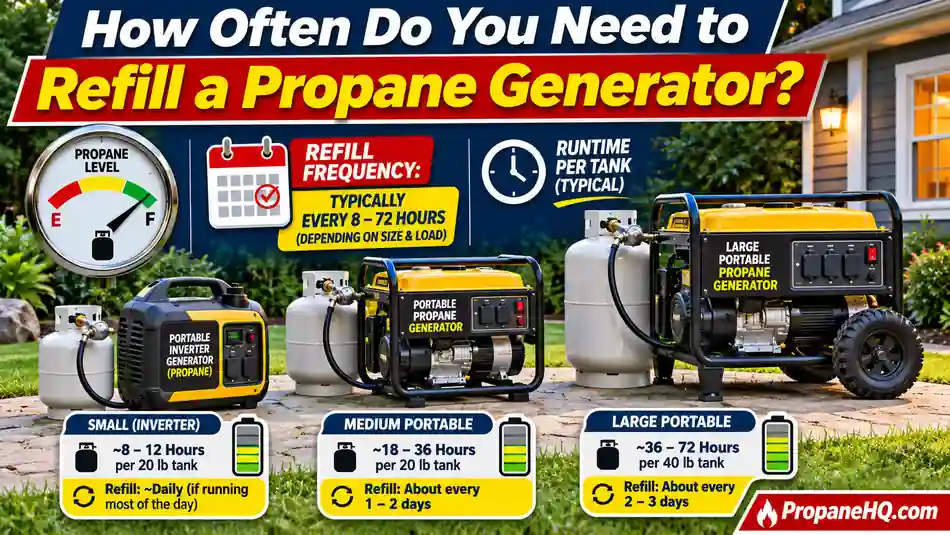
How often do you need to refill a propane generator? A portable generator on a 20-pound cylinder may need fresh propane every day or two—or sooner when heavily loaded. A whole-home standby generator connected to a nominal 500-gallon tank may run for several days continuously before its planned refill point. The deciding factors are gallons burned per hour, hours operated per day, tank contents, and the fuel reserve you want to retain. Generator wattage alone cannot tell you the answer.
TL;DR — Quick answer: A 20-pound cylinder contains approximately 4.7 gallons when properly filled. At 0.45 gal/hour, it supplies around 10.4 operating hours; at 0.14 gal/hour, it could approach 34 hours. A 500-gallon stationary tank normally holds up to approximately 400 gallons, not 500. At 2.36 gal/hour, that is roughly 169 hours (7.1 days) from an 80% fill to empty in ideal arithmetic, but only 127 hours (5.3 days) from 80% to a 20% gauge-level refill point. For accurate planning, use your specific generator’s propane consumption chart, calculate household loads separately, and reorder before the reserve is exhausted.
Propane Generator Refill Frequency Chart
I use the following as a planning illustration, not a promise of runtime. “Full-fill runtime” divides the listed fuel volume by the stated consumption rate; it assumes no other propane appliances, uninterrupted supply, and no operational interruptions. Portable rows are approximate; the 2,000W and 3,500W examples are derived from published Champion model runtimes, and the standby figures are from a specific Generac Guardian fuel-consumption family at 50% load. Your model can differ.
| Generator class | Tank | Load / propane use | Runtime from full fill | Practical refill plan |
|---|---|---|---|---|
| 2,000W inverter | 20 lb / 4.7 gal | 25% / 0.14 gal/hr | ~34 hr | Carry spare cylinders for outages |
| 3,500W portable | 20 lb / 4.7 gal | 50% / 0.45 gal/hr | ~10.4 hr | Refill after a long running day |
| 5,000W portable | 100 lb / 23.6 gal | Assumed moderate / 0.65 gal/hr | ~36 hr | Plan refill before day 2 of nonstop use |
| 7,500W portable | 100 lb / 23.6 gal | Assumed moderate / 1.00 gal/hr | ~24 hr | Arrange replacement within 1 day nonstop |
| 10,000W portable | 250 gal / 200 gal filled | Assumed moderate / 1.35 gal/hr | ~148 hr | Confirm stationary supply suitability |
| 14kW standby | 250 gal / 200 gal filled | 50% / 1.81 gal/hr | ~110 hr | Earlier with household heating |
| 20kW standby | 500 gal / 400 gal filled | 50% / 2.36 gal/hr | ~169 hr | ~127 hr to 20% gauge point |
| 22kW standby | 500 gal / 400 gal filled | 50% / 2.53 gal/hr | ~158 hr | ~119 hr to 20% gauge point |
| 26kW standby | 1,000 gal / 800 gal filled | 50% / 2.06 gal/hr | ~388 hr | ~291 hr to 20% gauge point |
Important: A 26kW unit can use less fuel at half load than an older 22kW unit because engine and alternator efficiencies differ. Do not interpolate one generator’s consumption from another’s nameplate rating. Also, portable-cylinder examples assume the cylinder can vaporize sufficient fuel at the outdoor temperature.


How Long Does Each Propane Tank Size Last?
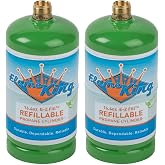
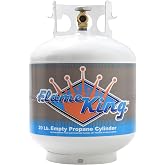
A cylinder’s “20-pound” rating describes propane weight. By contrast, the nominal gallons on stationary tanks describe water capacity, and their usual maximum liquid fill is around 80% to leave expansion space. That is why a nominal 500-gallon tank has approximately 400 gallons at a typical full fill. See my propane tank size chart for generators for the broader sizing comparison.
| Tank size | Propane at normal full fill | Example use / rate | Arithmetic runtime | Planning note |
|---|---|---|---|---|
| 20 lb cylinder | ~4.7 gal | Small portable / 0.45 gal/hr | ~10.4 hr | Exchange/refill or have a spare |
| 30 lb cylinder | ~7.1 gal | Small portable / 0.45 gal/hr | ~15.8 hr | Check transport limits |
| 40 lb cylinder | ~9.4 gal | Small portable / 0.45 gal/hr | ~20.9 hr | Heavier to move |
| 100 lb cylinder | ~23.6 gal | Medium portable / 0.65 gal/hr | ~36.3 hr | Confirm vapor-withdrawal capacity |
| 120 gal tank | ~96 gal | Generator / 1.0 gal/hr | ~96 hr | ~72 hr to 20% gauge point |
| 250 gal tank | ~200 gal | Generator / 1.81 gal/hr | ~110.5 hr | ~82.9 hr to 20% gauge point |
| 500 gal tank | ~400 gal | Standby / 2.36 gal/hr | ~169.5 hr | ~127.1 hr to 20% gauge point |
| 1,000 gal tank | ~800 gal | Standby / 2.36 gal/hr | ~339 hr | ~254.2 hr to 20% gauge point |
These numbers are fuel-volume calculations, not a statement that every tank is approved for every generator. Installation, regulators, piping, temperatures, withdrawal rates, and other household fuel demands must be evaluated. Remember that a cylinder-exchange service may provide a cylinder with less than 20 pounds of propane; check its actual net contents before using the chart.
How Often Do You Refill a 20-Pound Cylinder?
A properly filled 20-pound cylinder provides about 4.7 gallons of liquid propane. A manufacturer’s quarter-load runtime can look impressive, but running an air conditioner or microwave changes consumption substantially. Here are illustrative examples at different loads, not measured curves for one machine.
| Generator | Light use | Medium use | Heavy use |
|---|---|---|---|
| 2,000W class | 0.14 gal/hr → 33.6 hr | 0.25 → 18.8 hr | 0.40 → 11.8 hr |
| 3,500W class | 0.28 → 16.8 hr | 0.45 → 10.4 hr | 0.65 → 7.2 hr |
| 5,000W class | 0.40 → 11.8 hr | 0.65 → 7.2 hr | 0.95 → 4.9 hr |
The first figure in the 2,000W row is consistent with Champion’s published 34-hour quarter-load result for its model 201230; the 3,500W medium figure is consistent with the 10.5-hour half-load result for Champion model 201296. Other entries are rounded assumptions for comparison. For more model-specific context, see how long a 20-lb propane tank runs a generator.


For camping, I prefer planning by operating hours, not just calendar days. If your generator runs four hours daily at 0.45 gal/hour, a full cylinder lasts about 2.6 days mathematically; at eight hours daily, about 1.3 days. Keep a spare if losing power would mean losing refrigeration or battery charging.
How Often Does a 100-Pound Cylinder Need Refilling?
A 100-pound cylinder holds approximately 23.6 gallons at its rated propane fill. Assume a medium portable generator consumes 0.65 gal/hour. To avoid scheduling around the very last drops, suppose you plan to use 20 gallons before changing/refilling the cylinder.
| Operating schedule | Propane per day | Days to 20-gal planning budget | Days to theoretical empty |
|---|---|---|---|
| 4 hr/day | 2.6 gal | 7.7 | 9.1 |
| 8 hr/day | 5.2 gal | 3.8 | 4.5 |
| 12 hr/day | 7.8 gal | 2.6 | 3.0 |
| 24 hr/day | 15.6 gal | 1.3 | 1.5 |
I would not assume a 100-pound cylinder can feed every high-output generator continuously. In cold weather, vaporization can become the limitation before the liquid is consumed. Tank level, surrounding temperature, available liquid surface area, and generator BTU demand affect vapor supply; have the setup evaluated rather than improvising manifolds or regulator changes. See the dedicated 100-lb cylinder runtime guide.
Refilling a 500-Gallon Tank for a Whole-Home Generator
A nominal 500-gallon stationary tank typically receives about 400 gallons at an 80% fill. If I target a refill when the gauge reaches 20% of nominal capacity, I budget only 300 gallons between deliveries: 400 gallons at 80%, less 100 gallons at 20%. This margin protects against delivery delays; it does not guarantee adequate vapor pressure at low temperature or guarantee all 100 remaining gallons can be withdrawn in every condition.
The following consumption figures are manufacturer-published examples for a Generac Guardian generator family, not universal values for every 14–26kW model.

| Generator | Propane at 50% load | Propane at full load | 400-gal arithmetic runtime at 50% | Hours from 80% to 20% at 50% |
|---|---|---|---|---|
| 14kW | 1.81 gal/hr | 3.07 gal/hr | 221 hr / 9.2 days | 166 hr / 6.9 days |
| 20kW | 2.36 gal/hr | 3.74 gal/hr | 169 hr / 7.1 days | 127 hr / 5.3 days |
| 22kW | 2.53 gal/hr | 3.90 gal/hr | 158 hr / 6.6 days | 119 hr / 4.9 days |
| 26kW | 2.06 gal/hr | 3.63 gal/hr | 194 hr / 8.1 days | 146 hr / 6.1 days |
If the 20kW generator runs at full load, that 300-gallon delivery interval falls to 80 hours, only 3.3 days. Lower household demand can extend it. Heating, water heating, cooking, and clothes drying on the same propane tank reduce generator-only runtime further.
Weekly exercise cycles ordinarily consume much less fuel than a multi-day outage, but they still count. For example, at an assumed 0.6 gal/hour during a 12-minute weekly exercise, fuel use is 0.12 gallon/week, or about 6.2 gallons/year. This is strictly an illustration: your generator’s exercise speed, fuel rate, and schedule may differ. Regular servicing matters too; follow propane generator maintenance guidance instead of assuming fuel efficiency stays unchanged forever.
What About a 1,000-Gallon Tank?
At a typical 80% fill, a 1,000-gallon tank contains roughly 800 gallons; at 20% indicated level, approximately 200 gallons remain. For the same 20kW generator at 2.36 gal/hour, compare these two sizes:
| Tank | Maximum illustrative fill | Fuel between 80% and 20% | Time to 20% at 2.36 gal/hr |
|---|---|---|---|
| 500 gal | 400 gal | 300 gal | 127 hr / 5.3 days |
| 1,000 gal | 800 gal | 600 gal | 254 hr / 10.6 days |
That extra delivery interval can be useful for rural properties, lengthy storm outages, or homes also using propane heating. I would still size the fuel system professionally. Doubling storage does not automatically double cold-weather vaporization capacity at a low liquid level, and it does not remove the need to account for household loads.


Generator Size, Load, and Gallons per Hour
A generator’s 20kW rating is maximum electrical output under specified conditions, not a statement that your house draws 20kW all day. A refrigerator, furnace blower, well pump, and lights may draw far less when running. Heavy heating or cooling equipment can drive demand higher.
Fuel consumption normally increases as electrical output rises, but not in a perfectly straight line. Fixed engine losses are part of the reason. A manufacturer’s measured half-load and full-load rates are preferable to simply doubling fuel use for double the load.
| Example load on a 20kW generator | Electrical demand | Fuel rate assumption | 300-gal delivery budget |
|---|---|---|---|
| 25% | 5kW | 1.65 gal/hr, illustrative | 182 hr / 7.6 days |
| 50% | 10kW | 2.36 gal/hr, published example | 127 hr / 5.3 days |
| 75% | 15kW | 3.05 gal/hr, illustrative | 98 hr / 4.1 days |
| 100% | 20kW | 3.74 gal/hr, published example | 80 hr / 3.3 days |
The 25% and 75% rows are planning estimates, not a claimed manufacturer curve. Average demand over 24 hours usually changes as thermostats cycle; for the most precise forecast, log actual household demand and request the matching model consumption data.
How to Calculate Your Refill Frequency
I use three formulas. First, runtime (hours) = available propane (gallons) ÷ consumption (gal/hour). Next, daily fuel use = gal/hour × operating hours/day. Finally, days to planned refill = fuel above your chosen refill threshold ÷ daily fuel use.
Four worked examples
- 3,500W portable, eight hours/day: At 0.45 gal/hour, daily use = 0.45 × 8 = 3.6 gallons. A full 4.7-gallon cylinder lasts 1.3 days mathematically; a fresh cylinder is needed before the second full eight-hour day.
- 7,500W portable, three-day outage: At an illustrative 1.0 gal/hour and 12 hours/day, demand = 1.0 × 12 × 3 = 36 gallons. Two full 100-pound cylinders provide about 47.2 gallons nominally, leaving a margin if the fuel system supports the required flow.
- 20kW standby, 500-gallon tank: Using 2.36 gal/hour continuously at half load gives 300 ÷ 2.36 = 127 hours, or 5.3 days to a planned 20% tank-level refill.
- 26kW standby, seven days: At a model-specific 2.06 gal/hour at 50% load, seven days requires 346 gallons. A 500-gallon tank starting at 80% has 400 gallons total but only 300 gallons before reaching 20%, so an advance delivery or reduced load is prudent.
The key insight is to calculate the fuel you can consume before your planned refill level, not simply all fuel that exists in the container. You can read more about fuel storage selection in what size propane tank you need for a generator.
How Much Propane Does a Generator Burn per Hour?
One gallon of propane contains roughly 91,500 BTU and weighs about 4.2 pounds at 60°F. That chemical energy does not become electricity at 100% efficiency: the engine rejects heat and the alternator has losses. That is why you must not calculate gal/hour directly from rated watts without efficiency information.
| Generator class | Example load | Rate (gal/hr) | Pounds/hr | Fuel in 8 hr | Fuel in 24 hr |
|---|---|---|---|---|---|
| 2,000W inverter | 25% | 0.14 | 0.59 lb | 1.12 gal | 3.36 gal |
| 3,500W portable | 50% | 0.45 | 1.89 lb | 3.60 gal | 10.80 gal |
| 5,000W portable | Moderate, assumed | 0.65 | 2.73 lb | 5.20 gal | 15.60 gal |
| 7,500W portable | Moderate, assumed | 1.00 | 4.20 lb | 8.00 gal | 24.00 gal |
| 10,000W portable | Moderate, assumed | 1.35 | 5.67 lb | 10.80 gal | 32.40 gal |
| 14kW standby | 50% | 1.81 | 7.60 lb | 14.48 gal | 43.44 gal |
| 20kW standby | 50% | 2.36 | 9.91 lb | 18.88 gal | 56.64 gal |
| 22kW standby | 50% | 2.53 | 10.63 lb | 20.24 gal | 60.72 gal |
| 26kW standby | 50% | 2.06 | 8.65 lb | 16.48 gal | 49.44 gal |
Standby figures are representative published Generac Guardian half-load values; small portable figures other than the two Champion reference points are illustrative, rounded rates. They are deliberately separated so you can replace them with your own generator’s specifications.
How Much Does a Propane Tank Refill Cost?
Pricing varies with location, season, supplier, delivery minimum, taxes, and exchange versus refill. Instead of presenting an unverified nationwide average, I use example prices only: $3.75/gallon for cylinder refills and $2.75/gallon for bulk deliveries. An exchange may cost more per actual gallon because the exchanged cylinder’s net fill may be lower.
| Tank / transaction | Example gallons purchased | Assumed unit price | Illustrative bill |
|---|---|---|---|
| Refill 20-lb cylinder from empty | 4.7 | $3.75/gal | $17.63 |
| Refill 30-lb cylinder from empty | 7.1 | $3.75/gal | $26.63 |
| Refill 100-lb cylinder from empty | 23.6 | $3.75/gal | $88.50 |
| 120-gal tank, 20% to 80% | 72 | $2.75/gal | $198.00 |
| 250-gal tank, 20% to 80% | 150 | $2.75/gal | $412.50 |
| 500-gal tank, 20% to 80% | 300 | $2.75/gal | $825.00 |
| 1,000-gal tank, 20% to 80% | 600 | $2.75/gal | $1,650.00 |
These are fuel-only arithmetic examples, not quotations. A stationary delivery ordinarily adds only the gallons needed to restore the tank to the permitted fill level; it is not a purchase of the tank’s entire nominal capacity. For a broader fuel-cost comparison, read whether gas or propane is cheaper for a generator.
When Should You Schedule Your Next Propane Delivery?
For a stationary tank, 20%–30% remaining on the gauge is a common planning reference, but not a mandatory universal rule. I would order earlier if a major storm is approaching, access is difficult, heating shares the tank, or your supplier has long delivery lead times. Agree on a practical reorder threshold with your supplier.
A useful rule is to add delivery lead-time fuel to your chosen safety reserve. If you burn 25 gallons daily and your supplier could take four days, you need 100 gallons for the wait alone, before allowing for emergency or heating reserves. Auto-delivery and telemetry may reduce the need for constant manual checks; will-call owners should record the gauge and daily run hours. Explore ways to arrange propane delivery for a home generator.
Why Is My Generator Using Propane Faster Than Expected?
| What you notice | Possible explanation | Next step |
|---|---|---|
| Run time fell during cold weather | Higher heating load or insufficient vaporization | Check demand; ask supplier to assess supply |
| Cylinder empties quickly | Generator run hours or electrical load increased | Track both and compare with model chart |
| Standby tank gauge falls unusually fast | Heating, water heater, and generator all operating | Include every connected appliance |
| Generator surges or stalls | Fuel restriction, maintenance, overload or other fault | Stop and arrange qualified diagnosis |
| You smell propane | Potential leak | Stop use if safe, leave the area, avoid ignition sources, call supplier/emergency help |
Do not treat a propane smell as normal fuel consumption. If you suspect a leak, follow your supplier’s emergency instructions and do not restart until qualified personnel confirm the system is safe. Review what happens when a propane generator runs out of fuel for restart-related considerations after actual depletion.
How to Make Propane Last Longer
I would begin with load management: avoid running an electric water heater, clothes dryer, microwave, and air conditioner together when that load is unnecessary. Energy-efficient appliances and a battery bank for low-demand hours may help, especially with portable units. Proper maintenance also matters; use the approved oil, filters, and service intervals rather than modifying the fuel regulator or plumbing.
Shortening generator operating hours can save fuel when appliances and batteries can safely tolerate it. Never shut down essential medical devices, sump pumps, freeze protection, or other critical equipment just to meet a fuel target. And a larger generator is not automatically more economical at a tiny load; compare published fuel curves near your actual usage.
Fuel Planning for a 24-Hour, Three-Day, Seven-Day, or Two-Week Outage
| Outage | Assumed operating pattern | Generator fuel needed | Tank implication |
|---|---|---|---|
| 24 hr | 2,000W class at 0.25 gal/hr, nonstop | 6 gal | More than one full 20-lb cylinder |
| 3 days | 7,500W at 1.0 gal/hr, 12 hr/day | 36 gal | Two full 100-lb cylinders nominally |
| 7 days | 20kW at 2.36 gal/hr, nonstop | 396.5 gal | Nearly entire 400-gal full fill; reserve not protected |
| 14 days | 20kW at 2.36 gal/hr, nonstop | 793 gal | Almost 800-gal full fill; delivery or reduced load advisable |
I would add at least an explicit contingency allowance, such as 15%, to my estimated gallons for uncertain schedules: six gallons becomes 6.9, and 36 becomes 41.4. Do not confuse that allowance with the separate stationary tank refill threshold. A 500-gallon tank at 80% could mathematically support seven days at the example 20kW half-load rate, but not while preserving a meaningful reserve, and not if other propane equipment also runs.
Portable-generator safety is part of fuel planning. Run portable propane generators outdoors at least 20 feet from doors, windows, and vents, with exhaust pointed away from occupied spaces. Never operate one in a garage or enclosed RV area, even with doors open; use working carbon monoxide detectors. Do not backfeed a home outlet—use an appropriate transfer switch or interlock installed as required by a qualified electrician. Keep cylinders secured and use only approved fuel connections.
Cold Weather Can Change the Refill Plan
Cold propane produces lower tank vapor pressure, and a small cylinder’s vaporization capability can fall as the liquid level drops. A generator that quits or struggles in freezing conditions may still have liquid propane in the tank. This is not the same as running empty; the supply system might be unable to deliver enough vapor.
Snow-blocked access and propane heating loads can also shorten your delivery window. Before winter, have the supplier or qualified installer check tank sizing, regulator and pipe capacity, expected minimum temperatures, and generator maximum fuel demand. Keep the tank access and the generator’s required air/exhaust clearances safe. Do not heat cylinders with improvised devices or alter regulators to force more flow.
Frequently Asked Questions
1. How often should I refill my propane generator?
I plan refills from a fuel-rate estimate and a realistic running schedule. A 20-pound cylinder could last roughly 10 hours at 0.45 gal/hour, while a large stationary tank may last days. For standby service, set a reorder threshold and keep delivery lead time in the calculation. Use the consumption figures for your precise generator model rather than relying on its kilowatt nameplate.
2. How long will a 20-pound tank run a generator?
A properly filled 20-pound cylinder holds about 4.7 gallons. At 0.25 gal/hour, that is approximately 18.8 hours; at 0.45 gal/hour, about 10.4 hours; and at 0.65 gal/hour, about 7.2 hours. Your operating load, generator efficiency, weather, and the actual amount of fuel supplied determine the result. Some exchanged cylinders contain less than a full 20-pound fill.
3. How long does a 100-pound tank last?
At its rated propane fill, a 100-pound cylinder holds roughly 23.6 gallons. At an illustrative 0.65 gal/hour, the theoretical runtime is 36.3 hours. Running eight hours daily means around 4.5 days until empty, but I would plan to refill sooner. High sustained gas demand in cold weather may exceed the cylinder’s vaporization capability even with liquid remaining.
4. How long does a 500-gallon tank run a 20kW generator?
At a usual maximum fill, a 500-gallon tank carries approximately 400 gallons. A representative 20kW Generac Guardian uses 2.36 gal/hour at 50% load, making the arithmetic runtime around 169 hours. If you arrange refills at a 20% indicated tank level, only 300 gallons are in your delivery budget, or around 127 hours. Other house appliances shorten that window.
5. How long can a 1,000-gallon tank run a whole-house generator?
A nominal 1,000-gallon tank commonly holds approximately 800 gallons at an 80% fill. At 2.36 gal/hour, that is roughly 339 theoretical hours. From 80% down to a planned 20% gauge level, the fuel budget is 600 gallons or about 254 hours, approximately 10.6 days. That does not include fuel burned by heating and other household propane appliances.
6. How much propane does a generator burn per hour?
There is no universal gallon-per-hour figure. A small inverter at light load might consume around 0.14 gal/hour, while a 20kW standby generator at 50% load can use approximately 2.36 gal/hour in a specific published example. At full load, the latter example uses 3.74 gal/hour. Model, efficiency, maintenance, ambient conditions, and actual electrical demand all matter.
7. Does a propane generator use more fuel at full load?
Usually yes, although fuel use is not proportional to electrical load at every point. For one 20kW Generac example, the rate increases from 2.36 gal/hour at 50% load to 3.74 at full load. That is a significant increase, but not a simple doubling. Use your manufacturer’s consumption table to estimate how much load management will save in your situation.
8. How much propane do I need for a three-day outage?
Multiply operating hours by the generator’s gallons-per-hour consumption rate. A medium generator consuming 1.0 gal/hour for 12 hours daily needs 36 gallons over three days. A 15% contingency raises that planning amount to 41.4 gallons. If a standby generator operates continuously, the requirement will likely be much higher. Include heating and all other appliances drawing from the same tank.
9. How much propane should I keep for emergency backup?
Start with the outage duration you are planning for: 24 hours, three days, seven days, or longer. Calculate expected fuel use, add a contingency, and decide on a minimum remaining reserve. Also consider whether roads or suppliers may be unavailable after severe weather. The right quantity differs greatly between a modest portable-generator setup and a whole-home standby system sharing its fuel with heating.
10. At what tank percentage should I order propane?
Many homeowners use roughly 20%–30% remaining as a practical reorder range, but the best point depends on the supplier’s lead time, weather, and your usage. If daily fuel use is high or winter deliveries are uncertain, order earlier. The tank gauge indicates approximate liquid level, not guaranteed hours left, so combine it with your generator’s actual consumption and other propane loads.
11. Can a propane generator run for several days nonstop?
Some standby models are designed to support extended outages, but they still require scheduled maintenance, adequate fuel, airflow, and manufacturer-approved operating conditions. Portable models may have different oil-service and duty-cycle limits. Never assume fuel supply alone determines whether a unit can run continuously. Check the owner manual, monitor operation safely, and plan service access before a multi-day outage.
12. Does cold weather make a generator use more propane?
Electrical demand often rises in winter, especially where the generator runs furnace blowers or electric heating. Cold weather can also reduce a tank’s ability to vaporize propane quickly enough, particularly with a low liquid level or small cylinder. That problem can mimic an empty tank. A professional should evaluate inadequate fuel flow rather than trying to solve it by warming a cylinder or adjusting regulators outside specifications.
13. Is propane cheaper than gasoline for generators?
Not automatically. Compare fuel cost per kilowatt-hour delivered, not merely the price per gallon. Propane and gasoline contain different amounts of energy per gallon, and dual-fuel generators can have different output and consumption on each fuel. Local refill pricing, storage needs, and outage availability also matter. Propane’s long-term storage convenience may outweigh a higher running cost for occasional backup use.
14. How do I know when the tank needs refilling?
For stationary tanks, check the percentage gauge regularly and confirm a reorder threshold with your supplier. For portable cylinders, a suitable scale and the cylinder’s marked tare weight provide a better indication of remaining propane than guesswork; use the correct handling procedure. Combine that reading with expected operating hours. If the generator loses power, do not immediately assume the container is empty—overload, vaporization limits, and maintenance faults can cause similar symptoms.
Final Recommendation: Schedule Refills Before You Need Them
For portable and RV generators, I recommend using a written log of cylinder capacity, running hours, and estimated gallons per hour, plus a safely stored spare when appropriate. For whole-home standby generators, base fuel planning on your actual model’s half-load and full-load specifications, a 20%–30% refill planning threshold adjusted for your supplier, and the propane required by the rest of the household.
My simplest rule: start with the fuel level, subtract the reserve you want to preserve, then divide by your expected gallons per day. Check the assumptions before storm season. A refill schedule built on real consumption and delivery time is much more reliable than an optimistic “days per tank” claim.

Mike is an experienced propane technician with over 15 years of professional experience in the field. He has dedicated his career to helping customers with their propane needs, from installation to maintenance and repair. Together with Jeremy, he co-founded this website to provide useful information and guidance to customers seeking reliable propane services.