Quick Answer: What Propane Fire Pit Should You Buy?
For most homeowners, I would start with a 40,000–55,000 BTU/hour propane fire table if the goal is a furnished patio gathering space, or a portable 30,000–60,000 BTU/hour fire bowl if portability and lower purchase cost matter more. Typical planning budgets are about $100–$300 for a basic portable bowl, $200–$700 for a standard fire table, and $700–$2,500+ for premium designs. These are illustrative US shopping ranges, not promises of current retailer prices.
Before buying, I would confirm the exact model’s safety listing, installation clearance, approved propane cylinder, material, burner input, warranty, replacement parts, and complete ready-to-use price. At a steady 50,000 BTU/hour, a nominal full 20-pound propane cylinder yields roughly 8.6 ideal hours; at $4 per gallon, the fuel cost is approximately $2.19 per hour.
Updated: November 2026. Audience: US homeowners, campers, patio buyers, and renters. I base these comparisons on manufacturer-style equipment specifications, energy calculations, and practical ownership trade-offs. I do not claim to have personally tested every product, and specific store prices, manuals, and regulations must be verified for your model and location.
Propane Fire Pit Types and Prices: Quick-Reference Chart
| Type | Illustrative budget | Typical BTU input | Best use | Main trade-off |
|---|---|---|---|---|
| Tabletop feature | $60–$200 | 8,000–20,000/hr | Small decorative flame outdoors | Limited warmth; restricted setup options |
| Portable fire bowl | $100–$300 | 30,000–60,000/hr | Flexible yard, camping | Cylinder and hose often visible |
| Basic square fire table | $200–$500 | 30,000–50,000/hr | Compact patio seating | Less usable tabletop area |
| Rectangular fire table | $300–$900 | 40,000–70,000/hr | Outdoor sofas and entertaining | More space, weight, cleaning |
| Premium concrete/aluminum feature | $700–$2,500+ | 40,000–100,000/hr | Long-term patio centerpiece | Heavy, costly shipping and repairs |
| Custom built-in propane pit | $2,000–$8,000+ | 50,000–150,000+/hr | Permanent hardscape project | Professional fuel-supply and installation |
The reason I do not recommend one model for everyone is simple: a buyer with a narrow deck, a camping enthusiast, and a homeowner building a stone patio have different constraints. The cheapest device may not fit the space, and the biggest flame may not match the fuel budget. I use this article to help you narrow the type first, then study specific brands and prices in my complete propane fire pit price guide.
1. Choose the Right Type Before Comparing Brands
Portable propane fire bowls
I like portable bowls for occasional gatherings because they are easy to move after cooling and offer a campfire-like look without installing a permanent gas line. Many use a separate standard cylinder and a manufacturer-provided hose and regulator. A 19- to 24-inch bowl may fit in a travel setup, but portability does not make it universally allowed at campgrounds, on balconies, or during fire restrictions. I always confirm the location’s exact rules.
Propane fire tables
A fire table is outdoor furniture with a built-in gas burner. It may hide the cylinder in a ventilated compartment specifically designed for it. Tables can complement patio sofas and offer a perimeter ledge, but I check the manual before treating any part of that ledge as safe for drinks or objects while the fire is burning. A hot table rim is not a dining surface.
Decorative fire bowls and architectural features
Large concrete-composite and aluminum fire bowls are frequently purchased for their appearance. They can become the focal point of a patio without resembling ordinary furniture. Their increased weight can make shipping, positioning, and repair difficult, so I ask about delivery access and damage policies before ordering. Their burner and ignition parts still need appropriate servicing.


Built-in masonry fire pits
A custom feature makes sense when the patio is being designed for long-term use. I would price the approved burner, noncombustible enclosure, drainage, gas supply, permitting and professional installation as a single project. I would not build an unapproved wooden surround around a portable burner or improvise a connection to an existing household line. For deeper format comparisons, read propane fire pit versus fire table comparison.
2. Compare Technical Specifications, Not Just Photographs
I never assume a listing headline tells me everything. A claim like “50,000 BTU, stainless steel” may describe the burner rather than the entire enclosure. Another product may advertise a 20-pound tank but exclude the cylinder and first propane fill. My comparison sheet identifies the fuel system, burner, dimensions, ignition, construction and accessories separately.
| Design category | Representative dimensions | Fuel input | Tank arrangement | Ignition / design issue |
|---|---|---|---|---|
| Compact portable bowl | 19–24 in. diameter | 30k–60k BTU/hr | Approved external cylinder | Manual or spark ignition; check hose length |
| Square patio table | 28–36 in. width | 30k–55k BTU/hr | May conceal 20-lb cylinder | Access door and ventilation matter |
| Long rectangular table | 42–60 in. length | 40k–70k BTU/hr | Internal or external, model-specific | Flame alignment with seating matters |
| Concrete statement bowl | 26–48 in. diameter | 40k–100k BTU/hr | Often external or dedicated cabinet | Heavy body; surface care and service access |
| Permanent custom feature | Designed to site | 50k–150k+ BTU/hr | Engineered supply | Qualified installation and controls |
Look for a model-specific certification or listing for an outdoor decorative gas appliance, which may include CSA or an equivalent recognized testing organization. Check that the documentation matches the exact model and fuel configuration. One published 30-inch outdoor propane fire pit manual, for example, specifies CSA certification, 50,000 BTU/hour input, and a standard 20-pound propane cylinder. This demonstrates how much more useful an actual manual can be than a photograph of the flame.
I also check the specified operating pressure but do not use it to design a substitute regulator. Some low-pressure propane appliance manuals specify roughly 11 inches of water column downstream of a matching regulator. The correct supply pressure, hose and regulator are always determined by that appliance’s instructions—not by a general buying-guide number.
3. Choose the Right Size for Your Patio
When a customer asks me which size to buy, I would start by measuring the actual seating arrangement. Product width alone understates the space it occupies. Chairs, safe access to the cylinder valve, hose routing, combustible materials and manufacturer-specified clearances all compete for room. A long rectangular model may fit a sofa set well but overwhelm a small square patio.



| Patio arrangement | Design to consider | What I measure |
|---|---|---|
| Small outdoor seating nook | Compact square table or approved portable bowl | Full footprint plus specified clearances |
| Four-person conversation circle | Round bowl or square table | Seat distances and walkways |
| Long sofa and two chairs | Rectangular fire table | Length, access to controls and seating alignment |
| Large open backyard | Large bowl or table | Wind exposure and practical viewing distance |
| Balcony or rented property | Only explicitly permitted equipment | Lease, building rules, local fire requirements |
My original layout check is to mark the fire pit’s outline with painter’s tape on the proposed patio surface while the area is empty. Then I position actual chairs and mark where the cylinder would stand if it is external. If I cannot move around the area while meeting the manual’s clearances, I reject that model before comparing colors and finishes. See fire pit guide for renters if the property is rented.
4. Understand BTU Ratings and Real Fuel Consumption
The BTU/hour rating describes the fuel-energy input at the stated firing rate. It does not directly tell me how warm a particular chair will feel. A broad burner can create a different visual flame from a small circular burner with similar input. Wind, seating location, ambient temperature, and enclosure design affect comfort. I resist buying the biggest number simply because it looks impressive in a product comparison.
I calculate theoretical propane consumption using approximately 91,500 BTU per US gallon. A standard nominal 20-pound propane fill contains roughly 4.7 gallons. The manufacturer’s allowed cylinder fill is already accounted for in that quantity, so I do not subtract another 20% in the calculation.
| Rated burner input | Gallons/hour | Ideal runtime, 4.7-gal fill | Fuel cost/hour at $4/gal |
|---|---|---|---|
| 10,000 BTU/hr | 0.109 | 43.0 hr | $0.44 |
| 20,000 BTU/hr | 0.219 | 21.5 hr | $0.87 |
| 30,000 BTU/hr | 0.328 | 14.3 hr | $1.31 |
| 40,000 BTU/hr | 0.437 | 10.8 hr | $1.75 |
| 50,000 BTU/hr | 0.546 | 8.6 hr | $2.19 |
| 60,000 BTU/hr | 0.656 | 7.2 hr | $2.62 |
| 75,000 BTU/hr | 0.820 | 5.7 hr | $3.28 |
| 100,000 BTU/hr | 1.093 | 4.3 hr | $4.37 |
Here are the formulas I use:


- Gallons per hour = BTU/hour ÷ 91,500.
- Hourly fuel expense = gallons per hour × price per gallon.
- Ideal cylinder runtime = usable gallons ÷ gallons per hour.
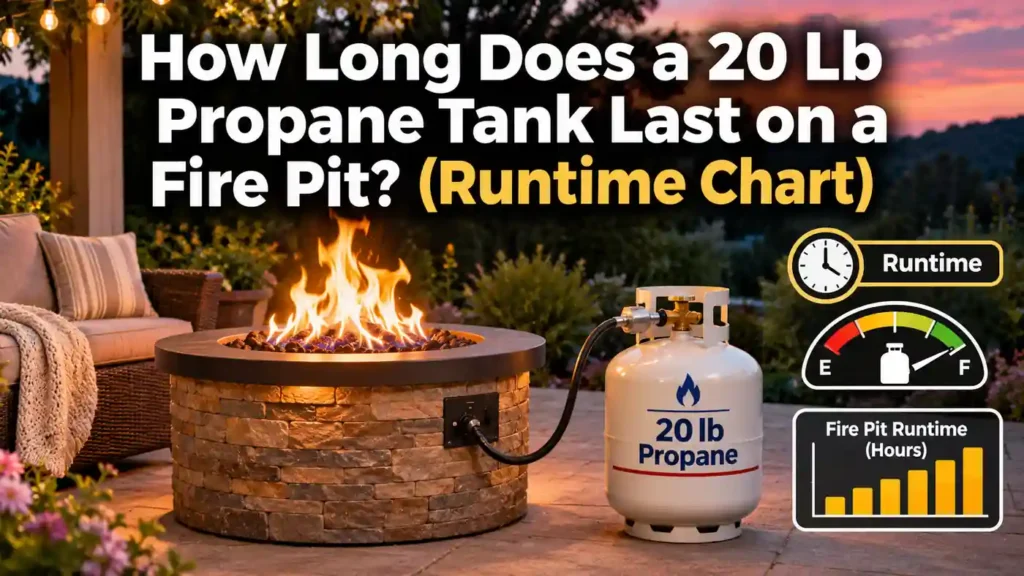
This approach lets me compare a 50,000-BTU fire table with a 58,000-BTU portable bowl without pretending they will burn equal fuel. But the published maximum rating is not a measurement at a lower flame setting. Real operating time can change with the control setting, cold-weather vaporization, and remaining fuel. Use my 20-pound tank runtime chart for a deeper 20-pound tank analysis.
5. How Much Does a Propane Fire Pit Cost to Run?
I estimate operating costs before choosing a model because the fire pit price is only a one-time expense. Propane is purchased again and again. I prefer a small range of fuel-price assumptions rather than one supposedly universal refill price. Your retailer may sell propane by the gallon, flat-rate fill or cylinder exchange; those transactions do not always supply the same quantity.
| Burner | At $3/gal | At $4/gal | At $5/gal | Monthly at 4 hr/week and $4/gal |
|---|---|---|---|---|
| 20,000 BTU/hr | $0.66/hr | $0.87/hr | $1.09/hr | $15.15 |
| 30,000 BTU/hr | $0.98/hr | $1.31/hr | $1.64/hr | $22.73 |
| 40,000 BTU/hr | $1.31/hr | $1.75/hr | $2.19/hr | $30.31 |
| 50,000 BTU/hr | $1.64/hr | $2.19/hr | $2.73/hr | $37.89 |
| 60,000 BTU/hr | $1.97/hr | $2.62/hr | $3.28/hr | $45.46 |
All examples assume continuous rated input and an average month of 52/12 weeks. They exclude cylinder fees, taxes, delivery, unused fuel and repairs. A buyer who uses a fire pit only during a three-month season should not multiply a peak summer weekend by 52. For more usage patterns, visit hourly and monthly fuel-cost guide.
6. Interactive Propane Fire Pit Runtime and Total Cost Calculator
I designed this calculator so you can compare a specific model’s BTU rating, a real propane refill quote, and how many hours you actually expect to use the appliance. It also projects first-year ownership cost, including a nonfuel setup budget. These are estimates, not cylinder gauges or promises about flame performance.
Assumptions: 91,500 BTU per gallon, steady specified input, 52 weeks/year. Actual runtime and expenses vary; this is not a safety or fuel-level instrument.
If your WordPress security settings prevent a script from executing, you can still use the calculation table above or multiply the gallons/hour figure by the local price. I would record a few real refill cycles after purchase, because actual propane consumption often differs from a rating-plate estimate when the flame is turned down.
7. Worked Example: What Does a $400 Fire Table Really Cost?
Assume I buy a 50,000-BTU table for $400, pay $55 for the compatible cylinder, and spend $45 for a cover and accessories not included in the package. My nonfuel setup cost is $500. I plan to use it for three hours every week and propane costs $4 per gallon. Here is my calculation:
- Fuel consumed per hour: 50,000 ÷ 91,500 = about 0.54645 gallons.
- Annual use: 3 hours × 52 weeks = 156 hours.
- Annual consumption: 156 × 0.54645 = about 85.25 gallons.
- Annual propane expense: 85.25 × $4 = about $340.98.
- First-year total: $500 nonfuel setup + $340.98 fuel = approximately $840.98, excluding taxes, fees and repairs.
The example illustrates why I do not compare a $250 bowl with a $400 table using sticker prices alone. The $400 table might serve as patio furniture, while a portable bowl may require an additional table or separate approved tank-cover cabinet. On the other hand, some expensive tables use more fuel than inexpensive bowls. Compare actual accessories, expected use and BTU rather than treating “premium” as fuel-efficient.
8. Which Materials Should You Buy?
Material choice matters most when the fire pit will be exposed to humidity, salt, sun or winter weather. I distinguish the decorative body from the burner and controls. A concrete fire pit may still have ordinary metal hardware; an aluminum table may contain steel fasteners; a product marketed with a stainless burner does not necessarily have a stainless enclosure.
| Material | Why buyers choose it | Potential drawback | What I check |
|---|---|---|---|
| Powder-coated steel | Affordable, common designs | Coating chips and corrosion | Seams, frame quality, finish warranty |
| Aluminum | Often resists red rust | Thin panels or mixed-metal corrosion | Thickness, hinges, fasteners |
| Concrete / GFRC | Architectural appearance, stable heavy form | Weight, cracks, surface stains | Weather care and freight handling |
| Stainless burner | Good corrosion performance when specified | Material grade and service vary | Burner documentation and replacement |
| Resin wicker finish | Matches patio furniture | Heat and UV aging concerns | Approved spacing from burner |
| Stone/tile finish | Decorative and often substantial | Grout, chips, cleaning demands | Temperature and weather guidance |
I would rather choose a reasonably priced, maintainable product with a clear manual than a visually impressive product without obtainable parts. For a realistic lifespan discussion, read how long propane fire pits last. And if you are shopping a marketplace catalog, my Wayfair propane fire pit quality review shows how to compare specifications and warranty details rather than depending on star ratings alone.
9. Features Worth Paying For—and Features I Would Skip
The best features help you use the fire pit safely and conveniently. Features that only look good in photographs should not dominate the budget. I put a model-specific safety listing, stable support, proper ventilation, accessible valve control, approved ignition and fuel arrangements above decorative accessories.
| Feature | Why it can matter | My recommendation |
|---|---|---|
| Adjustable flame control | Lets you change the actual burner output | Worth considering; do not assume knob percent equals BTU percent |
| Approved cylinder compartment | Keeps fuel supply concealed where permitted | Useful if correctly ventilated and accessible |
| Weather cover | May reduce exposure when fully cooled | Worthwhile if manufacturer approves it |
| Removable burner lid | Keeps debris out and can add surface when off | Useful only as manufacturer permits |
| Wind guard | Can change flame behavior | Only use compatible, approved version |
| Fire glass / lava rock | Creates a specific flame appearance | Use exact approved media and depth |
| Electronic ignition | Can improve convenience | Check parts availability and weather protection |
| Conversion to natural gas | May matter to future installations | Do not assume; use specified professional conversion |
Do not add fire glass simply until the entire burner is buried. Too much media may interfere with the appliance’s intended airflow or controls. The correct volume and depth must follow the manufacturer’s specific instructions. A glass wind guard is also not a universal modification; buy one specifically approved for the model.
10. Which Propane Tank Size Do You Need?
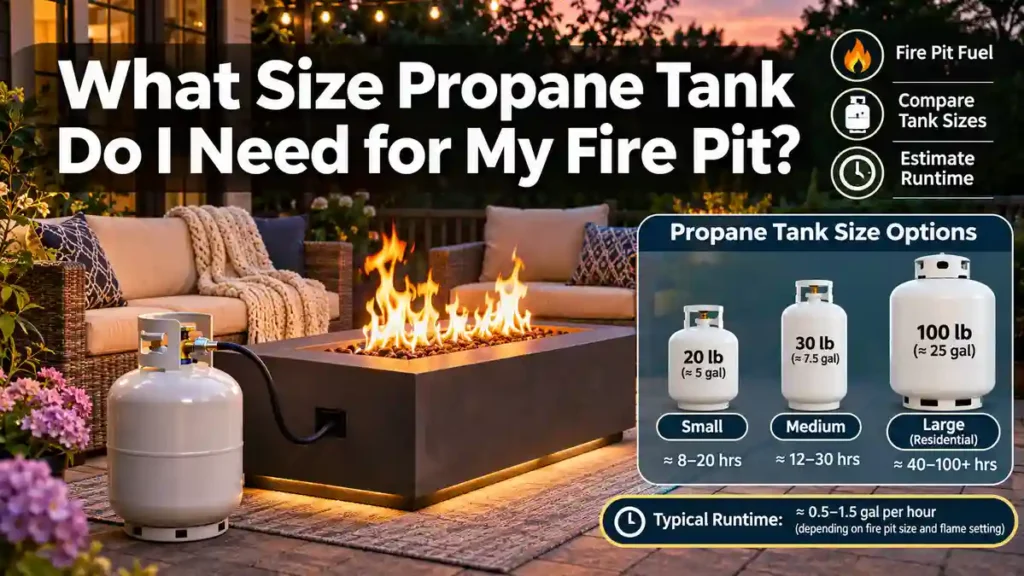
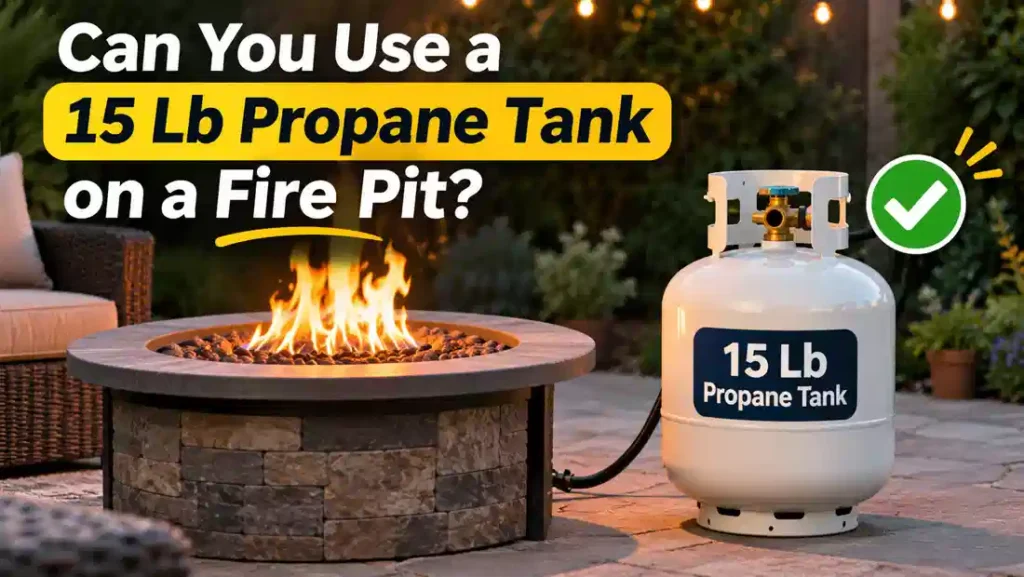
For many standard consumer units, the permitted arrangement centers on a 20-pound vapor-withdrawal cylinder. That cylinder supplies roughly 4.7 gallons when nominally full, and the tank must be handled upright and according to the manual. An exchange cylinder may have less propane by weight than a full 20-pound refill; compare the net fill rather than assuming all exchange cages provide equal fuel.
| Nominal propane fill | Approximate gallons | Ideal 50,000-BTU runtime | Practical caution |
|---|---|---|---|
| 5 lb | 1.18 gal | 2.2 hr | May be incompatible or inadequate at high load |
| 10 lb | 2.35 gal | 4.3 hr | Confirm cylinder type and vapor delivery |
| 15 lb | 3.53 gal | 6.5 hr | Often an exchange fill amount, not a distinct tank size |
| 20 lb | 4.7 gal | 8.6 hr | Common choice only when specified |
| 30 lb | 7.05 gal | 12.9 hr | Larger cylinder may not fit or be approved |
| 40 lb | 9.4 gal | 17.2 hr | Confirm permitted supply and storage |
These are energy-content comparisons, not a recommendation to connect an arbitrary cylinder to your fire pit. Cold temperatures and required vaporization capacity can prevent a small tank from supplying a high-output burner adequately. Never use unapproved adapters or place a cylinder inside an enclosure not designed for it. See propane fire pit tank-size guide before buying a second cylinder.
11. Safety and Installation: My Non-Negotiable Buying Checks
I check the exact manufacturer’s clearance and installation instructions before ordering, because a fire pit that cannot be operated where I intend to put it is a bad purchase regardless of price. Some manuals specify large distances from combustible walls or overhead structures. I do not invent a universal safe clearance from those examples: the listed appliance, local code, decking material and patio layout control the answer.
- Approved outdoor use: Never use a propane fire pit in a house, tent, garage or enclosed porch.
- Correct surface and clearances: Verify both against the manual; do not assume all decks and covered areas are approved.
- Fuel system: Use the specified cylinder, manufacturer-approved regulator and hose.
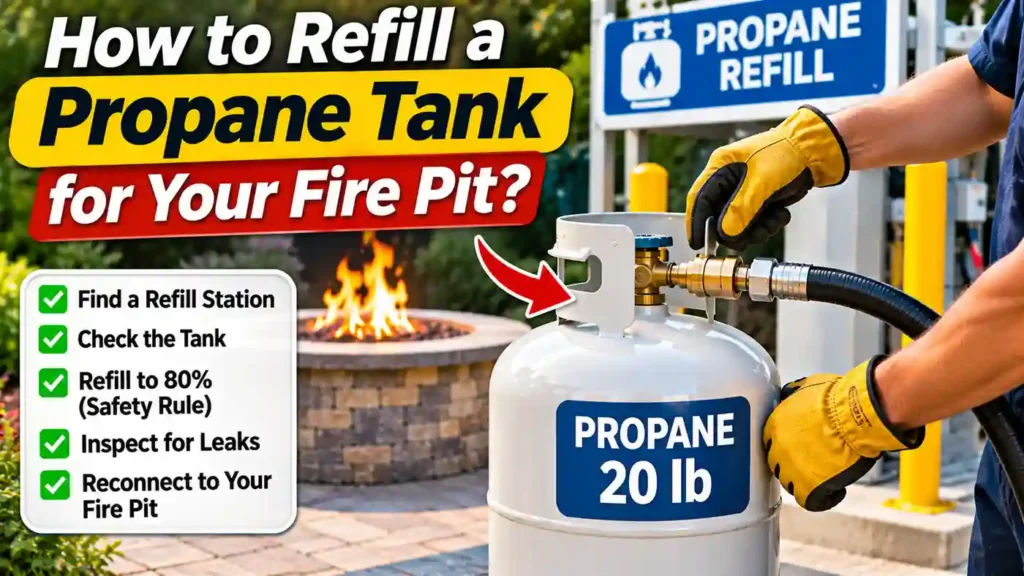
- Leak checks: Perform them only as described in the manual, usually with an approved leak-detection solution. Never use a flame to search for gas leaks.
- Ventilation and wind: Do not block air openings or operate outside stated wind limits.
- Storage: Keep disconnected propane cylinders outdoors in an approved, ventilated location; never indoors or in garages.
- Children and pets: Maintain supervision and separation from hot surfaces and controls.
I recommend reading propane fire pit safety guide before purchasing rather than after assembling the appliance.
12. Compare Five-Year Ownership Cost, Not Just Purchase Price
I use a hypothetical five-year cost comparison to decide whether a more durable or attractive product earns its premium. It is not a guarantee that any given unit lasts five years. For fairness, I assume four use hours each week and $4 per gallon for every product.
| Illustrative unit | Nonfuel setup | Rated BTU/hr | Annual propane | Five-year nonfuel + fuel |
|---|---|---|---|---|
| Budget portable bowl | $270 | 58,000 | $527.39 | $2,906.95 |
| Standard fire table | $590 | 50,000 | $454.64 | $2,863.20 |
| Premium lower-input table | $1,965 | 40,000 | $363.72 | $3,783.60 |
There is an important result here: in this example, the $590 table can cost slightly less over five years than the cheaper $270 portable bowl because it has a smaller rated burner. That is not proof that all fire tables save fuel. If both burners operate at the same BTU rate, the fuel-cost difference disappears. It is the actual gas consumption—not the shape of the enclosure—that drives this result.
The table deliberately omits taxes, repairs, replacement fuel equipment and the residual value of any product. It is most useful as an adjustable thought experiment: substitute the price and rated input of the models you are actually considering.
13. My Fire Pit Buying Decision Guide
When I narrow a purchase shortlist, I start with space and permission, then decide on the atmosphere, then calculate fuel costs. I do not let a sale badge decide before I know whether the model fits the planned location.
| Your situation | My initial shortlist | Next check |
|---|---|---|
| Under $300; occasional backyard gatherings | Portable fire bowl | Safety listing, included hose, camping/local rules |
| $300–$800; furnished patio | Standard fire table | Top size, cylinder access, cover |
| $800+; long-term visual centerpiece | Aluminum or concrete premium unit | Finish, freight, serviceable burner |
| Small patio with sofas | Compact table | Clearance and seating layout |
| Camping and variable locations | Portable bowl | Actual site rules and transporting fuel |
| Coastal/high-humidity location | Corrosion-conscious construction | Frame, burner, fasteners and care |
| Rental or condo | Only explicitly approved design | Written property rules and local restrictions |
| Permanent outdoor renovation | Professionally specified built-in | Permits, piping, installation costs |
I then make a simple purchasing scorecard with six checks: documentation, location fit, cylinder compatibility, material and repairability, total cost, and the review evidence for long-term performance. I score each from zero to two, for a maximum of 12. A high score helps me compare qualified options, but no score compensates for failed safety requirements.
14. My Before-Checkout Checklist
- Did I confirm the exact model’s outdoor listing and documentation?
- Have I marked all manufacturer-required clearances on the actual patio?
- Can the specified cylinder be stored and connected as instructed?
- Did I check rated input, fuel cost and estimated refill frequency?
- Do I know which accessories are included?
- Is the burner serviceable with manufacturer-approved parts?
- Have I read the actual warranty and seller’s return terms?
- Can delivery reach the location without damaging the product or surface?
- Does the fire pit match how often I really entertain?
- Have I considered maintenance and off-season storage?
My final tactic is to compare only two or three models after eliminating unsuitable ones. I create a small spreadsheet with their complete checkout cost, warranty, material, BTU rating, monthly propane budget, and permitted placement. This turns an overwhelming catalog into an understandable decision.
Frequently Asked Questions
How much should I spend on a propane fire pit?
I would expect a simple portable bowl to fit a roughly $100–$300 equipment budget and many standard fire tables to fall around $200–$700. Premium designs may cost considerably more. Compare the price of the complete setup, not only the appliance. See complete propane fire pit price guide for a dedicated breakdown.
Is a 50,000-BTU propane fire pit enough?
It is a common input rating for residential fire tables and portable bowls, but perceived warmth depends on burner geometry, wind and seating. Higher BTU also raises theoretical fuel use, so buy for real comfort and flame preference rather than choosing the biggest number.
Is a fire table better than a fire bowl?
A table is generally better for an integrated furniture arrangement, while a bowl can be better for portability and a campfire atmosphere. Neither design is inherently safer or more fuel-efficient. My propane fire pit versus fire table comparison explores the trade-offs.
How long will a 20-pound cylinder last?
Approximately 8.6 ideal hours with a 50,000-BTU/hour fire pit at full input, assuming 4.7 gallons of propane. At 40,000 BTU/hour, the estimate is about 10.8 hours. Real conditions and flame settings can change runtime.
Can I use a propane fire pit on my deck?
Only if the exact appliance’s manual, surface requirements and applicable rules permit it. Outdoor placement alone does not prove that a combustible deck or covered patio is acceptable.
Which material lasts longest?
There is no guaranteed winner. Aluminum resists red rust, steel can perform well with intact protective coatings, and concrete composites offer a different set of surface and cracking risks. I would judge workmanship, climate suitability, care requirements and replacement-part support. See how long propane fire pits last.
Are all propane fire pits supplied with tanks?
No. Many product packages exclude the cylinder and propane. Confirm “what’s included” and follow the exact model’s approved cylinder requirements.
Is a propane fire pit expensive to maintain?
Routine cleaning and inspection may be modest, but some units can need approved replacement ignition or gas-control components. The biggest recurring cash expense for active owners is often propane. Repair costs vary by model and whether parts remain available.
Should I buy a used propane fire pit?
I would be cautious about missing manuals, unverified gas components, corrosion, unauthorized modifications and uncertain service history. A lower price is worthwhile only if the appliance can be inspected, used and maintained safely with available approved components.
What is the best propane fire pit for beginners?
I would shortlist a complete, properly listed model with straightforward controls, a clear manual, compatible cylinder arrangement and good parts support. The best beginner choice is not necessarily the cheapest or highest-BTU product—it is the one you can safely install, understand and operate.
Final Verdict: How I Would Buy a Propane Fire Pit
I would start with a listed, documented propane appliance that fits the actual outdoor space. For occasional use and portability, a fire bowl often makes sense. For a patio arranged around sofas or lounge chairs, a fire table can be a better use of space. I would then compare materials, warranty, accessories and fuel consumption before deciding what “good value” means.
A high-output fire pit might cost less upfront but consume more fuel across years of use. A premium feature might be worth its price if the finish and furniture function match how I entertain. Neither purchase makes sense if the cylinder setup, clearances or local rules are unsuitable. To keep researching, go next to complete propane fire pit price guide, 20-pound tank runtime chart, propane fire pit safety guide and propane fire pit versus fire table comparison. Those articles answer the important questions that remain after you select your preferred fire pit type.

Mike is an experienced propane technician with over 15 years of professional experience in the field. He has dedicated his career to helping customers with their propane needs, from installation to maintenance and repair. Together with Jeremy, he co-founded this website to provide useful information and guidance to customers seeking reliable propane services.