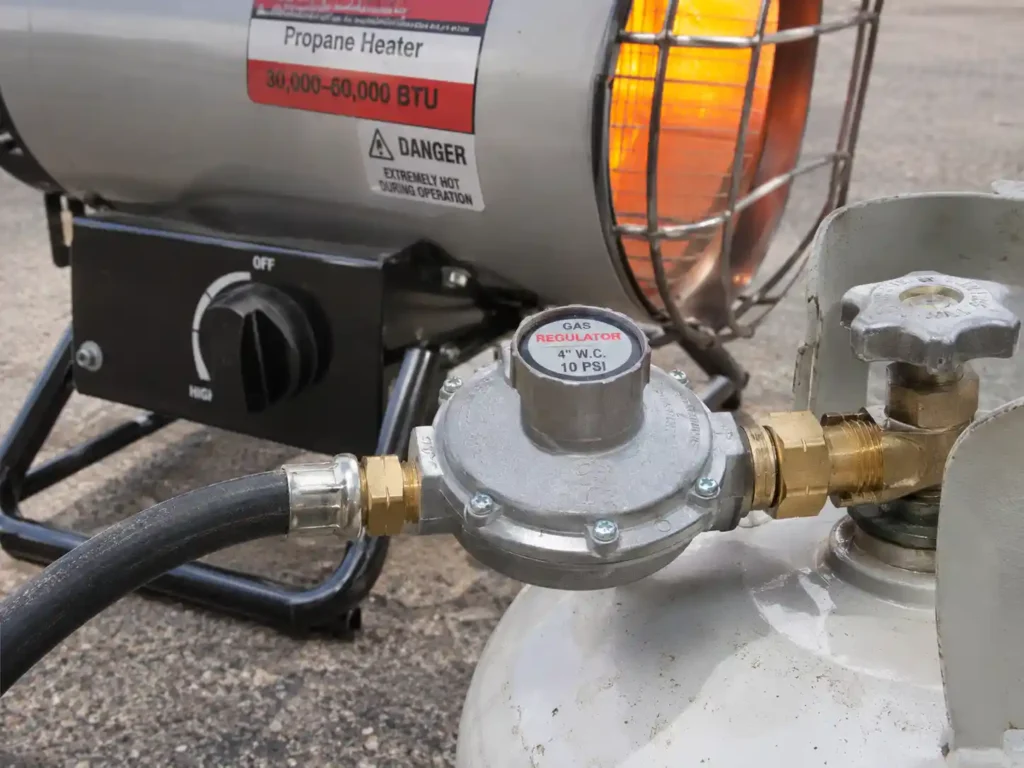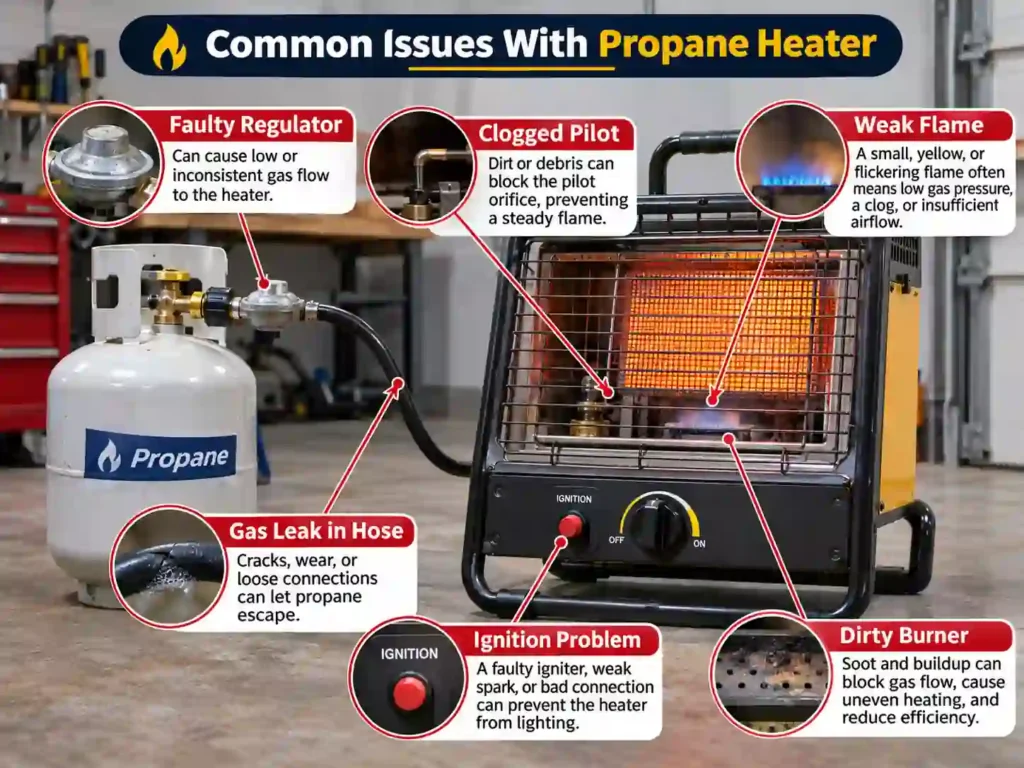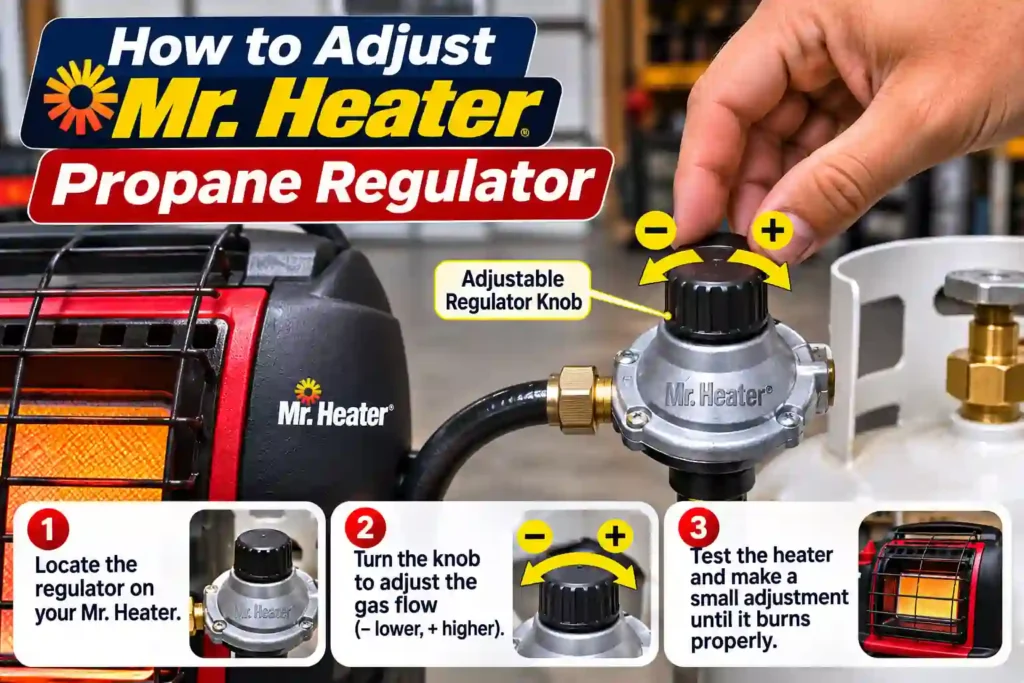


A Mr. Heater propane regulator plays an important role in controlling the gas pressure supplied to your heater. When the regulator operates correctly, the heater receives propane at the pressure required for stable combustion and dependable heating performance.
However, you may occasionally experience problems such as weak flames, insufficient heat, difficulty starting the heater, or unexpected shutdowns. When these problems occur, adjusting the propane regulator might seem like an obvious solution.
Before making any adjustments, you need to understand that not all Mr. Heater propane regulators are adjustable. Many models are factory-set to deliver a specific outlet pressure and should never be modified.


Other regulators, particularly those designed for certain high-pressure construction heaters, may have manufacturer-approved adjustable controls.
In this guide, I’ll explain how to determine whether your Mr. Heater propane regulator is adjustable, how propane pressure affects heater performance, what causes common regulator problems, and when replacement is a better option than adjustment.
Quick Answer
You can adjust a Mr. Heater propane regulator only if it is specifically designed and approved for user adjustment.
Most fixed-pressure regulators used on Buddy heaters, residential wall heaters, and similar appliances should not be internally adjusted.


If your heater has an approved adjustable regulator, follow the operating instructions for that exact model and remain within its specified pressure range.
| Mr. Heater Product Type | Regulator Configuration | Should You Adjust It? |
|---|---|---|
| Portable Buddy heater | Factory-set internal regulator | No |
| Little Buddy heater | Factory-set internal regulator | No |
| Big Buddy heater | Model-specific regulated fuel system | No unauthorized adjustment |
| Vent-free blue-flame heater | Regulated low-pressure supply | Professional servicing only |
| Vent-free infrared heater | Regulated low-pressure supply | Professional servicing only |
| Tank-top heater | Model-specific regulator and heat control | Use approved operating controls only |
| Forced-air construction heater | Model-specific high-pressure regulator | Only if explicitly permitted |
| Big Maxx garage heater | Regulated gas supply and appliance gas valve | Qualified technician only |
| Adjustable high-pressure regulator | Manufacturer-specified adjustment range | Only for approved applications |
If your heater produces insufficient heat, check the propane supply, hose compatibility, temperature conditions, and manufacturer-approved troubleshooting procedures before assuming the regulator needs adjustment.
Never increase regulator pressure beyond the heater manufacturer’s specifications. Excessive propane pressure can cause overfiring, unsafe combustion, equipment damage, fire, or carbon monoxide exposure.
What Does a Mr. Heater Propane Regulator Do?
A propane regulator reduces the relatively high and variable pressure inside a propane cylinder to the pressure required by the heating appliance.
Propane is stored as a liquid under pressure. As the heater consumes propane vapor, additional liquid vaporizes to replenish the supply.



Cylinder pressure changes according to temperature, while the heater requires a relatively stable operating pressure.
The regulator performs several important functions:
- Reduces incoming propane pressure.
- Maintains the required outlet pressure.
- Supplies fuel according to burner demand.
- Supports stable combustion.
- Helps prevent excessive gas pressure from reaching the appliance.
- Compensates for normal variations in supply pressure within its operating limits.
How Propane Pressure Regulation Works
Variable propane vapor pressure
Reduces and controls gas pressure
Supplies propane to the heater
Operates at its specified gas pressure
Conceptual operating diagram. Actual regulator locations, fuel delivery arrangements, and pressure requirements vary according to the heater model.
Without appropriate pressure regulation, the heater may receive too much or too little propane.


However, a regulator cannot compensate for every fuel delivery problem. An undersized propane cylinder, blocked hose, contaminated fuel passage, or malfunctioning gas valve can still cause poor heating performance.
1. Identify Which Mr. Heater Propane Regulator You Have
Before attempting any adjustment, identify the regulator model and the heater it serves.
Mr. Heater manufactures several different types of propane regulators, including fixed low-pressure regulators, two-stage regulators, tank-top regulator assemblies, and adjustable high-pressure regulators.
These products are not interchangeable simply because they are manufactured by the same company.
Common Mr. Heater Propane Regulators
| Regulator Model | Pressure Specification | Typical Application |
|---|---|---|
| F276136 | 11 inches WC | Compatible low-pressure appliances |
| F273767 | 11 inches WC | Compatible low-pressure appliances |
| F273719 | 1–20 PSI, according to the referenced product listing | Approved high-pressure appliances |
| F273763 | 11 inches WC | Two-stage low-pressure regulation |
| F273071 | 11 inches WC | Low-pressure hose and regulator assembly |
| F237314 | Model-specific | Compatible tank-top heaters |
| Buddy internal regulator | Factory specified | Compatible Buddy heaters |
Mr. Heater identifies the F273719 as an adjustable high-pressure regulator, while the F273763 and F273071 are designed for low-pressure applications.
Some older accessory documentation describes the F273719 pressure range as 0–20 PSI, while the referenced product listing specifies 1–20 PSI.
Always check the identification label and documentation supplied with your particular regulator.
A high-pressure regulator can deliver many times the pressure required by a conventional low-pressure propane heater. Installing the wrong regulator can result in serious combustion and fire hazards.
2. Fixed vs. Adjustable Mr. Heater Propane Regulators
Fixed-Pressure Regulator
Designed to maintain a predetermined outlet pressure.
- Factory-set pressure.
- Common in residential propane systems.
- Generally not consumer adjustable.
- Must match appliance pressure requirements.
Adjustable Regulator
Allows pressure selection within its manufacturer-approved operating range.
- Variable outlet pressure.
- Used in specialized applications.
- Requires appliance compatibility.
- Must remain within approved limits.
| Feature | Fixed Regulator | Adjustable Regulator |
|---|---|---|
| Outlet pressure | Predetermined | Adjustable within specified range |
| User adjustment | Generally not permitted | Only as instructed |
| Common applications | Residential and portable appliances | Specialized high-pressure appliances |
| Ease of operation | Relatively simple | Requires compatibility verification |
| Pressure adjustment risk | Unauthorized modification | Incorrect operating pressure |
| Replacement requirements | Match original specifications | Match range and appliance requirements |
A fixed regulator may contain a spring adjustment mechanism beneath a protective cap. However, this does not mean the manufacturer authorizes consumers to adjust it.
Some regulator settings are intended exclusively for factory calibration or qualified service technicians.
For additional information, read my article on inlet pressure versus outlet pressure on a propane regulator.
3. What Pressure Should a Mr. Heater Propane Regulator Be Set At?
There is no universal pressure setting suitable for every Mr. Heater product.
The required pressure depends on the heater’s burner design, gas valve, fuel delivery configuration, and intended application.
For example, Mr. Heater identifies an incoming propane pressure range of 11–14 inches of water column for applicable conventional vent-free blue-flame and infrared heaters.
High-pressure heating equipment may have substantially different requirements.
Propane Pressure Conversion Chart
| Pressure | Equivalent Pressure |
|---|---|
| 5 inches WC | 0.181 PSI |
| 7 inches WC | 0.253 PSI |
| 10 inches WC | 0.361 PSI |
| 11 inches WC | 0.397 PSI |
| 14 inches WC | 0.506 PSI |
| 27.7 inches WC | 1 PSI |
| 138.4 inches WC | 5 PSI |
| 276.8 inches WC | 10 PSI |
| 553.6 inches WC | 20 PSI |
WC stands for water column, a measurement commonly used in low-pressure gas systems.
Low-Pressure vs. High-Pressure Regulator Comparison
The chart compares each pressure against a conventional 11-inch WC gas supply.
11 inches WC: 1×
1 PSI: 2.5×
5 PSI: 12.6×
10 PSI: 25.2×
20 PSI: 50.4×
Pressure comparison only. These values are not interchangeable heater settings or recommended adjustment levels.
Notice that 20 PSI represents approximately 50 times the pressure of an 11-inch WC gas supply.
This illustrates why connecting an inappropriate high-pressure regulator to a low-pressure Mr. Heater appliance can be extremely dangerous.
4. How to Adjust a Mr. Heater Propane Regulator Safely
The correct approach depends on whether the regulator has a manufacturer-approved user adjustment control or a factory-set pressure mechanism.
I recommend following these steps before making any changes.
Identify the Heater Model Number
Locate the manufacturer’s rating plate or identification label.
| Model Number | Mr. Heater Product |
|---|---|
| MH4B | Little Buddy |
| MH9BX | Portable Buddy |
| MH18B | Big Buddy |
| MH15T | Single tank-top heater |
| MH30T | Double tank-top heater |
| MH40LP | Radiant workshop heater |
| MHVFBF30LPT | Vent-free blue-flame heater |
| MHU50 | Big Maxx unit heater |
The model number allows you to identify the correct operating manual, pressure requirements, and replacement parts.
Turn Off the Heater
Follow the manufacturer’s shutdown procedure, close the propane supply valve where applicable, and allow the equipment to cool.
Do not attempt regulator servicing while the heater is operating or when gas leakage is suspected.
Identify the Regulator’s Pressure Rating
Inspect the regulator identification label for the following specifications.
| Specification | What It Tells You |
|---|---|
| Model number | Exact regulator identification. |
| Inlet pressure | Permitted incoming gas pressure. |
| Outlet pressure | Regulated pressure supplied downstream. |
| BTU capacity | Maximum rated fuel delivery capacity under specified conditions. |
| Fuel type | Approved gas compatibility. |
| Adjustment range | Permitted range on adjustable models. |
| Connection type | Required fittings and connections. |
If the regulator label does not identify an adjustable operating range, do not assume it can be adjusted.
Identify the Approved Adjustment Control
Some Mr. Heater products have a marked heat-output control that allows you to select low, medium, or high heating settings.
Certain tank-top heaters, for example, feature a regulator assembly with selectable heating levels. These settings are intended for normal consumer operation.
This differs from removing a regulator’s protective cap and changing its internal spring calibration.
Only use externally accessible operating controls in the manner specified by the exact product manual.
Verify the Manufacturer’s Instructions
Consult the operating instructions for your specific heater and regulator.
If the regulator is designed for consumer adjustment, the manual should explain its permitted operating range and adjustment procedure.
Do not rely on generic instructions telling you to turn a regulator screw clockwise or counterclockwise. Control designs differ, and incorrect adjustment can result in excessive gas pressure.
Arrange Pressure Testing When Necessary
If you suspect that the actual outlet pressure is incorrect, have a qualified propane technician measure the pressure using appropriate testing equipment.
The technician may need to examine both supply pressure and appliance manifold pressure under operating conditions.
If the regulator cannot maintain its specified pressure, replacement may be necessary.
5. How to Adjust a Mr. Heater Buddy Regulator
The Mr. Heater Buddy series uses regulators designed specifically for its portable heating system.
The Portable Buddy MH9BX incorporates a swivel regulator that supports approved disposable-cylinder and remote-cylinder configurations.
You should not attempt to increase the internal regulator pressure to obtain additional heat.
If your Buddy heater produces weak flames, investigate other possible causes.
| Problem | Possible Explanation |
|---|---|
| Weak heating output | Low fuel supply or incorrect heat setting. |
| Heater does not ignite | Ignition or fuel delivery problem. |
| Pilot repeatedly shuts down | Pilot assembly or safety-system problem. |
| Heater works with small cylinder but not remote tank | Hose or fuel supply configuration problem. |
| Heater operates briefly before shutting down | Fuel delivery restriction or safety shutdown. |
| Heater loses output in cold weather | Inadequate propane vaporization. |
A particularly important consideration with Buddy heaters is hose compatibility.
Mr. Heater explains that contaminants from certain high-pressure hoses can enter the heater’s fuel passages and interfere with propane flow.
Manufacturer-approved hoses and filters help address this problem where required.
Replacing or adjusting the regulator will not necessarily correct a contaminated fuel system.
Use the original heat-output controls to regulate heating performance. If the heater does not operate normally at its approved settings, investigate the underlying malfunction rather than attempting to increase regulator pressure.
6. How to Adjust a Mr. Heater Tank-Top Regulator
Many Mr. Heater tank-top heaters allow users to select different heating levels through their original control assembly.
Unlike adjusting internal regulator calibration, selecting an approved heating level is part of normal heater operation.
Depending on the model, the heater may offer the following settings.
| Heat Setting | Intended Function |
|---|---|
| Low | Reduced heating output. |
| Medium | Intermediate heating output. |
| High | Maximum approved heating output. |
| Off | Stops normal heater operation. |
Always follow the model-specific lighting, adjustment, shutdown, and ventilation instructions.
Never modify the regulator to produce more heat than the highest approved setting.
Tank-top heaters are commonly intended for outdoor or specifically approved applications. Do not assume that they are suitable for enclosed residential rooms or garages.
7. How to Adjust a Mr. Heater Wall Heater Regulator
Mr. Heater blue-flame and infrared wall heaters generally require a regulated low-pressure propane supply.
The manufacturer’s vent-free heater guidance specifies incoming propane pressure of approximately 11–14 inches WC for applicable models.
These heaters may have thermostatic controls that regulate burner operation according to room temperature.
However, adjusting the thermostat is different from adjusting propane pressure.
| Control | Function | Consumer Adjustable? |
|---|---|---|
| Thermostat | Sets desired heating temperature. | Yes |
| Heat-output control | Selects approved heating level. | Where provided |
| External supply regulator | Controls incoming gas pressure. | Generally technician only |
| Internal gas valve regulator | Controls appliance gas pressure. | Technician only |
| Oxygen depletion sensor | Provides low-oxygen protection. | No |
| Burner orifice | Controls gas delivery characteristics. | No |
If your wall heater does not produce enough heat, increasing its regulator pressure is not an appropriate solution.
A qualified technician should determine whether the problem involves fuel supply, gas pressure, burner performance, thermostat operation, or building heat loss.
8. How to Adjust a Mr. Heater Big Maxx Regulator
The Mr. Heater Big Maxx series includes forced-air unit heaters commonly installed in approved garages and workshops.
These heaters use gas-control valves, electronic ignition systems, thermostats, and automatic safety controls.
Gas pressure requirements depend on the exact model and whether the heater is configured for natural gas or propane.
I recommend having a qualified technician handle any pressure calibration or fuel conversion.
Unauthorized adjustments may affect burner input, combustion quality, heat exchanger temperatures, and automatic safety functions.
For additional guidance, read my article on choosing a propane regulator for a garage heater.
9. Signs Your Mr. Heater Regulator May Be Delivering Incorrect Pressure
Several operating symptoms may indicate a fuel pressure problem.
However, these symptoms are not necessarily proof that the regulator is defective.
| Symptom | Possible Cause | Recommended Response |
|---|---|---|
| Weak flame | Insufficient gas supply | Check approved fuel configuration. |
| Low heating output | Low pressure or excessive heat loss | Arrange diagnosis. |
| Delayed ignition | Ignition or fuel delivery problem | Stop use and arrange inspection. |
| Unusually large flames | Excessive pressure or combustion fault | Stop using heater. |
| Soot accumulation | Improper combustion | Stop use and arrange professional inspection. |
| Frequent shutdowns | Fuel delivery or safety fault | Identify underlying cause. |
| Excessive regulator icing | Vaporization or regulator issue | Arrange fuel supply inspection. |
| Gas odor | Possible propane leakage | Evacuate immediately. |
| Whistling regulator | Flow, vibration, or regulator problem | Arrange inspection. |
| Unstable burner flame | Variable gas delivery or combustion problem | Professional testing. |
If you experience several of these symptoms simultaneously, read my guide on how to know if a propane heater regulator is failing.
10. How Is Mr. Heater Propane Regulator Pressure Tested?
A manometer allows a qualified technician to determine whether a low-pressure propane system is operating within its required specifications.
There are several measurements that may be relevant.
| Pressure Measurement | Purpose |
|---|---|
| Regulator inlet pressure | Evaluates incoming fuel supply. |
| Regulator outlet pressure | Determines regulated delivery pressure. |
| Appliance inlet pressure | Verifies pressure reaching the heater. |
| Manifold pressure | Evaluates pressure supplied to the burner system. |
| Operating pressure | Measures performance under fuel demand. |
| Lock-up pressure | Evaluates regulator behavior when demand stops. |
These measurements are not necessarily identical.
For example, the referenced Mr. Heater MH40LP manual specifies an incoming propane supply pressure of 11–14 inches WC and a manifold pressure of 10 inches WC.
Example: Mr. Heater MH40LP Pressure Specifications
Incoming Propane Supply Pressure
11–14
Inches WC
Manifold Pressure
10
Inches WC
Model-specific example only. Verify the specifications for your exact heater revision. These are not instructions for consumer pressure calibration.
Confusing manifold pressure with incoming supply pressure could result in improper calibration.
Professional testing is particularly important when servicing permanent gas appliances.
11. Why Your Mr. Heater Has Low Pressure Even With a Good Regulator
A propane regulator may be operating correctly while another part of the fuel system restricts gas flow.
Insufficient Propane
As available propane decreases, a small cylinder may struggle to supply sufficient vapor during cold weather or high-demand operation.
A cylinder can still contain liquid propane while being unable to provide the vaporization rate required by the heater.
Excess-Flow Valve Activation
Certain propane connections incorporate excess-flow protection. Opening the cylinder valve too rapidly can activate this mechanism and restrict fuel flow.
Follow the manufacturer’s approved shutdown and restart procedure if this occurs.
Incorrect Hose Configuration
Connecting an additional regulator to a heater configuration that already regulates gas pressure may cause insufficient delivery pressure.
Mr. Heater warns against over-regulating certain Buddy hose configurations.
Always verify whether your heater requires an unregulated approved hose or a specific regulated connection.
Contaminated Fuel Passages
Oil residue, debris, or other contamination may obstruct gas flow through compatible hoses or internal heater components.
Installing an approved replacement hose or filter may help prevent future contamination where required, but existing internal restrictions may require professional servicing.
Cold Weather
As propane temperature decreases, cylinder pressure and available vaporization capacity may decrease.
Increasing regulator pressure does not solve insufficient propane vaporization.
| Fuel Delivery Problem | Will Regulator Adjustment Solve It? |
|---|---|
| Empty propane cylinder | No |
| Insufficient propane vaporization | No |
| Activated excess-flow protection | No |
| Incorrect fuel hose | No |
| Contaminated fuel passage | No |
| Damaged regulator diaphragm | Approved replacement may be required. |
| Incorrect professional calibration | Qualified technician diagnosis required. |
For additional information, read my guides on why propane regulators have low pressure and why propane regulators keep freezing up.
12. Does Increasing Regulator Pressure Make a Mr. Heater Hotter?
Increasing gas pressure beyond the manufacturer’s specifications is not a safe way to obtain additional heat.
Every propane heater is designed around a particular relationship between fuel pressure, burner configuration, combustion air, and rated heating input.
| Operating Condition | Potential Result |
|---|---|
| Correct pressure | Normal rated heating performance. |
| Insufficient pressure | Reduced heating output or unstable combustion. |
| Excessive pressure | Overfiring and equipment damage. |
| Unstable pressure | Inconsistent burner operation. |
| Incorrect fuel-air mixture | Unsafe combustion. |
| Unauthorized adjustment | Increased fire and carbon monoxide risk. |
If your heater cannot maintain a comfortable temperature despite operating normally, you may need better insulation or a properly sized higher-capacity heater rather than increased propane pressure.
Increasing pressure above the manufacturer’s rating can cause equipment temperatures to exceed their intended operating limits. It may also result in incomplete combustion and increased carbon monoxide production.
13. Mr. Heater Propane Consumption Chart
Understanding normal fuel consumption can help you determine whether your heater’s performance is consistent with its rated input.
One US gallon of propane contains approximately 91,500 BTU of energy.
Gallons per Hour = BTU Input ÷ 91,500
For a 30,000 BTU Mr. Heater:
30,000 ÷ 91,500 = approximately 0.328 gallons per hour.
| Heater Input | Gallons per Hour | Hourly Cost at $3.50/Gallon |
|---|---|---|
| 3,800 BTU/hr | 0.042 | $0.15 |
| 4,000 BTU/hr | 0.044 | $0.15 |
| 9,000 BTU/hr | 0.098 | $0.34 |
| 15,000 BTU/hr | 0.164 | $0.57 |
| 18,000 BTU/hr | 0.197 | $0.69 |
| 20,000 BTU/hr | 0.219 | $0.77 |
| 30,000 BTU/hr | 0.328 | $1.15 |
| 40,000 BTU/hr | 0.437 | $1.53 |
| 50,000 BTU/hr | 0.546 | $1.91 |
| 80,000 BTU/hr | 0.874 | $3.06 |
| 125,000 BTU/hr | 1.366 | $4.78 |
| 170,000 BTU/hr | 1.858 | $6.50 |
These calculations assume continuous operation at the stated fuel input and an illustrative propane price of $3.50 per gallon. Actual consumption varies with burner operation and equipment characteristics.
14. Worked Example: A 30,000 BTU Mr. Heater
Suppose you own a 30,000 BTU Mr. Heater that appears to consume propane faster than expected.
At maximum rated input, its theoretical consumption is approximately 0.328 gallons per hour.
A full 20 lb propane cylinder contains approximately 4.7 gallons of propane.
Expected Fuel Consumption at Rated Input
30,000 ÷ 91,500 = 0.328 gal/hr
Hourly Consumption
0.328 gal
Theoretical 20 lb Fuel Runtime
14.3 hrs
Hourly Fuel Cost
$1.15
Four-Hour Fuel Cost
$4.59
Assumes full-input operation, adequate propane vaporization, and a $3.50 per gallon fuel price. This example does not establish cylinder compatibility.
If your heater consumes considerably more propane than anticipated, do not immediately adjust its regulator.
Actual fuel consumption should be evaluated alongside operating time, available fuel, pilot consumption, and equipment condition.
Mr. Heater Propane Runtime and Cost Calculator
Use this calculator to estimate normal propane consumption based on your heater’s rated BTU input, available propane, fuel price, and operating time.
Mr. Heater Fuel Consumption Estimator
Hourly Propane Consumption
0.328 gal
Theoretical Continuous Runtime
14.3 hrs
Hourly Fuel Expense
$1.15
Daily Fuel Expense
$4.59
Daily Propane Consumption
1.31 gal
Theoretical Fuel Availability
3.6 days
Estimated 30-Day Propane Expense
$137.70
Fuel planning estimates only. Propane tank compatibility, vaporization capacity, and permitted operating periods must be verified separately. This calculator does not diagnose regulator pressure problems or establish the safety of unattended heater operation.
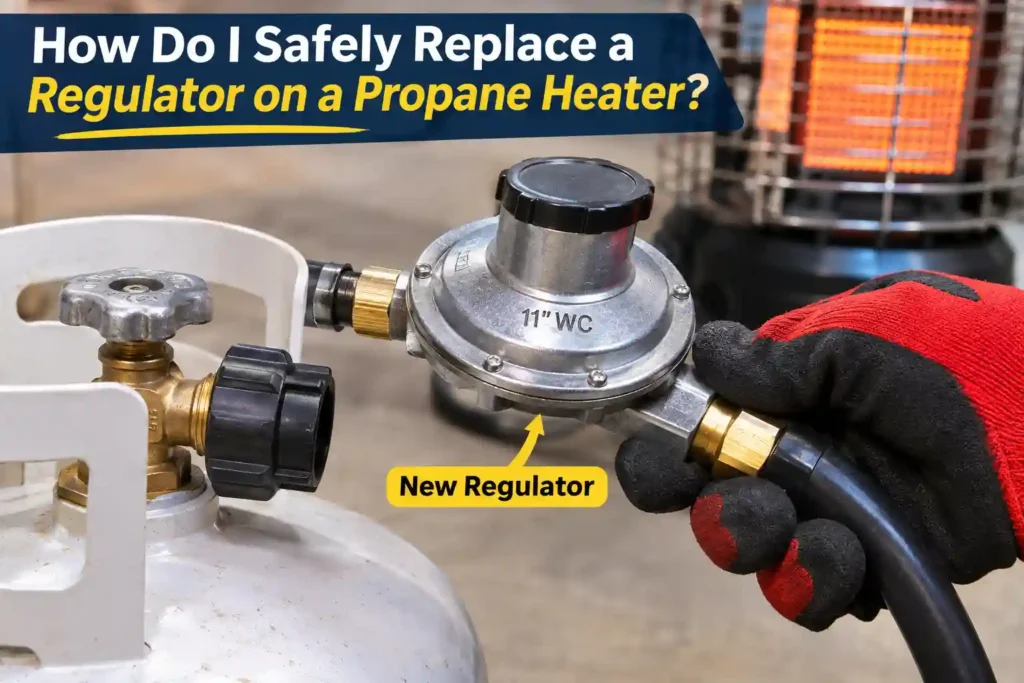
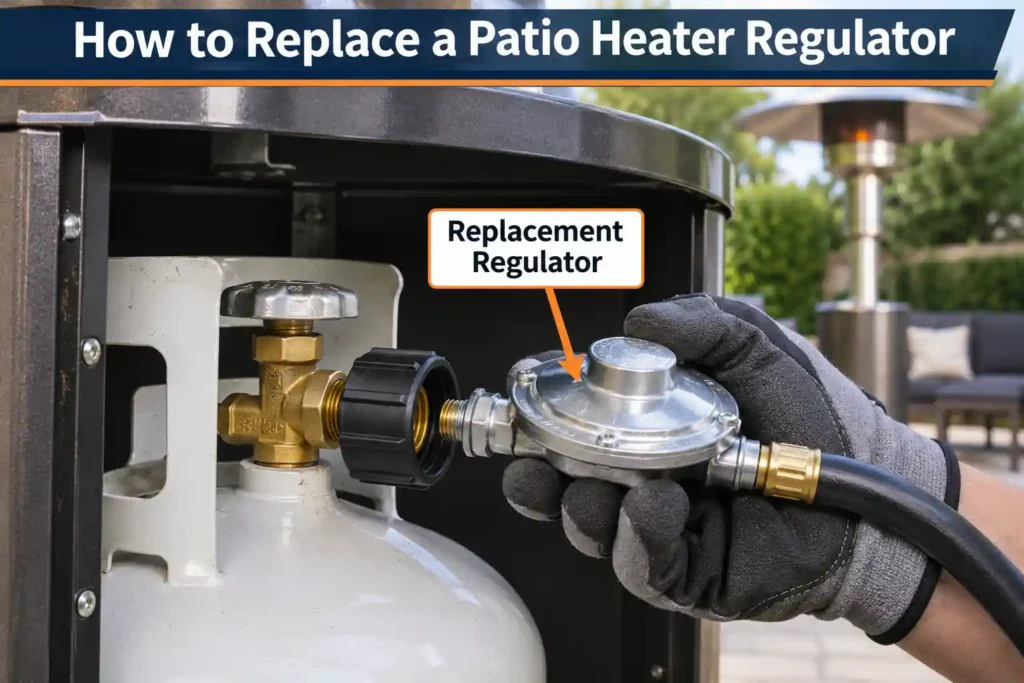
15. Can You Replace a Mr. Heater Propane Regulator Instead of Adjusting It?
Yes. Replacing a defective regulator with the correct manufacturer-approved component is often preferable to attempting to recalibrate or repair it.
Consider replacement if a professional inspection identifies:
- A damaged regulator housing.
- A defective internal diaphragm.
- Excessive corrosion.
- Failure to maintain specified pressure.
- Gas leakage from the regulator body.
- Damaged connections.
- Unreliable pressure regulation.
- A regulator that is no longer suitable for continued service.
The replacement regulator must match the heater’s required inlet pressure, outlet pressure, fuel type, connections, and fuel delivery capacity.
Mr. Heater offers the F237314 replacement regulator for several compatible tank-top heater series, including applicable MH15T, MH30T, and MH45T models.
Always verify the exact heater revision and replacement part number.
What to Check Before Buying a Replacement Regulator
| Specification | Buying Requirement |
|---|---|
| Fuel type | Approved for propane service. |
| Heater model | Confirmed manufacturer compatibility. |
| Outlet pressure | Matches appliance requirements. |
| Inlet pressure rating | Suitable for the approved fuel supply. |
| BTU capacity | Sufficient actual flow capacity. |
| Connection type | Matches approved fittings and connections. |
| Regulator configuration | Correct fixed, adjustable, single-stage, or two-stage design. |
| Installation requirements | Professional installation where specified. |
16. How Much Does a Mr. Heater Propane Regulator Cost?
Replacement expenses depend on the regulator design, heater model, and installation requirements.
| Regulator Type | Estimated Replacement Cost |
|---|---|
| Basic low-pressure regulator | $15–$30 |
| Tank-top replacement regulator | $20–$45 |
| Adjustable high-pressure regulator | $25–$60 |
| Hose and regulator assembly | $25–$75 |
| Two-stage propane regulator | $35–$100 |
| Model-specific internal regulator assembly | $35–$120 |
| Professional diagnosis and replacement | $100–$300 |
Mr. Heater Regulator Replacement Cost Comparison
Basic Low-Pressure Regulator: $15–$30
Tank-Top Replacement Regulator: $20–$45
Adjustable High-Pressure Regulator: $25–$60
Hose and Regulator Assembly: $25–$75
Two-Stage Regulator: $35–$100
Internal Regulator Assembly: $35–$120
Professional Diagnosis and Replacement: $100–$300
Bars represent the upper end of illustrative US budgeting ranges. These are not verified current retailer or contractor quotations.
For additional budgeting information, see my article on the cost of replacing a propane regulator.
17. Should You Adjust, Repair or Replace the Regulator?
Use the following decision guide to determine the appropriate next step when your Mr. Heater does not operate normally.
Mr. Heater Regulator Decision Guide
Yes
Stop operation.
Evacuate immediately if gas leakage or carbon monoxide exposure is suspected. Seek emergency assistance or professional service as appropriate.
No
Identify the heater model and consult its operating manual.
Determine whether consumer adjustment is explicitly permitted.
Yes
Use only the approved operating control according to the exact model instructions.
No
Arrange professional diagnosis and manufacturer-approved replacement if the regulator is defective.
Do not use regulator adjustment as a substitute for identifying a heater malfunction.
| Situation | Recommended Action |
|---|---|
| Heater operates normally but room feels cold | Evaluate heater capacity and building heat loss. |
| Approved heat-output control requires adjustment | Follow manufacturer operating instructions. |
| Fixed regulator produces incorrect pressure | Professional diagnosis. |
| Regulator body is damaged | Stop operation and arrange approved replacement. |
| Internal regulator components are defective | Manufacturer-approved servicing or replacement. |
| Propane leakage is suspected | Evacuate and seek assistance from a safe location. |
18. Mr. Heater Regulator Inspection Checklist
Before considering regulator adjustment or replacement, review the following requirements.
Propane Regulator Inspection Checklist
0 of 14 requirements checked
Completing this checklist does not certify the heater or regulator as safe to operate.
19. Common Mistakes When Adjusting a Mr. Heater Regulator
| Common Mistake | Potential Consequence |
|---|---|
| Assuming all regulators are adjustable | Unauthorized pressure modification. |
| Confusing PSI with inches WC | Severe pressure mismatch. |
| Increasing pressure to produce more heat | Overfiring. |
| Using a universal high-pressure regulator | Incorrect fuel delivery. |
| Installing incompatible hoses | Restricted or excessive gas flow. |
| Adding unnecessary regulators | Insufficient supply pressure. |
| Ignoring cold-weather vaporization | Continued heating problems. |
| Adjusting pressure without proper testing | Incorrect calibration. |
| Bypassing safety controls | Serious safety hazards. |
| Repeatedly restarting a malfunctioning heater | Continued unsafe operation. |
One of the biggest mistakes is assuming that a regulator is defective simply because the heater produces insufficient heat.
Proper diagnosis can prevent unnecessary replacement expenses and unsafe modifications.
20. Important Safety Precautions
Propane regulators are safety-critical components. Incorrect pressure adjustment can affect both fuel delivery and combustion performance.
Mr. Heater Propane Regulator Safety Reminders
- Never exceed the heater’s specified gas pressure.
- Never modify a factory-set regulator spring.
- Never bypass flame-failure or oxygen depletion protection.
- Never enlarge a burner orifice to increase heating output.
- Use only compatible regulators, hoses, and fittings.
- Never use an open flame to check for propane leakage.
- Never operate outdoor-only propane heaters indoors.
- Maintain manufacturer-required ventilation and clearances.
- Never heat a propane cylinder with an open flame or an unapproved heating device.
- Never leave portable propane heaters operating while sleeping or unattended.
- Arrange professional servicing for malfunctioning gas-control equipment.
- Install appropriate carbon monoxide alarms.
- Do not repeatedly restart equipment that experiences unexplained safety shutdowns.
If you smell propane: Leave the affected area immediately. Avoid electrical switches, flames, and other ignition sources. Contact your propane supplier or emergency services from a safe location.
Do not return to the affected area until it has been declared safe.
If a carbon monoxide alarm sounds: Move everyone to fresh air immediately and contact emergency services.
For additional guidance, read my article on whether you can install a propane regulator yourself or need a professional.
Frequently Asked Questions
Can You Adjust a Mr. Heater Buddy Regulator?
The internal regulator should not be adjusted by the consumer. Use the manufacturer’s provided heat-output controls to select the desired heating level.
If the heater produces insufficient heat at its approved settings, investigate possible fuel delivery, ignition, or combustion problems.
Can You Turn Up the Pressure on a Mr. Heater?
Only use adjustments explicitly authorized by the manufacturer. Never increase pressure beyond the heater’s specified operating limits.
Increasing gas pressure is not a safe alternative to purchasing an appropriately sized heater.
What PSI Regulator Does a Mr. Heater Need?
It depends on the model. Many conventional low-pressure heaters require approximately 11 inches WC, equivalent to around 0.397 PSI, while specialized high-pressure equipment may require different pressures.
Always check the appliance rating plate and operating manual.
Why Is My Mr. Heater Flame So Weak?
Possible causes include inadequate fuel supply, cold-weather vaporization, hose restrictions, regulator problems, or burner contamination.
Weak flames do not automatically indicate that the regulator needs adjustment.
How Do I Know if My Mr. Heater Regulator Is Bad?
A defective regulator may produce unstable outlet pressure, inconsistent heating performance, or gas leakage.
Professional pressure testing can help confirm whether replacement is necessary.
Can I Use a 20 PSI Regulator on a Mr. Heater Buddy?
No. Do not supply a Buddy heater with an arbitrary high-pressure regulator configuration.
Use only the connections and fuel supply arrangements approved for the exact Buddy model.
Does a Mr. Heater Regulator Need a Fuel Filter?
Certain Buddy remote-cylinder hose configurations require a compatible fuel filter, while some manufacturer-approved hoses do not.
Consult the exact heater and hose instructions before purchasing a filter.
Can a Mr. Heater Regulator Be Repaired?
Many consumer propane regulators are intended to be replaced rather than internally repaired.
Follow the manufacturer’s service recommendations and use approved replacement components.
Does Adjusting the Regulator Reduce Propane Consumption?
Unauthorized pressure reduction can interfere with proper combustion.
Use the heater’s approved thermostat or heat-output control instead. Improved insulation and shorter operating periods can also help reduce propane expenses.
Why Does My Mr. Heater Regulator Freeze Up?
Possible explanations include high propane demand, insufficient cylinder vaporization, environmental moisture, or equipment problems.
Excessive icing accompanied by poor heater performance requires investigation.
Are All Mr. Heater Regulators Interchangeable?
No. Regulators differ in outlet pressure, flow capacity, connection types, and intended application.
Even regulators manufactured by the same company may be incompatible with different heater models.
What Is the Difference Between a Thermostat and a Propane Regulator?
A thermostat controls heating demand according to temperature. A propane regulator controls gas supply pressure.
Adjusting the thermostat is normal operation on thermostatically controlled heaters. Changing regulator calibration is a separate process that may require professional servicing.
My Final Thoughts
Learning how to adjust a Mr. Heater propane regulator begins with understanding whether the regulator is designed for consumer adjustment.
Most regulators used on Buddy heaters, conventional wall heaters, and permanent garage heating equipment should not be internally adjusted by the user.
Certain tank-top heaters and specialized high-pressure appliances provide approved operating controls, but these must be used according to the manufacturer’s instructions.
If your heater produces weak flames, insufficient heat, or frequent shutdowns, I recommend investigating fuel supply problems, hose compatibility, propane vaporization, and equipment condition before considering regulator replacement.
A properly functioning propane regulator should maintain the pressure required by the appliance.
Increasing pressure beyond that specification is neither a safe nor reliable way to improve heater performance.

Mike is an experienced propane technician with over 15 years of professional experience in the field. He has dedicated his career to helping customers with their propane needs, from installation to maintenance and repair. Together with Jeremy, he co-founded this website to provide useful information and guidance to customers seeking reliable propane services.