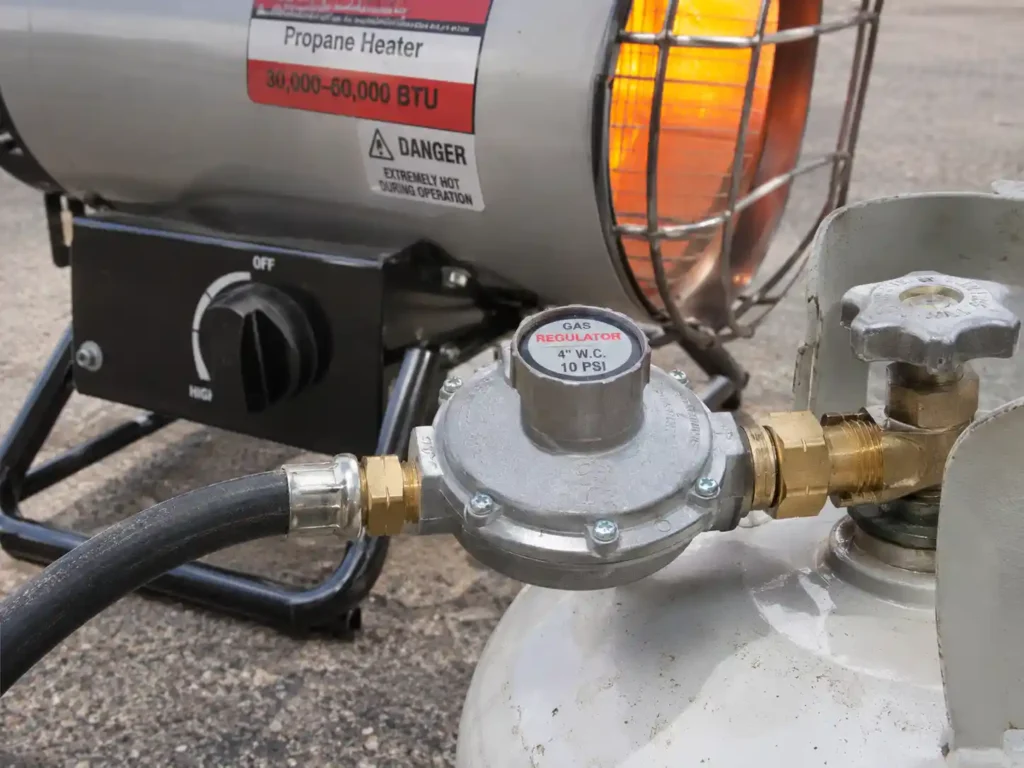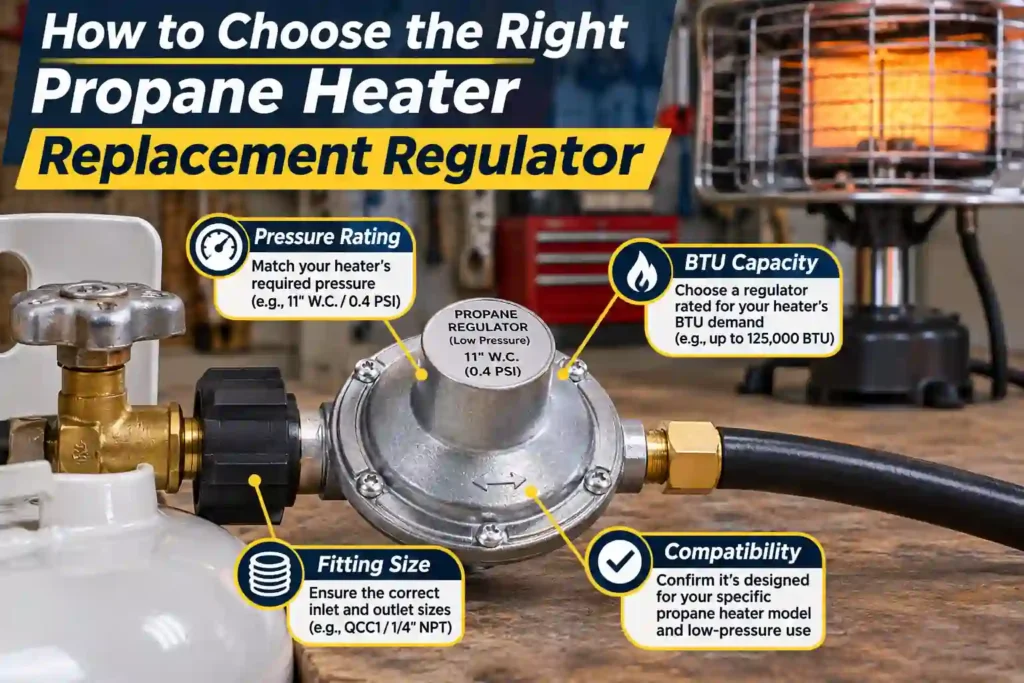


A propane regulator is one of the most important components of a propane heating system. It controls the gas pressure supplied to the heater, allowing the appliance to operate at its intended heating capacity.
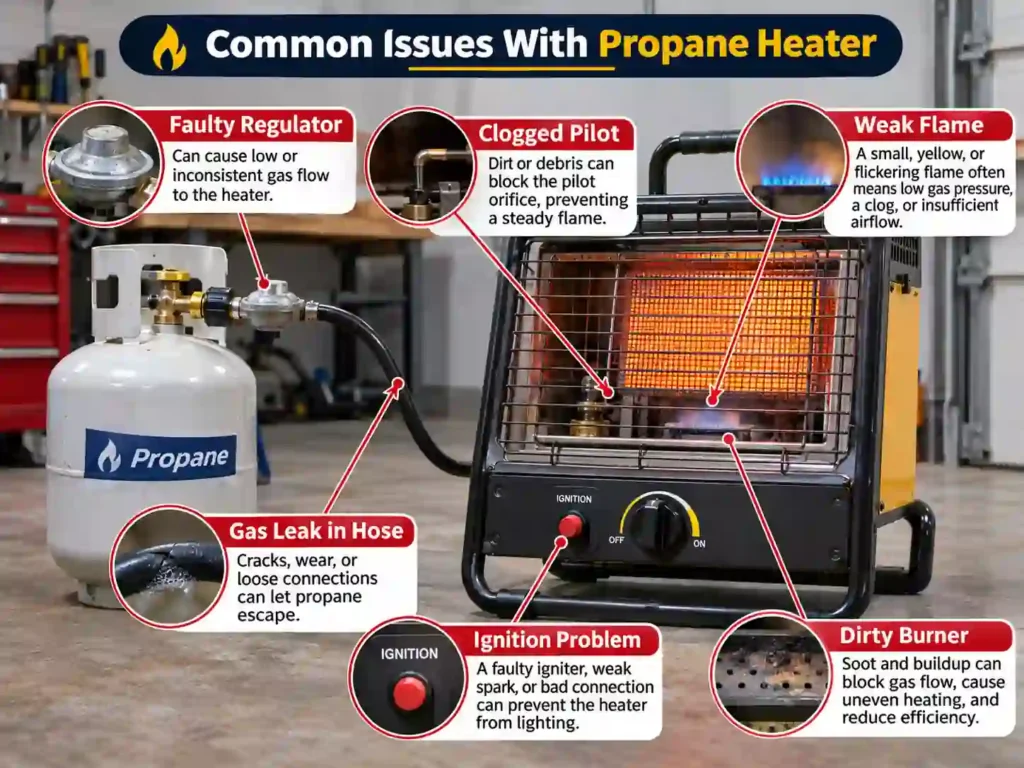
When a regulator becomes damaged, worn out, or defective, you may experience weak flames, insufficient heating, difficulty igniting the burner, or unexpected heater shutdowns.
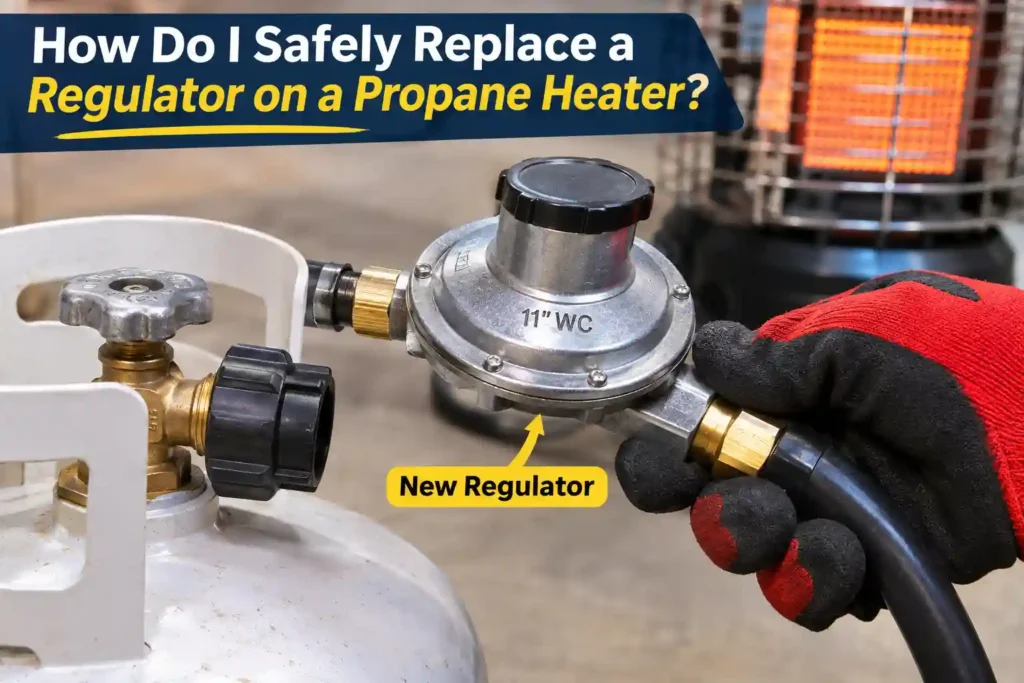
Replacing the regulator may resolve these problems, but choosing the wrong replacement can create additional fuel delivery issues and serious safety hazards.


Propane heater regulators are available in different pressure ratings, BTU capacities, connection sizes, and configurations. Although two regulators may look identical, they may have completely different operating specifications.
When purchasing a replacement regulator, I recommend focusing on compatibility rather than price, physical appearance, or brand alone.
In this guide, I’ll explain how to choose the correct propane heater replacement regulator, understand pressure ratings, identify compatible fittings, compare brands, and avoid common purchasing mistakes.
Quick Answer
To choose the right propane heater replacement regulator, match the original regulator’s outlet pressure, inlet pressure rating, BTU capacity, connection types, fuel compatibility, and manufacturer-approved configuration.


Do not assume that a universal propane regulator will work with every heater.
| Specification | What to Look For |
|---|---|
| Fuel type | Approved for propane or LP gas. |
| Outlet pressure | Matches the heater’s specified supply pressure. |
| Inlet pressure | Suitable for the approved propane supply. |
| BTU capacity | Sufficient for maximum connected fuel demand. |
| Inlet connection | Compatible with the propane supply connection. |
| Outlet connection | Compatible with the heater or approved hose. |
| Regulator type | Correct fixed, adjustable, single-stage, or two-stage configuration. |
| Hose rating | Appropriate for operating pressure and application. |
| Manufacturer approval | Compatible with the exact heater model. |
| Safety certification | Appropriate listing for the intended application. |
For many conventional low-pressure propane heaters, an 11-inch water column regulator may be appropriate. However, portable heaters with integrated regulators and high-pressure construction heaters can have very different requirements.
My recommendation: Identify your heater’s model number and original regulator part number before shopping for a replacement. This is the most reliable starting point for avoiding compatibility problems.
1. When Should You Replace a Propane Heater Regulator?
Before purchasing a replacement regulator, determine whether the existing regulator is actually responsible for your heater’s performance problems.
A propane regulator contains internal components that can deteriorate over time. Exposure to moisture, environmental contamination, corrosion, and physical damage may also affect its performance.



Signs That Your Regulator May Need Replacement
| Warning Sign | Possible Regulator Problem |
|---|---|
| Weak burner flame | Insufficient outlet pressure. |
| Inconsistent heating output | Unstable pressure regulation. |
| Excessive flame height | Excessive outlet pressure. |
| Frequent heater shutdowns | Fuel delivery problems. |
| Gas leaking from regulator body | Damaged internal components. |
| Excessive corrosion | Deteriorating regulator housing. |
| Unusual whistling | Internal vibration or flow restriction. |
| Excessive regulator freezing | Fuel supply or regulator malfunction. |
| Damaged threads | Compromised connection. |
| Cracked regulator housing | Physical damage. |
These symptoms may also result from problems elsewhere in the propane system.
For example, a heater may produce weak flames because the propane cylinder cannot supply sufficient vapor during cold weather, even when the regulator is functioning correctly.
If you are unsure whether replacement is necessary, read my guide on how to know if a propane heater regulator is failing.
Stop using equipment with suspected regulator damage, abnormal combustion, or unexplained safety shutdowns until it has been properly inspected.


If you smell propane, evacuate immediately and contact your propane supplier or emergency services from a safe location.
2. Identify the Type of Propane Heater You Have
Different propane heaters use different fuel delivery systems. Identifying your heater type is an essential part of choosing a replacement regulator.
| Heater Type | Typical Regulator Configuration | Replacement Consideration |
|---|---|---|
| Portable Buddy heater | Integrated regulator | Manufacturer-specific replacement. |
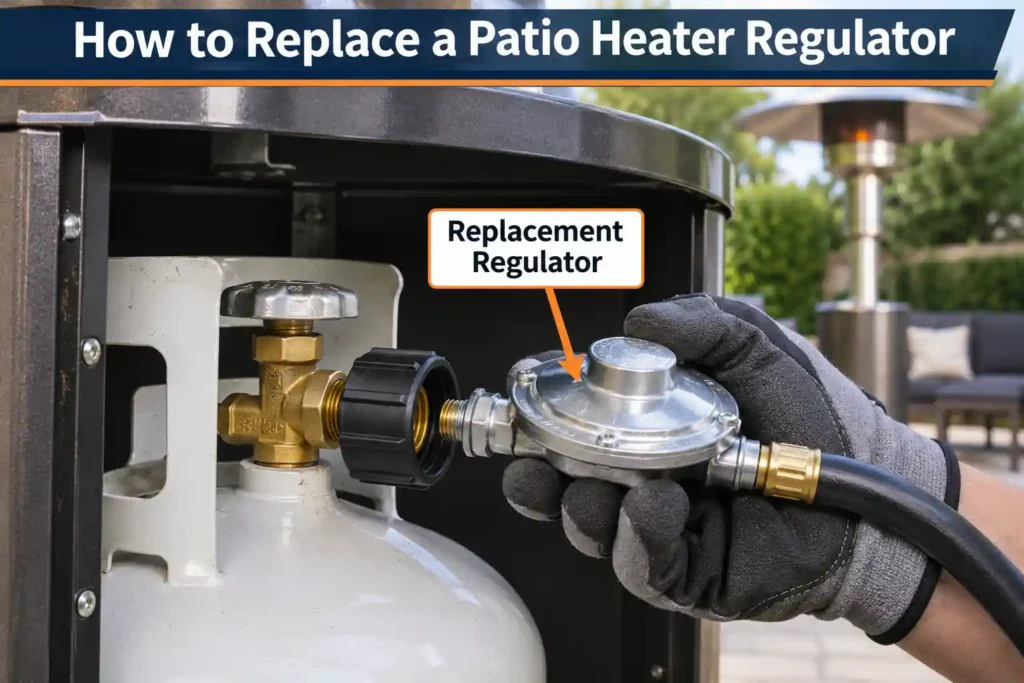
| Patio heater | External low-pressure regulator on many models | Match original hose assembly. |
| Tabletop patio heater | Integrated or compact regulator | Model-specific compatibility. |
| Tank-top heater | Specialized regulator and control assembly | Original replacement part preferred. |
| Blue-flame wall heater | Regulated low-pressure supply | Verify inlet pressure. |
| Infrared wall heater | Regulated low-pressure supply | Verify pressure and capacity. |
| Garage unit heater | External supply regulation and internal gas valve | Professional selection. |
| Forced-air construction heater | Often high-pressure regulation | Match exact model. |
| Commercial propane heater | Application-specific regulation | Professional system sizing. |
| Greenhouse heater | Model-specific gas supply regulation | Match installation specifications. |
Portable heaters commonly have proprietary regulator arrangements, while permanently installed heaters may use external propane regulators as part of a larger gas delivery system.
This means that a regulator intended for a patio heater should not automatically be used on a wall heater or construction heater.
3. Understand the Required Outlet Pressure
Outlet pressure is arguably the most important specification when selecting a replacement regulator.
It determines the regulated propane pressure delivered downstream to the appliance or another regulation stage.
Low-Pressure Propane Regulators
Many conventional propane appliances operate with a nominal supply pressure of approximately 11 inches of water column.
For example, the Mr. Heater MHVFBF30LPT wall heater manual specifies an incoming propane supply pressure between 11 and 14 inches WC.
Always verify the requirements of your exact heater model.
High-Pressure Propane Regulators
Certain construction heaters, torches, and specialized propane appliances require considerably higher operating pressures.
These pressures are commonly expressed in PSI rather than inches of water column.
High-pressure regulators must only be used with compatible equipment.
Propane Regulator Pressure Conversion Chart
| Pressure in Inches WC | Equivalent PSI |
|---|---|
| 5 inches WC | 0.181 PSI |
| 7 inches WC | 0.253 PSI |
| 10 inches WC | 0.361 PSI |
| 11 inches WC | 0.397 PSI |
| 14 inches WC | 0.506 PSI |
| 27.7 inches WC | 1 PSI |
| 55.4 inches WC | 2 PSI |
| 138.4 inches WC | 5 PSI |
| 276.8 inches WC | 10 PSI |
| 553.6 inches WC | 20 PSI |
| 830.4 inches WC | 30 PSI |
Propane Regulator Pressure Comparison
Relative pressure compared with an 11-inch WC propane supply.
11 inches WC: 1×
14 inches WC: 1.3×
1 PSI: 2.5×
2 PSI: 5.0×
5 PSI: 12.6×
10 PSI: 25.2×
20 PSI: 50.4×
These are pressure comparisons, not interchangeable appliance settings or recommended adjustment levels.
A 20 PSI regulator can deliver approximately 50 times the nominal pressure of an 11-inch WC regulator.
Installing an inappropriate high-pressure regulator on a conventional low-pressure heater can cause dangerous overfiring and equipment damage.
For a more detailed explanation, read my article on inlet pressure versus outlet pressure on a propane regulator.
4. Match the Regulator’s Inlet Pressure Rating
While outlet pressure determines what the regulator delivers, inlet pressure determines what the regulator is designed to receive.
A replacement regulator may receive propane directly from a cylinder or from another upstream regulator.
These configurations are not necessarily interchangeable.
How Inlet and Outlet Pressure Work
Variable propane supply pressure
Inlet Pressure
Reduces and controls incoming pressure
Outlet Pressure
Receives specified regulated pressure
Conceptual pressure regulation diagram. The correct number of regulation stages depends on the approved propane system design.
Never connect a regulator designed exclusively for an intermediate-pressure gas supply directly to an unregulated propane tank unless its specifications explicitly permit that arrangement.
5. Choose the Correct BTU Capacity
BTU capacity indicates how much propane energy a regulator can deliver per hour under specified operating conditions.
A replacement regulator must provide enough fuel to support the heater’s maximum rated input.
Propane Heater Regulator Capacity Chart
| Heater Maximum Input | Minimum Fuel Delivery Demand | Propane Consumption |
|---|---|---|
| 9,000 BTU/hr | 9,000 BTU/hr | 0.098 gal/hr |
| 18,000 BTU/hr | 18,000 BTU/hr | 0.197 gal/hr |
| 20,000 BTU/hr | 20,000 BTU/hr | 0.219 gal/hr |
| 30,000 BTU/hr | 30,000 BTU/hr | 0.328 gal/hr |
| 40,000 BTU/hr | 40,000 BTU/hr | 0.437 gal/hr |
| 48,000 BTU/hr | 48,000 BTU/hr | 0.525 gal/hr |
| 60,000 BTU/hr | 60,000 BTU/hr | 0.656 gal/hr |
| 80,000 BTU/hr | 80,000 BTU/hr | 0.874 gal/hr |
| 100,000 BTU/hr | 100,000 BTU/hr | 1.093 gal/hr |
| 150,000 BTU/hr | 150,000 BTU/hr | 1.639 gal/hr |
| 200,000 BTU/hr | 200,000 BTU/hr | 2.186 gal/hr |
A regulator’s advertised maximum capacity does not guarantee that it can deliver that amount under every inlet pressure and operating condition.
Consult its capacity specifications and manufacturer-approved application.
For additional guidance, read my article on what BTU capacity means on a propane regulator.
What Happens if You Buy an Undersized Regulator?
An undersized regulator may cause reduced heater output, pressure drop under load, unstable flames, or unexpected shutdowns.
A regulator with a higher flow rating may be acceptable when its pressure, flow characteristics, connections, and application are compatible.
However, a higher BTU rating alone does not establish compatibility.
Choose a regulator with sufficient documented flow capacity at the required operating pressure. Do not select a regulator solely because its advertised BTU rating exceeds the heater’s input.
6. Single-Stage vs. Two-Stage Replacement Regulators
Propane regulators can reduce gas pressure in one stage or multiple stages.
The correct configuration depends on the heating appliance and the overall propane supply system.
Single-Stage Regulation
Pressure reduction occurs in one regulation stage.
Two-Stage Regulation
Pressure reduction occurs in two regulation stages.
These are conceptual configurations only. Two-stage regulation can also be incorporated into a single regulator housing.
| Feature | Single-Stage Regulator | Two-Stage Regulator |
|---|---|---|
| Pressure reduction | One stage | Two stages |
| Pressure stability | Application-dependent | Generally improved |
| Physical size | Often compact | Generally larger |
| Purchase price | Usually lower | Usually higher |
| Common application | Individual appliances | Permanent propane supply systems |
| Replacement selection | Match original configuration | Match approved system design |
Not every two-stage regulator delivers 11 inches WC. For example, RegO manufactures both nominal 11-inch WC and 2 PSI two-stage regulators for different system configurations.
I would not replace a two-stage regulator with a single-stage model simply to save money.
7. Fixed vs. Adjustable Replacement Regulators
A fixed-pressure regulator delivers a predetermined outlet pressure, while an adjustable regulator allows pressure selection within its specified range.
Fixed-Pressure Regulator
- Predetermined outlet pressure.
- Generally simpler to operate.
- Common in conventional propane appliances.
- Usually not intended for consumer adjustment.
Adjustable Regulator
- Adjustable outlet pressure.
- Designed for compatible specialized equipment.
- Requires careful pressure selection.
- Must remain within approved operating limits.
| Feature | Fixed Regulator | Adjustable Regulator |
|---|---|---|
| Pressure setting | Predetermined | Variable |
| Ease of operation | Generally simpler | Requires careful selection |
| Typical use | Conventional propane appliances | Specialized equipment |
| Consumer adjustment | Generally not permitted | Where explicitly authorized |
| Risk of incorrect adjustment | Lower during normal operation | Higher if misused |
| Recommended replacement | Original approved specification | Exact approved operating range |
For most conventional patio heaters, wall heaters, and portable heaters, I would retain the original fixed-pressure configuration.
An adjustable regulator is not automatically an upgrade.
Never use adjustable pressure regulation as a method of increasing the heater’s maximum output beyond its rated capacity. Excessive pressure can cause overfiring, unsafe combustion, equipment damage, and carbon monoxide hazards.
8. Check the Inlet and Outlet Connection Types
Another common purchasing mistake is selecting a regulator with incompatible fittings.
Propane connections differ in thread size, sealing method, pressure rating, and intended application.
Common Propane Regulator Connections
| Connection Type | Typical Application |
|---|---|
| QCC1 / Type 1 | Modern refillable propane cylinders. |
| POL | Compatible propane cylinder service valves. |
| 1/4-inch NPT | Selected regulators and gas fittings. |
| 3/8-inch NPT | Gas piping and appliance connections. |
| 1/2-inch NPT | Selected higher-capacity systems. |
| 3/8-inch flare | Appliance hose connections. |
| Gas-rated quick-connect | Compatible detachable connections. |
| Proprietary fitting | Manufacturer-specific portable heaters. |
NPT stands for National Pipe Thread. A flare fitting seals differently from a tapered pipe-thread connection.
Two fittings may have similar dimensions but completely different sealing requirements.
Before purchasing a replacement, verify the following:
- Connection standard.
- Nominal fitting size.
- Male or female connection configuration.
- Required sealing method.
- Operating pressure rating.
- Manufacturer-approved compatibility.
Avoid using unnecessary adapters to compensate for incompatible regulator connections.
9. Should You Buy a Regulator With a Hose Attached?
Many patio heaters and portable propane appliances use a combined hose and regulator assembly.
Replacing the entire assembly may be preferable when both components are deteriorating.
| Hose Configuration | Common Application |
|---|---|
| Short regulator hose | Freestanding patio heaters. |
| Extended propane hose | Approved remote-cylinder arrangements. |
| High-pressure hose | Specialized propane equipment. |
| Regulated low-pressure hose | Compatible low-pressure appliances. |
| Stainless steel braided hose | Approved applications requiring abrasion resistance. |
| Manufacturer-specific hose | Portable heaters with proprietary connections. |
When selecting a hose assembly, consider its working pressure, temperature rating, length, connection types, and compatibility.
A longer or thicker hose is not necessarily a better replacement.
For certain Buddy heaters, Mr. Heater specifically identifies different hose configurations and fuel filter requirements. Some approved hose assemblies do not require a separate fuel filter.
This is why I recommend checking the exact hose part number instead of purchasing a generic propane extension hose.
10. Best Propane Heater Replacement Regulator Brands
Several established manufacturers produce propane regulators for residential, recreational, commercial, and industrial applications.
| Brand | Products Worth Investigating | Best Application |
|---|---|---|
| Mr. Heater | Heater-specific regulators and hoses | Mr. Heater appliances |
| Marshall Excelsior | Single-stage and two-stage regulators | Residential propane systems |
| RegO | Residential and commercial regulators | Permanent propane installations |
| Fisher | LP gas pressure regulators | Residential and commercial systems |
| Flame King | Regulators and hose assemblies | Compatible portable appliances |
| Camco | RV propane regulators | Approved RV heating systems |
| Cavagna Group | LPG regulators and valves | Residential and specialized systems |
My first choice would generally be the original equipment manufacturer’s replacement regulator.
Aftermarket products may be appropriate when their specifications, application approval, and compatibility have been confirmed.
Examples of Replacement Propane Regulators
| Model | Regulator Type | Application to Investigate |
|---|---|---|
| Mr. Heater F273767 | Low-pressure regulator | Compatible propane appliances |
| Mr. Heater F273763 | Two-stage regulator | Approved low-pressure systems |
| Mr. Heater F273719 | Adjustable high-pressure regulator | Compatible specialized equipment |
| RegO LV404B46 | Two-stage regulator | Nominal 11-inch WC propane systems |
| RegO LV404Y39V9 | Two-stage 2 PSI regulator | Intermediate-pressure systems requiring downstream regulation |
These examples illustrate how regulators differ in design and intended application. They are not universal replacement recommendations. Confirm current manufacturer specifications and exact heater compatibility before purchasing.
11. Choose the Right Regulator for Your Propane Tank
Your propane storage system must be capable of supplying the heater’s maximum fuel demand.
| Propane Tank Size | Approximate Fuel Capacity |
|---|---|
| 1 lb cylinder | 0.235 gallons |
| 5 lb cylinder | 1.18 gallons |
| 10 lb cylinder | 2.35 gallons |
| 20 lb cylinder | 4.70 gallons |
| 30 lb cylinder | 7.05 gallons |
| 40 lb cylinder | 9.40 gallons |
| 100 lb cylinder | 23.50 gallons |
| 120-gallon tank at 80% fill | 96 gallons |
| 250-gallon tank at 80% fill | 200 gallons |
| 500-gallon tank at 80% fill | 400 gallons |
Cylinder estimates assume the stated weight of available propane rather than the combined weight of the cylinder and fuel. Actual liquid volume varies with temperature and propane density.
Tank capacity alone does not determine whether a heater can receive sufficient propane.
Cold weather, liquid level, cylinder dimensions, and fuel demand affect available vaporization capacity.
If the propane tank cannot vaporize fuel quickly enough, replacing the regulator with a larger model will not necessarily solve the problem.
12. Worked Example: Selecting a Replacement Patio Heater Regulator
Suppose you own a 48,000 BTU patio heater whose manufacturer specifies an 11-inch WC regulator.
You are comparing two hypothetical replacement products.
| Specification | Regulator A | Regulator B |
|---|---|---|
| Outlet pressure | 11 inches WC | Adjustable 1–20 PSI |
| Rated capacity | 75,000 BTU/hr | 150,000 BTU/hr |
| Fuel compatibility | Propane | Propane |
| Heater approval | Confirmed | Not confirmed |
| Illustrative price | $25 | $40 |
| Suitable replacement | Yes, assuming all other specifications match. | No |
Although Regulator B has twice the advertised fuel delivery capacity, its pressure characteristics are inappropriate for this hypothetical heater.
Regulator A is the better choice because it matches the manufacturer’s approved operating requirements.
Expected Fuel Consumption
One gallon of propane contains approximately 91,500 BTU of energy.
Gallons per Hour = BTU Input ÷ 91,500
48,000 ÷ 91,500 = approximately 0.525 gallons per hour.
Hourly Propane Consumption
0.525 gal
Theoretical 20 lb Tank Runtime
9.0 hrs
Hourly Fuel Cost
$1.84
Four-Hour Fuel Cost
$7.34
Assumes continuous maximum-input operation, adequate propane vaporization, and propane costing $3.50 per gallon. This example does not establish cylinder compatibility.
13. Propane Heater Replacement Regulator Capacity Calculator
Use this calculator to compare your heater’s maximum fuel demand against a replacement regulator’s advertised capacity.
Replacement Regulator Capacity Estimator
Heater Fuel Demand
48,000
BTU/hr
Regulator Rated Capacity
75,000
BTU/hr
Nominal Capacity Difference
27,000
BTU/hr
Rated Capacity Utilization
64.0%
Hourly Fuel Consumption
0.525 gal
Theoretical Fuel Runtime
9.0 hrs
Heater Demand Relative to Advertised Regulator Capacity
Estimated Hourly Propane Expense
$1.84
This calculator compares nominal ratings only. It does not determine safe operating pressure, actual flow capacity, regulator compatibility, propane tank vaporization, or installation approval.
14. How Much Does a Propane Heater Replacement Regulator Cost?
Replacement regulator prices vary according to manufacturer, pressure rating, construction, connections, and installation requirements.
| Regulator Type | Estimated Replacement Cost |
|---|---|
| Basic low-pressure regulator | $10–$25 |
| Patio heater regulator | $15–$35 |
| Tank-top heater regulator | $20–$45 |
| Hose and regulator assembly | $20–$60 |
| Adjustable high-pressure regulator | $20–$65 |
| OEM portable heater regulator | $25–$80 |
| Two-stage propane regulator | $35–$120 |
| Commercial propane regulator | $75–$250 |
| Professional diagnosis and replacement | $100–$350 |
Replacement Propane Regulator Price Comparison
Basic Low-Pressure Regulator: $10–$25
Patio Heater Regulator: $15–$35
Tank-Top Heater Regulator: $20–$45
Hose and Regulator Assembly: $20–$60
Adjustable High-Pressure Regulator: $20–$65
OEM Portable Heater Regulator: $25–$80
Two-Stage Propane Regulator: $35–$120
Commercial Propane Regulator: $75–$250
Professional Diagnosis and Replacement: $100–$350
Bars represent the upper end of illustrative US price ranges. These are budgeting estimates, not verified current retailer or contractor quotations.
For a more comprehensive breakdown of replacement expenses, read my article on the cost of replacing a propane regulator.
15. OEM vs. Aftermarket Propane Heater Regulators
OEM stands for original equipment manufacturer.
An OEM regulator is manufactured or supplied for the original equipment, while an aftermarket regulator is produced by another manufacturer.
| Feature | OEM Regulator | Aftermarket Regulator |
|---|---|---|
| Model compatibility | Usually easier to establish | Requires verification |
| Purchase price | May be higher | Often lower |
| Installation compatibility | Generally more predictable | Product-dependent |
| Availability | Sometimes limited | Often wider selection |
| Warranty considerations | Usually easier to establish | Manufacturer-dependent |
| Quality | Original specified standard | Varies by manufacturer |
| Safety approval | Model-specific documentation | Must be independently confirmed |
I would particularly prioritize OEM replacement parts for portable Buddy heaters, specialized tank-top heaters, proprietary regulator assemblies, and internal gas-control components.
For standard external propane supply regulators, an approved equivalent may be appropriate when selected according to the complete system specifications.
16. Common Mistakes When Buying Replacement Regulators
| Purchasing Mistake | Potential Consequence |
|---|---|
| Buying according to appearance | Incorrect pressure regulation. |
| Ignoring outlet pressure | Unsafe combustion. |
| Selecting insufficient BTU capacity | Reduced heater performance. |
| Buying an adjustable regulator unnecessarily | Incorrect pressure settings. |
| Assuming all propane regulators are universal | Equipment incompatibility. |
| Ignoring fitting types | Connection and leakage problems. |
| Installing incompatible hoses | Fuel delivery restrictions. |
| Adding an unnecessary regulator | Insufficient downstream pressure. |
| Buying an unapproved regulator | Unverified safety performance. |
| Ignoring propane tank vaporization | Continued heating problems. |
| Choosing solely according to the lowest price | Potential compatibility and reliability concerns. |
If your replacement regulator still produces weak flames, the problem may be elsewhere in the fuel delivery system.
Read my guide on why propane regulators have low pressure for additional troubleshooting information.
17. Where Can You Buy a Propane Heater Replacement Regulator?
Replacement regulators are available from several types of retailers and suppliers.
| Retailer or Supplier | Products to Look For |
|---|---|
| Amazon | Regulators, hoses, and replacement assemblies. |
| Home Depot | Residential and portable propane accessories. |
| Lowe’s | Patio heater regulators and gas accessories. |
| Walmart | Selected portable propane accessories. |
| Tractor Supply | Agricultural and outdoor propane equipment. |
| Northern Tool | Workshop and construction heater accessories. |
| Heater manufacturer | Original equipment replacement parts. |
| Local propane supplier | Professionally sized propane regulators. |
| Authorized service center | Model-specific replacement components. |
For specialized or permanently installed propane heaters, I recommend contacting the manufacturer or an authorized propane equipment supplier first.
How to Select the Correct Replacement Regulator: Decision Guide
Step 1: Identify Your Heater
Locate the appliance rating plate and record the manufacturer, exact model number, fuel type, and maximum BTU input.
Step 2: Identify the Original Regulator
Record the original regulator’s part number, pressure specifications, connection types, and configuration.
If the regulator identification label is missing or unreadable, contact the heater manufacturer.
Step 3: Verify Pressure Requirements
Confirm both the required outlet pressure and permitted inlet pressure. Do not confuse appliance manifold pressure with incoming supply pressure.
Step 4: Check Fuel Delivery Capacity
Confirm that the replacement regulator can deliver the heater’s maximum fuel demand under the specified operating conditions.
Step 5: Verify Connections and Hose Compatibility
Match the required connection standards, hose pressure ratings, fittings, and manufacturer-approved fuel delivery arrangements.
Step 6: Confirm Manufacturer Approval
Choose an OEM replacement or an explicitly approved equivalent that satisfies the complete installation requirements.
Step 7: Arrange Proper Installation and Testing
Have permanent propane supply regulators and internal gas-control components professionally installed and tested. For consumer-replaceable components, follow the exact manufacturer instructions.
18. Propane Heater Replacement Regulator Buying Checklist
Use this interactive checklist before purchasing your replacement regulator.
Replacement Regulator Purchasing Checklist
0 of 15 requirements checked
Completing this checklist does not certify equipment compatibility or installation safety.
19. How Long Should a Replacement Propane Regulator Last?
Regulator service life depends on its design, operating environment, maintenance, and manufacturer recommendations.
| Factor | Effect on Regulator Service Life |
|---|---|
| Outdoor moisture exposure | May increase corrosion. |
| Extreme temperatures | May affect operating conditions. |
| Contaminated fuel supply | May obstruct internal components. |
| Physical impact | May damage housing and fittings. |
| Incorrect installation | May reduce reliability. |
| Excessive incoming pressure | May damage internal components. |
| Regular inspection | Helps identify deterioration. |
| Appropriate environmental protection | Helps reduce exposure-related damage. |
There is no universal replacement interval applicable to every propane heater regulator.
Follow the manufacturer’s specified service life and replacement recommendations.
For more information, read my guide on how long propane regulators last.
20. Safety Precautions When Replacing a Propane Heater Regulator
Propane regulators are safety-critical components. Incorrect replacement or installation can affect fuel delivery, combustion performance, and heater safety.
Important Propane Regulator Safety Reminders
- Never install a regulator with an incompatible pressure rating.
- Never modify a factory-set regulator.
- Never bypass the heater’s automatic safety controls.
- Use only approved propane hoses and connections.
- Never use an open flame to test for gas leaks.
- Follow manufacturer-required regulator mounting and vent orientation.
- Replace damaged gas delivery components.
- Never increase gas pressure to obtain additional heating output.
- Arrange appropriate leak and operating-pressure testing.
- Have permanent gas installations serviced by qualified technicians.
- Never operate outdoor-only propane heaters indoors.
- Maintain manufacturer-required ventilation and combustible-material clearances.
- Install appropriate carbon monoxide alarms.
- Do not repeatedly restart equipment that experiences unexplained safety shutdowns.
If you smell propane: Evacuate immediately, avoid electrical switches and ignition sources, and contact your propane supplier or emergency services from a safe location.
Do not return until the affected area has been declared safe.
If a carbon monoxide alarm sounds: Move everyone to fresh air immediately and contact emergency services.
Before undertaking any replacement, read my article on whether you can install a propane regulator yourself or need a professional.
Frequently Asked Questions
Are All Propane Heater Regulators Universal?
No. Regulators differ in operating pressure, capacity, fittings, regulation stages, and intended application.
Even if two regulators have identical physical dimensions, their internal pressure and flow characteristics may differ considerably.
Can I Use a BBQ Regulator on a Propane Heater?
Only if its specifications and application are approved for the exact heater. Similar-looking connections do not establish compatibility.
Verify the required outlet pressure, fuel delivery capacity, connections, and manufacturer approval.
What PSI Regulator Do I Need for a Propane Heater?
Many conventional low-pressure appliances require approximately 11 inches WC, equivalent to 0.397 PSI.
However, specialized propane heaters may require different operating pressures. Always consult the exact appliance manual.
Can I Use a Higher BTU Regulator on My Heater?
Potentially, provided its pressure characteristics, flow performance, connections, and manufacturer approval are compatible.
A higher capacity rating does not automatically make a regulator suitable.
Can I Replace a Fixed Regulator With an Adjustable Regulator?
Only when the heater manufacturer explicitly approves that configuration. Otherwise, retain the original specified regulator type.
Never use adjustable pressure regulation to exceed the heater’s maximum approved heating input.
Should I Replace the Hose and Regulator Together?
Replacing the complete assembly may be appropriate if both components are deteriorating or the manufacturer supplies them as an integrated replacement part.
Always select a hose and regulator assembly approved for your particular heater.
Will a New Regulator Make My Propane Heater Hotter?
A correctly selected replacement may restore normal heating performance if the original regulator was defective.
It should not increase heating output beyond the appliance’s rated capacity.
Can I Use a Two-Stage Regulator on a Propane Heater?
Yes, when the heater and fuel delivery system are designed for that configuration.
Verify the final outlet pressure, permitted inlet pressure, capacity, and installation requirements.
Does Every Propane Heater Need an External Regulator?
No. Some heaters incorporate internal regulators or proprietary fuel delivery configurations.
Adding an unnecessary external regulator can interfere with proper operation.
Is an Expensive Propane Regulator Always Better?
No. Compatibility, reliability, documented specifications, and safety approval are more important than purchase price alone.
Can I Use the Same Replacement Regulator for a Patio Heater and a Wall Heater?
Not necessarily. These appliances may have different fuel delivery configurations, pressure requirements, connections, and installation conditions.
Verify compatibility separately for each heater.
What Should I Do if My Replacement Regulator Does Not Fix the Problem?
The original problem may involve insufficient propane vaporization, a restricted fuel hose, contaminated burner components, ignition faults, or another equipment malfunction.
Do not continue replacing components or increasing gas pressure without identifying the underlying cause.
Arrange professional diagnosis if the heater continues to operate abnormally.
My Final Thoughts
Choosing the right propane heater replacement regulator is primarily about matching the original equipment specifications.
I would begin by identifying the heater model number, locating the original regulator part number, and reviewing the manufacturer’s pressure and fuel delivery requirements.
Next, I would compare the replacement regulator’s inlet pressure, outlet pressure, BTU capacity, connections, hose configuration, and intended application.
Whenever possible, I recommend purchasing an original manufacturer-approved replacement regulator rather than experimenting with generic or adjustable alternatives.
A properly selected propane regulator should support stable combustion, dependable heating performance, and safe fuel delivery.
Saving a few dollars on an incompatible regulator is not worth the potential equipment damage or safety risks.

Mike is an experienced propane technician with over 15 years of professional experience in the field. He has dedicated his career to helping customers with their propane needs, from installation to maintenance and repair. Together with Jeremy, he co-founded this website to provide useful information and guidance to customers seeking reliable propane services.