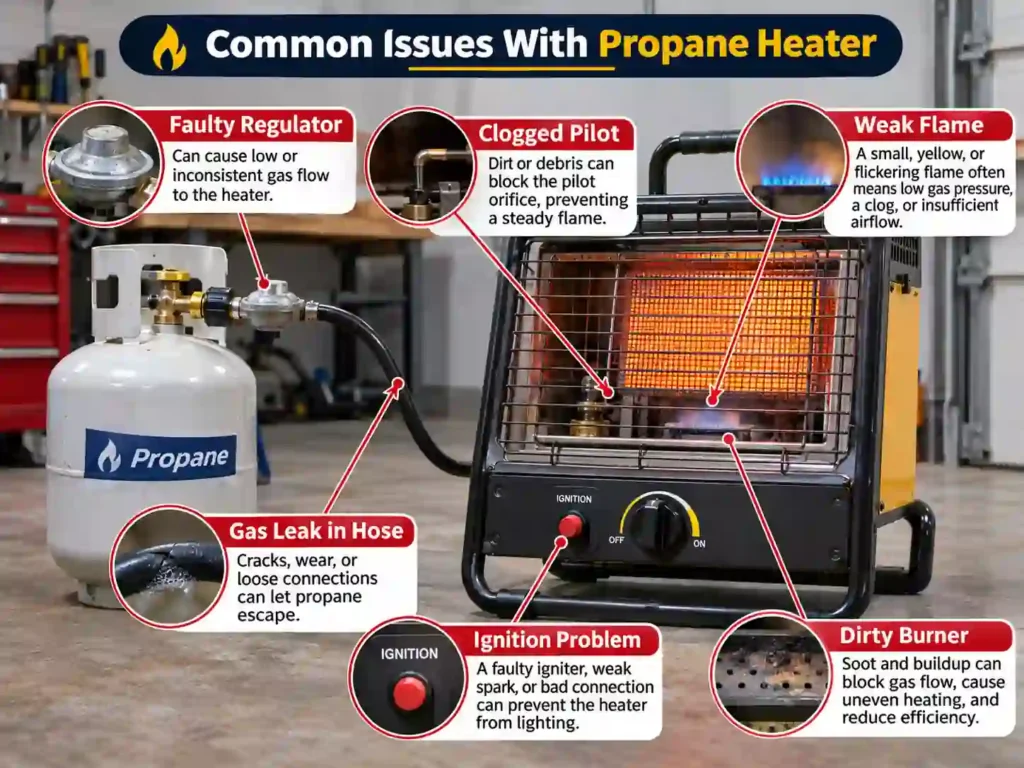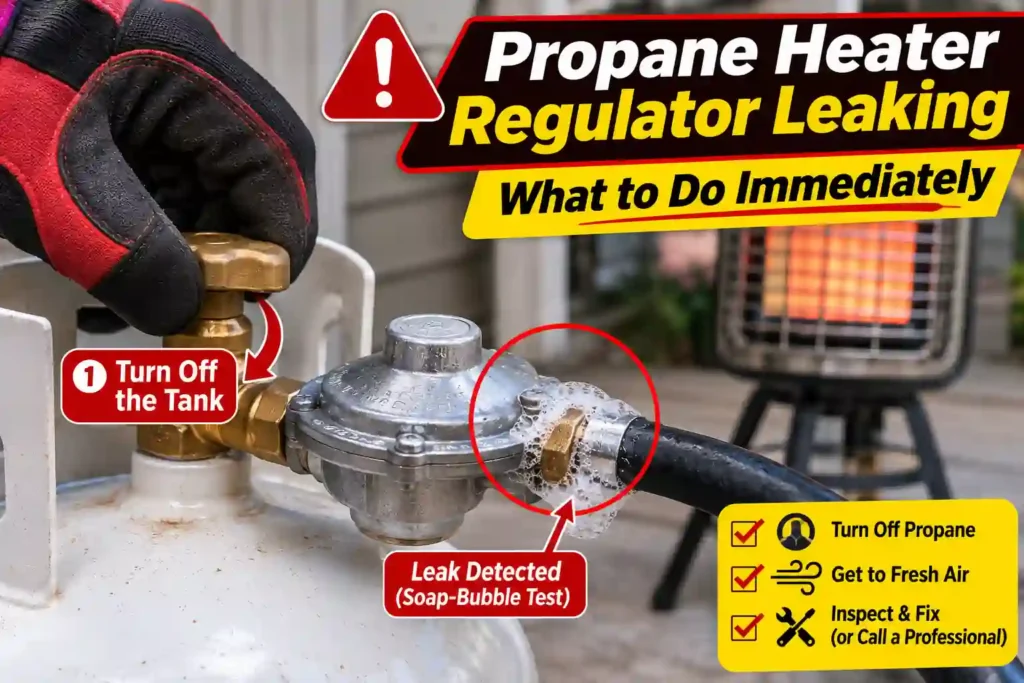


A leaking propane heater regulator is a serious safety concern that should never be ignored. Whether you use a propane patio heater, portable Buddy heater, wall heater, garage heater, or construction heater, a gas leak can expose you to fire, explosion, and other serious hazards.
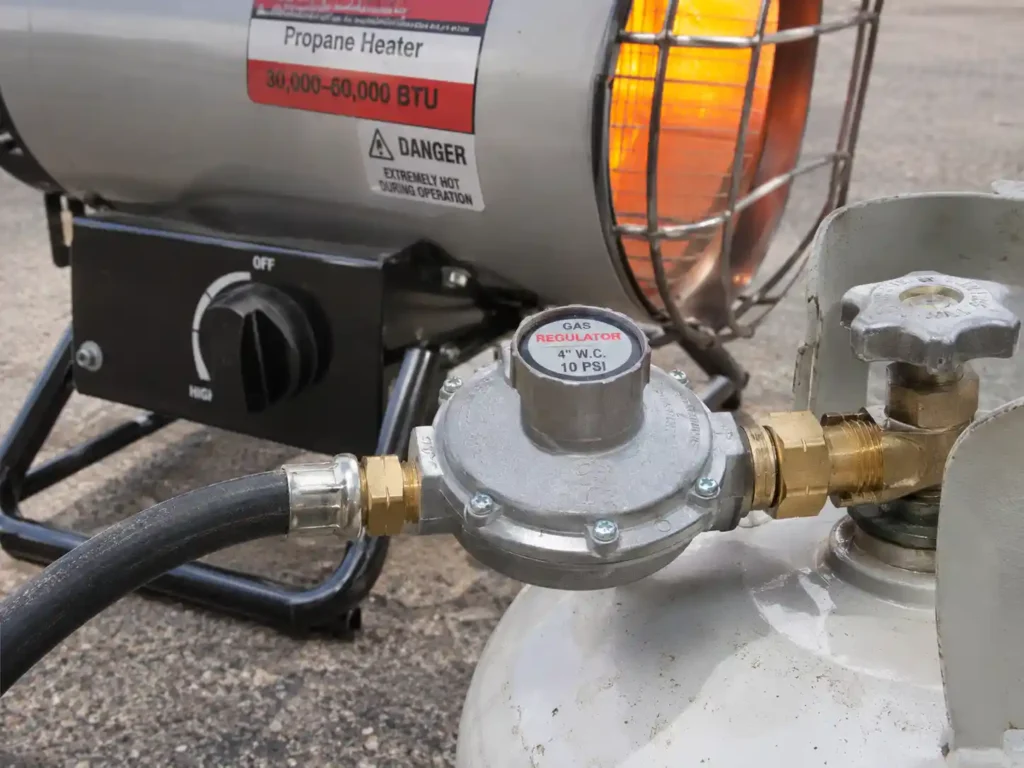
The propane regulator controls the pressure of the gas entering your heating appliance. Over time, internal components, seals, connections, and diaphragms may deteriorate, allowing propane to escape.
You might notice a rotten egg smell, a hissing sound, unusual frost around the regulator, or unexpectedly rapid propane consumption.


Regardless of how small the suspected leak appears, your immediate priority should be protecting yourself and everyone nearby rather than attempting to repair the regulator.
In this guide, I’ll explain what to do immediately when your propane heater regulator is leaking, the possible causes of regulator leaks, how professionals identify them, and when regulator replacement is necessary.
Quick Answer: What to Do Immediately
If your propane heater regulator is leaking, evacuate the affected area immediately, avoid ignition sources, and contact your propane supplier or emergency services from a safe location.
Do not attempt to tighten fittings, adjust regulator pressure, or restart the heater while a leak is suspected.


| Immediate Action | Why It Matters |
|---|---|
| Leave the affected area | Reduces exposure to escaping propane. |
| Warn other occupants | Prevents people from entering a hazardous area. |
| Avoid flames and smoking | Prevents accidental ignition. |
| Avoid electrical switches | Electrical sparks may ignite accumulated propane. |
| Avoid using your phone near the leak | Use your phone only after reaching a safe location. |
| Shut off the propane supply only if safely accessible without approaching the leak | May stop additional gas from escaping. |
| Contact emergency services or your propane supplier | Allows qualified personnel to respond. |
| Keep the heater out of service | Prevents further leakage and unsafe operation. |
Never approach a leaking regulator simply to shut off the propane cylinder. If you cannot safely reach the supply valve, leave immediately.
Do not return to the affected area or resume using the propane heater until qualified personnel have confirmed that it is safe.
The Propane Education & Research Council (PERC) and the National Fire Protection Association (NFPA) recommend treating suspected fuel gas leaks as emergencies.
1. What to Do Immediately When Your Propane Heater Regulator Leaks
Knowing how to respond during the first few moments of a suspected propane leak is extremely important.
Move Away From the Heater
If you smell propane or hear gas escaping from the regulator, immediately move away from the equipment.



Do not remain nearby to determine exactly where the gas is escaping.
Propane is heavier than air and can accumulate in low-lying areas, including basements, drainage channels, garages, and floor-level spaces.
Warn other occupants as you leave, without delaying your evacuation.
Avoid All Potential Ignition Sources
Even a relatively small ignition source can ignite a flammable propane-air mixture.


| Potential Ignition Source | What to Do |
|---|---|
| Cigarettes and lighters | Do not use. |
| Electrical switches | Do not turn on or off. |
| Mobile phones | Use only from a safe location. |
| Electric fans | Do not switch on. |
| Vehicles | Do not start near the leak. |
| Power tools | Do not operate. |
| Heater ignition system | Do not attempt to relight. |
| Electrical plugs | Do not connect or disconnect. |
Do not stay inside to open windows or operate ventilation equipment. Prioritize evacuation.
Shut Off the Propane Supply Only if Safe
If the propane supply valve is safely accessible away from the suspected leak, closing it may prevent additional propane from escaping.
However, if the leak originates near the cylinder valve or regulator, do not approach the equipment.
Never risk personal injury to protect a propane heater or cylinder.
Contact Emergency Services or Your Propane Supplier
Once you reach a safe location, report the suspected gas leak.
In the United States, call 911 if there is an active uncontrolled leak, fire, or immediate danger.
Provide information about the heater, cylinder location, suspected leak, and whether the equipment is indoors or outdoors.
Do Not Restart the Heater
Even if the propane smell eventually disappears, the underlying problem may still exist.
The entire affected gas system should be inspected and cleared for use before normal operation resumes.
2. Why Is My Propane Heater Regulator Leaking?
Propane regulators contain several components that work together to maintain the required outlet pressure.
A failure involving the diaphragm, valve seat, housing, seals, or connections may allow propane to escape.
Common Propane Regulator Leak Locations
Conceptual illustration of potential leakage locations. Actual regulator designs vary. Do not approach an active leak to inspect these components.
Common Causes of Propane Regulator Leaks
| Cause | Explanation | Typical Corrective Action |
|---|---|---|
| Damaged diaphragm | Internal flexible membrane deteriorates. | Regulator replacement. |
| Loose connection | Connection is not properly secured. | Professional inspection and correction. |
| Worn sealing components | Seals deteriorate or become damaged. | Approved component replacement. |
| Cracked housing | Impact or structural damage. | Regulator replacement. |
| Corrosion | Environmental exposure damages components. | Regulator replacement. |
| Excessive inlet pressure | Regulator receives pressure beyond its rating. | System inspection. |
| Defective relief mechanism | Internal relief components malfunction. | Professional diagnosis. |
| Incorrect installation | Incompatible fittings or configuration. | Correct installation. |
| Damaged propane hose | Cracks, abrasion, or deterioration. | Approved hose replacement. |
| Manufacturing defect | Regulator fails prematurely. | Manufacturer evaluation. |
Identifying the actual source of leakage requires appropriate testing after the immediate emergency has been resolved.
For additional information, read my guide on why your propane regulator is leaking.
3. Is It Normal for Propane to Escape From a Regulator Vent?
No. Persistent propane discharge from a regulator vent should not be considered normal operation.
The regulator vent allows the diaphragm mechanism to respond to pressure changes. Certain regulator designs also incorporate internal pressure-relief mechanisms.
Normal Regulator Operation
- Diaphragm responds to pressure changes.
- Vent remains unobstructed.
- Regulator maintains specified outlet pressure.
- No unexplained propane odor or discharge.
Suspected Vent Leakage
- Propane odor near the equipment.
- Possible internal diaphragm damage.
- Possible pressure-relief operation.
- Potential pressure regulation malfunction.
Evacuate and obtain qualified assistance.
Propane escaping through a vent may indicate diaphragm damage, relief-valve operation, excessive downstream pressure, or another internal malfunction.
Never plug, tape over, seal, or obstruct the regulator vent to stop a suspected leak.
Doing so may interfere with pressure regulation and essential safety functions.
4. Warning Signs That Your Propane Heater Regulator Is Leaking
A propane leak may produce several noticeable symptoms. However, not every leak is immediately visible or detectable by smell.
| Warning Sign | What It May Indicate | Recommended Action |
|---|---|---|
| Rotten egg smell | Escaping odorized propane. | Evacuate immediately. |
| Hissing near regulator | Possible pressurized gas leakage. | Move away. |
| Unexpected detector alarm | Possible propane accumulation. | Evacuate immediately. |
| Localized unusual frost | Possible escaping gas or another fuel issue. | Stop use and arrange inspection. |
| Rapid fuel loss | Leakage or excessive consumption. | Arrange investigation. |
| Damaged regulator housing | Potential structural failure. | Keep equipment out of service. |
| Visible hose cracking | Deteriorating gas delivery components. | Arrange approved component replacement. |
| Expanding bubbles during an authorized leak test | Gas escaping from a connection. | Stop the test and follow safety procedures. |
A leak may occur without all these warning signs being present.
Propane has an added odorant, but reduced odor perception, environmental conditions, and odor fade can make smell unreliable.
For additional guidance, see my article on why a propane regulator smells like gas.
5. How Dangerous Is a Leaking Propane Heater Regulator?
A leaking propane regulator creates several potential hazards, particularly when gas accumulates within an enclosed area.
Fire Hazard
Escaping propane may ignite when exposed to a suitable ignition source.
Explosion Hazard
Accumulated propane-air mixtures can ignite rapidly in enclosed spaces.
Oxygen Displacement
High gas concentrations may reduce available breathing oxygen.
Cold Burns
Contact with escaping liquid propane can cause severe cold injuries.
Propane leakage and carbon monoxide production are different hazards. Propane is the fuel itself, whereas carbon monoxide can be produced during incomplete combustion.
A malfunctioning propane heater may present either or both hazards.
If someone experiences dizziness, breathing difficulties, confusion, or loss of consciousness, seek emergency medical assistance from a safe location.
Do not enter a hazardous atmosphere to attempt an unprotected rescue.
6. What to Do if Your Patio Heater Regulator Is Leaking
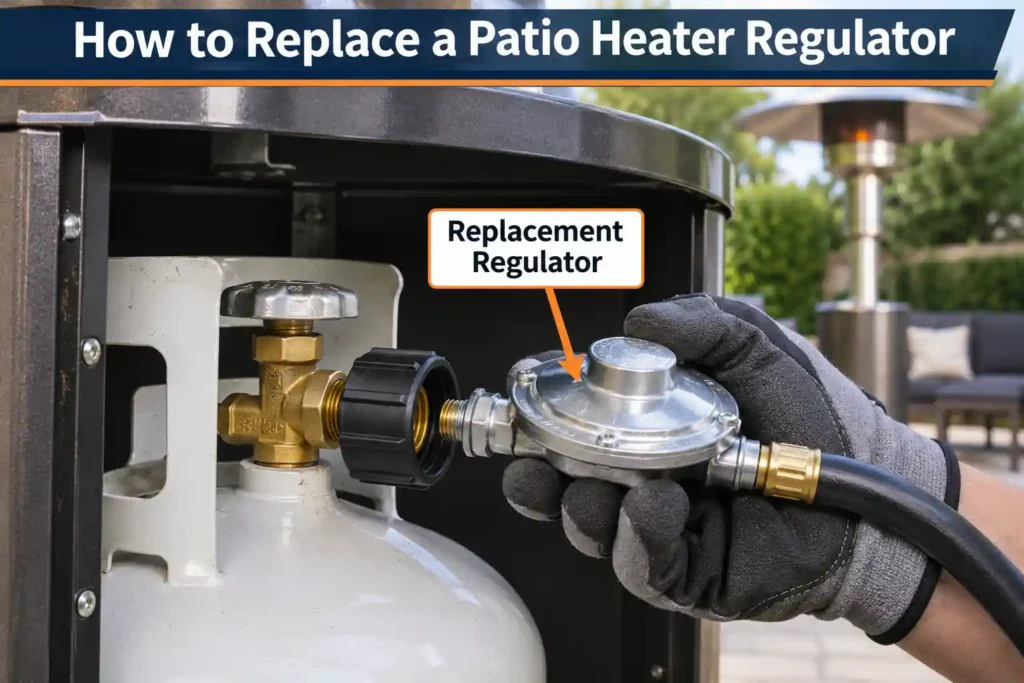
Patio heaters commonly use an external propane hose and regulator assembly connected to a refillable propane cylinder.
Because these heaters are exposed to outdoor conditions, their regulators may experience moisture exposure, corrosion, temperature fluctuations, and physical damage.
Common leakage locations include the cylinder connection, regulator housing, hose connections, and deteriorated hose material.
| Suspected Leak Location | Possible Cause | Corrective Action After Emergency Clearance |
|---|---|---|
| Cylinder connection | Damaged seal or incompatible connection. | Inspect approved connection. |
| Regulator vent | Internal regulator malfunction. | Professional assessment. |
| Regulator housing | Corrosion or physical damage. | Replace regulator. |
| Hose connection | Damaged or improper fitting. | Inspect and replace as necessary. |
| Hose surface | Cracking or abrasion. | Replace approved hose assembly. |
| Heater inlet | Damaged connection. | Professional inspection. |
Although patio heaters operate outdoors, escaping propane can still accumulate around enclosed cylinder compartments, nearby structures, and low-lying areas.
Never assume an outdoor propane leak is harmless.
If replacement is necessary, I recommend purchasing the manufacturer-approved hose and regulator assembly for your particular patio heater.
7. What to Do if Your Mr. Heater Buddy Regulator Is Leaking
Portable Mr. Heater Buddy heaters incorporate model-specific fuel regulation systems.
A suspected leak may originate from the cylinder connection, swivel regulator, remote-cylinder hose, or internal gas delivery components.
Because many Buddy heaters incorporate proprietary fuel-control assemblies, I would avoid attempting internal regulator repairs.
| Buddy Heater Component | Possible Problem |
|---|---|
| Swivel regulator | Internal malfunction or physical damage. |
| Disposable cylinder connection | Damaged seal or connection. |
| Remote-cylinder hose | Deterioration or incompatible hose. |
| Internal gas valve | Defective gas-control component. |
| Quick-connect fitting | Connection or sealing problem. |
After the immediate leak emergency has been resolved, contact Mr. Heater or an authorized service provider to identify the correct replacement component.
Do not bypass the integrated regulator or install an arbitrary high-pressure regulator.
Manufacturer operating instructions also emphasize avoiding open flames during leak testing and unauthorized servicing of gas-control equipment.
8. What to Do if Your Propane Wall Heater Regulator Is Leaking
Propane wall heaters may receive fuel through an external regulator, permanent gas piping, and an internal appliance gas-control valve.
A suspected leak in this type of installation should be investigated by a qualified propane technician.
Even when the wall heater is switched off, portions of the upstream gas supply system may remain pressurized.
This means turning off the thermostat does not necessarily stop a regulator leak.
The technician may need to inspect:
- External propane supply regulators.
- Permanent gas piping.
- Appliance shut-off valves.
- Internal gas-control components.
- Regulator inlet and outlet connections.
- Overall system pressure and leak integrity.
Do not remove the wall heater’s housing or disconnect permanent gas piping while leakage is suspected.
Evacuate the affected area and allow qualified personnel to handle the emergency and subsequent repairs.
9. Can a Leaking Propane Regulator Be Repaired?
Whether a regulator can be repaired depends on the exact source of the leak and the manufacturer’s service instructions.
Many consumer propane regulators are designed as sealed assemblies and are intended to be replaced rather than internally repaired.
| Regulator Condition | Repair or Replacement Consideration |
|---|---|
| Defective internal diaphragm | Replacement generally preferred. |
| Cracked regulator housing | Replacement. |
| Severe corrosion | Replacement. |
| Damaged regulator threads | Replacement may be necessary. |
| Leaking regulator vent | Professional diagnosis, often replacement. |
| Damaged hose | Approved hose replacement. |
| Improper external connection | Qualified correction and testing. |
| Damaged replaceable seal | Approved servicing where permitted. |
| Manufacturing defect | Warranty replacement may be available. |
I would not recommend attempting to repair a leaking regulator using silicone sealant, epoxy, adhesive, or improvised replacement components.
Such repairs may fail under gas pressure and may interfere with the regulator’s safety functions.
10. How Professionals Check a Propane Regulator for Leaks
After emergency personnel or qualified technicians have secured the affected area, appropriate testing can help identify the leak source.
Electronic Combustible Gas Detector
Professional combustible gas detectors can identify the presence of escaping propane around suspected leakage locations during controlled inspections.
Approved Leak Detection Solution
Approved leak detection solutions help identify gas leakage at appropriate connections during controlled testing.
They are not a substitute for emergency evacuation when an active leak is suspected.
Gas Pressure Manometer
A gas pressure manometer allows qualified technicians to measure operating pressure and identify abnormal pressure regulation.
A professional assessment may include several different tests.
| Test | Purpose |
|---|---|
| Visual inspection | Identifies physical damage and deterioration. |
| Combustible gas detection | Identifies possible escaping gas. |
| Connection leak testing | Evaluates connection integrity. |
| System pressure testing | Evaluates the gas system for leakage. |
| Operating pressure measurement | Verifies regulator performance. |
| Lock-up pressure testing | Evaluates regulator behavior when demand stops. |
| Combustion assessment | Evaluates heater operation following repairs. |
Regulator manufacturers such as RegO provide specific inspection and testing guidance for propane service professionals.
A pressure test and a leak test serve different purposes. Both may be necessary before equipment can safely return to service.
11. Can a Propane Regulator Leak Even When the Heater Is Off?
Yes. This is an important issue that propane heater owners sometimes overlook.
Turning off the heater normally interrupts burner operation, but the regulator and upstream fuel connections may remain pressurized when the propane supply valve is open.
Gas Supply When the Heater Is Switched Off
Illustrative configuration only. Actual valve and regulator locations vary by heater design.
This is why a heater that is switched off can still have a potentially hazardous gas leak.
The absence of a burner flame does not establish that the propane supply system is depressurized or safe.
12. How Much Does It Cost to Replace a Leaking Propane Heater Regulator?
Replacement costs depend on the regulator design, heater model, and installation requirements.
Estimated Propane Regulator Replacement Costs
| Replacement Component | Estimated US Cost |
|---|---|
| Basic low-pressure regulator | $10–$30 |
| Patio heater regulator | $15–$40 |
| Patio heater hose and regulator assembly | $20–$60 |
| Tank-top heater regulator | $20–$50 |
| Adjustable high-pressure regulator | $25–$70 |
| Portable heater internal regulator | $30–$100 |
| Two-stage propane regulator | $35–$120 |
| Commercial propane regulator | $75–$250 |
| Professional diagnosis and replacement | $100–$350+ |
Propane Regulator Replacement Price Comparison
Illustrative equipment and professional service budgets.
Basic Regulator: $10–$30
Patio Heater Regulator: $15–$40
Tank-Top Regulator: $20–$50
Hose and Regulator Assembly: $20–$60
High-Pressure Regulator: $25–$70
Internal Heater Regulator: $30–$100
Two-Stage Regulator: $35–$120
Commercial Regulator: $75–$250
Professional Replacement: $100–$350+
Bars represent the upper end of illustrative price ranges. These are not verified current retailer or contractor quotations. Actual repair expenses may differ considerably.
For additional budgeting information, read my article on the cost of replacing a propane regulator.
13. Propane Regulator Replacement Cost Calculator
Use the following calculator to estimate repair expenses after a qualified professional has determined that replacement is necessary.
Regulator Repair and Replacement Budget Estimator
Estimated Total Repair Expense
$155.00
Repair Cost Relative to New Heater
62.0%
Potential Repair Savings
$95.00
Estimated Repair Cost: $155.00
New Heater Cost: $250.00
This calculator compares financial expenses only. It does not determine whether a leaking heater can safely be repaired. Include installation expenses for both options where applicable.
Worked Example: Repairing a Leaking Patio Heater Regulator
Suppose a qualified technician determines that your patio heater requires a replacement regulator and hose assembly.
| Expense | Illustrative Cost |
|---|---|
| Replacement regulator | $35 |
| Approved hose and fittings | $20 |
| Professional labor and testing | $100 |
| Total estimated repair expense | $155 |
| Comparable new heater | $250 |
| Potential financial savings | $95 |
In this example, the estimated repair expense represents 62% of the replacement heater's purchase cost.
However, repair should only be considered if the heater can be restored to safe operating condition using approved replacement components.
If the heater has additional damage, severe corrosion, or unavailable replacement parts, purchasing a new heater may be more appropriate.
14. How to Choose a Replacement for a Leaking Regulator
Purchasing the wrong replacement regulator can create additional safety problems.
Before ordering a replacement, verify the following specifications.
| Specification | Requirement |
|---|---|
| Fuel type | Approved for propane. |
| Outlet pressure | Matches appliance specifications. |
| Inlet pressure | Suitable for the gas supply. |
| BTU capacity | Sufficient for heater demand. |
| Inlet connection | Correct approved fitting. |
| Outlet connection | Compatible with heater. |
| Regulator configuration | Matches approved system design. |
| Hose pressure rating | Suitable for operating conditions. |
| Manufacturer approval | Compatible with exact heater model. |
| Safety listing | Appropriate for intended application. |
My first choice would generally be a manufacturer-approved replacement assembly.
Do not purchase a regulator solely because its physical dimensions resemble the original component.
Record the heater model number and original regulator part number. Ask the manufacturer or an authorized supplier to confirm compatibility before purchasing a replacement.
Read my guide on what kind of regulator you need for your propane tank for additional selection guidance.
15. Propane Gas Detectors vs. Carbon Monoxide Detectors
One of the most common safety misunderstandings is assuming that a carbon monoxide alarm also detects propane leakage.
These devices perform different functions.
Propane Gas Detector
Detects combustible propane gas when specifically designed for that purpose.
- Detects escaping propane.
- Provides an audible warning on compatible models.
- Requires manufacturer-specified installation.
- Does not necessarily detect carbon monoxide.
Carbon Monoxide Alarm
Detects carbon monoxide produced by incomplete combustion.
- Warns of elevated carbon monoxide concentrations.
- Available in battery-powered configurations.
- Requires appropriate installation and maintenance.
- Does not ordinarily detect escaping propane.
| Feature | Propane Gas Detector | Carbon Monoxide Alarm |
|---|---|---|
| Detects escaping propane | Yes, on propane-rated models. | Generally no. |
| Detects carbon monoxide | Generally no. | Yes. |
| Detects combustible gas accumulation | Yes, where designed. | No. |
| Warns of combustion-related CO | Generally no. | Yes. |
| Installation location | Manufacturer-specific. | Manufacturer-specific. |
Combination alarms are also available, but you must verify which gases the particular device detects.
I recommend appropriate propane gas detection and carbon monoxide protection in accordance with manufacturer instructions and applicable requirements.
An alarm does not prevent a regulator from leaking, and the absence of an alarm does not guarantee that an area is safe.
16. How to Prevent Future Propane Heater Regulator Leaks
While it is impossible to eliminate every potential equipment failure, proper maintenance can reduce the likelihood of certain regulator problems.
| Preventive Measure | Benefit |
|---|---|
| Inspect equipment before use | Identifies visible deterioration. |
| Protect regulators from physical impact | Reduces structural damage. |
| Maintain approved vent orientation | Supports proper regulator operation. |
| Use compatible hoses | Reduces connection and pressure problems. |
| Avoid excessive hose tension | Helps protect fittings. |
| Use manufacturer-approved parts | Improves compatibility. |
| Replace deteriorating components | Reduces failure risks. |
| Follow manufacturer maintenance schedules | Supports equipment reliability. |
| Arrange professional inspections | Helps identify hidden faults. |
| Store equipment appropriately | Reduces environmental deterioration. |
Never cover the regulator in a way that obstructs its vent or interferes with required ventilation.
Regulator age should also be considered. Follow the manufacturer's inspection and replacement recommendations rather than relying on a universal replacement interval.
For more information, read my article on how long propane regulators last.
17. Propane Heater Safety Inspection Checklist
Use this checklist for routine inspection planning or after professional repairs have been completed and the equipment has been cleared for inspection.
If you currently smell propane, hear suspected escaping gas, or have received a propane detector alarm, evacuate immediately and contact qualified assistance from a safe location.
Propane Heater Inspection Checklist
0 of 15 items checked
Completing this checklist does not certify the equipment as safe. Professional inspection, testing, and clearance remain essential following a leak incident.
18. Common Mistakes to Avoid When a Propane Regulator Leaks
| Common Mistake | Why It Is Dangerous |
|---|---|
| Ignoring a small gas smell | Gas may continue accumulating. |
| Using a lighter to locate a leak | Can ignite escaping propane. |
| Plugging the regulator vent | Interferes with regulator operation. |
| Applying adhesive to the housing | Does not provide an approved repair. |
| Tightening fittings during active leakage | Exposes the user to escaping gas. |
| Increasing regulator pressure | May worsen equipment malfunction. |
| Repeatedly restarting the heater | Creates additional ignition hazards. |
| Turning on an electric fan | May introduce an ignition source. |
| Moving a leaking propane cylinder | May increase exposure and leakage. |
| Assuming a CO alarm detects propane | May leave combustible gas undetected. |
| Using an incompatible regulator | Creates incorrect fuel pressure. |
| Restarting after the smell disappears | Underlying leak may remain. |
When propane leakage is suspected, personal safety is more important than identifying or repairing the faulty component yourself.
19. When Is It Safe to Use the Heater Again?
A propane heater should only return to service after the source of leakage has been identified and corrected, and the affected equipment has been appropriately tested.
Safe Return-to-Service Process
Evacuate and report the emergency.
Qualified personnel secure the area.
Identify the actual leakage source.
Correct the underlying equipment fault.
Verify system integrity and performance.
Resume operation only after professional clearance.
Do not assume that installing a new regulator automatically resolves every gas delivery problem.
For professional installation guidance, read my article on whether you can install a propane regulator yourself or need a professional.
Frequently Asked Questions
Is a Small Propane Regulator Leak Dangerous?
Yes. Even a relatively small leak can create hazardous conditions if propane accumulates near ignition sources or within an enclosed space.
Treat every suspected propane leak seriously.
Why Is My Propane Regulator Hissing?
A hissing sound may be associated with gas flow, vibration, or escaping propane.
If you suspect leakage, evacuate and arrange professional inspection.
Why Is My Propane Regulator Leaking From the Small Hole?
The small opening may be the regulator vent. Propane escaping from this opening may indicate an internal malfunction or pressure-relief operation.
Never block the opening or attempt to seal it with tape, adhesive, or other materials.
Can I Fix a Leaking Regulator With Teflon Tape?
No. Thread sealant cannot repair a defective diaphragm, cracked housing, damaged seal, or regulator vent leak.
Approved gas-rated thread sealants are appropriate only for certain connection types and installation procedures.
Should I Replace a Regulator That Smells Like Propane?
First, treat the suspected leakage as an emergency.
Once the situation is secured, a technician can determine whether the regulator or another component requires replacement.
Can Cold Weather Cause a Propane Regulator to Leak?
Cold weather can affect operating conditions and reveal existing equipment problems. However, freezing temperatures do not make propane leakage acceptable.
Read my guide on why propane regulators keep freezing up.
Can a Brand-New Propane Regulator Leak?
Yes. Manufacturing defects, physical damage, incompatible connections, and incorrect installation can cause problems even with new equipment.
A new regulator must still be properly installed and tested before use.
Will a Carbon Monoxide Alarm Detect a Propane Leak?
An ordinary carbon monoxide alarm does not detect escaping propane.
Use a detector specifically designed to detect propane or an appropriately rated combination alarm.
Does a Leaking Propane Regulator Need Immediate Replacement?
It requires immediate emergency attention.
Replacement may subsequently be necessary if professional inspection confirms an internal regulator defect or structural damage.
Can I Continue Using My Heater if the Regulator Only Leaks Occasionally?
No. Intermittent propane leakage should not be considered acceptable.
Keep the equipment out of service until the problem has been corrected and the system has been cleared for use.
Can I Use Soap and Water to Locate an Active Propane Leak?
Do not remain near suspected active leakage to perform a leak test.
Evacuate immediately and contact qualified assistance. Appropriate leak detection procedures can be performed after the emergency has been resolved, according to manufacturer instructions.
Can I Move a Leaking Propane Cylinder Outdoors?
Do not attempt to move a leaking propane cylinder yourself.
Handling the cylinder may increase exposure to escaping propane or worsen the leakage. Leave the affected area and contact emergency services from a safe location.
My Final Thoughts
A leaking propane heater regulator is not something I would attempt to troubleshoot while the equipment remains pressurized or while escaping gas is present.
Your immediate priority should always be evacuating the affected area, avoiding ignition sources, and obtaining qualified assistance.
Once the emergency has been resolved, professional inspection can help determine whether the problem involves a damaged regulator, deteriorating hose, defective connection, or another fuel delivery component.
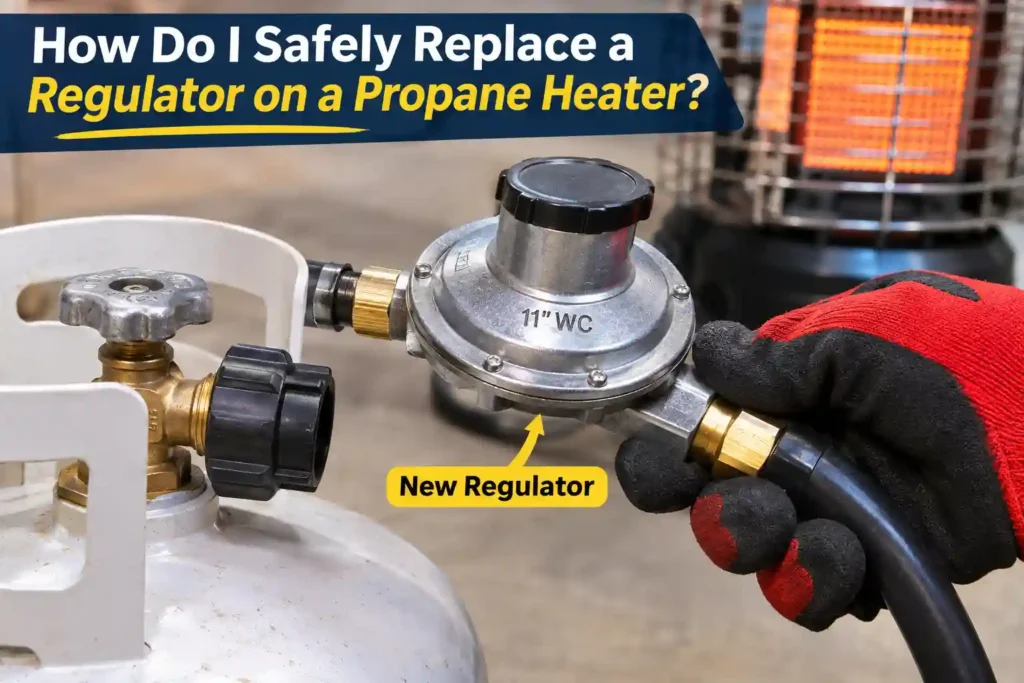
If replacement is necessary, choose a regulator that matches the heater manufacturer's pressure, capacity, connection, and compatibility requirements.
Regular inspection, appropriate gas detection, approved replacement components, and professional maintenance can help reduce the risk of future equipment failures.
Never sacrifice safety to save the cost of replacing a defective propane regulator.

Mike is an experienced propane technician with over 15 years of professional experience in the field. He has dedicated his career to helping customers with their propane needs, from installation to maintenance and repair. Together with Jeremy, he co-founded this website to provide useful information and guidance to customers seeking reliable propane services.