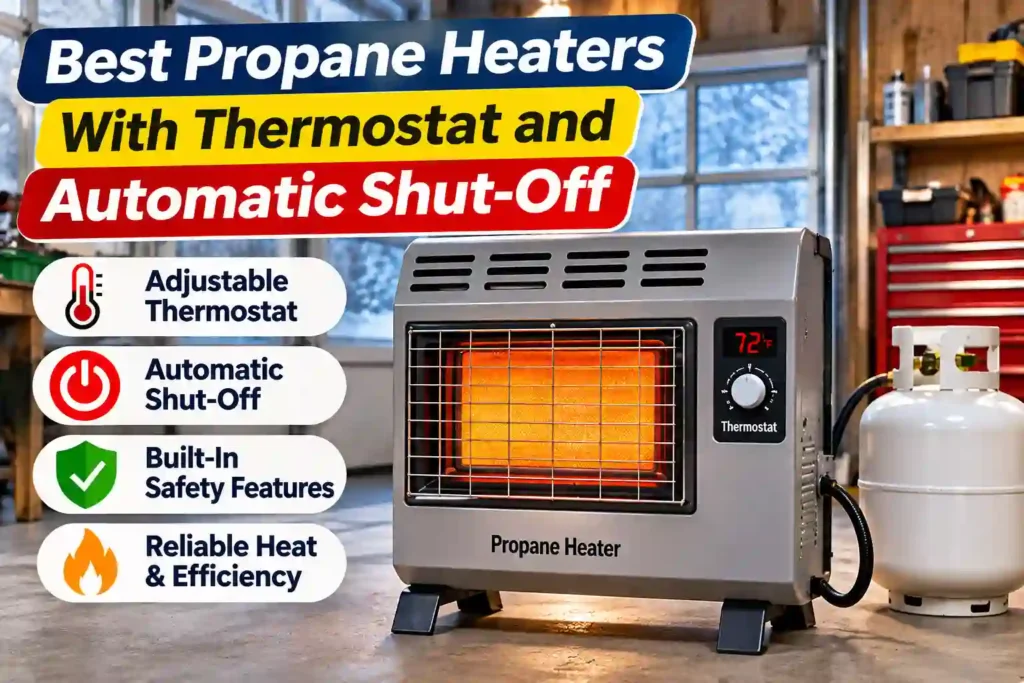


A propane heater with a thermostat and automatic shut-off can provide convenient heating while offering additional protection against certain unsafe operating conditions.
Unlike basic propane heaters that require manual heat adjustments, thermostatically controlled models automatically regulate burner operation according to the surrounding temperature.
Automatic shut-off systems provide another layer of protection by interrupting heater operation when specific abnormal conditions are detected, such as flame failure, oxygen depletion, overheating, or accidental tip-over.


However, not all propane heaters include the same safety features. Some have thermostats but lack tip-over protection, while others have automatic safety shut-off systems but do not provide genuine thermostatic temperature control.
Understanding these differences is particularly important if you intend to heat your home, garage, workshop, cabin, or off-grid property.
When choosing a propane heater, I recommend looking beyond its heating capacity and purchase price. You should also evaluate its safety mechanisms, ventilation requirements, thermostat functionality, electricity requirements, and intended application.
In this guide, I’ll discuss the best propane heaters with thermostats and automatic shut-off features, compare different models, explain their safety systems, and help you choose the right equipment for your heating needs.


Quick Answer
The best propane heater with a thermostat and automatic shut-off is one that combines genuine automatic temperature control with appropriate safety mechanisms and an approved combustion and ventilation design.
For permanent residential heating, I prefer a direct-vent propane heater with thermostatic control and flame-failure protection.
| Heating Requirement | Heater to Consider |
|---|---|
| Permanent residential heating | Rinnai direct-vent wall furnace. |
| Heating during power outages | Empire millivolt direct-vent furnace. |
| Affordable supplemental heating | Mr. Heater thermostatic blue-flame heater. |
| Localized radiant heating | Mr. Heater thermostatic infrared heater. |
| Garage and workshop heating | Modine Hot Dawg or compatible vented unit heater. |
| Construction site heating | Thermostatic forced-air construction heater. |
| Automatic temperature regulation | Mechanical, millivolt, or electronic thermostat. |
| Additional portable heater protection | Tip-over and flame-failure shut-off, where equipped. |
A thermostat is not the same as a safety shut-off device. The thermostat manages temperature, while safety controls respond to specific abnormal operating conditions.
Never assume that automatic shut-off features make a propane heater safe for unattended use, overnight operation, or use in an unapproved indoor environment.
Best Propane Heaters With Thermostat and Automatic Shut-Off: Top Picks
The following heaters are worth considering because they combine automatic temperature regulation with specific safety controls.



My recommendations prioritize appliance suitability, ventilation design, documented safety features, heating performance, and operating convenience rather than purchase price alone.
Top Propane Heater Comparison
| Brand and Model | BTU Input | Thermostat | Main Safety Feature |
|---|---|---|---|
| Rinnai EX38DTP | Up to 38,400 | Electronic | Flame monitoring and overheating protection |
| Empire DV35 LP | 35,000 | Millivolt | Pilot safety shut-off |
| Mr. Heater MHVFBF30LPT | 30,000 | Integrated | Oxygen depletion shut-off |
| Mr. Heater MHVFBF20LPT | 20,000 | Integrated | Oxygen depletion shut-off |
| Mr. Heater MHVFRD30LPT | 30,000 | Integrated | Oxygen depletion shut-off |
| Modine Hot Dawg HD | Model-dependent | External | Flame monitoring and high-limit controls |
| Mr. Heater MHVFGH30LPBT | 30,000 | Integrated | Oxygen depletion shut-off |
| Mr. Heater MH170QFAVT | Up to 170,000 | Integrated | High-temperature safety shut-off |
Safety features vary by model. The presence of one automatic shut-off mechanism does not mean that the appliance includes every available safety feature. Verify current manufacturer specifications before purchasing.
1. Rinnai EX38DTP Direct-Vent Propane Heater
| Maximum fuel input | 38,400 BTU/hr |
|---|---|
| Fuel | Propane |
| Thermostat | Electronic temperature control |
| Ventilation | Direct vent |
| Electricity required | Yes |
| Safety controls | Flame monitoring and overheating protection |
The Rinnai EX38DTP is one of my preferred options for homeowners seeking a professionally installed propane heating appliance with automatic temperature regulation.
Its direct-vent design separates combustion from the occupied indoor environment and discharges exhaust gases outdoors.


The electronic control system monitors operating conditions and can interrupt operation when certain faults occur. Its diagnostic system also helps identify equipment problems.
Advantages
- Automatic temperature regulation.
- Direct-vent combustion system.
- Electronic fault monitoring.
- Fan-assisted heat distribution.
- Suitable for approved residential zone heating.
Disadvantages
- Requires household electricity.
- Higher initial purchase price.
- Professional installation required.
- Not suitable as a portable emergency heater.
My recommendation: I would choose this type of equipment for regularly occupied residential spaces where consistent temperatures and proper exhaust management are priorities.
2. Empire DV35 Direct-Vent Propane Wall Furnace
| Heating input | 35,000 BTU/hr |
|---|---|
| Fuel | Propane configuration |
| Thermostat | Compatible millivolt thermostat |
| Ventilation | Direct vent |
| Household electricity | Not required for basic heating |
| Safety system | Pilot flame safety system |
The Empire DV35 is particularly attractive for rural homes, cabins, and properties that experience frequent power interruptions.
Its self-powered millivolt control system allows the burner and compatible thermostat to operate without household electricity.
The manufacturer identifies electrical independence as a feature of its compatible direct-vent wall furnace range.
Unlike electronically controlled furnaces, the basic heating system can continue functioning during an electrical outage, assuming adequate propane supply and normal operating conditions.
The optional electric blower, where fitted, requires power.
Advantages
- Operates without household electricity.
- Automatic thermostatic temperature control.
- Direct-vent combustion design.
- Suitable for permanent backup heating.
- Pilot flame safety protection.
Disadvantages
- Requires professional installation.
- Higher equipment purchase cost.
- Optional blower requires electricity.
- Thermostat inclusion may vary by package.
My recommendation: Consider the Empire DV35 or the smaller DV25 if emergency preparedness is important and you want a permanent vented heating solution.
3. Mr. Heater 30,000 BTU Blue-Flame Propane Heater
| Model | MHVFBF30LPT |
|---|---|
| Heating input | 30,000 BTU/hr |
| Thermostat | Integrated |
| Heating method | Convection |
| Ventilation | Vent-free |
| Automatic shut-off | Oxygen depletion sensor |
The Mr. Heater 30,000 BTU Blue Flame heater is a popular type of supplemental heating appliance designed to warm surrounding air.
Its integrated thermostat helps maintain the desired temperature, while its oxygen depletion sensor provides automatic fuel shut-off under specified low-oxygen conditions.
It does not require household electricity for basic burner operation, although ignition batteries and optional electric accessories may be required.
Advantages
- Relatively affordable.
- Automatic temperature control.
- Low-oxygen safety shut-off.
- Compact wall-mounted or approved floor-mounted configuration.
- Suitable for approved supplemental heating applications.
Disadvantages
- Releases combustion products indoors.
- Requires compliance with ventilation and room-size requirements.
- Vent-free heaters may be restricted locally.
- An oxygen depletion sensor does not detect carbon monoxide directly.
Although this model offers useful safety features, I would still prioritize a properly vented appliance for regular residential heating.
4. Mr. Heater 20,000 BTU Blue-Flame Propane Heater
| Model | MHVFBF20LPT |
|---|---|
| Heating input | 20,000 BTU/hr |
| Thermostat | Integrated |
| Automatic shut-off | Oxygen depletion sensor |
| Heating method | Convection |
The 20,000 BTU version provides similar temperature-control functionality to the larger blue-flame model but has a lower maximum fuel demand.
The manufacturer’s product information identifies both thermostatic control and an oxygen depletion sensor.
For an appropriately sized heating area, this model may provide a better balance between fuel consumption and heating capacity.
Advantages
- Integrated thermostat.
- Automatic low-oxygen shut-off.
- Lower maximum fuel demand than the 30,000 BTU version.
- Relatively affordable purchase price.
Disadvantages
- Vent-free installation restrictions.
- May be insufficient for larger spaces.
- Requires appropriate combustion-air provisions.
A smaller heater is not necessarily more economical if it must operate continuously to maintain the desired temperature. Correct sizing remains essential.
5. Mr. Heater 30,000 BTU Infrared Propane Heater
| Model | MHVFRD30LPT |
|---|---|
| Heating input | 30,000 BTU/hr |
| Thermostat | Integrated |
| Heating method | Infrared radiant |
| Automatic shut-off | Oxygen depletion sensor |
Unlike blue-flame models, infrared heaters primarily transfer heat to nearby surfaces, objects, and people.
This can provide a noticeable feeling of warmth before the surrounding air reaches the desired temperature.
The MHVFRD30LPT includes thermostatic control and an oxygen depletion safety system.
This heater is worth investigating for approved supplemental heating locations where radiant warmth is desirable.
Advantages
- Provides immediate localized radiant warmth.
- Integrated thermostat.
- Automatic oxygen depletion protection.
- Does not require household electricity for basic heating.
Disadvantages
- Hot radiant surfaces require appropriate clearances.
- Combustion products enter the room.
- Heat distribution differs from convection equipment.
Its hot radiant surfaces require particular attention to combustible-material clearances, furniture placement, and household traffic.
6. Modine Hot Dawg Propane Unit Heater
| Heating input | Model-dependent |
|---|---|
| Fuel | Propane configuration available |
| Thermostat | Compatible external thermostat |
| Heating method | Forced air |
| Safety controls | Flame sensing and temperature limits |
| Electricity required | Yes |
The Modine Hot Dawg series provides fan-assisted heating for approved garage, workshop, and other building applications.
Its control system incorporates burner monitoring and temperature-related safety controls. Different models offer power-vented or separated-combustion configurations.
I would particularly investigate the separated-combustion HDS series when selecting equipment for a workshop.
A properly installed unit heater can provide more consistent heat distribution than a small portable radiant heater.
Advantages
- Effective forced-air heat distribution.
- Compatible external thermostat.
- Automatic flame monitoring.
- High-temperature safety controls.
- Vented configurations available.
Disadvantages
- Requires electrical power.
- Professional installation required.
- Thermostat may be sold separately.
- Additional venting expenses.
The thermostat, venting components, propane configuration, and installation accessories must be selected according to the exact model.
7. Mr. Heater 30,000 BTU Propane Garage Heater
| Model | MHVFGH30LPBT |
|---|---|
| Heating input | 30,000 BTU/hr |
| Thermostat | Integrated |
| Heating method | Blue-flame convection |
| Automatic shut-off | Oxygen depletion sensor |
| Ventilation | Vent-free |
The Mr. Heater MHVFGH30LPBT is marketed for certain garage and storage-space heating applications.
It features thermostatic temperature regulation and automatic low-oxygen shut-off.
Although its relatively simple installation requirements may appeal to budget-conscious buyers, garage heating introduces additional concerns involving gasoline vapors, combustible materials, mounting requirements, and ventilation.
Confirm that this heater is permitted for your exact garage environment before purchasing it.
Do not operate propane heating equipment in an environment containing flammable gasoline vapors or other hazardous concentrations of combustible gases.
Follow applicable garage installation requirements and manufacturer-specified mounting heights and clearances.
For permanent workshop heating, I generally prefer professionally installed vented equipment.
8. Mr. Heater MH170QFAVT Forced-Air Propane Heater
| Maximum input | 170,000 BTU/hr |
|---|---|
| Heating method | Forced air |
| Thermostat | Integrated thermostatic control |
| Automatic shut-off | High-temperature limit |
| Electricity | Required |
| Intended application | Approved construction environments |
The Mr. Heater MH170QFAVT provides substantially more heating capacity than conventional residential wall heaters.
Its thermostatic control and high-temperature safety system are useful for approved construction heating applications.
Advantages
- High maximum heating capacity.
- Rapid forced-air heating.
- Integrated thermostatic control.
- High-temperature safety shut-off.
Disadvantages
- High propane consumption.
- Requires electricity.
- Direct-fired combustion design.
- Not suitable for ordinary residential heating.
Its direct-fired design makes it fundamentally different from a residential vented furnace.
It should not be used as a substitute for an indoor home heater, regardless of its thermostat or automatic shut-off features.
Product selections are based on documented equipment characteristics and intended applications rather than hands-on testing. Confirm current specifications, included accessories, and installation requirements before purchasing.
What Does Automatic Shut-Off Mean on a Propane Heater?
Automatic shut-off refers to the heater’s ability to interrupt burner operation or fuel delivery when a specified operating condition occurs.
There are several types of automatic shut-off systems, and each serves a different purpose.
| Shut-Off Mechanism | Activation Condition | Main Purpose |
|---|---|---|
| Thermostatic shut-off | Desired temperature reached | Temperature control |
| Oxygen depletion sensor | Oxygen availability falls below designed limits | Low-oxygen protection |
| Tip-over switch | Heater tilts beyond its designed limit | Reduces overturn-related hazards |
| Flame-failure protection | Pilot or burner flame is lost | Prevents continued unburned gas delivery |
| High-limit switch | Equipment temperature exceeds its designed limit | Overheating protection |
| Airflow proving switch | Required airflow is not established | Supports safe operation |
| Vent pressure switch | Abnormal venting pressure is detected | Supports proper exhaust operation |
| Automatic timer | Preset operating time expires | Operating convenience |
Not every propane heater contains all these mechanisms.
A wall-mounted furnace, for example, may have sophisticated flame-monitoring and overheating protection but no tip-over switch because it is permanently mounted.
How Does a Propane Heater Thermostat Work?
A thermostat monitors the surrounding temperature and controls the burner according to the selected temperature setting.
Automatic Thermostatic Heating Cycle
Temperature falls below the thermostat setting.
Heater begins its approved ignition sequence.
Room temperature gradually increases.
Burner shuts off or reduces its output.
The heating cycle repeats as additional heat is required.
Safety controls can interrupt operation independently of the thermostat. Actual ignition, burner modulation, and shutdown sequences vary by appliance.
Some thermostatically controlled propane heaters cycle the burner completely on and off, while others vary their heat output.
A standing pilot may remain lit even when the main burner shuts off.
Therefore, thermostatic shut-off does not necessarily mean the heater has completely stopped consuming propane.
Thermostat Shut-Off vs. Safety Shut-Off
One of the biggest misunderstandings among propane heater buyers is assuming that a thermostat and an automatic safety shut-off perform the same function.
| Feature | Thermostat Shut-Off | Safety Shut-Off |
|---|---|---|
| Primary purpose | Temperature regulation | Hazard protection |
| Trigger | Desired temperature reached | Abnormal operating condition |
| Normal operating event | Yes | Generally no |
| Automatic restart | Usually | Model-dependent |
| Controls heating expenses | Can help | Not its primary purpose |
| Requires troubleshooting | Generally no | May be necessary |
For example, if you set your thermostat to 65°F, the burner may shut off when the room reaches that temperature.
This is normal operation.
However, if the heater shuts down because of overheating or flame failure, the cause may require investigation before operation resumes.
Never repeatedly restart a propane heater that is shutting down because of an unresolved safety fault.
Do not bypass the safety system or increase propane supply pressure to prevent shutdowns.
What Is an Oxygen Depletion Sensor on a Propane Heater?
An oxygen depletion sensor, commonly called an ODS, is a safety mechanism used in many unvented propane heaters.
It uses a specially designed pilot system that responds to decreasing oxygen availability. Under specified low-oxygen conditions, the system interrupts gas delivery.
How Oxygen Depletion Protection Works
Conceptual illustration only. Actual sensing mechanisms vary by appliance. This is not a servicing or adjustment diagram.
An ODS provides additional protection, but it has limitations.
An oxygen depletion sensor responds to low-oxygen conditions. It does not directly measure carbon monoxide concentrations.
Dangerous carbon monoxide concentrations can occur without triggering the ODS.
The heater must still be operated according to its ventilation requirements, and appropriate carbon monoxide alarms remain essential.
What Is a Tip-Over Shut-Off Switch?
A tip-over switch is designed to interrupt heater operation if a compatible portable heater overturns or tilts beyond its permitted operating position.
This feature is particularly relevant to portable heaters used around busy work areas.
| Heater Type | Tip-Over Protection Availability |
|---|---|
| Portable radiant heater | Common on selected models |
| Portable camping heater | Model-dependent |
| Freestanding patio heater | Common on selected models |
| Wall-mounted propane heater | Generally not included |
| Permanent direct-vent furnace | Generally unnecessary for fixed installation |
| Construction heater | Model-dependent |
Many propane wall heaters and permanently mounted furnaces do not include tip-over switches because their installation configuration prevents normal overturning.
Also, some portable propane heaters include tip-over protection but only offer manual low, medium, and high heat settings.
If you want both genuine thermostatic control and automatic tip-over protection, verify that the exact model includes both.
Do not confuse an adjustable heat-output knob with a room-temperature thermostat.
What Is Flame-Failure Protection?
Flame-failure protection helps prevent propane from continuing to flow when the required flame is no longer present.
Depending on the heater’s design, this system may use a thermocouple, thermopile, electronic flame sensor, or another approved flame-monitoring mechanism.
| Component | General Function |
|---|---|
| Thermocouple | Detects heat from a pilot flame. |
| Thermopile | Generates a small electrical voltage from heat. |
| Electronic flame sensor | Verifies burner flame presence. |
| Gas-control valve | Interrupts or permits fuel delivery. |
| Ignition control module | Manages ignition and flame verification. |
If the flame is lost, the safety system may close the gas valve or initiate a manufacturer-designed restart sequence.
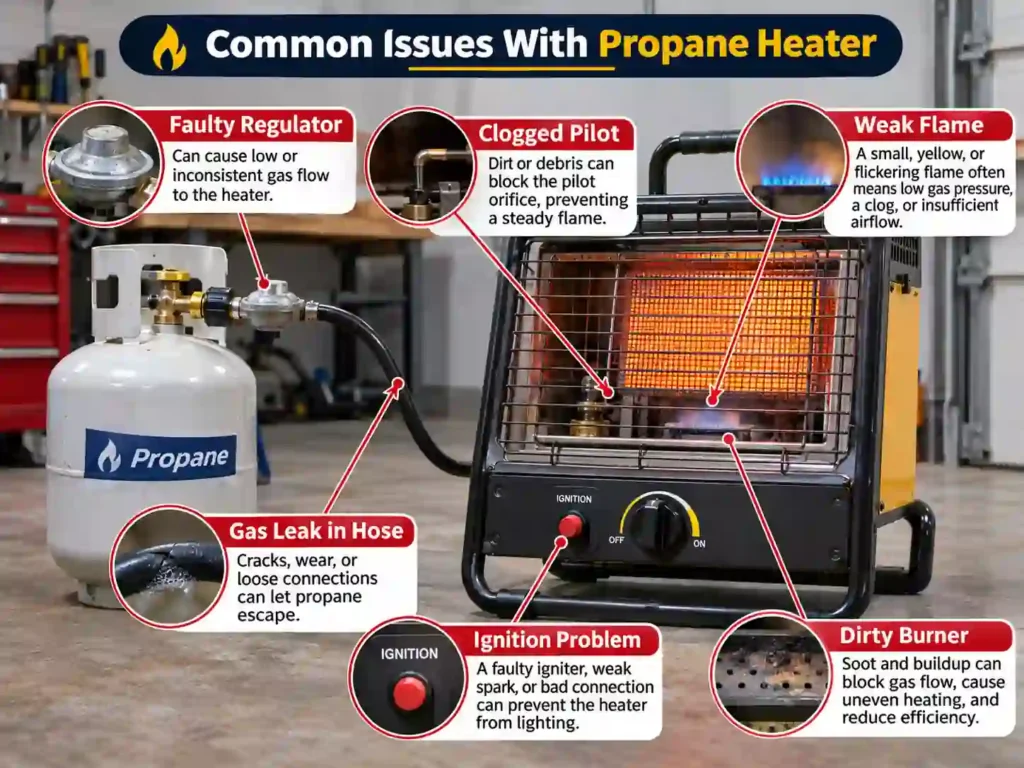
Repeated flame failure may indicate a problem with propane delivery, ignition components, combustion airflow, or the heater’s gas-control system.
Never bypass these safety components.
What Is Automatic Overheat Protection?
Certain propane heaters contain a temperature-sensitive limit switch designed to interrupt burner operation when equipment temperature becomes excessive.
Possible causes of overheating include restricted airflow, blower failure, obstructed air outlets, improper installation, or defective components.
Overheat protection is particularly important for forced-air propane furnaces and construction heaters.
Automatic Overheating Protection
Restart and lockout behavior depend on the manufacturer’s control-system design.
Unlike the room thermostat, a high-limit switch monitors equipment-related temperature conditions.
If your heater repeatedly shuts down because of overheating, stop using it until the underlying problem has been properly identified.
Choose the Right Heating Capacity
A propane heater must provide sufficient useful heat without being unnecessarily oversized.
The following table uses an illustrative heating requirement of 30–50 BTU/hr per square foot.
| Floor Area | Estimated Useful Heating Requirement |
|---|---|
| 100 sq. ft. | 3,000–5,000 BTU/hr |
| 200 sq. ft. | 6,000–10,000 BTU/hr |
| 300 sq. ft. | 9,000–15,000 BTU/hr |
| 400 sq. ft. | 12,000–20,000 BTU/hr |
| 500 sq. ft. | 15,000–25,000 BTU/hr |
| 750 sq. ft. | 22,500–37,500 BTU/hr |
| 1,000 sq. ft. | 30,000–50,000 BTU/hr |
| 1,500 sq. ft. | 45,000–75,000 BTU/hr |
| 2,000 sq. ft. | 60,000–100,000 BTU/hr |
These are preliminary estimates rather than professional heat-loss calculations.
Actual heating requirements depend on climate, insulation, ceiling height, windows, air leakage, and desired indoor temperature.
Propane Heater BTU Sizing Calculator
Estimate Your Heating Requirements
Estimated Useful Heat Required
20,000
BTU/hr output
Estimated Heater Fuel Input
25,000
BTU/hr input
For preliminary planning only. This calculator does not determine minimum ventilation requirements, safe room sizes, or appliance installation suitability. Obtain a professional heat-loss assessment for permanent installations.
Vented vs. Vent-Free Propane Heaters With Automatic Shut-Off
Even when both heaters include automatic safety systems, their combustion designs remain fundamentally different.
Vented Propane Heater
Discharges combustion gases outdoors through an approved venting system.
- Preferred for regular residential heating.
- Lower indoor combustion pollution concerns.
- Requires appropriate venting.
- Generally higher installation cost.
Vent-Free Propane Heater
Uses indoor combustion air and releases combustion products into the occupied space.
- Generally lower equipment purchase cost.
- Oxygen depletion protection on compatible models.
- Additional indoor air-quality considerations.
- Subject to location and ventilation restrictions.
| Feature | Vented Heater | Vent-Free Heater |
|---|---|---|
| Combustion exhaust | Discharged outdoors | Released indoors |
| Added indoor combustion moisture | Generally lower | Higher |
| Installation cost | Generally higher | Generally lower |
| Thermostat availability | Common | Common |
| Flame-failure protection | Common | Common |
| Oxygen depletion sensor | Generally not the primary safety mechanism | Common |
| Indoor air-quality concerns | Generally lower | Greater |
| Regular residential heating | Preferred | Conditional supplemental option |
For long-term residential heating, I prefer properly installed direct-vent propane heaters.
Automatic safety shut-off features do not eliminate the indoor air-quality concerns associated with unvented combustion.
How Much Propane Does a Thermostatically Controlled Heater Use?
One US gallon of propane contains approximately 91,500 BTU of energy.
A heater’s maximum fuel input determines its theoretical hourly propane consumption.
Gallons per Hour = BTU Input ÷ 91,500
For a 30,000 BTU propane heater:
30,000 ÷ 91,500 = approximately 0.328 gallons per hour.
Propane Heater Fuel Consumption Chart
| Heater Input | Propane per Hour | Hourly Cost at $3.50/Gallon |
|---|---|---|
| 10,000 BTU/hr | 0.109 gal | $0.38 |
| 15,000 BTU/hr | 0.164 gal | $0.57 |
| 18,000 BTU/hr | 0.197 gal | $0.69 |
| 20,000 BTU/hr | 0.219 gal | $0.77 |
| 25,000 BTU/hr | 0.273 gal | $0.96 |
| 30,000 BTU/hr | 0.328 gal | $1.15 |
| 35,000 BTU/hr | 0.383 gal | $1.34 |
| 40,000 BTU/hr | 0.437 gal | $1.53 |
| 60,000 BTU/hr | 0.656 gal | $2.30 |
| 80,000 BTU/hr | 0.874 gal | $3.06 |
| 100,000 BTU/hr | 1.093 gal | $3.83 |
| 170,000 BTU/hr | 1.858 gal | $6.50 |
These calculations assume continuous burner operation at maximum input and a hypothetical propane price of $3.50 per gallon.
A thermostatically controlled heater may consume less fuel when the burner cycles off or reduces output.
How Long Will a Propane Tank Last?
Knowing how long your propane supply may last is particularly important when using a heater during cold weather or power outages.
| Heater Input | 20 lb Propane | 40 lb Propane | 100 lb Propane |
|---|---|---|---|
| 10,000 BTU/hr | 43.0 hrs | 86.0 hrs | 215.0 hrs |
| 18,000 BTU/hr | 23.9 hrs | 47.8 hrs | 119.5 hrs |
| 20,000 BTU/hr | 21.5 hrs | 43.0 hrs | 107.5 hrs |
| 30,000 BTU/hr | 14.3 hrs | 28.7 hrs | 71.7 hrs |
| 40,000 BTU/hr | 10.8 hrs | 21.5 hrs | 53.8 hrs |
| 60,000 BTU/hr | 7.2 hrs | 14.3 hrs | 35.8 hrs |
| 80,000 BTU/hr | 5.4 hrs | 10.8 hrs | 26.9 hrs |
| 100,000 BTU/hr | 4.3 hrs | 8.6 hrs | 21.5 hrs |
These are theoretical continuous burner runtimes based on approximately 0.235 gallons of propane per pound. They do not establish cylinder compatibility or adequate propane vaporization capacity.
Higher-output propane heaters frequently require larger propane supplies, particularly in cold weather.
Worked Example: Operating a 30,000 BTU Heater With Automatic Shut-Off
Suppose you own a 30,000 BTU propane heater with an integrated thermostat.
You operate the heating system during an approved eight-hour daily heating period, and the burner operates at full input for approximately 50% of that time.
| Operating Condition | Example Value |
|---|---|
| Maximum fuel input | 30,000 BTU/hr |
| Daily heating period | 8 hours |
| Burner duty cycle | 50% |
| Actual burner runtime | 4 hours |
| Propane price | $3.50/gallon |
| Available propane | 100 lb |
Estimated Heating Expenses
Daily burner runtime = 8 × 50% = 4 hours.
Daily propane consumption:
30,000 ÷ 91,500 × 4
Maximum Hourly Consumption
0.328 gal
Daily Propane Consumption
1.31 gal
Daily Fuel Cost
$4.59
Monthly Fuel Cost
$137.70
Theoretical Fuel Availability
17.9 days
Equivalent Daily Burner Runtime
4 hours
Assumes adequate vaporization, 23.5 gallons of available propane, a 30-day month, and no additional pilot fuel consumption.
This example demonstrates how normal thermostatic cycling can influence heating expenses.
Safety shut-offs should not be considered a fuel-saving mechanism because they respond to abnormal operating conditions rather than ordinary heating demand.
Propane Heater Runtime and Operating Cost Calculator
Use the following calculator to estimate your daily propane consumption, theoretical fuel availability, and heating expenses.
Thermostatic Propane Heater Fuel Calculator
Maximum Hourly Consumption
0.328 gal
Daily Fuel Consumption
1.31 gal
Theoretical Fuel Availability
17.9 days
Daily Heating Expense
$4.59
Seven-Day Heating Expense
$32.13
Daily Burner Runtime
4.0 hrs
Estimated 30-Day Heating Expense
$137.70
Estimates exclude electricity, pilot fuel, and installation expenses. Operating periods must comply with manufacturer instructions. This calculator does not establish unattended-operation safety, propane tank compatibility, or sufficient vaporization capacity.
Does Automatic Temperature Shut-Off Save Propane?
A thermostat can reduce unnecessary heating when the desired temperature is reached.
Consider the following operating expenses for a 30,000 BTU heater during an eight-hour daily heating period.
Monthly Propane Expenses by Burner Duty Cycle
Based on propane priced at $3.50 per gallon and a 30-day month.
25% Burner Duty Cycle: $68.85
40% Burner Duty Cycle: $110.16
50% Burner Duty Cycle: $137.70
75% Burner Duty Cycle: $206.56
100% Burner Duty Cycle: $275.41
These figures represent hypothetical burner duty cycles, not guaranteed thermostat savings.
| Burner Duty Cycle | Daily Burner Runtime | Monthly Fuel Expense |
|---|---|---|
| 25% | 2 hours | $68.85 |
| 40% | 3.2 hours | $110.16 |
| 50% | 4 hours | $137.70 |
| 75% | 6 hours | $206.56 |
| 100% | 8 hours | $275.41 |
Insulation improvements and reasonable thermostat settings can help reduce the amount of time the burner needs to operate.
However, actual savings depend on the building’s heating requirements and how the heater would otherwise be operated.
What Size Propane Regulator Do You Need?
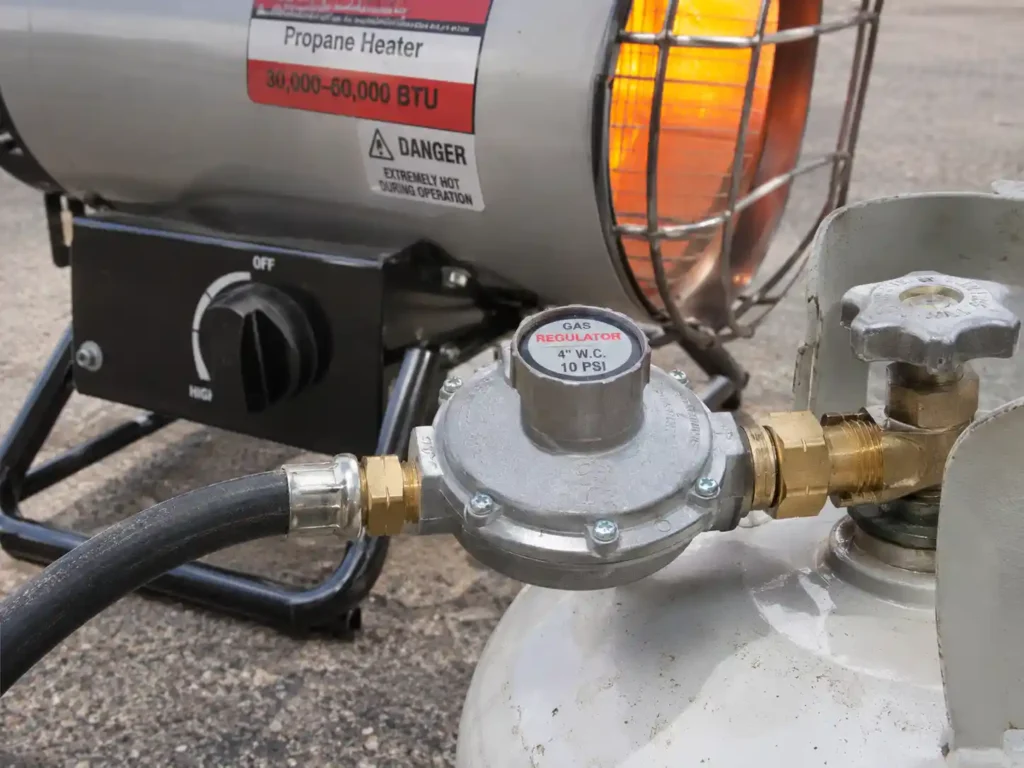
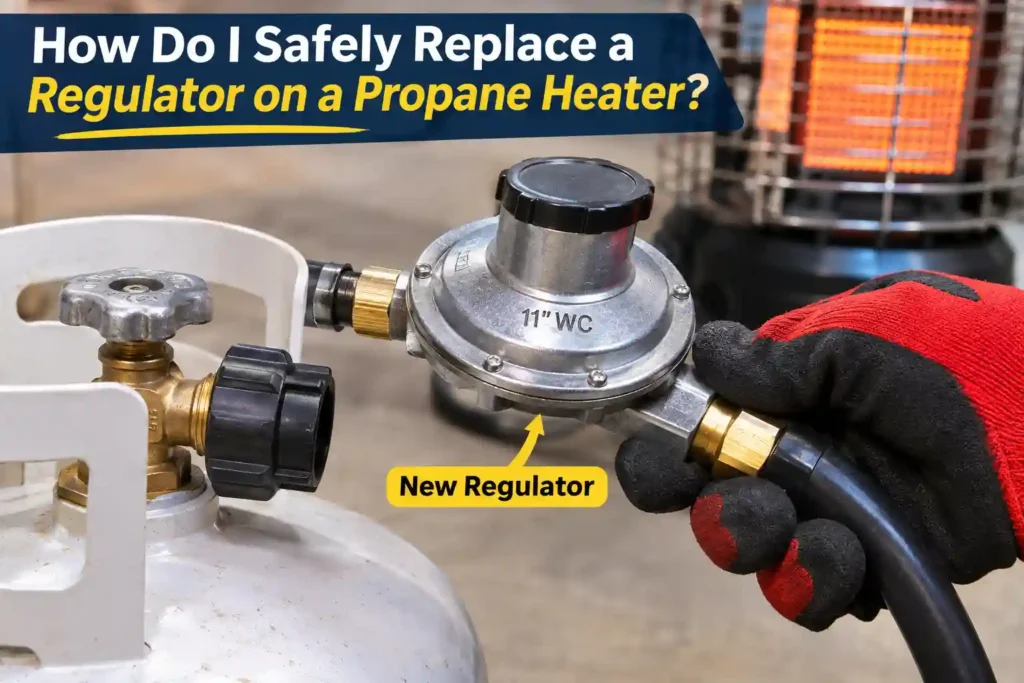
Even a propane heater with advanced automatic shut-off features requires correct incoming gas pressure.
Many residential propane heaters operate with low-pressure regulated gas, while certain construction heaters require substantially higher pressures.
| Heater Input | Minimum Fuel Delivery Demand |
|---|---|
| 20,000 BTU/hr | 20,000 BTU/hr |
| 30,000 BTU/hr | 30,000 BTU/hr |
| 40,000 BTU/hr | 40,000 BTU/hr |
| 60,000 BTU/hr | 60,000 BTU/hr |
| 100,000 BTU/hr | 100,000 BTU/hr |
| 170,000 BTU/hr | 170,000 BTU/hr |
The regulator must provide sufficient actual flow capacity at the required operating pressure.
For additional guidance, read my articles on what BTU capacity means on a propane regulator, inlet pressure versus outlet pressure, and what kind of regulator you need for your propane tank.
Never increase propane supply pressure to prevent a heater from shutting down.
An automatic shutdown may indicate an underlying safety problem. Increasing gas pressure could cause overfiring, equipment damage, or unsafe combustion.
How Much Do Propane Heaters With Automatic Shut-Off Cost?
Purchase prices vary according to heating capacity, manufacturer, combustion design, thermostat configuration, and available safety features.
| Heater Type | Estimated Purchase Price |
|---|---|
| Portable propane heater with safety shut-off | $80–$200 |
| 20,000 BTU thermostatic blue-flame heater | $150–$280 |
| 30,000 BTU thermostatic blue-flame heater | $180–$350 |
| Thermostatic infrared heater | $150–$400 |
| Forced-air construction heater | $180–$550 |
| Vented garage unit heater | $450–$1,500 |
| Millivolt direct-vent wall furnace | $900–$2,300 |
| Electronic direct-vent wall furnace | $1,200–$3,000 |
Propane Heater Purchase Price Comparison
Portable Heater: $80–$200
20,000 BTU Blue Flame: $150–$280
30,000 BTU Blue Flame: $180–$350
Infrared Heater: $150–$400
Construction Heater: $180–$550
Vented Garage Heater: $450–$1,500
Millivolt Direct-Vent Furnace: $900–$2,300
Electronic Direct-Vent Furnace: $1,200–$3,000
Bars represent the upper end of illustrative US equipment price ranges. These are not verified current retail quotations. Portable heater prices may include models without genuine thermostatic control.
Permanent heating installations may also require gas piping, regulators, venting materials, electrical connections, thermostats, and professional labor.
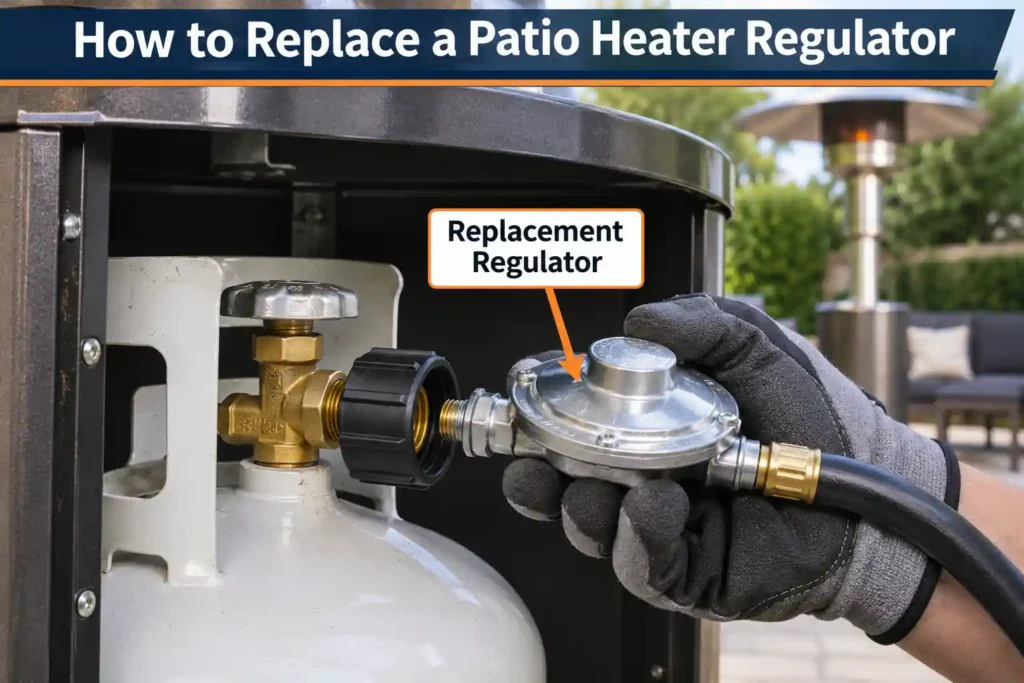
For related expenses, see my guide on the cost of replacing a propane regulator.
Why Does My Propane Heater Keep Shutting Off Automatically?
Repeated automatic shutdowns can indicate normal thermostat operation or an underlying equipment problem.
| Symptom | Possible Cause |
|---|---|
| Burner stops at desired temperature | Normal thermostat operation. |
| Heater stops shortly after ignition | Flame-monitoring or ignition problem. |
| Pilot repeatedly goes out | Pilot assembly or flame-sensing problem. |
| Heater shuts down when tilted | Tip-over protection, where equipped. |
| Heater shuts down during prolonged operation | Overheating or safety-control issue. |
| Heater shuts down during freezing weather | Inadequate propane vaporization. |
| Burner flame becomes weak | Insufficient fuel delivery. |
| Electronic heater displays an error | Detected operating fault. |
| Vent-free heater repeatedly shuts down | Oxygen depletion or another equipment issue. |
| Regulator develops excessive frost | Fuel supply or regulator problem. |
If the thermostat has reached its selected temperature, burner shutdown is generally normal.
However, unexplained or repeated safety-related shutdowns should be investigated before the heater is returned to service.
Read my related guides on how to know if a propane heater regulator is failing and why propane regulators keep freezing up.
Which Propane Heater Should You Choose?
| Your Heating Requirement | Recommended Equipment to Investigate |
|---|---|
| Regular living-room heating | Rinnai direct-vent furnace. |
| Heating during power outages | Empire DV25 or DV35. |
| Affordable supplemental convection heating | Mr. Heater 20,000 BTU Blue Flame. |
| Higher-output supplemental heating | Mr. Heater 30,000 BTU Blue Flame. |
| Localized radiant warmth | Mr. Heater Infrared series. |
| Permanent garage heating | Modine Hot Dawg. |
| Approved construction heating | Mr. Heater MH170QFAVT. |
| Portable heating with overturn protection | Approved model with documented tip-over protection. |
For regular home heating, I would prioritize a direct-vent heater with automatic temperature control and appropriate flame-monitoring systems.
For portable heating, tip-over protection and flame-failure protection are particularly important, but the equipment must also be approved for the intended location.
How to Choose the Best Propane Heater With Automatic Shut-Off
Step 1: Identify Your Intended Heating Location
Determine whether you need a propane heater for a living space, cabin, garage, workshop, or construction environment.
The intended location determines the appropriate combustion design, installation configuration, and required safety features.
Step 2: Confirm Genuine Thermostatic Control
Look for a thermostat that automatically regulates room temperature.
A manual heat-output control with low, medium, and high settings is not necessarily a thermostat.
Step 3: Verify Automatic Safety Shut-Off Features
Review the manufacturer’s documentation for flame-failure protection, oxygen depletion sensing, overheating protection, airflow monitoring, and tip-over protection where applicable.
Do not assume that every propane heater includes all these features.
Step 4: Determine Heating Capacity
Consider the area’s floor size, insulation, ceiling height, outdoor temperatures, and building heat loss.
Arrange professional sizing for permanent heating installations.
Step 5: Confirm Propane and Electrical Requirements
Verify regulator pressure, gas supply capacity, approved tank configuration, ignition requirements, and electrical power needs.
If emergency heating is important, confirm that the heater can operate during power outages.
Step 6: Compare Total Ownership Costs
Consider equipment purchase prices, installation expenses, propane consumption, maintenance, and replacement parts.
Prioritize equipment suitability and safety rather than choosing solely according to the lowest purchase price.
Propane Heater Buying Checklist
Before purchasing a propane heater with a thermostat and automatic shut-off, verify the following requirements.
Propane Heater Purchasing Checklist
0 of 15 requirements checked
Completing this checklist does not replace manufacturer approval, professional installation, or safety testing.
Important Safety Precautions
Automatic shut-off features provide additional protection, but they do not replace correct equipment operation, ventilation, professional installation, and regular maintenance.
Propane Heater Safety Reminders
- Never use outdoor-only propane heaters indoors.
- Never bypass automatic safety shut-off devices.
- Install carbon monoxide alarms with battery backup or independent battery power.
- Never leave portable heaters operating while sleeping or unattended.
- Maintain manufacturer-required combustible-material clearances.
- Never obstruct exhaust vents or combustion-air openings.
- Do not modify propane regulator pressure settings.
- Never use an open flame to check for propane leaks.
- Keep outdoor propane supply cylinders in approved locations.
- Have malfunctioning gas-control components professionally inspected.
- Never assume an oxygen depletion sensor replaces a carbon monoxide alarm.
- Follow manufacturer inspection and maintenance recommendations.
- Stop using equipment that repeatedly experiences unexplained safety shutdowns.
If you smell propane: Leave the affected area immediately, avoid electrical switches and ignition sources, and contact your propane supplier or emergency services from a safe location.
Do not return to the affected area until it has been declared safe.
If a carbon monoxide alarm sounds: Move everyone to fresh air immediately and contact emergency services.
For additional information, see my guide on whether you can install a propane regulator yourself or need a professional.
Frequently Asked Questions
Do Propane Heaters Shut Off Automatically When They Reach the Desired Temperature?
Yes. Models equipped with genuine thermostats can automatically interrupt or reduce burner operation when the desired temperature is reached.
A standing pilot may remain operating, depending on the heater’s design.
What Is the Safest Type of Propane Heater for Indoor Use?
For permanent residential heating, a properly sized and professionally installed direct-vent propane heater is generally preferable because combustion gases are discharged outdoors.
Do All Propane Heaters Have Automatic Shut-Off?
No. Available safety systems depend on the manufacturer’s design and intended application.
Always verify the exact model’s documented safety features.
Does an Oxygen Depletion Sensor Detect Carbon Monoxide?
No. An oxygen depletion sensor responds to low-oxygen conditions and does not directly measure carbon monoxide concentration.
Separate carbon monoxide alarms are essential.
Can I Leave a Propane Heater With Automatic Shut-Off Running Overnight?
Do not leave portable propane heaters operating while sleeping.
Permanently installed heating equipment must be operated according to its approved installation and operating instructions.
Automatic shut-off features alone do not establish suitability for overnight operation.
Will a Propane Heater Automatically Shut Off if It Runs Out of Fuel?
Many modern heaters incorporate flame-failure protection that interrupts fuel delivery when the required flame is lost.
The exact behavior depends on the heater’s control system.
Do Propane Heaters With Automatic Shut-Off Require Electricity?
Not necessarily. Mechanical and millivolt-controlled heaters can provide thermostatic and certain safety-control functions without household electricity.
Electronic furnaces and forced-air heaters generally require power.
Can I Add an Automatic Shut-Off Switch to My Existing Propane Heater?
Only use components and configurations specifically approved by the heater manufacturer.
Unauthorized modifications to gas-control systems can create serious safety hazards.
Does Automatic Shut-Off Make a Propane Heater More Efficient?
Normal thermostatic cycling can reduce unnecessary burner operation.
Safety-related automatic shutdowns are intended to respond to abnormal conditions, not improve efficiency.
Why Does My Propane Heater Shut Off Even When the Room Is Cold?
Possible causes include inadequate propane pressure, ignition problems, overheating, flame-monitoring problems, incorrect thermostat placement, or activation of a safety device.
Repeated unexplained shutdowns require proper diagnosis.
My Final Thoughts
Choosing the best propane heater with a thermostat and automatic shut-off involves more than selecting the appliance with the greatest number of advertised safety features.
For permanent residential heating, I would investigate direct-vent models such as the Rinnai EX38DTP and Empire DV35.
For budget-conscious supplemental heating, thermostatic Mr. Heater blue-flame and infrared models may be worth considering where vent-free equipment is permitted and appropriate.
For garages and workshops, professionally installed vented unit heaters such as the Modine Hot Dawg series offer another practical option.
Regardless of which heater you choose, remember that automatic safety systems provide additional protection rather than permission to ignore operating restrictions.
Correct heater sizing, proper propane pressure, adequate ventilation, carbon monoxide protection, professional installation, and regular maintenance remain essential for reliable heating.

Mike is an experienced propane technician with over 15 years of professional experience in the field. He has dedicated his career to helping customers with their propane needs, from installation to maintenance and repair. Together with Jeremy, he co-founded this website to provide useful information and guidance to customers seeking reliable propane services.