TL;DR: A professionally installed whole-house propane generator can increase home resale value, especially in outage-prone areas. Zonda’s 2025 Cost vs. Value Report estimated 95.3% cost recoupment for backup generator projects nationally. That is a benchmark, not a guaranteed return or a fixed percentage of your home’s value.
If I were spending $10,000 or more on a propane standby generator, I would want to know whether the investment helps when I eventually sell the house. The answer depends on where the home is, how often the power fails, the generator’s condition and what buyers in that market value.
I’ll break down the strongest available resale benchmark, show several realistic calculation scenarios and explain how to protect your investment with the right installation records.


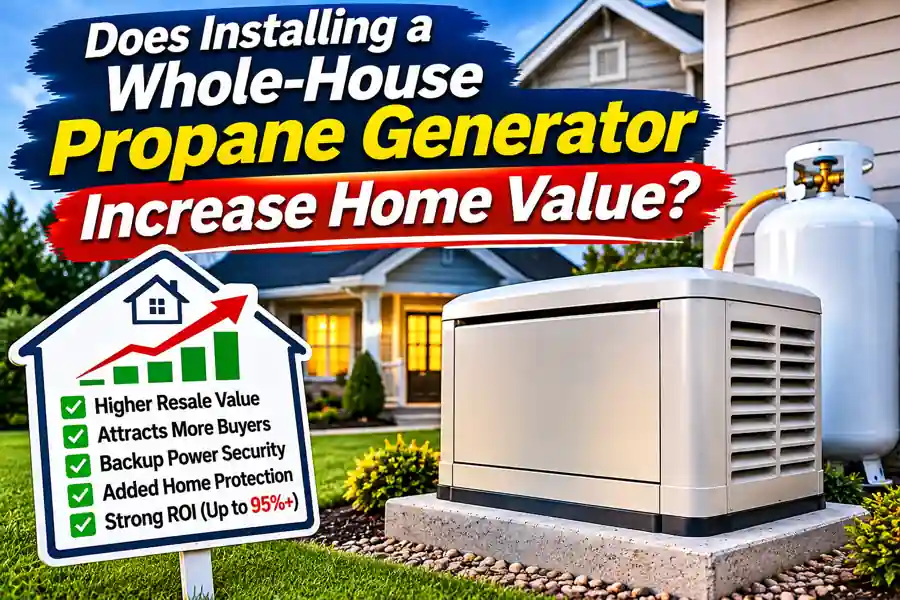
Does installing a whole-house propane generator increase home value?
It can. A permanently installed propane standby generator may make a house more desirable, particularly in places with hurricanes, ice storms, wildfire-related shutoffs, frequent outages or homes dependent on electric well pumps. But I would not promise that every installation raises the appraisal by a fixed percentage.
The best national benchmark I found is the 2025 Cost vs. Value Report from Zonda. It estimated an average installed backup-generator project cost of $13,534, resale value of $12,902 and cost recouped of 95.3%. That is a modeled national project benchmark, not a guaranteed result for your address or a propane-only figure. Zonda also highlighted substantial regional differences.
2025 national generator ROI: the numbers
| 2025 Cost vs. Value benchmark | National average |
|---|---|
| Backup generator job cost | $13,534 |
| Estimated value at sale | $12,902 |
| Estimated cost recouped | 95.3% |
| Difference between job cost and value | $632 |
Source: Zonda’s 2025 Cost vs. Value Report. This report combines construction-cost modeling and real-estate professional inputs. It does not mean every seller receives a $12,902 higher offer or that a 2026 propane installation will have the same return.


Why I don’t promise a 3% to 5% home-value increase
You may see generator marketing pages claiming a standby unit increases home value by 3% to 5%. That percentage is not a reliable universal appraisal rule. A $400,000 home would supposedly gain $12,000–$20,000 from that claim, but buyers in one market may value backup power much more than buyers in another.
I prefer to discuss cost recoupment and local comparable sales rather than apply a nationwide percentage to every house. The generator’s condition, capacity, permitted installation, transfer switch and remaining useful life also influence the result.
In short, the correct question is not “How many percent does a generator add?” but “How much more are buyers willing to pay for a comparable home with this specific functioning standby system?”



Where propane generators are most valuable
| Local condition | Likely buyer interest | Reason |
|---|---|---|
| Hurricane-prone coastal area | Often strong | Multi-day outages and refrigeration/AC needs |
| Ice-storm or snowstorm region | Often strong | Heating, sump pumps and frozen-pipe prevention |
| Rural home with electric well | Often strong | Water supply depends on electricity |
| Neighborhood with reliable grid | Variable or modest | Fewer outages reduce perceived need |
| House with critical home equipment | Buyer-specific | Continuity may be highly valuable |
| Home with unpermitted or poorly maintained unit | Potentially negative | Repair, safety and compliance concerns |
These are qualitative expectations, not a substitute for comparable-sale evidence. I would ask a local real estate agent and appraiser how often generators appear in nearby listings and whether buyers actually pay more for them.
How appraisers treat a permanently installed generator
A generator is not automatically worth its original invoice to an appraiser. Appraisers assess market value based on accepted valuation approaches and evidence from comparable properties. A permanent system may contribute value as a home feature, but that contribution can be lower than replacement cost, especially after years of use.
A portable generator that the seller takes away is usually personal property rather than a permanent home feature. A properly installed standby generator with an automatic transfer switch is more likely to be considered part of the real property, depending on the transaction and local rules.


I would give the appraiser the permits, installation invoice, model number, warranty information and service records, without telling them what value they must assign. The documents help establish what is installed and whether it works.
How much does a whole-house propane generator cost to install?
Total cost depends on generator size, electrical work, propane supply, trenching, permitting and site preparation. A home with an existing correctly sized propane tank may have a very different project cost from one requiring a new tank and long fuel lines.
Here is an illustrative breakdown for planning, not a live contractor quote.
| Component | Illustrative budget |
|---|---|
| Standby generator equipment | $4,000–$8,500 |
| Transfer equipment and electrical labor | $1,500–$5,000 |
| Pad, permits and site work | $500–$2,500 |
| Propane piping and regulator work | $500–$3,000+ |
| New tank, if needed | Additional; highly variable |
Actual bids may fall outside these ranges. My detailed whole-house propane generator installation cost guide covers the variables and common surprises.
The difference between cost recouped and profit
Suppose I spend $14,000 on a standby system and a local appraisal analysis attributes $10,000 of resale value to it. My cost recoupment would be 71.4%. That is not the same as losing $4,000 in cash on the day I sell, because I also received years of backup-power service, avoided some outage disruption and may have reduced risk of damage.
| Hypothetical scenario | Installation cost | Added resale value | Cost recouped |
|---|---|---|---|
| Low buyer demand | $14,000 | $4,000 | 28.6% |
| Moderate demand | $14,000 | $10,000 | 71.4% |
| Strong buyer demand | $14,000 | $14,000 | 100% |
| Exceptionally strong demand | $14,000 | $16,000 | 114.3% |
These scenarios illustrate the math; they are not measured regional returns. I would avoid budgeting for the high-end scenario unless comparable local sales justify it.
Does propane offer an advantage over gasoline or natural gas?
A propane standby system can be attractive where natural gas service is unavailable. Propane can be stored in a stationary tank on the property, and a permanently installed generator can start automatically when the utility fails. The trade-off is that the owner must manage fuel deliveries and adequate vaporization capacity.
A buyer who already uses propane for heating may appreciate one coordinated fuel supply. Another buyer may worry about tank lease terms, delivery contracts or fuel costs. Those details affect how the generator is perceived.
For general fuel trade-offs, see propane vs. gasoline generators. For a larger propane supply, I explain running a generator from a 500-gallon tank.
Does generator size affect resale value?
A 26 kW generator is not automatically more valuable than a correctly sized 18 kW unit. Buyers want reliable backup for the home’s actual loads. Oversizing may increase fuel use and upfront cost without producing proportionate market value.
I would document what the system is designed to support: central air conditioning, well pump, refrigeration, furnace, sump pump, lights or selected circuits. A clear load schedule and professional commissioning record are more persuasive than a big number on the enclosure.
Conversely, a generator that cannot support the advertised “whole-house” loads may disappoint buyers. Accurate listing language matters.
Age, condition and maintenance records matter
A brand-new system with a transferable warranty may have more buyer appeal than a neglected unit with repeated fault codes. As the generator ages, remaining useful life and expected repairs become more important.
I would maintain a file with annual service reports, battery replacement dates, exercise-test results and any major repairs. A buyer can then distinguish a functioning standby system from a decorative metal box beside the house.
See annual propane generator service cost for typical ongoing expenses. In cold-weather regions, a documented generator winterization routine also helps show responsible ownership.
Permits and professional installation can protect value
A generator installed without proper permits or a compliant transfer arrangement can create inspection, insurance and safety concerns. Buyers may ask for corrections, seek a price reduction or decline to rely on the system at all.
I would use licensed professionals as required, obtain the necessary electrical and fuel permits, and keep the final inspection paperwork. Propane piping, regulators, clearances, exhaust placement and transfer equipment must follow the manufacturer and local code requirements. Never backfeed a house through a receptacle or improvise a fuel connection.
How I would market a home with a standby generator
I would give the listing agent a short factual feature sheet: generator brand and model, rated capacity on propane, installation date, supported circuits, transfer-switch type, fuel tank ownership or lease status, service history and any transferable warranty. I would avoid claims such as “guaranteed uninterrupted power” because all equipment can fail and propane can run out.
During a showing, a safe, scheduled demonstration by a qualified technician may be more persuasive than a vague listing sentence. If the generator has a remote-monitoring feature, explain it accurately and arrange proper account transfer to the buyer.
What if I plan to sell within one year?
If resale is the main reason to install a generator, I would ask local agents for evidence before committing. A high-cost installation just before listing may not be recovered in a market where outages are rare. The calculation changes when buyers expect standby power or the home has a well, sump pump or other critical loads.
Get two or three installed quotes, identify likely local buyer demand, and compare the result with other projects competing for your renovation budget. The Zonda benchmark is useful context, not a substitute for local appraisal evidence.
What if I plan to stay ten years?
If I expect to remain in the house for a decade, resale becomes only one part of the decision. I would value the system’s ability to protect food, keep essential appliances operating and reduce disruption during outages. I would also budget for annual service, batteries, fuel and eventual replacement.
A generator may be worth owning even if the resale value added is modest. That is the central question in my article Is a Propane Generator Worth the Investment?
Frequently asked questions
How much value does a whole-house generator add?
There is no universal percentage. Zonda’s 2025 national backup-generator project benchmark estimated 95.3% cost recoupment, with substantial regional variation.
Does a propane generator add more value than a portable generator?
A professionally installed permanent standby system is more likely to contribute to real-property value than a portable unit that the seller removes.
Will an appraiser include my generator?
They may recognize its contribution where market evidence supports it. An invoice alone does not guarantee dollar-for-dollar appraisal value.
Does a generator increase home value in Florida or Texas?
Buyer interest may be stronger in outage-prone markets, but local comparable sales and the system’s condition still determine value.
Does the propane tank add value too?
It depends on whether the tank is owned or leased, its condition, installation and how buyers view the fuel supply. Disclose lease obligations.
Can a generator help sell a house faster?
It can be a differentiating feature, especially where outages are a common concern. Faster sale is possible, not guaranteed.
Should I install a generator only to raise my sale price?
I would first obtain local market evidence and installed quotes. Resale return alone may not justify the expense.
My bottom line
A professionally installed whole-house propane generator can increase buyer appeal and resale value, especially in outage-prone communities. The strongest defensible national benchmark I found is Zonda’s 2025 estimate of 95.3% cost recoupment for a backup-generator project, but no homeowner should treat that as a guaranteed return.
I would buy a generator first for the reliability it provides my household, install and maintain it properly, and let resale value be a possible additional benefit rather than the only justification.

Mike is an experienced propane technician with over 15 years of professional experience in the field. He has dedicated his career to helping customers with their propane needs, from installation to maintenance and repair. Together with Jeremy, he co-founded this website to provide useful information and guidance to customers seeking reliable propane services.