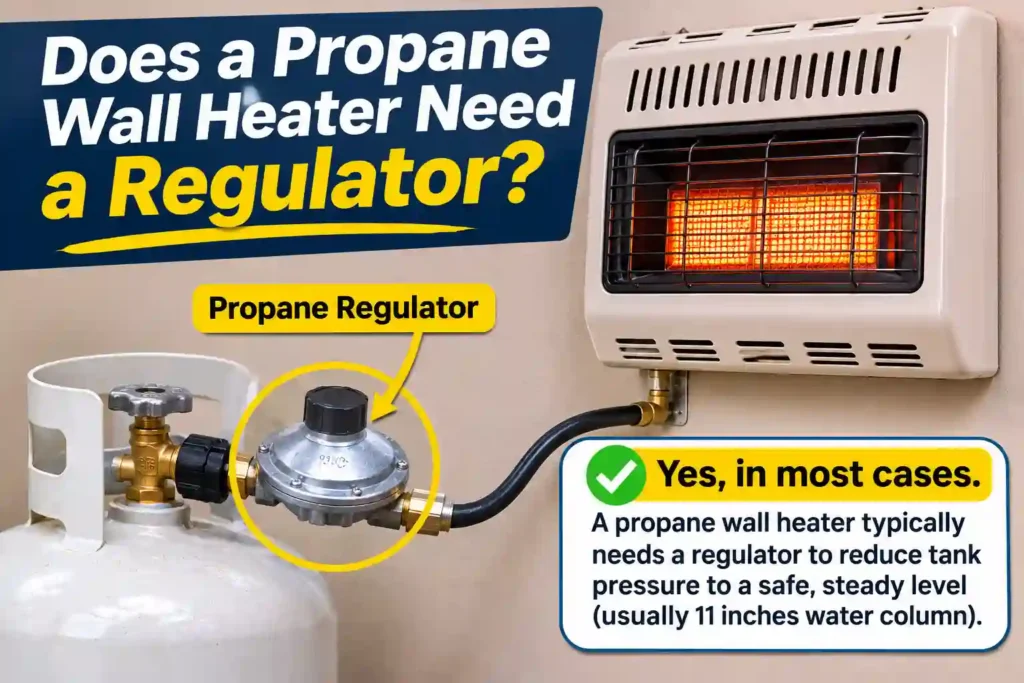


A propane wall heater is a practical heating solution for homes, cabins, garages, workshops, and other spaces where conventional heating systems may not be available.
However, one of the most important considerations when installing a propane wall heater is ensuring that it receives propane at the correct operating pressure.
Propane is stored inside cylinders and residential storage tanks under relatively high pressure. A wall heater cannot ordinarily use this pressure directly. It requires a controlled supply of propane that meets the manufacturer’s specifications.


This is where a propane regulator becomes essential.
Whether you are installing a 10,000 BTU wall heater, an 18,000 BTU infrared heater, or a 30,000 BTU blue-flame heater, understanding pressure regulation can help prevent installation mistakes, poor heating performance, and potentially dangerous operating conditions.
In this guide, I’ll explain whether propane wall heaters need external regulators, what pressure requirements are common, how to select the correct regulator, and whether you can connect a wall heater to an existing propane supply.
Quick Answer
Yes, a propane wall heater requires a properly regulated propane supply. However, you may not need to purchase a separate external regulator if your existing propane supply system already provides the correct gas pressure.


Many residential propane wall heaters require incoming propane pressure within a range of approximately 11–14 inches of water column (WC), equivalent to about 0.40–0.51 PSI. The exact requirements depend on the heater model.
| Installation Situation | Is an Additional Regulator Needed? |
|---|---|
| Connecting directly to an unregulated propane cylinder | Yes. An approved regulated supply is required. |
| Connecting to an existing regulated residential propane system | Not necessarily. |
| Heater has a built-in appliance regulator | External supply regulation may still be required. |
| Connecting to a 100 lb propane cylinder | An appropriately designed regulated supply is required. |
| Connecting to a 500-gallon residential propane tank | Usually handled by the existing regulation system. |
| Replacing an existing propane wall heater | Depends on the new heater’s specifications. |
| Connecting to a high-pressure propane line | Appropriate downstream regulation is required. |
Never connect a conventional low-pressure propane wall heater directly to unregulated cylinder pressure.
The regulator system must satisfy the heater’s specified inlet pressure range, BTU demand, fuel type, and applicable installation requirements.
Why Does a Propane Wall Heater Need a Regulator?
The primary purpose of a propane regulator is to reduce and control gas pressure before propane reaches the heating appliance.
Propane stored inside a cylinder exists as a combination of liquid and vapor. The pressure inside the cylinder changes depending on temperature.



A propane wall heater, however, is designed to operate within a specific gas pressure range.
Without proper regulation, the heater could receive gas at a pressure significantly higher than its design specifications.
A propane regulator performs several important functions:
- Reduces high cylinder pressure to an appropriate supply pressure.
- Maintains consistent gas pressure as fuel demand changes.
- Helps prevent excessive gas delivery.
- Supports proper burner combustion.
- Allows the heater to operate within its intended fuel input rating.
- Helps maintain reliable heating performance.
The regulator is not simply an accessory. It is an essential part of the propane delivery system.


For additional information, read my guide on inlet pressure vs. outlet pressure on a propane regulator.
Do Propane Wall Heaters Have Built-In Regulators?
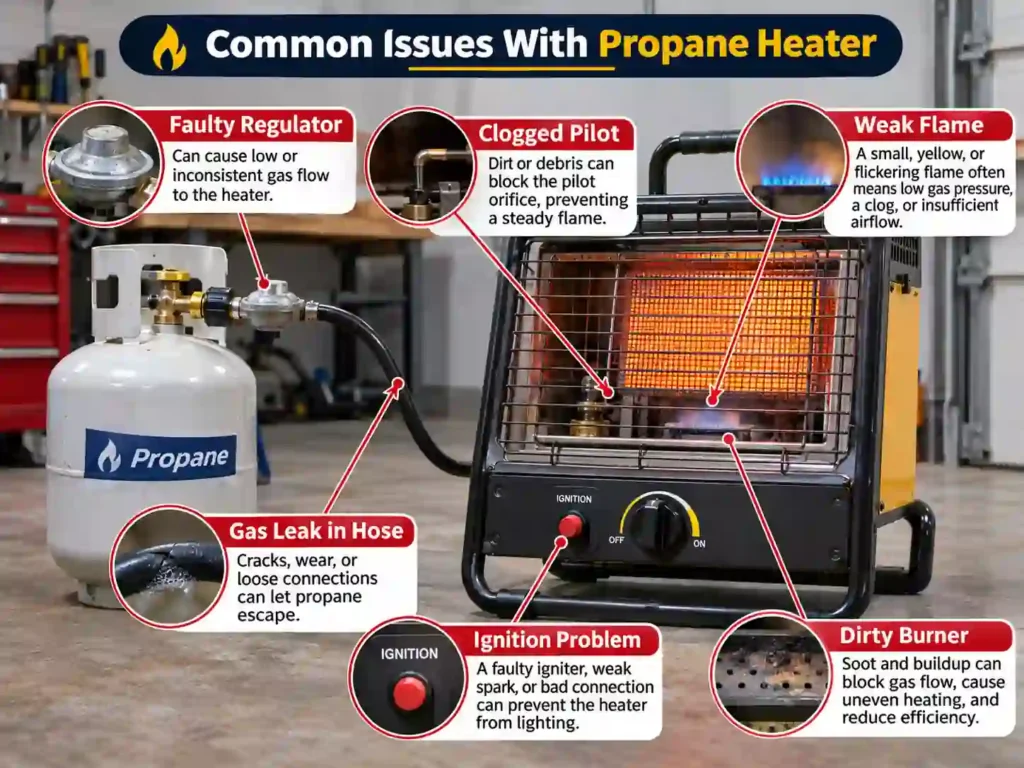
Many propane wall heaters contain an internal appliance regulator or a gas-control valve with integrated pressure regulation.
However, this does not necessarily mean that you can connect the heater directly to a propane tank.
An internal appliance regulator is generally designed to receive gas within a particular inlet pressure range. It is not necessarily designed to handle full propane cylinder pressure.
An external supply regulator reduces tank pressure before propane reaches the appliance’s internal gas-control components.
| Feature | External Supply Regulator | Internal Appliance Regulator |
|---|---|---|
| Primary purpose | Controls incoming supply pressure. | Controls appliance operating pressure. |
| Location | Outside the appliance. | Inside the heater. |
| Receives full tank pressure | Depends on regulator stage and design. | Generally no. |
| Supplies | Gas piping or appliance inlet. | Burner and internal gas system. |
| Replacement | Qualified professional servicing. | Manufacturer-approved professional servicing. |
| Interchangeable | No. | No. |
Think of the external regulator as the component responsible for delivering propane at an acceptable supply pressure.
The heater’s internal regulator then controls pressure according to the appliance’s operating requirements.
Both components may be necessary even though they perform related functions.
Where Does the Regulator Go on a Propane Wall Heater?
The supply regulator is installed upstream of the heater. Its exact location depends on the design of the propane system.
For example, a residential propane installation may have one regulator near the storage tank and another regulator nearer the building.
Typical Propane Wall Heater Supply System
Propane Tank
Regulator
Regulator
Wall Heater
This is a conceptual two-stage propane supply system. Actual regulator locations, piping, shutoff valves, and other required safety components must be determined by a qualified installer.
The regulator does not necessarily need to be mounted directly beside the wall heater.
What matters is that the complete propane supply system delivers gas at the correct pressure and flow rate.
Installing another regulator unnecessarily may reduce gas pressure below the heater’s operating requirements.
What Pressure Regulator Does a Propane Wall Heater Need?
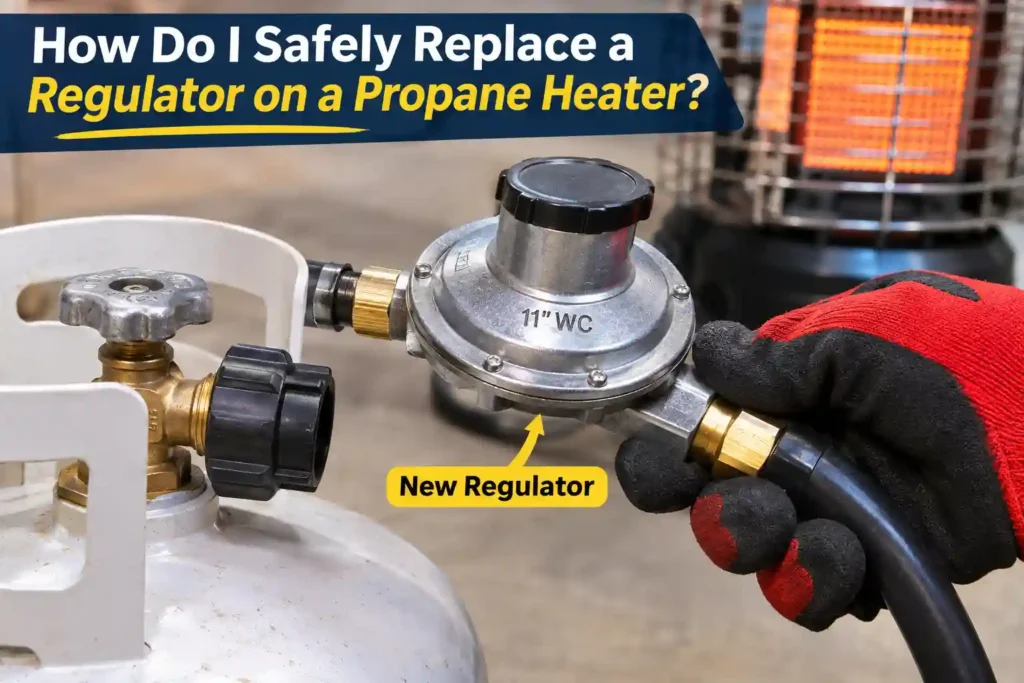
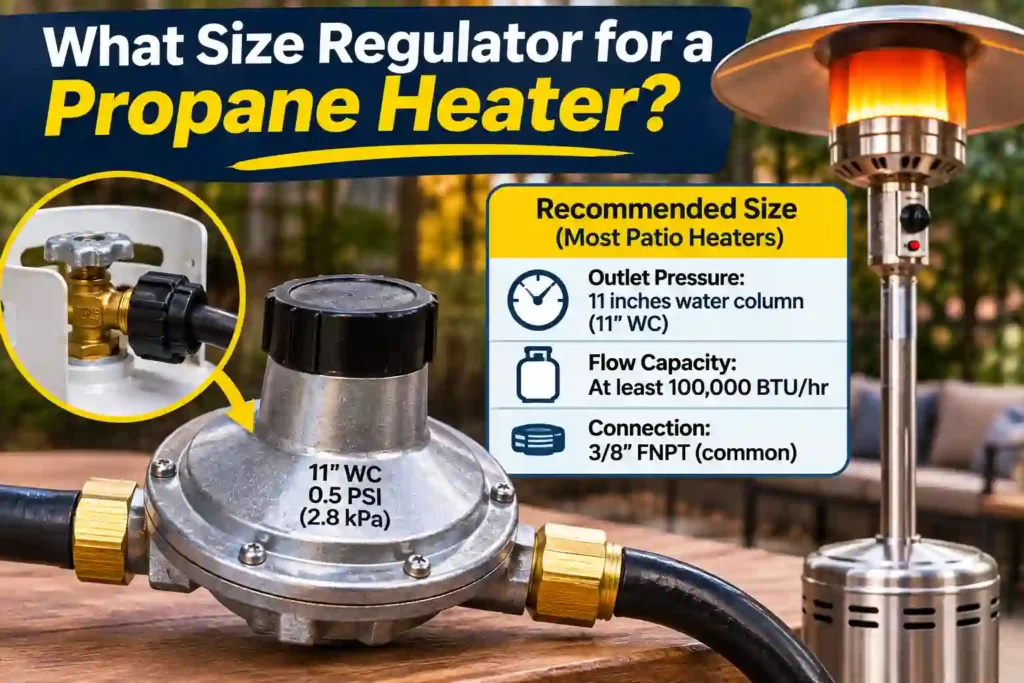
Many conventional propane wall heaters are designed to receive gas at approximately 11 inches of water column.
Some models specify a minimum inlet pressure of 11 inches WC and a maximum inlet pressure of 14 inches WC.
For example, certain Mr. Heater and Dyna-Glo propane blue-flame and radiant wall heaters specify similar low-pressure propane supply requirements. Always consult the manual for your exact heater model because specifications may vary.
Propane Wall Heater Pressure Chart
| Pressure | Equivalent PSI | Equivalent mbar |
|---|---|---|
| 10 inches WC | 0.361 | 24.91 |
| 11 inches WC | 0.397 | 27.40 |
| 12 inches WC | 0.433 | 29.89 |
| 13 inches WC | 0.469 | 32.38 |
| 14 inches WC | 0.506 | 34.87 |
| 1 PSI | 1.000 | 68.95 |
| 5 PSI | 5.000 | 344.74 |
| 10 PSI | 10.000 | 689.48 |
These are approximate pressure conversions, not universal wall heater operating specifications.
Understanding the Difference Between 11 WC and 11 PSI
11 Inches Water Column
0.397 PSI
Common low-pressure supply
11 Pounds per Square Inch
11 PSI
Approximately 304.5 inches WC
11 Inches Water Column
11 PSI
11 PSI is approximately 27.7 times higher than 11 inches WC.
Confusing PSI with inches of water column could result in dangerous overpressure, gas-control component damage, improper combustion, and fire hazards.
Never substitute a high-pressure regulator for a low-pressure regulator unless the heater manufacturer and the professionally designed gas supply system specifically require it.
I recommend reading my guide on what 11 inches of water column means for propane before purchasing a regulator.
Regulator Requirements for Different Wall Heater Types
Several types of propane wall heaters are available, and their installation requirements can differ considerably.
| Wall Heater Type | Typical BTU Input | Regulator Requirement |
|---|---|---|
| Small radiant wall heater | 6,000–10,000 | Approved regulated supply. |
| Blue-flame wall heater | 10,000–30,000 | Generally low-pressure supply. |
| Infrared wall heater | 10,000–30,000 | Generally low-pressure supply. |
| Direct-vent wall heater | 8,000–40,000 | Manufacturer-specified regulated supply. |
| Vented wall furnace | 20,000–60,000 | Professionally designed regulated supply. |
| Commercial wall heater | 30,000–100,000+ | Model-specific gas supply system. |
BTU ranges are illustrative and do not establish compatibility with a particular regulator.
Blue-Flame Propane Wall Heaters
Blue-flame heaters primarily warm the surrounding air through convection.
These heaters are commonly used for supplemental heating in approved indoor spaces.
They require a properly regulated propane supply to maintain appropriate burner operation.
Infrared Propane Wall Heaters
Infrared heaters produce radiant heat that warms nearby objects and surfaces.
Although the heating method differs from blue-flame heaters, the propane supply must still meet the manufacturer’s pressure and capacity requirements.
Direct-Vent Propane Wall Heaters
Direct-vent heaters typically obtain combustion air from outdoors and discharge combustion gases outside through an approved venting system.
These heaters also require regulated gas pressure.
Because direct-vent installations involve gas piping and venting requirements, professional installation is particularly important.
Vent-Free Propane Wall Heaters
Vent-free heaters release combustion products into the room and require specific room-size, ventilation, placement, and operating conditions.
They may also be restricted or prohibited in certain jurisdictions or locations within a building.
Always verify applicable local requirements before purchasing or installing a vent-free heater.
An oxygen depletion sensor does not eliminate all combustion-related risks or replace appropriate carbon monoxide alarms.
What Size Regulator Do You Need for a Propane Wall Heater?
The regulator must have sufficient capacity to supply the heater’s maximum rated BTU demand while maintaining its specified inlet pressure.
For example, a 30,000 BTU propane wall heater requires a regulated propane supply capable of delivering at least 30,000 BTU per hour under expected operating conditions.
Wall Heater Regulator Sizing Chart
| Wall Heater Input | Minimum Fuel Demand | Propane Consumption per Hour |
|---|---|---|
| 6,000 BTU/hr | 6,000 BTU/hr | 0.066 gal |
| 10,000 BTU/hr | 10,000 BTU/hr | 0.109 gal |
| 15,000 BTU/hr | 15,000 BTU/hr | 0.164 gal |
| 18,000 BTU/hr | 18,000 BTU/hr | 0.197 gal |
| 20,000 BTU/hr | 20,000 BTU/hr | 0.219 gal |
| 25,000 BTU/hr | 25,000 BTU/hr | 0.273 gal |
| 30,000 BTU/hr | 30,000 BTU/hr | 0.328 gal |
| 35,000 BTU/hr | 35,000 BTU/hr | 0.383 gal |
| 40,000 BTU/hr | 40,000 BTU/hr | 0.437 gal |
| 50,000 BTU/hr | 50,000 BTU/hr | 0.546 gal |
The regulator’s actual delivery capacity depends on its design, incoming pressure, outlet pressure, and operating conditions.
Do not select a regulator solely because its advertised BTU rating exceeds the heater’s maximum input.
For further information, read my guide on what BTU capacity means on a propane regulator.
Single-Stage vs. Two-Stage Regulators for Wall Heaters
Propane supply systems commonly use either single-stage or two-stage regulation.
Single-Stage Propane Regulator
Regulator
A single-stage regulator reduces incoming gas pressure to the required outlet pressure in one stage.
Certain approved portable appliance assemblies use single-stage regulators. However, they should not automatically be substituted for regulators designed for fixed residential installations.
Two-Stage Propane Regulator
Regulator
Regulator
A two-stage regulation system reduces propane pressure through two successive stages.
A common residential configuration uses a first-stage regulator to reduce tank pressure to an intermediate pressure and a second-stage regulator to provide the final low-pressure supply.
An integral two-stage regulator combines both stages into one housing.
| Feature | Single-Stage Regulator | Two-Stage Regulator |
|---|---|---|
| Pressure reduction | One stage | Two stages |
| Pressure stability | Design-dependent | Generally improved |
| Common use | Certain portable appliances | Fixed residential systems |
| Multiple appliance applications | Application-dependent | Commonly used |
| Installation requirements | Equipment-specific | System-specific |
| Typical purchase cost | Lower | Higher |
These diagrams illustrate pressure regulation concepts only. They are not complete installation plans.
For a permanently installed propane wall heater, I recommend having a qualified technician determine whether the existing regulation system is sufficient or whether an approved two-stage configuration is required.
You can learn more in my article about whether you need two regulators for propane.
Can You Connect a Propane Wall Heater Directly to a 20 lb Tank?
You should never connect an ordinary low-pressure wall heater directly to unregulated propane cylinder pressure.
A 20 lb cylinder may contain approximately 4.7 gallons of propane when filled to its rated propane capacity.
Although this may provide several hours of theoretical heating time, the cylinder must also have sufficient vaporization capacity to satisfy the heater’s fuel demand.
Furthermore, some wall heater manufacturers specify larger cylinders or particular supply configurations.
Estimated Runtime Using Different Propane Tank Sizes
| Heater Input | 20 lb Propane | 40 lb Propane | 100 lb Propane |
|---|---|---|---|
| 10,000 BTU/hr | 43.0 hrs | 86.0 hrs | 215.0 hrs |
| 15,000 BTU/hr | 28.7 hrs | 57.3 hrs | 143.4 hrs |
| 18,000 BTU/hr | 23.9 hrs | 47.8 hrs | 119.5 hrs |
| 20,000 BTU/hr | 21.5 hrs | 43.0 hrs | 107.5 hrs |
| 30,000 BTU/hr | 14.3 hrs | 28.7 hrs | 71.7 hrs |
| 40,000 BTU/hr | 10.8 hrs | 21.5 hrs | 53.8 hrs |
| 50,000 BTU/hr | 8.6 hrs | 17.2 hrs | 43.0 hrs |
These are theoretical estimates based on maximum rated fuel input and adequate propane vaporization. They do not indicate that every cylinder size is suitable for every heater.
Propane supply cylinders for typical fixed wall heater installations should be located outdoors in an approved location.
Do not bring an outdoor propane cylinder inside your home to supply a permanently installed wall heater. Follow the heater manufacturer’s requirements and applicable propane installation regulations.
What Regulator Do You Need for a 100 lb Propane Tank and Wall Heater?
A 100 lb propane cylinder is a potential fuel supply option for certain wall heating installations.
However, the cylinder’s weight capacity does not determine the correct regulator size.
For a typical 30,000 BTU low-pressure wall heater, the regulated supply must provide sufficient propane flow at the heater’s specified inlet pressure.
The installer must consider:
- Heater maximum BTU input.
- Required inlet pressure.
- Regulator capacity.
- Minimum expected outdoor temperature.
- Cylinder vaporization capacity.
- Gas piping size and length.
- Approved connections and installation requirements.
You may find my guide on what kind of regulator you need for a 100 lb propane tank useful when researching these installations.
Worked Example: Regulator Requirements for a 30,000 BTU Wall Heater
Suppose you have a 30,000 BTU blue-flame propane wall heater whose manufacturer specifies an incoming pressure of 11–14 inches WC.
Propane contains approximately 91,500 BTU per US gallon.
The theoretical hourly consumption is calculated as follows:
Gallons per Hour = Heater BTU Input ÷ 91,500
30,000 ÷ 91,500 = 0.328 gallons per hour
Maximum Fuel Demand
30,000
BTU/hr
Example Inlet Pressure
11–14
Inches WC
Hourly Consumption
0.328
Gallons per hour
Hourly Fuel Cost
$1.15
At $3.50 per gallon
100 lb Propane Runtime
71.7 hrs
Daily Fuel Cost
$9.18
At 8 hours per day
Illustrative calculations assuming maximum rated input, adequate fuel delivery, and a hypothetical propane price of $3.50 per gallon.
A regulator with a nominal capacity of 60,000 BTU per hour might have sufficient numerical capacity for this heater.
However, it must also provide the correct pressure under actual operating conditions and be approved for the installation.
Propane Wall Heater Fuel Consumption Calculator
Use the following calculator to estimate your wall heater’s theoretical fuel consumption, operating cost, and runtime.
Wall Heater Propane Calculator
Hourly Consumption
0.328
Gallons per hour
Estimated Total Runtime
71.7 hrs
Hourly Operating Cost
$1.15
Daily Operating Cost
$9.18
30-Day Heating Cost
$275.41
Estimated Days of Fuel
9.0
Days
Estimates assume continuous maximum rated fuel input during the selected operating hours. Thermostat cycling may reduce actual consumption. This calculator does not establish regulator or propane cylinder compatibility.
Can You Connect a Wall Heater to an Existing Residential Propane System?
Yes. In many situations, a propane wall heater can be supplied by an existing residential propane system.
If your property already has a 250-gallon or 500-gallon propane tank supplying other appliances, it may already have an appropriate pressure-regulation system.
However, adding another heater increases the total fuel demand.
Consider the following example.
| Existing Appliance | Maximum Fuel Input |
|---|---|
| Propane furnace | 80,000 BTU/hr |
| Water heater | 40,000 BTU/hr |
| Gas range | 50,000 BTU/hr |
| New propane wall heater | 30,000 BTU/hr |
| Combined Demand | 200,000 BTU/hr |
Combined Residential Propane Demand
200,000 BTU/hr
Furnace: 80,000 BTU/hr (40%)
Water Heater: 40,000 BTU/hr (20%)
Gas Range: 50,000 BTU/hr (25%)
Wall Heater: 30,000 BTU/hr (15%)
Illustrative simultaneous maximum appliance demand.
A qualified installer must determine whether the existing regulator, gas piping, and propane storage tank can accommodate this additional load.
For more information, read my guide on how to calculate total BTU load for a propane regulator.
What Happens If You Run a Propane Wall Heater Without a Regulator?
Operating a propane wall heater with unregulated gas pressure can create serious hazards.
Excessive gas pressure can overwhelm internal gas-control components and cause the burner to receive more propane than intended.
| Potential Problem | Possible Consequence |
|---|---|
| Excessive inlet pressure | Damage to gas-control components. |
| Oversized burner flames | Overheating and fire hazards. |
| Improper combustion | Increased carbon monoxide risk. |
| Damaged seals or valves | Propane leakage. |
| Uncontrolled fuel input | Equipment damage. |
| Unstable burner operation | Unreliable heating. |
Never bypass or remove a regulator required by the heater or propane supply system.
The fact that a heater can physically connect to a propane tank does not mean that the connection is safe.
Signs Your Propane Wall Heater Regulator Is Not Working Properly
A regulator that cannot maintain the appropriate pressure may cause several operating problems.
| Warning Sign | Possible Explanation |
|---|---|
| Weak burner flame | Insufficient gas pressure. |
| Heater repeatedly shuts off | Unstable fuel delivery. |
| Pilot light goes out | Pressure or flame-sensing problem. |
| Yellow flames with soot | Abnormal combustion. |
| Unusually large flames | Excessive gas pressure. |
| Whistling noises | Flow restriction or vibration. |
| Excessive regulator icing | Moisture or inadequate vaporization. |
| Propane odor | Possible gas leakage. |
| Heater loses output when another appliance starts | Insufficient system capacity. |
These symptoms do not necessarily confirm regulator failure.
A defective thermocouple, restricted gas line, dirty burner, or inadequate fuel supply can produce similar problems.
For more information, see my guide on how to know if a propane heater regulator is failing.
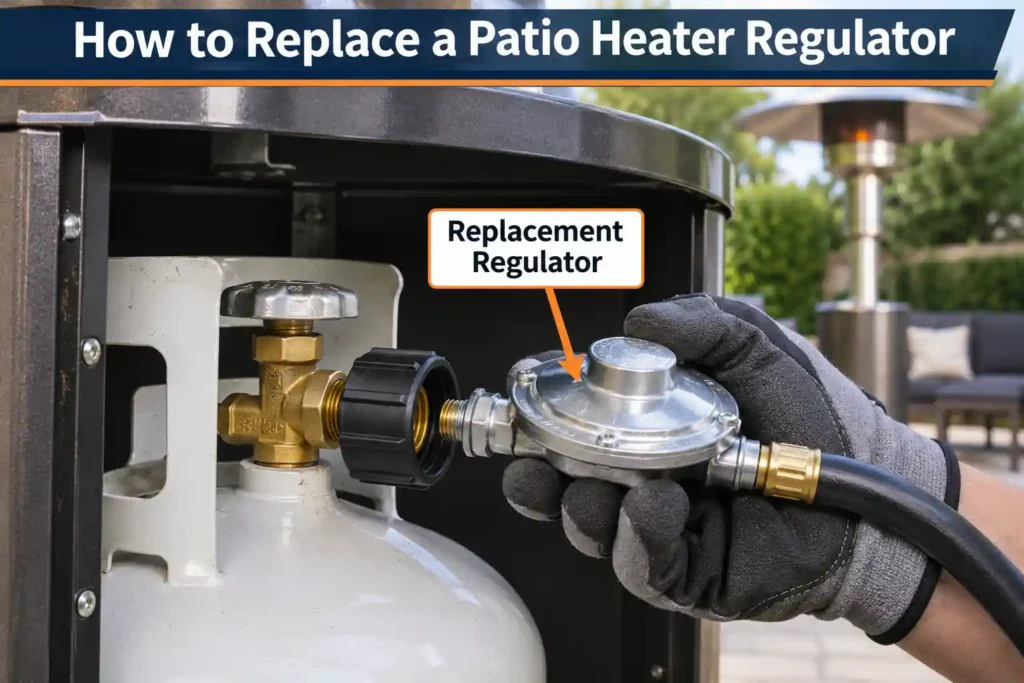
Can You Install a Propane Wall Heater Regulator Yourself?
I recommend hiring a qualified propane technician for fixed wall heater installations.
Unlike detachable regulator assemblies found on some outdoor appliances, permanent wall heater installations may involve gas piping, pressure testing, shutoff valves, venting requirements, and combustion assessments.
Installation and servicing should be carried out by qualified professionals in accordance with the manufacturer’s requirements and applicable propane safety regulations.
A qualified technician can evaluate the following:
| Professional Inspection | Purpose |
|---|---|
| Regulator capacity | Confirms adequate gas delivery. |
| Inlet gas pressure | Verifies incoming supply pressure. |
| Operating pressure | Checks pressure under demand. |
| Lock-up pressure | Evaluates regulator pressure control. |
| Gas piping capacity | Confirms sufficient fuel flow. |
| System leak testing | Identifies potential gas leakage. |
| Combustion assessment | Evaluates burner performance. |
| Ventilation requirements | Helps ensure suitable installation conditions. |
These checks are important before returning a newly installed wall heater to service.
Propane Wall Heater Regulator Buying Checklist
Before purchasing a regulator, gather the heater’s specifications and confirm that the replacement is appropriate.
Regulator Selection Checklist
Completing this checklist does not replace professional regulator sizing or installation approval.
Before ordering a regulator, provide the heater’s model number, BTU input, and required inlet pressure to your propane supplier or qualified installer. This can help you avoid purchasing equipment that is incompatible with your existing propane supply system.
How Much Does a Propane Wall Heater Regulator Cost?
The cost depends on the regulator design, capacity, installation configuration, and whether additional gas piping is required.
| Regulator or Service Type | Estimated Cost |
|---|---|
| Basic low-pressure regulator | $15–$40 |
| First-stage regulator | $30–$80 |
| Second-stage regulator | $35–$100 |
| Integral two-stage regulator | $40–$120 |
| Higher-capacity residential regulator | $75–$200 |
| Professional inspection | $75–$200 |
| Regulator replacement with labor | $100–$350 |
| New gas supply installation | $250–$800 |
Regulator Cost Comparison
Basic Low-Pressure Regulator: $15–$40
First-Stage Regulator: $30–$80
Second-Stage Regulator: $35–$100
Integral Two-Stage Regulator: $40–$120
Higher-Capacity Residential Regulator: $75–$200
Professional Inspection: $75–$200
Regulator Replacement With Labor: $100–$350
New Gas Supply Installation: $250–$800
Bars represent the upper end of each estimated price range.
These are illustrative US budgeting estimates rather than verified current contractor quotations. Actual costs vary according to location, equipment specifications, piping distance, and labor rates.
If your home already has an appropriately sized propane regulation system, you may not need to purchase an additional regulator.
This can reduce installation expenses, although professional verification is still necessary.
Common Mistakes When Installing a Propane Wall Heater
Avoiding installation mistakes is just as important as choosing the correct regulator.
| Common Mistake | Potential Consequence |
|---|---|
| Connecting directly to unregulated cylinder pressure | Dangerous overpressure. |
| Using a high-pressure regulator | Unsafe burner operation if incompatible. |
| Assuming an internal regulator is sufficient | Damage to gas-control components. |
| Adding unnecessary regulators | Restricted gas delivery. |
| Choosing by BTU capacity alone | Pressure incompatibility. |
| Using an undersized propane cylinder | Inadequate vaporization. |
| Using unsuitable gas hoses | Leakage or deterioration. |
| Ignoring ventilation requirements | Unsafe indoor air conditions. |
| Skipping leak testing | Undetected gas leakage. |
| Adjusting regulator pressure yourself | Unsafe combustion. |
My recommendation is to have the complete fuel supply system evaluated rather than treating the regulator as an isolated component.
Do You Need an Additional Regulator? Decision Guide
Determine whether the wall heater will receive propane from a dedicated outdoor cylinder or an existing residential propane supply system.
Review the manufacturer’s specifications for minimum and maximum incoming gas pressure. Do not confuse appliance manifold pressure with supply pressure.
Have a qualified propane technician confirm whether the current regulation system provides the correct pressure and sufficient capacity for the wall heater.
If the wall heater will share a propane supply with other appliances, the regulator, tank, and gas piping must accommodate the combined demand.
If the existing regulated supply is suitable, another external regulator may be unnecessary. If the supply is incompatible, have a qualified installer design the appropriate regulation system.
Safety Precautions for Propane Wall Heaters
Important Propane Heating Safety Precautions
- Never bypass a required propane regulator.
- Never increase gas pressure to obtain additional heat.
- Install appropriate carbon monoxide alarms.
- Follow the heater’s clearance and ventilation requirements.
- Never use an outdoor-only propane heater indoors.
- Keep combustible materials away from the heater.
- Never disable oxygen depletion or flame-sensing devices.
- Have suspected equipment problems professionally investigated.
- Keep outdoor propane supply cylinders in approved outdoor locations.
- Arrange professional gas pressure and leak testing where required.
If you smell propane: Leave the affected area immediately, avoid operating electrical switches or creating sparks, and contact your propane supplier or emergency services from a safe location.
If a carbon monoxide alarm sounds: Immediately move everyone to fresh air and contact emergency services.
Frequently Asked Questions
Does a 30,000 BTU Propane Wall Heater Need a Regulator?
Yes. It requires a regulated propane supply capable of delivering its maximum rated fuel demand at the manufacturer’s specified inlet pressure.
Many conventional 30,000 BTU wall heaters use low-pressure propane.
Do Mr. Heater Propane Wall Heaters Need an External Regulator?
Certain conventional Mr. Heater propane vent-free wall heaters require an external regulated supply, typically within an inlet pressure range of 11–14 inches WC.
Always check the exact model’s requirements. An existing residential regulation system may already provide the required supply pressure.
Do Dyna-Glo Propane Wall Heaters Need a Regulator?
Yes. Many Dyna-Glo wall heater models require an external regulated propane supply, with specific minimum and maximum incoming pressure limits.
Consult the installation manual for your particular heater before purchasing a regulator.
Can I Use a BBQ Grill Regulator for a Propane Wall Heater?
Do not assume that a grill regulator is suitable for a fixed wall heater installation.
Pressure, capacity, connections, certification, and intended application must all be appropriate.
Can I Use a 10 PSI Regulator on a Propane Wall Heater?
Not as the direct supply to a conventional low-pressure wall heater.
A 10 PSI regulator may be used as an intermediate stage in an appropriately designed system, but additional pressure reduction would be necessary for a heater requiring approximately 11 inches WC.
Do I Need Two Regulators for a Propane Wall Heater?
Not necessarily two separate regulator housings. Some installations use an integral two-stage regulator, while others use separate first-stage and second-stage regulators.
The appropriate configuration depends on the complete propane supply system.
Can One Regulator Supply Two Wall Heaters?
Yes, provided the regulator, piping, and propane supply can accommodate the combined demand while maintaining the required pressure.
A qualified technician should verify the system’s capacity.
Does a Regulator Reduce Propane Consumption?
A correctly functioning regulator maintains the required gas pressure. Fuel consumption primarily depends on the heater’s BTU input, temperature setting, and operating time.
Can an Incorrect Regulator Cause Carbon Monoxide?
Yes. Incorrect gas pressure may contribute to improper combustion and increased carbon monoxide production.
A regulator alone cannot eliminate all carbon monoxide hazards.
Can I Use a Natural Gas Regulator on a Propane Wall Heater?
Do not substitute a natural gas regulator unless the equipment manufacturer specifically approves that component for propane service and the intended installation.
My Final Thoughts
A propane wall heater needs a properly regulated gas supply, regardless of whether it uses a small outdoor propane cylinder or a large residential storage tank.
Many conventional wall heaters operate with incoming propane pressure between approximately 11 and 14 inches of water column. However, the exact pressure requirements must always be confirmed in the manufacturer’s documentation.
If your home already has a properly designed propane supply system, you may not need an additional external regulator.
The most important considerations are correct pressure, adequate BTU capacity, sufficient propane vaporization, and manufacturer compatibility.
I recommend having a qualified propane technician evaluate the entire installation before connecting a wall heater to your propane supply.
A properly selected regulator helps maintain reliable heating performance while reducing the risks associated with excessive gas pressure, improper combustion, and equipment damage.

Mike is an experienced propane technician with over 15 years of professional experience in the field. He has dedicated his career to helping customers with their propane needs, from installation to maintenance and repair. Together with Jeremy, he co-founded this website to provide useful information and guidance to customers seeking reliable propane services.