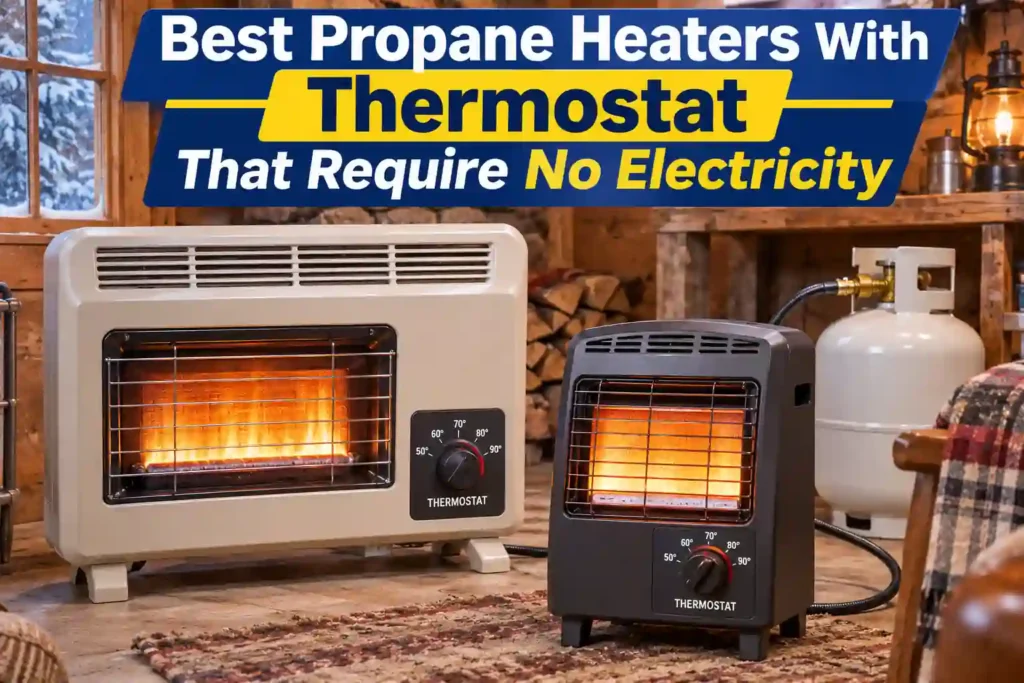


A propane heater with a thermostat that requires no electricity can be an excellent heating solution for homes, cabins, off-grid properties, and areas that frequently experience power outages.
Unlike conventional electric heaters and electronically controlled furnaces, certain propane heaters use mechanical or self-powered gas controls to regulate temperature without relying on household electricity.
This means you can enjoy thermostatically controlled heating even when the electrical grid is unavailable, provided the heater is specifically designed and approved for operation without external power.


However, not every propane heater advertised as having a thermostat can operate without electricity. Some require electrical power for their ignition systems, circulation fans, exhaust systems, or electronic gas-control valves.
Others use batteries for ignition but require no household electrical connection.
When choosing a propane heater for emergency preparedness or off-grid living, I recommend looking closely at the heater’s operating requirements rather than relying solely on its product description.
In this guide, I’ll discuss the best types of non-electric thermostatic propane heaters, recommended models, heating capacities, fuel consumption, operating expenses, and important safety considerations.


Quick Answer
The best propane heaters with thermostats that require no household electricity are generally mechanical or millivolt-controlled blue-flame heaters, infrared radiant heaters, and certain direct-vent wall furnaces.
| Heater Type | Typical BTU Input | Household Electricity Required? |
|---|---|---|
| Thermostatic blue-flame heater | 10,000–30,000 | No, on compatible models |
| Thermostatic infrared heater | 10,000–30,000 | No, on compatible models |
| Millivolt direct-vent wall furnace | 8,000–35,000+ | No, on compatible models |
| Mechanical convection heater | Model-dependent | No, on compatible models |
| Portable radiant heater | 4,000–18,000 | Often no, but true thermostats are less common |
| Forced-air construction heater | 35,000–200,000+ | Generally yes |
| Electronic direct-vent furnace | Model-dependent | Generally yes |
For regular residential heating and emergency preparedness, my preferred option is a properly installed, non-electric direct-vent propane wall furnace because it discharges combustion gases outdoors.
A thermostatic vent-free blue-flame or infrared heater may be a more affordable alternative where its installation and operation are permitted.
Important: No electricity does not necessarily mean no batteries. Some propane heaters require a small battery for ignition while operating independently of household electricity afterward.
Best Propane Heaters With Thermostats That Operate Without Household Electricity
The following heaters stand out because they offer thermostatic temperature control without relying on a conventional household electrical supply for basic heating.



My selections prioritize power-outage capability, thermostat functionality, intended application, and ventilation design rather than customer ratings alone.
Top Propane Heater Comparison
| Brand and Model | BTU Input | Heater Type | Household Electricity |
|---|---|---|---|
| Empire DV35 LP | 35,000 | Direct-vent | Not required |
| Empire DV25 LP | 25,000 | Direct-vent | Not required |
| Williams 1403821 | 14,000 | Direct-vent | Not required |
| Mr. Heater MHVFBF30LPT | 30,000 | Blue flame, vent-free | Not required; battery ignition |
| Mr. Heater MHVFBF20LPT | 20,000 | Blue flame, vent-free | Not required; battery ignition |
| Mr. Heater MHVFRD30LPT | 30,000 | Infrared, vent-free | Not required; battery ignition |
| Mr. Heater MHVFRD20LPT | 20,000 | Infrared, vent-free | Not required; battery ignition |
| Mr. Heater MH40LP | 40,000 | Radiant workshop heater | Not required |
| Williams Monterey LP | Model-dependent | Top-vent gravity furnace | Not required on compatible models |
Optional electric blowers, where available, may require household electricity. Always verify the exact model number, thermostat inclusion, fuel configuration, and current manufacturer’s specifications.
1. Empire DV35 Direct-Vent Propane Wall Furnace
| Heating input | 35,000 BTU/hr |
| Thermostat | Compatible millivolt wall thermostat |
| Ventilation | Direct vent |
| Electrical connection | Not required for basic heating |
| Installation | Permanent, professionally installed |
The Empire DV35 is one of my preferred choices for homeowners seeking a permanent propane heating appliance that continues working during power outages.
Its millivolt temperature-control system operates independently of household electricity. Its direct-vent design obtains combustion air from outdoors and discharges combustion gases outside.


This makes it particularly attractive for cabins, rural homes, and properties that experience winter power interruptions.
Advantages
- Operates during electrical outages.
- Supports automatic thermostatic control.
- Exhausts combustion products outdoors.
- Higher heating capacity than many compact wall heaters.
- Optional powered blower available for compatible configurations.
Disadvantages
- Higher initial purchase cost.
- Professional installation required.
- Requires an appropriate exterior wall and venting arrangement.
- Not designed as a portable heater.
My recommendation: Consider the DV35 if you need a permanent, non-electric heating solution for an appropriately sized residential heating zone.
2. Empire DV25 Direct-Vent Propane Wall Furnace
| Heating input | 25,000 BTU/hr |
| Thermostat | Compatible millivolt thermostat |
| Ventilation | Direct vent |
| Household electricity | Not required for basic operation |
| Installation | Permanent |
The Empire DV25 offers many of the benefits of the DV35 but with a lower maximum heating input.
Like its larger counterpart, it uses a self-powered thermostatic control system. An optional electric blower can improve air circulation when electricity is available.
I would consider this heater for a moderately sized cabin, living area, or residential addition where a 35,000 BTU appliance would be unnecessarily large.
The lower fuel input also means lower maximum hourly propane consumption.
Advantages
- No household electricity required for heating.
- Direct-vent combustion system.
- Lower maximum fuel demand than the DV35.
- Suitable for appropriately sized heating zones.
Disadvantages
- Higher purchase price than vent-free heaters.
- Permanent professional installation required.
- May be insufficient for larger buildings.
3. Williams 1403821 Direct-Vent Propane Furnace
| Heating input | 14,000 BTU/hr |
| Rated heat output | 9,800 BTU/hr |
| Thermostat | Millivolt |
| Ventilation | Direct vent |
| Household electricity | Not required |
The Williams 1403821 is a compact gravity-style propane wall furnace suitable for appropriately sized heating zones.
Its manufacturer specifications identify a millivolt thermostat and operation without an external electrical supply.
The distinction between input and output is important. Although the furnace consumes up to 14,000 BTU/hr of propane energy, its rated useful heating output is 9,800 BTU/hr.
Be careful when ordering this model because the similar Williams 1403822 is the natural gas version.
I would consider the propane version for smaller, well-insulated spaces where a larger furnace is unnecessary.
Advantages
- Compact heating design.
- Direct-vent operation.
- Lower maximum propane consumption.
- Suitable for off-grid heating applications.
Disadvantages
- Limited heating output.
- Professional installation required.
- Not suitable for every room size or climate.
4. Mr. Heater 30,000 BTU Blue-Flame Propane Heater
| Model | MHVFBF30LPT |
| Heating input | 30,000 BTU/hr |
| Thermostat | Integrated |
| Ignition | AA battery-powered |
| Household electricity | Not required for basic heating |
| Ventilation | Vent-free |
This Mr. Heater model uses convection heating to warm the surrounding air. Its built-in thermostat regulates burner operation according to the surrounding temperature.
The manufacturer documentation identifies a single AA battery for ignition. Household electricity is not required for normal burner operation.
Its relatively high heat input makes it worth researching for approved supplemental heating applications.
However, it is a vent-free appliance. Combustion products and water vapor are released into the room, making ventilation, room size, and local installation restrictions particularly important.
Advantages
- Built-in thermostatic control.
- No household electrical connection required.
- Relatively affordable compared with direct-vent furnaces.
- Compact design.
- Oxygen depletion safety system.
Disadvantages
- Requires an ignition battery.
- Vent-free operation introduces indoor air-quality considerations.
- Not permitted in every jurisdiction or room.
- Optional electric blower requires power.
5. Mr. Heater 20,000 BTU Blue-Flame Propane Heater
| Model | MHVFBF20LPT |
| Heating input | 20,000 BTU/hr |
| Thermostat | Integrated |
| Ignition | AA battery-powered |
| Ventilation | Vent-free |
This heater offers similar thermostatic functionality to the 30,000 BTU model but with a lower maximum propane demand.
Mr. Heater identifies this model as a supplemental propane heater with integrated temperature control.
For an appropriately sized space, the 20,000 BTU model may provide a better balance between fuel consumption, purchase cost, and heating capacity.
I would not automatically purchase the 30,000 BTU version simply because it produces more heat. Correct heater sizing is more important than maximum output.
Advantages
- Automatic temperature control.
- No household electricity required.
- Lower maximum fuel demand than the 30,000 BTU model.
- Relatively affordable purchase price.
Disadvantages
- Battery-dependent ignition.
- Vent-free installation restrictions.
- May be insufficient for larger heating areas.
6. Mr. Heater 30,000 BTU Infrared Propane Heater
| Model | MHVFRD30LPT |
| Heating input | 30,000 BTU/hr |
| Heating method | Infrared radiant |
| Thermostat | Integrated |
| Ignition | AA battery-powered |
Unlike blue-flame heaters, infrared heaters primarily transfer heat through radiation to nearby objects, surfaces, and people.
This can make radiant heating feel comfortable even before the surrounding air has reached its desired temperature.
The thermostatic MHVFRD30LPT uses a battery-powered igniter and does not require household electricity for basic burner operation.
It is best considered for approved supplemental heating locations where radiant warmth is desirable.
As with other vent-free appliances, its installation must satisfy the manufacturer’s ventilation, clearance, and location restrictions.
Advantages
- Provides localized radiant warmth.
- Integrated thermostat.
- No household electricity required.
- Useful for approved supplemental heating applications.
Disadvantages
- Hot radiant surfaces require proper clearances.
- Vent-free combustion releases products into the room.
- Heating distribution differs from convection equipment.
7. Mr. Heater 20,000 BTU Infrared Propane Heater
| Model | MHVFRD20LPT |
| Heating input | 20,000 BTU/hr |
| Heating method | Infrared |
| Thermostat | Integrated |
| Household electricity | Not required |
| Ignition | AA battery |
This heater is worth considering when you prefer radiant warmth but do not need the maximum output of a 30,000 BTU appliance.
Its lower maximum fuel input can be beneficial when heating a smaller approved space. Its thermostat and battery ignition provide convenient operation during household electrical outages.
The radiant heating method does not inherently consume less propane than a blue-flame heater with an equivalent fuel input.
Actual savings depend on operating time, thermostat settings, building heat loss, and heating comfort.
8. Mr. Heater MH40LP High-Intensity Radiant Workshop Heater
| Heating input | 40,000 BTU/hr |
| Thermostat | Millivolt |
| Heating method | High-intensity radiant |
| Household electricity | Not required |
| Application | Approved garages and workshops |
The Mr. Heater MH40LP is designed for certain workshop and garage heating applications where conventional electrical heating may be impractical.
The manufacturer supplies a compatible millivolt thermostat, allowing temperature regulation without household electricity.
Its radiant heating design is useful for warming work areas and nearby surfaces.
However, this is not an ordinary residential living-room heater. Installation must meet its specific mounting, ventilation, clearance, and gas supply requirements.
Never assume that a workshop heater is suitable for occupied residential living spaces. Verify the appliance’s intended use, mounting requirements, ventilation provisions, and applicable installation restrictions.
9. Williams Monterey Top-Vent Gravity Furnace
| Heating method | Natural convection |
| Heating input | Model-dependent |
| Thermostat | Compatible millivolt thermostat |
| Ventilation | Top vent |
| Household electricity | Not required for compatible configurations |
| Installation | Permanent |
The Williams Monterey gravity furnace is another option worth considering for homeowners who prefer a permanently installed heating system that operates independently of the electrical grid.
The manufacturer specifies that electricity is not required for basic operation on compatible models. A compatible thermostat may be sold separately.
Unlike direct-vent equipment, a top-vent furnace has different combustion-air and exhaust requirements.
Choose the correct propane configuration and arrange professional installation.
Product recommendations are based on documented equipment characteristics and intended applications rather than hands-on product testing. Confirm the current specifications before purchasing any model.
How Does a Propane Heater Thermostat Work Without Electricity?
A non-electric propane heater typically uses either a mechanical thermostatic gas valve or a self-powered millivolt system.
These designs eliminate the need for a conventional electrical connection to control the burner.
Mechanical Thermostat System
A mechanical thermostat contains a temperature-sensitive mechanism that responds to changes in the surrounding temperature.
When the room becomes cooler, the mechanism allows the heater to increase its heating output or resume burner operation.
When the desired temperature is reached, the thermostat reduces or interrupts the main burner fuel supply according to its design.
Millivolt Thermostat System
A millivolt heating system commonly uses a thermopile heated by a pilot flame.
The thermopile generates a small electrical voltage that powers the compatible gas-control circuit.
This allows a thermostat to control burner operation without drawing electricity from a household electrical outlet.
How a Self-Powered Millivolt Heating System Works
Provides heat to the thermopile.
Converts heat into a small electrical voltage.
Responds to the surrounding temperature.
Controls main burner operation.
Conceptual operating principle, not an electrical wiring or gas installation diagram.
Although a millivolt system generates a small amount of electricity internally, it does not depend on the electrical grid.
This is why these heaters are commonly described as non-electric propane heaters.
Mechanical vs. Millivolt vs. Digital Thermostats
| Feature | Mechanical | Millivolt | Digital Electronic |
|---|---|---|---|
| Household electricity | Usually unnecessary | Unnecessary | Often required |
| Temperature regulation | Automatic | Automatic | Automatic |
| External thermostat | Model-dependent | Common | Model-dependent |
| Power-outage operation | Generally available | Generally available | Model-dependent |
| Programmable schedules | Rare | Limited | Common |
| Temperature display | Usually unavailable | Model-dependent | Common |
| Off-grid suitability | Good | Excellent | Depends on power supply |
For permanent off-grid heating, I particularly like millivolt systems because they can accommodate compatible wall-mounted thermostats while operating independently of household power.
Blue-Flame vs. Infrared Propane Heaters
Two popular categories of non-electric thermostatic propane heaters are blue-flame and infrared models.
Blue-Flame Heater
Primarily warms surrounding air through convection.
It is worth considering when your objective is to maintain the air temperature throughout an approved heating area.
Infrared Heater
Primarily transfers radiant warmth to nearby surfaces and people.
It may feel comfortable even before the surrounding room air reaches its desired temperature.
| Feature | Blue Flame | Infrared |
|---|---|---|
| Heating method | Convection | Radiation |
| Primary heating target | Surrounding air | Objects and people |
| Immediate perceived warmth | Moderate | Generally faster nearby |
| Natural air circulation | Good | Less central to operation |
| Electricity requirement | Model-dependent | Model-dependent |
| Thermostatic models available | Yes | Yes |
| Fuel consumption | Depends on BTU input | Depends on BTU input |
If your goal is to maintain the air temperature throughout an approved room, I would generally consider a blue-flame convection heater.
If you prefer localized radiant warmth, an infrared heater may be more comfortable.
Neither design is automatically safer or more fuel-efficient simply because of its heating method.
Direct-Vent vs. Vent-Free Non-Electric Propane Heaters
This is one of the most important decisions you will make when purchasing a propane heater.
| Consideration | Direct Vent | Vent-Free |
|---|---|---|
| Combustion air | Obtained from outdoors | Obtained from indoors |
| Combustion exhaust | Outdoors | Indoors |
| Combustion moisture | Discharged outdoors | Released indoors |
| Installation complexity | Higher | Generally lower |
| Initial equipment cost | Higher | Generally lower |
| Indoor air-quality concerns | Generally lower | Greater |
| Exterior wall penetration | Usually required | Generally unnecessary |
| Local restrictions | Installation-dependent | May be prohibited |
| My preference for regular home heating | Preferred | Conditional alternative |
Vent-free heaters can introduce additional moisture into the home, which may contribute to window condensation and other moisture-related problems.
They also require strict compliance with room-size, ventilation, and operating restrictions.
For regular residential use, I would generally spend more on a properly installed direct-vent model rather than choose solely according to purchase price.
Keeping combustion products outside the occupied living space is an important consideration for long-term heating.
How Many BTUs Do You Need?
Buying an excessively large propane heater does not necessarily improve comfort.
An oversized heater may cycle frequently, while an undersized heater may struggle to maintain the desired temperature during cold weather.
The following table uses a rough illustrative heating-load range of 30–50 BTU/hr per square foot.
| Room Size | Estimated Useful Heating Requirement |
|---|---|
| 100 sq. ft. | 3,000–5,000 BTU/hr |
| 200 sq. ft. | 6,000–10,000 BTU/hr |
| 300 sq. ft. | 9,000–15,000 BTU/hr |
| 400 sq. ft. | 12,000–20,000 BTU/hr |
| 500 sq. ft. | 15,000–25,000 BTU/hr |
| 750 sq. ft. | 22,500–37,500 BTU/hr |
| 1,000 sq. ft. | 30,000–50,000 BTU/hr |
| 1,500 sq. ft. | 45,000–75,000 BTU/hr |
This table is for preliminary planning only. Actual heating requirements depend on insulation, ceiling height, climate, windows, air leakage, and desired temperature.
Also, remember that heater fuel input and useful heat output are not necessarily identical.
Non-Electric Propane Heater BTU Calculator
Estimate Your Heating Requirements
Estimated Useful Heating Requirement
15,000
BTU/hr output
Estimated Heater Fuel Input
18,750
BTU/hr input
Preliminary estimates only. Obtain a professional heat-loss assessment for permanent installations. This calculator does not establish minimum ventilation requirements or safe appliance sizing.
How Much Propane Do These Heaters Consume?
Even though these appliances require no household electricity, they still consume propane whenever the burner operates.
One US gallon of propane contains approximately 91,500 BTU of energy.
Gallons per Hour = Heater BTU Input ÷ 91,500
For example, a 30,000 BTU heater consumes approximately:
30,000 ÷ 91,500 = 0.328 gallons per hour
Propane Consumption and Operating Cost Chart
| Heater Input | Gallons per Hour | Hourly Cost at $3.50/Gallon |
|---|---|---|
| 10,000 BTU/hr | 0.109 | $0.38 |
| 14,000 BTU/hr | 0.153 | $0.54 |
| 15,000 BTU/hr | 0.164 | $0.57 |
| 18,000 BTU/hr | 0.197 | $0.69 |
| 20,000 BTU/hr | 0.219 | $0.77 |
| 25,000 BTU/hr | 0.273 | $0.96 |
| 30,000 BTU/hr | 0.328 | $1.15 |
| 35,000 BTU/hr | 0.383 | $1.34 |
| 40,000 BTU/hr | 0.437 | $1.53 |
These estimates assume maximum rated fuel input and a hypothetical propane price of $3.50 per gallon.
Thermostatically controlled heaters may consume considerably less propane when the burner cycles off or operates at a lower input.
How Long Will a Propane Tank Last?
Fuel availability is particularly important during extended power outages.
The amount of propane available, the heater’s BTU input, and actual burner runtime determine how long a propane supply may last.
Propane Heater Runtime Chart
| Heater Input | 20 lb Propane | 40 lb Propane | 100 lb Propane |
|---|---|---|---|
| 10,000 BTU/hr | 43.0 hrs | 86.0 hrs | 215.0 hrs |
| 14,000 BTU/hr | 30.7 hrs | 61.4 hrs | 153.6 hrs |
| 18,000 BTU/hr | 23.9 hrs | 47.8 hrs | 119.5 hrs |
| 20,000 BTU/hr | 21.5 hrs | 43.0 hrs | 107.5 hrs |
| 25,000 BTU/hr | 17.2 hrs | 34.4 hrs | 86.0 hrs |
| 30,000 BTU/hr | 14.3 hrs | 28.7 hrs | 71.7 hrs |
| 35,000 BTU/hr | 12.3 hrs | 24.6 hrs | 61.4 hrs |
| 40,000 BTU/hr | 10.8 hrs | 21.5 hrs | 53.8 hrs |
These figures represent theoretical continuous burner runtime at maximum input, assuming sufficient propane vaporization. They do not indicate that each tank size is suitable for every heater.
A high-output propane heater may require a larger cylinder or residential storage tank, particularly when outdoor temperatures are low.
Worked Example: Using a 30,000 BTU Heater During a Power Outage
Suppose you have a 30,000 BTU thermostatically controlled propane heater connected to an approved outdoor propane supply containing 100 lb of fuel.
Assume the heater is available for heating 24 hours per day, but the burner operates at maximum input for only 40% of that time.
| Operating Condition | Example Value |
|---|---|
| Maximum fuel input | 30,000 BTU/hr |
| Heating period | 24 hours/day |
| Assumed burner duty cycle | 40% |
| Actual burner runtime | 9.6 hours/day |
| Available propane | 23.5 gallons |
| Propane price | $3.50/gallon |
Emergency Heating Fuel Estimates
Daily burner runtime = 24 × 40% = 9.6 hours
Daily propane consumption = 30,000 ÷ 91,500 × 9.6
Daily Propane Consumption
3.15 gal
Estimated Daily Fuel Cost
$11.02
Theoretical Fuel Availability
7.5 days
Household Electricity Expense
$0.00
Illustrative fuel planning for an appliance approved for the assumed operating schedule. Excludes pilot fuel consumption and assumes sufficient vaporization. This is not permission to operate a portable or vent-free heater unattended.
A thermostat can significantly influence the duration of your propane supply. However, actual burner duty cycles vary considerably with weather conditions and building insulation.
Non-Electric Propane Heater Runtime and Cost Calculator
Use this calculator to estimate how long your propane supply could last and how much heating may cost.
Emergency Heating Fuel Calculator
Maximum Hourly Consumption
0.328 gal
Daily Fuel Consumption
3.15 gal
Theoretical Fuel Availability
7.5 days
Daily Heating Cost
$11.02
Seven-Day Heating Cost
$77.11
30-Day Heating Cost
$330.49
Estimated Propane Supply in Gallons
23.50 gallons
Estimated burner runtime: 9.6 hours per day.
Estimates exclude pilot fuel consumption and assume adequate propane delivery. Selected operating periods must be permitted by the heater manufacturer. This tool does not establish tank compatibility or unattended-operation safety.
Does a Thermostat Save Propane During a Power Outage?
A thermostat helps control fuel consumption by reducing unnecessary burner operation when the desired temperature is reached.
Consider a 30,000 BTU heater used during an eight-hour daily heating period.
Monthly Propane Costs by Burner Duty Cycle
Based on a 30,000 BTU heater, eight-hour daily heating period, and propane priced at $3.50 per gallon.
25% Burner Duty Cycle: $68.85
40% Burner Duty Cycle: $110.16
50% Burner Duty Cycle: $137.70
75% Burner Duty Cycle: $206.56
100% Burner Duty Cycle: $275.41
Modeled 30-day fuel costs. Lower duty cycles are not guaranteed and depend on the building’s actual heating requirements.
Good insulation, reduced unintended air leakage, and reasonable temperature settings can help reduce heating demand. Never seal or obstruct ventilation openings required for propane appliances.
Simply purchasing a heater with a thermostat does not guarantee a particular percentage of fuel savings.
What Size Propane Regulator Do You Need?
Non-electric propane heaters still require appropriate gas pressure regulation.
Many conventional residential wall heaters require incoming propane pressure of approximately 11–14 inches of water column, depending on the manufacturer.
The regulator must also provide sufficient BTU capacity to support the heater’s maximum fuel demand.
| Heater Input Rating | Minimum Fuel Delivery Demand |
|---|---|
| 10,000 BTU/hr | 10,000 BTU/hr |
| 14,000 BTU/hr | 14,000 BTU/hr |
| 20,000 BTU/hr | 20,000 BTU/hr |
| 25,000 BTU/hr | 25,000 BTU/hr |
| 30,000 BTU/hr | 30,000 BTU/hr |
| 35,000 BTU/hr | 35,000 BTU/hr |
| 40,000 BTU/hr | 40,000 BTU/hr |
For example, a 30,000 BTU heater needs a fuel delivery system capable of supplying its rated input at the correct operating pressure.
You can learn more in my guides on:
- What BTU capacity means on a propane regulator.
- Inlet pressure vs. outlet pressure on a propane regulator.
- What kind of regulator you need for your propane tank.
Never connect a conventional low-pressure propane heater directly to unregulated cylinder pressure.
Regulator pressure, actual flow capacity, fuel supply configuration, and connections must comply with the heater manufacturer’s specifications.
Can You Use a Non-Electric Propane Heater With a Fan?
Yes. Certain propane heaters are designed to operate using natural convection while offering an optional electric blower.
During a power outage, the burner and thermostat can continue functioning if the manufacturer permits operation without the blower.
| Operating Condition | Compatible Heater With Optional Blower |
|---|---|
| Household electricity available | Burner, thermostat, and blower can operate. |
| Power outage | Burner and thermostat may continue operating. |
| Optional blower switched off | Natural convection heating. |
| Ignition battery depleted | Battery-dependent ignition may become unavailable. |
| Propane supply exhausted | Heating stops. |
This configuration offers flexibility for homeowners who want improved air circulation during normal conditions and backup heating during electrical outages.
Do not disconnect a fan that is required for safe heater operation.
How Much Do Non-Electric Propane Heaters Cost?
Purchase prices vary according to manufacturer, heating capacity, venting design, and thermostat configuration.
| Heater Type | Estimated Purchase Price |
|---|---|
| 20,000 BTU blue-flame heater | $150–$280 |
| 30,000 BTU blue-flame heater | $180–$350 |
| 20,000 BTU infrared heater | $150–$300 |
| 30,000 BTU infrared heater | $180–$380 |
| Radiant workshop heater | $250–$500 |
| Compact direct-vent furnace | $650–$1,200 |
| Top-vent gravity furnace | $700–$1,500 |
| 25,000 BTU direct-vent furnace | $900–$1,800 |
| 35,000 BTU direct-vent furnace | $1,200–$2,300 |
Non-Electric Propane Heater Price Comparison
20,000 BTU Blue Flame: $150–$280
30,000 BTU Blue Flame: $180–$350
20,000 BTU Infrared: $150–$300
30,000 BTU Infrared: $180–$380
Radiant Workshop Heater: $250–$500
Compact Direct-Vent Furnace: $650–$1,200
Top-Vent Gravity Furnace: $700–$1,500
25,000 BTU Direct-Vent Furnace: $900–$1,800
35,000 BTU Direct-Vent Furnace: $1,200–$2,300
Bars represent the upper end of estimated equipment price ranges.
These are illustrative US budgeting ranges, not verified current retail quotations. Installation, venting, propane supply equipment, taxes, and shipping are excluded.
When comparing heaters, consider the total installed cost rather than the purchase price alone.
Additional expenses may include a regulator, gas piping, venting materials, mounting hardware, propane storage, and professional installation.
For related expenses, read my guide on the cost of replacing a propane regulator.
Which Non-Electric Propane Heater Should You Buy?
| Intended Application | Heater to Consider |
|---|---|
| Permanent home backup heating | Empire DV25 or DV35 |
| Small insulated cabin | Williams 1403821 |
| Affordable supplemental convection heating | Mr. Heater 20,000 BTU Blue Flame |
| Higher-output supplemental heating | Mr. Heater 30,000 BTU Blue Flame |
| Localized radiant warmth | Mr. Heater Infrared series |
| Approved workshop heating | Mr. Heater MH40LP |
| Permanent gravity heating | Williams Monterey |
| Off-grid residential property | Millivolt direct-vent furnace |
| Frequent winter power outages | Properly installed non-electric vented heater |
My preferred option for long-term residential use is a millivolt direct-vent furnace, provided the equipment is appropriately sized and professionally installed.
How to Choose the Best Non-Electric Propane Heater
Step 1: Identify the Intended Heating Location
Determine whether you need a heater for a residential living space, cabin, workshop, garage, or another approved environment.
The intended location should determine the appropriate combustion and ventilation design.
Step 2: Confirm That the Heater Has a Genuine Thermostat
Some portable propane heaters offer low, medium, and high settings without automatically regulating room temperature.
If temperature control is important, verify that the heater has a genuine mechanical or millivolt thermostat.
Step 3: Verify Electrical Independence
Check whether ignition, burner operation, safety controls, exhaust systems, and circulation fans require household electricity.
A heater that burns propane may still require electrical power for essential operating functions.
Step 4: Determine Heating Capacity
Consider building insulation, outdoor temperatures, ceiling height, room layout, and estimated heat loss.
Arrange professional heat-loss calculations when selecting a permanent heating appliance.
Step 5: Evaluate Propane Supply Requirements
Confirm adequate propane storage, tank vaporization capacity, regulator pressure, and fuel delivery capacity.
These requirements become particularly important during extended winter outages.
Step 6: Compare Total Ownership Costs
Consider equipment prices, installation expenses, propane consumption, replacement parts, and maintenance requirements.
A more expensive heater may be a better long-term investment when its design is more suitable for your property.
Non-Electric Propane Heater Buying Checklist
Before purchasing a propane heater, verify the following requirements.
Non-Electric Propane Heater Purchasing Checklist
0 of 15 requirements checked
Completing this checklist does not replace professional equipment sizing or installation approval.
Common Problems With Non-Electric Propane Heaters
Although non-electric propane heaters contain fewer household electrical components than many conventional furnaces, they can still develop fuel delivery, ignition, and temperature-control problems.
| Problem | Possible Cause |
|---|---|
| Heater will not ignite | Depleted ignition battery or ignition-system problem. |
| Pilot light will not stay lit | Thermocouple, thermopile, or pilot assembly problem. |
| Burner produces weak flames | Insufficient propane supply pressure. |
| Heater does not reach target temperature | Insufficient heating capacity or excessive building heat loss. |
| Thermostat does not respond | Thermostat or gas-control malfunction. |
| Heater repeatedly shuts down | Fuel delivery or safety-system problem. |
| Heater performs poorly in winter | Insufficient propane vaporization. |
| Excessive indoor condensation | Moisture from vent-free combustion. |
| Regulator develops excessive icing | Fuel supply or regulator problem. |
These symptoms are possible indications rather than definitive diagnoses.
For additional troubleshooting information, see my guides on how to know if a propane heater regulator is failing and why propane regulators keep freezing up.
Emergency Accessories Worth Having During a Power Outage
Purchasing a propane heater is only one part of preparing for an extended electrical outage.
Depending on your equipment, the following accessories may help you maintain fuel availability, monitor operating conditions, and improve emergency preparedness.
| Accessory | Purpose |
|---|---|
| Battery-powered carbon monoxide alarm | Provides CO detection independently of household electricity. |
| Spare ignition batteries | Supports operation of compatible battery-powered ignition systems. |
| Propane tank level monitor | Helps estimate remaining fuel. |
| Battery-powered room thermometer | Helps monitor indoor temperature. |
| Approved propane regulator | Provides the required gas supply pressure. |
| Compatible millivolt thermostat | Provides automatic temperature regulation for approved equipment. |
| Manufacturer-approved replacement accessories | Supports appropriate equipment maintenance. |
I particularly recommend checking your carbon monoxide alarms and ignition battery requirements before winter arrives.
Safety Precautions During Power Outages
The absence of an electrical connection does not eliminate propane combustion hazards.
Appropriate appliance selection, ventilation, professional installation, and carbon monoxide protection remain essential during electrical outages.
Important Non-Electric Propane Heater Safety Precautions
- Never operate outdoor-only propane heaters indoors.
- Install carbon monoxide alarms with battery backup or independent battery power.
- Follow manufacturer-required ventilation and clearances.
- Never use a propane cooking stove to heat your home.
- Never bypass oxygen depletion sensors or flame-failure devices.
- Keep combustible materials away from the heater.
- Never increase regulator pressure to obtain additional heat.
- Do not obstruct combustion-air openings or exhaust vents.
- Do not bring outdoor propane supply cylinders into living spaces.
- Do not operate portable heaters while sleeping or unattended.
- Arrange professional installation and maintenance where required.
If you smell propane: Leave the affected area immediately, avoid operating electrical switches or creating sparks, and contact your propane supplier or emergency services from a safe location.
Do not return to the affected area or resume heater operation until it has been declared safe.
If a carbon monoxide alarm sounds: Move everyone to fresh air immediately and contact emergency services.
For further guidance, read my article on whether you can install a propane regulator yourself or need a professional.
Frequently Asked Questions
Are There Propane Heaters With Thermostats That Require No Electricity?
Yes. Many mechanical and millivolt-controlled propane heaters provide automatic temperature regulation without household electricity.
These include certain blue-flame heaters, infrared heaters, and direct-vent wall furnaces.
Do Non-Electric Propane Heaters Require Batteries?
Some do. Certain Mr. Heater models use an AA battery for ignition, while some millivolt wall furnaces operate without a conventional battery-powered thermostat.
Check the manufacturer’s ignition requirements before purchasing.
What Is the Best Propane Heater for Power Outages?
For permanent residential backup heating, I prefer a properly installed direct-vent propane wall furnace with a millivolt thermostat.
This configuration can provide automatic temperature control without household electricity while discharging combustion gases outdoors.
Do Mr. Heater Buddy Heaters Have Thermostats?
Many standard Buddy heaters provide manually selected heat settings rather than true automatic room-temperature control.
Verify the specifications of the exact model if thermostatic operation is important to you.
Does a 30,000 BTU Propane Heater Need Electricity?
It depends on its design. Certain thermostatic wall heaters operate without household electricity, whereas forced-air heaters generally require electrical power.
The BTU rating alone does not establish electrical requirements.
Can I Heat My Entire House With a Non-Electric Propane Heater?
Possibly, but many wall heaters are designed for zone heating rather than whole-house heating.
Building heat loss, room layout, and air circulation determine heating coverage.
Are Non-Electric Propane Heaters Safe Indoors?
Only appliances specifically approved for the intended indoor environment should be considered.
Proper installation, ventilation, clearances, maintenance, and carbon monoxide protection are essential.
Can I Use a Non-Electric Propane Heater Overnight?
Do not assume that a thermostat makes overnight operation safe. Portable heaters should not be used while sleeping.
Permanently installed heating appliances must be operated according to their approved installation and operating instructions.
Does a Millivolt Thermostat Need Electricity?
It uses a small electrical voltage generated by the heating system itself, rather than relying on household electricity.
A compatible millivolt system commonly obtains this electrical energy from a thermopile heated by the pilot flame.
Can I Use a 20 lb Propane Tank With a Wall Heater?
Only if the heater manufacturer and approved installation requirements permit that cylinder configuration.
Many larger heaters require greater propane storage and vaporization capacity. Outdoor supply cylinders must remain in approved locations.
Will a Propane Heater Work Without Its Optional Blower?
Certain models will. Check whether the blower is genuinely optional or required for safe heater operation.
A heater with an optional circulation blower may continue providing natural convection heating during a power outage.
How Long Do Non-Electric Propane Heaters Last?
Service life varies according to construction quality, maintenance, frequency of operation, and environmental exposure.
Follow the manufacturer’s inspection and replacement recommendations.
My Final Thoughts
A propane heater with a thermostat that requires no household electricity can be a valuable investment for emergency preparedness, rural properties, cabins, and off-grid living.
For homeowners seeking reliable permanent backup heating, the Empire DV25, Empire DV35, and Williams direct-vent gravity furnaces are among the options I would investigate first.
For consumers with smaller equipment budgets, Mr. Heater thermostatic blue-flame and infrared wall heaters offer alternatives where vent-free heating is permitted and appropriate.
The important thing is to select equipment that genuinely provides automatic temperature control without depending on household electricity.
Consider heating capacity, propane availability, ignition requirements, ventilation, installation expenses, and equipment safety before making your purchase.
A properly selected non-electric propane heater can provide dependable warmth during electrical outages while helping you manage fuel consumption through automatic temperature regulation.

Mike is an experienced propane technician with over 15 years of professional experience in the field. He has dedicated his career to helping customers with their propane needs, from installation to maintenance and repair. Together with Jeremy, he co-founded this website to provide useful information and guidance to customers seeking reliable propane services.