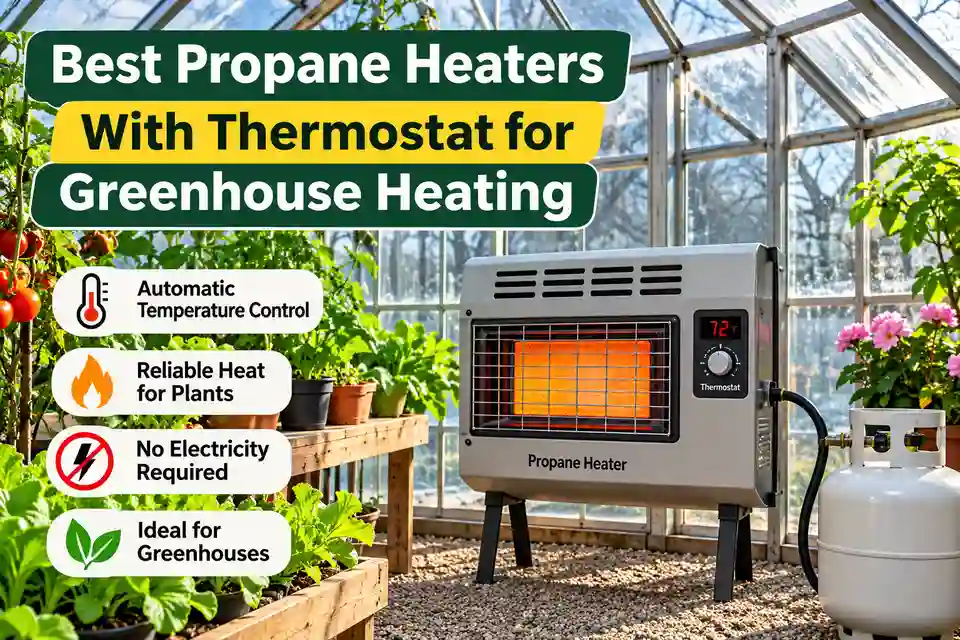


Maintaining a consistent temperature inside a greenhouse can be challenging, especially during winter, unexpected frosts, and extended periods of cold weather. While sunlight provides natural warmth during the day, greenhouse temperatures can drop rapidly after sunset.
A propane heater with a thermostat can help protect plants from freezing temperatures, maintain favorable growing conditions, and extend the growing season without requiring constant manual temperature adjustments.
Propane heating is particularly attractive for greenhouse owners who have limited electrical capacity, operate in rural locations, or need substantial heating output during winter.


However, choosing a greenhouse heater involves more than comparing BTU ratings and purchase prices. Humidity, combustion gases, temperature accuracy, air circulation, greenhouse insulation, and plant sensitivity must also be considered.
Unlike heating a garage or workshop, greenhouse heating requires particular attention to the effects of combustion products on living plants.
In this guide, I’ll discuss the best propane heaters with thermostats for greenhouse heating, recommended equipment, heating costs, propane consumption, heater sizing, and practical ways to maintain a healthy growing environment.
Quick Answer
The best propane heater for a greenhouse is generally a properly sized, vented propane heater with automatic thermostatic control and effective air circulation.


A separated-combustion heater is particularly attractive for permanent greenhouse installations because it obtains combustion air from outside and discharges combustion gases outdoors.
| Heating Requirement | Heater to Consider |
|---|---|
| Small hobby greenhouse | Compact, approved vented propane heater. |
| Medium-sized greenhouse | Modine Hot Dawg HDS. |
| Larger hobby greenhouse | Modine Hot Dawg HDC. |
| Commercial greenhouse | Modine Effinity or Reznor separated-combustion unit. |
| Energy-efficient greenhouse heating | High-efficiency condensing propane heater. |
| Automatic winter frost protection | Vented heater with greenhouse thermostat. |
| Backup heating during power outages | Greenhouse-approved non-electric vented heater. |
| Sensitive plants and seedlings | Separated-combustion heater. |
My recommendation is to prioritize vented equipment over ordinary unvented portable propane heaters. Protecting your plants from combustion pollutants is just as important as protecting them from freezing temperatures.
1. Best Propane Heaters With Thermostats for Greenhouses
The following recommendations prioritize greenhouse suitability, thermostatic control, combustion safety, heating performance, and long-term operating costs.
Top Greenhouse Propane Heater Comparison
| Brand and Model | Heating System | Best Application | Electricity Required |
|---|---|---|---|
| Modine Hot Dawg HDS | Separated combustion | Hobby and medium-sized greenhouses | Yes |
| Modine Hot Dawg HDC | Separated combustion with blower | Larger greenhouses | Yes |
| Modine Hot Dawg HD | Power-vented | Budget-conscious approved installations | Yes |
| Modine Effinity PTC | High-efficiency condensing | Year-round commercial growing | Yes |
| Modine PTX | Commercial separated combustion | Large growing facilities | Yes |
| Reznor UDZ | Separated combustion | Commercial greenhouse installations | Yes |
| L.B. White Therma Grow 2.0 | Direct-fired | Specialized commercial horticulture | Yes |
These recommendations are based on documented product characteristics, not hands-on testing. Thermostats, propane conversion kits, and venting accessories may be sold separately. Confirm the exact model’s greenhouse suitability before purchasing.
1. Modine Hot Dawg HDS
| Fuel | Propane or natural gas configuration |
| Combustion | Separated combustion |
| Heating input | 30,000–125,000 BTU/hr, depending on model |
| Thermostat | Compatible external thermostat |
| Heat distribution | Forced-air fan |
| Installation | Permanent, professionally installed |
The Modine Hot Dawg HDS is one of the first propane heaters I would investigate when installing a permanent greenhouse heating system.



Its separated-combustion design allows the heater to obtain combustion air from outdoors instead of relying on the air inside the greenhouse.
The manufacturer identifies greenhouses among its intended applications.
This is particularly beneficial in environments where humidity, airborne particles, and plant sensitivity can create additional heating challenges.
| Advantages | Disadvantages |
|---|---|
| Separated-combustion design | Requires electricity |
| Automatic thermostat compatibility | Professional installation required |
| Forced-air heat distribution | Higher initial investment |
| Multiple heating capacities | Requires approved venting |
| Suitable for approved permanent greenhouse heating | Thermostat may be sold separately |
My recommendation: For a serious hobby grower who wants reliable winter temperature control, this would be my preferred starting point.


2. Modine Hot Dawg HDC
| Fuel | Propane configuration available |
| Combustion | Separated combustion |
| Temperature control | Compatible external thermostat |
| Air circulation | Blower |
| Electricity | Required |
The Modine HDC is closely related to the HDS but uses a blower configuration.
This may be useful in larger or more complex greenhouse layouts where heat distribution requires additional planning.
A greenhouse with long rows of plants, shelving, hanging baskets, and growing benches can develop cold areas even when the heater produces sufficient heat.
The HDC offers external thermostat connections and outdoor combustion-air capability.
I would consider this model when airflow distribution is an important part of the greenhouse heating design.
3. Modine Hot Dawg HD
| Heating type | Power-vented |
| Fuel | Propane configuration available |
| Thermostat | Compatible external control |
| Electricity | Required |
The standard Modine Hot Dawg HD series provides forced-air heating with powered exhaust venting.
Unlike the HDS, a conventional power-vented configuration generally obtains combustion air from the surrounding indoor environment.
Some greenhouse equipment suppliers offer Hot Dawg heater packages that include thermostats and venting accessories.
The HD may be worth considering when the installer confirms its suitability for the greenhouse’s humidity, ventilation, and environmental conditions.
However, I would prioritize separated combustion whenever practical.
4. Modine Effinity PTC
| Heating type | Condensing gas-fired unit heater |
| Fuel | Propane configuration available |
| Thermal efficiency | Up to 97%, depending on model |
| Application | Commercial and year-round greenhouse heating |
| Thermostat | Compatible external controls |
The Modine Effinity series is worth considering when reducing long-term fuel consumption is more important than minimizing the initial purchase price.
Condensing heaters recover additional heat from combustion gases that conventional equipment would otherwise discharge through the exhaust system.
Modine identifies greenhouse applications and propane availability within its Effinity product information.
A condensing heater requires appropriate exhaust materials, condensate drainage, and installation planning.
For growers operating throughout the winter, the potential fuel savings may justify the higher equipment and installation costs.
5. Modine PTX Commercial Unit Heater
| Fuel | Propane or natural gas configuration |
| Combustion | Separated-combustion configuration |
| Application | Commercial and agricultural buildings |
| Thermostat | Professionally configured control system |
The Modine PTX is designed for more demanding commercial heating applications.
The manufacturer includes greenhouses and agricultural facilities among the applications for its PTX/BTX product line.
This equipment is more relevant to growers operating large structures than homeowners maintaining compact backyard greenhouses.
Commercial growers may benefit from installing multiple heating units to improve temperature distribution and provide partial backup capacity if one heater fails.
6. Reznor UDZ Propane Unit Heater
| Fuel | Propane configuration available |
| Combustion | Separated combustion |
| Venting | Powered exhaust |
| Temperature control | Compatible external thermostat |
The Reznor UDZ series offers separated combustion and powered venting in a commercial unit-heater configuration.
Manufacturer specifications identify propane-compatible versions.
For growers comparing commercial heating systems, Reznor provides an alternative worth discussing with an agricultural HVAC contractor.
Before purchasing, confirm that the selected configuration is appropriate for greenhouse humidity, possible chemical exposure, and the intended operating environment.
7. L.B. White Therma Grow 2.0
| Fuel | Propane versions available |
| Heating type | Direct-fired forced air |
| Application | Commercial horticulture |
| Thermostat | Compatible control configurations |
The L.B. White Therma Grow series is specifically marketed for greenhouse heating.
However, unlike separated-combustion heaters, it is a direct-fired heating system.
Combustion products enter the growing environment, making engineered ventilation and crop sensitivity especially important.
I would not recommend this as a general-purpose heater for an enclosed backyard greenhouse. It is a specialized option that should be evaluated by a qualified greenhouse heating professional.
University agricultural extension guidance warns that unvented combustion equipment can introduce moisture and pollutants that damage greenhouse crops.
Do not substitute an ordinary portable propane heater for a professionally designed commercial greenhouse heating system.
2. Vented vs. Vent-Free Propane Heaters for Greenhouses
This is arguably the most important decision when choosing a propane heater for plants.
Vented Greenhouse Heater
Discharges combustion gases outdoors through an approved exhaust system.
- Lower risk of combustion-related plant damage.
- Reduced combustion moisture inside the greenhouse.
- Suitable for many permanent heating applications.
- Requires approved installation and venting.
Unvented Propane Heater
Releases combustion products directly into the surrounding environment.
- Introduces additional indoor moisture.
- Greater combustion-related pollution concerns.
- Requires careful ventilation assessment.
- Generally unsuitable as ordinary unattended greenhouse heating.
| Feature | Vented Heater | Vent-Free Heater |
|---|---|---|
| Combustion exhaust | Outdoors | Inside greenhouse |
| Added combustion moisture | Generally discharged outside | Released inside |
| Plant pollution risk | Lower when maintained correctly | Greater |
| Initial installation cost | Higher | Generally lower |
| Ventilation requirements | Approved exhaust system | Engineered fresh-air provisions may be required |
| Suitability for sensitive crops | Generally preferred | Problematic |
| Long-term greenhouse heating | Recommended | Generally avoid |
Greenhouses are often relatively enclosed to retain heat. This can allow combustion pollutants to accumulate when unsuitable heating equipment is used.
For this reason, I would avoid ordinary tank-top heaters, patio heaters, vent-free residential heaters, and construction heaters inside an enclosed greenhouse.
3. Can Propane Heater Fumes Damage Greenhouse Plants?
Yes. Improperly vented or malfunctioning propane heaters can expose plants to harmful combustion pollutants.
Ethylene is particularly concerning because it acts as a plant hormone and can interfere with normal growth and development.
| Combustion Product | Potential Greenhouse Effect |
|---|---|
| Ethylene | Abnormal plant growth, flower damage, and leaf damage. |
| Carbon monoxide | Serious health hazard for people. |
| Water vapor | Excess humidity and condensation. |
| Nitrogen oxides | Potential plant injury. |
| Unburned hydrocarbons | Air-quality and combustion concerns. |
| Carbon dioxide | May support photosynthesis under controlled conditions but can accumulate excessively. |
Tomatoes, cucumbers, peppers, lettuce, bedding plants, and many flowering plants can be sensitive to ethylene exposure.
A malfunctioning furnace or damaged heat exchanger can also introduce contaminants even when the heater is designed to be vented.
Signs of Possible Combustion-Related Plant Damage
- Downward curling or bending of leaves.
- Premature flower dropping.
- Abnormal plant growth.
- Unexpected yellowing.
- Flower buds that fail to develop normally.
- Reduced crop productivity.
- Unexplained deterioration near heating equipment.
These symptoms may also result from other growing problems.
If combustion contamination is suspected, stop using the affected equipment, arrange professional inspection, and consult a horticultural specialist.
If there is a suspected propane leak or carbon monoxide emergency, evacuate the greenhouse and seek emergency assistance from a safe location.
4. How Many BTUs Do You Need to Heat a Greenhouse?
Greenhouses lose heat much faster than conventional insulated houses because their transparent walls and roofs allow considerable heat transfer.
Consequently, selecting a heater based solely on floor area can result in inadequate heating capacity.
The following factors determine greenhouse heating requirements:
- Total greenhouse wall and roof surface area.
- Type and thickness of greenhouse covering.
- Minimum expected outdoor temperature.
- Desired indoor growing temperature.
- Air leakage and wind exposure.
- Greenhouse height and shape.
- Foundation and perimeter insulation.
- Required ventilation.
Greenhouse Covering and Heat Loss Comparison
The U-value represents how readily heat passes through a material. A lower U-value generally indicates better insulation.
| Greenhouse Covering | Approximate U-Value | Insulation Performance |
|---|---|---|
| Single-layer plastic film | 1.25 | Poor |
| Single-pane glass | 1.20 | Poor |
| Single-layer polycarbonate | 1.20 | Poor |
| Double-layer plastic film | 0.80 | Moderate |
| Double-wall polycarbonate | 0.60 | Good |
| Single glass with thermal blanket | 0.50 | Improved |
| Double plastic with thermal blanket | 0.40 | Improved |
Approximate reference values based on greenhouse heating guidance from the University of Alaska Fairbanks Cooperative Extension Service. U-values are expressed in BTU/hr per square foot per degree Fahrenheit. Actual material specifications may differ.
Greenhouse Heat Loss Formula
Q = A × U × ΔT
| Variable | Meaning |
|---|---|
| Q | Conductive heat loss in BTU/hr |
| A | Exposed greenhouse surface area in square feet |
| U | Heat transfer coefficient |
| ΔT | Indoor and outdoor temperature difference in degrees Fahrenheit |
Additional heat losses from infiltration, ventilation, foundations, and other sources must also be considered when sizing the heating system.
5. Greenhouse Propane Heater BTU Sizing Chart
The following estimates assume a freestanding rectangular greenhouse with a pitched roof, six-foot sidewalls, a two-foot roof rise, and double-wall polycarbonate covering with a U-value of 0.60.
The estimates include an illustrative 20% addition to conductive heat loss. Actual infiltration and other losses should be calculated separately for permanent installations.
| Greenhouse Size | Floor Area | 30°F Difference | 50°F Difference | 70°F Difference |
|---|---|---|---|---|
| 6 × 8 ft. | 48 sq. ft. | 5,133 BTU/hr | 8,555 BTU/hr | 11,977 BTU/hr |
| 8 × 10 ft. | 80 sq. ft. | 6,944 BTU/hr | 11,573 BTU/hr | 16,202 BTU/hr |
| 10 × 12 ft. | 120 sq. ft. | 8,958 BTU/hr | 14,930 BTU/hr | 20,902 BTU/hr |
| 12 × 16 ft. | 192 sq. ft. | 12,148 BTU/hr | 20,247 BTU/hr | 28,346 BTU/hr |
| 12 × 20 ft. | 240 sq. ft. | 14,278 BTU/hr | 23,796 BTU/hr | 33,314 BTU/hr |
| 16 × 24 ft. | 384 sq. ft. | 19,610 BTU/hr | 32,683 BTU/hr | 45,756 BTU/hr |
| 20 × 30 ft. | 600 sq. ft. | 27,041 BTU/hr | 45,069 BTU/hr | 63,097 BTU/hr |
| 24 × 48 ft. | 1,152 sq. ft. | 44,902 BTU/hr | 74,836 BTU/hr | 104,770 BTU/hr |
Rounded preliminary estimates of useful heating output rather than heater fuel input. Greenhouse length, width, roof geometry, wind exposure, and actual insulation performance affect the results.
For example, if your greenhouse needs 30,000 BTU/hr of useful heat and the heater operates at 80% thermal efficiency, you would need approximately 37,500 BTU/hr of fuel input.
Greenhouse Propane Heater BTU Calculator
Use this calculator to estimate the heating requirements of a rectangular greenhouse with a pitched roof.
Greenhouse Heating Capacity Estimator
Conceptual greenhouse geometry used by the calculator.
Greenhouse Floor Area
192
Square feet
Exposed Surface Area
562.4
Square feet
Temperature Difference
50°F
Conductive Heat Loss
16,872
BTU/hr
Estimated Useful Heat Required
20,247
BTU/hr output
Estimated Heater Fuel Input
24,691
BTU/hr input
This is a preliminary planning calculator. The percentage allowance is not a substitute for calculating actual infiltration, ventilation, and perimeter heat losses. Have permanent greenhouse heating systems professionally sized.
6. What Temperature Should You Maintain Inside a Greenhouse?
The ideal greenhouse temperature depends on the plants you are growing.
Some plants tolerate relatively cool conditions, while tropical plants and warm-season vegetables require considerably more heat.
| Plant or Growing Application | Illustrative Nighttime Temperature |
|---|---|
| Basic frost protection | 40–45°F |
| Overwintering hardy plants | 40–50°F |
| Lettuce | 45–55°F |
| Spinach | 40–50°F |
| General cool-season vegetables | 45–55°F |
| Tomatoes | 60–65°F |
| Peppers | 60–70°F |
| Cucumbers | 65–70°F |
| Basil | 60–70°F |
| Tropical plants | 60–75°F |
| Many orchids | 55–70°F |
| Warm-season seedling propagation | 60–75°F |
These are general growing-temperature examples. Individual species, cultivars, growing stages, and soil temperature requirements vary.
Maintaining an unnecessarily high temperature can significantly increase propane consumption.
If your primary objective is frost protection rather than active winter production, a lower thermostat setting may be appropriate for cold-tolerant plants.
7. Choose the Right Greenhouse Thermostat
A reliable thermostat is essential because greenhouse temperatures can fluctuate rapidly.
There are several types of thermostats to consider.
| Thermostat Type | Advantages | Limitations |
|---|---|---|
| Mechanical thermostat | Simple operation | Limited programming |
| Digital thermostat | Numerical temperature settings | Requires power or batteries |
| Programmable thermostat | Day and night scheduling | More complex configuration |
| Remote-sensor thermostat | Measures temperature near plants | Requires compatible sensors |
| Two-stage thermostat | Supports compatible staged heating | Heater compatibility required |
| Greenhouse climate controller | Coordinates heating and ventilation | Higher initial cost |
| Wi-Fi temperature controller | Remote monitoring capability | Requires connectivity |
A greenhouse-rated thermostat should be suitable for the humidity and environmental conditions inside the structure.
Do not assume an ordinary residential thermostat will tolerate condensation or direct water exposure.
Greenhouse Thermostat Features Worth Buying
- Adjustable temperature settings.
- Remote temperature sensing.
- Suitable moisture and environmental protection.
- Low-temperature alarms.
- High-temperature alarms.
- Daytime and nighttime temperature scheduling.
- Compatibility with the heater’s control system.
- Reliable operation following power interruptions.
For commercial growers, staged heating and integrated climate controls may offer additional benefits.
8. Where Should You Place a Greenhouse Thermostat?
Recommended Temperature-Sensing Location
Illustrative sensor location. Protect the thermostat from direct sunlight, water exposure, and direct heater airflow.
A poorly positioned thermostat may switch the heater off before the plants receive sufficient warmth.
University of Florida greenhouse heating guidance recommends measuring temperature near plant level while shielding the thermostat from solar radiation.
Avoid positioning the thermostat immediately beside the heater, against an exterior wall, near a frequently opened door, or in direct sunlight.
| Thermostat Location | Recommendation |
|---|---|
| Near the plant canopy | Preferred representative location |
| Directly beside the heater | Avoid |
| In direct sunlight | Avoid |
| Near frequently opened doors | Avoid |
| Against cold exterior walls | Avoid |
| Directly in the heater’s air discharge | Avoid |
| Protected representative growing area | Recommended |
For larger greenhouses, multiple temperature sensors can help identify cold areas.
9. How Much Propane Does a Greenhouse Heater Use?
One US gallon of propane contains approximately 91,500 BTU of energy.
The heater’s maximum fuel input rating can be used to estimate its hourly propane consumption.
Gallons per Hour = BTU Input ÷ 91,500
For example, a 30,000 BTU greenhouse heater consumes approximately:
30,000 ÷ 91,500 = 0.328 gallons per hour.
Greenhouse Heater Propane Consumption Chart
| Heater Input | Propane per Hour | Hourly Cost at $3.50/Gallon |
|---|---|---|
| 10,000 BTU/hr | 0.109 gal | $0.38 |
| 20,000 BTU/hr | 0.219 gal | $0.77 |
| 30,000 BTU/hr | 0.328 gal | $1.15 |
| 40,000 BTU/hr | 0.437 gal | $1.53 |
| 45,000 BTU/hr | 0.492 gal | $1.72 |
| 60,000 BTU/hr | 0.656 gal | $2.30 |
| 75,000 BTU/hr | 0.820 gal | $2.87 |
| 100,000 BTU/hr | 1.093 gal | $3.83 |
| 125,000 BTU/hr | 1.366 gal | $4.78 |
| 150,000 BTU/hr | 1.639 gal | $5.74 |
| 200,000 BTU/hr | 2.186 gal | $7.65 |
These figures assume continuous operation at maximum fuel input and a hypothetical propane price of $3.50 per gallon.
A thermostatically controlled greenhouse heater may consume considerably less propane when outdoor conditions are milder.
10. How Much Does It Cost to Heat a Greenhouse With Propane?
Actual greenhouse heating expenses depend on insulation, weather, greenhouse size, thermostat settings, and burner operating time.
The following comparison assumes a 12-hour nightly heating period, a 50% burner duty cycle, and propane costing $3.50 per gallon.
| Heater Input | Monthly Propane Consumption | Monthly Fuel Cost |
|---|---|---|
| 10,000 BTU/hr | 19.67 gal | $68.85 |
| 20,000 BTU/hr | 39.34 gal | $137.70 |
| 30,000 BTU/hr | 59.02 gal | $206.56 |
| 45,000 BTU/hr | 88.52 gal | $309.84 |
| 60,000 BTU/hr | 118.03 gal | $413.11 |
| 75,000 BTU/hr | 147.54 gal | $516.39 |
| 100,000 BTU/hr | 196.72 gal | $688.52 |
| 150,000 BTU/hr | 295.08 gal | $1,032.79 |
Monthly Greenhouse Heating Cost Comparison
10,000 BTU/hr: $68.85
20,000 BTU/hr: $137.70
30,000 BTU/hr: $206.56
45,000 BTU/hr: $309.84
60,000 BTU/hr: $413.11
75,000 BTU/hr: $516.39
100,000 BTU/hr: $688.52
150,000 BTU/hr: $1,032.79
Based on a 30-day month and six hours of equivalent full-input burner operation daily. Electricity, pilot fuel, installation, and maintenance are excluded.
Heating a greenhouse throughout winter can become expensive, particularly if the structure has poor insulation.
Before purchasing a larger propane heater, I recommend considering improvements to greenhouse insulation and temperature management.
11. Worked Example: Heating a 12 × 16 Greenhouse
Suppose you own a 12-foot by 16-foot greenhouse with double-wall polycarbonate panels.
You want to maintain an indoor temperature of 60°F when the outside temperature falls to 10°F.
| Specification | Example Value |
|---|---|
| Greenhouse length | 16 ft. |
| Greenhouse width | 12 ft. |
| Sidewall height | 6 ft. |
| Roof rise | 2 ft. |
| Floor area | 192 sq. ft. |
| Exposed surface area | Approximately 562.4 sq. ft. |
| Covering U-value | 0.60 |
| Indoor temperature | 60°F |
| Outdoor temperature | 10°F |
| Temperature difference | 50°F |
| Additional heat loss allowance | 20% |
| Heater thermal efficiency | 82% |
Estimated Greenhouse Heating Requirements
Conductive heat loss:
562.4 × 0.60 × 50
Approximately 16,872 BTU/hr.
Including an illustrative 20% additional heat loss allowance:
16,872 × 1.20 = approximately 20,246 BTU/hr.
Estimated Useful Heat Required
20,246
BTU/hr
Estimated Fuel Input Required
24,691
BTU/hr
Example Heater Input
30,000
BTU/hr
Useful Output at 82% Efficiency
24,600
BTU/hr
A 30,000 BTU input heater could be a candidate for this hypothetical greenhouse, subject to professional sizing and installation approval. Minor differences result from rounding.
A Modine Hot Dawg HDS30 is an example of a heater in this input capacity range. The manufacturer offers HDS models from 30,000 to 125,000 BTU/hr.
Greenhouse Propane Heating Cost Calculator
Use this calculator to estimate daily propane consumption, fuel availability, and seasonal greenhouse heating expenses.
Greenhouse Propane Consumption Estimator
Maximum Hourly Consumption
0.328 gal
Daily Burner Runtime
6.0 hrs
Daily Propane Consumption
1.97 gal
Daily Fuel Expense
$6.89
Theoretical Fuel Availability
50.8 days
Total Propane Consumption
59.02 gal
Estimated Total Heating Expense
$206.56
Assumes adequate propane vaporization and full rated fuel input during burner operation. Excludes electricity, pilot fuel, installation, and maintenance expenses. The calculation does not establish propane tank compatibility or safe operating schedules.
12. Does a High-Efficiency Propane Heater Save Money?
High-efficiency heaters can reduce propane consumption by extracting more useful heat from the same amount of fuel.
Modine advertises thermal efficiencies of up to 82% for its HDS/HDC series and up to 97% for its Effinity condensing series.
Suppose your greenhouse requires 30 million BTU of useful heat over a heating season, and propane costs $3.50 per gallon.
| Thermal Efficiency | Estimated Propane Required | Seasonal Fuel Cost |
|---|---|---|
| 70% | 468.4 gal | $1,639.34 |
| 80% | 409.8 gal | $1,434.43 |
| 82% | 399.8 gal | $1,399.44 |
| 90% | 364.3 gal | $1,275.05 |
| 93% | 352.5 gal | $1,233.91 |
| 97% | 338.0 gal | $1,183.03 |
Seasonal Fuel Cost by Heater Efficiency
70% Efficiency: $1,639.34
80% Efficiency: $1,434.43
82% Efficiency: $1,399.44
90% Efficiency: $1,275.05
93% Efficiency: $1,233.91
97% Efficiency: $1,183.03
Potential Seasonal Fuel Savings: 82% vs. 97% Efficiency
$216.41
Approximately 15.5% less propane for the same useful heating output.
Illustrative calculation based on equal useful heat output. Actual seasonal performance may differ from rated thermal efficiency.
For commercial growers with substantial annual propane expenses, a high-efficiency heater may be worth the additional investment.
For occasional frost protection, the higher purchase price may take considerably longer to recover.
13. What Size Propane Tank Do You Need for a Greenhouse?
Greenhouse heaters can operate for extended periods during winter. Selecting an appropriate propane supply is therefore particularly important.
Propane Tank Runtime Comparison
| Heater Input | 20 lb Tank | 100 lb Tank | 250-Gallon Tank | 500-Gallon Tank |
|---|---|---|---|---|
| 20,000 BTU/hr | 21.5 hrs | 107.5 hrs | 915 hrs | 1,830 hrs |
| 30,000 BTU/hr | 14.3 hrs | 71.7 hrs | 610 hrs | 1,220 hrs |
| 45,000 BTU/hr | 9.6 hrs | 47.8 hrs | 406.7 hrs | 813.3 hrs |
| 60,000 BTU/hr | 7.2 hrs | 35.8 hrs | 305 hrs | 610 hrs |
| 75,000 BTU/hr | 5.7 hrs | 28.7 hrs | 244 hrs | 488 hrs |
| 100,000 BTU/hr | 4.3 hrs | 21.5 hrs | 183 hrs | 366 hrs |
Assumes approximately 4.7 gallons in a full 20 lb cylinder, 23.5 gallons in a full 100 lb cylinder, 200 gallons in a 250-gallon tank, and 400 gallons in a 500-gallon tank at approximately 80% fill.
These are theoretical maximum-input burner runtimes. They do not establish whether a particular tank can deliver the required propane vapor flow.
A small cylinder may struggle to supply a high-output heater during freezing weather.
For permanent greenhouse heating, I would ask a propane supplier to determine an appropriate tank size based on peak fuel demand and local winter temperatures.
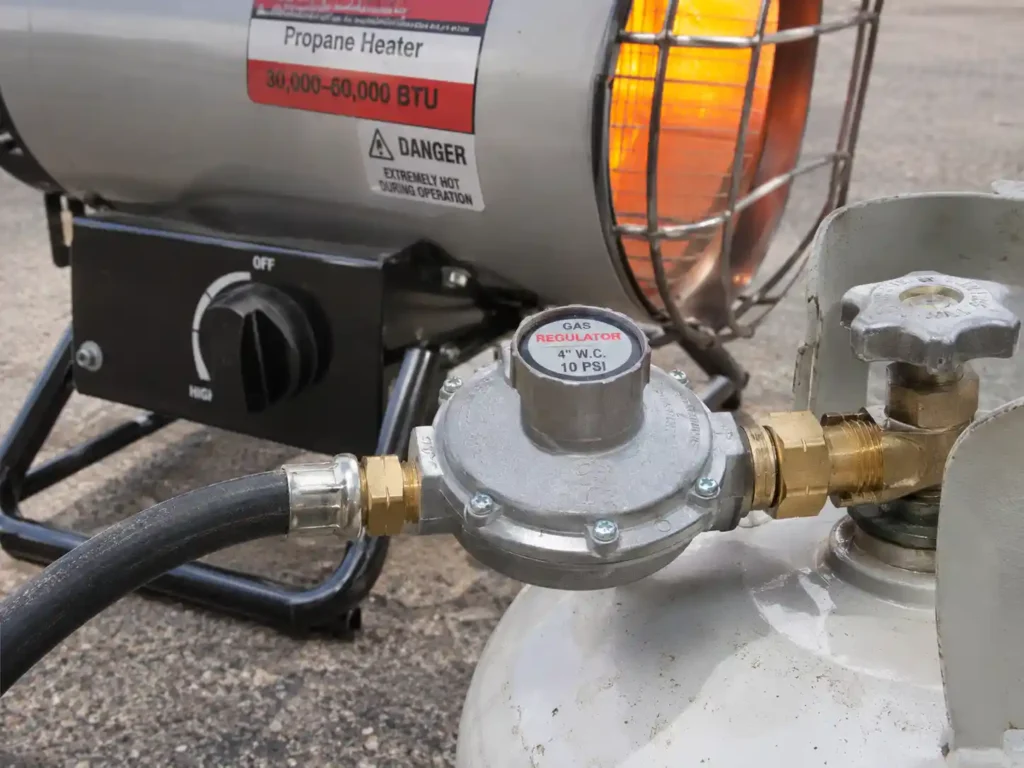
14. Choose the Correct Propane Regulator
A greenhouse propane heater requires a fuel delivery system that maintains the manufacturer’s specified gas pressure and flow capacity.
An incorrectly sized regulator may cause weak heating performance, unstable combustion, or unexpected shutdowns.
| Heater Fuel Input | Minimum Fuel Delivery Demand |
|---|---|
| 30,000 BTU/hr | 30,000 BTU/hr |
| 45,000 BTU/hr | 45,000 BTU/hr |
| 60,000 BTU/hr | 60,000 BTU/hr |
| 75,000 BTU/hr | 75,000 BTU/hr |
| 100,000 BTU/hr | 100,000 BTU/hr |
| 150,000 BTU/hr | 150,000 BTU/hr |
| 200,000 BTU/hr | 200,000 BTU/hr |
The regulator’s actual capacity must satisfy the maximum demand at the required operating pressure.
For additional guidance, read my articles on what BTU capacity means on a propane regulator, inlet pressure versus outlet pressure, and what kind of regulator you need for your propane tank.
Never connect a conventional low-pressure greenhouse heater directly to unregulated propane cylinder pressure.
The regulator, piping, tank capacity, and connections must comply with the appliance manufacturer’s specifications and applicable installation requirements.
15. Do Greenhouse Propane Heaters Require Electricity?
Most permanently installed forced-air greenhouse heaters require electricity for their fans, ignition systems, exhaust equipment, and thermostatic controls.
| Heater Type or Component | Electricity Required? |
|---|---|
| Modine Hot Dawg HDS | Yes |
| Modine Hot Dawg HDC | Yes |
| Modine Effinity | Yes |
| Reznor separated-combustion heater | Yes |
| Commercial direct-fired heater | Generally yes |
| Compatible millivolt direct-vent heater | Not for basic heating |
| Greenhouse circulation fan | Yes |
| Mechanical thermostat | Model-dependent |
If your greenhouse is located off-grid, electrical independence should be part of your heating system design.
A greenhouse-approved non-electric vented heater may be worth investigating, although equipment availability and greenhouse suitability must be confirmed.
For valuable crops, I would also consider a professionally designed backup power system capable of operating the heater and essential greenhouse controls.
Generators must always be operated outdoors, at least 20 feet away from occupied buildings where practicable, with exhaust directed away from doors, windows, greenhouses, and air intakes. Follow manufacturer instructions and applicable safety requirements.
16. How Much Does a Greenhouse Propane Heater Cost?
The purchase price depends on the heater’s capacity, combustion design, manufacturer, thermostat requirements, and efficiency.
| Equipment Type | Estimated Purchase Price |
|---|---|
| Greenhouse thermostat | $40–$180 |
| Greenhouse circulation fan | $80–$350 |
| Compact vented propane heater | $700–$1,500 |
| Modine Hot Dawg HD | $900–$1,800 |
| Modine Hot Dawg HDS | $1,200–$2,500 |
| Modine Hot Dawg HDC | $1,800–$3,500 |
| Reznor commercial unit heater | $1,500–$4,500 |
| Modine Effinity condensing heater | $2,500–$6,000 |
| Large commercial heating equipment | $3,000–$8,000 |
Greenhouse Heater Purchase Price Comparison
Compact Vented Heater: $700–$1,500
Modine Hot Dawg HD: $900–$1,800
Modine Hot Dawg HDS: $1,200–$2,500
Modine Hot Dawg HDC: $1,800–$3,500
Reznor Commercial Heater: $1,500–$4,500
Modine Effinity: $2,500–$6,000
Large Commercial Heater: $3,000–$8,000
Bars represent the upper end of illustrative US equipment price ranges. These are not verified current retail quotations.
Additional installation expenses may include venting materials, gas piping, regulators, electrical connections, thermostat wiring, mounting equipment, and professional labor.
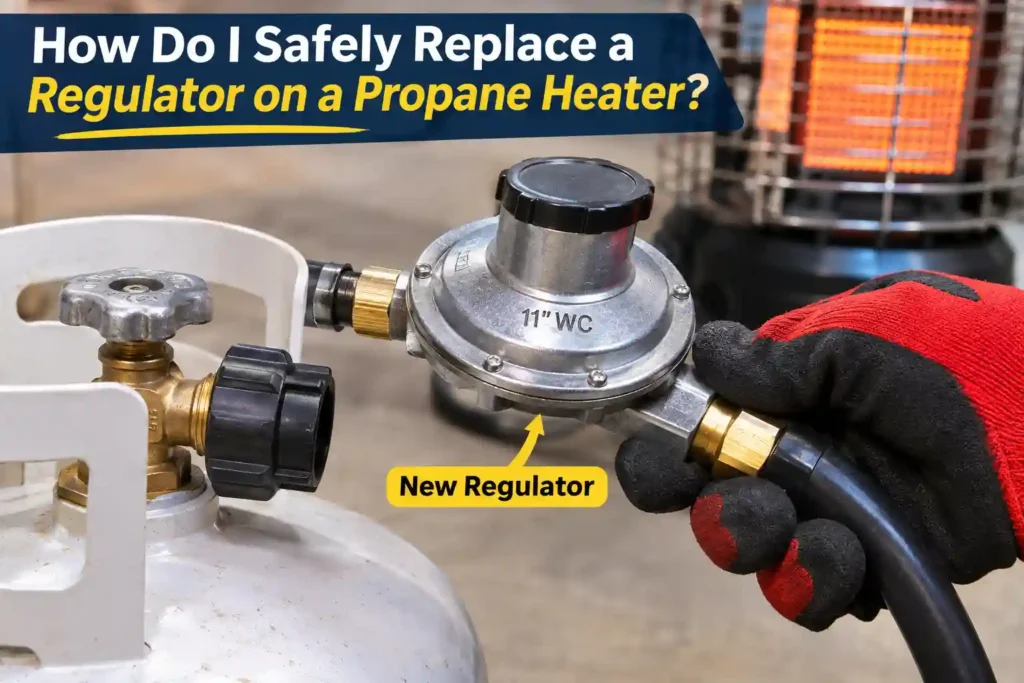
For related expenses, see my guide on the cost of replacing a propane regulator.
17. Best Accessories for Propane Greenhouse Heating
Several accessories can improve temperature monitoring, energy management, and greenhouse heating reliability.
| Accessory | Primary Benefit |
|---|---|
| Greenhouse thermostat | Automatic temperature regulation. |
| Remote temperature sensor | Measures temperature near crops. |
| Wi-Fi temperature monitor | Remote temperature alerts. |
| Horizontal airflow fan | Reduces uneven temperature distribution. |
| Digital hygrometer | Monitors greenhouse humidity. |
| Thermal curtain | Helps reduce nighttime heat loss. |
| Greenhouse insulation panels | Improves thermal performance. |
| Propane tank level monitor | Helps prevent unexpected fuel shortages. |
| Carbon monoxide alarm | Provides additional human safety protection. |
| Backup power system | Supports electrically dependent equipment. |
| Low-temperature alarm | Warns of heater failure or freezing conditions. |
| Soil temperature probe | Monitors growing-medium temperature. |
For expensive or sensitive plants, I would particularly prioritize a low-temperature alarm with independent backup power.
A thermostat controls the heater, but a separate monitoring system can alert you if the heater stops working.
18. How to Reduce Greenhouse Propane Heating Costs
Improving greenhouse thermal performance can sometimes provide greater long-term savings than simply purchasing a higher-output heater.
Compare Greenhouse Covering Materials
Consider a hypothetical greenhouse with 600 square feet of exposed covering and a 50°F difference between indoor and outdoor temperatures.
| Covering Material | Conductive Heat Loss |
|---|---|
| Single plastic film | 37,500 BTU/hr |
| Single glass | 36,000 BTU/hr |
| Double plastic film | 24,000 BTU/hr |
| Double-wall polycarbonate | 18,000 BTU/hr |
| Double plastic with thermal blanket | 12,000 BTU/hr |
Heat Loss Through Greenhouse Coverings
Single Plastic Film: 37,500 BTU/hr
Single Glass: 36,000 BTU/hr
Double Plastic Film: 24,000 BTU/hr
Double-Wall Polycarbonate: 18,000 BTU/hr
Double Plastic With Thermal Blanket: 12,000 BTU/hr
Single Plastic Film Heat Loss
37,500
BTU/hr
Double-Wall Polycarbonate Heat Loss
18,000
BTU/hr
52% Lower Conductive Heat Loss
Illustrative comparison between single plastic film and double-wall polycarbonate. Excludes air leakage, ventilation, foundation losses, and differences in solar heat gain.
Practical Ways to Save Propane
- Repair damaged greenhouse covering materials.
- Seal unintended air leaks without blocking required ventilation.
- Install suitable nighttime thermal curtains.
- Group plants according to their temperature requirements.
- Improve perimeter insulation.
- Use compatible programmable thermostats.
- Maintain lower nighttime temperatures when crops tolerate them.
- Improve warm-air circulation.
- Have heating equipment professionally maintained.
- Monitor fuel consumption throughout the winter.
Never obstruct required combustion-air openings, exhaust vents, or safety-related ventilation to conserve heat.
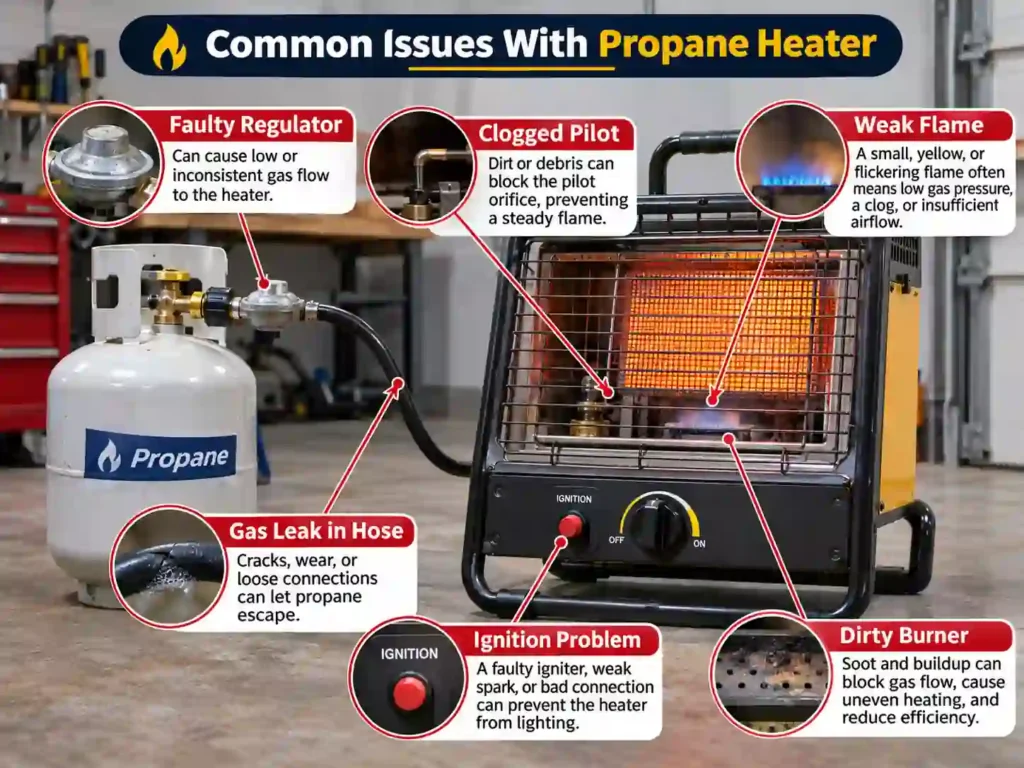
19. Common Greenhouse Propane Heater Problems
| Problem | Possible Cause |
|---|---|
| Heater does not ignite | Ignition system or gas supply problem. |
| Greenhouse remains cold | Insufficient heater capacity. |
| Uneven plant temperatures | Poor heat distribution. |
| Heater cycles too frequently | Thermostat placement or oversized equipment. |
| Excessive propane consumption | High heat loss or inappropriate temperature settings. |
| Weak burner flame | Fuel pressure or delivery problem. |
| Heater shuts down during cold weather | Inadequate propane vaporization. |
| Excessive condensation | Humidity or ventilation problem. |
| Plants develop unusual damage | Possible combustion contamination. |
| Regulator develops excessive frost | Fuel delivery or regulator problem. |
These symptoms may have multiple causes and should not be treated as definitive equipment diagnoses.
Read my related guides on how to know if a propane heater regulator is failing and why propane regulators keep freezing up.
How to Choose the Best Propane Heater for Your Greenhouse
Step 1: Identify Your Crop Temperature Requirements
Determine whether your objective is basic frost protection, overwintering plants, seedling propagation, or year-round vegetable production.
Different crops require different temperature ranges.
Step 2: Estimate Greenhouse Heat Loss
Measure the greenhouse dimensions and determine the covering material, insulation performance, outdoor design temperature, and required indoor temperature.
Use the greenhouse heating calculator for preliminary planning and obtain professional sizing for permanent installations.
Step 3: Prioritize Appropriate Combustion Design
I recommend investigating separated-combustion propane heaters first because they discharge combustion products outside and obtain combustion air independently of the growing environment.
Step 4: Select a Compatible Greenhouse Thermostat
Choose temperature controls suitable for the heater and the greenhouse’s environmental conditions.
Consider remote sensors and independent low-temperature alarms when protecting valuable plants.
Step 5: Confirm Propane and Electrical Supply
Verify the required propane tank capacity, vaporization rate, regulator specifications, gas piping, and electrical power requirements.
Determine how your greenhouse will maintain safe temperatures during power outages or fuel interruptions.
Step 6: Compare Total Ownership Costs
Consider heater purchase prices, professional installation, annual propane consumption, electricity costs, maintenance, and potential insulation improvements.
20. Greenhouse Propane Heater Buying Checklist
Before purchasing a propane heater, use this checklist to help verify the essential requirements.
Greenhouse Heater Purchasing Checklist
0 of 15 requirements checked
Completing this checklist does not replace professional equipment sizing or installation approval.
21. Safety Precautions When Heating a Greenhouse With Propane
Important Greenhouse Heating Safety Precautions
- Use equipment approved for the intended greenhouse environment.
- Avoid ordinary unvented portable heaters inside enclosed greenhouses.
- Maintain manufacturer-required clearances from plastic coverings and combustible materials.
- Keep propane supply tanks in approved outdoor locations.
- Never obstruct combustion-air intakes or exhaust vents.
- Install suitable carbon monoxide alarms rated for the environmental conditions.
- Never bypass thermostat or safety-control systems.
- Arrange regular burner, exhaust, and heat exchanger inspections.
- Keep flammable agricultural chemicals away from heating equipment.
- Never use an open flame to check for propane leakage.
- Do not increase regulator pressure to obtain additional heat.
- Have gas piping and permanent heating equipment professionally installed.
If you smell propane: Leave the greenhouse immediately, avoid ignition sources and electrical switches, and contact emergency services or your propane supplier from a safe location.
Do not return to the affected area until it has been declared safe.
If a carbon monoxide alarm sounds: Move everyone to fresh air immediately and contact emergency services.
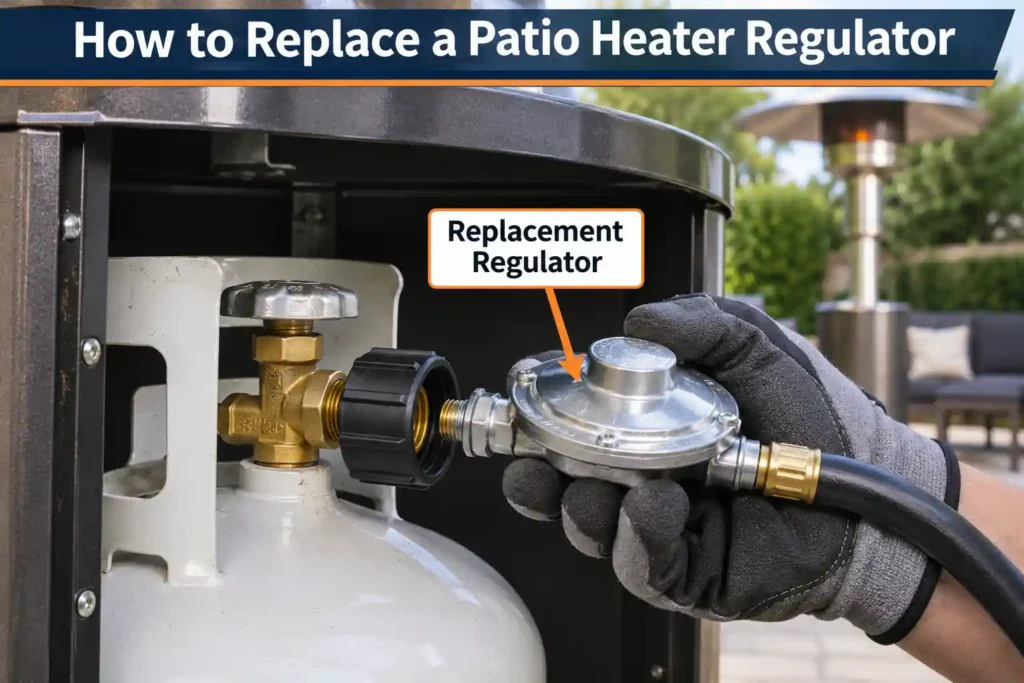
For further guidance, read my article on whether you can install a propane regulator yourself or need a professional.
Frequently Asked Questions
What Is the Best Propane Heater for a Greenhouse?
For permanent greenhouse heating, I would generally recommend a properly sized separated-combustion propane heater, such as the Modine Hot Dawg HDS series.
This configuration provides thermostatic temperature control, forced-air heating, and outdoor discharge of combustion gases.
Can I Use a Mr. Heater Buddy Inside a Greenhouse?
I would not recommend an ordinary unvented Buddy heater as a permanent or unattended greenhouse heating system.
Combustion products, moisture, plant sensitivity, and operating restrictions make purpose-designed vented equipment preferable.
Is a 30,000 BTU Propane Heater Enough for a Greenhouse?
It depends on the greenhouse’s surface area, insulation, outdoor temperatures, heat loss, and the heater’s useful output.
A 30,000 BTU input heater may be sufficient for some small greenhouses but inadequate for others. Use the heating capacity calculator for preliminary planning.
Are Propane Heaters Bad for Plants?
Properly installed and maintained vented propane heaters can provide effective greenhouse heating.
However, unvented or malfunctioning equipment may release pollutants capable of damaging plants.
Does Propane Heating Produce Carbon Dioxide for Plants?
Yes, propane combustion produces carbon dioxide. However, it also produces water vapor and may generate harmful pollutants.
Ordinary unvented heating equipment should not be used as a substitute for professionally designed greenhouse carbon dioxide enrichment systems.
Can I Leave a Greenhouse Propane Heater Running Overnight?
Only use a permanently installed heating system specifically approved for the intended automatic or unattended operation.
A thermostat alone does not make a portable heater safe for overnight operation.
What Is the Cheapest Way to Heat a Greenhouse With Propane?
The most economical approach often involves improving greenhouse insulation, maintaining appropriate crop temperatures, reducing unintended heat loss, and using an efficiently sized vented heater.
Is Propane Better Than Electricity for Greenhouse Heating?
It depends on local energy prices, equipment efficiency, available electrical capacity, and heating requirements.
Electric resistance heaters eliminate on-site combustion pollutants, while propane can provide substantial heating capacity without requiring large electrical heating loads.
Do I Need a Fan With My Greenhouse Propane Heater?
Air circulation is particularly beneficial in larger greenhouses. It helps reduce localized cold areas and uneven crop temperatures.
Many commercial propane unit heaters already incorporate a fan.
Can a Greenhouse Thermostat Save Propane?
Yes, automatic temperature regulation can reduce unnecessary burner operation.
Actual savings depend on weather conditions, crop temperature requirements, greenhouse insulation, and the alternative heating method.
Can I Heat a Greenhouse With a 20 lb Propane Tank?
Only if the equipment and approved fuel supply design permit it.
Larger heaters and cold-weather operation frequently require greater fuel storage and vaporization capacity.
What Temperature Should I Set My Greenhouse Heater To?
For basic frost protection, approximately 40–45°F may be suitable for many cold-tolerant plants. Warm-season vegetables and tropical plants often require higher temperatures.
Choose your thermostat setting according to the needs of your particular crops.
My Final Thoughts
Choosing the best propane heater with a thermostat for greenhouse heating requires careful consideration of both heating performance and plant health.
For most permanent hobby greenhouse installations, the Modine Hot Dawg HDS is one of the first heater series I would investigate.
For larger greenhouses requiring sophisticated heat distribution, the Modine HDC and Reznor separated-combustion units are worth considering.
Commercial growers with substantial annual heating expenses may benefit from high-efficiency equipment such as the Modine Effinity series.
However, I would not select a greenhouse heater based solely on BTU capacity or initial purchase price.
The correct heater should provide reliable temperature regulation, adequate heating output, appropriate ventilation, effective heat distribution, and safe operation within the growing environment.
Investing in greenhouse insulation, compatible thermostats, temperature monitoring, and adequate propane storage can also help protect your plants while managing long-term fuel expenses.

Mike is an experienced propane technician with over 15 years of professional experience in the field. He has dedicated his career to helping customers with their propane needs, from installation to maintenance and repair. Together with Jeremy, he co-founded this website to provide useful information and guidance to customers seeking reliable propane services.