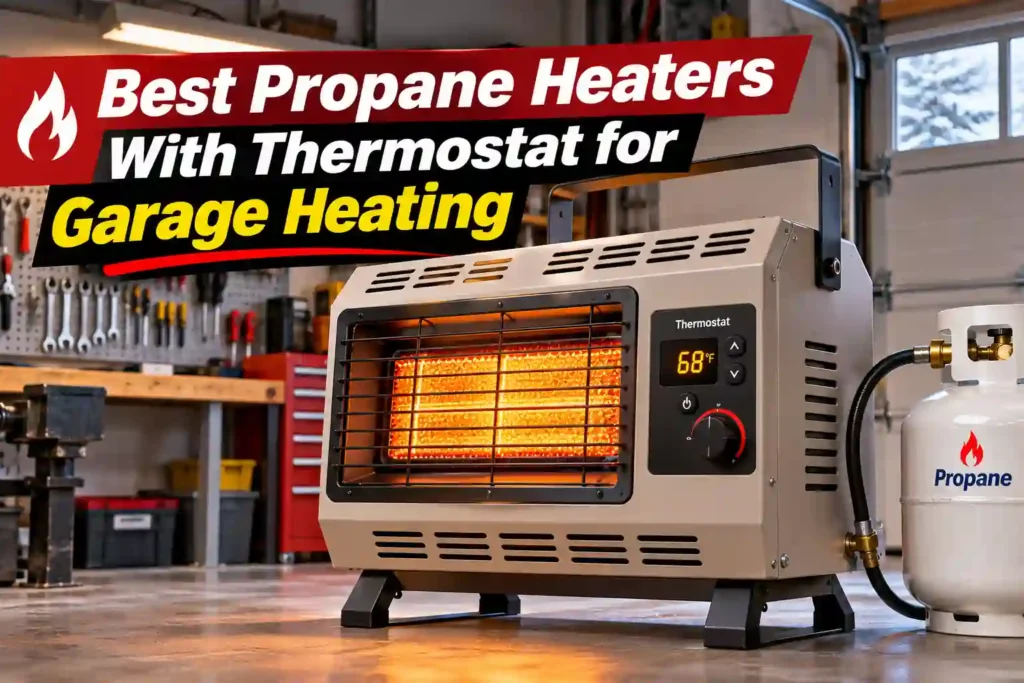


Heating a garage during winter can be challenging, particularly if the building has poor insulation, concrete flooring, high ceilings, or frequently opened garage doors.
Whether you use your garage for vehicle maintenance, woodworking, home improvement projects, or storing temperature-sensitive equipment, a propane heater with a thermostat can help maintain a more comfortable working environment.
Unlike manually controlled propane heaters, thermostatically controlled models automatically adjust burner operation according to the surrounding temperature. This can reduce unnecessary fuel consumption and eliminate the need for constant manual adjustments.


However, not every propane heater is suitable for garage heating. Garages present additional safety concerns involving gasoline vapors, combustible materials, vehicle movement, ventilation, and carbon monoxide exposure.
When choosing a propane garage heater, I recommend looking beyond the advertised BTU rating. You should also consider the combustion system, thermostat compatibility, fuel requirements, installation costs, and automatic safety features.
In this guide, I’ll discuss the best propane heaters with thermostats for garage heating, compare popular brands, explain how to calculate heating requirements, and help you estimate your propane expenses.
Quick Answer
The best propane heater with a thermostat for regular garage heating is generally a professionally installed, vented propane unit heater with sufficient BTU capacity and automatic temperature control.


| Category | Recommended Heater |
|---|---|
| Best overall | Modine Hot Dawg HDS45 |
| Best for smaller garages | Modine Hot Dawg HDS30 |
| Best value vented heater | Mr. Heater Big Maxx 50,000 BTU |
| Best for medium-sized workshops | Modine Hot Dawg HD60 |
| Best higher-output option | Mr. Heater Big Maxx 80,000 BTU |
| Best budget supplemental option | Mr. Heater 30,000 BTU Garage Heater, where permitted |
| Non-electric option to investigate | Mr. Heater MH40LP |
For permanent garage heating, I prefer vented equipment, particularly separated-combustion models that obtain combustion air from outdoors.
The thermostat may be included or sold separately, depending on the heater and retailer package.
Important: A thermostat or automatic safety shut-off does not make a heater suitable for every garage environment. Verify the appliance’s listing, installation requirements, and local restrictions.
Best Propane Garage Heaters With Thermostat Compared
| Brand and Model | BTU Input | Heating Type | Thermostat |
|---|---|---|---|
| Modine Hot Dawg HDS30 | 30,000 | Separated combustion | External |
| Modine Hot Dawg HDS45 | 45,000 | Separated combustion | External |
| Mr. Heater Big Maxx MHU50 | 50,000 | Vented forced air | External |
| Modine Hot Dawg HD60 | 60,000 | Power-vented | External |
| Mr. Heater Big Maxx MHU80 | 80,000 | Vented forced air | External |
| Mr. Heater MHVFGH30LPBT | 30,000 | Vent-free convection | Integrated |
| Mr. Heater MH40LP | 40,000 | Radiant | Millivolt |
Recommendations are based on documented product characteristics rather than hands-on product testing. Confirm current specifications, fuel configuration, included accessories, and installation approval before purchasing.
1. Modine Hot Dawg HDS45
| Heating input | 45,000 BTU/hr |
|---|---|
| Fuel | Propane configuration available |
| Combustion | Separated combustion |
| Thermostat | Compatible external thermostat |
| Heat distribution | Forced air |
| Electricity required | Yes |
| Installation | Permanent, professionally installed |
The Modine Hot Dawg HDS45 is one of my preferred options for homeowners seeking a permanent propane garage heating solution.



Its separated-combustion design obtains combustion air from outdoors and discharges combustion gases through an approved exhaust system.
This can be advantageous in garages and workshops where airborne particles, temperature fluctuations, and environmental conditions differ from ordinary living spaces.
The 45,000 BTU input rating makes it a useful candidate for many appropriately sized residential garages, although actual suitability depends on the building’s heat loss.
Advantages
- Separated-combustion design.
- Compatible external thermostat.
- Forced-air heat distribution.
- Permanent overhead installation saves floor space.
- Multiple capacities available within the product series.
Disadvantages
- Requires electricity.
- Professional installation required.
- Additional venting expenses.
- Thermostat may be sold separately.
My recommendation: Investigate this model first if you regularly use your garage throughout winter and want a permanent thermostatically controlled heating system.


2. Modine Hot Dawg HDS30
| Heating input | 30,000 BTU/hr |
|---|---|
| Combustion | Separated combustion |
| Thermostat | External |
| Fuel | Propane configuration available |
| Electricity | Required |
The HDS30 offers many of the same benefits as the HDS45 but has a lower maximum heating input.
For a smaller insulated garage, purchasing a larger heater may result in unnecessary equipment expenses and frequent burner cycling.
The HDS30 is worth considering when a professional heat-loss assessment indicates that its heating output is sufficient.
Advantages
- Separated combustion.
- Lower maximum fuel consumption than larger models.
- Compact overhead installation.
- Automatic temperature control with a compatible thermostat.
Disadvantages
- May be insufficient for large garages.
- Requires permanent installation.
- Requires electricity and approved venting.
3. Mr. Heater Big Maxx MHU50
| Heating input | 50,000 BTU/hr |
|---|---|
| Heating method | Forced air |
| Thermostat | Compatible external thermostat |
| Ventilation | Vented unit heater |
| Fuel | Verify propane configuration or approved conversion kit |
| Electricity | Required |
The Mr. Heater Big Maxx MHU50 is a popular type of overhead gas unit heater for residential garages and workshops.
Its fan distributes warm air throughout the garage, while a compatible external thermostat automatically regulates heating demand.
One important purchasing consideration is fuel configuration. Some packages are supplied for natural gas operation and may require an approved propane conversion performed by a qualified technician.
Do not assume that every Big Maxx heater is ready for propane operation immediately out of the box.
Advantages
- Substantial heating capacity.
- Forced-air heat distribution.
- External thermostat compatibility.
- Overhead mounting saves floor space.
- Worth comparing against higher-priced unit heaters.
Disadvantages
- May require professional fuel conversion.
- Thermostat and venting accessories may cost extra.
- Requires household electricity.
- Professional installation required.
4. Modine Hot Dawg HD60
| Heating input | 60,000 BTU/hr |
|---|---|
| Heating type | Power-vented forced air |
| Thermostat | External |
| Fuel | Propane configuration available |
| Electricity | Required |
The Modine HD60 offers a higher heating capacity for garages and workshops that require more useful heat than smaller unit heaters can provide.
Unlike the HDS separated-combustion series, a conventional HD installation generally obtains combustion air from the surrounding environment.
This distinction matters when evaluating a workshop’s ventilation conditions and potential airborne contaminants.
I would consider the HD60 when the building requires its heating capacity and the installer confirms that the combustion design is appropriate.
5. Mr. Heater Big Maxx MHU80
| Heating input | 80,000 BTU/hr |
|---|---|
| Heating method | Forced air |
| Thermostat | External |
| Fuel | Verify approved propane configuration |
| Ventilation | Vented |
| Electricity | Required |
The Big Maxx MHU80 provides more maximum heating input than the 50,000 BTU version.
It is worth investigating for larger garages, high-ceiling workshops, and buildings with substantial winter heat loss.
However, I would not purchase an 80,000 BTU heater simply because it can warm a space quickly.
An excessively large heater may cycle frequently and create temperature fluctuations. Its greater maximum propane demand also requires an appropriately sized gas supply system.
6. Mr. Heater 30,000 BTU Propane Garage Heater
| Model | MHVFGH30LPBT |
|---|---|
| Heating input | 30,000 BTU/hr |
| Heating method | Blue-flame convection |
| Thermostat | Integrated |
| Ventilation | Vent-free |
| Safety feature | Oxygen depletion protection |
This thermostatically controlled garage heater may appeal to buyers who want a lower equipment purchase price.
Its blue-flame heating system warms surrounding air, while the integrated thermostat regulates burner operation.
Unlike vented unit heaters, however, this appliance releases combustion products and moisture into the garage.
Advantages
- Integrated thermostat.
- Relatively affordable equipment cost.
- Compact design.
- Automatic low-oxygen protection.
Disadvantages
- Combustion products remain indoors.
- Additional moisture may contribute to condensation.
- Subject to ventilation and installation restrictions.
- Not permitted in every garage or jurisdiction.
An oxygen depletion sensor does not detect carbon monoxide directly. I would generally prioritize vented equipment for regular garage heating.
7. Mr. Heater MH40LP
| Heating input | 40,000 BTU/hr |
|---|---|
| Heating method | High-intensity radiant |
| Thermostat | Millivolt |
| Household electricity | Not required for basic heating |
| Application | Approved garage and workshop installations |
The Mr. Heater MH40LP is worth investigating if you need radiant workshop heating without relying on household electricity.
Instead of primarily warming the surrounding air, its radiant heating system transfers warmth to nearby objects, surfaces, and people.
This can be useful when working in a designated area of a larger workshop.
However, it requires careful attention to its specified mounting height, ventilation provisions, combustible-material clearances, and intended operating environment.
It should not be treated as a general-purpose indoor residential heater.
What Type of Propane Heater Is Best for a Garage?
Several propane heating technologies are available, but their performance and installation requirements differ considerably.
| Heater Type | Primary Benefit | Garage Suitability |
|---|---|---|
| Separated-combustion unit heater | Outdoor combustion air and vented exhaust | Preferred for many permanent installations |
| Power-vented unit heater | Effective forced-air heating | Suitable when approved for the environment |
| Infrared radiant heater | Localized surface heating | Model-dependent |
| Vent-free wall heater | Lower equipment cost | Conditional on local and manufacturer requirements |
| Portable forced-air construction heater | Rapid temporary heating | Only approved temporary work environments |
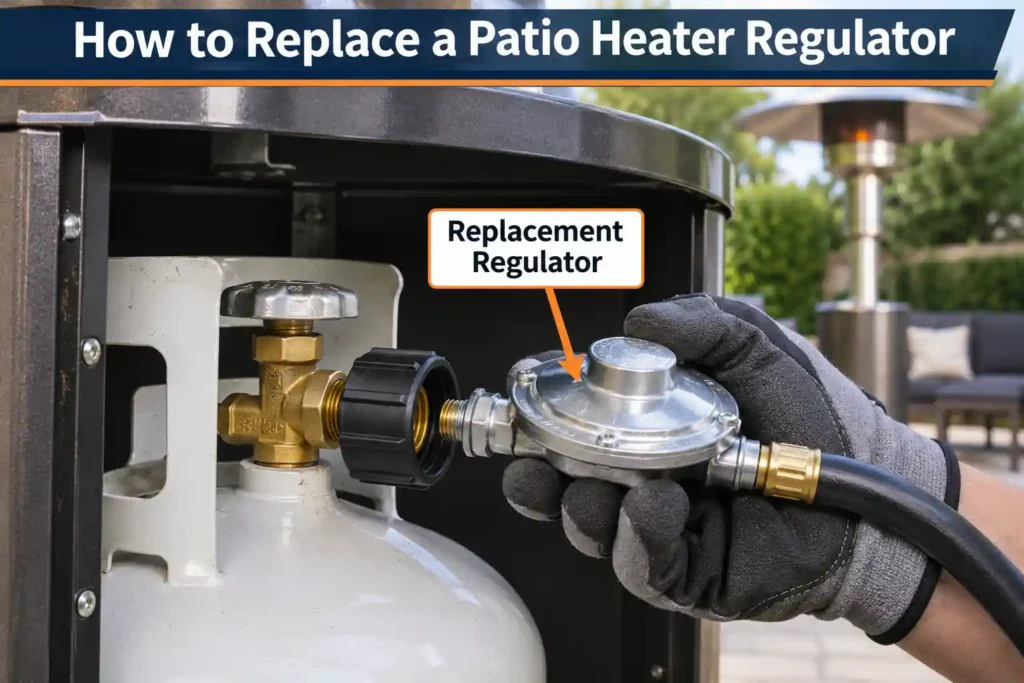
| Outdoor patio heater | Outdoor radiant warmth | Not suitable inside an enclosed garage |
For homeowners who regularly use their garage during winter, I prefer permanently installed vented equipment rather than ordinary portable propane heaters.
Vented vs. Vent-Free Propane Garage Heaters
Understanding the difference between vented and vent-free heaters is particularly important when heating enclosed garages.
| Feature | Vented | Vent-Free |
|---|---|---|
| Combustion exhaust | Discharged outdoors | Released indoors |
| Indoor combustion moisture | Generally lower | Higher |
| Installation complexity | Higher | Generally lower |
| Equipment cost | Generally higher | Generally lower |
| Thermostat availability | Common | Common |
| Long-term garage heating | Preferred | Conditional |
| Indoor air-quality concerns | Generally lower | Greater |
Unvented propane combustion introduces water vapor into the garage. In cold conditions, this moisture can contribute to condensation on windows, tools, vehicles, and metal surfaces.
A separated-combustion heater offers an additional advantage because it obtains combustion air independently of the surrounding garage environment.
However, separated combustion does not make equipment suitable for explosive atmospheres or locations containing hazardous concentrations of flammable vapors.
How Many BTUs Do You Need to Heat a Garage?
Garage size is an important consideration, but it is not the only factor determining heating requirements.
A poorly insulated two-car garage in a cold climate may require substantially more heating capacity than an insulated garage of the same size in a milder climate.
Consider the following factors:
- Total garage floor area.
- Ceiling height.
- Wall and ceiling insulation.
- Garage door insulation.
- Outdoor winter temperatures.
- Air leakage around doors and windows.
- Frequency of garage door opening.
- Desired indoor temperature.
- Heater efficiency.
Preliminary Garage Heater BTU Sizing Chart
| Garage Dimensions | Floor Area | Estimated Useful Heat at 30–50 BTU/hr per Sq. Ft. |
|---|---|---|
| 12 × 20 ft. | 240 sq. ft. | 7,200–12,000 BTU/hr |
| 14 × 22 ft. | 308 sq. ft. | 9,240–15,400 BTU/hr |
| 20 × 20 ft. | 400 sq. ft. | 12,000–20,000 BTU/hr |
| 22 × 24 ft. | 528 sq. ft. | 15,840–26,400 BTU/hr |
| 24 × 24 ft. | 576 sq. ft. | 17,280–28,800 BTU/hr |
| 24 × 30 ft. | 720 sq. ft. | 21,600–36,000 BTU/hr |
| 30 × 30 ft. | 900 sq. ft. | 27,000–45,000 BTU/hr |
| 30 × 40 ft. | 1,200 sq. ft. | 36,000–60,000 BTU/hr |
| 40 × 40 ft. | 1,600 sq. ft. | 48,000–80,000 BTU/hr |
These are illustrative screening estimates, not professional heat-loss calculations. Actual requirements may fall considerably outside these ranges. Useful heat output is different from the heater’s fuel input rating.
Garage Propane Heater BTU Calculator
Use this calculator to estimate preliminary heating requirements based on your garage dimensions, assumed heat loss, and heater efficiency.
Garage Heating Capacity Estimator
Garage Floor Area
576
Square feet
Estimated Useful Heat Required
23,040
BTU/hr output
Estimated Heater Fuel Input
28,800
BTU/hr input
Assumed Thermal Efficiency
80%
For preliminary budgeting only. Ceiling height, climate, infiltration, garage door operation, and other heat losses require separate consideration. This calculator does not establish safe appliance sizing, ventilation, or installation suitability.
What Size Propane Heater Do You Need for a Two-Car Garage?
A typical two-car garage may have approximately 400 to 600 square feet of floor space.
For many insulated garages, a propane unit heater in the 30,000 to 50,000 BTU input range may be worth investigating.
However, a garage located in a severe winter climate, with poor insulation or high ceilings, may require substantially more heating capacity.
Before purchasing a larger heater, compare its useful heat output with your garage’s estimated heat loss. A properly sized smaller heater may provide better temperature stability than an unnecessarily oversized appliance.
Choose the Right Thermostat for Your Garage Heater
A thermostat allows your propane heater to operate automatically according to the temperature you select.
Many permanently installed garage unit heaters support compatible external thermostats, while certain wall heaters use integrated mechanical thermostats.
| Thermostat Type | Advantages | Limitations |
|---|---|---|
| Mechanical thermostat | Simple operation | Limited scheduling |
| Digital thermostat | Numerical temperature display | Requires compatible power and controls |
| Programmable thermostat | Automatic work schedules | More configuration required |
| Millivolt thermostat | Compatible with certain non-electric heaters | Limited equipment compatibility |
| Wi-Fi thermostat | Remote temperature monitoring | Requires power and connectivity |
If you use your garage only during evenings or weekends, a compatible programmable thermostat may help reduce unnecessary heating during unoccupied periods.
Verify thermostat voltage, control-circuit compatibility, temperature range, and environmental suitability before purchasing.
An ordinary household smart thermostat is not automatically compatible with every propane garage heater.
Where Should You Place a Garage Heater Thermostat?
A thermostat should measure a representative garage temperature rather than the temperature immediately surrounding the heater.
Illustrative Garage Thermostat Placement
Conceptual layout only. Actual heater mounting, thermostat placement, clearances, and venting must follow manufacturer instructions and applicable installation requirements.
Avoid placing the thermostat directly in the heater’s discharge airflow, beside frequently opened garage doors, on unusually cold exterior walls, or in direct sunlight.
For larger workshops, multiple temperature sensors may help identify areas that receive insufficient heat.
How Much Propane Does a Garage Heater Use?
One US gallon of propane contains approximately 91,500 BTU of energy.
The heater’s maximum fuel input rating can be used to estimate its hourly propane consumption.
Gallons per Hour = BTU Input ÷ 91,500
For a 50,000 BTU propane garage heater:
50,000 ÷ 91,500 = approximately 0.546 gallons per hour.
| Heater Input | Gallons per Hour | Hourly Cost at $3.50/Gallon |
|---|---|---|
| 20,000 BTU/hr | 0.219 | $0.77 |
| 30,000 BTU/hr | 0.328 | $1.15 |
| 40,000 BTU/hr | 0.437 | $1.53 |
| 45,000 BTU/hr | 0.492 | $1.72 |
| 50,000 BTU/hr | 0.546 | $1.91 |
| 60,000 BTU/hr | 0.656 | $2.30 |
| 75,000 BTU/hr | 0.820 | $2.87 |
| 80,000 BTU/hr | 0.874 | $3.06 |
| 100,000 BTU/hr | 1.093 | $3.83 |
| 125,000 BTU/hr | 1.366 | $4.78 |
Estimates assume continuous maximum-input burner operation and an illustrative propane price of $3.50 per gallon.
Worked Example: Heating a Two-Car Garage
Suppose you have a 24-by-24-foot garage equipped with a 50,000 BTU propane unit heater and a compatible thermostat.
You use the garage for six hours per day. During that period, assume the burner operates at maximum input for approximately 40% of the time.
| Operating Condition | Example Value |
|---|---|
| Garage floor area | 576 sq. ft. |
| Heater maximum input | 50,000 BTU/hr |
| Daily heating period | 6 hours |
| Assumed burner duty cycle | 40% |
| Equivalent burner runtime | 2.4 hours/day |
| Propane price | $3.50/gallon |
Estimated Garage Heating Expenses
Daily burner runtime = 6 × 40% = 2.4 hours.
50,000 ÷ 91,500 × 2.4
Daily Propane Consumption
1.31 gal
Daily Heating Cost
$4.59
Monthly Propane Consumption
39.34 gal
Monthly Heating Cost
$137.70
Based on a 30-day month. Excludes electricity, installation, maintenance, and any separate pilot fuel consumption. Actual burner duty cycles vary.
Garage Propane Heater Operating Cost Calculator
Use this calculator to estimate propane consumption, fuel availability, and monthly garage heating expenses.
Garage Heating Cost Estimator
Maximum Hourly Consumption
0.546 gal
Daily Burner Runtime
2.4 hrs
Daily Propane Consumption
1.31 gal
Daily Heating Expense
$4.59
Theoretical Fuel Availability
76.3 days
Total Propane Consumption
39.34 gal
Estimated Total Heating Expense
$137.70
Assumes adequate propane vaporization and full rated input during burner operation. Excludes electricity and other expenses. This calculator does not establish safe operating schedules or tank compatibility.
Does a Thermostat Save Propane in a Garage?
A thermostat can reduce unnecessary burner operation when the desired garage temperature is reached.
The following comparison illustrates monthly fuel costs for a 50,000 BTU heater during a six-hour daily heating period.
Monthly Fuel Cost by Burner Duty Cycle
Assumes propane costs $3.50 per gallon and a 30-day month.
25% Duty Cycle: $86.07
40% Duty Cycle: $137.70
50% Duty Cycle: $172.13
75% Duty Cycle: $258.20
100% Duty Cycle: $344.26
These are hypothetical duty-cycle comparisons rather than guaranteed thermostat savings.
Improving garage insulation and using appropriate temperature settings can reduce heating demand.
However, the thermostat cannot compensate for excessive heat loss caused by inadequate insulation or frequently opened garage doors.
What Temperature Should You Set Your Garage Thermostat To?
The ideal temperature depends on how you use your garage.
| Garage Application | Illustrative Temperature Setting |
|---|---|
| Basic frost protection | 40–45°F |
| Vehicle storage | 40–50°F |
| Occasional maintenance work | 50–60°F |
| Regular workshop use | 55–65°F |
| Extended work sessions | 60–68°F |
These are general comfort and planning examples. Stored chemicals, water pipes, equipment, and other materials may have specific temperature requirements.
If your primary objective is frost protection, maintaining residential living-room temperatures throughout winter may result in unnecessary propane consumption.
What Size Propane Tank Do You Need for a Garage Heater?
Adequate propane storage is essential, particularly when operating a high-output garage heater during freezing weather.
| Heater Input | 20 lb Propane | 100 lb Propane | 250-Gallon Tank at 80% Fill | 500-Gallon Tank at 80% Fill |
|---|---|---|---|---|
| 30,000 BTU/hr | 14.3 hrs | 71.7 hrs | 610 hrs | 1,220 hrs |
| 45,000 BTU/hr | 9.6 hrs | 47.8 hrs | 406.7 hrs | 813.3 hrs |
| 50,000 BTU/hr | 8.6 hrs | 43.0 hrs | 366 hrs | 732 hrs |
| 60,000 BTU/hr | 7.2 hrs | 35.8 hrs | 305 hrs | 610 hrs |
| 80,000 BTU/hr | 5.4 hrs | 26.9 hrs | 228.8 hrs | 457.5 hrs |
| 100,000 BTU/hr | 4.3 hrs | 21.5 hrs | 183 hrs | 366 hrs |
Theoretical maximum-input burner runtimes assume approximately 4.7 gallons in 20 lb of propane, 23.5 gallons in 100 lb, and sufficient vaporization. These figures do not indicate that each tank size is compatible with each heater.
Cold weather can reduce a propane cylinder’s ability to vaporize fuel. A cylinder may contain sufficient liquid propane but still be unable to supply a high-output heater at its required rate.
For a permanent garage heating installation, I recommend consulting a propane supplier about storage capacity and cold-weather vaporization requirements.
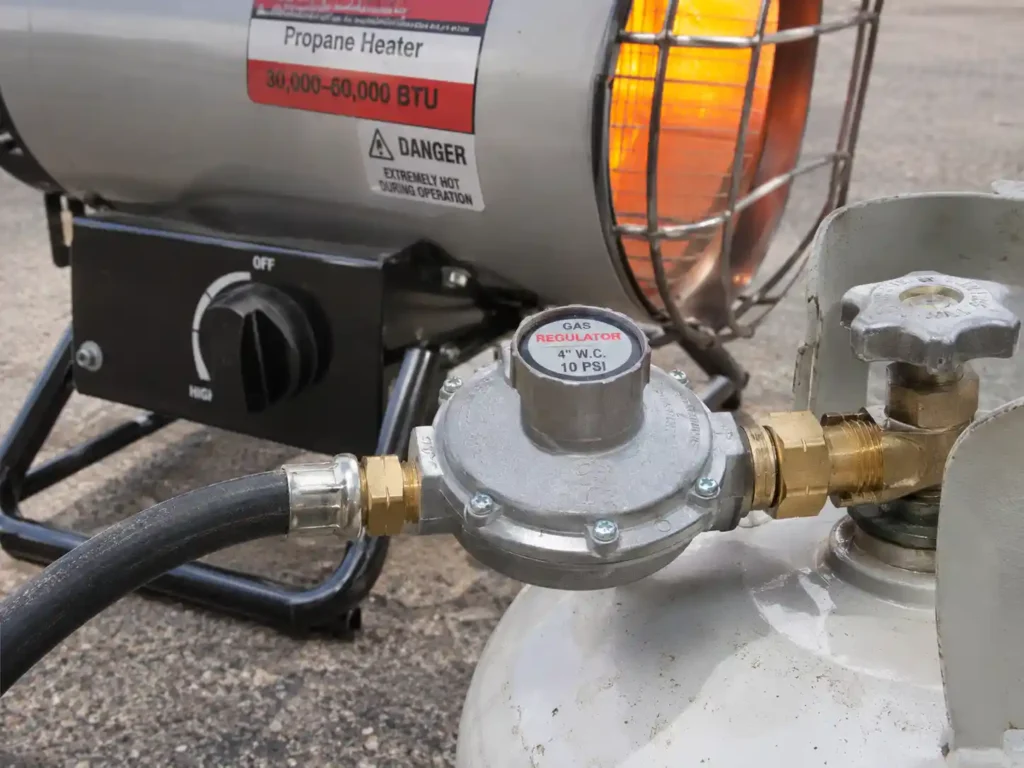
Choose the Correct Propane Regulator
A thermostat cannot maintain reliable heating if the propane supply system provides incorrect gas pressure or insufficient fuel flow.
The regulator must supply the manufacturer’s required pressure while accommodating the heater’s maximum fuel input.
| Garage Heater Input | Minimum Fuel Delivery Demand |
|---|---|
| 30,000 BTU/hr | 30,000 BTU/hr |
| 45,000 BTU/hr | 45,000 BTU/hr |
| 50,000 BTU/hr | 50,000 BTU/hr |
| 60,000 BTU/hr | 60,000 BTU/hr |
| 80,000 BTU/hr | 80,000 BTU/hr |
| 100,000 BTU/hr | 100,000 BTU/hr |
The regulator’s actual capacity must satisfy the total connected fuel demand at the required operating pressure.
For additional information, read my guides on choosing a propane regulator for a garage heater, what BTU capacity means on a propane regulator, and inlet pressure versus outlet pressure.
Never increase regulator pressure to obtain more heat or prevent automatic heater shutdowns. Gas pressure, piping, regulator capacity, and fuel connections must comply with the appliance manufacturer’s specifications.
How Much Does a Propane Garage Heater Cost?
Garage heater prices depend on heating capacity, combustion design, brand, thermostat configuration, and installation complexity.
| Equipment Type | Illustrative Purchase Budget |
|---|---|
| Vent-free thermostatic garage heater | $200–$400 |
| Non-electric radiant workshop heater | $250–$550 |
| 50,000 BTU vented unit heater | $500–$1,000 |
| 80,000 BTU vented unit heater | $650–$1,300 |
| Modine power-vented unit heater | $900–$1,800 |
| Separated-combustion unit heater | $1,200–$2,500 |
| Compatible mechanical thermostat | $25–$80 |
| Compatible programmable thermostat | $50–$150 |
| Compatible smart thermostat | $100–$300 |
Garage Heater Purchase Price Comparison
Vent-Free Garage Heater: $200–$400
Radiant Workshop Heater: $250–$550
50,000 BTU Vented Unit Heater: $500–$1,000
80,000 BTU Vented Unit Heater: $650–$1,300
Modine Power-Vented Heater: $900–$1,800
Separated-Combustion Heater: $1,200–$2,500
Bars represent the upper end of illustrative US equipment budgets. These are not verified current retailer quotations. Installation, shipping, and taxes are excluded.
Additional Garage Heater Installation Expenses
| Installation Component | Illustrative Budget |
|---|---|
| Thermostat and control wiring | $50–$300 |
| Venting components | $150–$600 |
| Gas piping and fittings | $200–$800+ |
| Regulator and related equipment | $50–$300+ |
| Mounting materials | $50–$250 |
| Electrical work | $150–$600+ |
| Professional installation labor | $500–$2,000+ |
Illustrative planning allowances only. Some contractor quotations combine these items. Site conditions, permits, propane storage, and local labor rates can significantly affect total costs.
For related expenses, see my guide on the cost of replacing a propane regulator.
How to Reduce Propane Garage Heating Costs
Purchasing an efficient heater is only one way to manage garage heating expenses.
I would also investigate improvements to the building itself, particularly if the garage loses heat rapidly when the heater shuts off.
- Improve garage door insulation.
- Insulate walls and ceilings where appropriate.
- Replace damaged door weatherstripping.
- Reduce unnecessary garage door opening.
- Use compatible programmable temperature controls.
- Maintain lower temperatures when the garage is unoccupied.
- Improve air circulation using approved equipment.
- Arrange regular professional heater maintenance.
Never block required combustion-air openings or ventilation provisions while attempting to conserve heat.
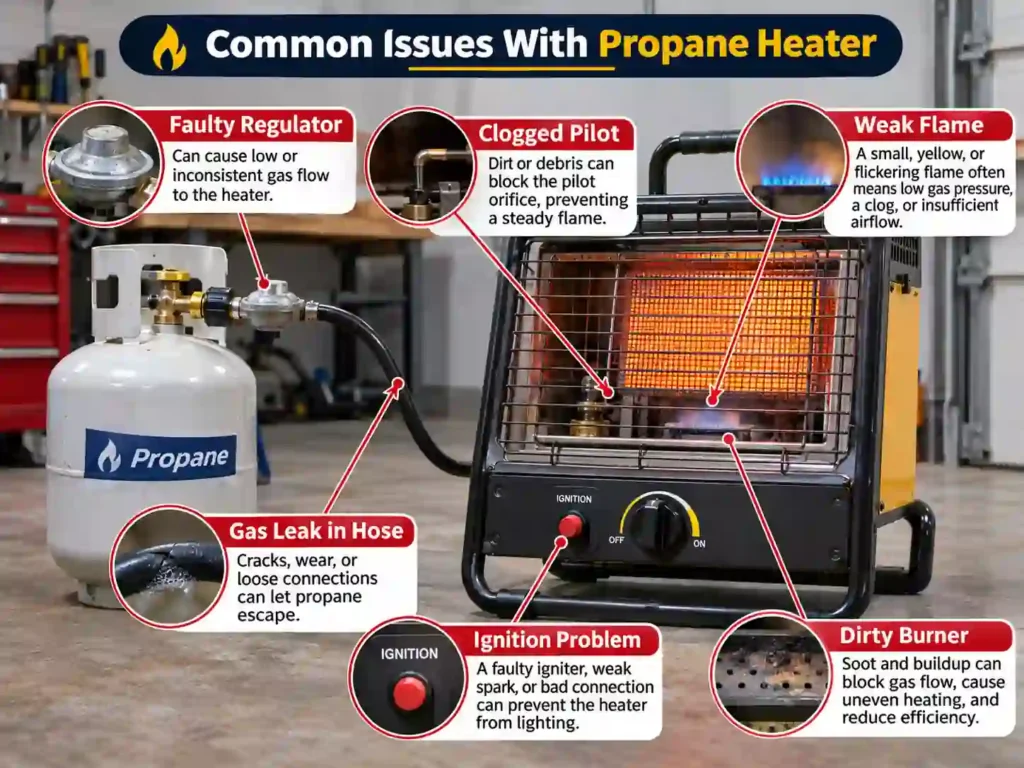
Common Problems With Propane Garage Heaters
| Problem | Possible Cause |
|---|---|
| Heater does not ignite | Ignition, electrical, or fuel supply problem. |
| Garage does not reach target temperature | Insufficient capacity or excessive heat loss. |
| Heater cycles too frequently | Oversizing or inappropriate thermostat placement. |
| Weak burner flame | Fuel delivery or pressure problem. |
| Heater shuts down unexpectedly | Safety-control or equipment fault. |
| Fan does not operate | Electrical, motor, or control-system problem. |
| Excessive condensation | Unvented combustion or humidity problems. |
| Heater loses output during freezing weather | Insufficient propane vaporization. |
| Regulator develops excessive frost | Possible regulator or fuel supply issue. |
These symptoms can have multiple causes and should not be treated as definitive diagnoses.
For additional guidance, read my articles on how to know if a propane heater regulator is failing and why propane regulators keep freezing up.
How to Choose the Best Propane Heater for Your Garage
Step 1: Determine Your Heating Requirements
Measure the garage and evaluate its insulation, ceiling height, outdoor temperatures, and intended heating schedule.
Step 2: Choose an Appropriate Combustion Design
I recommend investigating permanently installed vented or separated-combustion equipment first.
Step 3: Verify Thermostat Compatibility
Determine whether the thermostat is included, whether external controls are supported, and whether programming features are available.
Step 4: Confirm Propane Supply Requirements
Verify the correct fuel configuration, regulator pressure, gas piping capacity, and propane storage requirements.
Step 5: Compare Total Installation Costs
Include the heater, thermostat, venting, mounting hardware, electrical work, and professional installation rather than comparing equipment prices alone.
Step 6: Confirm Garage Installation Approval
Have a qualified installer confirm appliance suitability, mounting requirements, combustible-material clearances, vehicle impact protection, ventilation, and applicable local requirements.
Propane Garage Heater Buying Checklist
Garage Heater Purchasing Checklist
0 of 15 requirements checked
This checklist does not replace professional installation approval or equipment safety testing.
Important Propane Garage Heater Safety Precautions
Garages present heating hazards that may not exist in ordinary residential living spaces.
Gasoline, solvents, combustible dust, paint products, vehicles, and other materials require particular consideration.
Garage Heating Safety Reminders
- Use only heating equipment approved for the intended garage environment.
- Never operate outdoor-only patio heaters inside an enclosed garage.
- Do not operate heating equipment where hazardous concentrations of flammable vapors are present.
- Follow applicable ignition-source elevation and mounting requirements.
- Protect heating equipment and gas piping from vehicle impact.
- Maintain manufacturer-required clearances from combustible materials.
- Keep propane supply cylinders in approved outdoor locations.
- Install carbon monoxide alarms suitable for the operating environment and follow their placement instructions.
- Never obstruct combustion-air openings or exhaust vents.
- Never bypass thermostats or automatic safety controls.
- Never leave portable heaters operating unattended.
- Do not run vehicle engines inside an enclosed garage.
- Arrange professional installation and regular servicing.
If you smell propane: Leave the affected area immediately, avoid electrical switches and ignition sources, and contact emergency services or your propane supplier from a safe location.
Do not return until the affected area has been declared safe.
If a carbon monoxide alarm sounds: Move everyone to fresh air immediately and contact emergency services.
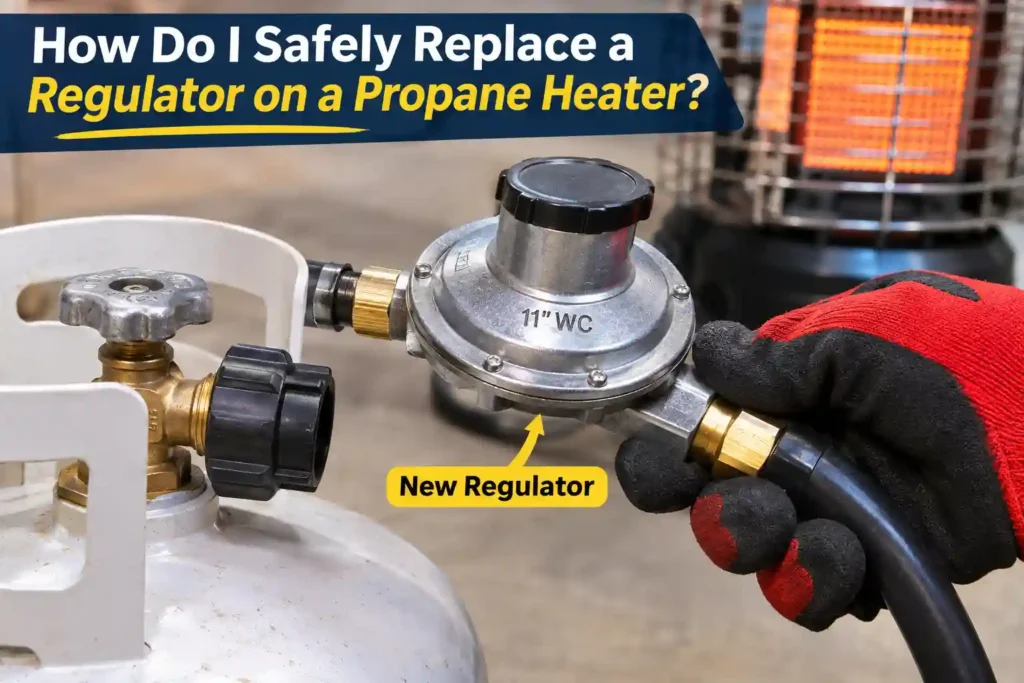
For additional guidance, read my article on whether you can install a propane regulator yourself or need a professional.
Frequently Asked Questions
What Is the Best Propane Heater With a Thermostat for a Garage?
For permanent garage heating, I would generally investigate a properly sized Modine Hot Dawg separated-combustion heater or an approved Mr. Heater Big Maxx vented unit heater.
Is a 30,000 BTU Propane Heater Enough for a Two-Car Garage?
Possibly. A well-insulated two-car garage in a relatively mild climate may require less heat than an uninsulated garage in a severe winter climate.
Correct sizing depends on building heat loss and useful heater output rather than floor area alone.
Is a 50,000 BTU Heater Too Big for My Garage?
It may be oversized for a small insulated garage but appropriate for a larger or poorly insulated building. A professional heat-loss calculation can help determine the correct capacity.
Can You Use a Vent-Free Propane Heater in a Garage?
Only when the appliance is approved for the intended garage environment and its installation satisfies manufacturer requirements and applicable local restrictions.
I generally prefer vented equipment because combustion products are discharged outdoors.
Do Propane Garage Heaters Require Electricity?
Most modern forced-air unit heaters require electricity for their fans, ignition systems, and safety controls.
Certain radiant heaters use millivolt controls and can operate without household electricity, subject to their installation requirements.
Can I Use a Smart Thermostat With a Propane Garage Heater?
Yes, on compatible systems. Verify the heater’s control voltage, wiring requirements, thermostat compatibility, and environmental conditions before purchasing.
How Much Does It Cost to Run a 50,000 BTU Propane Garage Heater?
At maximum fuel input, a 50,000 BTU heater consumes approximately 0.546 gallons per hour. At $3.50 per gallon, this equals approximately $1.91 per hour of full-input burner operation.
Can a 20 lb Propane Tank Run a Garage Heater?
Only if the equipment manufacturer and approved fuel supply design permit it. Many permanent high-output garage heaters require considerably greater propane storage and vaporization capacity.
Can I Leave a Propane Garage Heater Running Overnight?
Only permanently installed equipment specifically approved for the intended automatic operating conditions should be considered. Portable heaters should not be left operating unattended or while sleeping.
Is Propane Heating Cheaper Than Electric Garage Heating?
It depends on local propane prices, electricity rates, appliance efficiency, installation costs, and heating demand. Compare the cost of delivering the same amount of useful heat rather than comparing fuel prices directly.
Will a Propane Garage Heater Cause Rust on My Tools?
Unvented propane combustion introduces moisture into the garage, which may contribute to condensation and corrosion under certain conditions. Properly installed vented heating equipment avoids releasing its combustion moisture directly into the garage.
Does a Thermostat Reduce Propane Consumption?
Automatic temperature control can reduce unnecessary burner operation. Actual savings depend on the building’s insulation, outdoor temperatures, temperature settings, and heating schedule.
My Final Thoughts
Choosing the best propane heater with a thermostat for garage heating requires more than comparing advertised BTU ratings and purchase prices.
For most permanent garage installations, I would investigate the Modine Hot Dawg HDS series because of its separated-combustion design and external thermostat compatibility.
The Mr. Heater Big Maxx series is another practical option for homeowners comparing vented forced-air heating equipment.
If electricity-independent heating is important, a compatible millivolt radiant workshop heater may be worth considering, provided it is appropriate for the intended environment.
Regardless of the model you choose, prioritize correct heater sizing, appropriate ventilation, reliable temperature control, propane supply compatibility, and professional installation.
A properly selected propane garage heater can provide comfortable working conditions throughout winter while helping you manage long-term fuel expenses.

Mike is an experienced propane technician with over 15 years of professional experience in the field. He has dedicated his career to helping customers with their propane needs, from installation to maintenance and repair. Together with Jeremy, he co-founded this website to provide useful information and guidance to customers seeking reliable propane services.